Showing posts with label Trotskyism. Show all posts

Tuesday, 24 May 2022

The Socialist Party/Galloway Love-In

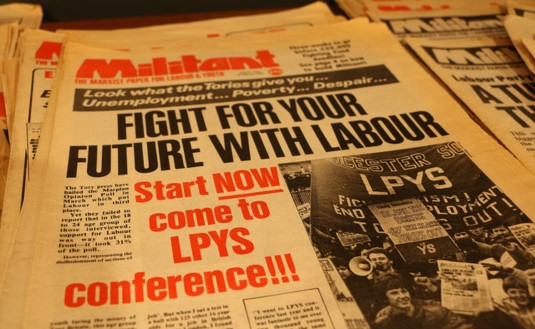
Back in the day, and we're talking back in the day, Militant (as was) looked upon its far left brethren with disdain for all sorts of reasons. One of them was the propensity of other Trotskyist outfits to split all over the place. Taken as evidence of their petit bourgeois composition and orientation, the Revolutionary Socialist League (Militant's "undercover" name) was sturdy and proletarian and didn't do that sort of thing. But then it did and split in 1991, expelling its founder and guru, Ted Grant and his loyalists. In 1997, a small group decamped and set up the short-lived Socialist Democracy Group. Between 1999 and 2001, a group of key cadres from Liverpool were expelled en bloc and were followed out by virtually the entire Scottish organisation. The Socialist Party, as it came to be, helped form the Socialist Alliance, before splitting away from that. In 2009 it formed No2EU with the RMT to contest the European Union elections, which became the basis of the Trade Unionist and Socialist Coalition. Its arch rivals the Socialist Workers Party joined in, before splitting away in 2017. And then in 2019, the SP proper suffered its most damaging split yet in which the vast bulk of its international organisation, including the electorally successful Irish section and important long-standing cadres in England and Wales were expelled as more or less the final act of the retiring general secretary, Peter Taaffe. Just like the right wing Labour apparatchiks he spent years railing against, Taaffe elected to set fire to his entire organisation rather than face criticism and accountability for the mistakes made on his watch.

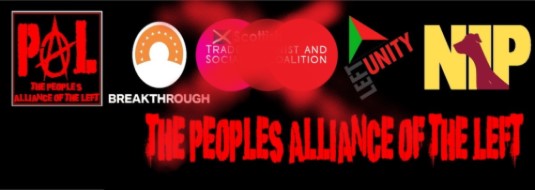
And here we are again in 2022, just three years after the dust had settled with another split. Except this time TUSC has elected to split from the People's Alliance of the Left, a new grouping that was set up in conjunction with the new, so-called pop-up parties that emerged from the debris of Corbynism (the Northern Independence Party and the Breakthrough Party), as well as what was left of Left Unity, the small non-Trotskyoid regroupment project that pre-dated the Labour left's resurgence. And why has this split taken place? Here's the statement from LU's Facebook page:
Statement on the Change of Relationship Between the People's Alliance of the Left (PAL) and the Trade Union and Socialist Coalition (TUSC).

In February 2022 the majority of member parties of PAL (all except TUSC) decided that they could have no formal association with George Galloway's Workers' Party.

This was because of a number of statements by Galloway and the WP on a wide range of social issues (including, but not limited to, women's rights, trans rights and immigration) which demonstrated politics that are irreconcilable with the policy of those parties or the founding principles of PAL. In addition Galloway and leading WP members had made public statements denigrating a Breakthrough member for being non-binary.

Despite this, and in full knowledge of this decision, the all-Britain TUSC Steering Committee has accepted the request by George Galloway's Workers' Party for formal observer status within TUSC and agreed to attempt to avoid electoral clashes where possible. This creates a formal association between TUSC and the WP which TUSC is aware the majority of the other parties within PAL have decided is incompatible with PAL membership.

As a consequence, the remaining PAL member parties regretfully consider that TUSC has, by its formal association with the WP, removed itself from membership of PAL at national level.

We recognise that TUSC is a coalition of different organisations and individual socialists and trade unionis who in their great majority do not share the politics of George Galloway and the WP, although they are prepared to critically collaborate with it as they (TUSC) consider it to be an organisation with origins in the labour and trade union movement. It will remain open to local PAL party members and supporters to cooperate with those socialists at a local level (provided they are not WP members). However, tere can no longer by any national alliance between PAL and TUSC for so long as it has a formal association with George Galloway's Workers' Party.

23 May 2022
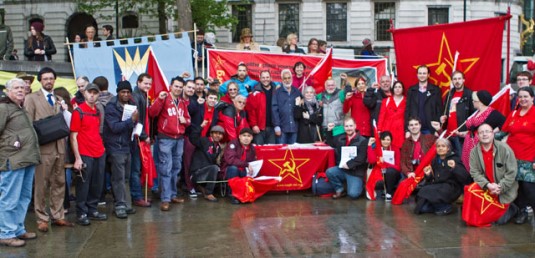
This is fair enough. George Galloway is a British nationalist, one of Putin's useful idiots, and an occasional Tory voter. His so-called Workers' Party of Britain is dominated by the ultra-Stalinist Communist Party of Great Britain (Marxist-Leninist) who, when they're not carrying around their giant portrait of Uncle Joe at London May Day celebrations, spend time denying the mass murders of their hero (the Holodomor? Bad weather! The Great Purge? Model jurisprudence! The Katyn Massacre? The Nazis!) and crossing class lines to support reactionary outfits like the Brexit Party and the Canadian "freedom convoy" movement. Given their appalling politics, it shouldn't be surprising that they've swallowed the Tory/centrist line that the British working class are as backward and as socially conservative as them. The industrial (male) worker figures large in their political imaginary, and the everyday politics they push is a nationalist tinged version of post-war Labourism. It's worth noting the last minor party that had some success with such a stance was the British National Party.

The PAL parties are right to want nothing to do with Galloway and his acolytes. Their politics aren't just wrong - in words and deeds they're scabby. But that begs the question, why does the Socialist Party want an alliance with them? It's pure opportunism. The SP has form for ditching its principles to pal around with demagogues if it thinks a political profit can be turned, as per the Tommy Sheridan saga. Simply put, Galloway still has a real depth of support among British Muslims for his - admittedly principled - defence of their community and his consistent stand against the war in Iraq, Libya, and the ongoing occupation of Palestine. The Batley and Spen by-election was a rude reminder to an arrogant Labour machine that these voters won't automatically tick their box. Because of this standing, the SP has designated Galloway a significant personality with clout whose endorsement might see a few deposits saved, and a trickle of recruits come their way, if they can ride on his coattails in future election contests. In other words, the SP is doing what it once took great delight in criticising the SWP for doing when they formed Respect in alliance with Galloway in 2004. It's not principled, it won't get the SP anywhere, and if anything they're cosying up to the most frightful horrors nominally on the left is guaranteed their eternal new workers' party project won't come to fruition. At least not by their efforts, anyway.


Friday, 22 January 2021

A Note on Ruthlessness

Critique Keir Starmer. Mock his pleading patriotism. Laugh at him and call him Keith (Kieth), but comrades should pay attention and learn from his leadership in one crucial aspect: his handling of Labour's internal politics. As NEC member Mish Rahman reported earlier, Keir means to and, well, effectively has stitched up parliamentary selections. The executive voted through a paper that will grant David Evans, the general secretary (and unelected party employee) the right to refuse a candidate selected by a constituency party if he determines they're unsuitable because they don't meet the right standards. A vote for any of these decisions to be referred to the NEC also fell.

You can imagine the press furore and the whingeing of the parliamentary party if Jeremy Corbyn had bounced the NEC into conferring this power on Jennie Formby. In fact, that doesn't sound too much of a bad idea ... But we don't have to imagine. In March 2018 the ridiculous Owen Smith got the heave ho from the front bench for peddling his own line and generally being disagreeable. The response? Outrage and the cry of "this is a terrible Stalinist purge!". Your reminder, as if it needs repeating, that there is no such thing as a point of principle where the Labour right are concerned. Everything is a factional football for them. Everything.

The lesson? Well, Keir might be as far from Trotskyism as you can get (though not as far as some ex-Trot fellow travellers of the Trilateral Commission), but he certainly remembered something from the branch lead offs on permanent revolution. Not a doctrine for constantly fermenting revolution and storming heaven, as pretended by Trotsky's Stalinist nemesis, it is the simple insight that if workers seize power they'd better organise to keep it by moving to expropriate the property of the capitalist class, disarm the soldiery of the bourgeois state, clear out the old bureaucrats, etc. In other words, making the revolution permanent. This is exactly what Corbyn didn't do and, arguably, refused to do. There were opportunities to break the hold of the parliamentary party on Labour and enshrine the sovereignty of the membership, most crucially in 2018 when the leadership manoeuvred at conference to defeat a mandatory reselection motion and go for the compromise mess of a reformed trigger ballot. There was the opportunity to decisively tilt the balance of forces in the party, but it was not taken up. And here we are.

Keir is not making the same mistake. He's got his majority on the NEC. The press aren't causing him grief. The left are large, but contained. And nothing (yet) has come of his suspension of Corbyn from the PLP. And what's the cost of anti-democratic shenanigans. A few thousand resignations by leftists and some moaning on Twitter? Big deal. So why not go for a power grab at a moment of oppositional weakness and where, seemingly, the stars are aligning. From Keir's point of view of recasting Labour in his bland, managerial image, he'd be stupid not to. His writ rules the roost, and for all his talk of "unity" the apparatus is in place to screen out leftwingers selected to run in any upcoming by-elections and, of course, the general election itself. Perhaps not a few sitting MPs might also find themselves out on their ear for lacking the required "probity".

Despair? Absolutely not. This can be turned over and reversed by party conference. The "SLT" can ignore the party on matters of policy, as it always has done, but not when it comes to conference rulings on how the party should organise itself. Momentum has launched its policy primary with a view to pushing for positions at 2021 conference. Organising against the Evans veto alongside measures aimed at reversing the deadening creep of Starmerist authoritarianism seems like an entirely appropriate thing Momentum and the rest of the left should be pushing for. If the lesson from Keir is he's serious about power, at least where machinations in the Labour Party are concerned, then the obvious, the only worthwhile response from the left is we should be too and struggle with as much determination. And, yes, ruthlessness.

Image Credit

Saturday, 27 June 2020

What is the Point of a New Left Party?

Seeing as Keir Starmer is gearing up for a confrontation with the left following Rebecca Long-Bailey's sacking and despite what's in the best interests of the Labour Party, debate in and outside of the party has started thinking aloud about a new one. This would be a complete waste of time, whether the objective is to replace Labour with a mass socialist party or something modest like a 'left UKIP', an organisation of limited electoral appeal but viable enough to keep Labour from straying too far from left wing policies. As a wise voice points out, "If you spent the TIG years laughing at how they were going to lose their seats because the name recognition lies with Labour and not individual MPs how do you square that with the desire to have left Labour MPs break away now?" Quite. Let's think this through.

Anyone serious about either projects must reckon with history. The old, official Communist Party failed miserably in elections, only getting three MPs elected under its name in its 70-year history and, at most, a couple of hundred councillors. It was able to build significant influence in several trade unions but this withered as trade unionism changed and went into decline. The Independent Labour Party, which disaffiliated from Labour in 1931, had three MPs elected in 1945 and gained another the following year in a by-election, but they were all swept away in 1950. Militant was later to have success in the 1980s with three MPs, but these were only elected because they were Labour candidates. The Scottish Socialist Party had six MSPs elected in 2003 off the back of the anti-war movement, but that was thanks to the list PR system used to elect half of Holyrood's members. In 2007 these gains evaporated. And lastly George Galloway was able to get himself elected in 2005 and in the 2012 Bradford by-election as Respect's sole MP. This is your lot - it's gone from bad to worse since.

A question of the electoral system? Well, yes. But not the whole story. When you look at the left alternatives and formations of the last 25 years, whatever potential they had were hobbled by infighting and sectarianism. The Socialist Labour Party was strangled at birth by Arthur Scargill's failure to, first, reach an accommodation with Militant Labour (as the Socialist Party then called itself) to break the mould of sectarian politics, and then a subsequent witch hunt against anyone not to his liking. The Socialist Alliance was destroyed by the little Lenin syndrome of each of its two main participants, as was the case with Respect and latterly, the Trade Unionist and Socialist Coalition. This was forbidden from developing any life of its own by its principal sponsor, the SP. Indeed, the two largest Trotskyist organisations on the British left have undergone profound crises of their own - the SWP has its grotesque culture of leader worship to blame, one which saw it embroiled in covering up rape and sexual assault. And the Socialist Party preferred implosion to an honest accounting of, to everyone else, its obvious fallibility. Left Unity, an attempt to cobble something together in the early years of the decade sans the SP and SWP failed thanks to the double whammy of unseriousness and playground trottery. Last of all, the Scottish Socialist Party ekes out an existence doing nothing in particular - Tommy Sheridan's bitter legacy continues to cast its shadow.

Because these failed doesn't mean new initiatives are predetermined to follow their path, right? The issue all these organisations share was a failure to build a mass base. The CPGB, SSP, and Respect were able to acquire some aspects of one but this did not reproduce itself as a stable constituency, nor were these organisations sufficiently rooted to the point where they could shape their base. Leadership matters, of course, but the propensity for sectarian and unaccountable petty elites to emerge grows the more insulated they are from wider struggles. Take the British far left as a case in point: the bulk of their activism is not around workplace struggles, campaigns or what not, but the reproduction of their organisations themselves through petitions and paper sales - which tends to reinforce their distance from the class they aspire to lead as opposed to merging with it. This makes building a sustainable base difficult because this work is always prioritised. If they want to begin breaking out of this ghetto, a fundamental rethink and reorientation of their politics is required - something the far left as a collective have avoided since the CPGB's foundation.

Then we have competitors. I don't believe Keir Starmer or his people understand the composition of Labour's base, its dynamics and movements, nor its trajectory. The Labour Together report doesn't change that, despite the diplomatic nice words said in its direction by the leader's office. As Keir pivots to the right and the base starts fraying, there's an opportunity to intersect with activists and voters left high and dry. Indeed, and the Greens and Liberal Democrats (if they have any sense) are well-placed to scoop them up. They have activists, a proven (modest) record of electoral success, and are superficially attuned to the concerns of a chunk of Labour's new core vote. The SNP shows what happens when Labour loses sight of where its base is. How can a new left party that doesn't even exist and enjoys zero name recognition offer credible answers and be considered a good punt for the extra-Labour curious? Look at the state of the latest new left party, George Galloway's Workers' Party. Consciously a "patriotic" party that attempts to combine Brexity nationalism with Putin apologetics, and an undisguised (and unironic) admiration for Joe Stalin and all his works, it makes you wonder who it could possibly appeal to - apart from aged tankies nostalgic for the time before. It's embarrassing, frankly.

Let's park these issues to one side and consider the strongest argument from history in favour of a new workers/new left party: first past the post has locked all small parties out of parliamentary representation, but this was the case when Labour was founded. And yet Labour came to replace the Liberals as an electorally viable party of government in spite of the high bar of entry. True, true. But how did this happen? It involved alliances of convenience with the Liberals in certain seats and, oh yes, the small matter of a rising labour movement locked out of mainstream political representation. In the 2020s the situation is completely different. Trade unions aren't barred from political entry - most of them are satisfied (at the moment) with Keir Starmer nor is there much grumbling among the now growing membership about him. And besides, the contemporary work force is highly individuated: true, we have a rising cohort of the new working class, but their institutional expression was found in Corbynism. With its dissolution, its attachment to Labour is much more conditional. Good news for a new party, then? Well, no. Because it is more diffuse and harder to organise, even with the coronavirus crisis set on polarising the UK's political economy further. Its less conscious and confident sections are more likely to lapse into despondency and abstention than get angry and organised. We saw it happen last December, and it can happen again. In short, the conditions for a new party for the replacement of Labour are simply not there.

How about a left UKIP instead, effectively an electoral pressure group for socialism? Assuming it manages to avoid all the pitfalls outlined above, how does it move from a standing start to something that makes for sweaty palms in the leader's office? It's difficult to see how. UKIP's success tapped into a consolidating (but declining cohort) of voters largely organised by the hard right press, and tapped into widespread cultural currents of racism, Empire nostalgia, and British exceptionalism. Every five years it also had a set of elections it could easily dominate as a repository of protest voting. Its threat pushed Dave and the Tories to promise the referendum and, well, here we are. What opportunities are available for a left alternative to make a nuisance of itself? Local council by-elections? Elections for the devolved governments in Scotland, Wales, Northern Ireland, and London? Favourable press coverage? Considering the extra-Labour left's record of strategic ineptitude when it's not busy fighting among itself, the chances of navigating choppier political waters and reaching the golden isle range from nil to Davey Jones's locker.

Last of all, what is a new party for? You can look at the existing Labour left and answer this question easily: pushing socialist policies, building an infrastructure for political education and empowerment, drawing more people into politics, holding Labour's leadership to account. Success isn't guaranteed and it's never a bed of roses, but it exists, has a mass influence, and tens of thousands of activists. It's a serious endeavour and one that could retake control of Labour's National Executive Committee this summer. Some might think it's a waste of time, the right have won the leadership so why bother, but being part of this movement doesn't preclude doing things outside the party. Nothing is stopping anyone giving up dull party meetings and getting stuck into workplace or community activism, for example, and many thousands are going to do just that. It is not the be-all and end-all. Compared to this, what might a new party have to offer? Judging by snippets of conversation here and the odd polemic there, those arguing for one desire a space of the like-minded where they aren't sabotaged by their own side and feel it would be a better use of their time. That's fair enough, but let's not kid ourselves here. This is a project for building a social club or, at best, a sect no different from everything that has gone before.

If people want to leave Labour, fine. It's up to them. It is nevertheless better if comrades stay, even if, for totally understandable reasons, they choose not to actively participate and concentrate their energies elsewhere. This is simply a basic fact of the political situation we find ourselves in, this is our reality. A new party at best is an irrelevance, and at worst a means for disorganising the left further.

Tuesday, 7 January 2020

The Far Left in the 2020s

Taking a break from weightier matters, it's time we turned to one of this blog's more niche interests: how will Britain's band of self-described revolutionaries and assorted extra-Labour left projects fare in the decade ahead? Before we look to the future, it's necessary to reflect on the past. And, well, what can you say. Perhaps nothing better demonstrates what has happened by comparing the spread of the far left's collective general election challenge from 2015 with the meagre numbers mustered in December. Never commanding reasonable votes (with the notable exception of People Before Profit in Belfast), the campaigning collapse has mirrored a political and organisational collapse across the far left. Labour's election of Jeremy Corbyn is some of the story, sure, but is not the last word on what has happened.

Writing at the turn of the last decade, I suggested the far left, and by this meaning principally the Socialist Party and Socialist Workers Party, were well placed to intervene in workplace struggles (particularly the SP, fresh from the role it played in a number of significant disputes back then) and wider campaigns. This was while the space to Labour's left was likely to contract, therefore putting question marks over the viability of electoral vehicles of convenience. However, what could not be foreseen was how the SWP's reputation, already pretty low among anyone who has spent more than five minutes around the labour movement, would be thoroughly trashed. Months into the new decade the SWP turfed out that section of the then leadership who had previously made the running with regards to Respect and Stop the War, who then went on to form Counterfire. Much more seriously, in early 2013 it emerged the SWP had tried dealing with a rape complaint against a central committee member. Surprise, surprise, the case against was heard by a cadre of his mates and long-term comrades and they let him off. If that wasn't bad enough, the crisis was compounded by no small amount of arse covering and, in one particularly despicable case, the harassment of a complainant by SWP members.

They suffered a drip drip of splits as the leadership regrouped around the defence of their handling of the fiasco and, needless to say, the SWP were very badly damaged the point of becoming pariahs. Working under much reduced circumstances, the SWP nevertheless reverted to type and tried to make themselves indispensable as an infrastructure for mobilising street politics. They achieved this best first as a front outfit against UKIP, and latterly as Stand Up to Racism, which still operates as a means of organising conferences and organising demonstrations. And, sadly, one Jeremy Corbyn was never put off.

While the SWP suffered its meltdown, in relative terms the SP flourished. Free from hints of scandal (though the same could not be said for some of its international affiliates), the usual rounds of campaigning, trade union activism, paper selling, and electoral outings via the Trade Unionist and Socialist Coalition saw it continue its recovery trajectory since the doldrums of the late 90s and early 00s. Nothing it did was overtly spectacular, not being as showy as the SWP. It trudged along the revolutionary treadmill, pausing to wheel out the ridiculous No2EU vehicle for the 2014 EU elections, before hunkering down for more plodding up until and beyond the 2015 general election. That's when things started going wrong.

For the best part of 25 years until that point, the SP's big shtick was that Labour was no longer a workers' party and therefore needed replacing. If you were of a leftish persuasion and all you knew of Labour was Tony Blair, it was a compelling position and seemed ever truer as his years in government wore on. This was the key reason why I joined the SP in 2006, and coming to the conclusion this was utterly wrong was why I left and joined Labour in early 2010. During Ed Miliband's tenure, the SP could just about keep up the pretence it was a straight party of capital thanks to the nonsense triangulation and fidelity to neoliberal nostrums. Then Jeremy Corbyn emerged and drew hundreds of thousands to the party. And what did the SP do? Rather than account for the complete collapse of their central shibboleth, they pretended Corbynism was the confirmation of their perspectives. What it represented was the creation of the new workers' party they had campaigned for all along that just so happened to be, um, coalescing in the Labour Party. This was stretching credulity too far for many loyal activists, and in dribs and drabs they drifted away and ended up in Labour. Meanwhile, the appeal of Jeremy Corbyn ensured the conveyor belt of freshers fairs didn't deliver new recruits in anything like the same number as previously. And as the SP stagnated, the fissures started opening up. The crisis first manifested in the PCS, previously the grandest constellation in the SP firmament, where fallings outs with Mark Serwotka and internal strife led to a split and the utter annihilation of their position in a union they once dominated. And then last year, rather than being held to account for a decade of getting it wrong the leadership basically expelled the entirety of its international organisation, the Committee for a Workers' International, as well as most of the SP's young activist base.

Therefore at the start of 2020, the two standard bearers of Trotskyist politics in Britain are respectively reviled, or in disarray. So bad things are it fell to the weirdest and most appalling micro groups to fly the banner in the election just gone. Things then do not look good for either the SP or SWP, the new outfit formed by ex-SP members, nor the rest. Could the 20s then be the decade that sees the far left go even more subterranean?

There are two ways the far left restore their collective strength to how they were 10 years ago. And they're both dependent on what happens in the Labour Party. Whether Rebecca Long-Bailey or Keir Starmer wins the overlong leadership contest, there is going to be some slippage. The cross over between left wing conspiracy theory and anti-Israel obsessive Twitter will be annoyed their chosen one, Ian Lavery, has wisely decided not to stand, and will now be looking for a home. Obviously if Starmer wins it is hard to believe he won't make moves against the left, try and restore the right's pre-eminence, and work to snuff out the movement to democratise the party. And under those circumstances the trickle of stans and sociopaths would open out into a flood of thousands of activists. And Labour's loss might be the far left's gain.

Except there is a new kid on the block all ready to receive. Noticed only by a few, from the ashes of another humiliating election defeat another organisation was born. Following his drubbing in West Bromwich East, Tom Watson's old seat, George Galloway announced the creation of the Workers Party of Britain. Modelled on the view the British working class is patriotic but economically radical, it is suffused with the strident anti-imperialism and pro-Putin politics of its best known figure. Also intriguingly, the new party is committed to "defend the achievements of the USSR, China, Cuba etc." Which comes as no surprise when you see Joti Brar's name attached to the project, and a proud link to everyone's favourite Stalinist sect, the prolier-than-thou Communist Party of Great Britain (Marxist-Leninist). Normally, no one would rate the chances of a party whose members carry huge portraits of Stalin on May Day demonstrations unironically, but these are strange times. It could prove to be a pole of attraction for those who find Labour's new leadership too metro, insufficiently critical of Tel Aviv and, of course, too beholden to social liberalism. However, given Galloway's reputation as a saluter of dictators and fondness for Russian foreign policy it's difficult to see how much of the "patriotic working class" this outfit can appeal to in electoral terms. As a pro-Brexit red UKIP by design, headway beyond a gullible few is unlikely.

Nevertheless, there are things we cannot see. Former Labourites looking for a new home is a cert, but the specifics of the struggles and upheavals coming down the road can only be guessed at. Opportunities there will be for the far left to rebuild. And so while there are few reasons for the left in general to be cheery, things are looking up for our revolutionary brethren. After all, they could hardly be worse.

Wednesday, 26 June 2019

Waiting for the Revolution, 1st July

Have an interest in the far left and Trotskyism? Perhaps a member of an organisation within these traditions, have a past activist record with them, or have developed an interest with the minutiae of left wing history? And happen to be in or near the Nottingham area on Monday 1st July between 7pm and 8.30pm? Then why not join me and Evan Smith, co-editor of Against the Grain and Waiting for the Revolution, and author of British Communism and the Politics of Race for an evening discussing Trotskyana, sectariana, far left history, Evan's work, and what the rich history of labour movement struggles in the UK and Australia have to teach us today.

The event is at Five Leaves, Nottingham's radical bookshop. Tickets are £4 waged, £2 student/unwaged and you can book your place via events@fiveleaves.co.uk. Hope to see you there!

Sunday, 23 June 2019

Obsolete Politics and the Socialist Party Split

It's not only Theresa May who's preparing her departure from the political scene. At the time of writing, the Socialist Party is on the verge of the most damaging split in its history. On the one side you have Peter Taaffe, the organisation's general secretary of 55 years and counting. Backing him is the majority of the membership in England and Wales, the Scottish "section" and, um, precious few others. Arrayed against the loyalists are the majority of the international organisation - the Committee for a Workers' International - including its most successful section, the Socialist Party in Ireland. And as with all splits in politics, which Change UK have recently reminded us, there are good reasons and there are real reasons. If you care to avail yourself of the leaked documents the different players have exchanged (and leaked), for Taaffe and his comrades this is the struggle between proletarian politics, as uniquely elaborated by the SP's particular brand of Trotskyism, vs petit bourgeois contagion and the importation of identity politics into the organisation.

The full gist is a critique of recent successes achieved by the Irish organisation in the women's movement. This is elaborated in more depth by Coatesy and the Weekly Worker here and here. One can't help but be struck by the coincidence of Taaffe's critique of an organisation that has made political headway, versus the almost total collapse of the SP's position in the Public and Commercial Services union where, in a very short space of time, they've gone from virtually running the shop to a couple of seats on its executive committee. And that's before considering the significant losses of cadre and possibilities for recruitment to Corbynism, that has been the SP's lot these last four years. You might be tempted to think Taaffe should account for his leadership's blunders before attacking others for not having the right kind of success as per his Marxism-by-numbers.

The politics, however, are an excuse for a reassertion of authority against other sections in the "international" showing too much independence of thought from the London mothership. And so we have declarations of ludicrously wordy factions (Taaffe's, as it is formally a minority in the international, is 'In Defence of a Working Class Trotskyist CWI'), a roughshod disregard for the procedures of the organisation, expulsions, departures of entire sections and, interestingly, the declaration of 127 England and Wales comrades - approximately a third of the activist membership - signing a protest letter. Woe betide any full-timers who dare disagree with the eternal general secretary or they will find their "careers" disappeared, as has happened to the editor of the ever-dreary Socialist.

As night follows day, their former comrades around Socialist Appeal have weighed in. In their open letter to current and former members of the CWI, they argue the bureaucratic thuggery dispensed at Taaffe's behest is reminiscent of their own departure from Militant (as was) in 1992. For those not around at the time or for the not terribly interested, the Taaffe-led majority wanted to decamp from the Labour Party for the sunlit opportunities that they thought existed outside, whereas the minority around their guru, the unimaginative and plodding Ted Grant, argued that they should stay the course. The minority went on to publish Socialist Appeal, hence the name, but nevertheless retained and built a fairly substantial international (in Trotskyist terms) roughly comparable in size to the CWI. Its highpoint was having the ear of Venezuela's Hugo Chavez, and its low was its own catastrophic split at the turn of the decade. Nevertheless, they suggest the degeneration of the CWI lies in their rejection of Grant's work and Labour Party entryism. Though, to be fair to the Taaffe position, being burrowed in Labour has barely increased Appeal's membership nor brought it influence over the development of Corbynism. They are just as isolated from where the socialist action now is as the SP themselves, despite being embedded in Labour like a limpet.

The real crisis for the SP is exactly the same reason why all self-styled Leninist organisations around today are in crisis, and that's because they are engaged in sect-building projects. Even at its height, for all the trouble and sleepless nights Militant caused Labour Party bureaucrats, even following its initial period of success at Liverpool City Council and the role played leading the Anti-Poll Tax Federation - achievements the SP ritually trumpets some 30 years after the fact - it amounted to no more than 8,000 members. And most of these vanished in the blink of an eye. These are issues shared with the disgraced Socialist Workers Party, who once boasted of having 10,000 members, and other moderately sized sects elsewhere. The SP and SWP are the lucky ones. Much smaller outfits never take off, despite differing politics and strategic orientations. Anyone been troubled by Workers Power since they wound themselves up and entered the Labour Party en bloc?

The biggest difficulty all revolutionary socialist projects face is pushing what are essentially insurrectionary politics in societies in which workers' organisations have long been institutionalised, pacified and integrated into the smooth(ish) running of things. And where democratic habits of mind have been the common sense, at least as far as the UK goes, for well over a century. Yet the UK remains a capitalist state overseeing a capitalist society, class struggle hasn't gone away, and still Trotskyist outfits are sidelined and irrelevant. The problem the SP has specifically is the class subject they orientate towards and seek to shape is completely obsolete. It's more than an issue of the SP's notorious economism, of its dismal reduction of class struggle to saving jobs, stopping cuts, and protecting services, but of an old hat approach to what class is.

This is inadvertently highlighted in Taaffe's recent and dishonest article, In Defence of Marxism, ostensibly about Trotsky's posthumously published In Defence of Marxism. Dishonest because this is less a commentary on the book and more another tedious big-up of Militant's record. Indeed, you might say Taaffe is the Nick Cohen of the Trotskyist movement. Regardless of the occasion or the subject, the same article is always produced. Rather than take on his opponents directly in open political argument, we get this:
At the same time, we have to combat and defeat all ideologically petty-bourgeois political trends which seek to divide, to introduce separatism into the workers’ movement. Under the signboard of ‘identity politics’, the US bourgeois first use their ‘ideological factories’, the universities, to spread their pernicious doctrines in order to divide mass opposition to them and their system on separatist lines – race, gender, caste, etc. While Marxists support the rights of all oppressed minorities, we always emphasise and strive for the maximum unity of the working class.
If Marxism was a programme of research and a guide to action for Taaffe as opposed to, say, a dreary justification of his six decades of political activity, this kind of nonsense - a left spin on Jordan Peterson-style anti-PC ranting - would not pass muster. As explained on a number of occasions, what is often misnamed as identity politics is a central characteristic of contemporary class politics. Not because of bourgeois conspiracies but because it is a property of capitalist political economy, and one that is increasingly important. As the production of intangibles - knowledge, services, experiences, care, subjectivities - depend on human brains and our social being, the character of exploitation changes. The vector of surplus value extraction in the advanced countries has grown more off the back of rentier-style relationships, vs the "classical" and "invisible" production of surplus value as the difference between the value of labour power vs the value of goods it produces. It means that, in the long-term, capital is less able to deskill workers as it has done historically because it cannot replicate or own the brains cognitive capitalism requires. Instead, capital now tries harnessing the spontaneous creativity of masses of networked but largely atomised workers to sell stuff, to surveill behaviour, and to try and generate the kinds of human beings more likely to accept the prevailing state of affairs as normal and natural.

Ah, but how does this explain the absurdities identity politics can descend into, where one identity is valorised and used to exclude other identities? Well, just as Lenin once observed that in and of itself everyday trade unionism was the bourgeois politics of the working class, limiting what, for the sake of brevity, you might call identity questions to issues of representation and recognition is the equivalent. Without a critique of capitalist political economy, trade unionism tends toward accommodation and reformism. Ditto, minus an understanding of the production of identity in intangible production, identities can appear to be off-the-peg cognitive structures, and exclusive spaces - even if their root is in oppression. Without grasping the relationship between identity production and capitalism, it naturally tends toward a liberal pluralism, which is a million miles away from intersectional politics: the only class politics worth the name.

I suppose this is beyond Taaffe, for whom Marxism stopped when Trotsky's book - probably his worst book, incidentally - was published. But it nevertheless demonstrates the hiding to nothing his politics is doomed to pursue. The SP's politics makes certain assumptions about the workers they address: that they are trade unionists, are motivated primarily by economistic concerns, and see themselves as workers above all else. This sounds suspiciously like a liberal identity location that claims a special privilege for itself, while dismissing other experiences of capitalism as ephemeral and in some way inauthentic. The SP used to talk about how the labour movement was in crisis in the 90s and 00s, and how consciousness had been thrown back. All true, but its solution was and remains an attempt to jumpstart a class politics of a simpler, easier time. Of when industrial workers commanded the field, workplaces were huge affairs, and a basic class consciousness could be taken for granted. Taaffe's template of class is not what it is, but how he wishes it to be: the so-called mass worker that dominated the labour movement imaginary of the 1950s, 1960s, and 1970s. Small wonder the SP aren't going anywhere. They're chasing the past.

The same, however, cannot be said of the Socialist Party in Ireland. While also wedded to a sect building model, which has limited their development over the years and will no doubt present more difficulties in the long run, their more sophisticated understanding of class and identity politics - if not in thought at least in practice - has enabled them to build influence and intervene in the struggles around abortion and reproductive politics. Issues, in case Taaffe and co need reminding, that are crucial to how the system reproduces itself.

Sadly, a reckoning between the SP's antiquated politics and the realities of 21st century class politics are overdue, the result, as with all splits, will see dozens of socialists give up on politics altogether, their fingers burned by the hothouse pressures of sectarian struggle. I sincerely hope that is not the case. Plenty of former SP members made the leap into Corbynism while their former organisation pratted about on the fringes of the labour movement and, in some instances, tried sabotaging it. If you happen to be in this position, don't give up and retire into private life punctuated by occasional Twitter ranting. Corbynism is an expression of the new class politics, warts and all. Its importance cannot be overstated, which is why we need your experience and your commitment.

Tuesday, 8 January 2019

Weak Bonapartism

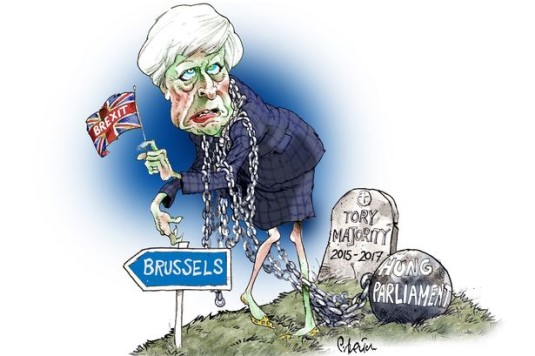
It's worthwhile thinking about the concepts that emerge from the analysis of politics, particularly when it is fraught and strained as per, well, now. And, after all, if commentators are doing their job properly they should be thinking about how to describe and explain what's going on. First up is weak Bonapartism, which is something used here loads of times to describe the situation in the Tory party and the position of Theresa May. It describes how her weakness vis the rest of the party paradoxically gives her room for manoeuvre and strength.

Bonapartism as a concept has a lengthy history among the grey beards. Coined by Marx himself in the articles collected in The Class Struggles in France, Bonapartism refers to the politics in France between the failed revolution of 1848 and 1850, when universal suffrage was abolished. This culminated in 1852 with the founding of the ill-fated Second Empire. Without getting bogged down into the historical detail, Louis Bonaparte (later Napoleon III), the nephew of the original Napoleon, was elected President in 1848. Having been shook by a failed plebeian revolt and thanks to fractiousness between the remnants of the aristocracy and different sections of the rising bourgeoisie, Marx argued the struggle of classes and class fractions had balanced out. The popular masses were no longer willing to be ruled in the old way, but were not capable of exercising power themselves, and likewise the ruling class were disorganised. Into the vacuum the state stepped and assumed political independence from landed interests and industrial capital. It became less a committee for managing the common affairs of the bourgeoisie, as per The Manifesto, and more an organised power for stamping the authority of a single man. The state was strong, the contending classes were weak, and so state authority prevailed. Nevertheless, as Trotsky later observed it was still a bourgeois state because it preserved prevailing class relations and, later on, used government to drive economic development and participate in the European scramble for global markets and colonies.

There have been various adaptations of Marx's concept since. Most controversially in Marxist circles, Trotsky used it in his analysis of Stalinism. In a series of articles written in the 1930s, and most famously in his semi-holy screed (for some), The Revolution Betrayed, he argued what the Soviet Union had become following the October Revolution and its subsequent international isolation an example of 'proletarian Bonapartism'. Again, sparing the details, Trotsky argued that following the revolution and civil war the Russian working class were devastated, the country lay in ruins, and the party had effectively fused with the state as the only organised power in the land. Because the workers and peasants were ruined so were the chances of socialist democracy. And so the organs of direct democracy withered, followed by internal democratic norms in the party itself and the bureaucracy assumed power. However, because capitalism wasn't restored and, indeed, the power of the apparatus flowed from its command over a post-capitalist economy, this dictatorship over the proletariat nevertheless protected the nationalised property bequeathed by the revolution. Hence Stalin's Bonapartism was progressive and marked a gain over what existed previously.

Trotsky also employed Bonapartism in his analysis of fascism in Germany as overlapping categories. Here, fascism started as a mass movement of petit bourgeois reaction against a rising workers' movement, which propelled it to power. Once there, the Nazis turned the organs of the state against their political enemies without and, eventually, within their own movement. And once it was tamed/absorbed into the state it more or less settled into something akin to Bonapartism. Whether he'd have changed this assessment had he lived beyond the early years of the Second World War is a matter of speculation.

In the post-war period there were a number of permutations of Bonapartism. The expansion of Stalinism to Eastern Europe and South East Asia proved/disproved Trotsky's concept, depending on your view of the Soviet Union. For some Trotskyists, the coming to power of De Gaulle in 1958 and the founding of the Fifth Republic was a moment pregnant with Bonapartist dangers. With decolonisation often the only organised body in newly independent states was the military, and often found themselves in situations analogous to, but not as fortuitous as that of Napoleon III, and more recently the army played a Bonapartist role in Egypt's Arab Spring.

Bonapartism then has a pedigree of unpicking the relationship between classes and the state in rapidly moving historic movements and processes. What use could it have for understanding the predicament of Theresa May?

In what you might call the long June since May lost her majority at the 2017 general election, the Tory party has been in a state of stable instability, or permanent disarray. The membership are drifting away or dying, and at the top of the party May's shattered authority is beset by rival factions and ambitious individuals. I guess we've become habituated to it, but we should remember that the spectacle of cabinet members thinking aloud about Brexit is unprecedented and a symptom of May's weakness. Yet thanks to the disunity of the Tories, the awful mess May has on her plate, and leadership contenders balancing one another out, paradoxically the Prime Minister is safe from challenge. After all, if you were an ambitious MP and fancied a bite at Number 10, would you make your move now when Brexit is up in the air and there is still the drawn out process of a trade deal to come? Likewise, would you want it while the party is in the midst of tumult and you're unable to exercise your authority over it? No, and so May abides.

This is where the perverse character of weak Bonapartism is brought out. The central authority is weak, but none of May's would-be rivals have the strength to see her off and replace her. This gives May considerable strength and autonomy, something she only really cottoned on to over the summer. When the details of her Chequers Deal was made public, the likes of David Davis and Boris Johnson could have made a move. But they didn't, preferring to resign and grandstand from the back benches. May also realised that there was no need to appease the hard Brexiteers either, and that if they were able to force a no confidence vote in her leadership she would see them off - a calculation that proved correct. However, weak Bonapartism is an anomalous situation and one that, for May, can't less forever. Should her deal fall at next week's vote, what then? Will she soldier on, knowing no one's about to usurp her (indeed, under party rules this cannot happen until next December), apply for an Article 50 extension, which is the talk coming out of Brussels today, or throw in the towel - assuming she survives Labour's no-confidence vote?

And of weak Bonapartism itself, if May goes in short order her successor will be prey to the same pressures. But weak Bonapartism is so out of the ordinary that I can't think of any other examples or situations where it applies. Any suggestions?

Tuesday, 26 June 2018

Contemporary Trotskyism: A Symposium

At a loose end on Thursday afternoon? In (or can be in) London? Then this might be of interest to you.

Description

A symposium on British Trotskyism jointly organised by the Political Studies Association Labour Movements and Communism Specialist groups for John Kelly’s new book Contemporary Trotskyism: Parties, Sects and Social Movements in Britain (Routledge, 2018)

Speakers

John Kelly (Birkbeck)

Ian Birchall

Phil Burton-Cartledge (Derby)

Madeleine Davis (Queen Mary)

Kevin Morgan (Manchester)

Mark Wickham-Jones (Bristol)

In a major new study of British Trotskyism, John Kelly looks in detail at the influence, resilience and weaknesses of the British Trotskyist movement, from the 1970s to the present day. This afternoon seminar brings together experts in the history and politics of the labour movement, Communism, New Left and far left to debate the arguments of the book and reflect on the significance of the Trotskyist movement for contemporary British politics.

Date and time

Thu 28 June 2018

14:00 – 16:30 BST

Location

Arts One Building, Room 1.28

Queen Mary University of London

Mile End Campus

London

E1 4NS

My piece is provisionally titled 'Trotskyism and Corbynism' and will be looking at the attitude, tactics and strategy the Socialist Party and the Socialist Workers Party have adopted vis a vis the transformation of the Labour Party under Jeremy Corbyn's leadership. Given the scorn I lately poured on the SP, folks might find my analysis somewhat surprising ...

The event is free but you do need to register. You can do so here.

Tuesday, 7 November 2017

Hailing and Heeding Red October

Karl Marx enjoyed historical ironies, but I doubt he'd have been cheered by this one. The greatest event in human history is simultaneously its most tragic event, a people who reached for the heavens laid low by the harsh, hellish realities of war, starvation, repression and dictatorship. The Russian Revolution, Red October, has met its centennial. An occasion to celebrate or commemorate depends very much on your political persuasion, but what it is, what the whole Soviet experience should be is something too many on the left have resisted: an occasion for learning.

If the 1871 Paris Commune was the first breach in the international order of capital, the October Revolution posed it an existential threat. Not only did it expropriate the aristocracy and emergent bourgeoisie, it lit the touch paper of a revolutionary blaze that fanned outwards into Europe, into the colonies, into India and China and won it a global army of adherents. After the collapse of Imperial Germany the continent came close, very close, to turning red. Alas the revolutionary wave ebbed and socialism's outrider became its sole bastion. Nevertheless the establishments of Europe knew what the revolution represented. It was a warning, an unwelcome intrusion of the masses into history bearing one simple message: that capitalism was on notice. The propaganda aimed against the Soviet Republic, the soldiers and material the colonial powers shipped to Russia to strangle the experiment in its cradle, this was done not to restore democracy or prevent dictatorship. Its simple aim was to drown the revolution in blood. The Russian civil war that raged from 1918-1921 consumed the lives of 10 million people, but even that couldn't break it. Nevertheless the utter devastation - think 1990s Afghanistan on a much larger canvas - saw to its pacification in terms of the international game. Socialism in one country, Stalin's original sin as far as the Trotskyists were concerned, was a break with received Marxist understandings of the global character of revolution, but also a doctrinal adaptation to material circumstances and the rebadging of the old Tsarist bureaucracy as so many people's commissariats.

And here lies the first problem with coming to grips with the revolution. Marxist understandings of the revolution performed in its name are too often bogged down by factional debates and their attendant mythologies. For the Social Democrats it was a case of instant dismissal. They preached against the violence of putschism, fetishised constitutionalism and attacked the Bolsheviks for not respecting the political gradualism they were wedded to. Yet this condemnation was strangely absent when it was a matter of turning guns on colonised peoples or the revolutionary masses of Europe, as was the case in Germany after the Great War. The anarchists were simultaneously hostile for the revolution not being revolutionary enough and located Soviet authoritarianism in a red thread stretching back to Marx's expulsion of Bakunin from the First International for ... wanting to place the organisation under the control of a secret conspiratorial outfit with him as the head. Hmmm. For the Trotskyists everything was fine and dandy until the 1921 party congress banned factions and it was the slippery slope after then, and for your Stalinists (depending on the flavour) things were a-okay until Khrushchev's secret speech in 1956, or right up until the Berlin Wall fell.

Of course, this account leaves out much detail, but the point remains. There is little consensus about what the lessons of the Russian Revolution are, and therefore conclusions, be they scholarly or political, are footballs to be kicked about in the ebb and flow of interests. For much of the Cold War period, despite the prevalence of us-vs-themism, there were contesting interpretations. After the end and the temporary triumph of neoliberal capitalism and governance, the USSR and the revolution that spawned it were an aberration, something to be reviled if it was ever to be talked about at all. As politics opens up again and socialism and communism are once more at large, ambiguity is more the order of the day - of which this post is one of many left wing examples.

The crucial problem, the issue returned to time and again is the erroneous suggestion the Bolsheviks started out as a dictatorial outfit. After all, it's there in Lenin's What is to be Done?, an otherwise obscure pamphlet of boring polemics old Lenners aimed at his rivals and fellow exiles in the Russian Social Democratic Labour Party. Indeed, Trotsky earned his spurs if not his notoriety in these self-same circles for attacking Lenin's "authoritarianism". He was more right than he could have ever supposed when he argued "... these methods lead, as we shall see below, to the Party organisation “substituting” itself for the Party, the Central Committee substituting itself for the Party organisation, and finally the dictator substituting himself for the Central Committee". And yet contrary to the standard interpretation of Lenin and the bureaucratic sects and cults who farcically claim to be repositories of the Bolshevik tradition, "these methods" were not Lenin's argument at all. As the sterling scholarship of Lars T Lih on the life and works of Lenin show, the model he favoured and worked to base the revolutionary party on was actually German Social Democracy, albeit adapted to conditions of Russian illegality. That was a tradition of relating democratically to workers and peasants, it meant a disciplined approach to political activity married to a noisy and dynamic culture of criticism and open debate. The RSDLP, which incubated the Bolshevik and Menshevik factions was never a monolith, and following the final split between the two and the transformation of both into parties, they inherited the characteristics of its defunct parent. The party that led the insurrection was also a party with a democratic culture and with open factions who published their own material. It was formally and substantively more democratic than the Labour Party. There was clearly a qualitative break between the Bolshevik Party of Lenin prior to the revolution and the mockery of workers' power it later became.

How did we arrive at the gulag from this? For Trotskyist accounts of the revolution, the young Soviet Republic was hampered by its narrow social base. Only small numbers clustered in the urban areas and attending the (then) limited transport network could be considered proletarian - the rest were the peasantry. In short, the revolution had to rely on winning over a much more numerous class whose immediate interests were in tension with socialist aims. Complicating this was the revolution coming under siege by internal reaction and the armies of the Allied Powers, who poured in once Germany and Austro-Hungary were put in their boxes. As the civil war persisted the Soviets, the constitutional bedrock of the new order, got sidelined and, to make matters worse, the most conscious and dedicated revolutionaries were killed in the slaughter or absorbed by the bureaucracy in directional roles. This, goes the story, provided the material base for the strangling of the revolution by the apparatus and the subsequent rise of Stalin as its champion and overlord. The Trotskyist account is right as far as it goes, but as anarchist criticisms make clear, the disruption and destruction of democratic functioning was a pronounced tendency from the very start. In her memoirs Alexandra Kollontai recalls weeping as she called in the heavies to disperse protesters at her commissariat, and this was before the civil war got properly underway.

Bolshevist authoritarianism came not from the party but the process of revolution itself. As Engels himself noted in a polemic with "anti-authoritarian" socialists,
... the anti-authoritarians demand that the political state be abolished at one stroke, even before the social conditions that gave birth to it have been destroyed. They demand that the first act of the social revolution shall be the abolition of authority. Have these gentlemen ever seen a revolution? A revolution is certainly the most authoritarian thing there is; it is the act whereby one part of the population imposes its will upon the other part by means of rifles, bayonets and cannon — authoritarian means, if such there be at all; and if the victorious party does not want to have fought in vain, it must maintain this rule by means of the terror which its arms inspire in the reactionists.

A revolution leaves very little room for democratic niceties, as every single one from the English Civil War to the 1979 overthrow of the Shah in Iran demonstrates. For all the fantasies of the cleansing violence of revolutionary action, revolutions have the tendency to consume everything, not least the people who made it, as the French and Russian examples attest. And that, ultimately, has to be the enduring lesson of what happened a century ago this evening. A peaceful putsch - more people were injured during the staged and filmed storming of the Winter Palace than the actual event - was a prelude to a war so bloody that only the Nazi invasion of Russia surpassed it. For Marx, socialism and communism was the immense majority moving in the interests of the immense majority, a position now opening up again by the confluence of rising culture, rising networks, and sharpening politics. Going beyond capitalism doesn't, at least in the advanced West, require an insurrection and civil war precisely because the character of class struggle is changing. There are no blueprints for what comes next, only pointers provided by the directions new struggles takes and what new constituent processes are tending towards. Therefore one should mark the October Revolution, even raise a toast to the comrades who made it, but never forget it's a warning as well.

Monday, 24 October 2016

Hitler: The Rise and Fall

Broadcast on More4 these last few weeks is the definitive documentary about the Nazi leader. Bear in mind those are their words, not mine. Like most pieces that try and unpick Adolf Hitler, this claims to get at the man behind the monster by building on insights dredged up by decades of scholarship. And yet, somehow, despite there being virtually nothing that hasn't been said or written about Hitler, TV documentaries always miss the mark. Rather than challenge the myth that he was a political titan in a field of mediocrities, they tend to reconfirm it. In no sense is he analysed in his context, as the head of a social movement and, as such, he gets off as one of history's great (but damned) men. In this respect, I'm afraid to say Rise and Fall is no different.

Despite drawing on academics and experts, Rise and Fall's obvious shortcoming concerns Hitler's rise to power. Obvious, because it is repeated time and again. As even my cat knows, after the Munich Beer Hall Putsch Hitler came to the conclusion that (relatively) peaceful and constitutional campaigning was the way forward for the fledgling Nazi movement. Violence against opponents was ever present, but this took place alongside the work of contesting elections, kissing babies, setting up Nazi social clubs, and so on. After his release from Landsberg prison, Hitler set about reorganising the Nazis and polishing up his image as a dynamic politician. The conventional narrative, which Rise and Fall parrots, is that he got nowhere - despite the celebrity Hitler's trial afforded him - until the Depression came knocking and Germany's economy nosedived. Once this happened, Hitler's assumption of power was more or less guaranteed.

As anyone who imbibed their inter-war history from the teet of Trotskyism knows, matters were more complex. In histories of the time, backed up by Trotsky's excellent contemporary analyses of the rise of Nazism, we were told that Hitler was the fault of Joe Stalin and his minions in the German Communist Party (KPD). The most powerful and well-organised party in the Communist International outside of the USSR, with the onset of economic crisis the official Comintern line declared that a new period in politics had opened up in which revolution was imminent. The time now was to take the offensive and declare war on all capitalist parties, and this included (and especially targeted) the mainstream social democratic and labour parties. In Britain's case, where the tiny CPGB's positioning vis a vis the Labour Party merely reinforced their stillborn status, in Germany the effects were far more serious. Trotsky had rightly identified that the Nazis presented the labour movement a mortal threat, and for that reason the KPD and Social Democrats (SPD) should make common cause to crush the Nazis on the streets and drive them out of politics. They certainly had the combined social weight and large enough militias to do so. And yet, time and again, opportunities for unity were passed up as the KPD pursued the "class against class" line. Rather than seeing the SPD as potential allies, they were "social fascists" to be smashed alongside the real fascists. The fact Stalin's Comintern carried on with this policy to the mutual ruination of German communism and social democracy underlined its bankruptcy and the need for a new revolutionary centre, as far as Trotsky was concerned.

While this was true, Trotsky is a touch guilty of over egging the pudding. Yes, the main enemies were the Nazis, but the KPD didn't pursue the class against class line just because Moscow told them to. The KPD was mainly a young party, but it contained plenty of activists who were around when the Social Democrats in government used proto-fascist militias to murder Rosa Luxemburg and Karl Liebknecht, two of the party's outstanding early leaders. It was the SPD that colluded with the army against the communist government in Bavaria, and summarily executed its key cadre when the Munich soviet collapsed. While history does not excuse the communist failure to unite against the Nazis, it helps explain why many party members swallowed the social fascist line. Meanwhile, the SPD weren't especially keen on forging an alliance against the Nazis with the revolutionary left either - what was taking place on Germany's streets were secondary to its constitutional responsibility toward the republic it had created, and manoeuvring with bourgeois parties to keep the possibility of mainstream coalition government open.

The Nazis were fortunate to face a divided labour movement. By the time they were in government and used the emergency powers contrived by Hitler in the wake of the Reichstag Fire, they were able to roll over both parties without so much as a shot fired. This outcome, however, was not predetermined. Politics are always fluid, and because of the repeated blunders in the face of the Nazi threat Germany succumbed to fascism.

Needless to say, this opportunity to defeat the Nazis was passed over in favour of a narrative of a smooth assumption of power. But the second point, which rarely warrants a mention, is that by the time Hitler was invited to form a government, his party was past its electoral peak. In the July 1932 general election, the Nazis became the biggest party in the Reichstag with 37% of the popular vote (13,750,000 votes) and 280 seats. Come the November election, they lost two million votes and 34 seats. Rise nevertheless portrayed Hindenburg's invitation to Hitler as a natural outcome of an insurgent Nazi party. In fact, by this time Germany was over the worst of the economic crisis and clearly, all it took was a few months for former Nazi voters to get fed up of Hitler's shenanigans and posturing. It was the play of bourgeois coalition politics that elevated the Nazis to the level it could cut liberal democracy's throat. The options were there for yet another bourgeois/SPD coalition, and yet at this late stage the establishment feared the KPD more. In those final free elections it rose to 100 seats and almost six million votes while the SPD's support was spiralling downward. Again, Hitler's rise was not inevitable.

Unfortunately, by skirting over these important historical details they reinforce the Führer myth. As established scholarship has asserted time and again, Hitler was an ignorant blowhard that rendered him entirely inflexible, and was a man consumed by infantile fantasies fed by cowboy novels and Wagnerian opera. He had a talent for rabble rousing, a flare for marketing, and a cunning that could sniff out weakness in others. None of these attributes are signs of genius: they are banal character traits shared by tens, if not hundreds of millions of people. In his rise to power, what is striking is less an exercise of preternatural talents but exceptional luck. Luck that his opponents underestimated the Nazi movement, despite the living example of Fascist Italy, luck that the labour movement was consumed by its own civil war, and luck that the game of government formation made the Nazis an invitation at the moment their support had started to plunge. If you're looking for the last word on this topic, Hitler: The Rise and Fall isn't it.

Thursday, 11 August 2016

Against Entryism

Haven't we already done this? The spectre of Trotty entryism is being raised again, this time by deputy leader Tom Watson. Writing to Jeremy Corbyn, his recent warnings that the Old Man's followers are pouring into the party to twist minds as well as arms now, apparently, has some evidence to back it up. In addition to a dossier comprising the pronouncements from the likes of the Socialist Party and Socialist Workers Party, Tom exposes a nefarious document allegedly passed between Momentum activists on how to take over Labour Party branches. As this recommends making meetings interminably boring, uncomfortable, and adversarial, long-term members could be forgiven for thinking the party has been infested with Trots for years. Alas, there is a problem with Tom's claims of leftist diabolism. Embarrassingly, and hat tip to Dave Osland, the lines are lifted from a Progress book review. Super ouch.

Tom's claims are ridiculous and overblown, but there is no denying the two principal organisations of the far left - our aforementioned SP and SWP friends - would dearly love a piece of the Corbynist action. I mean, to think of yourselves as the most far-sighted section of the proletariat and spending decades attacking and standing against the Labour Party, only for a mass take over of the party by the left to happen. And all without you, how embarrassing. I guess when you don't bother analysing anything afresh and stick with creeking formulae from 20-odd years ago, you're bound to come unstuck from time to time. Still, with so much new blood for the left around they want in. Here are some very good reasons why they should be kept out.

The first is their modus operendi. As each, even the smallest group, believe they are the future revolutionary party in embryo, it is the building of that organisation that matters first and foremost. And as there is no higher authority than the central committee, that inevitably leads to the subordination of all political activity to its self-interest. It's one reason why all the extra-Labour left unity initiatives of the last 20 years have failed. One would-be Lenin could never submit to the will of another, even if the political moment demanded it. And when it comes to campaigns, again, there are countless examples of left groups, and the SWP in particular moving into/trying to take over campaigns, and then running them down or smashing them to bits when they no longer serve their purposes - which is always party building. Truly an example of the goal being nothing, and the movement being everything. Though the "movement" in this case is a cranky cult with an unenviable record of covering up sexual assault allegations.

Ultimately, what all Leninist groups share is a parasitic approach to politics: find a host, attach, suck in as much fighting fund and recruits as possible, and then move onto something else. The SWP do it. The SP did when they were Militant, and subsequently worked toward a time when they could play their former role afresh in a new workers' party. Their shared political parasitism is at odds with the patient, methodical activity the building of a truly mass, deeply rooted party demands. Nor would it be helpful for Labour to have its name hijacked and traduced by people wedded to the fantasy of revolution when, in fact, they speak only for themselves.

The second issue is related to the first. While obviously a revolutionary as opposed to a constitutional reformist party with extra-parliamentary extensions, the Bolshevik party that led the October Revolution was criss crossed with platforms, open factional presses, and a democratic culture of debate and accountability. Yes, really. In form, Lenin's party bears more of a passing relationship to the freedom that exists within the Labour Party than the small groups claiming our Vladimir's mantle now. Our contemporary advocates of workers' democracy finds their parties groaning under a "managed democracy" in which that year's outgoing central committee is always the incoming central committee, that internal debate exists within tightly circumscribed lines and pays all due deference to an entitled and overblown full-time apparatus; and as an authoritarian culture breeds sycophancy and unaccountable power, both organisations have an ugly history of mistreating and, in some cases, abusing their members. Something you might expect from a religious cult, the last thing from collectives nominally committed to building a socialist society.

Thirdly, their authoritarian politics are absolutely not suited to the moment. Where and when it had a mass base, revolutionary politics in Western Europe were symptomatic of the workers' movement being largely outside of political systems. The reasons why Germany's SPD voted for war credits, attacked revolutionaries, and later dumped its formal adherence to Marxism wasn't solely because of its leadership. Much more importantly, their members were getting progressively integrated into parliamentary politics with all the opportunities and problems that brings. It has since proven to be true that wherever representative democratic systems are at the heart of constitutional politics, the tendency is for the majority to be brought "inside". Only those who, for whatever reason, are or feel excluded are likely to be drawn into revolutionary socialist politics. Hence why the far left here remains marginal - the natural constituency for them is vanishingly tiny.

As well as being obsolete, politics is now undergoing profound change. A key contradiction for contemporary capitalism is between the need to maintain labour discipline, and the active, creative forms of subjectivity (modes of living, self-identities) we all possess which it is simultaneously dependent on for aligning them with consumption and, more importantly, for generating the innovative, analytical, critical cognitive skills becoming more central to work (and therefore surplus value production) in the 21st century. These modes of life are embedded and and cannot easily, if at all, be disentangled from the social media networks that enable the sharing of interests, the swapping of knowledges, and the senses of mutual recognition these have brought. Left politics is still in the process of figuring out what this means, but it's clear that when widespread horizontal communication exists and is part of the everyday existence of masses of people, and that the numbers engaging in these practices continue to grow, the command-and-control politics espoused by our Leninist friends is, at best, ill-suited. At worst, it works against this progressive trend, severing its adherents off from it while wasting their time on political work that has next to no impact, or frustrates the work of others.

In short, the revolutionary left as represented by British Trotskyism is a dead end trend, albeit one that could cause damage and division if they were let into our rapidly changing, rapidly growing party. Best to keep the proscription on Militiant and its successor organisation, to tell both the SP and SWP their parasiting the Corbyn campaign is not needed, and communicate to them in no uncertain terms their "support" is as welcome as syphilis.