Showing posts with label Public Sector. Show all posts

Friday, 2 January 2026

What is the "Stakeholder State"?

Paul Ovenden is someone we did not need to hear from again. He could have spent his time over Christmas reflecting on what cost him his job. But what disgraced former special advisor could resist the chance of redress in the pages of The Times? And at what has his spleen been vented at? The double whammy of cluelessness and cruelty that characterises the government he served? Don't be silly. The new bĂȘte noire is something called the "stakeholder state".

Picture the scene. A government is elected and wants to do things, but at every juncture they're besieged by lobbyists and campaigners. Some are from outside the state. But what is new is that within the institutions itself, even within a "neutral" civil service purposed to carry through the wishes of their political masters, there are networks of interest groups supporting and pushing issues they're exercised about. Particularly egregious are the quangos, those arms-length agencies of state that work to water down executive decisions they do not like. And where are the British people while this is going on? Nowhere. Voters don't get a look in. They're not the real stakeholders; a bloated establishment is. What they say goes, and for those inside government the weight of this machinery quickens a state-of-siege sensibility.

A couple of things about this. The stakeholder state stuff isn’t specific to Ovenden, or this government. Anyone familiar with politics memoirs will see shades of his complaints in former politicians' frustrations. It's also the inverse of the pluralist theory of politics. In the Marketplace of Ideas, different groups tussle for influence and policy. That is entirely what politics is, and parties have to build coalitions out of this to win and hold office. It's one of the first perspectives sixth form/FE students learn when studying politics. In other words, all he's stating is a banality.

The second point is this dovetails with every right wing, tin foil hat argument about the character of the state. Ovenden rightly says "It isn’t a grand conspiracy. There aren’t secret meetings or handshakes. Rather, it is a morbid symptom of a state that has got bigger and bigger while simultaneously and systematically emasculating itself." But the effect is the same. Nigel Farage's insincere whingeing about the liberal elite finds confirmation in these arguments. Liz Truss's ranting about the deep state and how it derailed her premiership is there, between Ovenden's lines. Michael Gove and Dominic Cummings's objections to "the blob" are echoed in the article's words.

What Ovenden doesn't talk about is how this form of the state came about. And, the truth of the matter is, this is what it has become after nearly 50 years of rebalancing labour and capital in the latter's favour. It was our old friend Margaret Thatcher who not only smashed and shackled the labour movement, but reconfigured the state away from a rough pyramid of clustered bureaucratic institutions to a looser collection of semi-autonomous bodies whose horizontal relationships were mediated by government-mandated markets. Business logic only works if there is competition. Meanwhile, the pre-existing expertise that existed within them was undermined and/or scrapped, and market thinking was granted the status of common sense. What happened to education, for example, in which local democracy, professional autonomy and independence, and the curriculum was done away with or reconfigured by government diktat typifies what Thatcher, the John Major government, and New Labour did to the state. But it wasn't just about creating new opportunities with a guaranteed return for (internationally uncompetitive) British capital. It was an issue of governance. In his memoir, John Major wrote with a sense of accomplishment about how shifting institutions to metric chasing and enforcing competition between departments to meet them improved the "customer experience". From a governance point of view, central government could just leave them to chase their tails. A case of winding them up and letting them go, while the relevant minister could spend their time on more interesting things outside of their brief.

Likewise, during the Thatcher years it became evident that government and governance could be outsourced. We're not talking just about the privatisations, but how the state became content to leave sectors to the province of "independent" regulators and watchdogs. This constellation became increasingly complex as charities and campaigning organisations engaged with and became embedded in a bewildering array of fields and sub-fields concerned with this or that aspect of social life. From here lobby outfits multiplied, to seemingly absurd outcomes where parts of the state lobby parts of the state. But crucially, what Thatcher enshrined and has been consolidated ever since is that government is the absolute sovereign, both as arbiter and the one point of the state that can unilaterally restructure everything else. Yet this appears to be a formality for those inside the system. Occasionally the Tories declare war on the quangos, but this same constellation structure with the executive at the centre persists. For anyone with a sense of history, its endurance as such might suggest an element of fit between contemporary politics and economics. It was all, after all, designed to be by the same sort of state functionaries now decrying it.

Ovenden finishes his article by saying it doesn't have to be like this. That is true. He talks about the power of government to change things and respond to democratic aspirations. And yet, this government, in case anyone needs reminding, has declared Palestinian solidarity protestors terrorists, wants to abolish jury trial for most court cases, is moving to shut down VPNs, and has legislated to officially scapegoat refugees and trans people. These were not in Labour's manifesto. It is true that Thatcher's restructuring of the state was minimising the democratic checks on capital, but - as it always has been - the main threat to liberty and democracy stems from the centre. Obviously, Ovenden cannot and will refuse to see it because he personifies this outlook.

Image Credit

Monday, 3 November 2025

Nigel Farage's Tory Economics

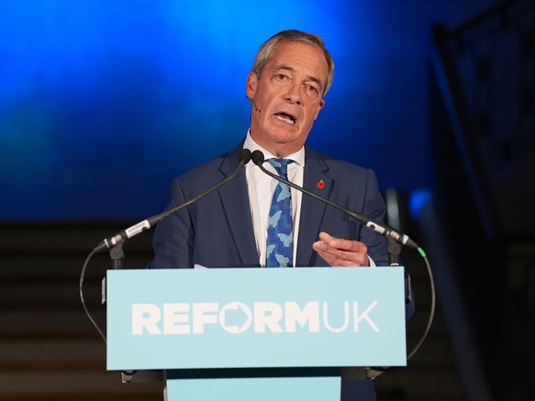
That Nigel Farage, he's proven himself a dab hand at politics. Having replaced the Conservatives as the main party of the right, at least in the opinion polls, he said he was coming for Labour. And a number's been done on them too. Their figures are the worst ever while Keir Starmer's personal ratings sit somewhere between Liz Truss's and Vladimir Putin's. Even more unbelievably, it's only recently that the very clever politics brains the Prime Minister employs have come to the conclusion that challenging Farage's politics might be a good idea. Having spent the last few years caving to his framing. The result? Farage riding high on a bubble of popular support. Sure, Reform are stealing a march on the politics of anti-immigration and race, but can they convince as many people that they - the party that successfully defended the sovereignty of sterling - care about the pounds in their pockets?

It's telling, but not surprising that the champion of Brexit chose the City as the venue for his big economics speech. The symbolism will not be lost on the oligarchs who are now assessing Farage's suitability as the political custodian of their interests. And it's these people, not the downtrodden little men that comprise his usual audience, he wanted to address. The most eye-catching item in his list of promises was not the rowing back of the ridiculous tax cuts promised previously ("they were only ever aspirations"), but his desire to put the screws on young people. "The minimum wage is too high", and poor businesses are suffering. Cutting it would boost aspiration. Either that, or employers' National Insurance Contributions should be cut by lifting the cap at which they should be paid. It's a good job Reform's imaginary army of enthusiastic young people are imaginary, otherwise they would be in the process of evaporating.

Farage said he would abolish George Osborne's - and now Labour's child benefit cap. But only for British nationals, and only if both parents were working. In other words, those most in need would lose out. He also wouldn't be drawn on whether to keep the triple lock on pensions, which usually indicates that yes, they are thinking of tinkering with it in some way. A reminder that the state pension here is still weaker than it is in Ireland, Germany, France, Denmark, etc despite the upratings the lock has delivered these last 15 years. While we're on pensions, having consumed many a Telegraph editorial, Farage thinks he can clamp down on spending by attacking the "gold plated" schemes public sector workers apparently enjoy. Also, disabilities are "over-diagnosed", so more penny pinching and cruelty is being plotted against the most vulnerable people in our communities.

Gruel for the little people. But treats for the rich. The pledge to reverse Labour's land tax on the rural rich made the cut, as did a promise to abolish inheritance tax on family-owned businesses. He argued that Britain operates a punitive tax regime that drives successful people abroad. Out of the ether, he pulled the example of £100k/year "young professionals" leaving these shores. He knew none of his adoring stenographers would ask him how those fleeing abroad would take those jobs with them. There were the ritual assaults on net zero, and he took aim at diversity and inclusion policies. Recalling his time as a metals trader during the 1980s, he said no one cared about race, religion, or gender on the famously diverse commodities floor. There were, after all, blond white men, bald white men, dark haired white men.

What is striking about his speech is the dropping of anything approaching the populism, however you define it. Farage has made a solemn vow that regardless of the rhetoric and the chaos, he has no plans whatsoever to reshape Britain's political economy. Which isn't a surprise, seeing as his party are as much affected by the crisis in mainstream politics as the rest. What he presented is pure and simple Tory economics, a programme openly dedicated not to driving GDP growth, increasing employment, and doing the things responsible helmsmen of British capitalism are supposed to do. This is the economics of strengthening class relations by throwing more people off social security and onto the job market without support, while driving down the wages and conditions of young people who subsist on the minimum wage. It's not difficult to work out who benefits from this. The political of Farage's economy also owes more to the miserly managerialism of Rishi Sunak than the bombast of fellow "populist" Boris Johnson. As per the last Tory government, Farage is promising a smaller state not to meet his ideological peccadilloes but to try and manage the politics. People demand less if the state is underfunded, run down, and barely works. For all intents and purposes, Farage has stolen the Conservatives' prospectus. Reform is set on becoming a Tory home from home.

At the same time, this leaves Farage vulnerable. We've seen in recent weeks that overt racism can damage Reform. Most of the public aren't on board with his anti-Net Zero drivel, and Farage's murky finances and penchant for Russian talking points are hanging round his neck like a 300lb albatross. This City speech is also a political liability, as he unambiguously paints which side he is on. And it's not the one most of his support think it is. Pathetically, both Labour and the Tories have attacked his plans as "unworkable" and spun a weave of boring, technocratic reasons why they won't work. But Farage has made himself uncharacteristically vulnerable by painting a target on his rather large weak spot. He's conceded populist ground where, should they choose, the Greens, the left, and the labour movement can have him.

Image Credit

Saturday, 15 March 2025

Labour's Enthusiasm for Artificial Intelligence

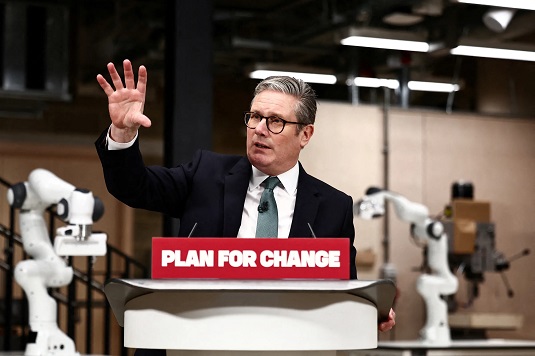
30,000 jobs are set to disappear with the closure of NHS England and its merging with the Department of Health and Social Care. Echoing the Tories, tens of thousands of civil service jobs are on the chopping block. And this planned massacre of livelihoods were presided over by a grinning Keir Starmer and Wes Streeting and presented to the media as unalloyed goods. This is set to cut down on duplication and save lots of money (£45bn, apparently). But something else is also on the cards: the replacement of jobs by Artificial Intelligence. In his enthusiasm at the prospects of jobless service provision, Starmer gushed that "No person’s time should be spent on a task where digital or AI can do it better, quicker and to the same high quality and standard."

This is the umpteenth speech in which the Labour leadership have espoused their enthusiasm for AI. For Starmer and his project of authoritarian modernisation, the technocratic attractions are obvious. A state that is neither bigger or smaller but works better is enticing, particularly when previous attempts at digitisation have been hit by delays and costly failures. Those long in the tooth will recall efforts at harmonising the NHS's IT systems, and the huge problems rolling out Universal Credit encountered. But the prize is the speeding up of the state's mundane activities, like answering HMRC inquiries and sorting out driving licences quickly. AI is part of Starmerism's answer to the crisis of government legitimacy. If the bureaucracy can be automated and the discharge of its functions be made as rapid as placing and receiving an Amazon order, belief in the efficacy of government and, possibly, the standing of politics could improve - to Labour's benefit. If only people could forget about winter fuel cuts.

Those are the good reasons. What are the real reasons? The PCS response argues that new innovations should be introduced and embedded in cooperation with staff and be used to enhance working conditions and job security. A position likely to have gone in one ear and out the other. This is because AI's promise speaks to the dominant pole of (right wing) Labourism: its relation to "working people" not as working people, but something far more passive and politically innocuous: as consumers. The ultimate aim is impeccably Blairite: the depoliticisation of politics, and the reduction of choice between the parties that offer the best value, best quality services. This alignment with Labourist assumptions is more a coincidence of congruence. As ever, it comes down to interests.

On plenty of occasions, Starmer has staked out his intention to transform the UK into an AI superpower. This does involve infrastructure like building the first reservoir for 30 years, which handily is earmarked for land not far from the planned expansion of data centres in Cambridgeshire. But more importantly, he's leveraging the state as the anchor customer for AI services and innovation. There is nothing particularly innovative about this. In the Blair years outsourcing, Public-Private Partnerships, PFIs, etc. were used to provide guaranteed markets for everything from cleaning companies to construction firms. The aspiration was to tie the interests of those firms to the largesse of New Labour ministers, thereby expanding the party's base among capital's exalted circles. When the crash came and Gordon Brown's government became a busted flush, they were happy to carry on accepting these sorts of contracts while transferring their allegiance to the incoming Conservatives - who continued with the same practice. Streeting's love-ins with far right tech oligarch Peter Thiel, the enthusiasm for using AI in patient-facing interactions, and the endless promises of using the private sector to "help" with the NHS are part of the same piece. This is the mood music designed to entice Silicon Valley and giving them a stake in the British state, while generating a home grown ecology of expertise around innovation and application. Something that could have the happy by-product down the line of sheltering the UK from Trump's tariffs, and making Labour - on paper, the political antipode to their brand of freakish authoritarianism - their preferred political partner this side of the Atlantic.

Everyone wins, right? No. Supposing AI can fulfill the grandiose claims made for it, the British state is being used as a test bed for, to borrow a recent phrase, feeding jobs into the wood chipper. The purpose of generative AI is not to make things more efficient, but to deskill and digitise as many of the properties of immaterial labour that are feasible. I.e. The social competencies that capital accumulation increasingly depends on can, after a fashion, now be separated from workers and therefore tip the balance of forces further away from labour. To all intents and purposes, as per previous waves of automation what the government are promoting is a power grab at capital's behest. If these schemes are successful, the next targets are millions of jobs across private industry for the benefit of shareholders. And Labour ministers who fancy themselves as future consultants on implementing AI "solutions" in large organisations when they're done with politics. Just like the Thatcher years, Britain could pioneer a new class settlement. And just like the 1980s, unless the left and the labour movement gets its act together it will be our class who loses.

Image Credit

Tuesday, 11 February 2025

The Politics of Noticing

Comrades on the left call it the Great Noticing. This is where observations and arguments made in public fora by absolutely awful beyond-the-pale left wingers and are customarily ignored (if not denounced as tinfoil hattery) by the great and the good of sensible, grown up politics. Yet there comes a point when something cannot be blanked any longer. The crisis of the Conservatives and the confessions of right wing Labour factionalists are a couple of recent examples. One where the reality became too obvious to deny and now a cottage industry has sprung up about the long-term problems of the Tories, and another when the players themselves candidly admitted to all the things they were denying with straight faces a few years ago. Naturally, the left gets no credit for being right on these things.

Another noticing is happening right now. Unsurprisingly, the over-hyping of Nigel Farage from all quarters of pundit opinion has helped put Reform in the lead in several polls. And now commentators from The Sun to mainstream political science are writing about how Keir Starmer's strategy is undermining the Labour Party.

Take Rob Ford for example. Discussing the rise of Reform, he notes that for Labour "wooing back Reform voters with red meat on Farage’s favourite issues is a strategy with low prospects of success and high risks." And what is the nature of this risk? "A populist Labour campaign for Reform votes may be the last straw for many in this socially liberal, viscerally anti-Farage group, putting at risk hundreds of marginal seats where Reform is out of the running, but where Labour needs a united progressive front to prevail next time." At the risk of tooting the old horn, the problem Rob identifies was something I identified in a 2021 special issue of Political Quarterly. A more respectable organ where polite opinion is concerned than this corner of the internet. But I'm not pretending originality. Plenty of other left wingers were making similar arguments at the time.

The question then is why now? Why are sections of establishment opinion not only waking up to Labour's counter-productive positions, but are fretting about it? On the one hand there is the government's refusal to do much to forestall the crises in state institutions. The utter indifference Labour has shown universities has become emblematic of their high-handed neglect, as they hide a lack of leadership behind vague and indefinite reviews. As the professional base of Starmerism was divided going into the election and largely stayed on board to see the Tories defeated, this is an exasperation in frustration. But more than that, Donald Trump is giving a chaotic lesson in what could be visited on the British state if a Reform/Tory coalition won office in 2028/29. Not just a flagrant disregard of the law, but the tearing up of state institutions, NGOs, the charitable sector, environmental protections and sustainable energy projects, and an evisceration of whole swathes of the economy present themselves as a real possibility. It appears significant sections of establishment opinion have learned the lessons of the Democrats' complacently dismal campaign, understand how Joe Biden's administration paved the way for Trump, what that could mean for their future and are - rightly - worried that Starmer's government is on an identical path.

This isn't to say this layer ae champing at the bit for radical solutions to deep seated problems. But they want to see the government prioritising the fixing of institutions, putting money in people's pockets, and going for a sensible economic strategy instead of prioritising the same old interests. More reforming zeal, less scapegoating of people desperate enough to brave the Channel in a dinghy in the winter. Starmerism, if it means anything, was for this layer a take over of the state by the state. In other words, professionals, experts, and technocrats motivated by public service were in charge at last. Tackling problems and presenting solutions was their jam - in marked contrast to the cynical, reckless mess that preceded them. This Labour government therefore comes as a shocking disappointment, best typified by Starmer's defence of the institutionalised acceptance of bungs.

If Labour carries on as they are doing, it won't just be the bulk of the working class that will be deserting the party, the Prime Minister's core constituency will do too. Which makes the nightmare outcome they fear the most more likely. And the blame for this would lie entirely at the feet of Starmer and his lieutenants.

Image Credit

Wednesday, 30 October 2024

A Typical Labour Budget

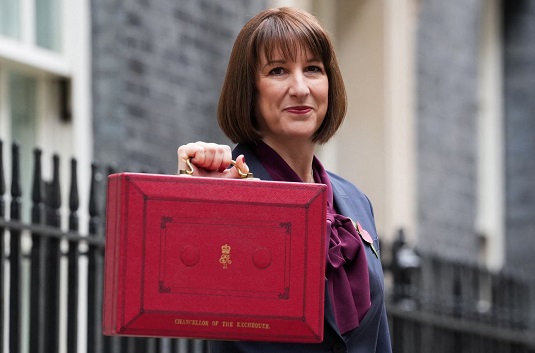
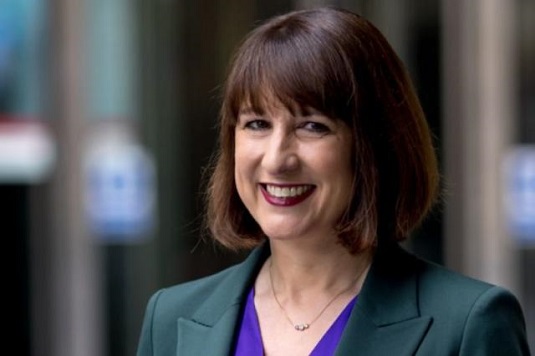
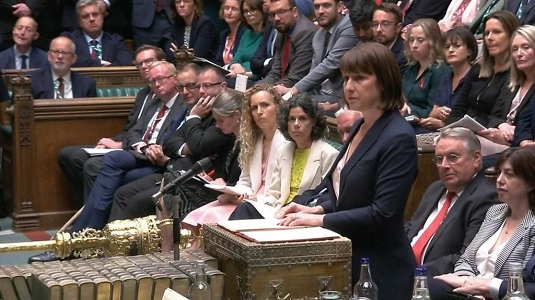
"This is not a budget we want to repeat", said Rachel Reeves of her Autumn statement this Wednesday afternoon, but if past behaviour is any indicator of future behaviour then she'll make similar choices again and again and again.

I won't wear anyone's patience by raking over the minutiae line by line. Yes, on balance this is a budget in which the most privileged will be coughing up a fraction of the huge gains they banked under the Tories. Hence the absurdity of the 'Comrade Reeves delights the workers and peasants with class war' headline on Conservative Home. This was nothing of the sort, but tallies with what was argued the other day about their hypersensitivity to any measures that strike at unearned income - the lynchpin of class relations. And so, the pips are squeaking as VAT goes on private school fees and business rate relief ends, huge duties are slapped on private jet passengers, capital gains tax goes up (but is still not equalised with income tax), non-dom status is scrapped, the minimum wage increases, and more will be scooped from inheritance and stamp duty.

And where will the money be spent? Commitments have been confirmed on sending HS2 to Euston, reversing the Tories politically motivated cuts. NHS and education spending will increase by 4.7%, a £1.3bn increase in council funding - but that would not meet the demand on adult social care and children's services alone. £12bn was also set aside for infected blood compensation, and £2bn for victims of the Post Office Horizon scandal. There's also a boost to the miners' pension scheme as the government has stopped taking its punitive share of the fund's surplus. And because there's always money for war, while some departments have to cut their cloth the MoD can look forward to an extra £3bn.

There has been some concern across the political spectrum about the increase in employers' National Insurance contributions, which will raise a projected £25bn. These worries echo the Office for Budgetary Responsibility's comment that this will mostly be passed on through lower wages and higher prices. Far be it for me to defend Reeves, but we know that Keir Starmer's programme is premised on a decade-long series of missions. Therefore, a lot of Reeves's decisions have to be considered in the longer view. Where the OBR's assessment of NICs is concerned, also relevant here is Reeves's minimum wage announcement. Following the Tories, she too has agreed to an above-inflation increase, amounting to approx £1,400/year boost from next April. In the context of the rest of the labour market and pay award structures among larger employers, this could ricochet up the pay structure, particularly for those on modest wages and salaries. More money goes into better paid workers' pockets, meaning more consumer spending, and the consequent multiplier effects eventually cover the NICs increase. This appears to be what the chancellor is banking on.

This was also a punitive budget for many on the sharpest end of the income scale. The bus fare increase stays. Even worse, Reeves confirmed she is keeping the last vindictive Tory attack on disabled people with her carrying through their plan (now her plan) to change the Work Capability Assessment so up to 450,000 stand to lose hundreds of pounds per month. There was more money released for supporting disabled people into work, but no recognition that not everyone can, and nothing about winding back the sanctions regime. As Disability Rights UK put it, "At the end of the day, the biggest announcement was one our community had been expecting: more Disabled and working-class people seeing their benefits cut whilst there will be no real difference in our local services."

This budget was high handed, overly technocratic (supported by a cynical framing), and gives with one hand while takes with another. It was Reeves, after all, who said over a decade ago that Labour didn't want to be the party of benefits, and so the preoccupation with authoritarian welfarism continues. There are elements of longer-term thinking here but not match with funding commitments adequate to the challenge. Her settlements do little to nothing to fix persistent social problems and a crumbling public infrastructure. In other words, because of its inadequacies and petty punishments Reeves's effort lies entirely within the envelope of her predecessors in Number 11. This was a Labour budget through and through.

Image Credit

Wednesday, 21 August 2024

Playing Two-Dimensional Chess

Am I the only one experiencing a Rachel Reeves-shaped double dose of deja vu? On the one hand, there is her copying Gordon Brown's "prudent" management of public finances which, in the first two years of the New Labour government, saw him stick to Tory spending plans. And then there is Tuesday night's briefing to the Graun. We are warned that her Autumn statement will include tax rises and public sector cuts. Stuff that she has already said. I suppose plagiarising one's self is a step up from ripping off others.

What does the piece say? Despite the economy puttering along better than expected, state borrowing for July had doubled compared to this time last year. Because it's £3bn over target, "tough decisions" are called for. I thought economic growth was supposed to be our magical cure-all? There are four measures that are being trailed. Raising capital gains and inheritance tax, and keeping to the letter of no new taxes on "working people". Going for a 1% increase in public spending, while expecting some departments to find savings. The child benefit cap is staying in place because the point of hard choices is to look tough and uncaring. And finally, the Bank of England will be excluded from state debt figures.

The last is the most wonkish, but is politically interesting. As we know, taxes are paid into the consolidated fund, which is effectively the government's current account with the Bank. It suits Labour and the Tories to pretend its incomings and outgoings have to be balanced, and that borrowing money from other sources is super bad. However, the money lender of first resort is always the Bank. In 2022-23, the Bank owned 25% of government bonds (gilts), effectively meaning a quarter of the state's debt is owned by the state. According to the House of Commons public finance report published this Wednesday, redefining state debt so it excludes money the state owes itself would depress debt from 99.4% to 91.9% of GDP. An accounting trick that can be presented as Labour's achievement in getting the figures down when everyone's forgot the redefinition, and allows more borrowing from the Bank off the books (as it were).

To underline the point that this means absolutely no relief for the party's base, the FT splashed on Reeves's plans to raise social rents above the rate of inflation. This means "stability" apparently, because it's a 10-year settlement that will allow housing associations and councils to plan and use monies to invest in new builds. A way of diverting housing benefit for those who qualify into the sector, while hammering those who don't. But ultimately, efforts at trying to rebuild social rents by putting costs onto tenants is undermined by Labour's retention of Right to Buy. Why invest in new housing when tenants can buy them at a discount after three years of 'permanent tenancy' status? No wonder councils have put cash in build-to-rents via "private" local authority-owned landlords. They get a return without the asset being sold from under them. And in the mean time the housing crisis worsens.

One might say Reeves is moving pieces around a chess board. Except there are no clever-clever 11-dimensional moves here. The Chancellor is narrowing the range of public debate and purposely pretending her choices are "necessities". Therefore, Labour has "no option" but to throw public money at business, can't do anything about the financial crisis in public services, and demand those at the sharpest end cough up to cover the costs of refurbishing the state. She is presenting a false, dishonest politics, and it's up to the labour movement to expose it as such and push back.

Image Credit

Wednesday, 14 August 2024

Rachel Reeves's PFI Enthusiasm

Having ripped off Wikipedia, is Rachel Reeves about to rip off the Treasury? According to Monday's FT, the Chancellor is mulling over a Private Finance Initiative-style scheme to build a new £9bn highway and tunnel linking Kent and Essex just east of Gravesend. This "reinvented" form of PFI differs from the predecessor pioneered by John Major and made New Labour's own during the Blair/Brown years in several respects. The state will underwrite the risky parts of the investment (i.e. the tunnel), with the rest coming from private capital. In return, investors would receive returns from the tolls levied. However, these would be capped and the operation of this son-of-PFI would come under the scrutiny of an independent regulator ("changed" Labour loves its quangos, as forecast).

Leaving aside whether such a project is "necessary" when we should be reducing road traffic, it is politically attractive to Reeves because like Gordon Brown before her, it would keep some of the costs off the government books, enabling her to claim fidelity to her self-imposed fiscal rules. It would score points with FT and Economist editorials, while signalling to overseas capital that returns are guaranteed thanks to Labour's industrial activism. But there are wider concerns impinging on Reeves's decision about the Thames crossing. What you might call the good reason and the real reasons.

There are close parallels between Keir Starmer's authoritarian modernisation project and the drum Will Hutton has spent the last 30 years banging. Starmer is appalled by and opposed to "sticking plaster politics", and wants to renovate the mindset of the state so it takes the longer view. Hutton back in his celebrated (but, pointedly, ignored by Blair) The State We're In railed against the short-termist culture of British capitalism, and argued building a competitive economy in the 21st century requires planning and interventionism. In this respect, the new PFI - rebrand incoming - can be seen as a government effort at tackling the short-termism, a habit picked up from the City, and therefore endemic amongst British capital and its hangers ons. Underwriting risk while capping returns forces investors to think longer-term. And if more similar schemes can be spun off (aspects of this are included in Great British Energy, for instance), Starmerism could affect the attitude change it wants to see. On paper, it could lead to a more stable economic environment, and one where investors are prudent with their stakes instead of chasing high risk, high reward fancies that have the periodic tendency of bringing stock markets crashing down.

As for the real reasons, the same applies here as it has always done with PFIs. Creating public-private partnerships brings business interests to the top of ministers' in-trays. It works as a pressure as office holders come and go, making sure they're treated as preferential clients as opposed to contractors engaged to provide a service. And, as everyone knows, if a minister is seen as "good for business", the rewards will be there when the political career is over: consultancies, board positions, chairs, retainers. All offering the promise of a comfortable retirement. We cannot forget the politics either. What motivates the Labour right more than anything else is their self-importance, and that is guaranteed by sustaining their careers as stewards of the state. PFI is a means of offering the fearless risk-taking animal spirits of British business guaranteed markets. Just as in the New Labour years a section of capital was annexed by Blairism, the aim is to repeat history - hopefully not as farce - and create a big bourgeois tent. If Labour are good for business, most sections of capital will support them. Which makes it harder for the Tories to come back and take their ministerial cars from them.

In other words, Reeves's preference for PFI-style schemes has nothing to do with "learning the wrong lessons", or "ideology", nor nostalgia for Blairism. It's about interests, which is what politics always is.

Image Credit

Monday, 29 July 2024

Robbing Peter to Pay Paul

We can't say we weren't warned. Cuts to infrastructure projects, removing the Winter Fuel Allowance for 10 million pensioners, a fire sale of state owned buildings and land to fund a public sector pay uplift, along with a 22% pay deal to avoid more junior doctor strikes. Rachel Reeves's statement was less an announcement of renewed austerity, and more a case of robbing Peter to pay Paul.

For political reasons, the government persists in treating state finances like a household budget. This isn't because Reeves or the cabinet really believe this (though the same cannot be said of many a clueless MP of every political persuasion), but it's useful for managing expectations. Whereas the previous government did this by promising nothing and defunding public services so state provision got such a bad name that no one would demand more, Labour's approach is to depoliticise politics and render it a technocratic exercise in which the bottom line is the bottom line, no questions asked. Hence our fearless "no one tells us what to write" press might quibble about this or that decision, but not challenge the framing of what "needs" to be done.

Nevertheless, going after Winter Fuel Payments is a strange one. Yes, Reeves caveated this with a campaign to sign up more pensioners who are eligible and don't claim, but unlike income tax thresholds the cut off is brutal. A few pounds over the qualifying line and its removal will make someone worse off than those just under it. But savings? On the one hand the introduction of a means test will put more off claiming, regardless of whatever Liz Kendall-designed initiative is launched to encourage take up. On the other, this creates delays in the system and the necessity of employing more civil servants to administer payments. In that sense, it's an under-the-radar pledge fulfilled. The manifesto, after all, implied a public sector job creation scheme.

Will there be a political price to pay? It's provided something for Tory leadership contenders to rail against as they try and rebuild their shattered coalition, but without any elections due until next May's locals and the general election four or five years off it's unlikely this will be top of the issue pops. Especially as Reeves has scheduled her budget for 30th October. There will be plenty of other issues exercising politics after then.

However, above inflation pay rises across the public sector and the big rise in junior doctors' salaries has almost certainly avoided another round of strikes in hospitals and schools. Who says industrial action doesn't work? But this is consistent with what you might call the Starmerist programme. I.e. the modernisation of the state and restoration of its functions as well as its authority. Of course, the concessions on pay do not address over a decade of salary erosion but it makes for a good start to the government's industrial relations and is therefore good politics as far as Labour is concerned. By offering more money from the off, unions will be minded to be less confrontational in future negotiations. Also, because there is something demonstrable and tangible to show this early in the new government - something more than piss and wind - we might get back to a situation where unions can be counted on to moderate and police workplace demands. Which is partly the object of Keir Starmer's enthusiasm for them. They, not managers, can be the most effective means for tempering and disciplining labour.

There was devil hidden in Reeves's detail. She said all departments will be given savings targets with the aim of finding £3bn between them. This apparently is supposed to be through dispensing with consultants (which will have the knock on effect of improving institutional skill pools and memory in lieu of anything else) and "back office" savings. How this won't impact the delivery of services Labour are committed to renewing after 14 years of cuts remains to be seen. Some road and rail projects have also got the axe, including the ridiculously stupid Stonehenge tunnel. Actual tax rises, which everyone knows are coming, are going to wait until the budget.

In all, what Reeves delivered was a speech that was almost entirely expected. The junior doctors' settlement was a surprise, and before today she could have done the "tough choices" routine on public sector pay. But this concession and everything else that was given and taken away is consistent with their authoritarian modernisation project. We can expect future financial statements and budgets to adopt exactly the same tone.

Image Credit

Tuesday, 7 May 2024

What is the Point of TUSC?

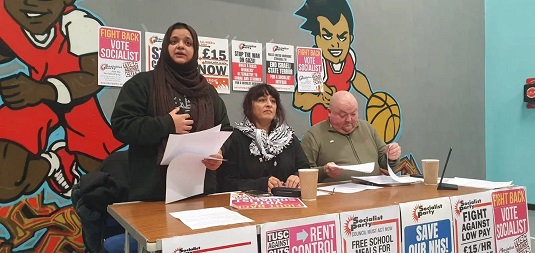
There were some very good results for the organised far left in last week's local elections. But only if you count George Galloway's "Workers' Party" as a left wing organisation. It won four seats in all. In the WPB's new Rochdale stronghold, the party won two seats and 13% of the votes cast across the borough. Leaving aside the very significant issues with the organisation's politics, this could be interpreted as a straight forward protest against British complicity in the massacre of Palestinians. Moving to another stronghold, and I use that term advisedly, the Trade Unionist and Socialist Coalition stood in all the seats in Coventry's council elections. After more than 30 years of standing under a variety of labels, TUSC managed a princely 2% and failed to come close in any seat. The results elsewhere were hardly encouraging. Despite promising to publish its results on social media as they came in, they were so bad TUSC's Twitter feed publicised just two: the five per cent achieved in Blaydon ward in Gateshead, and the (admittedly very good) 32% in Bevois in Southampton. For some reason, presumably an oversight, the other 16 TUSC candidates in the city didn't merit a mention. And it's not hard to see why. It could only manage 1,072 votes between them, and in Coxford - a ward a TUSC-aligned Independent held as recently as 2019 - the coalition came at the bottom of the poll with 43 votes. Or, to you and me, 1.5% of votes cast.

In a lengthy piece in last week's issue of The Socialist, Socialist Party general secretary Hannah Sell regurgitates exactly the same arguments that were put forward when TUSC officially launched 14 years ago. It is "gaining ground" and "TUSC is not a mass party but it is an important lever to fight for steps in that direction." This is pure piffle. For instance, not only does TUSC's vote not improve from one election to another it lost its sole trade union affiliate a couple of years ago. Some progress.

There are three interlinked problems with TUSC. The first is political. Its pitch as doughty defenders of public services is worthy, but completely uninspiring. They say cutback we say fightback is alright for chanting on demonstrations, but does nothing to contest the politics of public service provision. When politicians have talked about the "necessity" of cuts since before the Tories took office in 2010, simply saying "no cuts" and pretending everything would be fine if local authorities launched campaigns to get back the money denied them is, at best, a prospectus for a society in which there are greater generalised levels of class consciousness than there is now. In its absence, the SP and TUSC are doing King Canute cosplay. They do not explain the class politics that lies behind programmes of cuts, despite positioning themselves as the working class opposition to them. And without this, they don't tell a story that punters might find engaging and convincing. For example, one reason why Jeremy Corbyn was successful for a time is he did offer a simple explanation that linked up society's ills. It owed more to moralism than class analysis, but his brand of anti-cuts politics proved much more effective and appealing than the SP/TUSC's economistic fare.

The second is strategic. In all the years the SP and its forerunners have been involved in left regroupment projects, it has fetishised a federal arrangement for participants. It often cites the original Labour Representation Committee to give their stance a principled gloss, but in reality it's about protecting the sanctity and coherence of the SP itself. Over 20 years ago in the Socialist Alliance, it preferred to walk out of the organisation rather than accept majority voting and a membership structure. And now, in TUSC, it reserves the right to stand as Socialist Alternative in seats where they think the opportunities for party building are particularly strong. Needless to say, results show that label doesn't offer any electoral premium over TUSC's. The behave like this because they have a very narrow, Leninist view of themselves. I.e. That they are the revolutionary party, and it's through participation in broader parties and movements that they will grow and, hopefully, overthrow capitalism. With such a millenarian conception of themselves, TUSC, their allies in TUSC, the rest of the labour movement, and so on are but foils for their grand ambitions. In this they don't differ any from the Socialist Workers' Party, the newly minted (and absurdly named) Revolutionary Communist Party, or virtually every other far left organisation that claims some fidelity to Lenin and his works. Where they differ is how they get to become the Bolshevik top dog.

Because TUSC is a means, this flows into its third problem. Because the SP is the revolutionary party, its energy has to be devoted to reproducing itself as a combat party of class conscious militants. This means prioritising the much derided stalls and paper sales, the trade union work where its approach to class politics has, in the past, awarded the SP some profile, and whatever it determines its organisational priorities to be. Putting energy into TUSC dilutes the SP's primary purpose. What this means in practice is TUSC is a useless electoral front that has no real life of its own. And this is a problem if you want to use elections to push an anti-cuts politics. For example, the current surge in support for the Greens to the point where they're in contestation for a handful of parliamentary seats hasn't come from nowhere. It's the result of targeting and campaigning consistently in the same seats over years. For the SP, supposedly the repository of the most advanced theory ever wielded by the working class, this super basic approach to building a profile has passed them by. Either that, or the SP don't want TUSC to grow into anything other than a conveyor belt of one of two recruits per election campaign. Readers can be their own judge.

We've already seen that the pathetic failure of the SP and TUSC to amount to anything has left the floor open to Galloway. Remember, this is not only a party whose ostentatious anti-woke posturing effectively attacks the working class it claims to speak for, it has selected candidates who are antisemitic and anti-Muslim. This will be the face of the extra-Labour left going into the next election, giving the enemies of the labour movement another stick to beat us all with. But everything is not lost for TUSC. It's too late to make a difference between now and the next election, but in the longer term it could profit from the same disaffection with Labour the Greens and Liberal Democrats are poised to do well put of. Provided TUSC dumps its unserious approach to elections. Nadia Ditta's campaign in Southampton did well because it appears she is a community rooted campaigner who has and is likely to continue working her seat. She points to TUSC's future as a viable opposition to Labour. But only if the SP allows it.

Image credit

Sunday, 3 December 2023

Embracing Thatcher?

On this Sunday's Laura Kuenssberg, our eponymous host asked business shadow Jonny Reynolds if Keir Starmer's Telegraph article was "trolling the left". To be fair to Starmer, he wasn't. But the Tory house journal certainly was, with their cover piece appearing under the bannerline "Starmer heaps praise on Thatcher as he woos Conservative voters". Not that the leader's office is going to complain about the framing. They want to give Labour the appearance of responsible right wingery, and the Telegraph have duly obliged.

On the point about Margaret Thatcher, it's a very small sentence. Starmer discusses the stagnation and decline of Tory Britain, and that meaningful change only happens when politics is in alignment with the wishes of the people. A banality some undoubtedly celebrate as a profundity. On the Tories' blessed pin-up, he writes "Margaret Thatcher sought to drag Britain out of its stupor by setting loose our natural entrepreneurialism." And that's it. This is followed up with a couple of tributes to Tony Blair (optimism!) and Clement Attlee (duty and patriotism). But we should contest Starmer's enthusiasm for Thatcher. Her counterrevolution destroyed communities and funnelled billions in state aid (and oil money) into the pockets of the wealthiest. Her attacks on the working class wrecked countless small businesses that helped tie our communities together. And the kind of entrepreneurialism she was most successful in promoting was that of the poorest having to stretch every pound to make ends meet. As if hard knocks, suffering, and misery are worthwhile celebrating. It's especially bad taste doing so when it was not your own lot.

Apart from that, this is the sort of article any Tory leader since 2010 - excepting Liz Truss, perhaps - could have written. The opening paragraph signals where we're going. Among Starmer's brief survey of a broken Britain, he notes "crumbling public services that no longer serve the public". An interesting phrase that buys directly into right wing framing of the state. Everyone can agree that the public sector is on its knees, but suggesting they no longer serve the public recalls Blairist broadsides that public services primarily serve themselves. The old producer vs consumer conflict is never far away and is ready to provide a rationale for more for-profit involvement in running state institutions. Which we have seen in Starmer's invocations of public sector reform as a cure-all, and appointment of Liz Kendall to the DWP shadow brief.

Starmer also goes out of his way to emphasise how changed his party is. The spectre of Jeremy Corbyn is present through his absence, as the article stresses Labour's hard won sensible sensiblism. We listened to those who did not vote for us, writes Starmer, and we have moved toward the voters. Except on issues like nationalising utilities. Or committing to public spending that can fix broken institutions. Or questions of war and peace in Palestine. In other words, Labour are "now ready to deliver" on anything but what public opinion desires. And so we get the tedious reiteration of the "iron-clad fiscal rules", which has "stick to beat us with" written all over them. We also see Starmer keen to play politics with immigration and small boats in the Channel. A bit of a gift considering Rishi Sunak has no intention to address the issue. But because this is Keir Starmer, we see no attempt to move the dial on migration and asylum. The pledge to reverse that Tory policy on allowing business to recuit overseas staff on wages up to 20% lower than the going rate is a welcome one, but also promising to smash "criminal gangs" that facilitate Channel crossings does nothing to address the concerns that exist out there about immigration. Concerns that exist because everyone in front line politics has cultivated and pandered to them. Not least Labour governments of the recent past.

And then we have the final rhetorical flourish. Order. Stability. Security. Protect and preserve. National renewal. The kind of vibe, as recently noted, that used to be the unsolicited advice proferred by this blog during my unfortunate soft left phase. Useful for a Tory-loyal audience, and nothing too worriesome provided one is ignorant of or indifferent to Starmer's authoritarian politics.

Since becoming leader, Starmer has gone out of his way to court The Telegraph. Certainly more so than dwindling mass market tabloids like The Sun and Daily Mail. Therefore, his concern has not been one of chasing Tory votes. Instead this is a strategy of elite reassurance. Only the most dyed-in-the-wool Tory can possibly think Starmer's going to into office, undo the Thatcherite settlement abd squeeze the rich until the pips squeak. With the election in the bag, when Starmer tacks right he absolutely means it. Yes, there might be some progressive-sounding policies. Despite the daft self-imposed rules, there might be more wealth taxes. But in all fundamentals Britain at the start of the 2030s will be little different to the Britain of the early 2020s. The rich will carry on getting richer. The asset price bubble won't be deflated. And absolutely under no circumstances is there going to be a hint of leftism. The political legitimacy of British capitalism requires its B team to step up and protect its interests, and Starmer isn't about to disappoint.

There will be some that think this "audacious" pitch in The Telegraph is a masterstroke, but it only if one's politics is a parlour game, of determining which set of managers get to manage. Should it be Starmer with his nice haircut, or Sunak and his suits and briefcases? But this is not the whole story. Labour's self-fancied boffins and politics understanderers are making the same sorts of assumptions once subscribed to by Blair. That the core support has nowhere to go. Unfortunately for Labour, as the party powers ahead in the polls we are seeing signs of fragmentation among this base - as forecast on here more or less since Starmer became leader. And though it doesn't matter much this side of the election, when Starmer is in Number 10 his lack of a loyal hinterland, apart from only a portion of his own natural base, will cost him and the party dear.

Image Credit

Wednesday, 4 October 2023

The Tory Politics of Cancelling HS2

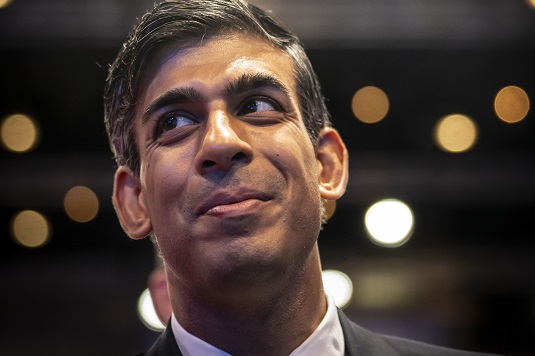
Over the strap line 'Long-term decisions for a brighter future', at the close of his waffling conference speech Rishi Sunak declared that he'd made three mig decisions: the scrapping of HS2 and its replacement by "Network North"; effectively banning smoking by increasing the legal purchase age by a year every year; and announcing the scrapping of A-levels and T-levels and replacing them with the "Advanced British Standard", a new system that will be studied up until the age of 18 - with compulsory English and Maths. Being very much the do-nothing Prime Minister, Sunak has belatedly woken up to the fact that he's got to offer more than wedge issues to stand any hope of re-election. Dressing up as the change candidate as Boris Johnson did four years ago might work if you're a break with what went before, which in some sense Johnson was. But Sunak was not. He was an integral part of that government, and because he oversaw the purse strings its failures are very much his failures. And so he wants to wipe it all away.

Cancelling HS2 was by far the most controversial of his "big decisions". After years of Tory governments stop-starting it, trains from London to Birmingham can expect to glide along sleek, state-of-the-art track in no time at all, before getting shunted onto the dilapidated and delay-prone Brum-Manchester line. I suppose the only saving grace is Stoke-on-Trent won't now have its London service reduced. But, understandably, mayors at both ends of the track are furious. Andy Burnham rightly attacked the decision as the Tories showed, once again, a Westminster-centric disrespect for northern England. When rumours about the axe were circulating, Birmingham's Andy Street said it was tantamount to "cancelling the future". Alas, his anger did not burn bright enough for him to cancel his Tory party membership.

But what about the replacement? Sugar coating the pill, Sunak said the pandemic has meant the nature of work has changed and the business case for HS2 is no longer there. Instead, the monies saved have been promised for "hundreds" of other projects in the North, such as electrifying the Leeds-Hull line, expanding tram networks in several cities, filling potholes in Kent, Suffolk, and Devon (Tory seats now redefined as "the North"), and connecting Manchester's metro to the airport. Which opened in 2014. Should civic leaders in the Midlands and North trust Sunak's promises? Seeing as many projects have got cancelled over the years, and Johnson's talk of levelling up is proven vapourware, anyone believing the Prime Minister's words are probably in the market for a bridge.

This is not just a matter of cost though. Cancelling HS2 and dividing the effort into a series of localised projects destined to become invisible as far as national media is concerned fits everything we know about Sunak's politics. The do-nothing character of his record thus far isn't a personal quirk or a sign of incompetence, it's a strategy geared at lowering expectations. We saw this manifest first in his Jobs Guarantee Scheme (which he singled out in his speech as coming from his conservative values). No sooner was it up and running that he severely limited its scope, refusing to close loopholes for a couple of million self-employed people left without incomes, promoting a pre-vaccine 'return to normal' via the criminally negligent Eat Out to Help Out initiative, and looking to wind furlough down as quickly as he could get away with. Subsequent tensions in the Johnson government, particularly around the failure of levelling up, was part Johnson's lack of interest in detail, and part Sunak's refusing to stump up the money for the government's plans. Saving money was only half of it. The other was to reinforce the view that the state should not be seen doing things, because it raises political expectations. If the state delivers nothing or is bad at providing the services it does offer, the better off will go for private alternatives and people won't make any demands of it. In this sense, Sunak was the right man at the right time for the Tories. Just as the yes campaign in Scotland, Corbynism, Johnson's rash Brexit promises, and the state's temporary nationalisation of the nation's payroll demonstrated the scope and capacity of the state to change things for the better, his time in high office has been devoted to throwing that hope into the trash compactor. Therefore, HS2 never really stood a chance. The arguments about cost overruns and business cases are Sunak's good reasons, but his real reason is a deep seated animosity to the state taking on and completing a huge infrastructure project. Had HS2 continued on his watch, what next? The Eastern leg of the route? More money for rebuilding public buildings? An end to the shuttering of state provided services and, gasp, perhaps the opening of new ones?

HS2 worked against every political instinct Sunak has. Even if it was on course for completion on time and on budget. Therefore, sooner or later, he was always going to come for it. And his speech at Tory conference was as good an occasion as any to announce it.

Image Credit

Wednesday, 16 August 2023

Keir Starmer's Radicalism

Is Labour going to be more radical in office than the image currently projected by Keir Starmer and the shadow cabinet? Yes, if you take this New Statesman headline as good coin. But what counts as radicalism? After all, Tony Blair's period in office, which saw the retrenchment of the Thatcherite settlement under new branding and the continued undermining of Labour's own base was dubbed "radical". Mostly by Blairite loyalists and no one else, but the point remains.

Radical, if it's to mean anything in politics, refers to a break with the status quo. I.e. The conventions, practices, and ideas that dominate the bourgeois mainstream. But anyone can do that. Boris Johnson's contempt for constitutional niceties and probity would, by this definition, cast him as a radical politician. But this was subordinated to a very conservative aim (self-promotion) with equally conservative outcomes: the continued political dominance of the Conservative Party. Radicalism has to do more than upset: it has to fundamentally threaten the power relationships that structure and are upheld by a political settlement, and does so in a way that opens up opportunities for more democracy. Radicalism is a politics that embraces the potentials of the mass, and looks to invite the demos in. It cannot therefore ever be about replacing one ossified elite structure by another. New Labour then? Very obviously not radical. The "gains" of that period of government, where they were not undercut, raised living standards and made life better for millions of people. But it did not alter the fundamentals.

And according to Freddie Hayward, our NS scribe, neither will Starmerism. He says that Labour have opted for a "better managers" strategy, and as such have decided to follow political opinion. Which, in practice, has meant not saying much. But we can look forward to a veritable policy blitz this Autumn as per Starmer's five missions. There are announcements due on net zero, economic growth, and plans to cut violent crime. These are the headline grabbers-to-be, but the real radicalism on offer is virtually cost-free: planning regulations, public sector reform, devolution, collective bargaining.

Are these radical? They are certainly different to what the Tories are offering, as well as Labour pre-Corbyn. The change to planning will allow building on the greenbelt, which would increase housing supply and should contain the rise in prices. Except this is what developers have been lobbying for for years. Reforming the public sector suggests making state services work better and be more responsive, but could easily be the Trojan horse for more private sector involvement and reinscribing the state/citizen relationship as provider/customer. I doubt private health and other outsourcing specialists are bunging shadow ministers because they agree with a radical democratic vision of politics. Devolution will see more powers pushed out of Westminster, but this is more consistent with setting up a new regime of accumulation. And the one unalloyed good, the expansion of collective employment rights and bargaining backed by statute itself owes more to managerial imperatives than an endorsement of workers' self-organisation.

What of the other claim Hayward makes? He says that for all Labour's caution on fiscal matters, "you can already picture [Rachel] Reeves standing at the despatch box, brow furrowed, proclaiming that action is required because the situation is worse than she understood." Can you? This is exceedingly unlikely, because she routinely defers to Bank of England orthodoxy. Be it on the causes of inflation and how it should be dealt with, her understanding of state finances, attitude to social security recipients, and suspicious attitude toward spending money, all come with a whiff of City consensus about them. Just because something is broken and it's necessary to fix it doesn't mean a government will cleave to this necessity. As the lessons of this very Tory government teaches us week in, week out. But supposing Reeves, faced with collapsing public services, does act. The options are borrowing more or taxing more. Closing tax loopholes, equalising capital gains and income tax rates, and upping the higher bands to address the NHS and teacher retention crises would be welcome. Chances are it would be very popular, but it's not radical.

Here's where we get to the nub of the matter. Labourism, apart from the programme the party had between 2015 and 2019, has never been radical. It is an ameliorative project, the political expression of a workers' movement that has long been integrated into the UK's constitutional order. It is circumspect and loyal, and is intellectually impoverished and intellectually elitist at the same time. The shock of Starmerism isn't that it abandoned Labour's radical tradition, but has rather forcibly returned the party to the historical mean. Starmer's politics does not break with Labourism, it's a rude instantiation as authentic to its tradition as any of its predecessors in government. If there is a radicalism here, it's the stark way Starmerism is presenting Labourism's true face to the public's gaze.

Image Credit

Wednesday, 5 July 2023

Tony Blair Vs the NHS

It's the 75th birthday of the NHS, so what better time for another rare intervention from Tony Blair. This morning his institute published a paper about the future of the NHS. In line with current Labour thinking that what public services need is reform, not funds (which, in turn, are informed by Tony Blair Thought of two decades ago), the report offers a number of technical and seemingly technical fixes to improve the health service. But the overall thrust is clear: bureaucratic centralisation is the chief opponent of efficient delivery, not lack of cash.

It shouldn't need saying that this corner of the internet rarely receives Blair's missives with open arms, but it would be churlish to file the report in the desktop recycling bin just because of its provenance. The report, authored by a health policy wonk and an academic, does make some good points. Yes, there does need to be an injection of capital so the NHS can fully utilise new technologies. Who would be against that? The report says this can be utilised to cut waste and introduce less labour intensive treatment. There should be local autonomy for what are termed 'integrated care systems' to treat and improve health outcomes in their areas, backed by the stability of multi-year budgets and incentives to innovate - which include keeping and reinvesting any savings made. A digitised 'Personal Health Account' - a souped-up NHS app enabling access to services and putting patients in charge of their own health data, which can be linked to secondary apps and wearable technology, would revolutionise and personalise our relationship to the NHS. Rolling health services out from GP surgeries and hospitals, which would reduce demand on those services through an expansion of provision is another floated suggestion. And making more use of personal-use genomic medicines, making sequencing available on a mass scale and integrating genetic susceptibilities it into one's personal data is another ambitious goal. If we absent social relationships for a moment, this is what a 21st century health service should look like.

But social relations aren't about to go away, and how the report frames this technologically enabled vision raises a lot of political questions. Firstly, the report says it wants to move the NHS away from a patch-them-up-and-let-them-go model of treatment to one more reflective of complex health needs. This is nothing new. In fact, the first NHS reorganisation in the mid-1970s was premised exactly on these terms. Of moving from treating disease to addressing the long-term health problems of a population that was living longer. Indeed, that is the main business of the NHS today. Therefore, the report's argument that we "must move from a health-care model set up to treat episodic sickness to one that prioritises continuously improving individual and population health" is an extension of what the NHS already does in part to the whole. A useful straw man if you want to exaggerate the case for reform though.

Then there are the rocket boosters these proposals have put under the so-called patient choice agenda. This is not an innocent idea of simply allowing patients more choice in their treatment, but was under Thatcher, Major, and Blair designed to introduce and bed down marketised relationships between different parts of the NHS. In the New Labour years, the idea was to allow patients complete choice of where they were treated. NHS organisations would compete with each other for patients, allegedly driving up standards and increasing efficiency. This was swept away by the Tories in 2012 for thoroughgoing marketisation, semi-privatisation, and outright scamming in which "any willing provider" was in with a shout of scooping up NHS money. What happened over Covid procurement and the missing billions was this writ large. The Blair Institute are proposing is something a bit more subtle. Through the use of personal health technologies, they want to bed down principles of individual responsibility for health - which can be monitored via the app. This builds on the individualist (and individuating) thrust of public health strategies in the Blair years, and one that attempts to evacuate politics from health altogether. I.e. You have the power to choose healthy outcomes informed by constantly updated metrics, and therefore what happens to you is (largely) in your hands. It's consistent with the modes of governance Blair enforced across the public sector, and one that proved (politically) effective quite recently. If you get ill, it's going to either be a case of 'pathogenic life factors' or bad luck. Never air quality, food quality, environmental despoliation, unhealthy work practices.

And then we have the private provider argument, because of course we do. There's the useless argument about "spare capacity" in private health that gets mentioned every five minutes by Wes Streeting. As an aside, Streeting often defends this saying he wants the NHS to get to the place where it can out-compete the private sector. Yeah, right. I'm sure the private health interests funding his operation do so because they want to be put out of business. The Blair Institute goes there, but they flag up more opportunities for private sector involvement. Remember the localised integrated care systems? "Freedom" of ICS chiefs would inevitably mean contracting in for-profit providers to meet targets, just as they did 20 years ago. Indeed, these organisations should "empower" patients to make "informed choices" about choosing between GPs and "secondary providers". On the dispersal of health services, the report is explicit that "high-volume, low complexity" services should routinely be hived off to "multiple providers". Again, it's all about patient choice. The patient data revolution the report envisages allows for more public private partnerships, and larger market for data add-ons to the key NHS app as well as "innovation". Undoubtedly encouraged by a generous system of state grants and inducements.

This, again, carries on where Blair left off in 2007. While there were plenty of New Labour true believers in marketised policies as drivers of best outcomes (the Tories, despite their well earned 'stupid party' monicker, are never daft enough to really believe this twaddle), the politics of this made sense because NHS outsourcing, PPPs, and Private Finance Initiatives tied - at least for a while - sections of British capital to what you might call the Blair Rich Project. By pouring state money into private pockets, this was one means by which New Labour was able to cultivate patronage and crony networks that helped ensure, for a brief window, that it was the favoured party of (most of) capital. It's entirely a matter of coincidence that ex-health ministers and certain MPs later enjoyed handsome consultancies and board positions advising private health and outsourcing giants. It didn't last, and when Labour was dumped out of office the Tories ramped up the openings through the total marketisation of the NHS. Here, the Blair Institute's programme for change is more than just about the future of the NHS. It is directly advising the incoming Labour government about how to use NHS reform to win over a section of British business, with the obvious consequence of diluting the popular pressures that will bear down on the party after such a long period of Tory rule.

Image Credit

Sunday, 30 April 2023

Keir Starmer and Public Sector Reform

The left - the far left in particular - are often criticised for their commitment to certain shibboleths. These can take a variety of forms, such as how China today is some sort of workers' state, that the crisis of our times can be reduced to the problem of proletarian leadership, and that Labour at the height of Jeremy Corbyn's leadership remained a "bourgeois party" no different in quality and kind from the Tories and Liberal Democrats. But the grown-ups of so-called centrism have their own as well. Like believing that beating up your own party wins votes. That defending tuition fees and hospital car parking charges are very good actually. How the NHS could do with more private involvement. Last and, by no means least, public services need one thing more than money: reform.

Which brings us to Keir Starmer's Sunday interview with The Observer. While the headline goes with "I’ll be bolder than Blair on public service reform", not much is given away as the article concentrates on other things. But on public services themselves, Starmer said his government would be a "reforming government ready to go from day one, further than Blair on public services, further than the Tories in the private sector", noting that "“I think we can go beyond what the Blair government did on public services … because I think there is unfinished business there.” That doesn't sound particularly heart warming.

Casting our minds back to the Blair years, it is true to say New Labour did renovate public services, expanded them, and improved them with great wodges of cash. One of the ironies of the early period of the Tory-led Coalition was how many of these services were subsequently defended by leftists who'd spent the previous decade attacking Blair for being no better than a Tory. I was one of these people. But, as ever, the detail is where the Devil resides. Blair accomplished this by forcing public sector bodies to take up costly PFI schemes to refurbish or rebuild their physical infrastructure. There was the imposition of targets and competition between state bodies, a scheme carried over from John Major's Citizen's Charter (more in the book), and the bedding down of "choice" agendas designed to make the public sector more "responsive", as if local community centres were branches of New Look. It still jars with me how local authorities refer to its service users as "customers". Blair's plan was to take this even further with more markets, more outsourcing and privatisation, and more attacks on the people Labour is supposed to represent. And, reportedly, that he wasn't able to see this through was his one regret upon leaving office.

You can see why Starmer's comments on public services are enough to give any labour movement person pause. Mindful of what went on 20 years ago, the Labour leader was quick to add that this did not mean the expansion of private provision but repositioning services so they meet current needs, and with an accent on prevention. Let's pretend we trust Keir Starmer for a moment. It sounds innocuous enough. As is well documented, the Tories have been running public services into the ground. In the NHS, the refusal to pay nurses and junior doctors the market rate for their services has nothing to do with the struggle against inflation and everything to do with their efforts at residualising the health service. Management have been given carte blanche to run down the semi-privatised Royal Mail. Local authorities struggle to deliver statutory services. Dental deserts are common. Even getting a passport these days is a slog. Wanting to make sure these services work properly, as Starmer appears to, is like pushing at an open door. It's a concern that chimes with the experiences of millions of people.

We know what the problem is: the withholding of monies. And quite deliberate it is too. When this is obvious, are we right to be worried that the Labour leader goes on about reform instead of funding? The more credulous Starmerites might think this is more clever-clever politics, or "hard ball" as they call it these days, whereby promising nothing is smart politics because if you don't stand for anything then the Tories will have a problem nailing you down. Good luck with that. Or you might believe in the equally preposterous notion that all the reactionary rubbish pushed by Starmer so far is establishing "permission" to be heard so the bag of goodies he's itching to open won't frighten former Tory voters.

It's better to be realistic about such things. In as far as a coherent Starmerism exists, it's a programme of state modernisation. To be a little bit more sociological, in terms of bourgeois politics it's the collective effort of bureaucrats and technocrats to take the state back from the show boaters, wreckers, and placemen that have run it into the ground over 13 years of Tory government. This is also an authoritarian politics. You don't need to look at Labour's equivocations over spy cops and war crimes legislation, Starmer's approving comments about locking Just Stop Oil protesters up, and the heavy handed way he policies the Labour Party (with extreme hypocritical prejudice) for clues. It's been there in the DNA of his politics all along, and one with deep roots in the Labour and Fabian traditions. I.e. Vote us in, we'll look after the politics, and you only need bother about this stuff in another four or five years' time. The flip side of this is, of course, do as I say not as I do, and treating promises instrumentally. I.e. Sticking to them for as long as the expedience is there.

I have no doubt Starmer wants to reform the state and make it work, and how it plays out in his project involves two things. Subordinating everything to economic growth, which is restated as the driving principle of his government and legitimating essence of everything he does. As per the recent embrace of decentralisation and devolution. And modernising the state also means repositioning the British people. In recent years, too many have become an angry, unruly, and irreverent (elderly) mob motivated by Brexit and other right wing hobby horses. Even worse, more have been actively politicised in the other direction. First Corbynism, and now millions of workers are participating in industrial action of some description, exacerbated by the Tories' abrogation of responsibility and refusal to negotiate. Starmerism wants to put a lid on this by partially re-institutionalising the labour movement in state structures. Second, whatever reform comes forward from Starmer-friendly think tanks and the Fabians' policy pamphlets, finding other ways of gifting state money to business is only secondary. What matters is getting the state running and offering new and improved public services so millions have a stake in it again (which Labour can reap the election benefits of), and so millions more people relate to it as service users. This repairs the authority of state institutions, which have taken a battering, the legitimacy of the state itself, and recasts politics around the Starmerist/Fabian model. In short, it's a depoliticisation strategy. Depleting the state is the Tories' not-very-successful attempt at the same, whereas Starmer's approach - gleaned from everything said and promised so far - is suggestive of a politics marked by redrawing the boundary between lay people and experts, reconstituting a consumerist relationship to state services (perhaps with some funky "co-designing" going on), and letting the technocrats and high foreheads get on with the business of government.

A bit speculative, perhaps, but this is what drives Starmer's preoccupation with public sector reform: the definition of politics and what the limits of acceptable discourse under his government are going to be.

Image Credit

Thursday, 23 February 2023

On "Trusting" Keir Starmer

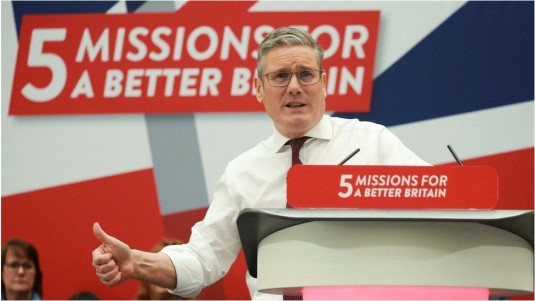
Why undertake one mission when five will do? Speaking in Manchester on Thursday morning, Keir Starmer set out his plan to transform Britain. For a politician not normally associated with excitement and exuberance, by his standards the speech was soaring and ambitious. Imagine a firework display where every rocket, streamer, and fountain explodes in sparkles of grey.

It's long been argued here that "Starmerism" is a project of state modernisation, though unlike his December speech with Gordon Brown this was more philosophical, more about the vibes and contours of his government instead of specifics. His five missions - secure the highest sustained growth in the G7, build an NHS fit for the future, make Britain's streets safe, break down the barriers to opportunity at every stage, make Britain a clean energy superpower - offer a set of themes that will structure his reform programme. Anyone who has sat in corporate planning meetings making plans about plans will be familiar with the approach. Concrete policies and state money will fill in the gaps as the missions are implemented, and progress toward the missions goals will get measured along the way because, as Starmer acknowledged, none of these are quick fixes. Asked about whether it could take longer than one term, Starmer was unapologetic. Long-term thinking underpins long-term stability, and that is what the country is crying out for.

With no policies to shout about, there were some interesting remarks fleshing out what Starmer's government will look like. Having done the authoritarian hard yards on plenty of previous occasions, the talk today was of partnership. Half-inching the "what works" rhetoric from Tony Blair's past speeches, he said state spending - fully costed and accounted for, of course - would be deployed in a way to encourage more private investment. Rather than "doing stuff" to people, Starmer wanted to ensure everyone came along for the journey. That economic rejuvenation of the country's neglected cities and regions won't be top down but involves all residents in all localities. The heavy emphasis was on inclusive growth and making life better for everyone, which at times sounded like a 10 year old one nation vintage disinterred from Ed Miliband's cellar. This sounds like vacuous piffle, and undoubtedly already is written off as such by many comrades.

Given the trust issues surrounding Starmer vis a vis dumping his leadership campaign pledges and the subsequent dreadful treatment of his predecessor, it might be surprising for some that I think Starmer can be trusted to roll out his "missions". Their "vision" speaks to his managerial imagination. Can he therefore be trusted to set about reforming institutions? Yes, especially where it doesn't involve new money. And all the stuff about decentralisation, trade unions, levelling up, and long-term plans for state renovation and improvement? Also yes. Chapters in the next manifesto will appear around the missions, policies listed in them, and the first six months of a Starmer government will be a flag fluttering jamboree of mission statements and policy crusades. But this says nothing about the content. Today, the Labour leader continued his polemic against sticking plaster politics, and pointedly denounced "partnership" schemes with business where they creamed off the profits while the risks and the costs were socialised. I would be more inclined to believe Starmer's genuine intentions here were he not so determined to press ahead with using private services in the NHS. An early test before he's had a whiff of government and already the results are not looking good. Where a policy sounds radical and transformative, like the direction of travel on trade unions, watering down is to be expected.

With Labour so far ahead in the polls, received political wisdom suggests that whatever Starmer says now he will do. There is no electoral compulsion to promise things he has no intention of delivering, especially when the Tories have nothing to offer apart from more misery and scapegoating. But as far as our movement is concerned, history tells us Labour governments have to be pressed from below to make modest improvements. It's never a case of you look after the industrial sphere while we take care of the politics, as per the old Fabian assumption. On this, I can safely guarantee Starmer will be no different. Therefore, Labour are going to disappoint, but that's no reason to be despondent. It's the way of the world and we need to using our rising tide of struggle to prepare for it.

Image Credit