Showing posts with label Derby. Show all posts

Thursday, 15 May 2025

Immaterial Labour, Values, and Voting

Happen to be at a loose end in Derby on Thursday 22nd May?

Why not come to The Quad and listen to me speak about a paper I have in the works. For long time readers, the subject won't come as much of a shock: the talk is called Immaterial Labour, Values, and Voting Behaviour. Here is the blurb.

Phil Burton-Cartledge’s research into the changing character of work and class in the 21st century argues that there are reasons to think the future might be a better place. Phil argues that observations around the values differences between generations, which results in different voting preferences as well as tendency to not vote at all, the emergence of gender splits along attitudinal lines, and the decline of anti-immigrant, racist, sexist, and homophobic prejudices are all part of the same process. In this talk, Phil explains and criticises other approaches offered by political science scholarship that have observed the same phenomena, but offer limited and, at times, contradictory explanations that avoid addressing the significant structural changes capitalism in the West has undergone. In contrast, Phil suggests that analysing these changes in their entirety brings out their political implications – which might mean the present resurgence of extreme right wing authoritarian politics could be its last gasp.

This is at The QUAD at 7pm. It's free but booking is recommended - you can do that here.

The Research Cafe is a monthly event where researchers, activists, academics, artists, and authors talk about their work. If you'd like to sign up for notifications for future events, just drop me a line and I'll get you on the mailing list.

Image Credit

Thursday, 4 July 2024

The Creaking Duopoly

As the get the vote out operations are finishing off knocking up their promises and stuffing letter boxes with voting reminders, it's worth thinking about the character of the general election campaign and what it says about politics in Britain.

Considering how seismic the result will be, the putative scale of Labour's victory and the promise of annihilating the Tories for at least a generation, if you're outside the hurly burly of campaigning and following politics on social media this has been the lowest key election for some time. Probably since 2001. Those around back then will remember that the result was also a foregone conclusion, and it was a low effort affair where the main parties were concerned. Even so, window posters and sign post placards were a common feature of election season. These days, local authorities are precious about their "street furniture" and far fewer people advertise their voting intentions. Just from my experience living in Derby, around where I live and on the route to work I've seen one Labour sign (tucked away down a back road) and one Vote Green board plonked on an arterial route in and out of the city centre. Not even the local Tory councillor or prominent Tory activists have signs on their properties. Similarly, unlike previous elections where the doormat has been buried under small mountains of party literature, it's been conspicuous by its absence this time. We've received every Tory leaflet, two direct mails from Labour, and that's it.

The hack obsession with "cut through" doesn't extend to why the election hasn't cut through. There are, of course, long-term reasons that trouble most liberal democracies. And it's also true that the main parties almost collaborate over what the salient issues are going to be. This election is no different. The pollsters show that the cost of living crisis and the NHS are right at the top of people's concerns, with immigration coming a distant third. But you wouldn't know that from the dreary debates and the press coverage. Except this time, a certain weariness has set in. People worried about how to pay their bills, or fed up with the 8am rush for emergency GP appointments are not hearing any solutions to the problems that make everyday life difficult, if not an ordeal. Renters are hearing nothing about housing. Disabled people nothing about making life easier. Parents worried about cuts at their kids' schools, people of all ages despairing at the dearth of mental health support, the hope of action on climate change, the collapsing transport infrastructure, climate change, and the outright indifference/support of Israel's massacre of the Palestinians. The conspiracy of silence about these issues have turned millions of people off.

As such, both the mainstream parties have run awful campaigns. The Conservative campaign has proven far worse than Theresa May's ever did in 2017. Not even John Major's doomed effort in 1997 plumbed the depths of Rishi Sunak's incompetence. What the Tories needed was something that could have changed the course of the campaign and ceded them the initiative. They thought they had this with their stupid conscription scheme, but in a campaign where even the base of mass conservatism is feeling the pinch, attacks on young people were not going to convince. Especially when Nigel Farage's posh bloke authenticity is a more convincing repository for punters who are motivated by spite and fear. But there was almost a master stroke at the beginning of their campaign. The Sun excitedly announced that under the Tories, pensioners could look forward to an extra £2,000/year. This was how they chose to announce Sunak's promise to raise the tax threshold so the state pension didn't fall into it, which led to some weak attacks against Labour's plans to impose a "pensions' tax". And this £2k was cumulative up to 2030. If instead they'd gone for an uncomplicated £2k uplift, politically it would have been a big hit. Probably stemming the bleed in Reform's direction and forcing Labour onto the back foot, maybe even inducing Keir Starmer and Rachel Reeves to attack it from the right. No, it wouldn't have fit the fiscal framework both main parties are abiding by, but Sunak wouldn't have to implement it anyway. An opportunity to salvage a few dozen more seats, lost.

Labour's has been a weird twin track campaign. The leadership have tried dampening expectations and have pushed messages about not being complacent. And to be fair to teams on the ground, in the main candidates haven't been. Fewer bodies than 2019 has meant longer sessions and harder work. Again, locally here in Derby North, given the hard yards she's put in for a couple of years no one could accuse Labour's Catherine Atkinson for treating the election as a foregone conclusion. Judging by the spread of social media reports, the same has been true nearly everywhere. That, however, cannot be said for Starmer and co. Despite their warnings, this has been the most complacent campaign run by Labour since 2005. Not just because of its thin manifesto, assuming anti-Tory voters will back Labour come what may, but because of its faux pas. No one forced the Labour right to chance their arm at purging candidates in full public view. Or openly admitting to lying for factional reasons. Or singling out Bangladeshis as the sorts of refugees they should be deported. These were th actions of a party unconcerned about their electoral consequences, and were took place under zero pressure from the media, are contributing toward the decomposition of Labour's base which will be increasingly felt over the course of their first term, and also suggest they will come to grief when the media does turn the heat up on their government.

This election then has almost entirely been defined by the duopoly domination of British politics. Reform were covered because its campaign plays direct into their use of immigration as displacement activity. The daft stunts by Ed Davey to try and get the Liberal Democrats noticed, particularly their emphasis around fixing social care, and the strong challenge of the Greens and the stress on climate change has bounced off the shielding Labour and the Tories have built to shelter themselves. How long this will last after the election with a severely weakened Tory party and leading Labour figures taking to their ministerial motors, no one yet knows. But also with a press in long-term decline and their ability to set the agenda going with it, the narrowness that typically defines British politics might be about to get wrenched open.

Wednesday, 12 June 2024

Foucault at Derby

Doing anything on Wednesday 19th June? Interested in Michel Foucault and his works? The University of Derby is hosting a day conference to honour him almost 40 years to the day after his untimely death. More information is available here.

I'll be presenting something too, so I'm unlikely to surface from the Foucault mines this weekend. This is what my paper is on.

Retro Foucault, Our Contemporary? Revisiting The Subject and Power Afterword at a Time of Desubjectivation Crisis

The contemporary reception of Foucault as a theorist governance has proven extremely influential at explaining how Western governments have reshaped their institutions to encourage the formation of neoliberal subjectivities. However, with falling living standards, stagnant wages, and restricted housing supply, the offer of social mobility and material abundance that has worked as the carrot to the neoliberal stick of surveillance and punitive measures suggests the assemblage supporting this form of governance is breaking down. This is not a crisis of the passage from logics of discipline to logics of control (Deleuze 1992), but a more fundamental problem of desubjectivation. That is, a withering away of relations and motivations that provide neoliberal capitalism everyday legitimacy and justification, with more reliance on mechanisms of “machinic enslavement” (Lazzarato 2014). In Britain, the likely election of a government that defines itself in relation to an ethic of public service, has a programme of refurbishing institutions of state, and has the ambition to restore their authority, will have to face up to this problem. At the time of writing, the Labour Opposition’s discourse on social security and the centrality of employment suggests they do not recognise the challenge or are relying on the need to work – one machinic compulsion among many that Lazzarato identifies – to maintain the order necessary for their project. In parallel with this, Labour has emphasised its support for authoritarian state institutions, has ostentatiously dressed itself up in national colours, has flirted with socially conservative positions, regularly invokes ‘security’ as a theme, and has presided over an authoritarian internal party regime, which likely indicates its policy approach to domestic questions and law and order.

This is where the “old” Foucault of the microphysics of power might prove useful. By returning to his famous afterword, The Subject and Power, in Dreyfus and Rabinow (1982), we find a useful toolkit for analysing political efforts that either found post-neoliberal forms of subjectivation or co-opt other subjectivities that have grown up in resistance to neoliberal governance to patch up/maintain prevailing assemblages of extraction, exploitation, and control. As Labour is offering a state-centred political project, Foucault’s sketches of pastoral power and attacks on forms of individualism congenial to the operation of state institutions, his analytical separation of power from linguistics and sign systems, understanding as power as action on action, the constitution of “others”, and the how points of agonism and tension are incorporated into dominant modes of governance, as well as Foucault’s five methodological points for analysing power so we can make sense of what Negri (2017, p.161) calls a circulation of “command, exclusion and violence” are essential points of departure for analysing and anticipating what is likely to come. While accepting Deleuze’s (and Foucault’s!) argument that disciplinary techniques and logics are obsolete in the absence of a regime of control, a politics of re-founding and re-emphasising the state as the official centre of social life makes a return to the crude technologies of power more likely.

Image Credit

Monday, 15 May 2023

Conservatism at Derby Literary Festival

How are you fixed for Thursday 25th May between the hours of 10.30 and 11.30am? If you are at a loose end and happen to be in or around Derby, I am speaking at Derby Literary Festival. What about? This image might provide a clue:


I'll be discussing the thesis of my book with a focus on the new material about to be published in the paperback edition, now titled (in case you missed it) The Party's Over: The Rise and Fall of Conservatism from Thatcher to Sunak.

The talk will be taking place at the aforementioned time at the Artcore gallery, Osnabbruck Square, Derby, DE1 2DS. Entry is free BUT the organisers require you book a free ticket beforehand. They are available here.

Sunday, 7 May 2023

Derby Politics after the Elections

Local elections happened in Derby as well, so I'm going to break habit and write on something I know nothing about. Going into the city's first all-out elections, the Tories have occupied the driving seat in a de facto coalition with the Liberal Democrats and Reform UK. Following Thursday and in line with the national trend, Labour surged ahead with 23 seats (up six) and the Tories fell four to 15. With 26 being the magic number and the rest of the chamber comprising Reform (six), Liberal Democrats (four), and independents (three), Labour should have an easier time of making Sinfin's Baggy Shanker the Council Leader than the Tories have holding on. But this is local politics, and 'should' is never will. The results of council wheeling-and-a-dealing will be known this week.

There are a few things politics-wise I've got to get to grips with yet, such as why Alvaston - a white working class district in the south of the city - returned a full roster of Reform candidates in its two wards when other similar seats proved resistant to the "party's" charms. And why Chaddesden, another not altogether demographically dissimilar estate in the north were saddled with Tory councillors until Labour took them back on Thursday. All things to look forward to finding more out about, and if anyone wants to enlighten me in the comments or over coffee then please be my guest.

Labour had been campaigning hard, but there is a small lesson from the ward I now reside in - Mackworth and New Zealand. On Wednesday, it had one Labour, one Tory, and one (ex-Labour) independent. Come Friday morning, Labour retained both the seats but the Tories topped the poll. Again, predominantly white working class but with a mix of council and housing association-owned homes (39%), owner occupied (42%), and privately rented (16%). Plenty of pensioners as well (27%), and so the vote result mix shouldn't come as much of a surprise. Which explains why the two other Tory candidates put in strong showings as well. But the Tories did have an advantage: a highly visible councillor.

Readers might recall one of the reasons the Tories did unexpectedly well in 2015 was because of their Facebook efforts. Not just targeted advertisements, but the fact many Tory councillors had set up Facebook groups that put the party's name to a local face. As a general rule, these would be of the pothole-filling and fly tipping-clearing sort, but give those who founded the group an opportunity to build name recognition and a reputation for community work in the hope this would translate into votes. These groups would often have thousands of members and, because they were administered by either a councillor or a trusted Tory, political rivals often didn't get a look-in. Winding forward to 2022 and while we were buying the new house, we clocked We Love Mackworth, Morley, and New Zealand and encountered Gaurav Pandey, the local Tory councillor. With a membership of 4,300 members, his mercurial activities will have been noticed by nearly everyone on the estate. If there was a problem, Guarav would fix it. Day or night he was absolutely on it, and his fellow Tory candidates were never far away from the camera when he was out and about doing his good works. He cultivated the persona of an almost apolitical community champion, and appeared genuinely shocked that while his hard work paid off for him his fellow Tories lost out to Labour's Ndukwe Onuoha and John Whitby.

Undoubtedly, the likes of Cllr Pandey will carry on fixing parking bollards and documenting it on their Facebook groups and pages. And that will translate into votes and council seats down the line. Which reiterates the need for Labour councillors wherever they are to root themselves in their communities, and not rely on regular voter ID sweeps for "contacts" and "conversations".

Turning to the wider Derby council result, as per Stoke-on-Trent the results are encouraging for the general election. Derby South is likely to remain Labour, and on paper the boundary changes for Derby North make it a surer proposition for Labour with the hiving off of Oakwood and Allestree - pretty solid Tory wards - into neighbouring constituencies. As a swing seat historically, the good news for Labour is its candidate Catherine Atkinson is all over the constituency and featured prominently in local election literature and social media content. Sitting Tory MP Amanda Solloway who, as it happens, I saw near my house on polling day while nipping out for a cream cake, was nowhere near her party's council leaflets. Though a sheet got posted through at the beginning of the campaign that credited "Amanda" for everything from photosynthesis to the discovery of special relativity.

Things are looking good for Labour in Derby. There are some serious messes left by the Tories that need cleaning up, with nurseries and libraries facing closure, issues with the arms-length body that manages the city's council housing, and questions over the financing of the flagship Becketwell regeneration scheme. If Labour can undo the damage while remaining transparent and begin offering a new way of doing things that brings the city with them, then there's no reason to believe why its leadership can't be successful and that both constituencies won't return Labour MPs. The ball is in the party's court.

Image Credit

Tuesday, 28 March 2023

Hello Derbados

From the pearl of North Staffordshire to the South Derbyshire riviera!

Saturday, 27 April 2019

Remembering Simon Speck

My friend and colleague Simon Speck passed away on the 19th after a short illness. Finding words to describe the shock and accompanying numbness is difficult. It still hasn't properly sunk in.

I first met Simon at my Derby job interview - he was one of the panellists. Little did I then know we would be spending the next couple of years cooped up in a cramped three-person office. And in such surrounds, you can't fail to get to know someone well. He would talk with pride about his footy-mad daughter, Melitta, while offering caustic observations about the mums and dads who would bawl at their girls from the touchline. I'd get stories about his time in public school where he would labour under the watchful eye of a Lenin poster, revel in a reputation for being a red, and also how he developed his talents as a mimic and cartoonist to ward off the attentions of the bullies. As a boy hailing from the labour aristocracy - his words to describe his dad's itinerant oil worker/engineer job - such comparatively humble origins might have otherwise singled him out, were it not for his wit and ability to make people laugh.

When it came to matters of sociology, he could broadly be described as the department's theoretician. He ran the heavy duty social theory modules, which betrayed, how shall we say, a broad Germanic flavour. As one of Gillian Rose's PhD students, who supervised his dissertation on Hegel and Derrida, his thought was deeply immersed in the Frankfurt School and especially Adorno. His other main intellectual influence was Anna, who he spoke of frequently, and through her he had a serendipitous link to the critical culture he revered. She was born into the West German New Left, and her family participated in the rebellions of the late 1960s, the formation of the Green Party, and debates with key post-war intellectual figures, including Jurgen Habermas. It was no accident then that when, in recent years, the university gave us fully-funded "teaching and learning" trips overseas for third year students, Simon was in charge and Germany was the inevitable destination. The photo above, for instance, is from the first such outing abroad and where Simon taught the students that the hard drinking you pick up in your younger years is never a skill you entirely relinquish.

Steeped in critical theory, his chief intellectual influences, along with Adorno, were Hannah Arendt and Ulrich Beck, the theorist of the risk society. As such, he certainly retained the pessimism of the first two, but this was not the dour miserablism you typically associate with Adorno. Indeed, he had a certain fondness for Bertolt Brecht, whose own impish humour was often channelled in a wry Simon observation. Resistance therefore wasn't always futile, but it would nearly always throw up absurd, comedic results. Indeed, one of his favourite stories concerned his own spell of resistance in the mid-1980s. On a miners' picket line, he oft told in excruciating, nay eye watering detail how a copper grabbed his ghoulies and squeezed them really hard during a spell of argy bargy. Of all the methods of physical assault Simon could have experienced - a baton charge, a clip over the head, a roughing up in the back of a van - he of all people had to fall victim to the most schoolyardish of police brutalities.

Simon was especially interested in the nascent sociology of humour, and ran a successful third year Humour and Society module. Plenty of people have noted that what a society finds funny says a great deal about it, and also how the role of comedians have changed from bearing witness to political actors in their own right - see Ukraine's Volodymir Zelensky, Bepe Grillo in Italy, and to a lesser extent, Russell Brand. Simon was interested in taking this further to investigate how risk and reflexive modernity - the notion advanced societies have an unprecedented capacity to know themselves (but frequently eschew it) - inflect and inform contemporary forms of humour. For instance, he was fascinated by the British custom that everything has to be a laugh. Politics couldn't be too serious, weighty and grave matters were not for everyday conversation, and that even staring down the barrel of disaster one had to face the inevitable with a smile on your face and laughter on your lips. Why? Unfortunately, I haven't yet read his paper so will have to see how his framework can go about answering this question.

Given his intellectual roots, you might expect him to not have much time for authority. And you would be right. Simon detested managerialism, its cynicism, and its happy clappy adaptation of universities to the marketisation of higher education. Teaching and academia were very much his vocation, while the oft unnecessary bullshit accompanying it was something to be endured. I know he felt a great deal of relief when programme leadership was passed from him to me. Indeed, during the job interview I mentioned my (relative) competence as an administrator which got a "did you hear that, Simon?" from someone around the table. Sadly, his warnings that one might wake up at night with a student's name playing on your mind has proven correct on more than one occasion. Yet he was second to none in caring for the students. He wanted to make social theory intelligible in the hope they too would inhabit it and use it to critique the world, rather than a means of passing a few credits on the road to graduation. Judging by the tributes received from former students on the Derby Sociology Facebook group, he certainly had a big, and deeply appreciated impact on many.

Sociology at Derby is a small team, and we are missing Simon. We will never stop missing him. Our best tribute is to try and live up to the standards he expected of himself as a teacher and a scholar. This way he will always be with us. Andrew Wilson, the member of the Sociology dept who knew him the longest has set up this memorial for Simon. If you knew Simon please leave a contribution.

My love and sympathies to Simon's family, especially Anna and Melitta.

Thursday, 3 January 2019

Trash Talking the Tories

Back in September, yours truly was privileged enough to speak at the Derby Transformed event. This is the audio of the rally at the end featuring Chris Williamson, Derby City Labour Group leader Lisa Eldret, Lauren Mitchell, a Labour councillor in Hucknall in Ashfield, Paul Mason and, um, me. Please find below the recording - I start sounding off at 44.50. Also, keep an eye out for further recordings from the day on Derby Social Club's Soundcloud page.

Monday, 27 August 2018

Come to Derby Transformed

All the best politics events are in London, aren't they? WRONG. Well known activists, journalists, and trade unionists have been brought together by Chris Williamson's office for a day of discussion and debate in Derby city centre. Derby Transformed is taking place Saturday 1st September at St Peter's Church. The event is free but ticketed. Solidarity prices, of course, apply. You can book yourselves in here and see the day's programme here (you'll need to be logged into Facebook to see it).

There are sessions on trade union history, men and #metoo, media bias, challenges for the Midlands, Corbynomics, Corbynism and conspiracy, why Jeremy Corbyn is a marmite politician, how to combat the rising tide of racism, drugs, local government, and transforming Derby and beyond. There is plenty of time for discussion and no doubt a few will veer off piste, as it were.

Guests include Paul Mason | Grace Blakely | Ash Sarkar | Alex Nunns | Liam Young | Maya Goodfellow | Richard Seymour | Cheryl Pidgeon | Chris Williamson | Margaret Beckett | Lisa Eldret | Emily Owen | Cecile Wright | Simon Hannah | Phil Burton-Cartledge | Nikki Dancey | Sarah Russell | Wendy Liu | Tom Mills | Mathew Brown | Nahella Ashraf | Lauren Mitchell | Steve Battlemuch | Anne Western | Greg Marshall | Ann Pettifor | Vox Feminarum + many more, including workshops led by local activists!

After a hard day's debate, comrades are invited to the Maypole in the evening for a pub quiz hosted by the good folks of Novara Media.

Do come along. And if you see me, say hello!

Saturday, 20 January 2018

Tory Cynicism: A Stoke-on-Trent Case Study

On Twitter a few weeks back, Cllr Dan Jellyman, cabinet cloak room attendant on Stoke-on-Trent City Council invited me to sign a petition pushed by fellow Tory councillor and MP for Stoke South, Jack Brereton. The issue concerns the hourly train service that runs from Crewe to Derby. This also happens to be the train I have the pleasure of commuting to work on nearly every day. The problem with the service is not punctuality (which is nearly always good) but the quality of the stock. More often than not the heating is broken or doesn't work properly, and leaky windows are a persistent annoyance - we're talking torrents here, not the odd drop. However, by far the most egregious problem are the number of carriages. 80% of the time we make do with a single coach. If you can visualise a carriage trundling along the railway you have accurately captured what the service is. Sometimes it's not too bad, but at rush hour it is and if Uttoxeter races are on and the company - East Midlands Trains - have forgot to lay on extra, you're talking dangerous overcrowding.

I'm sure any MP would want to see something done if this was the case in their constituency. As a new honourable member, Jack has taken up an issue the hundreds of people who use the route every day are annoyed about. Nevertheless I turned down Cllr Jellyman's request I lend my signature to Jack's petition, and that wasn't because it was being pushed by a Tory MP. It's because things are about to change.

Derby train station has started a long overdue remodelling of the lines running in and out. Presently there are bottle necks at both ends that limits the station to the entrance of two trains at each end at any given time, which is a bit of a pain when you consider there are six platforms. It can mean a delay to one service often has major knock-on effect on others, and as far as my train is concerned about half the time we have to pull up and wait outside the station for another service to clear the points. By the end of the summer this will be cleared, meaning a cut down in delays as trains no longer have to criss-cross the lines. Also, according to a number of rail workers of my acquaintance, the Crewe-Derby service is due a revamp with extra rolling stock added to it, and the roll out for this is scheduled for around the time the Derby work is completed.

Which brings us back to Jack's petition. He's had coverage on local radio and the local press, and has got the backing of Chris Grayling. Yet it's all a complete waste of time because the extra carriages he is petitioning for are happening anyway.

This begs a couple of questions. Is Jack ignorant of the changes to the service, which is worrying considering his old portfolio at the City Council covered transport. Or are we talking about a cynical stunt in which a song and dance now can be built up into a famous victory party later when the rolling stock is increased? Are we seeing ignorance or cynicism? I'll leave you to be the judge.

Tuesday, 6 June 2017

Campaigning in Derby North


Thought I'd make myself super useful last Saturday and head to my nearest ultra-marginal, which happens to be Derby North (coincidentally, I work there too). Readers may recall this was unexpectedly snatched from Labour by a cruel 41 votes, and Parliament lost Chris Williamson, bête noire to rightwingers (and Masters of Hounds) everywhere. This time, the Greens - who polled 1,300 votes last time - are not standing so everything is up for grabs. If most of those voters simply switched to Labour, we'll romp home. But as politics is politics nothing is so simple. The collapse of UKIP as an electoral force is disproportionately favouring the Tories in the polls, even though they are standing a candidate in the constituency. And, it's worth noting, from our experience in Stoke a lot of what was a protest vote is returning to Labour. Could that happen in Derby North? It's very difficult to say. It's close.

Anyway, there I was with 120 or so other volunteers ready for a mass canvas of the constituency. I was paired up with Paul and Dave who'd also travelled in from outside the area and, with board in hand, off we were packed to do our round. Our destination was Darley Abbey, which is well known in Derby as the main "rich area". Huddled in a patch of greenery that stretches around the Derwent, we were in the bit that was built around the mid 1980s where the average house price weighs in at the £450k bracket. Tidy. We spent a couple of hours knocking on doors and trying to avoid the sun burn, but apart from a caught neck there were two things that stood out.

First was the novelty of working such an area. I've campaigned in safe Labour seats and marginals, but never what you would describe as safe Tory areas in either. Seeing consistent records of Tory support for a lot of voters was an entirely new experience. We also spotted a sign for Amanda Solloway, their candidate and incumbent, in one of the gardens - a Tory sign in a city is not something you see everyday. There was also a Labour poster up in one window, unfortunately tucked away down a cul-de-sac where approximately two neighbours and the postie will see it. Also, those Tory voters were pretty much staying Tory - not that their past records showed much movement. We did find some Labour voters on the round, including two switches from 2015, but definitely not the most fertile patches in the city for us.

The second problem, and a salutary lesson for any Labour supporter tempted to sack the polling station off for Jeremy Kyle, the pub, or whatevs, is this. Every Tory voter, every one who clearly weren't voting for us, every won't say had either posted their vote or were definitely turning out on Thursday. I have never done a round before where we didn't encounter a single non-voter. What does that tell you? It indicates that the better off, those who feel they have a wee bit to lose (despite the dementia tax and other idiocies) will turn out to cast their ballots for the party they feel best defends their interests. Meanwhile, and every comrade who came to the Stoke Central by-election knows this, those people who need a Labour government to take the pressure off their lives, who would materially benefit from a changing of the guard are those least likely to vote to further their interests.

As we know, the wildly variant figures reported by the pollsters hinge on turnout. We're playing a mobilisation game, and here the Tories have an advantage as their core support - the better off, a majority of older voters - are much more likely to vote. Luckily, because the party is a ridiculous size, a veritable mobilising machine, and there has been a shifting politicisation of the young in Labour's direction, there is a possibility that the nice Conservative voters of Darley Abbey will be matched vote for vote for a change, and then some.

Tuesday, 28 March 2017

The Impossibility of Satire?

Yours truly was at the last Sociology Research Seminar Series at the University of Derby. On this occasion our speak was Simon Speck, also of Derby. His paper, 'The Cynical Image: The Critical Potential of the Political Cartoon in the Age of Self-Satirising Authority' took a look at how the powerful have absorbed the bite of satire and transformed it into something that helps legitimise them, and whether using humour to attack those interests was still possible. This was explored this through the medium of political cartoons.

He argued that satire takes the powerful as its target, and locates humour in the contrast between the lofty ideals they espouse and their often grubby practice. In this sense, satire is close to the immanent critique often associated with the Frankfurt School/critical theory, of the practice of confronting something with its foundational principles. For example, the controversial Jyllands-Posten Muhammad cartoons send up the piety of Islamists by forcefully contrasting their sacred pretensions (Jihad motivated by the glory of God) with the profane (Heaven stuffed full of virgins).

In liberal democracies, however, satire has become incorporated, and in few places more so than the UK. The cutting Supermac cartoon by Vicky for the Evening Standard in the late 50s, early 60s sent up Harold Macmillan. They set out by taking the mick, but over time the demeaning caricature came to be a nickname and latterly the title of a MacMillan biography. And so the satirical monicker was incorporated into an appreciation of him, and the humour attached to it a sign of his sacralisation into the hall of the political establishment, of having made it. Similarly, former Tory education secretary Kenneth Baker, who on Spitting Image was regularly portrayed as a slug thanks to his slimy reputation, managed to recuperate the attack by noting how, as a self-described historian of satirical cartoons, his depiction was part of one of the fine traditions of British democracy.

The logical end of this incorporation is someone like Boris Johnson, who has astutely and assiduously built up a self-mocking, self-satirising image. He was quick to realise, helped in part by regular Have I Got News For You appearances, including four stints as the host, that not only does it raise his profile but the laughter directed by him and at him could be harnessed to confer legitimacy. Hence Johnson was once regularly referred to as the most popular/most recognisable politician in Britain, purely because he was a bit of an oaf. He exploited it to the hilt during his campaign for the London mayoralty, and drew deep once again during the EU referendum campaign. Like many other MPs, liking a joke and being able to laugh at yourself shows up your human side, it papers over power and interest by showing how "down to earth" they are. Johnson, however, took it a step further. His false bonhomie, which is entirely tedious for some, has another happy - for him - consequence: he can use it to evade criticism, and often "humorously" did so when he was in office. Satire then not only flatters, it can make careers.

In these conditions, following Sloterdijk's Critique of Cynical Reason, with the disappearance of political alternatives to the status quo, the more cynical society become about itself. This, for Simon, is also the lot of satire now. The spreading of cynical sensibilities means that satirical critique is marketable and feeds into open irony. Vicky's Supermac attack was an ironic attack on Macmillan as a blundering fool. In the 21st century, Johnson contrives to be a blundering fool.

Does this mean satire is now impossible? Not necessarily. Exploring Sloterdijk's use of ancient Greek understandings of satire, of kynicism as opposed to cynicism. This was an underdog perspective that set itself against dogmatism, abstraction, and the theoretical while celebrating the disinhibited, the embodied, the gestural, the shameless, and the animal. It has an insubordinate, profaning impulse that made the Greek authorities of the day uncomfortable?

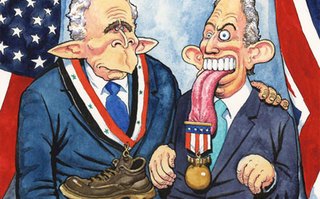
In the realm of political cartoons, for Simon there is a cartoonist working with this sensibility: Steve Bell. His cartoons are able to avoid the kinds of incorporation suffered by Vicky because he eschews tradition (particularly the liberal tradition, despite most of his work appearing in a liberal paper, and established ways of doing political cartooning), but more importantly his depictions are viscerally materialist and shameless. Physiques are blown up and caricatured in grotesque ways, eyes constantly wander and possess a crazed look, bad language is a staple, and he merges the animal, the inhuman, the synthetic and, in Dave's case, the prophylactic. It's difficult to see Osborne finding flattery in his rendering as a ring-nosed gimp, or May her depiction as a scrawny clown, Bush jr as a simian, nor Blair as an unhinged grin-agog. This aesthetic doesn't make any grand statements or pay tribute to a tradition curated by the likes of Kenneth Baker, but captures the ground ceded by satire in the age of cynicism and ironic incorporation.

Is satire possible? Yes, it would appear. But only by abandoning tradition and getting visceral can it regain its bite.

Tuesday, 16 August 2016

Jeremy Corbyn in Derby

12pm on a Tuesday in the middle of August perhaps isn't the best time ever to hold a rally, but the odd scheduling did nothing to depress turnout at Jeremy Corbyn's rally in Derby city centre earlier today. I'd say between 500-600 assembled in the summer sun to listen to what the Labour leader had to say, as well as a few others. Again, like last year's rally at the Roundhouse the former Derby North MP Chris Williamson oversaw proceedings.

If you've seen or heard a Jeremy Corbyn speech before, there isn't a great deal to tell. We too often think of the orator as a demagogue, but Jeremy's presentation is as far away from this as possible. His style consists of listing a series of problems and posing a number of solutions. It doesn't require much in the way of theatre nor the raising or lowering of the voice. And herein lies his appeal. As Chris rightly observed in his introduction, the people who label Corbyn's support as a cult don't understand or begin to address the causes of his popularity. The "secret" is he speaks up for an alternative politics that has equality, justice, and the good life at its heart. Jeremy says what was pretty much unsayable in politics for the last 30 years and it's refreshing to hear. For those entirely new this is the first time in their lives socialist ideas have gained any prominence. Jeremy's not-ranty and reasonable style works because these views are plainly stated. They require no spin.

That said, I would offer a couple of comradely criticism's of Jez's speech this lunchtime because, you know, I address rallies of hundreds and thousands regularly too. Firstly, his events are lefty rallies but he shouldn't assume everyone is conversant with the lingo and know what our movement's multiple acronyms mean. For instance, you and I know who the RMT are, but do the few students I spotted from my degree programme? Just prefacing it with something like "the railworkers' union, the RMT ..." might help cut through the blizzard of big letters. The other thing is I'd like to see Jeremy say more things about the party and trade unions. Hold on a minute, isn't that pretty much all he talks about? It's one thing to talk about the good works our unions do, and how we have the largest political party in Europe, but for us to succeed and win we've got to keep piling up the members. The vast bulk of today's audience weren't in the party, and I'd wager a good chunk aren't in a union either. Jeremy absolutely must use his platform to encourage/invite/cajole the crowds to join and join now.

The most interesting thing about today's rally, however, was the crowd. I've been around the block and lost count of the demonstrations, rallies, and other labour movement gatherings I've been on. But what they all had in common, regardless of size, militancy, and politics is their composition: they were all blessed with an over-preponderance of middle-aged men. It was nothing like this earlier. Young and old, women and men, disabled people, mums and dads with prams and pushchairs, it was easily the most mixed political crowd I've been in - even better than last year's Jeremy event. And from the standpoint of what rallies do, and the health of our movement, this is a good thing.

Overall, a job well done. A tired old cynic is what I am, but today I got a sense of the hope more enthusiastic Corbyn supporters feel. And when was that the last time a factor in our politics?

Monday, 7 March 2016

Understanding Roma in the Criminal Justice System

Does the English criminal justice system discriminate against the Roma? Well, of course it does, would be the right-on answer. Haven't years of experience with the police, the courts, the prisons shown us that the whole thing is institutionally, irredeemably racist? As with most things once you scratch the happy official reality and dig a bit deeper than most radical critiques one finds a messy, complex situation that requires nuance and a bit of tact to address. At the first University of Derby Sociology Research Seminar Series last Wednesday, Phil Henry took us on a guide of this difficult terrain in his paper, 'Deviance and difference, stereotypes and stigma: pathogising Roma within the criminal justice system in the UK, what evidence do we have?'.

As well as being a member of the Sociology department, Phil doubles up as the director of the university's Multi Faith Centre where he and his colleagues are engaged in several outreach projects, and that includes supporting young people from the (primarily Slovak) cohort of Roma who arrived in Derby after 2004. His way in to exploring how this community is disadvantaged and has its young people up before the courts in disproportionate numbers proceeds via some elementary and widely-applied sociological concepts. Is it the case that a moral panic surrounds the Roma which stigmatises and labels them, in turn compounding the magnitude of the panic and driving a criminal justice response, or is something else happening?

Drawing on the classic study by Stanley Cohen, a moral panic is an exaggerated social action attributable to a social group that is amplified (if not stoked by) the media and certain political concerns. Each panic seeks to construct a folk devil on which a panic can ultimately be hung, re-hung, and hung again for good measure. Longtime readers/observers of the right wing press in this country will certainly have an idea of which groups have received this treatment over the years.

In many ways, the Roma are the perfect set of folk devils, which is fed by centuries of antipathy toward Gypsies and travellers. The Roma also bring with them associations formed in Eastern Europe and reinforced by non-Roma migrant workers who've also settled here. These tend to be associated with littering, overcrowding, loitering in public, anti-social behaviour, lack of parental supervision, and petty crime. Phil also observed that Roma, or at least those living in Derby, tend to live in relative isolation marked both by very close proximity and communal living. 3,500 (approximately) are clustered in three wards in the south of the city. Furthermore, some community practices such as kids having a freer reign, and more problematic ones such as marriage-at-16 tend to reinforce separation from the host society.

Erving Goffman's Stigma, is useful for thinking through some of these issues. Goffman understands stigma as a socially attributed status disqualifying people caught up in it from full acceptance. In the UK context, Phil noted that certain cultural mores might contribute to stigmatisation in the eyes of the host community. Firstly, however, it was important to note the Roma do not see themselves as stigmatised. Most important are "internal" dynamics of shame and honour, and anything belonging to the outside is just that - they pay second fiddle to what you might call their own specific forms of symbolic and social capital. It followed that tensions between these structures and the conventions and law of the wider society are bound to happen. As Phil illustrated by anecdote, Roma youth tend not to take encounters with the police too seriously as here they tend to get cautioned and locked up, whereas back in Slovakia beatings and getting threatened with guns is the normal run of things. Either way, whether policing is violent or not, what matters most are the cultural codes of the Roma.

Hence from their point of view, boisterous behaviour on street corners and petty crime is normal behaviour whereas it can be viewed as threatening by others, and therefore brings forth a criminal justice response. Developing strategies to tackle the over-representation of young Roma in offending and re-offending rates means understanding the culture and, crucially, not turning a blind eye to practices that transgresses the law but develops a strategy that can discourage, promote integration, and not come over as crudely assimilationist and bureaucratic. To this end, informed by this analysis Phil and the MFC have been working with the office of Derbyshire's Police and Crime Commissioner. Together they have provided outreach workers and mentoring to provide activities that take folks off the streets - in full consultation with the Roma themselves, and to work with young offenders. There is always two-way consultation to let the authorities know about any issues as well.

Going from the pilot work done so far, it appears to have had some positive results. First time offending and reoffending rates are well down - of 17 young offenders who received mentoring, only one ended up back in the criminal justice system. Of course, there may be other factors in play not controlled for by the study and intervention. For instance, Derby these days is growing quickly and providing greater numbers of job opportunities than other similar-sized cities, particularly outside of the south east. It is possible that a more benign economic environment could be having an impact coincident with the study, though that caveat seems to be stretching credulity a touch.

By way of a tentative sociological conclusion, Phil argued that the fieldwork showed that the Roma weren't disadvantaged and targeted by law enforcement because of the mainstream labelling them deviant and stigmatic, but rather lay in the tensions between their internal values systems and wider British society. While moral panics a media stigmatisation are damaging, it's not a simple case of doing away with negative portrayals of Roma and everything will be alright - as I hope my rendering of Phil's paper has demonstrated.

Saturday, 1 August 2015

The Stupidity of Stoke's City Independents

Ah, Stoke-on-Trent. How I love thee. It's not the oatcakes that captured my heart, but the utterly dysfunctional local politics. And the latest twists and turns by nominal Council Leader Dave Conway has caused my heart to throb even more. This week the long, drawn out saga of the new council offices' concrete floors has got resolved. As predicted by this blog, there was no real cause for concern. However, Cllr Conway has ruled out a proper move. One of the two buildings is to be occupied by council staff, and the other will be marketed for tenants until this capital asset can be disposed of - no doubt on the cheap. Needless to say, this is incredibly stupid.

A little story. As long-time readers know, I'm from Derby originally and that is where I now work. Since I left the place on an Autumnal morning almost 20 years ago the city has transformed itself utterly. There are new buildings everywhere, a huge shopping centre, and a vast business park where there used to be nothing but rotting ruins from Derby's industrial peak. All the big names in shopping, eating, and services have a presence too. You might say it's an example of successful regeneration. That isn't to say it's without problems - the city's renaissance has barely touched some of the inner city wards and outlying suburbs, and some of its schools have some issues. But overall, it's a position most medium-sized cities would like to be in.

Derby and Stoke share a key advantage - location. They more or less occupy the same position in the Eastern and Western parts of the Midlands. They're both on a London line and both reside near heavily urbanised areas. Stoke is between Manchester and Birmingham. Derby is a stone's throw from Nottingham, Leicester, and Sheffield. Both are surrounded by relatively affluent county hinterlands. There are, however, divergences. Derby kept its crucial manufacturing base and supply chain, Stoke did not. As Rolls Royce kept chugging along, as Toyota arrived, as trains kept getting made and repaired, the Potteries lost its potteries. Steel, gone. Mines, gone. Pot banks - mostly overseas. Derby therefore had a much stronger economic base on which it could draw, and the persistence of manufacturing acted as an attractor for more advanced industry and hi-tech firms. It had an added advantage too. Like most 'normal' cities, it had a core shopping and business district. Public spending for economic regeneration could be concentrated in one central area, which ran from what became Pride Park to the city centre proper. That is an advantage Stoke lacks. As a federation of six towns, it has six centres. Hanley, as the Potteries' traditional commercial heart is the generally acknowledged city centre. However, compared to other cities of a quarter of a million people (320,000 if you lump in the good people of the contiguous towns of Kidsgrove and Newcastle-under-Lyme) there's very little to write home about. A few high street names, a small modernish shopping centre, a bus station, and a handful of eateries. Non-retail business is almost completely absent. Why? The primary reason is the other towns compete with rather than complement Hanley. As a city dominated by low-paying jobs, what disposable income there is gets spread thinly across those town centres. As such, Hanley looks like a small town rather than the heart of a sprawling, populous conurbation.

That's the background, without a little bit of violence to some of the detail. How then does one regenerate a place like Stoke with two disadvantages vis a vis its competitor city 40 miles to the east? There's only one option available, and that's to try and overcome the accident of the city's geography. During Labour's 2011-2015 tenure, the limited resources available to the City Council tended to be spent in Hanley. In a series of related projects, the strategy was to make the nominal centre a proper centre attractive to inward investment. More business = more jobs = more reasons to live in Stoke, thereby upping the council tax take. The council did this by improving the roads (including getting a missing quarter of the ring road built), pedestrianising and sprucing up bits and bobs and, most controversially, relocating the main council offices from Stoke to the centre. There was a sound business case for doing so. It meant the demolition and redevelopment of a decrepit section of Hanley. It would also have entailed two thousand or so council staff being about in the city centre in peak business hours, popping into shops, eating out at lunch and after work. Its very presence would have clustered more people to give it the economic boost the centre badly needed. By virtue of its presence it would have drawn people that have dealings with the council - everyday folk, businesses, out-of-town visitors - into the centre too. In all, a clustering of spending power would have improved the centre, provided ready made business units for inward investors with easy access to key council personnel, and have helped that nebulous but nevertheless important structure of feeling: business confidence.

That was before the City Council was gifted to the city's new rulers, a clueless coalition of independents, Tories, and UKIP. All three were opposed to the council move to the new Smithfield development. The indies because time for them stopped in 1971. The Tories because they stupidly think regeneration is driven by business investment, an evidence-free belief that contradicts the experience of city rejuvenation everywhere - including London. And UKIP because they know a bandwagon when one trundles by. The case against as articulated by the independents that saw people take to the streets boils down to a set of interrelated arguments.

1. Hanley is always favourited when it comes to public funds. It's not fair.
2. Moving the civic centre from Stoke would devastate the town.
3. The present civic centre is a perfectly adequate building.
4. It's a waste of public money. The move wouldn't create a single job.

As the move was premised on the council's location, not the fitness or otherwise of its present abode; and that the case for regeneration was always about knock-on effects, the latter two points can be consigned to the 'dealt with above' drawer.

On "fairness", over the years I've heard a great deal about the distinctive character of the six towns. That each place has an identity that should be cherished and nurtured. What does this mean? In Stoke I can hang out in the library, do some shopping in Sainsbury's, and nip for a pint down Wetherspoon's. Things that can also be done up 'anley, duck. Down Longton way I can avail myself of the market and scoot around some charity shops. Everything that can be done in all the other towns, except Fenton. Perhaps that's where the character doesn't lie. Maybe it's in the dilapidated buildings that afflicts the towns. Or the communities grown up around factories and pot banks that, like everywhere else, now find most of its cultural meanings in popular/mass culture as conveyed by television, the internet, radio, papers, and magazines. Is it in the pubs independent councillors drink in, or at resident associations where the same-old same-old turn up and reminisce about leaving school on the Friday and having a job by the Monday morning? Is there something I'm missing, an essential 'Stokieness' about Stoke that marks it out from 'Hanleyness', 'Tunstallness', 'Burslemness', 'Longtonness' and 'Fentonness'? There is no such character, truth be told. As much a minority, and it is a minority, think their town is the bee's knees there are no distinctive identities now. And since the majority of Stokies live in districts outside of the towns, this is irrelevant to the lives of the city's residents and the ways they think about themselves. If you want to talk about fairness, how is holding back a regeneration project so the "precious" unique qualities of Stoke's town centre is preserved fair when, ultimately, it means fewer jobs.

On the second point, true, moving the council wouldn't have a beneficial effect on Stoke town centre. The case, however, has been massively overstated. Having worked in Stoke myself, if I nipped out at lunch time more often than not it was to the pub. Or to the supermarket. Or perhaps for a Wright's Pies. Funnily enough, most council workers did exactly the same. You could sit in the window of the White Star and watch council workers file into town and return with either a Wright's Pies or Sainsbury's bag. The town's so-called retail offer consists of charity shops, three bookies, and a Cash Converters. The disposable income of council employees aren't going to the independent coffee shops, the clothes stores, the restaurants, and whatever other small business you can think of. It's going into the pockets of one large and one medium-sized chain. Besides, since Staffs Uni announced its full relocation to its base in nearby Shelton, Stoke Town is set to be inflated by the arrival of a couple of thousand extra students. The passing trade would have been more than made up by new students living in the town. Because of a lack of imagination and a seeming unawareness of what's actually happening, should the continued health and wellbeing of a supermarket and a baker's trump economic regeneration that would benefit the city as a whole? Our pretend Council Leader and his small-minded helpers think it should.

Now the Smithfield development has been passed as move-in-able, the council has decided that one building is to be occupied by staff ... already located in Hanley. The Hanley local centre, the library and archives, and the offices scattered about are going to be condensed here. Everyone else is staying put. Now, that concentration will save money on rent and bills but completely defeats the purpose of the whole exercise and fatally undermines a key prop of city regeneration. Instead, our cack-handed coalition are pushing forward with something they call a "six town strategy". In other words, spreading limited resources thinly in the hope things will somehow get better. Such an approach might have made sense if the city was different and each of the towns had something unique to offer, but they don't. All are smaller, more depressed versions of Hanley itself.

Fewer than three months in and the new council are all set to compound Stoke-on-Trent's economic weakness. If they can screw up economic strategy because their own prejudices come before evidence and experience from elsewhere, I shudder to think how they will deal with the cuts coming from central government.

Wednesday, 3 April 2013

A Vile Product

Could this be the most disgusting headline to have hit news stands since The Sun's coverage of Hillsborough? The dehumanising of the children ("bred 17 babies"), the welfare-baiting headline, the sideswipe at social workers; seldom has a tragedy been exploited so brazenly and cynically to score political points. And for the judgement to land at the very moment the government are actively impoverishing hundreds of thousands of low paid workers, unemployed people, and the disabled, it's enough to give those of us who aren't of a conspiratorial turn of mind pause.

There is no merit in The Mail's argument whatsoever. On this Owen Jones is absolutely right. The criminal ends Michael Philpott used to try and wrangle a larger council house out of Derby City Council says nothing about people who receive Child Benefit, live in social housing, or receive out-of-work support. If The Mail seriously believed their poisonous rubbish, and I'm not convinced they do (which, of course, makes it even worse) let's have pages of moral panics against market relationships. Don't they, after all, incentivise robbery and murder?

The press usually defend the foul ideas they promote by saying they give what their readers want. If people didn't like what they had to say, the democracy of the market would kick in and no one would buy it. And indeed, with one or two exceptions, newspapers are declining almost entirely across the board - including The Mail. They're definitely not giving people what the people want. And, with a bit of luck, this headline will cost another chunk of the paper's readership too.

Nevertheless, while the print format is declining, The Mail has got the website side of things all figured out. Mail Online is more than just a newspaper in digital format, it is a mega-blog that effortlessly combines the paper's usual, swivel-eyed fare and celebrity "news". Rare is the person who hasn't found themselves sidetracked by their sidebar of shame.

Part and parcel of this strategy is friction, and it's something they cottoned on to very early on. As the print edition shows, the core audience for unreconstructed bigotry is limited and declining. The same processes prising apart organised conservatism are slowly but surely snuffing out its base. To get the wider audience in, the affluent younger, the urbane and intelligent, you don't water the content down. You up the ante. You play on the paper's reputation as the most scurrilous of all Britain's right wing rags and publish ever more outrageous things. They seek to anger, shock and outrage as many moderate, liberal and left people to drive greater quantities of traffic to their site. As a case in point, this morning's headline was bandied about on Facebook by various lefties. In other words, hate and bile is what ensures stories go viral among the very people who detest the paper the most. It's a business model. As I wrote a couple of years ago, "It's a stroke of genius: exploit your opponents' right-on politics and they will market your putrefying product across their social media networks for you."

The Mail is stupid. But The Mail is not stupid.

Sunday, 17 October 2010

Political Influences: Conservatism

Some time ago, I was tagged by Bob's political influences meme and now, finally, I've got the time to do it. While it's tempting to list super serious canonical figures from the world of activism and theory to boost one's credentials as an erudite thinker, I'm going to plump for a mix of the personal and political. Copying Bob's format of a series of posts, I begin with my introduction to politics.

Josephine Barbara Carver, or, as she was known to my family, Nana Barbara, is probably more responsible for my developing an interest in politics than anyone else. My Nana spent most of her life in Normanton, an inner city working class district in Derby. She worked as a housewife and later in the canteen at the local nick.

She was also a life-long Tory.

During a mock election at school run to coincide with the 1987 general election, Nana gave me my basic course in politics. She admired Thatcher and fully subscribed to the view that Thatcher's policies would ultimately benefit everyone, despite the short term pain. Labour on the other hand wanted to get in everyone's way, and had "made a mess" last time they were in government. Thatcher was a woman of action who had sorted out the unions and empowered council tenants by giving them the right to buy their own homes. In short, my Nana was like millions of other working class Tory supporters. They aspired to better things for themselves and their families and it was Thatcher who was clearing the way for them. The state, the unions, Labour: they were the real conservatives holding Britain and British people back.

Nana's conservatism was firmly in the bootstraps mould. It was not about doffing your cap or being latter day ragged trousered philanthropists. It was about accepting the way of the world and getting on with things. But also it was a conservatism that had little time for bigotry. As far as she was concerned what you did was always more important than your background. When I dilly-dallied with racism in my early teens she helped talk me out of it. When I brought my school yard homophobia home with me she always challenged it (she was much more critical years later after I returned from nine months at university with anarch-ish views and a copy each of Lenin's Selected Works and Marx's Capital in tow).

Nevertheless despite her influence I could see what was going on around me. After Major's election victory in 1992 I quickly became very disillusioned. By the time I'd left school I no longer saw myself as a Tory but as a socialist (whatever one of them was). This was defined by an inchoate sense of being against certain things but being unsure what I was for. Because the Tories were against socialism, it seemed convenient to rebadge myself as such.

Where that went next I'll leave for another post, but what has proved to be an abiding influence is the bootstraps aspects of my Nana's conservatism. This doesn't mean I'm for chopping up the welfare state and public services, or the removal of the many things performed under the aegis of the state that makes life, as well as British capitalism, tick. But I am sceptical of overly statist conceptions of socialism (whether reformist or revolutionary) and believe we should celebrate the self activity of our class. From voluntary work to community activism, from everyday trade unionism to political work, our class and our movement has been doing the Big Society from year dot. We don't need lectures from Dave or cadres of semi-detached BigSoc consultants. Socialism is, among other things, the unleashing and harnessing of the collective ingenuity each of us carry a particle of. This is our political DNA, and we should not allow the Tories to hijack it.

(As this is a meme I hereby tag a few regulars: Splinty, Dave and Paul, Stroppy, Dave O, Madam Miaow, and Andy.)