Labour people have a simple way of separating those worth listening to from those who aren't on social media platforms. If someone says "it wasn't because of Jeremy Corbyn, it was Brexit that killed us", they very obviously knocked on zero doors. Likewise, if a post claims the referendum was irrelevant and Corbyn was responsible for doing us in, then the author's experience of canvassing was limited indeed. I suppose then the Labour Together report is welcome for backing up the evidence of activists' senses. There's nothing especially revelatory in the report - Ed Miliband's summary flags up long-term issues various Labour folks have banged on about for years, including this blog. Therefore, I don't think it's necessary to revisit them as we've talked about them before and, given the character of our present leadership, will doubtless be talking about them again.
That said, there are a few things missing in this account. The report tells us about the popularity, or lack thereof of Jeremy Corbyn, and provides graphs aplenty covering 2017 and the lead up to the 2019 election. While true, this was not some Durkheimian social fact warranting neutral observation and notation: Corbyn's ratings started off bad and for the following four years he was systematically screwed by the press and the broadcast media. You don't have to take the word of an embittered factionalist as gospel, repeated content analyses proves it. This matters. The power of the newspapers is thankfully waning, but broadcast media takes their cue from the editorial offices and in turns determines what are the main political issues of the day. Not addressing this basic point, which the authors know is true, does undermine the scientific creds of the report.
Perhaps this is related to the second thing that goes unexplored: "factionalism". When this is bandied about by mainstream commentators and politicians they're talking about the left. Everything from blocking right wing trolls on Twitter to asking people to vote for a left wing NEC slate is not on. What factionalism never refers to how the right behaved, from its apparatchiks to Labour MPs who, from day one, did everything in their power to destroy Corbyn's leadership. They said it was a going to be a disaster, and worked tirelessly to make it one. What the report's authors mean by factionalism is something of a symptomatic silence, so let's spell it out. The media was stacked against Corbyn's leadership, but it was Labour MPs from the Deputy Leader down who gave them the attack lines, leaked the documents and highlighted the weaknesses: they enabled the onslaught, and were the ones cheering when Labour seats fell - if they were able to save their own skins. There is a ridiculous school of thought that suggests none of this matters, as if voters would look upon the political equivalent of a chimps' tea party with indulgence if it wasn't for Corbyn. Why then did Tony Blair and Alastair Campbell obsess over media management and used carrots and sticks to make sure MPs toed the line, particularly before 1997? Perhaps it has something to do with fractious parties not winning elections?
Labour Together's assumption of a diplomatic silence gets in the way of reckoning properly with the impact of Brexit. In 2017 Labour deftly killed it as an issue and denied Theresa May the election she wanted to fight. Had the party adopted the 2019 positioning then, she would be the one presiding over an 80-seat majority, with Boris Johnson a high profile and annoying back bencher. Following that election Corbyn should have moved quickly to affirm Labour's backing for a negotiated settlement, such as Norway Plus. This would have anchored Labour to an exit, but the softest possible exit. Instead it was left ambiguous which gave the second referendum/remain-at-any-price crew room to start driving Labour's policy. This was a failure of his leadership, and easily his most catastrophic mistake. Yet he does not bear this cross alone. No one forced Labour MPs, including the current leader of the party, to bang the drum for remain. Nor were they forced into backing a referendum campaign that not only aimed at driving a wedge between Corbyn and EU-friendly Labour voters, but in fact later split over the issue. Brexit was a battering ram, alright. Johnson wielded it to collapse the so-called red wall seats, but not before the remainers had used it repeatedly to pulverise the party's standing. The appalling EU election results and the panicked adoption of the second referendum was the result, and the Tories got the election they wanted on the ground of their choosing.
We'll look at what the report says about future strategy tomorrow, but I'm not holding out much hope for keen insight. The reason for looking at politics as it really is, for soberly and honestly addressing our achievements and failures even, no especially if they upsets and makes for uncomfortable reading for those who would prefer delusions is so we don't repeat the past. While the Labour Together report is right to point out the failings and mistakes Labour made and stress the importance of long-term processes, it lacks an explanation of why the party expended so much effort struggling with itself. It's understandable: Ed Miliband, Lucy Powell and friends don't want to point fingers and their diplomacy is an effort to present something that cannot be dismissed lightly. Indeed, they were not entirely innocent parties in the nonsense of the last few years. But if your analysis misses the one thing that ate away at Labour for over four years, destroying its coherence and its electoral chances, then you're not preparing the party adequately for when it comes back. Because it will. In their own ways, Blair, Gordon Brown, and Ed were each destabilised by elements of the Labour right. What's going to stop them from doing the same when they think it's Keir Starmer's turn?
It is a truth universally acknowledged that social movements provoke into being their countermovements. The labour movement and fascism. The third and fourth waves of feminism, and the so-called alt-right. Black Lives Matter and a disturbing, gibbering menagerie of violent cop stans, the KKK, and every two-bit racist from society's effluent pipe. Here, last weekend's welcome action against Edward Colston's likeness has provided the far right a new cause to latch onto. Casting themselves protectors of our precious heritage, a few hardy souls camped out overnight to guard Robert Baden-Powell and Capt. James Cook from the left-wing threats existing in their minds. Hope they didn't get a chill.
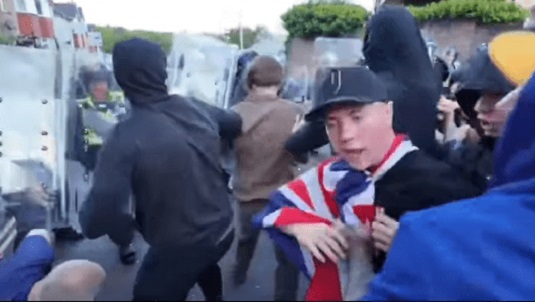
And then there was London, today. The fighting with the cops, the racist chants, the seig heils by the Cenotaph, the harassment and attacks on anyone who wasn't white, this didn't drop from nowhere. It didn't happen because Black Lives Matter happened. The far right are a persistent feature of British politics, and in recent years there has been much to encourage them. Since the beginning of last decade, hate crimes have more than doubled, with a marked acceleration between 2015-16 and 16-17. What on earth might have happened then? *innocent face* Since, nationalist rhetoric has ramped up, along with overt state racism, scapegoating has become official policy in the Tory manifesto, a uniformly racist Tory press carrying on being racist, a subset of celebrity for whom fame is inseparable from racism and so-called anti-woke politics, and the utter demonisation of parliament's most consistently anti-racist figure by an establishment for whom a poisoned politics and the hardest of exits from the European Union is preferable to a mild redistribution of wealth. As much as the establishment protests their innocence and liberally condemns a white riot, they can't fling their plague seeds hither and thither and not expect them to sprout.
The mainstream then have emboldened the far right, and the Conservative Party continues to do so. Why else were the far right, in-between swigging beer, shouting Nazi slogans, and pissing on memorials to dead coppers, voicing their support for Boris Johnson? Why do they think they're on the same side? Johnson overcame his customary torpor to fire off a speedy denunciation, but polarising the electorate and pushing Brexit as an explicitly nationalist project (so much for "Out of Europe and into the world!") has got us to this situation. As recently noted, fascism in the 21st century turns towards identity politics. It offers a performative masculine violence against despised others, a studied and contrived attempt to shock with anti-social behaviour, vandalism and physical assaults, and glories in war, past atrocities committed against subject populations, and a sense of grievance to "the traitors" who condemn this rancid heritage. The fascism of the street is episodic and opportunist, and is the perfect foil for violent men who have something to prove. Theirs is a power politics of destruction, a nihilistic desire to destroy for its own sake. And, as a current on the fringes, it's dying.
As Paul Mason reported earlier, those getting beery in Parliament Square were the usual suspects: ageing hooligans, some of whom were likely veterans of the English Defence League travelling circus, a couple of younger footy firms, and the usual fascist riff raff, including Anne-Marie Waters and Paul Golding. What he witnessed, he said, was the outpouring of rage for a world view that is fast evaporating. Considering all that is said about the far right getting enabled by the mainstream, this might seem like a curious point to make, but it is true. The rising tide of hate crime is precisely because society as a whole is slowly growing more intolerant of intolerance, not least thanks to the efforts of comrades like Black Lives Matter and their forebears in the anti-racist and anti-fascist movements. The social cost of prejudice, on the whole, is increasing and they know, every thug who ran amok today knows the game, in the long-term, is up. This is why they lash out, why they attack the defenceless, desecrate the monuments they affect to protect, and find a kindred spirit in a Prime Minister who offers them new wine in reassuringly familiar bottles. Their precious characteristics, their illusory sense of superiority bound to the intertwining of pale and male no longer guarantees them anything. And where does this leave them? Nowhere.
Fascism, the postmodern fascism Toni Negri wrote about, is therefore a politics of decay. As masculine and racial privilege carries on evaporating, the residue left is concentrated and poisonous. We need to protect ourselves when coming into contact, but it too dessicates and becomes dust. And it isn't long until the air carries its flecks away.
And the answer to that is ... some do. Every time there is a Labour leadership contest, some Tories come forward and let it be known they're super scared of this or that candidate. In 2010 David Miliband was said to give them squeaky bums. In 2015, it was Liz Kendall who sent the chills running down their collective spines. These were "endorsements" only the most politically naive would take seriously. At the time our David was on board with the "necessity" of austerity and wasn't about to offer the Tories a hard time in the Commons, and in 2015 Liz was even less likely so, given her almost total abandonment of Labourism. However, what was curious about the tediously long contest just gone was the dearth of Tories fighting to endorse any Labour candidate. Perhaps they were too busy dining out on their famous victory to notice or care.
Yet some Tories noticed, and some are worried. One of them is Gavin Barwell, known around these parts as the ex-bag carrier of the unlamented Theresa May. Tories are making a big mistake underestimating Labour's coiffured leader, he suggests, which is good news if we want to see the back of Johnson and friends in four years' time. So what are his workings?
First up, the opposition are less likely to be divided in the future. This is true in the sense he means it, that Labour and the Liberal Democrats will have a better relationship with one another. The practicalities of an unstated non-aggression pact will force themselves on acting LibDem leader Ed Davey, if he wins their eventual leadership election, but be more likely embraced with enthusiasm if someone from the left of the party is successful. Additionally, Labour itself is not about to be in the same position as it was before December's election, with confused factional messaging and the open rebellion of the parliamentary party. I doubt we'll get to the point of Blairist Borg discipline, but having a party all pulling in the same direction helps campaigning efficacy and perception of competence. After all, if you can't govern your own party you're not going to get enough votes to govern the country.
Second, Barwell appreciates the Brexit factor in the Tory vote much better than sundry centrists. This was obvious when May turned in a creditable performance in terms of votes cast in 2017, even though she lost the Tory majority. Brexit was the glue holding their declining coalition together, and helped boost it further when Johnson had a crack at it. What this election showed was how people were prepared to overlook the baggage successfully heaped on to Corbyn's shoulders as long as the party was seen to respect their referendum vote. When it became clear in 2019 it didn't, far from the promised 20-point leads Labour could expect had it gone full remain, the party instead had to console itself with the trauma of heavy defeat. Going into the election with one wedge issue, of leadership, was manageable. Going in with two was suicide. Yet without Brexit, where indeed will the Tories be? Even now after a partial collapse in trust, the solidity of Tory support still rests on the bloody minded fidelity to Brexit. Remove that, remove the Tory majority?
On his third and fourth points, Labour's path back to power does not necessarily rest on winning back its former heartland seats and could pick up more Tory seats in the South East, which would be strengthened by Keir's move toward the centre of politics. Leaving that aside for the moment, the jury is out on whether the coronavirus crisis will accelerate population movement trends. If there is any truth in the death of the office discourse, the distribution of jobs becomes less concentrated in London and the supermajorities for Labour we see stacked up in seat after seat can flow out as remote working rebalances the geographic spread of career opportunities and the London property pinch drives hundreds of thousands back to their home constituencies.
Fifth and sixth, in the eyes of the Keir-curious his response to the removal of Edward Colston's statue and to the government's handling of coronavirus is where most of the public are: wrong to simply tear down the statue minus the show of due process, but it shouldn't have been there anyway; support the government when they're doing the right thing, criticise them fairly where they mess up. Seventh, there's the desire for change, which will be hard for the Tories to affect after 14 years. Though not impossible - Johnson is proof the Tories can renew themselves in office when an (old) new face with new priorities comes to the fore. There's also the taste of the electorate to consider - after a showman, might they want sensible and boring?
Lastly, the path to a Labour majority is incredibly difficult without winning back masses of Scottish seats, but what isn't is the creation of an anti-Tory majority in parliament. A progressive coalition of some sort might work where it was a non-starter under Jeremy Corbyn, despite the comforting myths some on the left enjoy telling themselves. And Barwell is right - there has always been an anti-Tory majority in the electorate, but one divided along party lines. If it can be cohered to run in a similar direction then the chances of the Tories securing another term in 2024 diminishes.
In all then, quite a perceptive account of where Labour can threaten the Tories. Yet Barwell's focus on all things Westminster blinds him to Keir's biggest weakness. What he sees as a strength - his centrism - could act as the Achilles Heel. Retreading the old 1997 triangulation strategy might scoop up a layer of swing voters and post-Brexit refugees from the Tories, but at the price of alienating the new core constituency. This doesn't mean knocking a few votes off those London majorities, it would suppress the vote of our core support elsewhere, which would be absolutely fatal in the tight contests Barwell thinks could fall to Labour in the south. And with these voters moving/being driven out of London and the bog cities, the positive-for-Labour consequences of their dispersal is bound to be stymied. For a number of reasons, the new base does not habitually vote like the Tory core does and are more mercenary with their loyalties. If Keir cleaves too much to the Tory position on key issues, say backs landlords over renters, is seen to affirm the privileges of business and the old versus the young, or otherwise supports the present political settlement significant sections of this base can disengage completely, or boost fragmentation of the anti-Tory opposition by going Green or supporting the reinvented LibDems. They have somewhere to go, and will not be afraid of going - even if it increases the chances of the Tories getting back in.
If following the end of Brexit dominance we revert back to something like the pre-2015 situation, i.e. "normal" politics plus SNP dominance in Scotland, wiser Tories know Keir has a number of advantages that would play well when matters are less fraught and polarised. What they're blind to, however, is how conditional the Labour core is. They won't be forever, though. May and Johnson were sensitive enough to sniff the Brexit discontent in our voter coalition and worked, with differing degrees of success, at exploiting it. Looking at what remains, we should fully expect them to try and set Keir Starmer against the interests his party is supposed to articulate and prosecute. Avoiding their pitfalls means sticking up for what is right and refusing to accept the Tory framing of key issues. On this, he is largely untested but the initial signs, on internal issues, on "slapping down" MPs who talk out of turn, on renting, on confronting racism, on a growing number of little things, the initial signs ... aren't good. As such, if he persists down this line or, worse, listens to the siren voices demanding a reckoning with the left we will have the answer to the fear question: the Tories won't have to worry about a single thing.
Image Credit
I've lost count over the years of the things that have made mainstream politics a laughing stock. It's good to know then, in serious times like these we can still find something that beggars belief. Take Jacob Rees-Mogg's insistence that the Commons returns to normal, for instance. Westminster watchers know how parliament has, sensibly, been ticking over at reduced capacity for the duration of the lockdown. No more than 50 MPs in the chamber at a time, two metre physical distancing, screens so other MPs can participate from home and electronic voting. The latter has raised a few eyebrows as technical difficulties has seen Rishi Sunak vote against the government, and Rachel Reeves rebelling twice against the party whip. This for Rees-Mogg is too much, however. These emergency measures must be dropped forthwith.
Under the cloak of democratic accountability, the Leader of the House believes parliament's functions can only be discharged properly if honourable members are there in person to challenge the government. After some pressure, he put forward a motion that would allow MPs to ask urgent questions and make statements remotely but rule out electronic voting. The result? An easy win for the government's plans to open parliament by 261 to 163 votes, but not before the absurdity of over 400 MPs standing in a socially distanced queue snaking its way around the estate. The vote took 36 minutes and, again, made a mockery of the so-called mother of parliaments. Obviously a stupid scheme, plenty of MPs have talked about their unhappiness. Tory MP Robert Halfon on BBC Breakfast Tuesday morning said Rees-Mogg was uninterested in his own difficulties - he's presently shielding due to underlying health conditions. Margaret Hodge has complained for the same reasons, and Valerie Vaz has criticised the plans for being discriminatory. You have to ask why the government are so wedded to this absurdity.
We know accountability is poppycock. If Boris Johnson took it at all seriously he wouldn't dive out of Downing Street Covid updates at every given opportunity. Nevertheless while this is farcical for everyone concerned, with potentially deadly consequences for some MPs, there are real political logics behind the move. Moves that will advantage the government.
The first is keeping up appearances. With MPs spread about the chamber, Johnson looks isolated and all at sea when he addresses the assembled. Even though Keir Starmer's questioning is quite restrained the Prime Minister has had trouble coming up with convincing answers. With most workers still at home and more watching PMQs than usual, Rees-Mogg knows having his boss floundering without the encouragement of his satraps, the look is not a good one. To enhance the optics, as they say, the government are happy to risk the health of hundreds of others. Well, it's all of a piece.
Then we have the issue of authority. The standing of the government has come under strain of late thanks to the Cummings affair, opposition to easing the lockdown, and U-turns on NHS charges. There was also a mounting rebellion of MPs against Johnson's refusal to let Cummings go. Picking a fight to enforce something petty, pointless and going against all reason is a useful reminder of who is in charge. It won't do anything to restore the government's good fortune, but a quick Commons win will assure some jittery supporters worried it's all starting to run away from them.
And then we have the main reason, at least where Rees-Mogg is concerned. The move to remote sitting and electronic voting is something of a Trojan Horse. Not because he's fondly attached to parliament's absurdities and mind-boggling traditions, though he's more than happy to cultivate the country gentleman fondly attached to custom and ancient ritual. This is all about power. The convenience of something as basic as push button voting would speed up proceedings, meaning more time for debate and a pressure for more private members' bills - plenty of which are never to any government's liking, and has potential to put it in difficult positions. But more than that it's the thin end of a wedge. If electronic voting, where might the change-minded end? Sittings at reasonable hours? More powers for back benchers and select committees? Electoral reform? Someone as hyper class conscious as Rees-Mogg wants to preserve parliament as is because it is a bastion of class privilege. The stupidity has the consequence of framing British democracy and its constitution, such as it is, a strange and alienating beast. The building and its rituals affects the private school/Oxbridge atmos, a home from home for generations of bourgeois politicians. The accent on tradition comes before democracy, underlying the political habitus of the British ruling class. It's almost as if representatives of the popular will are unwelcome in the corridors of power and everything about the House contrives to remind MPs of this. Naturally, some find this charming and others the pinnacle of democracy. Labour MPs in particular are prone to this parliamentary cretinism. Tories, especially so Tories from bourgeois backgrounds, aren't stupid enough to fall for these transparently obvious illusions. Nevertheless, Rees-Mogg understands the smallest of changes challenges the established way of doing things, and with it comes a host of unforeseen dangers - as the Tories have found out with their two recent experiments with referenda. Keeping the arcane traditions going throws chains of procedure and pomp around the dangers of the democratic impulse and harnesses it to innocuous and often useless ends.
The government then have had their way on this, but again they are storing up trouble. 24 MPs in the current parliament are 70 or over, 11 of whom are Tories. And of those who shielding, we are talking dozens from all parties. By bulldozing its way through opposition in the Tory ranks, Johnson and Rees-Moog are sowing the seeds of ill will. We saw how that undid Thatcher in the long-run and more recently, Theresa May following her imperial phase where she rode roughshod over dissenting voices. Could we yet see a case of history repeating?
Image Credit
Worried about the consequences of the coronavirus-induced depression? The next few years are going to be very difficult and are sure to polarise further the class and generational differences that have ripped apart British politics these last few years. But in a number of ways, the developed world is lucky. It has the health infrastructure, strong institutions, and the expert knowledge to pull through the crisis relatively undamaged in the long-term. Assuming their government's aren't incompetent or borderline psychopathic. The challenge in the developing world, however, is much greater. A number of countries lack the technical base or resources to mitigate the consequences of the pandemic and their efforts are further weakened by the debt burden and, if they happen to reside in an oil producing region, the geopolitical games of the great powers. In this interview with Alex, Adam Hanieh looks at the impact of Covid-19 on the developing world and sketches out a bleak picture the mainstream media are simply refusing to cover.
As ever, please don't forget to support Politics Theory Other via Patreon.
There is always a tweet. During last week's furore over Dominic Cummings, Opposition whip and Labour MP for Canterbury got on her high horse about social distancing. Little did anyone know that she herself was being somewhat economical with the actualité of the rules. Well, thanks to the Mail on Sunday we now know their letter and their spirit mattered as much to her as the niceties of Catholicism do to Sicilian mob bosses. Caught red-handed, at least she did the decent thing and resigned her shadcab role, turning what could have been an embarrassing story for Labour into a strength. If Rosie can fall on her sword, why can't Dom?
A couple of things about this affair about an affair. Like the case of Prof Neal Ferguson, the author of the lockdown strategy who broke his own rules for a knee trembler, the Mail now as the Telegraph then cultivated salacious gratification from talking up the married lover angle, as if the matrimonial arrangements of Ferguson's and Duffield's significant other has any bearing whatsoever. A reminder of the Tory press using sexual morality to defame their opponents while turning a blind eye to the extra-marital dalliances rife among the government benches. While most don't care about whom is bed hopping with whom, it does matter to a small and important social conservative section of the Tory base. It wasn't that long ago when ministers used to resign as a matter of course if they were caught with their trousers down, and in the 1990s scandal after adulterous scandal helped compound the sense of sleaze clinging to John Major's government. While the vast majority of the Tory base were prepared to overlook everything to get their precious Brexit done, that weapon will not be available in 2024. If trust becomes as an issue, as it clearly has now thanks to the Cummings crisis, reports of Tory infidelities can only contribute to its draining away and staying at home. Don't expect any more stories about Boris Johnson's colourful "innovations" in his private life between now and election day.
On resignation, sundry Tories on Twitter have tried to fool themselves into thinking there is complete equivalence between Rosie Duffield and Dominic Cummings, that the left are complete hypocrites for demanding action against the latter while ignoring the former. Well, Rosie has resigned. Aha, say the Tories, but she hasn't resigned her seat! Well, they've got us. What a gotcha. Of course, if we're abiding by the logic of their argument seeing as Cummings hasn't resigned neither should Rosie. Second, when Ferguson stepped back from his official role with the government he didn't resign his academic job as well. Considering Rosie is far more peripheral to the government's mishandling of the crisis than Ferguson or Cummings, it's ridiculous to expect her to pay a heavier price for breaking the rules. And third, while Ferguson's work informed the Tory quarantine strategy Dominic Cummings is the one figure in Downing Street more responsible than any other for its formulation and messaging. If the law maker can't be, refuses to be a law taker, their position is utterly untenable.
Overall, the Mail on Sunday's splash on Rosie Duffield might be counterproductive from the point of view of defending the government. They have fired the starting gun on other papers scrutinising the comings and goings of other MPs, including Tory MPs. Will the Conservatives be helped by more stories of salacious lockdown breaking? I doubt it.
Image Credit

It's hard to recall now, but there was a time the UK looked on top of Coronavirus. In the very early days as the outbreak was raging in Wuhan, Iran, and northern Italy, we were treated to a reassuring show of covid-19 victims getting tracked down and carted off to hospital. The people they had been in contact with were traced, tested, and told to stay put. For once, the Tories were on the edge of ... doing the right thing. As the rest of Italy succumbed and Spain fell under its pall, there was a smidgen of possibility the UK might weather the storm with fewer infections and fewer deaths than the countries across the Channel. Two months is a long time in epidemiology these days, and here we are at the end of May leading Europe with the highest incidence of disease and the greatest number of dead. And we take this grisly trophy for one reason. Despite their best efforts at trying to blame the public for not obeying lockdown rules, the Tories' tardiness at implementing the measures necessary to save tens of thousands of lives is responsible. This disaster is on them. There is no one else to carry the can.
Yet, as with all political things, fortune contrived to smile kindly on the Tories. With the initial shock of people being forced to stay home, combined with record job losses, significant cuts to the income of millions of others, and the fear covid-19 has struck into our collective hearts, this sheer incompetence wasn't much noticed. Labour's new leadership also fought shy of trying to highlight it fearful of Keir Starmer being seen playing politics with a life-or-death crisis. Therefore, many were prepared to forgive the government their innumerable sins because we needed them to get it right and, well, no one had been in this situation before. See, the Tories are lucky. The wrong choices could be put down to exceptionalism.
Nothing lasts forever, not even polling honeymoons facilitated by a deadly disease. In this last fortnight, the Tories have appeared determined to do everything to take their immense advantage and throw it around like non-functioning testing kits. We saw the imbecility of forcing open the schools while picking fights with teachers and their unions, retreats on ending furlough early and on NHS charges for foreign-born NHS workers, and a collapse in support thanks to the eternal Dominic Cummings crisis. And the government's response to this state of affairs couldn't be worse. Mindful of the u-turn-if-you-want-to nostalgia of the Tory imaginary, and the barrelling approach to Brexit, they've decided to hunker down and go through with school openings and further lockdown relaxations, with arbitrary dates set for the resumption of sports and opening of non-essential shops. This despite infections and death rates standing many times higher than the next worst afflicted European country. That's what they think of the science they're supposedly led by.
Over the coming decades the awful decisions of this government are sure to be pored over. They're going to be a factor at the general election in four years time and be scrutinised with a fine tooth comb at the upcoming round of trials. Well, you can't blame a guy for dreaming. But what is the root of this bloody-minded idiocy? We know Johnson is lazy and would know a brief if one came to get him out of jail, but it's more than having a personality indifferent to the suffering of others. Remember, this is someone entirely driven by self and the desire for popularity - you couldn't find a politician more appropriate to the age of the attention economy. The government's psychopathy isn't thanks to the personality traits of its Prime Minister and chief adviser, it's the collective property of the dominant wing of the Tories. Before the fall out of Dominic Cummings forced the right wing press to reflect the anger of its readers they were strongly agitating for lockdown restrictions to be eased. Whence does this will-to-psychosis come?
There are two intertwining aspects to understanding the Tories here. The first barely needs much rehearsing because it will be familiar with anyone reading anything to the left of the liberal press: class politics. The history of the Tory party is of its being the preferred, but not sole, arena for the political articulation of ruling class interests, for organising those interests, and representing these sectional interests as if they're identical with those of the country/people. The Tories' hesitation over implementing quarantine measures, their being forced by the measures already taken by the public was, transparently, about keeping the UK's stagnating economy from seizing up. How they've supported people through the crisis by tying subsistence to employers, keeping Universal Credit low, propping up landlords and issuing loans to businesses demonstrated their first concern was maintaining the disciplinary complex underpinning waged labour and market competition. No matter how many old people are shipped back into coronavirus-riddled care homes to die, no capitalist relations of production will be harmed by the pandemic. Even if some changes to the workplace are accelerating. Therefore the lifting of the lockdown is about putting profits before people, reasserting employer authority over employee, and starting the bounce back from the viral depression.
The second is about authoritarianism, which has been the ingrained common sense of British state craft since Thatcher. This is different to what we see in Russia, Hungary, the US, and elsewhere but is driven by the same sorts of processes. As Andrew Gamble observed in his 1988 book, The Free Economy and the Strong State, Thatcher's roll back of the post-war social order was not possible without the state tooling up. Famously it did so to see off the labour movement in the key disputes of the 1980s, but the authoritarianism ran deeper than handing the police more powers and carte blanche to do as they pleased. The Thatcher project was about positioning the government as the absolute authority within the state system. Her attacks on the civil service, the restructuring of education and health, the gutting of local government, and her overall disdain for expert knowledge (except when it was in accordance with her prejudices) reinforced Downing Street as the seat of command to which all other institutions cleaved. Tony Blair settled very well into this practice of government - the rows with the BBC, enforcing more marketisation on public services, and so on. Ditto for Dave's lash up with the LibDems and their programme of austerity in defiance of economic sense, and doubly so with Johnson first on Brexit and now with coronavirus. The parading of SAGE is just there for show - Johnson has no intention of abiding by their advice not because he thinks they're wrong and he's right, but because it goes against the entirety of his political socialisation. There cannot be room for alternative bases of authority in government if, crucially, the Thatcherite settlement within the state apparatus is to be maintained. I therefore fully expect the government to declare victory over the virus some point this summer while infections head toward a second peak and deaths accumulate at a greater rate than present.
I doubt Johnson consciously see things this way. His modus operandi is opportunism, not ideology or an appreciation of the interests of his class. As such, he's also well suited to the government machine bequeathed him by his predecessors. He doesn't have to be held to account, no one in the civil service is going to say no, experts and critics are rubbished as activists with political axes to grind, and they have zero authority in the state system anyway. Whether an active authoritarian like Thatcher or a couch potato authoritarian like Johnson, they want to maintain government privilege - hence also the outright refusal to sack Cummings, even at the risk of diving poll ratings.
In the 1970s, right wing columnists and rent-a-quote Tory MPs used to regularly describe Britain as the sick man of Europe because of rising inflation, sclerotic growth, strikes, inflation, and a generalised malaise. With an unenviable record and a rate of transmission higher now than when we entered quarantine, more people are going to be getting ill, getting incapacitated, and dying as other European countries start easing things and begin the slow journey back to something approximating the normal. Our continued morbidity contrasts unfavourably with their recovery. But our sickness is deeper - the illness of the social body is exacerbated by a disease of the mind, of a governing party and a Prime Minister prepared to sacrifice the many to conserve the profits and power of the few, and a practice of government that encourages him to do so.
Image Credit
What was one of the enduring lessons of Theresa May's premiership when it entered into crisis following the 2017 general election? And what did we learn from the chaos in parliament last Autumn? Repeat after me: there is no such thing as a Tory rebel. Or at least a consistent one. With inglorious recent history in mind, how does this bear on recent events? It's now obvious Dominic Cummings isn't about to go willingly, and Boris Johnson has decided to cling on to him for dear life. Even if it means dynamiting essential public health messaging and exposing people to needless risk. Where does this leave the Tories?
Most MPs are at their lickspittle best, trotting out identical tweets and writing messages cut and pasted from whips' office circulars. But an increasing number have poked their heads above the parapet. Conservative Home stopped their rolling list when 36 names broke cover. Throughout the day and following Johnson's half-arsed appearance in front of the select committee chairs this afternoon, this has now mushroomed to somewhere in the region of 50. And, apparently, there are eight cabinet members who've indicated to the lobby hacks they're unhappy and think Cummings should go. With the exception of Penny Mordaunt, who has publicly criticised Cummings, the rest have stated their opposition from the consequence-free cloak of anonymity.
Readers might recall George Freeman from the Brexit wars, the soft-spoken but loquacious member for mid-Norfolk and victim of February's cabinet clear-out, which also saw the departure of Sajid Javid. His call for Cummings's resignation summates the views of his disgruntled colleagues. In his letter to the Prime Minister, he writes about his postbag and describes the moods as a "scale of depth and of the anger felt by constituents is like nothing I have seen in ten years." And remember, we have lived through the polarising fun that was Brexit. He goes on to note the multiple breaches of the rules, which Cummings brazenly owned up to and tried claiming they were nothing of the sort, before moving on to the killer punch: Cummings's behaviour and refusal to even apologise (or even issue a politician's non-apology) has fatally undermined the public health strategy and trust in the government at the very moment the rules are changing and become more complicated. Exactly right. Proof even a Tory is right about politics twice a day.
50 MPs for whom public health comes before the Johnson/Cummings project, but what are they going to do about it? As plenty of Westminster watchers have noted, it's one of those occasions where absences say a great deal more than who has signed up. Apart from Freeman, the very Brexity Steve Baker, and a few names who rebelled for remain reasons in the Autumn, those coming forward thus far are hardly A-listers. Where are the big names? Jeremy Hunt is about the only front rank Tory to have cast aspersions on Cummings. The others have so far kept quiet, though understandably in Javid's case any complaints could/would be spun as sour grapes. Yet the longer these oppositionists, and I use that term advisedly, are out in the open and enjoying the backing of the Tory press the greater the damage. If more senior members come out the more acute the crisis becomes.
And yet, in all truth, provided disgruntled Tories write letters and give critical interviews, from a party management point of view Johnson and Cummings can tough it out. This isn't like Theresa May after June 2017, when she was assailed from all sides by would-be leaders who lacked the strength to depose her and carry the party, there are no contenders to give Johnson the heave ho. Despite his manifest laziness, he has proven his electability as far as they're concerned. And, well, in the middle of a crisis that has killed more Britons than the Blitz launching any kind of leadership bid is hardly the best of looks. Political suicide just about covers the consequences. And so the anti-Cummings tendency are stuck. They're not going to put Johnson on notice. They're not going to start rebelling against his legislative programme. They're not going to do anything.
While it is true one should take Tory rebellions with a pinch of salt, in this case it's not lack of spine that's stymieing them but the balance of forces in the parliamentary party and the national crisis. As they're not going to move neither is the situation. The Cummings wound remains open and, too late, has introduced sepsis into the Tory body politic, destroying its poll standing and the government's legitimacy as the custodian of public health. Boris Johnson has shown he'd rather protect the career of his indispensable advisor than the health of the tens of thousands likely to get infected as others feel free to play fast and loose with the distancing regulations. The Cummings hubris has paved the way for nemesis, but it's us - our relatives, our friends, maybe ourselves - who might be called upon to pay the ultimate price.
Image Credit
After keeping the TV schedules waiting for half an hour, did Dominic Cummings do enough to save his bacon? It's doubtful his presentation in the Downing Street rose garden changed anyone's mind. If you're prepared to defend the government and Cummings after the weekend's revelations you're going to carry on doing so. After all, for the likes of Dan Hodges and Guidelet-at-large Tom Haywood the truth is a firm second to media profile - even if it means eating shit on the government's behalf. And if you're angry because Cummings flouted lockdown rules, you're still going to be angry.
In an impressive display of doublethink, Cummings said he did nothing wrong. And then admitted to the assembled pressers all the times he disobeyed the rules he helped write:
1. Concerning the events of 27th March, Cummings admitted he went home, discovered his wife was ill, and then returned to work at Downing Street. The rules, of course, were very clear. He should have immediately self-isolated as a member of his household was ill. Now, Cummings has attempted to get round this by arguing Mary Wakefield did not have a cough. If he didn't suspect this was Coronavirus, then why did he leg it back from Downing Street and drive all the way up to Durham to self-isolate? Hmmm.
2. The actual relocation itself was against the rules. If you or a member of your household were displaying symptoms or otherwise suspected of having the disease, you are supposed to stay put. As it happens, the common sense argument Cummings makes in his defence is one, I'm sure, most people would sympathise with. If you had an alternative bolt hole that was even more isolated and you could travel to it without risking exposing anyone else, then why not? Except, again, the rules have been very clear. In the early part of the lockdown there were repeated complaints of our more affluent citizens fleeing London for their holiday homes in the arse end of nowhere. Readers might recall Neil Gaiman had to publicly apologise for heading to Skye for the duration. Cummings has also tried justifying this in terms of "exceptional circumstances", but when tens if not hundreds of thousands of parents have been placed into a similar position and abided by the rules then his situation isn't exceptional at all.
3. You couldn't make it up. He said he stayed on his family's land in a cottage/nissan hut. After having recovered somewhat following a couple of days in bed, he felt his eyesight had been adversely affected. So to see if his eyes were up to driving, he packed everyone into his car and drove 30 miles to Barnard Castle - a 60 mile round-trip in total. I'm sure you would agree this is an entirely normal thing to do. Again, the rules were clear. You were supposed to stay put, and go out once a day in your locality for exercise. Cummings did not. Instead, he was one of those awful people the likes of Derbyshire plod and the Daily Mail were moaning about for travelling into the countryside. Also, entirely coincidentally, the Cummings/Wakefield visit to Bernard Castle was on the occasion of her birthday.
Asked about issuing an apology, Cummings repeated he'd done nothing wrong. Asked about whether he had considered resigning, he said no. Instead, he tried turning it around to the press and blame them for the furore. Perhaps if the Scottish chief medical officer and the author of the lockdown strategy hadn't lost their jobs and the right wing press hadn't demanded their heads - a certain Tom Haywood among them - this would be a non-story worth a shrug and a couple of column inches in Private Eye.
And so he's dug his heels in, and Boris Johnson is backing him to the hilt. Their fates are now tied - they stand together or they full together. And are they going to? There is a real split among Tory ranks on this, if Conservative Home is anything to go by - props to the contributor arguing driving with impaired insight is exactly what you should do). And so far 21 Tory MPs have called for Cummings to resign. However the bulk of the right wing media are also against Cummings, reflecting the anger of their thinning readership. And Tory MPs generally are reportedly in a flap, with their WhatsApp groups buzzing with complaints and those worried by the growing pile of hostile letters from constituents. Good, let them feel the heat.
The question is will it matter? I guess we won't know until we see the first clutch of polls, but it feels like it does. The government were starting to look a bit shaky anyway, and doubling down on the nothing to see here defence is hardly helpful for keeping popular confidence on side. Could this be Boris Johnson's Black Wednesday, the moment when speculation forced the pound out of the Exchange Rate Mechanism in 1992 and afflicted a blow on John Major's government from which it could never recover - despite being fewer than six months on from a famous general election victory? The parallels are there. With widespread doubts over the return to school and return to work strategies, there's nothing like a case of brazen hypocrisy on the part of a self-styled people's government to provoke anger and collapse confidence along with popular support. Whatever the case, the story isn't about to go away. Because of Cummings, the whereabouts and movements of other senior officials and the cabinet itself comes under the spotlight and other examples or rule-breaking are sure to be uncovered.
Cummings has always been fancied as something of a chaos agent, a tsunami of terror that would roll in and sweep way the corrupt establishment that has held back British politics for so long. After today's press conference, it's looking like he'll meet this happy objective.
Image Credit
If you have Coronavirus symptoms, the government's rules are very clear. You should self-isolate for a fortnight. No ifs, no buts, unless there is an obvious risk to life. Why then did Dominic Cummings, the "mastermind" behind the government's complacent and disastrous response to the covid-19 emergency, drive from London to Durham to drop his kids off when, by his own admission, he was showing all the signs of the disease? We know why. He drove there for the same reasons why Catherine Calderwood, Scotland's chief medical officer visited her second home, and why Neal Ferguson, author of the lockdown strategy, broke the rules to get his leg over. They did it because they could. They did it because the quarantine measures they proffered for others do not apply to them.
News of course for the rest of us. Those parents who were ill with children at home, people banned from the bedside of family members, the bereaved having to grieve in absentia because distancing rules applied to funerals, these sacrifices - which Boris Johnson has the habit of patronisingly congratulating us for - are for the likes of us, not the likes of them. Even when it means pointing people in harm's way, which is exactly what Cummings did. Cummings and his partner were both obviously ill with the bug, but thought nothing of dumping the sprog on the elderly parents. At least his lack of regard for the safety of the old is consistent. Still, given the opportunity to pick a side between the many and the few, true to form senior Tories have marched out to defend Cummings. Michael Gove said "caring for your wife and child is not a crime." Rishi Sunak and Dominic Raab said it was a justifiable action, and condemned political point scoring. At the daily press conference, Grant Shapps went as far to suggest Durham Police were lying about speaking to Cummings's family about the matter. You can find other ministers, MPs, and their social media satraps doing the same. Though, strangely, not our frequently absent Prime Minister.
Speaking outside his house Saturday morning, Cummings told the assembled press pack it wasn't about what "looks good", but "doing the right thing." He added it didn't matter what the journos thought. Typical of him, he's brazening it out. He's wagering that this is a media confection that will bother the usual excitables on Twitter, while out in the country people will see it as a fuss over nothing. Well, he's neglected two things. First is the anti-elite narrative he has carefully crafted since rocking up at Downing Street. Drawing on decades of right wing fulmination against experts and so-called liberal elites, it was easy to weave a story about privileged remoaners when they acted like spoiled brats who simply wanted to set aside the referendum. The problem is when an anti-elitist starts acting like the elite they affect to despise, and do so in the full glare of publicity.
And the second thing? Ho, ho. Pippa Crerar was sitting on a follow-up story about the other time Cummings had broken the lockdown. After a full day of senior Tories making up excuses for "Dom" and trying to pretend anyone interested in the truth had anti-Tory axes to grind, the behaviour of Johnson's essential familiar savages them, Pennywise-style, in the backside. This has led Sophy Ridge to take the extraordinary step of giving Shapps, her Sunday guest, the questions she's going to ask in advance so we can get some proper answers.
This Cummings scandal couldn't come at a more delicate time. Facing sustained criticism over plans to ease the lockdown, the government have blundered into an unnecessary confrontation with teachers which has formed up devolved authorities, metro mayors, and local government behind them. With the plan unravelling, they were forced to concede waiving NHS surcharges for foreign-born staff to try and keep the main objective front and centre. And now the Cummings revelations have wrecked that, and made the government look like complete idiots. Does it matter? Well, yes. It's sure to help speed up the slow erosion of the Tory poll lead, but one shouldn't underestimate the potentially deadly consequences of Cummings's irresponsibility. If the government's spad-in-chief can get away flouting the law and not be seen to suffer any consequences, why shouldn't everyone else drive here, there, and everywhere to have meetings with family and friends. It sends absolutely the wrong message, but the government haven't got a leg to stand on for as long as Cummings resides in Downing Street.

Political science is a weird term. When you think about politics with its shifting alliances, shock results, splitting and merging parties, the rise and fall of careers, and the interests that work through and find voice among this mess, making head or tail of it is a laborious process indeed. And even having the right analysis doesn't mean the guarantee of success. It's for this reason Lenin considered politics more an art than a science. But when you look at actually-existing political science, the stuff filling up the journals bearing that moniker and that takes home the academic prizes, it couldn't be further away from politics. Open any introduction to political science or work self-consciously identifying itself as such and what you get are acres of tables, an obsession with quantification and the occasional mathematical modelling, a preoccupation with conceptual clarity, and a set of unthought presuppositions informed (some might say damned) by empiricism, functionalism, and rational choice. If that wasn't bad enough, the focus - the theoretical object if you want to be a bit Althusserian - is entirely the trappings of official politics: parties, voting behaviour, electoral systems and how they behave, the character of party systems, and what have you. On occasion political science has drawn attention to wider processes that might be driving political change, such as the cleavage structures underpinning political conflict, or cultural change as the driver of transformation. Given the empiricism underpinning political science, it's not surprising these forays into political sociology hardly piqued the attention of sociologists and other social science disciplines.
What's prompted this return to political science. Hadn't this blog settled accounts with it a long time ago? Well, yes. But there was a question Tom Gann of the New Socialist posed earlier. Imagining a huge cash money advance, he fantasised about writing a book in which a militant political science could be worked out. But what might it look like? Well, nothing like established political science except in the most superficial of senses.
The difference between the academic and militant kinds is that between description and explanation. For instance, in the book I'm writing about the Tories there are elements you would find in any traditional work of political science, such as descriptions of the party's performance, the character of its institutions and rules, membership demographics, the alliances formed with other parties, and so on. However, it goes beyond political science by explaining strategy in terms other than parliamentary/vote catching concerns. In other words, the first thing a militant political science must do is abandon the naivete of the autonomy of the political and put it in its proper place. Politicians make decisions, parties discharge strategies, but they're conditioned not just by their own ideas and prejudices acquired through a career of political socialisation but by the assumptions and pressures conditioning politics. And these pressures come in two flavours - from above or from below.
Consider the pickle Boris Johnson finds himself in presently, by way of a quick case study. He is being pressured by business, his backbenchers, his chums, and the Tory press to ease the lockdown and restore a semblance of normality. Why? Partly because British business is losing money hand over fist because workers aren't working - an acute demonstration of who the real wealth creators are. But also because of a relaxation of the disciplining effects of work. There is a concern it will be more difficult for managers to exert their authority after all this is over. And consider the pressures on Johnson not to liberalise the lockdown. He's going to have a tough time forcing more teachers back to work in the absence of proper checks when the public are broadly supportive, and local councils and the devolved administrations are not on the same mad Tory page. Walking this tightrope means he's prone to the gusts from side issues, hence his U-turn on health care fees for NHS staff and care workers from abroad.
The job of a political science worthy of the name is to understand and get a grip on the cohesion of these relationships and interests, and understand they proceed at a number of levels encompassing surveillance and discipline, population management, cultural politics, lawmaking, the street, the point of production. This is where we encounter the ever-vexatious issue of the state. In this picture, it's not good enough to blandly assert capitalist states automatically serve the (collective) capitalist interest. The state itself is a field of forces, a system of more or less extensive, more or less autonomous institutions that exist in tension to one another and are always subject to struggle, be it the petty empire building of ambitious bureaucrats to employer/employee confrontations, to being the site of contestation over wider issues. Likewise the government's relationship with different parts of the state is not one of straightforward domination, though the further the social distance from the environs of Number 10 the greater the autonomy and, possibly, propensity to resist diktat. Therefore the state as guarantor or private property and class relations does not, itself, have a final guarantee. It is maintained by the messy inertia of its operation, the networks of its personnel, and the coalition of forces condensed in the governing party. To all intents and purposes then political parties, or to be more precise the parties of government, are part of the state.
The state then is neither a simple expression of capital, as per crude Marxism, nor a neutral party as fancied by social democracy and Labourism - it is much more complex. And at any given juncture, analysis is about unravelling these relations to get a picture of the balance of forces arrayed against us. Therefore, referring to our above/below shorthand to get a handle on bourgeois politics we have to pay attention to their alliances and relationships, their networks, friendships, and back-scratching arrangements, how they come together inside and outside of parliament as movements to meet their objectives, and how these are replicated and reproduced across parties and institutions. These are dynamic and shifting processes, but are entirely observable because they come into public view primarily in the machinations of the Tory party - but also occasionally in the Labour Party. Under Blair, the New Labour project did represent an attempt to cohere the party as the primary axis of ruling class politics, and it worked for a time. Recall the many money scandals that plagued New Labour - the cash for honours, the dodgy loans, the relaxation of tobacco sponsorship for F1. More recently the final collapse of the Blairist contingent of right wing Labour, the Change UK split, and the funnelling of huge quantities of money and personnel (and rivalries) into the remain movement offered a glimpse into the doings of what our non-Tory sections of the bourgeois class were up to now Labour was (temporarily, as it turned out) no longer amenable to them.
Militant political science is sensitive to the machinations of our rulers and how they come together episodically and over the long-term around communities of interest. Yet it must also be open to the idea of ruling class failure. One of the reasons why crude Marxism reads like conspiracy theory is because it always assumes the representatives and agents of capital always know their interests. They have perfect information, and so whatever happens in politics, domestic or international, reflects the interests of capital/imperialism. This is wrong, and not just because their power always abuts and begets resistance. Contrary to what we might call rational choice Marxism (not to be confused with the old edited collection of the same name), capital does get it wrong. Businesses fail. They invest in the wrong product or expand into the wrong market. They introduce policies that hamper the productivity of their workers, or launch attacks on them that backfire spectacularly. And they can support parties and politics inimical to their interests. During the 1980s, there were plenty of manufacturing concerns that lined up behind Thatcher. And now, you have big business like JCB and Dyson happily lining up behind Brexit - even though, you would think, their commercial interests are best served by having unfettered access to the world's largest market. Bourgeois politicians make mistakes too. They take chances and gamble, just as Boris Johnson did with pushing his hard Brexit against all comers. And how a certain unlamented Tory leader bet his career on the EU referendum, and lost.
Naturally, militant political science pays attention to resistance. Or, to be more accurate, the problematic of movement (and party) building. Taking its cue from Deleuze and Guattari, and the approach to social movements pioneered by Alberto Melucci, a militant political science does not reify the working class, or women, or minority sexualities and people of colour as a category with a structural imperative to overthrow capitalism, patriarchy and white supremacy but as a multitudinous complex of billions always in the process of formation. By virtue of wage labour and its development over five centuries, including how it is foisted upon the great mass of humanity and has in turn been reconfigured and continually subverted by resistance, in this regard militant political science is no different from Marxism, feminism, anti-racism and LGBTQ liberation politics. It looks where resistance is, analyses the dynamics and power relations in play, the organisation of resistance in its formal and informal aspects and draws out the necessary lessons. But unlike establishment political science, with its formalism and divorce from political practice militant political science is fundamentally open. It seeks audiences at the coal face of struggle, wherever it is, bringing insights, histories, and concepts synthesised from other struggles and presents itself as tools to be used, wherever appropriate, to make sense of the event as it happens and the opportunities and dangers unfolding from it. Militant political science is an informed imaginary, the collective product of millions that itself is in a process of becoming - a diffuse and collective enterprise that acts as a great organiser, attempting to pull politicised order out of the multitudinous chaos. A radical commonwealth or, to use another favourite Althusser phrase, the class struggle in theory.
Is any of this new? Absolutely not. A militant political science exists in a peculiar process of becoming. It is always developing, always learning, always shifting in nuance and focus with every struggle enriching it and every mind coming into contact with it. And yet, unlike other processes of becoming, it does have an end point: its own abolition. It is no different to existing revolutionary politics and theory because it is the struggle to end struggle. It wants to become so it can finish. Its heart desire is to be nothing more than the narrative of humanity's pre-history, of being a tale of what was that would horrify but inspire future generations fortunate enough to live in a society in which the old crap of class and capital, of oppression and hatred is done with. For us though, militant political science opens the way to the freedoms of the future by struggling for them in the present. It is open and inclusive vs the closed and exclusionary social system limiting us, exploiting us, oppressing us, and murdering us. It shows the world as it so we can make what it might be. Therefore, unlike the dessicated tundra of bourgeois political science, with its frozen categories and assumptions mired in permafrost, militant political science is warm, living, and exciting.
Image Credit
Compromise and deal making is the DNA of Labourism. Rooted in the day-to-day practice of the workers' movement, the reason why many trade unionists have proved effective and adept politicians, regardless of their politics, is the culture of negotiation, brinkmanship, persuasion and, some might say, accommodation is the way the House of Commons is set up too. When, a wee while back, Laura Pidcock caused a stir by ruling out cross-bench friendships with Tory MPs it was because she shone a light on the essential similarities of the politics of the boss party and the politics of the labour movement's political wing. This is what we must bear in mind as we attend to today's comments in parliament by Yvette Cooper.
In case you haven't followed proceedings, and who can blame you, she indicated she is minded to vote for the government's new immigration bill - a bit of a coup considering her seniority in the PLP, buttressed by her chairing the Home Affairs Select Committee. The government's plans involve the introduction of the much-vaunted points-based system. It's likely points will be awarded for language proficiency, education level, holding a job offer, and (whisper it) assets. Priti Patel herself has stated this is explicitly aimed at keeping out unskilled workers, hence a proposed salary threshold of around £25k. As the new shadow home secretary, Nick Thomas-Symonds rightly noted in reply to the debate "those who clapped on Thursday are only too happy to vote through a bill that will send a powerful message to those same people - that they are not considered by this government to be skilled workers." Not only that, unless the rules are flexible the UK will see a sharp deficit where recruitment to care and the NHS is concerned. This according to the ever-objectionable Patel is "laying the foundation of a high wage, high skill productive economy." Yes, because tightening the mobility of Labour will automatically put rocket boosters under an already stagnant economy and blast us to the altitude of double-digit growth. It's complete codswallop.
The reason the government are going hard on this is governed entirely by the interests of the Tory party. Their paltry manifesto didn't promise much, but this was one of the pledges in there. But in the strange days of the Coronavirus crisis, bulldozing this through assumes some importance. To say their handling of the lockdown has been uncertain is perhaps the most euphemistic characterisation you can come up with. When this incompetence is compounded by alarm among important layers of Tory support, the greater the compulsion to ensure the core programme - immigration controls plus Brexit - is wrapped up. It also delivers on the promise Johnson made to the conditional, wobbly-handed Tory voters who supported him in December, and becalms the yellowing grassroots.
Therefore, you have to ask what the hell Yvette Cooper, a Labour MP and frequenter of what-might-have-been dreams for the beer mat collecting anoraks of the Labour right, is doing helping the Conservatives meet key political objectives. And jokers from this wing of the party think they're serious about power and winning. The Tories don't need her charity thanks to their majority, which makes her going out on a limb even more puzzling. In her contribution to the Commons this afternoon, she said she wanted to meet the Home Secretary "in cross-party spirit", and amend the legislation with a view to arriving at a consensus. These amendments? Who the hell knows what's she's suggesting, but given her willingness to support the government they're not about to disagree with the substance of the legislation. Perhaps we'll see a few extra points added for nursing and caring jobs, but to all intents and purposes her "effective opposition" is a capitulation of the most miserable kind.
What then is her game? There are two strategies in play here. The first is the eye on the old constituency. In 2019 her seat went from super safe to marginal, with only 1,200 votes separating her from the Tories. She was hit by a modest uptick in Tory support, a creditable performance from the Brexit Party and a not insignificant increase in LibDem support, all more or less at Labour's expense. Like the (mostly) unlamented Labour leavers, she believes making a song and dance about a topic close to the heart of a large number of voters in Normanton, Pontefract and Castleford will get her noticed and build up local support. Because it worked so well for Caroline Flint. No doubt Yvette thinks this is leadership, but there's another word for this: pandering. The second is potentially more serious. Labour have applied a three-line whip vote against the government bill, so breaking party discipline will not be without consequence. But politically, Yvette is saying she has zero confidence in Labour's position and, by extension, the ability of our snazzy new leader to hang on to her seat. That, or she feels her nose was put out of joint by not getting anything in the new round of shadcab appointments. Given her seniority, it must grate to know no marks and idiots got promoted ahead of her.
Many times have the left forecast that the right would move to undermine Keir Starmer, but this has come as a bit of a surprise. The favoured method under the last three Labour leaders was the snarky briefing and leaking of documents. For Yvette to come into the open is either a clumsy attempt to bounce the party into her way of thinking because she thinks she's teflon, or doesn't care for the consequences because, once the crisis is over, she's off to do Strictly or something. Whatever the case, here we have a Labour MP who wants to chuck members of our class under the proverbial to help the Tories. This is what it boils down to, and these baldly stated facts condemn her.
There is a light that never goes out, so sang Morrissey. Unfortunately, there are some that never properly switch on. A case in point is Labour's new shadow housing spox, Thangam Debbonaire. As renting and the rights of tenants is a hot button issue, especially now covid-19 means the return of huge unemployment figures and a dent in incomes for millions more, it would be nice to know Labour is on the side of a core component of its voter coalition. Sadly, where clarity is needed and our people could do with knowing the party is on its side we find equivocation and timidity.
Speaking at a Fabian event on Thursday, Thangham said cancelling rent payments is "un-Labour" and "really regressive". What could she possibly mean? Responding to criticisms of Labour's current position, which grants renters two years to make good any arrears, she said "there are people who are still in work, still able to pay their rent. And if you just cancelled rent, they would also benefit and they don’t need to." In other words, it's fair for the poorest to continue struggling with the deleterious impacts this has on mental health and family life in case someone else gets a few extra bob. She even cites herself as one of these people who doesn't deserve rent forgiveness, which is interesting seeing how her London flat is paid for, um, under the MP's expenses scheme. Now, there are practicalities to consider if rent payments were cancelled for some time. The state could, for example, pick up the tab if we're really worried about landlords themselves getting put out into the streets. But whichever way you dice it, this policy isn't is regressive.
Being the forgiving sort, this elementary misunderstanding of what regressive means could be put down to the milieu in which Thangam circulates. There is an overlapping cohort of Labour MPs and centrist opinion who thinks conditionality is progressive and universalism is reactionary and unfair. I'd humbly submit these people have never had to jump through the hoops social security payments demand. Work capability assessments as the hallmark of a civilised society, anyone? In this occasion, there's no overlooking this idiocy. You see, Thangam has form. Far from being "un-Labour", rent strikes were constitutive of the party itself. Perhaps Thangam would like to step into a TARDIS to lecture these malcontents, or better yet get to know some history about the party she affects to represent? Unfortunately, it doesn't end there. In an exchange with Ash Sarkar, Thangam tried to get her expelled from the party - before she had even joined - because "being a communist" means she had to be a member of the Communist Party. And being told once to 'get in the sea' on Twitter circa the time that popular insult was everywhere, she openly and publicly declared this was a death threat. Cynical? Thick? Ignorant? You decide.
Yesterday, a couple of worthies noted Keir Starmer had built a more competent team around him. The significant gaps in Thangam's understanding will see that assumption tested to destruction over the coming months, this can't be heaped at her feet. She's responsible for the gaps in her understanding of the party but she isn't a free agent. Her position on housing policy is the leader's position on housing policy. The question then isn't really why Thangam isn't much cop, but why Labour's position isn't. And the answer is, I'm afraid, Keir Starmer's reasonable reasonableness strategy. He is determined to play politics by the rules in the belief this will net him better press coverage than previous Labour leaders and, obviously, boost his chances at election. Not upsetting the landlord strata defuses an anticipated angle of attack from the likes of the Mail, etc, thereby making it easier to win over Tory voters. That the shadow cabinet contains landlords of its own is entirely coincidental.
Needless to say, this is troubling for the same reasons why Labour couldn't simply carry on facing two ways over Brexit. Labour is dependent on the new working class of immaterial labour. It is disproportionately younger, precarious, locked out of property acquisition and at the sharp end of our systems' myriad inequalities. Corbynism's accomplishment, despite its failings, was to re-orientate Labour toward this rising class and make the party respond to their concerns. However, in the absence of other collective organisations integrating new supporters and voters into the party and the wider labour movement their adherence is uncertain and conditional. And this conditionality, surprise surprise, comes in the form of not doing their interests over. Now, a cynic might look at the super majorities Labour has in the big cities and think we can trade blocks of a few thousand here and there for some nice middle England seats, but it doesn't work like that. A partial demobilisation in the cities of this vote also means partial demobilisations everywhere else. There are renters in the medium sized cities and towns, and immaterial workers in the constituencies Labour has to win back. In other words, triangulation of Blairite vintage is not on the cards. It's impossible.
The question is does Labour's leadership realise this? Paul Mason was a handy ally for Keir to have during the leadership contest, and the hire of Claire Ainsley of The New Working Class fame suggests there's an awareness at the top that the party has to at least nod in the direction of travel established under Jeremy Corbyn. Unfortunately, having dim bulbs anywhere near a crucial brief like housing doesn't speak of the leadership's seriousness and it's this that could cost the party dearly.
Image Credit