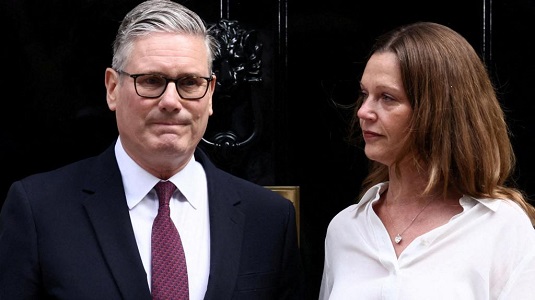
It's funny how tributes to Starmer studiously avoid all mention of these things. That offered by George Eaton typifies the trend. This Labour government is "surprisingly left wing" but is never "identified as such", framing the failure of Starmer as a matter of comms. As if left wing politics is about tractor production figures, and not challenging class power and expanding the realm of human freedom. Something that even post-war Labourism in its finest hours did. For every watered-down gain in workplace rights can be opposed by Starmer's chilling and dangerous clampdowns on collective liberties and personal autonomy. A legacy to be repudiated and undone to be sure.
Authoritarianism is just one thing Starmer will be remembered for. The other is his dishonesty. Boris Johnson was left holding Keir's beer has he brazenly lied throughout his time as leader. It began when Starmer unveiled the policy pledges that won him Labour's leadership, and then spent the next few years disowning every single one. No one, not even a Tory leader has so gracelessly abandoned the platform that got them into office. The signs were there early on, and some were sharp enough to draw the right conclusions. The two obvious ones were his refusal to come clean about his main donors during the leadership campaign who, quelle surprise, turned out to be wealthy businessmen. And his first foray into criticising the Tories over their Covid crisis management showed whose side Starmer was on. Weak, pathetic, and arguably peddled in bad faith, it was a studied effort in refraining from upsetting the apple cart. These proved to be the touchstones how Starmer would conduct himself in high office. Thanks to a combination of meticulous journalism and arrogant boasting, we have a good idea of the extent to which the people behind Starmer defamed and harassed critics, and manipulated outcomes with the full support and connivance of British politics journalism.
There is one aspect of politics Starmer did prove rather good at. That was the neutralisation and dispersal of Labour's solid bloc of left wing votes. It's no word of exaggeration that large sections of official politics lost their minds after Jeremy Corbyn's better-than-forecast performance in 2017, and even after 2019, 10-and-a-quarter million votes for a left programme were far too many. Starmer's tenure can be read as a ceaseless effort to take the coalition assembled by Corbyn and unpick it. Every abandonment of Starmer's socialist-sounding pledges, every betrayal, funnelled the official politics of opposition into narrower and narrower channels. With each one came despondency, of a layer here, a layer there falling away. The big break, of course, was Starmer's unqualified support for Israel's genocide against the Palestinian people. From opposition he cheered it on, and large chunks of Muslim and progressive opinion decisively broke with Labour. This culminated in a miserably thin manifesto, dubbed Change, that promised anything but, and Labour got the result it got. Fewer votes than Corbyn's Labour at its most damaged and self-sabotaging, and as with all governments the only way was down. Helped by Starmer going after pensioners' winter fuel payments from the off, making summer speeches about more pain to come, and then vigorously defending his right to the perks of office. Labour's coalition continued flaking, and now thanks to Starmer's arrogance and straightforward commitment to the authoritarian class politics of capital, the party for the first time faces a viable challenger to its left.
Those are the reasons why Starmer has folded. He lost the confidence of his colleagues because his ruination of Labour's vote means many members of the PLP were set on being one-term wonders. Who could have known that a strategy for dispersing your party's support would ... disperse your party's support? If Starmer is lucky, he'll only be remembered as the most dishonest and authoritarian PM in British political history. Because if the damage done cannot be repaired by his successor(s), Starmer's entry in the history books will be as the man who killed Labour.
Image Credit

24 comments:
Now, no doubt, we watch as the same people who undermined Corbyn to install Starmer pick that playbook straight up again to try and ensure Burnham's failure. Because to them, the people must be silenced.
I understand why many people on the left feel betrayed by Starmer. He campaigned for the Labour leadership on a platform that was considerably to the left of where he ultimately positioned the party. It is entirely reasonable to criticise him for abandoning pledges, centralising control, or for his specific decisions on welfare, protest legislation, and foreign policy.
Where I part company with this analysis is the assumption that there is only one possible explanation for those changes: deliberate, day-one dishonesty.
Between Starmer becoming leader in 2020 and entering government in 2024, the UK navigated the aftermath of Labour's worst electoral defeat since 1935, a global pandemic, an energy crisis, war in Europe, and soaring inflation. It is fair to argue that Starmer responded to those events badly, timidly, or by unnecessarily sacrificing progressive commitments. But it does not automatically follow that every policy shift was evidence of bad faith from the outset.
The central question is whether Starmer's trajectory was a calculated deception, or whether it reflected a political judgement, right or wrong, that Labour needed a drastic course correction to become electorally viable under First-Past-the-Post.
The difficulty with the original critique is that it leaves no room for political complexity or competing interpretations. Every action is retrofitted into a pre-existing conclusion: dropping pledges proves dishonesty; moderating policy proves service to elites; electoral caution proves bad faith.
A balanced assessment should weigh the whole record. One can believe Starmer made serious political errors and mismanaged his coalition, ultimately leading to the collapse in colleague confidence that forced his resignation, while still acknowledging achievements the left spent years demanding. The introduction of major employment protections and stronger tenant rights are real policy shifts that cannot simply be brushed aside.
A commentator should not have to like Starmer to acknowledge facts that cut against their argument, nor should doing so require abandoning criticism. The problem is not criticism itself. The problem is when criticism becomes so totalising that every achievement is discounted, every compromise becomes a betrayal, and every event is interpreted through a rigid moral framework.
Ironically, this totalising framework is precisely the criticism that the activist left has spent years making of the mainstream media. The complaint has long been that mainstream outlets view politics through a narrow ideological lens, minimise contradictory data, and present complex events as a simplistic morality play between heroes and villains.
Yet, some sections of the activist left now appear to be doing exactly the same thing from the opposite direction. If we object to newspapers ignoring evidence that complicates their narrative, then we should also object when left-wing commentators ignore evidence that challenges theirs.
This is precisely why large parts of the contemporary activist left struggle to build lasting political coalitions. When partial victories are dismissed as insufficient and every disagreement is treated as evidence of bad faith, it results in a style of politics that is excellent at identifying enemies but far less successful at persuading allies or winning durable public support.
If every politician who delivers 60% of what you want is denounced as an authoritarian traitor, then eventually there is nobody left to work with. You end up shooting yourself in both feet and wondering why you cannot move forward.
BBC political reporters, Becky Morton and Brian Wheeler, managed to write 3,000 words on how Starmer ‘failed to connect with the public’ without once mentioning the Gaza genocide.
Owen Jones played the clip of him in DC introducing Mandelson. "We call him Pete", with a big stupid grin on his big stupid face. He had no empathy for Epstein's victims either. And even less for the elderly Jewish woman on her deathbed (described in Holden's book 'Fraud') who was slandered as an anti-semite in her dying hours. I think she had better things to have on her mind in that time, but Starmer and his soulless droids thought otherwise.
And now we have the enigma of Burnham who seems to have mythologised his Mayorship into a heaven on earth on the basis of a bus service and private apartment building - ignore the state of Gatley and Wythenshaw or the town centres of Rochdale, Oldham, Bolton and Wigan. The true believers in Labour seem to want to see him as a force of nature who will transform their fortunes, drive back Reform and Restore and see off the Greens. So much hope invested in so little achievement.
Should he tack left in anty real sense he will have hell unleashed on him. The 'Labour Together' gang are still there and running the party machinary with easy access to the political journalists waiting for the stories to print about Andy's problems and issues. For the time beeing they are keeping their heads down and waiting. McSweegan et al will be developing their approach to incorporating Burnham or destroying him. They can't help themselves. It is their cultural and psychic instinct.
All quite true McIntosh. But I don't think we need worry about the slippery shape-shifter, Andy Burnham suffering any political or moral dilemmas. He will be fully on board with the existing policies of Labour's billionaire donors, ie, ever-greater income and wealth disparity, permanent austerity for most of us, privatising the NHS, and backing fully the military industrial complex and Deep State full time UK bureaucracy who are preparing us for open war with nuclear superpower ,Russia ,circa 2029/30.
And as you say, most of the claims about Andy Burnham's supposed "triumph" as Manchester mayor is pure hype and tosh. Andy, and his Labour council pals gave most of the public grant cash supposedly for affordable housing to ONE developer, who built luxury flats , not affordable ones. Hardly any genuine social housing was built during Burnhams' tenure as mayor. Unfortunately a couple of years of Andy overseeing all the same dire stuff as Starmer will finally kill the Labour Party , and usher in a pretty loony racist, authoritarian, ultra neoliberalism on steroids Far Right, Argentina-style, government.
Starmer has left the Labour Party politically, financially and morally bakrupt. Can't think where I heard that before. First time it was said it was for effect and to create a mythology. Now it is true.
It's been pretty comprehensively documented that Starmer was adopted as the front man for a project to drive the left out of the party, and he willingly accepted the deal. You can criticise that on the basis of it being a 'narrative', but it's one that fits the available evidence rather well.
No amount of attempting to sloganise "Labour's worst electoral defeat since 1935" (as if the context of Brexit did not exist, and as if their previous one weren't their best result since before the shine wore off Blair's grimace); no amount of invoking the protective demon of "first part the post"; no amount of frankly transparent apologetics, can negate the impact of the uncomfortable central facts.
Starmer won a huge majority on a shallow vote share and then took his party's poll position on a continuous, precipitous downward trajectory, literally attacking his own party and its natural supporting coalition, trying to appease the natural voters of its opponents instead, and making some of the most egregious and blatant political missteps imaginable. If we're to assume incompetence rather than malice here, then the sheer magnitude of wilful incompetence which we need to assume in order to explain the facts is pushing into superhuman territory. Indeed the incompetence requires errors of judgement which are almost indistinguishable from the malice that our blogger writes of; so why bother making a distinction so slight that you need laboratory grade equipment to measure it?
Starmer ran his premiership unapologetically for the Labour Right Wing and its paymasters first, the citizens a distant second, and for the future electability of his party almost not at all. That reality was proudly displayed to everyone. And this is the inevitable result.
Taking up the point of Labours worst electoral defeat since 1935, 2019 is a neverending source of fascination for me, because although 2024 gave Starmer a massive majority of MPs, it was hardly a ringing endorsement by the electorate, as subsequent public attitudes have shown.
Starmer is totally detested across whole swathes of the electorate. His great electoral victory had 3million votes less than Corbyn achieved in 2017, and 1.2 million less in 2019. It should also be noted that Starmer had just over 20% of the electorate behind his 2024 victory, again notably less than Corbyn.
Of course we know and accept that Corbyn lost and Starmer won in the electoral test, but only one can claim the moral high ground and it isn't the one who occupied the role of a useless, incompetent, dissembling, lackey of foreign governments, genocide apologist and enabler, at the expense of the civil liberties of British citizens.
I mean when the 40% is so bad it sets the ground for the far-right to destroy the 60% then yeah, denouncing him as an authoritarian traitor feels entirely justified. Have we really learned nothing from the while Biden débâcle ?
Current press reports say that Andy Burnham will appoint his old uber Blairite , bestie House of Commons office sharing, buddy, back in the day, ex Labour minister, James Purnell, as his key , Cummings , or McSweeny, like, key advisor. This guy is no soft leftie, and , if the widespread press reports are true, will clearly show the intended , no significant change, agenda of the Burnham premiership. Can a quick visit to cuddle Zelensky in Kyiv, be assumed as a priority as soon as he is PM ? The neoliberal, warmongering shitshow will continue , but with a more chirpy Scouse ringmaster to attempt to sell the usual barrel of dreck to us gullible punters ! I dont think the public is by now quite so gullible though.
Not even in Downing street yet, but with his imminent appointment of old Blairite parliamentary days buddy, James Parnell, as his Chief of Staff , "Good old radical Andy" has torn off his affable, folksy, " gonnado something different" mask, and whaddya know, he's just a dodgy neoliberal globalist after all. Parnell is currently CEO of Flint Global, yet another of those ghastly companies assisting international Big Business to circumvent regulations across the globe. Purnell was very keen on "welfare reform" back in the 1980's, as a much hated Blairite minister. The Ian Duncan Smith of Labour , ie, " you gotta be cruel to be kind to force these unemployed and disabled folks into work" and all that crap. Appointing Parnell immediately signals from Burnham to Big Business that it will be neoliberal and warmongering business as usual under his Prime Ministership ! Yep, Andy is just another sleezy Nulabour conman, not the soft left radical figure he claimed to be.
James Purnell was a very controversial Work and Pensions Secretary in 2008, his ideology being very much as one with Tory "force em back into work by taking away benefits" line , in the Tory Ian Duncan Smith mould. Bringing this uber Blairite back as Burnham's Chief of Staff , fresh from being CEO of the Flint Global neoliberal consultancy firm, should immediately explode Burnham's claimed "radical" persona that we have been fed by his slippery verbiage, and faked Manchester mayor record hype
Well it looks like Burnham is going to appoint James Purnell as his chief of staff. This is the same Purnell who pushed through welfare reform in the dying days of the Brown government. He's responsible for Work Capability Assessments and gave Atos the contract. Labour likes to blame Iain Duncan Smith for this but the truth is they opened the door for IDS to walk through. The fact that Burnham is best buddies with Purnell tells you everything you need to know about the new regime. Burnham offers nothing but business as usual in a folksy accent.
We only need Burnham to be better than Starmer in one respect: understanding that wrestling Farage for right wing votes, whilst taking the left for granted, is a catastrophically poor strategy in the post-2008 world.
Then it's up to the Green Party to apply relentless pressure from his left.
Oops, typo/brainfade moment : my otherwise accurate post at 11:52 should of course read "Parnell was very keen on "welfare reform" back in the 2000's as a Labour minister... " not the 1980's !
I am currently reading Karl Polanyi's "The Great Transformation" and much of what he wrote in 1940 is sounding very current. The growing swell of dissatisfaction and anger. The feeble attempts at 'managing' it without addressing any of the fundamental causes. The search for a saviour. Shifting the blame. Finding enemies to direct the pitchforks at. The dominance of economic explanations for everything. The complete failure to understand that humans are social, and cannot thrive outside a supportive community. The manipulation of information. All of these are echoing loudly.
The idea that by simply swapping a leader we can solve all the problems that have been building over the last 50 years (or, more realistically, since the industrial revolution) is obviously ridiculous. I think most people know that, if they care to give it some thought. But our froth-filled media exists to grab attention and direct it away from the real issues. Many people probably uderstand that any real solutions to the many malaises of existing society require fundamental change. They may even grasp, deep inside, that the utopian vision of a world where we could all indulge our individual urges under the benign, magical influence of the market, where the gentle ministrations of the invisible hand ensure the greatest good for the greatest number and optimal economic effciency, are delusions.
But nobody would vote for a politician who said that. And the media and the wealthy would destroy them. So we are left waiting for the saviour that we won't follow, instead pursuing any number of false messiahs that we know are unreal - in the desperate hope that we can continue to defy reality.
Burnham, and Starmer, are creatures of our times. Prepared to say what will get them elected, and do what they are allowed by the controlling interests of the status quo. For them, reform (in both senses) is a placatory device to defuse or redirect the rage, desperation and despair that is building. Any change has to be approved as suitable to their interests, which means nothing of genuinely beneficial consequence can happen. We are trapped in a cycle of pretence.
Aimit, you appear to ignore the fact that capital-R Reform are not merely a device for redirecting the rage and despair - they are an outlet, which offers the prospect of an explosion of lawless chaos and mass murder, just as in the Trumpist USA and its various unsavoury new friends. However much a servant of the status quo that he might be in secret, Farage cannot possibly control what would happen if his cultists were unleashed with real power.
Whilst Starmer and Burnham and those closest to them could probably be expected to possess the resources to personally escape the blast radius relatively unscathed, the same is certainly not true of every sitting Labour MP, and some of them must be wise enough to have noticed the fact. The same goes for the whole Establishment; although assuredly many of them are in deep denial, they can't all be.
Reading the article and responses has reinforced something that increasingly concerns me about British political culture.
My academic background is in History, and one of the habits it encourages is caution around simple explanations. Historians are trained to consider context, competing interpretations, structural factors, and unintended consequences rather than reducing complex events to a single cause.
That is why I struggle with claims such as "Starmer will be remembered as the man who killed Labour". Not because Starmer is beyond criticism, but because history rarely works through single individuals acting in isolation. If Labour were to enter long-term decline, historians would likely examine Blair, Brown, Miliband, Corbyn, Starmer and whoever follows him, alongside Brexit, changing voter coalitions, economic pressures and wider social change.
One response accused me of "sloganising" Labour's worst defeat since 1935. I intended the point in precisely the opposite way. It was not a slogan or a justification. It was context. The fact Labour suffered its worst defeat since 1935 does not prove Starmer was right. Equally, Brexit does not prove Starmer was wrong. Both are relevant pieces of context that any serious analysis should take into account.
Likewise, the comment about the "40%" being bad enough to justify describing Starmer as an authoritarian traitor illustrates the point I was making. The issue is not whether that 40% was good or bad. It is whether the existence of policies we strongly oppose justifies collapsing an entire political record into a single moral judgement.
What concerns me is the growing tendency to treat complexity itself as a form of evasion. To acknowledge context, competing explanations or partial successes is often interpreted as defending someone rather than attempting to understand them.
Yet understanding and defending are not the same thing.
More broadly, I wonder whether this tendency contributes to our wider political instability. Across politics, media and public discourse, complex events are increasingly reduced to stories about heroes and villains, traitors and saviours. Every setback becomes sabotage, every compromise betrayal, every disagreement evidence of bad faith.
My disagreement with Phill is therefore not primarily about Starmer. It is about method. It is about whether political analysis should begin with a conclusion and fit all evidence into it, or whether we should remain open to competing interpretations and follow the evidence where it leads.
Given the influence that commentators, academics and public intellectuals have on wider political culture, I would suggest that responsibility falls especially heavily on them.
Dear academic historian, Anon 19:09 here. If you're indeed as concerned with the full examination of complexity as you wish to portray yourself, you'd do well to re-read your earlier comment and ask yourself why you did two things: 1. Ignored Blair, Brown, Milliband, Cameron, and (most significantly) Corbyn's 2017 election result, instead singling out 2019 alone for your context to explain the strategy of Starmerite Labour; and 2. Ignored the complete and devastating failure of that strategy - which in fact played out very close to Phil's expectations (and mine, incidentally). Should you be surprised at all that we read you as nothing more than a slippery factional apologist?
If responsibility falls heavily upon academics and commentators, then pay heed to your own. An honest historian examining the Starmer years today, alongside Phil's blog posts over the same period, ought to be forced to conclude that Phil offered some very perceptive commentary indeed on what was occurring. Of course, historians writing in years to come (I am ever the optimist) may come to different conclusions with the aid of longer hindsight. But today, the viewpoint which you have offered here is rather less compelling.
I don't think you've actually engaged with the central argument I was making. Instead, you've driven straight past it and responded to a different one.
You begin by criticising me for not mentioning Blair, Brown, Miliband, Cameron or Corbyn's 2017 result. But my original comment wasn't trying to write a complete history of Labour since 1997. It was responding to Phil's argument about Starmer. My later comment explicitly broadened the discussion to include those leaders because my point was that historians generally widen the frame rather than narrow it when trying to explain major political change.
Likewise, you say I ignored the failure of Starmer's strategy. I didn't. I acknowledged more than once that he may have misjudged the political landscape, alienated parts of Labour's coalition, lost the confidence of his colleagues and deserves substantial criticism. None of that is really in dispute.
What I questioned was the conclusion being drawn from those facts. A failed strategy does not, by itself, demonstrate that it was conceived in bad faith from the outset. Poor judgement, changing circumstances, political caution and deliberate deception can all produce similar outcomes. My point was simply that we should be careful not to assume one explanation without properly testing the alternatives.
That is why my disagreement wasn't primarily about Starmer. It was about methodology.
Phil wrote that Starmer "will go down in history as the man who killed Labour." That was the sentence that prompted me to bring up history. Historians are generally cautious about explaining major political developments through a single individual or a single motive. If Labour were to enter long-term decline, I would expect historians to examine Blair, Brown, Miliband, Corbyn, Starmer and whoever follows him, alongside Brexit, changing voter coalitions, economic pressures, institutional constraints and wider social change. That doesn't absolve Starmer of responsibility; it simply recognises that historical explanation is rarely monocausal.
Understanding and defending are not the same thing. My concern is that attempts to introduce context or alternative explanations are increasingly interpreted as apologetics rather than as an attempt to understand how political outcomes arise. Ironically, I think your description of me as a "slippery factional apologist" illustrates that concern rather well. Despite repeatedly acknowledging serious criticisms of Starmer, questioning the methodology being used was interpreted as defending him. That is precisely the tendency I was describing.
You also suggested that academics and commentators carry a responsibility. I agree entirely. In fact, that was precisely my point. I think that responsibility includes distinguishing between evidence, interpretation and inference, and being cautious about fitting every piece of evidence into a conclusion that has already been reached.
That is also why I find the phrase, "an honest historian ought to be forced to conclude...", slightly uncomfortable. Historians certainly weigh evidence and reach conclusions, but they're generally reluctant to suggest there is only one interpretation that an honest scholar can hold, particularly when writing about events that are still unfolding. More often, they would argue that the balance of evidence currently supports one interpretation while remaining open to revision as further evidence emerges and with the benefit of historical distance.
So I suspect we're debating on two different levels. You're making an argument about Starmer's premiership. I'm making an argument about how we reach conclusions about political figures in the first place. Those questions are related, but they aren't the same question.
I don't mind people disagreeing with me, in fact, that's the point of discussion. I would simply ask that my comments be read as they were written rather than through the lens of arguments I wasn't making. That way, we can disagree on the substance of the argument rather than on assumptions about what my position is.
Academic historian, you protest a lot, but your comments taken all together are beginning to read more like honest dialogue. I know full well that first impressions are never to be trusted, and wish that more people also knew it.
Nonetheless, I believe that the point of my own replies still stands: your first comment was very poorly worded for the forum where it was posted, and invited suspicion (which I now hope was undue). I'm not sure whether or not you have grasped that yet, but I hope that you can do so and learn from it.
When discussing the record of a politician who has become known for treating his promises like toilet paper, and associating closely with characters whose cynical machinations are such a matter of public record that their own friends have published books boasting of them; and addressing a forum dominated by the very people whose political will the aforementioned group have striven to disenfranchise; and attempting to make a point which might be read as a defense of the disenfranchisers, and doing so anonymously; you really should think twice before repeating verbatim any of the arguments which were central to establishing their regime. Lest you be understandably mistaken for one of their flunkies attempting to control the narrative.
I certainly grant that it is possible to construct an explanation for the Starmer years which depends more upon misjudgement and misfortune than cynical intent. But rightly or wrongly, it's not the most parsimonious explanation. Far more parsimonious is the scenario in which Starmer's project was never about anything so noble as trying to make the party electable under FPTP, it was only ever about being in position to collect when the Tories were voted out - and then trying to find a way to somehow stay there, without having to offer anything at all to the coalition which voted for Corbyn.
Post a Comment