Friday, 11 September 2026
25 Years
Old father time could be the culprit. The world has sped up, culture is more fragmented, popular memory isn't what it used to be. You'd have to more or less be in your 30s to have first-hand memory of watching it happen live. And yet, that doesn't really work as an explanation. Arguably, the Kennedy assassination persists as a livelier presence in the popular imagination despite most people alive when it happened having gone. Looking at the perfunctory postings across British news sites on the quarter-century anniversary, they convey little sense of the shock that was sent through the transatlantic body politic. The only other event in recent years to match the wall-to-wall coverage of 9-11 is Covid at the height of the pandemic, and that too has been blotted out. In a world that's forever switched on, of endless positivity, trauma is to be negated by incorporation, usually as entertainment, or where that's not possible it goes unsaid and unremarked.
As we watched unfold on the news, there was a real sense of what now? What are the consequences? The myth of American invulnerability, an advantage it enjoyed during the two world wars, lay shattered and wrecked on New York's streets. It was a pivot point, a moment of carnage that changed everything. But did it really? Perhaps the fading of September 11th in wider culture is because, as things turned out, the trajectory of history, the direction American power has taken did not change in substance. Consider the counterfactual. How different would the world have been had the attacks not taken place? In their absence, would the invasion of Iraq, the million deaths that caused, and the resulting destabilisation of the Middle East not happened? Unlikely, seeing as Saddam Hussein's regime had nothing to do with 9-11 anyway. Afghanistan? The pressure for a "humanitarian" intervention there existed long before that sunny September morning. George W Bush's administration was hawkish, was stuffed to the gills with hard power advocates committed to maintaining US domination of the 21st century. The attacks were an excuse, a pretext for accelerating a timetable to remind the post-Cold War world who was boss by the crude assertion of military strength. The politics of that government had baked in war and catastrophe from the outset.
This is probably why 9-11 is fading. It was a shocking moment, but not one on which history turned. No attacks would not have made for a vastly different world to the one we've lived through since, which is why what-might-have-beens are absent. There was no innocence lost, nothing robbed save the lives cruelly taken. The future was set - the attacks only ensured we met it sooner than we otherwise might have.
Thursday, 9 April 2026
The Consequences of Defeat

The truth of the matter is before this crime against peace, the Strait of Hormuz was open. It no longer is, subject to a fee. Iran have shown, regardless of the threats, regardless of the thousands dead, that they can exert control over passage and will do so should the terms of the ceasefire be breached. Hence why it has closed the waterway again, following Wednesday's outrages in Lebanon. But for Trump, political realities are stood on their head. The greatest strategic defeat since the 2nd World War has to be spun as a beautiful thing in the President's ever-green world. Look! We took out their military! Look! The ships are moving again. Unfortunately for Trump and the Republicans, loyal supporters can see the prices at the pumps shooting upwards and the grocery basket weighing heavier on their bank balance. Even the most gullible find it hard to swallow lies if they cost them more today than it did yesterday.
Trump's colossus with the feet of clay moment has upset the world balance of power. The US's declinist trajectory vis a vis China and India has sped up as a much smaller and less powerful country has faced Washington down, and won. The consequences for this are two-fold. Opponents of the US are likely to be emboldened. Or, to be more accurate, less fearful. The brute strength of American arms can no longer dictate outcomes. And secondly, the foundation of US leadership is fraying as its range of subordinate powers, including the UK, slip the leash and start acting more independently of it. We see this with the bilateral talks several West European countries have arranged with Iran as they seek preferential passage through the Strait for ships sailing under their flags.
Nothing says this more than the reaction to Israel's terror bombing of Lebanon on Wednesday, which as of writing has claimed 303 lives. Israel have tried arguing that their operations ostensibly against Hezbollah are not covered by the ceasefire, and they were initially backed up by the US. But throughout Thursday, there has been a steady stream of countries criticising Netanyahu and contradicting the American line. Keir Starmer said the attacks were wrong and "should stop". Australia has said the ceasefire should apply to Lebanon "as well". Brazil has said Israel risks further destabilisation. This builds on the joint statement put out by EU leaders, plus the UK and Canada. With everyone else going one way, Israel has offered talks with Lebanon - seemingly with the US nod. If only the Europeans were as assertive with Israel two-and-a-half years ago. They may have prevented a genocide.
As the American alliance system starts to fray, where does this leave Trump? Lashing out at all and sundry. He's taken to complaining about NATO, again, and continues to drop heavy hints that the US will withdraw from the alliance. An act that requires two-thirds majority approval from Congress, following a 2023 law. Having failed so utterly overseas, and with a budget targeting the living standards of ordinary Americans, Trump and his helpers will be looking to cook up another circus. More super high profile ICE raids? Loud complaints about this Sunday's Hungarian election? For Trump, little over a quarter into his presidency he's already looking at re-running the outrages from his first year, but with diminishing audiences. There are few options open to him to try and bolster his party's support, beyond egregiously and obviously trying to fix elections. Nothing is going Trump's way, and with all this there is still the Epstein scandal waiting to unveil the full depths of his depravity.
Image Credit
Tuesday, 7 April 2026
"A Whole Civilisation Will Die Tonight"

"A whole civilisation will die tonight, never to be brought back again. I don't want that to happen, but it probably will." The genocidal words of Donald Trump, the President of the United States. For days Trump has promised a buffet of war crimes, with targets including bridges, power stations, energy infrastructure, and desalination plants. It goes without saying that residential areas and "soft" institutions, like schools, hospitals, universities, are likely to be in the firing line as the Pentagon designates them semi-military in nature. Just as the Israelis did for the entirety of Gaza.
Trump has promised escalation before, and not delivered. His civilisation-ending rhetoric fits the usual pattern of making extreme, and in this case blood-curdling statements, to monstrously browbeat opponents into submission. Unfortunately, what makes a cataclysm possible is the US government's refusal to understand Iranian strategy. Because Tehran is not responding how Trump and the State Department expects them to, this makes the carrying through of the threats more likely. Even if the US unleashes hell, Iran's position is unlikely to change. It will continue to exert control over the Strait of Hormuz, and it will continue to humiliate the Americans and Israel by striking back. Even more dangerously, the relative restraint Iran has shown toward Gulf state oil refineries and desalination facilities could be gone. Iran alone isn't facing catastrophe.
This brings to head a crisis of US constitutionalism as well. The US and Israeli war on Iran is an illegal war, a conflict that fits the UN definition of war of aggression and an understanding endorsed by the US itself. Attacking civilians occurred at the outset, with the murder of 168 people, including approximately 110 school girls at the Shajareh Tayyebeh primary school in the first wave of American bombings. The administration has done nothing to hide these crimes, and explains its actions as big power bullying. They openly, cynically tell the truth of themselves. But with a declaration of genocidal intent, the consequences of the war should rebound sharply on domestic politics. The 25th amendment allows for the provision of the removal of a president "unable" to discharge their duties, and indeed the Democrat leadership have called on the cabinet to oust Trump. The Republicans, however, are now the face of open, illusion-free, and unaccountable oligarchical power. And there is little chance those cabinet members, who are on the hook for war crimes too, would accede to the pleas for political proprietary. JD Vance, who would take over from Trump, is spending this crisis campaigning for Hungary's Viktor Orban ahead of this Sunday's election. The only Republican to have joined with the Democrats is Marjorie Taylor Greene.
As with the Greenland crisis in January, what the West and significant sections of the US itself are seeing for the first time is how the state operates as a (declining) global hegemon. How it threatens, how it bares its teeth, how it rains death with no regard to the rules of war on its opponents. Iran's every refusal invites a response that tears away not just the liberal democratic veils US power has hitherto dressed itself in, but shows up the emptiness of American constitutionalism itself. If Trump can't be checked, cannot be removed over his stated intent to murder an entire country, how then can he ever be removed? In that question lies the fundamental, and possibly terminal crisis of US legitimacy abroad. And at home.
Image Credit
Tuesday, 31 March 2026
Iran's Baudrillardian Strategy

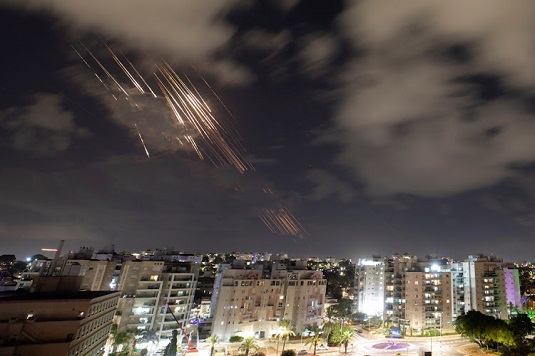
As the third gulf war drags into its fifth week, neither the end nor the end game are anywhere in sight. Big bets on the stock market before Trump makes an announcement are now routine. And the President's remarks are as incoherent and contradictory as ever. "We're talking to nice people in Iran" one hour, the next is a threat to smash power stations and destroy desalination plants. He says negotiations are ongoing, while Tehran denies any such dialogue. The bombs keep raining down from Iranian skies, while in return their ballistic missiles and drones prick Israel's Iron Dome hype and thwart US defences to make life at 13 of its regional bases difficult. Here, Keir Starmer castigates the Tories and Nigel Farage for wanting to drag the UK into this war, while at the same time the US Air Force is using these islands, as well as Cyprus and Diego Garcia for "defensive strikes". Airstrip One is very much part of the conflict.
It doesn't take much to bamboozle Trump, but the White House and military planners cannot grasp why Iran is still fighting. The boasts about annihilating the navy and air force are noisy brags, but do contain some truth. Conventionally speaking, Iran cannot hold a candle against the firepower America and its Israeli satrap can field. So why aren't they surrendering? Why aren't they keen to cut a deal? Why haven't Iranians taken to the street to depose the regime? Instead, Iran is absorbing the punishment, following through with promised retaliation, shouting its defiance, and trolling Trump with Lego memes. He was expecting a gift-wrapped victory, as per Venezuela, or perhaps an Iraq-style collapse into barbarism. Something that could be sold at home as mission accomplished and, for the Israelis, the elimination of the one regional power that goes some way to matching them. None of this has happened, nor is it likely to happen.
The inscrutability of Iran, its refusal to play by the White House's rules of war is not new. It was something dissected with precision by Jean Baudrillard over 20 years ago in his famous essay, The Spirit of Terrorism. Written in November 2001 and reflecting on the September 11th attacks, much of what he diagnosed then carries over to the Iran war and the country's - apparently baffling - resistance to overwhelming force.
On the spectacle of the attack on New York, Baudrillard wrote the destruction of the Twin Towers fascinated and appalled because of their position in the global order. It symbolically embodied American-led globalisation. But, at the peak of its power, order begot an internal will to disorder, a dream of destruction fed by the conveyor of Hollywood disaster movies. As he put it, "Very logically - and inexorably - the increase in the power of power heightens the will to destroy it." (The Spirit of Terrorism and Other Essays, pp 6-7). Entertainment was meant to exorcise this suicidal impulse through pyrotechnics and special effects, but instead of dampening it down it readied us for catastrophe, almost to the point of desiring the spectacle of disaster. The West was primed for September 11th long before it happened, and the spectacle of the attack was captivating precisely because it showed the mortality of the world's greatest military power. Trump, as a television man, understands the superficiality of the spectacle. Burning Iranian cities and cratered infrastructure is dazzling to him, and plays well to his base. But far more fascinating are the military reversals - the banned footage of Iranian missile strikes across the Gulf states, the hard-to-find smashing up of US military bases, of Israeli cities mourning their dead and counting the cost of demolished districts.
The spectacle of one's own defeat goes beyond the furtive hunt for concealed imagery. It's seen in the endless reams of punditry. The discussion of how, come what may, Iran can exert its control over the Strait of Hormuz. Of how targeted bombing taking out leading regime figures, past and present, has solidified the Iranian position. How Trump's war is spiralling into global economic chaos. How, despite the severe asymmetry in the respective militaries, the US is on the brink of a catastrophic strategic defeat. The talk is of nothing else. The spectacle is as much about the tarnishing of Trump's star power and how he can lie his way out of the calamity. Like all good reality TV, the audience wants his actions to rebound back on him in abject humiliation.
What makes this more acute for Trump and the US is that Iran are refusing to abide by their rulebook. Baudrillard talks about the singular character of large scale suicidal terrorist attacks. In a system of generalised exchange, which American-led globalisation is, this kind of terrorism cannot be "exchanged" - there is no equivalent of it. 20-odd years ago pundits characterised the domestic terrorism in Europe, be it of separatist/nationalist provenance or rooted in political extremism of the left or right, as entirely understandable. Their goals were within the horizon of the modern, if not theoretically possible within the prevailing system. But suicidal Islamist terror was not. The very thing Western societies try and deny - death as a rude tragedy, as the worst thing that could possibly happen to any of us - lies at the heart of its fundamentalist nemesis. This itself is an inevitable outcome of the free, unhindered, and unbalanced operation of global capitalism since the end of the Cold War. Baudrillard argues that the duality of struggle, of good and evil, or capitalism and communism, are as interdependent as they are opposed. When one triumphs over the other, as the principle of good has in the operation of our system, and capitalism has versus its other, the defeated party becomes disarticulated but autonomous. Resistance to and the rejection of globalisation assumes an unpredictable virality, of which Islamist terrorism was one example. And one that, because its existence lies in the inherent contradiction of the system's victory, appears anywhere and everywhere against which the most powerful society in existence appears impotent.
The virality has moved on since then, but the character of Islamism has not. The Islamic Republic is now the repository of this logic. Iran's defiance attacks the logic of an order based on the positivity of life. By propaganda and by deed, the Iranian state is willing to stake its lives and those of its citizens in what amounts to a symbolic challenge. It knows Iran cannot possibly win a military confrontation, but through sacrificing itself while inflicting damage on the US, Israel, and the Gulf states, it assumes the monstrosity of terrorism, of a fundamentally 'other' foe that will not yield. Faced with such an implacable opponent, of seemingly suicidal defiance, the US is powerless. It can commit troops to a ground invasion, carry on the bombing, see through the promised destruction of civilian infrastructure - but because the Iranian state will offer up any number of lives to maintain this position, the US is doomed to defeat. For Baudrillard, as it was for the 9/11 terrorists the same applies here. For the Iranians are in a duel with the Americans, it is very personal. Their maximalist demands - reparations for damages, closure of American bases, sovereignty of the Strait - dovetail with the "internal" Western desire. Both want to see the US humiliated, not liquidated. Hence Iran's responses to missiles and bombs are missiles and drones, its counter-violence is governed by a symbolic logic, not the operational calculation of x airfields destroyed, and y soldiers and civilians blown up. Trump's empty boasting about victory secured followed swiftly with fire and brimstone is the usual bombast that ordinarily keeps his opponents unbalanced, but Iran has rejected this logic. And that is why underneath it all, panic is the mood among White House insiders, the military, and their allies abroad.
Trump then is looking for the exit ramp, and nothing he does now can look like a victory. More killing and more unnecessary destruction is, sadly, entirely likely. But the strategic defeat has already happened. Iran knows this, and so does the rest of the world.
Image Credit
Monday, 9 March 2026
Slipping the Leash

Unusually for a US war of aggression, the UK have proven extremely reluctant to get involved. Keir Starmer tried his best to be accommodating without actually committing British forces. After the initial raids over Tehran he was quick to call on Iran to show restraint, and was equally quick to condemn when their missiles and drones found their targets in reply. When British bases and Gulf "partners"/clients were hit, he announced that the US Air Force were welcome to use British facilities for "defensive strikes". Which is so much evasive lawyer babble to avoid admitting his government's complicity in something that, in theory, should see its instigators in the dock at The Hague. Not that this has impressed Trump, who branded Starmer "no Churchill", and downplayed belated UK efforts to move aircraft carriers in sortie distance from Iran. Trump's cheerleaders in this country couldn't help themselves either. The Tory/Reform press have been attacking Starmer ever since the bombs started falling for not joining in, with preposterous stories that the nature of Labour's voting coalition has stayed his hand. Oh yes, the same party so concerned with Muslim voters that they gave Israel a free hand in massacring Palestinians in Gaza. Kemi Badenoch has dived in, saying Starmer can find plenty of money for social security instead of bullets and bombs. Laughable. Nigel Farage said the UK should be dropping ordinance alongside the US. Both have received backing from Tony Blair. He, unsurprisingly, thinks Britain should follow whenever the White House says heel. Once a poodle, always a poodle.
Starmer's effort to keep Britain to a limited role has little to do with the niceties of international law, and even less to do with electoral embarrassment. On paper, the UK's interests in the Middle East and the Gulf are practically identical to the Americans. They want friendly, preferably autocratic regimes, and Israel's role in this set up is the quick-to-anger gendarme. Iran is the destabilising element who, through its own regional strength and networks of irregular allies and semi-state actors were checks on Israel's aggressive posture and, by extension, the challenger to Western hegemony. This suffered severe setbacks with the obliteration of Gaza, incursions into Lebanon, the bombing of the Houthis in Yemen, and missile exchanges between Israel and Iran over the last 18 months. From Britain and, by extension, Western Europe's perspective Iran had largely been put back in its box. There was now no real threat to Israel. Everything was fine.
Until Netanyahu and Trump started their war of aggression. Britain is not concerned about civilian deaths, be they Iranian, from the Gulf states, or fiercely patriotic tax exiles. It is worried about the consequences of destabilisation. As far as the government and the foreign office are concerned, the war is utterly reckless. The disruption to energy supplies, air travel, shipping, and the sloshing of Gulf money into and through the City are unwelcome costs with a range of politically undesirable consequences. Being at odds with the US is a rarity thanks to establishment slavishness - as typified by the repugnant axis of Badenoch, Farage, and Blair - but remaining separate and disengaged reduces political costs and keeps material costs to a minimum. The price shock and mess of Trump's war is not worth it when the overall outcome will largely be no different to when the bombing started, despite White House hyperbole. The special relationship has proven to be anything but since the razzmatazz of the second state visit, and it appears Starmer, David Lammy, and friends have - rightly - calculated that nothing would be gained from joining this criminal enterprise. All of which helps explain why, for once, we're not being dragged into an unwanted war by the government at America's behest.
Image Credit
Friday, 6 March 2026
Sunday, 18 January 2026
The Softness of the Hard Right

Blimey. On Friday, Keir Starmer put out a statement that said "no" to the White House. The language wasn't tough and it did play into the fantasy that Russia is a threat in the north Atlantic, but it also said applying tariffs on NATO members supporting Greenland is "completely wrong". And, for legal eagles of international law, arguably a breach of the first four articles of the alliance's founding document. Emmanuel Macron was somewhat tougher in France's statement, and the EU collectively have threatened €93bn worth of tariffs and scrapping the US/EU trade deal if the heavy arm-twisting/bullying continues. As Donald Trump might say, it makes for great television.
Fresh from sacking Robert Jenrick, Kemi Badenoch is backing Starmer. As are the sovereignty maximalists and Brexit supporters of this country's right. Right? Conspicuously, Nigel Farage - who was due on Laura Kuenssberg on Sunday morning - cried off. Was he ill? Did he want to avoid a face-to-face clash with Zack Polanski? Or might questions over his Greenland whataboutery and Trump cronyism cause him embarrassment, and help that recent dip in the polls pick up momentum? Farage is not alone in his equivocation over American provocations, however. Last week, Tim Stanley was at it.
In his wretched piece, Stanley pushes the usual peace-through-strength rubbish, in the context of Trump's pirate raid on Venezuela. But rather than Britain attempting to project power, he advocates for a position that his employers at The Telegraph would ordinarily frown on: an almost Corbynist position. He writes, "We cannot defend Ukraine. We might, if we try very hard, be able to, say, construct a decent system of care for the elderly." But this is in the context of saying bon voyage to any influence in foreign affairs. Not so bad, you might think, considering the centuries of Albion's perfidy but what Stanley is trusting in is letting the USA tear around the world as it sees fit. Greenland, Venezuela, Ukraine, they're no concern of ours. We'll sit by ourselves in splendid isolation.
Why are the hard right soft on Trump? Our old friend Peter Mandelson spelled it out last week. The British state, and particularly its military, is integrated into the US projection of global power to such a degree that its operations, as a matter of course, need Washington's nod. The so-called independent nuclear deterrent cannot be supplied without US support, let alone launched. And because the City remains the key global centre of finance, the dominant wing of British capital is highly internationalised but, in the main, bound up with US capital. Sections of the ruling class are so compromised, particularly its most class conscious sections - which just so happen to be the ones (rhetorically) obsessed with sovereignty. They rightly see the US as the main protector of their interests, because they're so closely intertwined. It means that much of the right, most overtly the Tory press and Reform, can at best be ambivalent and at worse outright apologists for Trump's antics. Hence dullards like Stanley who argues that an American world is fine, even one as brutal as Trump's USA, is entirely fine with him and his employers.
Image Credit
Sunday, 4 January 2026
Playing the Supplicant

Having lost their chief Trump whisperer to disgrace, nothing can be done to jeopardise cordial relations with the White House. In an uncharacteristic moment of honesty, the Prime Minister spelled it out on Sunday morning. That is the special relationship is maintaining Britain's status as Washington's favourite supplicant. The intelligence apparatus and the military are so thoroughly integrated into US operational command that, to all intents and purposes, the British state does not have sovereignty over deploying its forces. It always has to "inform", or to be accurate, ask the Pentagon for permission before taking action. Funny how the right in this country have never complained about this infringement of our independence.
Sundry liberals got a bit excited early in 2025 after Trump's initial bouts of rudeness. European governments realised that America was an unreliable ally and EU/NATO countries would have to look to themselves to fend off Russian subversion and aggression. This slice of cringe did numbers on social media as there was talk of "going alone" and positioning a nascent European superpower as the real bastion of liberty. But there were practical questions of collective security and these apply to Britain as well. Starmer's trumpeting of increases in military spending is a crowd pleaser to the Stop Russia Now sliver of elite opinion and allows them to believe Britain is heading in the same direction as the rest of Europe, but this is not so. There is nothing in the government's actions or comms to suggest they're looking at even slightly untangling themselves from the US "partnership".
The dominant section of the British ruling class - the commercial and financial capital of the City - is also closely intertwined with its US counterparts, and a plurality have long hitched their interests to the US as the guarantor for open markets around the world. It was therefore no surprise, considering his proximity to these parts of the British establishment, that Nigel Farage said "The American actions in Venezuela overnight are unorthodox and contrary to international law — but if they make China and Russia think twice, it may be a good thing. I hope the Venezuelan people can now turn a new leaf without Maduro." And, as we've seen, where the right goes Labour follows. Supplication and slavishness to the US is embedded in UK bourgeois culture, and that finds an echo in the common sense of "Atlanticism" in the Labour Party. And there are no crimes even the most extreme, reckless, and right wing American president in history can commit that would cause our country to step away from its subordination to Washington
. Image Credit
Saturday, 3 January 2026
Trump's Venezuelan Oil Piracy

Maduro, like Hugo Chavez before him, has always been objectionable to sections of the US ruling class and their foreign policy establishment. Venezuelan socialism was always overstated, but that's beside the point. The US has been denied tribute since US oil firms were effectively turfed out in 2007 - unless they submitted to giving Petroleos de Venezuela, the state-owned national oil company, a controlling share of their operation. Exactly what Trump is insisting TikTok does as the price of doing business in "his" market. The "official" reason for Maduro and Flores's arrests and the bombing of Caracas - drug trafficking - is but a pretext, regardless of the evidence of Maduro presiding over a narco state. As this piece from November by a liberal think tank argues, regime change under American sponsorship is unlikely to stop the flow of drugs. Those of us with memories will recall that when Latin America was awash with right wing, Washington-backed caudillos they weren't much of a bulwark against the rush of cocaine to the north. Where would Trump's parties in the 1980s and 90s have been without it?
None of this needs second-guessing or hard thinking about shady motives. In Trump's press conference on Saturday morning, he said that "we", as in the US, will be selling Venezuelan oil. That "we" are going to make a lot of money, and that the US running the country won't cost anything because the cash to pay for any occupation, restructuring, and US oil interests "going in" will be met from the wealth pumped from the ground. He expects some kind of reparations as well for the "damage" Venezuela has caused the United States, and for good measure, he issued casual threats in the dircction of Cuba and Colombia.
What sundry liberals and centrists either side of the Atlantic are seeing is the US as it routinely behaved toward developing states throughout the post-war period. Trump forgoes the lip service and usual hypocrisies that attend military incursions because he's blunt about US interests, and because he knows no one is going to challenge him. The European states, which fancy themselves America's peers, have either prevaricated and avoided making a comment or fallen into line. Trump knows that when he says jump, the Europeans will do themselves a mischief trying to out-leap one another. And this is part of a pattern. The brute deployment of US firepower reflects the openness with which Trump enriches himself and the oligarchs around him. A government by and for billionaires, they don't try dressing up as anything else. And this is paralleled here too. Our own government cares little for democracy or ideas. If it collectively cares about anything, it's the future advancement of its senior members after politics. The Tories and Reform offer nothing else either, apart from more racism - which even here Labour has tried outflanking them on.
Trump's international piracy is, obviously, something he and his lackeys were agreed on. But it typifies a wider trend across the West: the assertion of authoritarianism and, with that, the open and unquestioned dictatorship of capital.
Image Credit
Thursday, 27 February 2025
Trump/Starmer

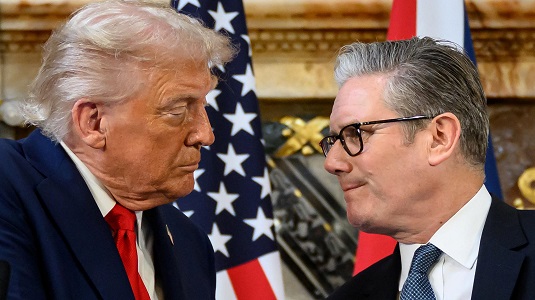
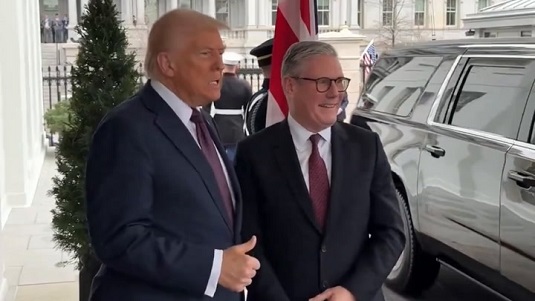
But Starmer got much more than that. Yes, the government's increased military spending was noted and appreciated by Trump, and the letter from the King inviting the Donald for an unprecedented second state visit went down very well indeed. No one does flattery quite like the Brits, and so Starmer will come home lugging two big bonuses: the possibility of a trade deal (hello again, chlorinated chicken!), and US backing of the Chagos Island plan. The very same one Kemi Badenoch and Nigel Farage have berated Starmer for because it serves China's interests or something. I look forward to the leader of the opposition rising at the next PMQs and taking credit for the negotiations she was against, until Trump supported them.
Trump also spoke approvingly of the Ukraine mineral deal that has been cooked up in double quick time. Asked by the BBC's Chris Mason about whether the President still thought Volodymyr Zelenskyy was still a dictator, Trump replied dead pan, "Did I say that? I can't believe I would say that". Some would take that as evidence of cognitive decline. Others as someone who enjoys toying with and discombobulating the press pack. Either way, the Ukrainian president is due to visit Washington, and while Trump refused to be drawn on security guarantees he's unlikely to begin digging without the threat of force backing US investments. However, knowing most of the resources he wants to dig up are in the Russian-occupied east, a partnership there with Putin's regime is unlikely to spark off a shooting war once the signatures are on the armistice. Therefore, the security guarantee isn't there in words but it's implied in the scheme the White House are drawing up for Ukraine after the war. In short, Starmer got all he wanted and then some.
The Prime Minister knows he had to walk a tricky tightrope with Trump. He knows how unpopular he is here (and undoubtedly there will be a large crowd welcoming Trump to London, just like last time), how toxic Tony Blair's relationship with George W Bush was, and would like to avoid similar problems. But while most don't like Trump, public opinion knows that Starmer cannot denounce the president from the roof tops and has to deal with him. The game of diplomacy must be played, and Starmer has so far managed this well. He had to avoid was looking like a supplicant, and for those watching at home this pit fall was side stepped. For now at least, where domestic politics are concerned, Labour is probably going to avoid any negative fall out from this meeting. But it won't always be as easy as this.
Image Credit
Wednesday, 26 February 2025
The Obscenity of Trump Gaza
Tuesday, 25 February 2025
The New Realpolitik

There was also a speech by Kemi Badenoch, who readers might recall is the leader of the opposition. Trying to pre-empt whatever Starmer was going to announce on Tuesday afternoon, the Tory leader demanded an increase in military spending to 3% of GDP by gutting foreign aid entirely. She also doubled down on a suggestion made by James Cartlidge, the shadow defence minister, on Sunday's Laura Kuenssberg. He floated the idea of cutting more from social security for disabled people specifically to buy bombs and bullets. Badenoch confirmed that further "savings" could be made from the welfare bill, one of many "painful decisions on government spending" she would find morally wrenching in an unfortunate world where she becomes Prime Minister.
She went much further than Starmer did on Britain's place in the world. Badenoch said Britain believes rules are important because it is a trading nation. "... other countries are breaking the rules and we need to get serious about that and not pretend that those things aren't happening ...". Is she saying that the UK should take rule breakers to task for flouting global obligations, or is she suggesting we should be prepared to discard them ourselves? The implication tends toward the latter as she attacked Britain's membership of the European Convention, saying the ECHR should not stop this country from doing what is right for its people. This is "conservative realism". Not the "progressive internationalism" supposedly characterising Labour's approach to world affairs (a demonstrably stupid charge).
"It was so bland, formulaic, and unsurprising that it would have made Chat-GPT blush" went Conservative Home's scathing review. Quite. But Badenoch's address wasn't without politics. Because the Tory leadership are desperate, desperate to court Trump's administration they are in their own pathetic, twee way pantomiming US unilateralism and prostrating themselves as doormats and supplicants. Ironically, the US strategy they're kowtowing to was the stock-in-trade of the Tories themselves for the latter half of the last government. This was sovereignty without limits, or to put it more baldly, power without checks. Having seen off the encumbrances of the labour movement and institutional autonomy within the state during the Thatcher/Major years, and then extricating the country from the very limited checks on executive authority represented by the EU via Brexit, the Tories want to set Britain free from any remaining obligations, including those enforced by treaty, allowing it to pick and choose. For what purpose? To give them maximum flexibility to manage class relations at home in an uncertain world where unexpected, unwelcome upsurges happen.
But this is so very academic considering how Badenoch is exceedingly unlikely to see the next election as leader, let alone be within a shout of capturing Number 10.
Starmer, however, must be eagerly awaiting how this militarist turn lands. Yes, it will go down well with with the Donald on Thursday - especially the move to cut foreign aid (which is equally as stupid as the USAID cuts, considering how much soft power is bound up with the disbursement of funds). But domestically, more military spending might cut the mustard with the Reform-curious reactionary Labour voter. It's Britain standing on its own feet and not being reliant on America any more (therefore being implicitly anti-Trump), while being framed as against Russia - something that Nigel Farage and the other bad boys of Brexit have an ambiguous relationship with. Starmer is pummelling Reform exactly where they have a significant weakness and are in a position to challenge its patriotism, and without Reform having a convincing counter-argument. Starmer, therefore, is well positioned to reap some much needed political capital from the changed circumstances and reverse Labour's mediocre polling position. Badenoch? Not so much.
Image Credit
Monday, 17 February 2025
Explaining Insanity

That Donald Trump, coming over here and tearing up the post-war international order, putting a question mark over the United States' support for Europe and chumming up to Vladimir Putin. His second coming has continued as it started: unsettling friends and upsetting certainties while turning everything the new administration touches into chaos. Who can disagree with Keir Starmer that, from the standpoint of great power politics, this is a "once in a generation moment"?
The calling of an emergency European summit sans the US in response to the Trump "peace plan", that freezes Europe and Ukraine out while he and Putin draw new lines on the map is the biggest breach in the Western alliance since the Suez crisis. Then, in no uncertain terms, the Americans said the Anglo-French-Israeli invasion of Egypt was a no and that overseas military adventures without Uncle Sam's blessing were over. With talks between the US and Russia to start as early as Tuesday in Saudi Arabia, it appears now that Trump wants to break with seven decades of foreign policy common sense and let Europe do its own thing. Suddenly, the talk is about Europe ramping up military spending and huge numbers of soldiers being shipped to Ukraine to act as peace keepers to police the eventual peace. Starmer was quick to volunteer British troops for any such force, with estimates for the combined mission topping out at 100,000 soldiers. But also Starmer as the "bridge" between an aggressive US and an appalled EU/rest of NATO has carried on talking up the need for US security guarantees to back an armistice and a permanent end to the war. Which will probably come to pass, seeing as Trump has made no bones about his desire for Ukrainian mineral stocks. Though it is worth noting the bulk of these materials are in the eastern Russian-occupied zone of the country.
For liberal internationalists, the supporters of the fictional "rules-based order" it's enough to drive them into despair. The rights of a small nation trampled on and disregarded as the big players sit down to haggle over its fate is a grotesque spectacle. But what Trump is demonstrating is the naked truth of global politics. The US is the (declining) hegemon, but is dispensing with the usual protocols and politesse about "allies" and "partners". But what is the game plan here? Not normally known for his political insights, on Sunday's Laura Kuenssberg Reform's Richard Tice said this was the hardball way of ensuring Europeans meet a long-held Trumpist aim: a collective increase military spending so the continent's security is no longer bankrolled from the Oval Office. This take is fine as far as it goes. It would allow for more tax cuts at home, which Trump can then crow about. But it only goes part of the way.
As forecast before the election, Trumpism wanted to shake down the state for the benefit of the billionaires. Not just so capital can pocket more tax cuts and enjoy a freshly enfeebled regulatory environment, but to ensure the balance in class relations is tilted further in their favour. Cutting the state reduces the checks and encumbrances placed on capital by generations of workplace, court room, and legislative struggles. The prize here is the sovereignty of unfettered class rule - a project identical in intent, but much larger in scale than the obsessions of the Conservative Party in this country.
Trump's rude antics overseas are an extension of the domestic project. Never mind the international order he's seemingly intent on smashing up was constructed by the US for America's benefit, Trumpism here is the extrication of the US from obligations to allies (if they're not deemed in the White House's immediate interests), and a decisive move away from soft power operations so the US can bestride the world as a military colossus. The peace-through-strength impulse of Trumpism is really strength-through-fear, of the presidency openly and clearly declaring that it alone is sovereign and nothing can stop US capital from getting its way. This is not a new isolationism, as the talking heads on respectable podcasts keep saying, but a shift in the US's imperial orientation to the world. An overly aggressive posture rather than diplomacy, a readiness to rely on threats and cajoling if not force to get its way. The limits of such an approach are not infinite, but they are distressing for anyone unused to seeing international power politics for what they really are.
In other words, Trumpism - despite its chaotic outbursts, upending of custom, and seemingly self-defeating decisions - is not an expression of insanity. Its actions over Ukraine and the rapprochement with Russia are the open politics of the American oligarchy. Once again, it comes back to interests. Class interests.
Image Credit
Thursday, 6 February 2025
The Limits of Trumpism

Then on Tuesday, he announced the most Trump-brained scheme imaginable. Welcoming indicted war criminal, Benjamin Netanyahu to the Oval Office the president announced his scheme for lasting peace in the Middle East: expel all Palestinians from Gaza. Under this "initiative", Israeli troops would withdraw and US troops would come in to facilitate the relocation of the remaining population to neighbouring Arab states. Not having consulted the governments of these countries, and Amman making it clear that such an expulsion would mean Jordan going to war with Israel, it's fair to say the proposal hasn't landed well. White House pressers and Trump's State Department stooge, the ultra-Zionist Marco Rubio, found this too much to stomach. Any transfer would be "temporary", he said and wouldn't involve any American troops. Unfortunately for little Marco, the boss has other ideas.
On his Truth Social vanity site, Trump restated his support for removing Palestinians. Gaza should be turned over to the US after they've been resettled. And how is this going to happen? Presumably, by Israel. Which would can the pause in the massacre and the exchange of hostages and spark off another round of bloodletting. But all Trump can see are the beach front real estate opportunities, of turning the site of this century's live-streamed genocide into a tourist trap. What a moral blank of a man. And one unlikely to get his way.
It was far from intentional, but Israel's indiscriminate "revenge" for the 7th October Hamas offensive sparked off a series of events that consolidated the State Department's Middle Eastern objectives. Hamas and Hezbollah, severely weakened. Iran's military capacities diminished. Supply routes from Tehran to Beirut curtailed. Al-Assad gone. Russian bases removed. And client Arab regimes safe from the backlash against their craven acceptance of the massacre, for the moment. Trump's comment alone threaten to reverse the strong US position by uniting Arab publics and governments against America. And the only way such an operation could be achieved is by a US occupation, which would lead to hundreds if not thousands of US soldiers heading home in body bags, an even more febrile Middle East, and undoubtedly a turn away from America to China. And, for that matter, a global distancing from the US. It would be an unparalleled and grimly ludicrous failure of statecraft.
And there's the home front too. No one among the MAGA base are keen to see American lives expended in Palestine. No Republican member of Congress wants to bleed votes. And that's before we get to the humongous anti-war movement Trump's stupidity would touch off. The new White House might want to bury politics-as-usual under a blizzard of unhinged and vindictive executive orders, but not even the Donald's tangerine dream world can ignore political realities.
Following the Steve Bannan play book of "flooding the zone with shit", the into-everywhere-at-once chaos of Trump's presidency has discombobulated and demoralised swathes of bourgeois opposition that fashionably associated with "the resistance" between 2016-2020. Which itself takes advantage of the zero preparation the Democrats have undertaken for life in opposition to Trump since their miserable failure in November. But doing so much at once threatens opposition on all fronts too. Despite this, the administration cannot help itself. That having re-won the presidency by something of a sliver, different sections of the Trump coalition are going fast and hard on meeting their own individual objectives. It's every oligarch for themselves with little sense of a common project or for things like maintaining popular consent for their rule. In Musk's case, it's dismantling regulators and shaking down the state, and smashing up other agencies as red meat for the base. Presently, this behaviour has stunned domestic politics and has left America's allies/satraps aghast and consequences there will be for the US in general and Trump's presidency in particular. The retreats on tariffs and welfare cheques, and the speed at which decisions are made are demonstrative of a fundamental weakness in the Trump project. It is not time for opponents to give up or, worse, bend the knee. Amid the razzmatazz of reaction lies a regime vulnerable to elite and mass opposition. Trump and his acolytes are testing their limits, which makes now the best and potentially most decisive moment for fighting back.
Image Credit
Sunday, 19 January 2025
Pausing the Massacre

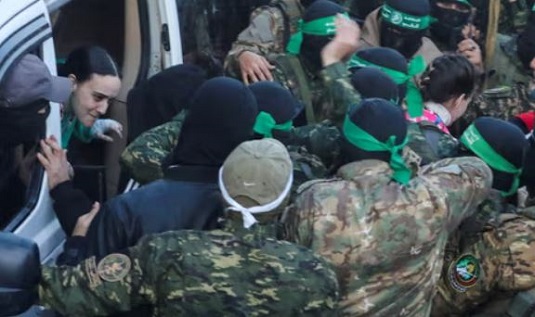
The sorties might have paused, but some things never change. At the time of writing the BBC News website leads with four stories about the three Israeli captives released as Hamas's part of the ceasefire deal. The dedicated Israel-Gaza War [sic] page is little different. 'What was it like to be a Hamas hostage?' goes one of the stories. 'Who are they?' asks another. Nothing on the Palestinian hostages Israel is releasing, on the abuses and torture meted out to the incarcerated. And you can forget anything about extra-judicial killings in Israeli jails. There are no interviews with Palestinian families welcoming home their loved ones, no human interest portraits about people being united amid the rubble of Gaza. The active phase of the massacre might be at an end, but the dehumanisation of Palestinians by the BBC continues unabated.
When the deal was announced last week, social media was awash with self-congratulation. Democrat supporters were praising the leadership of Joe Biden and thanking him for bring such a terrible episode of recent history to an end. It's as if the 50,000 tonnes of weapons shipped from American shores and making available United States surveillance capacity in service of the massacre of the Palestinians didn't happen. It was gut churning. But just as objectionable was their employment of the truce to score points against Donald Trump. "This is the Dems' victory. Trump had NOTHING TO DO WITH IT" was the flavour of many a contribution. It was, of course, completely wrong. Biden needed something for his legacy other than prices galloping ahead of wages, and Trump wants to start his second presidency on a high note. And so we had close collaboration behind the scenes in making sure a deal was done.
The truth is, as far as the US is concerned, Israel's massacre inadvertently led to rebalancing the Middle East squarely in the State Department's interest. Hamas might claim victory, but its most experienced cadre are nearly all dead, its tunnel network partially demolished, and its ability to wage asymmetrical warfare severely blunted. Likewise Hezbollah in Lebanon. The IDF's invasion was much bloodier than military planners were expecting, but its capacity is also stymied. It also appears the "reply" to the Iranian assault on IDF targets was more effective than the damage Israel sustained. And there was the small matter of Bashir al-Assad's collapsed regime, an Iranian ally, and the subsequent withdrawal of Russian military assets from Syria. The US did not foresee any of this, but with the benefit of hindsight the deaths of tens of thousands was a price they were happy for the Palestinians to pay for their regional goals to be met.
And now? Trump wants to keep everyone guessing with regard to his foreign policy, but it's not hard to discern what his priorities are. There is bipartisan agreement that China is the big threat to American hegemony. Biden did nothing to help thaw relations with Beijing, and Trump is keen to big up their "threat". It seems likely he doesn't want any distractions from confronting Xi Jinping. So a becalmed Middle East with Israel the regional arbiter, some sort of peace in Ukraine with a view to US rapprochement with Russia, and perhaps a rejuvenation of the North/South Korea peace process. Success is not just about boosting Trump's ego as a deal maker, they are steps aimed at isolating China diplomatically and reasserting American leadership on the world stage. By the end of his presidency and regardless of the horrors Trump commits domestically, centrist and establishment Democrats will show their appreciation for his positioning by carrying on where he leaves off - just as retiring old Biden did.
What that means for Israel and the Palestinians is anything but a lasting peace. The occupation continues, and so the resistance will continue. Assuming Trump's State Department follow through with the logic of peace through strength for the Middle East, that means an endless flow of weapons to Israel continues, and the turning of a blind eye to the pre-7th October business-as-usual of internment, "targeted" assassinations, and sporadic punishment bombings. Meet the new peace, just like the old peace.
Image Credit
Sunday, 8 December 2024
The Death of a Dictatorship

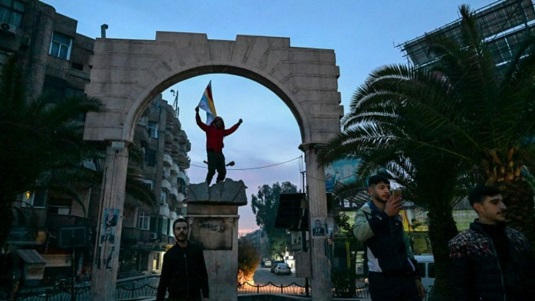
There are those who are arguing that the fall of Assad is an outcome of US-Israeli activities, and that the rebel movement Hayat Tahrir al-Sham (HTS) - whose offensive drove the final nail into the regime's coffin - is about to consume Syria in the darkness of an Islamist caliphate, with full backing of the US and Israel. But this gives the West and its clients too much credit and reduces international politics and war to their manoeuvres only. Rather, what has happened is the unforeseen outcome of the acceleration of the Middle East's instabilities, which began with the 7th October Hamas offensive and the appalling genocide Israel has carried out in response.
While there are also domestic political reasons why the United States have generously supplied Israel the weapons necessary for the ongoing massacre of the Palestinians, as previously argued the relationship between the two is straightforward. Israel is a tool of US foreign policy, and its reason for existence in the eyes of the State Department is to enforce the US-led global order. As we'll see when Donald Trump takes over, this is likely to include recognising Israel's annexation of more occupied territories so the new administration can present itself as the presidency that brought "peace" to the Middle East. That's for the immediate future. In the present under Joe Biden, the atrocities in Gaza - despite unconvincing hand wringing - are justified because it's a "war" against Hamas, and therefore rooting out an Iranian proxy. Likewise, the Israeli army's confrontation with Hezbollah in Lebanon was far from the one-sided fight it's typically accustomed to, and poor performance on the battlefield is why Israel quickly suspended ground operations. But its programme of air strikes seriously degraded Hezbollah's capacities, and regular bombings of Assad regime targets and Iranian assets in Syria stemmed Hezbollah's supply of arms and the support Assad has enjoyed from Iran throughout the civil war.
Israel meeting the US's war aims is only part of the story. The Assad family have never benefited from popular consent, choosing instead to rely on fear and coercion. At least outside of the Alawite minority. When Hafez al-Assad seized power in 1970 he institutionalised sectarianism, ensuring that anyone who became a figure in the state had to have a power base among this community. Or, to be more exact, its elite cadres. This included non-Alawite Sunni Arabs. Assad also moved Syria away from Ba'athist commitments to (state) socialism. He championed private property and sought development along capitalist lines, which handily enriched his family and those of his cronies. It was the same old story: kickbacks and the dubious channelling of state funds into enterprises owned by the elite. None of this prevented its aligning with the USSR, though ostensibly out of "anti-imperialist" and anti-Israel commitments. The domestic state of affairs exploded toward the end of the 70s with the outbreak of armed opposition, and after 1980 the state cracked down with repression rather than conceding to demands for a non-sectarian state and anti-corruption drives. This culminated in massacres and the levelling of Homs. The repression only loosened by degree for the remainder of al-Assad's life. When his son, Bashir, secured the succession in 2000 there was a brief period of liberalisation in which some of the worst aspects of the regime were shorn, but almost immediately it clammed up again with a wave of further repression. It was almost as if conceding a measure of freedom was designed to flush out pro-democracy oppositionists. This did not stop Syria from pivoting away from anti-imperialism to cosying up with Uncle Sam during the War on Terror. Having previously dealt with one insurgency that was part Islamist, under Bashir al-Assad it, like Gadaffi's Libya, came in from the cold to strike a new deal with the global hegemon. Syria dutifully played its role during the CIA's extraordinary rendition programme - it was a centre for torturing detainees captured in Afghanistan and Iraq.
When the Arab Spring broke out in 2011, mass protests against the regime was met with the customary brutality it had become known for. With ugly scenes filling up television screens, the Assad regime was hypocritically but ruthlessly abandoned by its US patron and condemned. Syria became subject to Western sanctions. As revolution descended into civil war, Assad's regime distinguished itself by killing even more people than its gruesome opposition in Islamic State managed, which had taken advantage of the power vacuum and seized huge swathes of the country. The regime increasingly became paralysed by infighting and passive opposition among Alawites as IS rolled over government troops. This was despite the fact Iran had begun shipping "volunteers" to Damascus to defend Assad from 2012, backed by fighters from Hezbollah. But it was only the intervention of Russia that prevented the regime from falling to Islamist insurgency. This turned the war around, and though unable to reconquer the entirety of Syrian territory the application of psychotic levels of violence stabilised the situation. As a measure of how successful this appeared, it was only a fortnight ago that neighbouring states were engaged in efforts to normalise diplomatic relations. What the temporary victory Putin's forces brought Assad did not bring was a peace dividend. Sanctions and inflation have made the lot of the ordinary Syrian miserable, giving them no material stake in the regime's continuance either. As such, in retrospect, too much repression and too much recession fatally undermined Assad. All it required was a shove.
And that came from HTS. Having operated in an enclave around Idlib for the last seven years, despite its roots in al-Qaeda it has been in running battles with its local affiliates throughout the 2020s. It's this, rather than a desire to appear acceptable to the West or a cloak and dagger master plan to hide Islamist intent that explains their relative moderation, religious tolerance, and degree of pluralism. Its offensive against Aleppo, which seemingly came out of nowhere on the 27th November was like steam-rolling a collapsing barn. Having been softened up by Israeli attacks but sapped by years of internal crackdowns, massacres, and stagnation, the army melted away. Less than a fortnight later from the initial attacks we are here: to all intents and purposes the dictatorship has evaporated.
None of this was expected by the US, Israel, and the so-called international community. It introduces a range of unforeseen complications. Local powers will try and seize the moment to extend their interests. Israel has occupied its "buffer zone" with Syria, and will undoubtedly look to extend it further. Turkey likewise will be looking to guard its "perimeters" in the north of the country, while making life difficult for the Kurds in their US-backed autonomous zone. But both are consequences of actions to which they were bystanders. Undoubtedly, the latter day cold war re-enactment society will be pleased. If Russia's intervention in 2015 was a demonstration of strength and confidence, this marks an eclipse of such ambitions. Attempted air strikes against bridges in the Aleppo region marked its desultory effort at defending Assad's folding regime, and will encourage the incoming administration to play hard ball over ending the war in Ukraine.
But they are not the only ones looking on with glee. The truth is for hundreds of millions across the Arab world, the final reckoning of a hated tyrant will give heart in the same way the eruption and initial victory of the Arab Spring in Tunisia and Egypt did over a decade ago. For Cairo, the Gulf's absolutist monarchies, for the opposition in Iran, and even here in the West, successful uprisings help encourage and embolden movements from below. As establishment figures welcome Assad's fall, and particularly so in authoritarian states, there is always that sliver of fear that they could face a similar fate. That a movement of the immense majority could come and sweep them away.
Friday, 8 November 2024
Amsterdamned

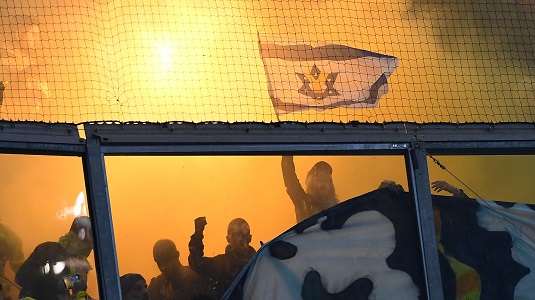
In case you haven't been on social media today, for the last three days footy hooligans attached to Maccabi Tel Aviv have rampaged through the Dutch capital. They have attacked Arab and Arab-looking passers-bys, caved in the windows of buildings flying Palestinian flags, and sought at every turn to provoke fights with locals. At the match they disrupted the minute's silence for victims of the flooding in Valencia, and before and after tore through Amsterdam shouting "death to Arabs!" and mocked the bombing of children in the ethnic cleansing of Gaza. And so fists and boots of the away fans were met by the boots and fists of the home end. A common or garden tale of football-related violence from a team that has a far right firm, and no more newsworthy than that. Until it became something else.
On Friday morning, the Israeli press reported the IDF were sending a team to Amsterdam to rescue citizens from a "pogrom". Taking the cue, virtually the entire West European media followed suit, describing shocking levels of "antisemitism" and the "hunting down" of Israelis. This BBC report is typical, describing how "youths" used scooters in hit-and-run attacks on innocent footy fans. The Dutch king typified the one-sided denunciation of the violence, siding with foreign thugs over his subject's right to self-defence. The rest of establishment politics have weighed in, with David Lammy denouncing "last night’s antisemitic attacks on Israeli citizens in Amsterdam." The Holocaust Education Trust invoked the memory of Kristallnacht, a phrase Benjamin Netanyahu also used in an address this evening. To put things into context, the complete twisting of what's happened was so bad that even the Daily Mail couldn't go along with it.
Israel is a dependent of the West, and knows how to play its patrons to keep the flow of weapons and money coming. In the UK's case, while the government has acknowledged that a catastrophe has unfolded they've framed it in such as if they were talking about a natural disaster. They have not attached any blame to Netanyahu's actions, nor the mass enthusiasm there is in Israel for the Palestinian genocide. Having been partners in supporting Israeli operations since it launched its first air strikes, they can't go back on the crimes they are now associated with. Admitting hesitancy in backing Israel on anything threatens to open the damming operation official politics has erected around the aftermath of the 7th October attacks. So far the political damage of supporting Israel resulted in the loss of one Tory home secretary and Labour's underperformance at the general election, including losses to the Greens and the left. The last thing the government and the official opposition want are the full facts splayed across broadcast news programmes, opening up a new avenue of political pressure. The consequences could be strengthening Palestinian solidarity mobilisations and the moving of their complicity in murder up the range of salient issues. Not a place they want to be in because they know it's completely indefensible, which is why they don't bother to try.
Hence they'll be glad Israel has led the way in portraying the aggressors as the victims. It's not as though it hasn't had plenty of practice. And, handily, this exercise in crude propaganda occasioned Israel's announcement that the residents of northern Gaza will not be allowed to return to their homes. What a coincidence. By entirely distorting what has happened in Amsterdam and confecting a pogrom where none existed, Israel benefits from its continuing efforts at equating anti-Zionism with antisemitism, and Western foreign policy establishments and their political masters gain from having their support for Israel put beyond reproach. Though, as they know, the desperation of running this sort of interference cannot stand indefinitely in the age of social media. They are putting off today what they will have to answer for tomorrow.
Image Credit
Tuesday, 1 October 2024
A Proxy and a Meat Shield

Since the 7th October attack by Hamas, virtually every Western power has granted Netanyahu a free hand in the region. The gut wrenching butchery of Gaza had, until recently, garnered nothing but a whisper of protest from European governments. The attacks on Yemen and Syria, the flagrant military actions on Iranian soil, and now the invasion of Lebanon give the impression of a rabid Israel that has slipped the leash of its sponsors. Britain announces a limited moratorium on some weapons it exports, and is castigated by their ungrateful recipients. Germany appeared to slow the flow of arms several days ago, and later denied it was doing so to avoid an establishment backlash. And while Western leaders did their love, love, peace, peace thing at the UN last week Netanyahu took to the stage and peddled the racist rubbish that Israel was waging a war for civilisation. He effectively announced that Iran was next.
The truth is, the West and above all the United States have not reluctantly gone along with but are actively aiding Israel. A fact that is obvious from even a cursory glance at mainstream media sources. Its war aims, the "neutralisation" of Gaza and destruction of Hamas, reducing and, if possible, defeating Hezbollah, and bombing targets in Syria are American war aims. They want Iran's regional influence pared back, and to see it punished for the assistance it has rendered Russia in its pointless Ukraine quagmire. And the State Department, loyally followed by Germany, France, and the UK, have gone about it in the most underhanded way.
The spectacle of a ranting, if not crazed Netanyahu has suited his sponsors very well. With every outrage committed, the Biden administration has cast themselves as the helpless observer from afar. The briefings are on "words exchanged" behind the scenes, of "warnings" and "concerns" that Israel's recklessness could provoke a wider conflagration. While this charade has gone on, Israel has been inundated with Western munitions, and there is ample evidence its intelligent assets and special forces have variously assisted the IDF in their operations. In other words, what we have seen this last year is a reversion to Israel's historic role in the region: as a proxy and as a meat shield for interests beyond its borders. The appearance of Netanyahu's autonomy hides Western complicity. Indeed, it gives every impression that the relation of force is the other way round. That Tel Aviv says jump and Washington and London ask "how high?" The utter cynicism of faux concern and studied helplessness feeds antisemitic conspiracy theories. It positions Netanyahu and/or Mossad as behind-the-scenes puppeteers. And American, German, and British governments are fine with this because they escape immediate responsibility for atrocities committed while seeing their interests served.
At any moment, Joe Biden could have stopped this. He could have picked up the phone to Netanyahu and said no and halted the slide to a generalised Middle Eastern war. Israel is militarily and economically dependent on the good will of the world's hegemon, and would have had a hard time carrying out their colonial campaign of ethnic cleansing and murder by itself. They have done so with American blessing, and it's at America's behest that Israeli bodies will now start piling up.
Image Credit
Friday, 7 June 2024
Sunak's D-Day Clanger

The popular legitimacy of the British state has declined in recent years, exemplified by the relatively muted popular reaction to the death of the Queen and King Charles's coronation. But the Second World War and the role Britain played in the defeat of the Nazis remains a source of pride and nostalgia, particularly for the post-war generation who grew up in its shadow. They learned about the hardships and tragedies straight from their parents. Most families have relatives that served in the war and, in a lot of cases, that has become part of the background of who they are. Even if people don't know the ins and outs of the major battles. They appreciate and respect what millions went through, and feel gratitude for the hundreds of thousands of Britons who were killed at home and overseas.
By ducking out of the commemorations early, ostensibly to record an interview with ITV News to deny allegations of lying during Tuesday night's leaders' debate is a double thumbing of the nose to official ritual and the sacrifices made by those who did not come home. If this was not the middle of the election, in terms of the mores and propriety of bourgeois politics it would be a resigning matter. Especially so now it has emerged that Sunak had to be persuaded by Emmanuel Macron to attend in the first place.
What the hell has happened? For Nigel Farage, Sunak "doesn't care about our culture" (nudge, nudge, wink, wink). This dog whistling doesn't wash. Rather, Sunak's clanger has its roots in his class politics. For one, this place was talking about his lack of nous before it was fashionable. It might be that Sunak is a singly incompetent guy, but this is inseparable from his political programme. Which, baldly put, is to offer absolutely nothing. It was evident from his first day in office, and since then all of his policies have been punitive culture war rubbish. This is about trying to manage people's expectations by offering nothing, so they in turn won't make future demands on the state. Pulling off the class politics of not doing anything requires skill, and that's something Sunak obviously lacks.
This is compounded by what is becoming the worst Tory election campaign ever. Even worse than Theresa May's 2017 debacle which, you'll remember, still managed to get her over the line as the largest party. Sunak's challenge - to keep together a rump from which some sort of recovery might be staged - was rendered almost impossible by Farage's return. And so, he's done what so many of his boss class fellows rail against: he's quietly quit. This checking out is evident from the half-arsed round of apology interviews. With him looking under threat in his own nominally super safe seat, who can blame him if his vista is filled not by the Downing Street dining table but a golden horizon of silhouetted palm trees and sun kissed beaches? Life as a moneybags venture capitalist hanging out in Silicon Valley must seem so much simpler and alluring than the dross of British politics.
It's all over. All Labour need do is sit back, and perhaps have a bit of fun speculating what terrible blunder Sunak will commit next.
Image Credit
Monday, 20 May 2024
Rewriting History

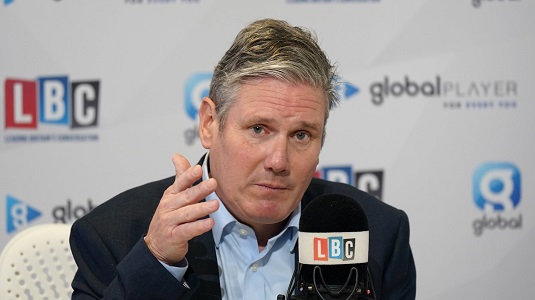
In a now notorious interview with LBC's Nick Ferrari on 11th October, asked about Gaza he condemned Hamas, stated his support for Israel's right to defend "herself", and do whatever it takes to get the hostages back. Responding, Ferrari asked if a "... siege is appropriate? Cutting off power? Cutting off water?" And then came the reply: "I think Israel does have that right." Stated baldly in black on white text, this looks what it is: an endorsement of war crimes. But pay attention to his countenance in the footage. Coming off what was a well received conference speech the day before, instead of emoting confidence Starmer was hesitant and slow, weighing every single word and seemingly terrified of saying the wrong thing. Indeed, if one wants to be generous this stilted, worried Starmer misspoke.
Okay, it happens. Mangling one's words and saying the wrong thing is an every day occurrence if your job involves a lot of talking. However, supposing Starmer did stumble, he was quite happy to let the impression that he supported Israel's war on Palestinian civilians continue. There is, for example, Emily Thornberry - the shadow attorney general - endorsing what Starmer said in her own mealy-mouthed way. And David Lammy, before his 'progressive realism' guff, defending the siege. Indeed, this was the line until Labour could no longer ignore the the corrosive effect it was having on its core support. And then the line changed. It went from supporting war crimes to not only not supporting them, but denying they were ever given the shadow cabinet's backing in the first place. History has been rewritten, and whenever it's raised - as it was recently by Grace Blakeley on Question Time - recalling Starmer's remarks are met with a flat denial.
We know Starmer lies. And his readiness to tell porkies comes from a place of political frailty. Ferrari's gentle probing of Labour's position on Gaza saw the Labour leader almost come apart as he uncertainly made policy on the hoof. One that had nothing to do with principle or even his own personal convictions. It was the one that would keep the press, the government, and the increasingly unhinged Israel lobby off his back. This zone of establishment non-punishment has been occupied by Labour ever since, though the position has evolved from supporting attacks on civilians to being wholeheartedly and very genuinely concerned about the danger of famine and attacks on women on children. Though not enough to support stopping weapons shipments to Tel Aviv. It's no different when it comes to greeting the news of the mooted ICC prosecution. The government says it's a "mistake", while Labour say they respect the court's neutrality. It has nothing of substance to say.
What this tawdry episode says about Starmer in power is his will be a government forever chasing its tail whenever there's some awkward press criticism, or a minister gets found out for dodgy donations, or they come under lobbying pressure from moneyed interests. Last week, the Labour leader's pledge card promised economic stability. But even with a huge majority within reach, it would be rash to expect political stability.