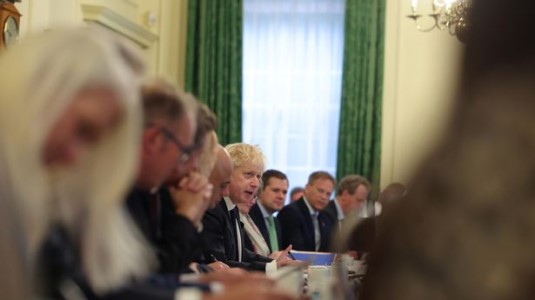
Among the big ticket items was the bumping of Gavin Williamson down to the backbenches. Rumour has it there will be a knighthood in the post to ease his bruises, and knowing Williamson is the worst vainglorious place seeker he's going to insist on the "Sir" at every conceivable function. Up to and including dealings with his kids. As for offences committed during his time in office, Williamson distinguished himself with singular incompetence and arrogance and attracted the brickbats for it, which does provide the Prime Minister some service. The debacle of Covid in schools is the education secretary's fault and not Boris Johnson's responsibility, for instance. But there's only so much punishment such a figure can soak up before the flood of anger swamps the Prime Minister. Williamson was at saturation point and had to go. Moving Nadhim Zahawi indicates that Johnson has a similar role in mind for him. Zahawi has become a relatively familiar government face during the pandemic, but apart from that he's not well known among the public. On the surface more reasonable and more popular in Westminster than his predecessor, it's worth remembering his "reasonableness" extends to backing Johnson from the beginning, and claiming for heating his nags' stables on MP's expenses. A more emollient tone is the most that can be expected, and for his fans on the centre left and columnist land, that will be enough.
The other big casualty was the appalling Dominic Raab. Like Williamson, by the time Johnson shuffled him out of the foreign secretary role he was resembling a punch bag with stuffing spilling everywhere. His incompetence, like that of his boss, received the full glare of publicity following the disintegration of the British position in Afghanistan. And here, Raab performed the fall guy role brilliantly. At a rate of knots, the media spotlight shifted from the humiliation inflicted on the Western allies to the drama of the Pen Farthing animal airlift, and whether Raab picked up the phone to his outgoing counterpart in Kabul or not. A masterpiece of misdirection, having it consume the foreign secretary was a price Johnson was happy to pay. And with the energy bar depleted, he's been demoted - albeit disguised as a promotion - by his appointment as justice secretary, with the deputy PM dunce cap added to spare his blushes. Raab himself is as stupid as he is unsuited as a parliamentarian, let alone any office of government, but Westminster watchers and their appreciation of its history know that the last time the deputy honorific was doled out to ease a demotion - the blessed Margaret's "retirement" of Geoffrey Howe - the worm turned with devastating effect when the time was right. History could well repeat itself, but as we're dealing with Dominic Raab here it's unlikely to be anything other than farce. Moving up Liz Truss into Raab's boots is, from a Tory party point of view, a wise move. She's popular with the wider party and is seen as a "doer" thanks to her modest clutch of Brexit trade deals. Just don't ask about the abandonment of greenhouse standards in the Australian deal.
Meanwhile the actual deputy PM, Michael Gove, was awarded a super department. As politically awful Gove is he has proven himself a competent administrator, which is something of a rarity among Johnson's cabinet of prima donnas and failures. Having carried the Johnson operation on the business side of things, this most obsequious of satraps is in receipt of a mega office combining housing and local government with the official, no one's making this up, title of 'the Department of Levelling Up. As firm believers of 'if you repeat a lie enough the punters will believe it', the suspicion is we're going to see some "radical" thinking applied to housing, given the reputation as a reformer/wrecker Gove acquired when he was at education. When he held the shadow brief under Dave, Gove was interested in increasing the housing supply. But radical action in this direction, like a right to buy for private tenants, for example, is highly unlikely given the Tory dependence on propertied interests.
Naturally, neither Priti Patel nor Rishi Sunak were in any danger. As heirs apparent, getting shot of either would have riled up their followings on the backbenches. But what was entirely predictable was the elevation of the likes of Nadine Dorries and Kemi Badenoch. Dorries finds herself as culture secretary not because of her expanding library of romantic novels (readily available in a charity shop near you), but precisely because she's pig ignorant. Coming to notice as a "colourful" character after 2005 and best known for her stint in the celebrity jungle, Dorries's litany of "gaffes" and outright bullshit is perfect for upsetting liberal sensitivities and acting as a lightning rod for "elite" concerns with things like inconveniently situated listed structures. The same is true of Badenoch. Appointed equalities minister, the unearthing of homophobic and transphobic comments from three years ago are unsurprising. Johnson appointed her in the full knowledge of her views, and is fully aware past and future outrages would, in his view, play well in firming up the Conservative vote ahead of the next election. In true Tory form, that she will give succour to bigotry and make life a misery for precarious and targeted minorities counts for nothing.
Meet the new government, same as the old government. Johnson has cleared out the dead wood, firmed up his position by promoting new meat shields, and has signalled that it's business as usual as far as he's concerned. And with an opposition going nowhere fast, except inwards, the sad, awful truth is he's likely to get away with it.
Image Credit

There are two key points Tugendhat summed up. As a combat veteran himself followed by a stint advising the Afghan client state apparatus, his speech condensed the widely reported disgust and bewilderment other soldiers have reported. To have seen friends and allies killed, sustained injuries, experienced the heart-stopping terrors of ambush, the strain of wondering whether some obscure corner of Afghanistan will be your grave, attending the funerals of colleagues and comrades, and knowing the lasting consequences for those unable to adjust to civilian life after the military for nothing is galling. Some might put a brave face on it by talking up the numbers of girls in schools, but deep down there aren't many servicemen and women who think the lives lost and traumas endured were worth it. And this is a big problem for Boris Johnson. Despite the Tories only paying lip service to the military covenant they are happy to let ex-forces people rot on the streets. It's the Conservatives' open secret, and it's testament to their political skill (as well as the assistance of their media friends) that this rarely becomes a political issue. However, the UK/US withdrawal brings to the fore the real Tory attitude: that they don't give a damn about those who sacrificed themselves for their military adventures.
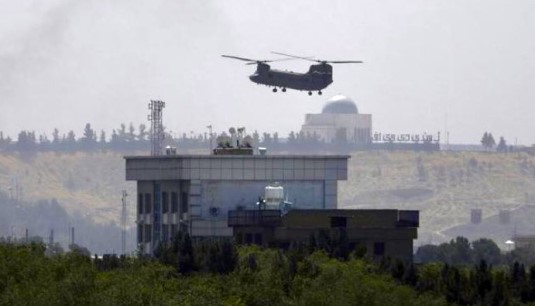
If this wasn't bad enough, there is the carefree attitude Johnson has shown throughout the crisis. Last week as the Afghan collapse grew more obvious, both he and Dominic Raab made themselves scarce by disappearing off on holiday - something Keir Starmer did not fail to make hay with. But even worse, Raab couldn't be bothered to lift the phone to speak with his Afghan counterpart - something the Daily Mail are going heavy on. With the likes of Tugendhat and Johnny Mercer harrying them from the backbench, and the Defence Secretary Ben Wallace (ex-military himself) cutting an apologetic figure on the news broadcasts, pressure is now being applied on a previously safe and loyal segment of the Tory electoral coalition. If there's a moment Blue Labour social patriotism is going to work, this is it.
Then there's the second strand to Tugendhat's speech, the apologia for interventionism. Despite his veiled criticisms of the government, he does not question the right to bomb people overseas while trotting out the customary platitudes. Johnny Mercer, taking time out from his campaign to exempt British soldiers from war crimes charges, summed up the entitlement best. He said "These are new feelings we are not trained to deal with. We're not trained to lose." Indeed. It's difficult to think of another moment in the last 20 years, including Iraq, where the designs of the US and UK alliance have been so comprehensively defeated in full public view. As noted previously, this is significant: it makes the obscene doctrine of "humanitarian" interventionism much more difficult to push in the future, strengthening the hands of the anti-imperialist left and anti-war movement and the isolationist right. And if the domestic scene wasn't bad enough, equally devastating is the positioning of the United States itself.
In his speech on Monday, Joe Biden defended the rapid pull out of American forces and, somewhat distastefully considering the 65,000 Afghans killed fighting alongside the allied military, attacked them for "not having the will to fight." This might have appalled parliamentarians, but what has got the mainstream of warmongers properly spooked is the freezing out of the UK from negotiations by the US, and the refusal of Biden to take Johnson's call. As noted last November, for a number of bourgeois commentators Biden found Johnson distasteful because of his crude populism, his racism, and the devil may care stance to the Good Friday Agreement. Cut from the Trumpist cloth, in this instance it appears the President is closer to the style and leadership of The Donald than our Prime Minister. Cue the ritual jitters about the special relationship, but this has further ramifications. If Biden is happy to do America's own thing without consulting its closest military ally, this has direct consequences for the UK's ability to project hard power. If the US isn't interested, then the UK's posturing as the global bully's sidekick can only ever be that. You can understand how the Afghan debacle appals so much of the establishment on the government and opposition benches: their horizon, everything they've known about their privileged place in the world, looks like it's about to implode.
Image Credit
1. The Taliban have assured the populace and the Western media that everyone is safe, and there will ne no reprisals against those who were part of the previous government. Actions might be at odds with the words, but no insurgency riddled with factions and whose rapid advance is largely thanks to deals cut with localised militias and regional government are about to openly declare a reign of terror, even if this is what they will end up doing.
2. The Taliban's leadership are aware they must placate the Western powers, even as they continue removing their forces. 20 years of war has devastated the countryside in their rural strongholds, but many Afghan cities have been rebuilt. Bombed out central districts have been repaired, electrical, water, and road infrastructures renewed, and the capacities of the state apparatus modernised. The Taliban of 1996 had to build a ramshackle and repressive state from scratch in an utterly devastated country, while the Taliban of 2021 inherit something entirely different. Antagonising the West, for all they know, could unleash a campaign of air strikes that would easily rub all of this out. Therefore the reassuring words, their commitment to prevent Afghanistan from becoming a haven for terrorists again, the retention of UN agencies and aid-related NGOs, and the more welcoming attitude to Western journalists is part of this. In other words, the Taliban are proving adept exponents of statecraft.
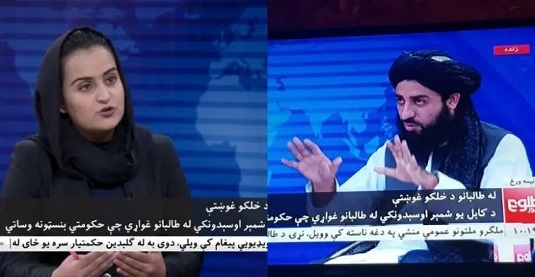
3. The position of women is central to this. Going from the previous horrors of their regime, large numbers of women in Kabul have taken to the burqa and have disappeared from public places. Except for some courageous women who have publicly protested in defence of their rights. Here, the Taliban have fudged the issue, with their spokesman Zabihullah Mujahid saying "The Islamic Emirate is committed to the rights of women within the framework of sharia. Our sisters will have the same rights, will be able to benefit from their rights." Which can mean anything as there are as many interpretations of Sharia as there are Sharia jurists. However, while women have suffered appallingly in Taliban-controlled areas the leadership know it's good optics to talk up women continuing in work and education, and having a woman interview a commander for one of the news channels. This reduces the chances of antagonism with the West and keeps the aid money flowing.
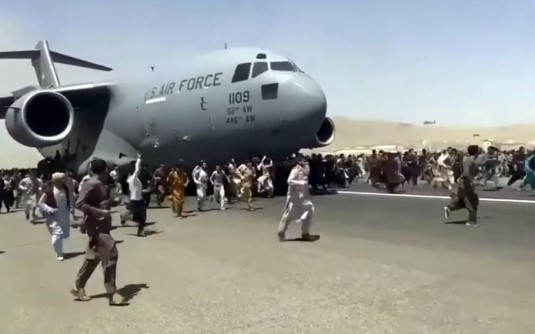
4. Another good reason for not rubbing the United States up the wrong way is the service they and the West are rendering the Taliban. As awful as the scene at Kabul airport was on Monday, it appears the Taliban are utterly uninterested in preventing the evacuation of Afghan civilians who were variously employed by the previous government - apart from some warm words about staying and rebuilding. Here, a layer of the (mostly urban) population are removing themselves from the equation. Potential oppositionists, and potential points of tension with whatever form of Islamism they end up installing as the official ideology are gone. And while they might be an annoyance to the regime as they take to the airwaves safely overseas, the post-occupation recovery will be greatly assisted by whatever remittances they send to relatives remaining in Afghanistan.
5. What's the Taliban end game? It's the retention of power. As the last 20 years have shown, the Taliban leadership are far from stupid and are unlikely to make the mistakes that saw them ousted by the West. They can see from looking at Iran and Saudi Arabia, and how the military elites from Pakistan who've generously funded and supplied them that modernised Islamist states can support theocratic or religiously-aligned ruling classes and repressive religious doctrine. And as controllers of the state, they're well positioned to seriously enrich themselves from the scramble for rare earths. The Gulf states have shown official ideology is no barrier to wealth and (lopsided) capitalist development. The Taliban are unlikely to proves themselves any different.
Image Credit
Readers of a certain age will remember the lead up to the US-led invasion of Afghanistan well. In the immediate aftermath of the September 11th attacks, there was precious little public debate about the wisdom of going in mob-handed to seize Osama Bin Laden and put the regime that sheltered him to flight. Indeed, some might recall the infamous Question Time of 13th September where audience members refused to adhere to the niceties of official mourning and linked these attacks to the violence of US foreign policy across the Middle East and elsewhere. The BBC hurriedly apologised and ate humble pie, but the establishment backlash against this episode set the tone for the subsequent public debate. Critical voices appeared in the liberal press, but the newly-launched Stop the War Coalition and other anti-war oppositionists were out in the cold. The popular mood was hesitantly supportive of action, which was acquiescence enough for Tony Blair, and off to war went tens of thousands of British troops.
This time, however, we were told it was going to be different. The history of past military interventions and occupations were pored over, and the public of the UK and the United States were told this was no smash and grab (not that there was anything left of Afghanistan to grab), but this was a long-term state building project. You might recall, if you were around, that similar arguments were fielded about Iraq too. Our presence in the country was a commitment to bringing Afghanistan into the modern world, rescue the population from medievalism, and liberate women and girls. The practice said something else. More money was spent on humvees and daisy cutters than rebuilding a shattered country. The statelet set up with some autonomy was riddled with corruption the occupying powers not only turned a blind eye to but encouraged - cash binds better than liberal iterations of the white man's burden, after all. And little illustrates this better than the deposed president Ashraf Ghani fleeing to Uzbekistan with literal bags of cash in tow.
Could it have been different? Opinion punditry is awash with assessments. Some will criticise the egregious corruption of the state, and the failure of Western governments to match the commitments made with money. But ultimately this is besides the point. These are features, not aberrations of occupation authorities - a point that should be well understood following centuries of Western colonialism, all-out war, and the "police actions" of the post-cold war period. It couldn't and can't be avoided by enlightened military government, because the fact of invasion and occupation is its root. Hence Stop the War, who sundry cheerleaders of Blair's invasions of Afghanistan and Iraq are, with impressive violations of the laws of logic, holding responsible for the Taliban's victory, have been proven exactly right. Progressive social change, they argue, can only be durable if the dynamism for it arises from within. If it comes on the end of drone strikes, it's an imposition.
What now? Reports are filtering out of the Taliban going house to house in Kabul seeking people on their "list", despite promises given to respect human rights. The future for Afghanistan does not look any better thanks to the West, with the even worse outcome being the Taliban and its allies fragmenting and descending into outright warlordism not an unlikely possibility. As for us in the metropolitan heartlands, the utter waste of the last 20 years will cast a long shadow over future military adventurism - a new political reality warmongers everywhere are going to spend decades lamenting. And, at least in Britain, there's going to be a sense of revulsion and loss among former military and their families. Why have they suffered and what did their mates die if Afghanistan has simply reset itself to where they began? Matters are not helped by the characteristic lack of seriousness shown by the Prime Minister, and the government's refusal, up to now, to discuss the country's obligation to the tens of thousands of Afghans it put in harm's way as interpreters and support workers. There is a political price to pay, and the Tories will try their damnedest, as they always do, to offload responsibility for this mess onto something or someone else.
None of this soft soaps the Taliban. This might be Taliban 2.0, one savvier when it comes to diplomacy and cutting deals with regional powers, not executing Western journalists and allowing aid agencies to stay, but their extreme gynophobia and suppression of select aspects of modernity remains. What happens next? In this discussion between Alex and Paul Rogers of Bradford University's Peace Studies department, Paul explores the difficulties the American-led coalition faced, the division in their foreign policy establishment, the stupidity of the occupation authorities, and how the Central Asian great game is going to play out between Pakistan, India, and China as well as the US. Events have unfolded rapidly since this was uploaded yesterday, but the analysis underpinning it is a must listen.
And don't forget to help support Politics Theory Other out via its Patreon.
What is the point of fisking? They were all the rage back in the halcyon days of the UK Left Network. The point-by-point rebuttal of another contribution largely fell out of use with the passing of first age of political blogging. Yet nostalgia freaks occasionally enjoy giving the form a dusting down. Mark Wallace of Conservative Home is the latest to wheel one out, taking objection as he does to the anti-imperialism/anti-NATO statement agreed by Young Labour's conference last weekend. He says "Impressively, it is stuffed to the brim with ahistorical nonsense – basing its pitch on what appears at best to be a total misunderstanding of British and world history." Bold claims. Let's see how his fisk goes by subjecting his fisk to a fisk. YoungLab are in bold and Mark is in italics. Seat belts ready?
Since at least the mid-nineteenth century, the relationship between ‘the West’ and the rest of the world has been one defined by imperialism
At least the mid-nineteenth century’? If you’re going to cast yourself as an anti-imperialist, at least appreciate the true length of the history of imperialism.
How very dare Young Labour. Because they haven't condemned the Romans for occupying Gaul nor criticised the Spanish sacking of South America, how can these preposterous people possibly call themselves anti-imperialists? Amateurs.
Mark isn't a stupid man, but like most Tories he can't help but be disingenuous. He knows there's a world of difference between the imperialism of slaver societies, absolutist regimes and the imperialism of 19th century colonialism. In his more honest moments he might recognise the hierarchy of nations that dominate the world (the Tories' desire to crawl up the United States' backside, in spite of its idiot president, shows they do), and acknowledge this dominance is wielded in ways some might find problematic, even if he doesn't. And though he disagrees with their analysis, he might accept there is a collection of scholarly work that traces the lineage of these relationships from the War on Terror back through the Cold War, the World Wars and to the pulse of imperial plunder and annexation that establishes a line of evolutionary continuity between them. What continuity might that be? The forcible integration of peoples and territories into the world market to the benefit of the leading powers.
… the North Atlantic Treaty Organisation was formed, in order to enshrine the dominance of American interests.
Or to protect the free, democratic nations of Western Europe from a very real threat of invasion or destruction by the Soviet Union. The Young Labour version of these events is straight out of Stalin’s lines-to-take – and a huge, shameful misrepresentation of the decision of the Attlee Labour Government to join NATO in the first place.
Is this supposed to be a refutation? The United States weren't persuaded of the necessity of rebuilding Western Europe and guaranteeing its security out of charitable or avuncular concerns, but because it believed it was in its interests to do so. It's why it overthrew the liberal democratic (and anti-communist!) government of Jacobo Árbenz in Guatemala and backed the absolutist monarchy of the Shah of Iran until his overthrow. As Henry Kissinger famously observed, "America has no permanent friends or enemies, only interests". America's wars and police actions sometimes enforce economic objectives, and at other times are designed to shock and awe would-be opponents and challengers, and as the US favours confronting weak regimes it gives others an impetus to try and match them.
Second, there was never any threat from the USSR in the immediate aftermath of the war. As this analysis by the RAND corporation - a nest of pro-Soviet apology if there ever was one - makes clear, Western intelligence on the Soviet military was poor. While it concedes the American and British armies demobilised very quickly, it also notes many opposing units and divisions in the East had an existence that didn't extend beyond Stalin's filing cabinet. Nor did Western accounts recognise troop quality. It was only in the latter stages of the war after force of numbers had ground Nazi Germany down that the Red Army could be considered better fed and equipped than the Wehrmacht and Waffen SS. After the devastation visited on Eastern Europe and the resources thrown into reconstruction and acquiring a bomb, your average Soviet soldier was still more likely to suffer worse rations, be barracked in worse accommodation and handle dud equipment than Western forces. This matters, as the huge number of Soviet war dead vis a vis that inflicted on Germany brutally demonstrates.
Third, who's talking about Attlee? Seeing as Young Labour don't mention the 1945 government and focuses on America's role in NATO, it's a clumsy and desperate aside to suggest a "shameful misrepresentation" when there is no representation at all.
Between 1945 and 2000, American imperialism bombed at least 27 countries, assassinated or attempted to assassinate thirty world leaders and tried to overthrow forty governments
I’m not sure ‘American imperialism’ is a person or state, but assuming the author means ‘America’, which exact actions are included in this list? To reach ’27 countries’, the list would have to include: the 1995 campaign to prevent Serbian forces in Bosnia, which had just committed the Srebrenica massacre, from carrying out further atrocities; missile strikes against Al Qaeda bases in Afghanistan in 1998; and bombing Iraqi forces which had invaded Kuwait in 1991. Are Young Labour of the opinion that these actions should not have taken place?
As misdirection and whataboutery goes, this lunge is as clumsy as Mark's use of the semi-colon. He knows there are grisly skeletons knocking about the State Department's closet, like the aforementioned Guatemala. And, thanks to a recent document dump, America's collusion in the murder of 500,000 Indonesians. The one thing that unites these barbarities with the 90s heroism against targets barely able to fire back are interests. If Bush senior and Bill Clinton were in the business of smiting evils, where was the intervention against the sinking of Rwanda into depraved slaughter? That's right, from the State Department's point of view US interests were unaffected, so they stayed away and wrung their hands. I also have no doubt Young Labour would have opposed the actions listed because they have a more advanced understanding of the dynamics and drivers of American military action while Mark's analysis owes more to Autobots vs Decepticons then anything considered and thoughtful.
‘Such episodes include the wars of aggression in Korea in the 1950s …’
Sorry, what? The Korean War was sparked by the North, under Kim Il-Sung, invading the South. It wasn’t a ‘war of aggression’ on the part of the US, or the wider West. Nor was it a NATO action – the defence was mounted by the United Nations. If we hadn’t defended South Korea, then the whole Korean peninsula would now be a hellhole, not just the northern half. Does Young Labour wish that South Korea did not exist as a free and sovereign nation?
And we're off to disingenuous territory again. Young Labour know the Korean War had nothing to do with NATO. Which is why their point three submits that America has bombed "at least 27 countries", to which they follow up "Such episodes [emphasis mine] includes wars of aggression in Korea in the 1950s ...". If you can't argue honestly, it's not worth arguing at all - especially when your half arsed deception is easily exposed. But on the question of Korea itself, while I would accept that describing the American-led UN intervention as an act of aggression is suspect, nevertheless the utter devastation visited upon the north by the US Air Force set the pattern for the shock and awe that was to follow in Vietnam and Iraq. More bombs were dropped on North Korea than the entirety of Europe during the Second World War. The North's claims that only two buildings in Pyongyang made it through the conflict unscathed sound, for once, credible. Also, Mark can chalk up ignorance about the political economy and social development of North Korea as another thing about which he knows little. The country is obviously a hellhole, and a lot of this has to do with its response to abandonment by the USSR and having to maintain its own Cold War frontier itself. The division of Korea has distorted its development. Had the country united under a Stalinist regime it's unlikely to have assumed the absurd proportions of the Kim monarchy and would probably be a lot like contemporary China. Being able to suggest credible scenarios on the basis of analysing social trends and dynamics is a wonderful thing.
The collapse of Communism post-1989 rendered any real logical justification for NATO moot, since the European glacial states no longer needed defence ...
Try telling that to NATO member states in Eastern Europe like Estonia, Latvia, Lithuania and Poland, who feel a very real need for defence against a certain neighbour which has carried out cyber- and real-world attacks against their institutions and citizens.
I knew this would get wheeled out. The West's relations with Russia after the Cold War and fall of the Soviet Union could have been very different. Putin is certainly no friend of leftwing politics. He is a Great Russian chauvinist in the same vein as dear old Uncle Joe, sans the gratuitous brutality but capable of matching him for cynicism and ruthlessness. Yet Putin, like any leader, didn't simply pop out of nowhere. He hasn't stayed atop Russian politics by violence and ballot rigging alone - there is genuine popular support, even if it is fraying and under increasing challenge. Nevertheless, Putin's appeal lies in restoring national pride and prestige to a great power fallen on hard times, and here he has the West - particularly NATO and the State Department - to thank for his aggrieved, Russia-is-hard-done-to narrative. There is a prolonged and running dispute over the assurances given to the USSR during the negotiation over a reunited Germany about whether NATO would expand Westwards. The Russians say the West ruled out an expansion of membership after the dissolution of the Warsaw Pact, and various Western diplomats say no such assurances were given. Alas, the documentary evidence bears the Russians out. From Russia's point of view, running troll farms, buzzing NATO aircraft and piling into the Ukraine conflict are entirely legitimate responses to what they see as aggressive moves by powers that didn't keep to their word. Perhaps if the West had kept to its promises, we might not even have Putin running the show and Russia could have turned out an altogether happier place.
…the European glacial states…
Isn’t that a peculiar phrase? In fact, a Google search reveals this motion is the only time the precise term ‘European glacial states’ has ever been used online. It seems to be an auto-correct of ‘glacis states’, ie the Eastern European states used by the Soviet Union as a defensive rampart or buffer zone. Indeed, it would be more common in English to use the words buffer zone, or Warsaw Pact countries, or former Communist countries – ‘glacis states’ is the preferred name in Trotskyist terminology.
As a former Trot who was variously involved in Trottery for 15 years, I've never encountered this term. Rather it appears to be an academic term used by a small number of scholars discussing the USSR's East European satellites. Why make the claim, then? I can only suppose Mark is trying to discredit YL by implying they're a bunch of Trots. If anything, the politics of the YL statement sounds very official communism-y, but that's for another time.
In order to regain an ideological justification, NATO member-states, including the UK, pursued a policy of wars of aggression against predominantly Muslim countries, first in Afghanistan ...
Yes, that’s why we invaded Afghanistan. Nothing to do with 9/11 at all. Also, why has the author leapt from ‘the collapse of Communism post-1989’ to Afghanistan in 2001? Given the author’s apparent interest in the history of NATO operations, why has he missed off the campaign to protect Bosnian civilians from Serbian war crimes, or the campaign to protect Kosovo from similar atrocities?
Why has Young Labour leaped from discussing Eastern European to Afghanistan? Well, if you read the original statement it's pretty obvious. YL is claiming the end of the Cold War robbed NATO of its justification, and suddenly, post September 11th, it had a raison d'etre again. Either Mark has temporarily misplaced his capacity to follow an argument that builds on preceding claims (YL's paragraphs are numbered for a reason) or bad faith got the better of him. I'll leave it up to the reader to judge.
... then in Iraq.
Which wasn’t a NATO war. Remember Bush putting together the ‘coalition of the willing’ for that precise reason? NATO’s presence in Iraq dated from 2004, as a training mission after the invasion. Is Young Labour of the opinion that once the Iraq War had taken place, there shouldn’t have been an effort to retrain the Iraqi police and military in the hope of stabilising the situation?
Mark's lost the ability to read as well. Young Labour here says NATO member states (italicised for Mark's benefit) were determined to give the alliance a lick of ideological paint. The only way the YL statement is wrong is if the US and Britain weren't NATO members, or the US and Britain didn't attack Iraq.
These wars did nothing to make the citizens of Western countries safer; instead they fuelled Islamophobia at home and intense resentment abroad.
We can argue forever about the security impact of Afghanistan and Iraq – though it seems unlikely that leaving Al Qaeda free to operate in Afghanistan unimpeded even after 9/11 would have made us any safer either. More generally, it is a fallacious argument that the reason for the Islamist threat to the West is foreign policy, when in reality it is grounded in a fundamental opposition to our existence and way of life. Furthermore, if the author is concerned about ‘intense resentment abroad’, what does he think the reaction would have been if the West had sat on its hands and done nothing to defend muslim civilians in Bosnia and Kosovo?
Why is it a fallacious argument? In the 1980s Islamism was variously encouraged by the West, and America in particular. They enabled the creation of an international brotherhood of fundamentalists who, after the collapse of the USSR in Afghanistan, then turned their sights on Western interests. Then with the series of wars in the Middle East, the aiding and abetting of Israel's murderous assaults on Gaza, the blockade and invasion of Iraq, too many drone strikes to count that have killed innocent civilians, and the wave of Islamophobia in the West itself, you might start understanding that the growth of Islamist terrorism is linked to grievances and resides in a dialectical relationship to the policies and actions of Western states. A couple of weeks ago Mark nodded through a piece on how the Spanish state is fuelling and exacerbating nationalist grievances in Catalonia by its stupid heavy handedness. He therefore understands how actions and reactions interplay and can escalate situations. Except, it seems, when the topic of Islamism is to hand.
Today Donald Trump stands astride NATO ...
What does ‘stands astride NATO’ even mean? Trump is famously a sceptic and critic of NATO – placing him closer to Young Labour’s position than to that of the alliance.
If Mark had bothered quoting the rest of the paragraph, he'd know attention is being drawn to the fact an idiot and a narcissist has the world's most powerful military at his fingertips. Rather than be concerned about this situation Mark would presumably like us to cosy on up to Donald Trump in the manner of his dear leader.
Jeremy Corbyn is a long-time opponent of imperialism and aggressive wars.
Unless they’re imperialist or aggressive wars prosecuted by people who dislike the West, of course. This point appears to be the actual purpose of the motion – they’d have done better not to have bothered writing the rest of it.
If there is any such evidence of this "support" we would have heard about it by now. But there is none. Since becoming leader of the Labour Party Jeremy Corbyn has continued to comment on conflicts around the globe and has consistently argued for negotiated settlements in Syria, in Israel and Palestine, to the ethnic cleansing of the Rohingya Muslims, to the crisis in Venezuela and many more besides. In the same two years what has Mark's party done? While denouncing Corbyn for chumming up with Venezuela, the Tories have sold them actual weapons. As they've attacked Jeremy for giving succour to Islamist radicals, they've been caught apologising for and receiving gifts from the most disgusting fundamentalist regime of them all. And so it goes.
There you have it, a fisking thinking it reflects the historical record but is a stream-of-consciousness mess of misdirection, woolly and wishful positions, whataboutery, bad faith and a demonstrable inability to comprehend basic English. Remember, Mark is supposed to be one of the smart Tories. If this is all their brightest can manage, they're further up shit creek than I thought.
I'm definitely not a fan of the Stop the War Coalition. It has a legion of problems, rooted in a rather reflex anti-imperialism that leaves it open to claims of soft soaping dictators, and providing cover for whosoever incurs the displeasure of the State Department and Whitehall. That said, some of the criticisms thrown at the group over the last couple of days strike me as stupid and disingenuous. Such as Boris Johnson's argument that it should be organising demonstrations outside the Russian embassy against the vile atrocities committed in Aleppo.
First things first, Stop the War was set up to oppose the war drive against Afghanistan in the immediate aftermath of the September 11th attacks. Building on the organisation that came together to protest the bombing of Serbia in 1999, it put on flesh in the demonstrations leading up to and during the first phase of the Iraq War. It has also been very clear the Coalition's strategy is about building anti-war public opinion against the British government because, well, it's a Britain-based outfit. It aims to change British foreign policy by putting pressure on its democratic institutions via mass mobilisation, civil disobedience, influencing MPs, making the case against military adventurism, and so on. Furthermore, as even my cat knows, Britain is part of a web of alliances and strategic military partnerships. It has particularly close ties to the United States, and in the Middle East, Israel and Saudi Arabia. Wherever these states are involved in military activity, it is usually with the tacit or practical support of the British government. The 2006 Lebanon War, the 2009 and 2014 war on Gaza, and current commission of war crimes by Saudi Arabia in Yemen incur the opposition of Stop the War because of our complicity. For Israel, UK and US companies have happily furnished them with armaments to drop on largely defenceless populations. For Saudi Arabia, not only are we providing ordinance but also "military advisors", thereby exposing British military personnel to possible war crimes charges in the future.
With a Labour Party forever divided on questions of war and peace, someone has to take up the cudgels of making the case against Britain's wars.
Oh, but what about Russia and Assad? Sure, there are tankie nostalgics in Stop the War, but backward glances of this kind are very much a minority interest. The reason why the coalition doesn't protest against Russian militarism is a political calculation: what would such actions achieve? In the first place, picketing the Russian embassy is unlikely to change the minds of the Kremlin clique. With its reputation mud in most NATO countries, the kind of actions Stop the War undertake aren't going to have an effect. Whereas, say, a big march on the Saudi Arabian embassy has the potential of giving our government pause. Second, and most obvious - too obvious for our Boris Johnsons - if Stop the War begin agitating against Putin, that contributes to the case for war. Imagine, if half a million on the streets gives a British government jitters over its support for the latest US action, then the same number protesting the bombing of an aid caravan on Aleppo's approaches might encourage them in its Syrian no fly zone idiocy. Having Stop the War co-opted for a war drive kind of defeats their purpose.
I don't particularly like Stop the War's politics, but it is what it is. Instead of griping, there is nothing stopping Boris Johnson and his Progress cheerleaders organising their own gathering in Kensington Palace Gardens if they felt so strongly about "doing something". But they won't, which makes their criticisms of Stop the War sound like hollow point-scoring.
Seven years in the making and the Chilcot Report confirms virtually everything said by the anti-war movement in the lead up to the invasion of Iraq. The conclusion was pre-determined, the intelligence was full of holes, the British military were ill-equipped for an adventure in the desert, it was known beforehand that chaos and terror would be the invasion's children, and last of all it was pointless and unnecessary.
As we know, our soon-to-be-ex-Prime Minister acquired a gambling habit that will cost us all dear. But in a way, Dave's deliberate positioning as the heir to Blair, perhaps unbeknownst to him, led him to ape "The Master" when it came to brinkmanship. Blair's desire to "sort out" Iraq came off a roll of foreign policy "triumphs". In 1997 part of Labour's success in weaning swing voters off the Tories was the party's business-as-usual pitch. There were to be no nationalisations, no splurging of the public finances. Just careful, competent management of the economy, a commitment to "what works" (i.e. privatisation and marketisation of services), and investment in crumbling infrastructure. Furthermore, as per the celebrated deal Blair had struck with Gordon Brown, the chancellor looked after domestic issues, particularly where matters economic were concerned, while Blair had a free hand elsewhere. One of these was the determination of New Labour's "ethical" foreign policy.
The West's view of the world in the late 1990s basked in the afterglow of the collapse of the USSR and its client regimes. Dictatorships in the East and Global South were giving way to nascent liberal democracies and a new world order of globalised capitalism. The West had won and now was the moment to impose a new settlement. Liberal internationalism, or "humanitarian" imperialism - depending on where you stand - was the foreign policy doctrine of choice in Washington and London, and was informed by two suppositions. The first was the "lesson" that military competition with the West destroyed the Soviet bloc and ushered in market and democracy-friendly governments in Eastern Europe - so standing up to tyranny pays. The second was the trauma of the Rwandan genocide. The so-called international community stood aside as about a million people were butchered in a state-sponsored blood rage. Victory in the Cold War showed what good interventionist policies can bring. What happened in Rwanda stood-in for the consequences of doing nothing. Therefore it had ready ideological cover to range where it pleased and was always already predisposed to meddling and intervention.
Blair was fully signed up to an interventionist foreign policy to try and solve the world's problems and make it safe for freedom and, whisper it, business. To his credit New Labour were committed to the peace process in Northern Ireland, which began under John Major, and Blair and his team deserve full credit for delivering the Good Friday Agreement. One intractable problem, solved. Contemporaneously, the conflict in the former Yugoslavia boiled over into the Kosovo crisis. Previous "humanitarian" intervention had seen the bombing of Bosnian Serbs - the "baddies" in media constructions of the conflict - and had the assisted ethnic cleansing of Serbian Krajina by Croatia in 1995. When the oppression of the Albanians of the Serb provoked resistance, a low-level conflict simmered up until the late 90s, when Milosevic set in what remained of the Yugoslav army to stamp out the Kosovan Liberation Army. Under the attempt by the Western powers to bomb Belgrade to the negotiating table, Serb forces managed to expel about a million Kosovars. Blair was an enthusiastic participant in the bombing campaign, and it appeared to work. The Serbs were no match for NATO air power, they withdrew, Kosovo became a Mafia-riddled UN protectorate, key figures - including the loathsome Milosevic - ended up in The Hague, and everyone could pretend it was a triumph for muscular liberalism.
Then came Afghanistan. After September 11th "something" had to be done about the Taliban. Cashing in the capital earned from the appalling attacks, the US pulled together a NATO coalition and started bombing Afghanistan barely a month after the fall of the towers. Providing air and special forces support for the Northern Alliance, the US and Britain helped drive the Taliban from Kabul in November. In early 2002 an interim government was formed out of exiles and anti-Taliban militias, backed up by American military power. A new liberal democratic constitution was ratified in 2004 and the first nationwide election since 1973 was held in 2005 on the basis of universal adult suffrage. Again, as a full participant in this war the ease with which the country appeared to be taken must have reinforced Blair's preference for interventionism. Remember, in the build up to Iraq the running sore of Afghanistan was not then apparent.
The lesser known 2002 British intervention in Sierra Leone makes a more convincing argument for liberal militarism than the Kosovan conflict. After 11 years of civil war, British forces were sent in to rescue foreign nationals as a hard won peace accord collapsed. But with scarcely any debate or media coverage, the British abandoned its mandate and defeated the rebel Revolutionary United Front, a peasant-based nationalist outfit noted for its thuggish cruelty and penchant for amputating limbs. It ended the civil war, restored peace and started rebuilding the country's shattered infrastructure. Blair was then, and is still regarded fondly by large numbers of Sierra Leoneans for the "services" rendered, and helps explain why Britain did much of the leg work during the Ebola crisis.
And one shouldn't forget the first Gulf War between the West and Iraq, which set the tone for the hegemonic foreign policy to come. The invasion of Kuwait by the million-strong Iraqi army, then considered the fourth largest in the world, and the subsequent coalition building and assault under US leadership had absolutely nothing to do with humanitarian concerns, but was dressed up and sold that way. Saddam Hussein wasn't removed from power, but it was a victory for democracy as the ruling Al-Sabah family scuttled back to Kuwait under Western protection. It was also in the name of humanitarian intervention that sanctions were applied and destroyed Iraq's economy, plunged its people into misery, and were occasionally bombarded under some pretext or another. This, obviously, was not Blair's doing but he inherited a set of foreign policy priorities that list Iraq and its grotesque regime the number one bogey. His toadying to Bush was as much continuity John Major as the Good Friday Agreement.
Of the four, Northern Ireland and Sierra Leone have been the most enduring of Blair's accomplishments. Kosovo is still an impoverished proto-state going nowhere fast, but at least the spectre of ethnic cleansing - of Kosovan Albanians at least - has gone. And Afghanistan? Well. But for someone at the time sold on liberal interventionism, each in their way could have been read as mission accomplished. If you wanted to believe and were prepared to suspend your critical faculties, there was ample grounds for those beliefs.
I don't think Blair should go to The Hague. I've never been convinced about the legalistic and procedural arguments around the invasion of Iraq, especially when the grounds for opposing it were ample. But what Blair is guilty of is criminal negligence and recklessness, and there is a 2.6 million word judgement to back that up.
It says everything you need to know about the state of journalism.
Last week, there was a brief flurry of excitement and incredulity when Sylvester Stallone reportedly announced that he was making a final Rambo movie (dubbed Last Blood) and the baddies he'd be mowing down were to be ... our friends Islamic State. There were a lot of red faces in the news room when a Stallone spinner intervened to deny the announcement. The original source was a spoof news site that ran with the headline "Sylvester Stallone to Employ ISIS Militants for New Rambo Film?". It would have taken but two seconds to note that a) it doesn't actually say IS are going to be Rambo's cannon fodder, and b) that a site running stories like Caitlyn Jenner Innocent; Bruce Jenner Crashed Car, Witness Claims might not be the most credible of sources.
Such touching naivete. Whatever happened to the world-weary cynical hack?
That said, I'm actually a bit disappointed that Rambo V is reportedly socking it to Mexican drug cartels instead, because parachuting John Rambo into IS-occupied Syria might have made for an unexpectedly good movie. Okay, an interesting one. For two reasons.
First, action movies can be a proxy by which audiences vent sublimated frustrations against an enemy - whether real or imagined. Despite IS being on the receiving end of US and UK bombs, there isn't a great deal of news coverage. You can partly understand why when, in north Syria, the Americans are acting as an air force for anarcho-communist Kurdish militias. Hence there is little chance Westerners feel "enough" is being done to curb IS, leaving it free to murder tourists in Tunisia and gunning down Parisian cartoonists. The urge to hit back is understandable, even if misplaced. Likewise, IS feel similarly. They cannot mix it up directly with Western military, hence why they brutally kill hostages. Seeing how Stallone taps into these frustrations would have proved an interesting way into reading Rambo.
What would be much more interesting, however, is if Rambo were to drop into Syria, hook up with someone vaguely palatable to mainstream Hollywood - such as the Free Syria Army. After mucho macho combat, Rambo ends up in a foxhole with an injured IS fighter ... and finds they fought alongside one another in Afghanistan against the Soviets in Rambo III. Together they explore how they went from allies to foes, and it gradually dawns on Rambo that he is but a pawn and his employers - the US government - are unconcerned with freedom per se. They covet regional hegemony. After the Afghan assists Rambo's escape from the predations of Jihadi John, he radios in for a pick up and returns home to raise some very awkward questions.
If Stallone is serious about making a Rambo that is a serious departure from its predecessors, I'd recommend another think about the IS angle.
At yesterday's 45th Munich Security Conference, US vice president Joe Biden outlined the character of Obama's foreign policy for the next four years. While it contained no real surprises it is an important speech for socialists to look at, even if it is light on detail. The US economy might be sliding perilously close to depression, but by a vast distance it remains the world's only imperialist superpower and no other state, be they the great powers of old or the emerging might of China and India, has the kind of global reach America possesses.
It is probably too early to speak of a distinctive approach to foreign affairs but at first glance you could be forgiven for thinking otherwise. Biden speaks of a "new tone" requiring "strong partnerships to meet common challenges", and a casting "aside the petty and the political to reject zero sum mentalities and rigid ideologies, to listen to and learn from one another and to work together for our common prosperity and security." He goes on to say there cannot be a choice between liberty and security as they are mutually reinforcing - "the example of our power must be matched by the power of our example", as he pithily puts it. Despite the diplomatic wording (it would have been impolitic for Biden to have said "we're breaking with Neoconservatism"), these comments clearly mark a change in direction.
What the administration has in mind is a return to a more collegial approach, but this is hardly earth-shattering news. Overseas antipathy toward Bush and the appeal of Obama to a large degree turns on this question of international cooperation. But nevertheless it's worth remembering that despite its Neoconservatism the Bush administration worked multilaterally through NATO and the UN to secure the invasion and occupation of Afghanistan (and let's face it, much of the liberal opposition to the war in Iraq was because it did not successfully proceed through their precious UN, not because the invasion was intrinsically wrong). Therefore what really matters is not Obama's readiness to work with other states, but to what ends the "understandings", pacts, treaties and alliances will be put.
On this occasion though, Biden was careful to sound a liberal note few international relations watchers would grumble about. He identified the key challenges as:
* The spread of mass destruction weapons and dangerous diseases;
* A growing gap between rich and poor;
* Ethnic animosities and failed states;
* A rapidly warming planet and uncertain supplies of energy, food, water;
* The challenge to freedom and security from radical fundamentalism.
He argues America will work with others wherever possible and waxes lyrical about the building and enforcing of collective security arrangements. This enables him to wag a finger at Iran for pursuing its "illicit" nuclear programme and sponsorship of terrorist organisations, but also Biden explicitly states the US is willing to negotiate. What he doesn't elucidate is the second part of this principle - the reservation of the right to act unilaterally "only when we must"; an omission that lends a degree of pregnant menace to his Iran comments.
The second principle is a move from the Bush doctrine of pre-emption to prevention with the heavy accent on diplomacy. As Biden admits, the acid test for multilateral diplomacy is the ever-present destabilising effects of Israel/Palestine. He argues for aid efforts that strengthen the 'official' Palestinian authority at the expense of Hamas, the establishment of a lasting two state solution, and the defeat of "extremists" who perpetuate the conflict (as if the interminable strife can be boiled down to die-hards on either side). The second is the worsening situation in Afghanistan and Pakistan, which will require multilateral cooperation from all interested parties. For Afghanistan it means ridding the country from terrorists. For Pakistan it is aiding the state against its recalcitrant tribal territories in the north and along the Afghan-Pakistani border and helping out with economic development - probably much easier said than done given the depths of the country's economic crisis.
The third, quoting from Obama's inauguration speech, is "America will extend a hand to those who unclench their fists." He rejects the clash of civilisations thesis and instead paints a picture of a decent world threatened by extremism. Part of the foreign policy programme will see the USA reaching out to hundreds of millions across the Islamic world to strengthen the values most Muslims and America hold in common - and naturally restore the global hegemon's legitimacy. Biden may have in mind Islamic fundamentalism, but what of other sorts of "extremism"? How long will it be before growing labour and socialist movements are grouped into this category? Again, the Obama Doctrine is designed to avoid this scenario. Its favoured method of prevention is the encouragement of liberal democratisation and economic development.
Moving on to the 'vision thing' the development goals Biden sets the administration reads like a liberal interventionist's dream. Their objectives are
* To help eliminate the global education deficit;
* To cancel the debt of the world’s poorest countries;
* To launch a new Green Revolution that produces sustainable supplies of food and;
* To advance democracy not through its imposition by force from the outside, but by working with moderates in government and civil society to build the institutions that will protect freedom.
These are prefaced by a desire to cut global poverty by half by 2015. I think they're going need a bit of assistance meeting that one.
In the final part of the speech, Biden turns his attention to NATO and the perennially frosty relationship with a more assertive Russia. First off he recommits the administration to maintaining a missile defence capability, but only to protect the West from Iran and, importantly, in consultation with the Putin-Medvedev regime. This sounds the tone for a more conciliatory approach to Russia. For example, there is a strange almost-admission that its Soviet predecessor was right to fight fundamentalist Islam in Afghanistan and calls for more cooperation between Russia and NATO against the Taliban (and presumably the Islamic movements and militias active in Russia's near-abroad). He also looks forward to cooperation with Russia over arsenal reduction and against nuclear proliferation. Interestingly Biden notes US opposition to the puppet states of Abkhazia and South Ossetia, but signals America's intent to keep it as a paper position.
And all this is concluded with a neatly-tied pledge to transatlantic cooperation. So far, so liberal.
It remains to be seen whether the administration's actions will match the rhetoric. But when all is said and done after Guardianistas, Decent-types, sundry Democrat and LibDem commentators, and 'soft' anti-imperialists have pored over this speech, there is no real qualitative difference between the new administration and the ancien regime. Neoconservatives were equally partial to wield the apologia of liberal interventionism - their problem was virtually no one took their humanitarian gloss seriously, least of all themselves. The difference is because our liberal friends want to believe in Obama and his foreign policy actions are likely to get a free pass from this quarter for quite a while. It falls to us socialists to articulate the criticisms and offer an alternative.
It fell to me this evening to pull a lead off out of the hat for the weekly branch meeting of Stoke Socialist Party. My topic of choice was the recent sorry history of Afghanistan. The occupation of Afghanistan tends to be treated almost as an afterthought by the mainstream media, especially when you compare it to coverage of the Middle East's other trouble spots - the occupying presence of US and UK troops in Iraq and the Israeli occupation of Palestine. Furthermore many more people are supportive of the role Britain is playing in Afghanistan than Iraq. A March ICM poll for the BBC measuring public backing for the war in Afghanistan puts it on 40% (with 48% opposed). Compare this with a similar poll conducted in March 2007 on Iraq, again for the BBC. Only 29% thought the conflict was justified. Another key difference is whereas British troops are more or less confined either to barracks or patrolling the border with Iran in Southern Iraq, the government has stepped up its commitment to Afghanistan. Des Browne, the minister for "defence" announced in June that the government will be increasing personnel by 230 by next Spring, taking the total number of troops to over 8,000 and making available greater numbers of aircraft.
My aim therefore was to provide a potted modern history of Afghanistan from the period shortly prior to the Soviet Union’s invasion in 1979 up until the present day. I aim to set out why the US saw it necessary to invade the country, the nature of the resistance to the occupation, a brief discussion of Afghanistan’s class structure and politics, and what socialists should be doing about it.
With the rising prominence of the European empires of the 19th century, Afghanistan was caught between the expanding British and Russian empires. Between 1838 and 1919 Britain fought three wars in Afghanistan to reduce it to the status of a puppet buffer state and ward off Russian designs on its Indian possessions. By 1933 the country settled into a rare long period of political stability. King Zahir Shah ruled until 1973 and tried to undertake a series of modest reforms. During this time Kabul saw the building of its first university and an attempt to become a liberal democracy with free elections, universal suffrage and the establishment of a parliament. However development was constantly frustrated by infighting among the elites, which meant modernisation was a very slow process.
In 1973 the monarchy was overthrown in a coup by the King's former prime minister, Mohammed Daoud, a coup backed by the People’s Democratic Party of Afghanistan. The King’s liberal democratic set up was replaced by a Loya Jirga – a grand assembly of various (appointed) tribal/regional leaders. Furthermore the new government grew closer to the USSR and received modern military equipment to ward off the predations of the USA’s regional client states – Pakistan and Iran under the Shah. Initially he also promised many progressive reforms but reneged on them and began to build a dictatorship marked by repressive methods. Having got what it wanted from the soviets, the government began to make overtures to the West and tried to move against the PDPA.
The PDPA was a soviet-aligned political party primarily composed of the urban intelligentsia and army cadres. It was an organisation divided into two factions – the Khalq who argued for a party of professional revolutionaries who would lead the working class in revolution, and the Parcham, who argued for an alliance between the working class and “anti-imperialist” patriotic sections of the elite. Reacting against government repression, the USSR gave the PDPA the green light to overthrow the leadership, which it did on April 28th, 1978.
Like its predecessors the PDPA promised ambitious reforms, but actually moved to implement them. It stood for freedom of religion, secularisation of government, land reform, waiving of farmers’ debts, and womens’ equality. Unfortunately all of these progressive measures, though supportable, were implemented in a particularly heavy-handed fashion. Conservative Islamic opposition was strong in the countryside and was antagonised by a reform agenda imposed through administrative feat. Then US president Jimmy Carter saw an opportunity to lure the Soviet Union into its own Vietnam and began authorising CIA arms shipments and training for the rag tag bands of Mujahideen who had risen against the PDPA government. The USSR took the bait. Already it had been covertly backing the Parcham wing of the government, and when it finally invaded Afghanistan one of the first things it did was purge the PDPA of the Khalq and install its own puppet leader. And so began a war that was to last until 1996.
The war was a disaster for Afghanistan. Casualty figures put the number of deaths anywhere between 600,000 and two million. An estimated five million Afghans fled and the country itself was comprehensively devastated. To give one example, the soviet military systematically demolished and forcibly removed/massacred villages to the south of Kabul to make the capital easier to defend. This kind of stupid brutality not only alienated Afghans from the government, it served to discredit progressive policies generally.
In 1989 the USSR withdrew and the PDPA finally defeated in 1992, but the misery was far from over. The Mujahideen fell upon each other and spent the next four years carving up the country among themselves. This renewed round of bloody civil war was the context in which the Taliban emerged. They were able to gain ground initially because of the promise of ending the war and ridding the land of petty warlordism. From their point of origin in 1994 it took them only two years before they occupied Kabul, and by 2000 95% of Afghanistan was under their control.
In the aftermath of the September 11th attacks the Taliban refused to handover Al-Qaeda suspects to the Americans. Very quickly the US was able to pull together a military coalition of NATO countries and began bombing Afghanistan on October 7th, specifically targeting Taliban and Al-Qaeda camps. Simultaneously the Northern Alliance grouping of old Mujahideen warlords launched a ground offensive with US assistance and ousted the Taliban from Kabul in November, and their base in Kandahar in December. In early 2002 an interim government was formed out of exiles and anti-Taliban militias, backed up by American military power. A new liberal democratic constitution was ratified by a Loya Jirga in 2004 and the first nationwide election since 1973 was held in 2005 on the basis of universal adult suffrage. This came at a price of 5,000 civilian deaths and the destruction of what was left of the Afghan infrastructure.
Since 2005 the insurgency has grown in intensity. Though the Taliban are used to blanket label the resistance there is evidence to suggest not all of it is Taliban inspired. The ethnic grouping they’re primarily drawn from, the Pashtun, has a popular folk history of resisting invaders, be they British, Russian or American. They reside in the south of the country, which is where NATO personnel are most heavily concentrated. Furthermore the insurgency receives a lifeline from Pashtuns over the porous Pakistani border, as well as acting as a magnet for militant Islamists who travel from all over the world to confront the ‘great Satan’.
So why is the US concerned with the occupation of Afghanistan? After all, they more or less abandoned the country to its fate after it has served its purpose for weakening the USSR. To recap the official view, in the aftermath of the Sept 11th attacks Bush and Blair argued Afghanistan was a failed state that was allowed to become a Mecca for terrorist organisations. The West, as defenders of civilisation against the Taliban’s and Al-Qaeda’s barbaric medievalism had a humanitarian duty to stamp them out. This was certainly part of the story, there was a pressing need on the US and British administrations to be seen to be doing something to avenge 9/11. But as is usually the case, there was more bubbling beneath the surface.
Some on the left argued this was a war for oil. Though simplistic there’s an element of truth to the argument. The primary effect of the war was to strengthen the USA's grip on the region. The Carter Doctrine of 1980 declared Middle Eastern oil reserves vital to US strategic interests and would regard any attempt to remove them out of its control as an attack on the USA itself. Hence, for example, the USA’s military response to the Iraqi invasion of Kuwait in 1990-1. The invasion of Afghanistan gave the US a relatively secure base of operations from which it could defend its interests in Saudi Arabia, menace Iraq and Iran, and serve as a starting point for establishing military bases in the central Asian states with an eye toward the Caspian Sea oil reserves.
There have been some economic benefits from the invasion and occupation for Afghanistan. When a country is laying in ruins there is a demand for reconstruction, and there are some indications this has been taking place. In terms of GDP – the measure that adds together the sum value of all goods and services produced in a particular country, it has grown 29%, 16%, 8% and 14% in the years 2002-5 respectively. While not bad on paper, considering Afghanistan is starting from a very low base this is pretty slow progress. These figures however do not factor in poppy production for the global black market in opiates. Some 3.3 million Afghans out of an ‘economically active’ population of 11 million are engaged in this industry. Furthermore surveys have indicated modest gas and oil reserves that may encourage reconstruction.
The problem however is reconstruction is likely to be uneven and will reflect the strategic interests of the US rather than the needs of nascent Afghan capital. The continuing insurgency in the south allied to sporadic bombings in the north, plus seemingly arbitrary US bombings of civilians is not a conducive environment for attracting foreign capital.
So what is to be done? I suggested a number of talking points. First, given the small size of the Afghan working class what kind of strategy would we pursue if we had a sizable section there? How do we make the case against the Afghan war at home? How do we counter the argument that pulling the troops out will leave the country to the Taliban? And how would we win over the popular support for the insurgency in the south?
N suggested opiate production could provide one way of addressing Afghanistan's developmental needs by having it produce for the pharmaceutical industries. If the CWI had activists on the ground a demand of this character would also call for agricultural cooperatives, which would help improve the incomes of the people at the bottom of Afghan society. T argued socialists in the West can spur this development on by arguing for a decriminalisation of all drugs. Heroin should be available free on prescription from the NHS, which in turn would cancel out the material basis of a good deal of crime and the need to expend vast resources on a fruitless war on drugs. N observed that Afghanistan is also a major source of Cannabis. As a material less water intensive and more resilient than cotton, hemp production should also be encouraged.
On the question of the occupation and whether there would be chaos if NATO troops left the country, C noted it's a bit rich to describe the current situation there as "stable". E suggested that as long as the troops are present there will be an anti-occupation dynamic that distorts Afghan society. M said that to replace the troops perhaps a series of militias need to be set up, but as N noted this was part of the problem in the 1992-6 phase of the war, as private armies faced off against private armies. M then pondered whether it really suits NATO to have peace in Afghanistan. If there is no threat from an insurgency it becomes more difficult to justify a lengthy occupation. Plus it provides an exercise in low level warfare and a live arena for testing the latest weaponry. Plus a section of Afghan society materially benefits from the occupation in terms of local contracts, employment, etc.
A said we shouldn't underestimate the capacity of Afghans to drive out invaders, after all they've done it before. But the only lasting solution to the problems facing the country is a socialist one. Thing is, how do we get there? The perspective of troops out needs to be linked with the development of multi-ethnic militias made up of and subject to the control of 'normal' Afghans. A socialist programme would also call for the nationalisation and democratic control of what industry that exists, as well as a redistribution of the land. The only force capable of doing it is the tiny but growing working class in alliance with others. It requires an independent organisation linked up to others in the region. It may well be ambitious and difficult to achieve, but how else can the problems of Afghanistan be resolved?