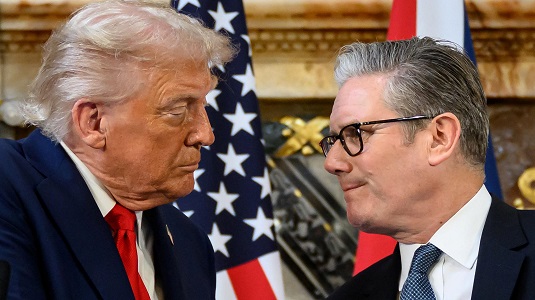
Unusually for a US war of aggression, the UK have proven extremely reluctant to get involved. Keir Starmer tried his best to be accommodating without actually committing British forces. After the initial raids over Tehran he was quick to call on Iran to show restraint, and was equally quick to condemn when their missiles and drones found their targets in reply. When British bases and Gulf "partners"/clients were hit, he announced that the US Air Force were welcome to use British facilities for "defensive strikes". Which is so much evasive lawyer babble to avoid admitting his government's complicity in something that, in theory, should see its instigators in the dock at The Hague. Not that this has impressed Trump, who branded Starmer "no Churchill", and downplayed belated UK efforts to move aircraft carriers in sortie distance from Iran. Trump's cheerleaders in this country couldn't help themselves either. The Tory/Reform press have been attacking Starmer ever since the bombs started falling for not joining in, with preposterous stories that the nature of Labour's voting coalition has stayed his hand. Oh yes, the same party so concerned with Muslim voters that they gave Israel a free hand in massacring Palestinians in Gaza. Kemi Badenoch has dived in, saying Starmer can find plenty of money for social security instead of bullets and bombs. Laughable. Nigel Farage said the UK should be dropping ordinance alongside the US. Both have received backing from Tony Blair. He, unsurprisingly, thinks Britain should follow whenever the White House says heel. Once a poodle, always a poodle.
Starmer's effort to keep Britain to a limited role has little to do with the niceties of international law, and even less to do with electoral embarrassment. On paper, the UK's interests in the Middle East and the Gulf are practically identical to the Americans. They want friendly, preferably autocratic regimes, and Israel's role in this set up is the quick-to-anger gendarme. Iran is the destabilising element who, through its own regional strength and networks of irregular allies and semi-state actors were checks on Israel's aggressive posture and, by extension, the challenger to Western hegemony. This suffered severe setbacks with the obliteration of Gaza, incursions into Lebanon, the bombing of the Houthis in Yemen, and missile exchanges between Israel and Iran over the last 18 months. From Britain and, by extension, Western Europe's perspective Iran had largely been put back in its box. There was now no real threat to Israel. Everything was fine.
Until Netanyahu and Trump started their war of aggression. Britain is not concerned about civilian deaths, be they Iranian, from the Gulf states, or fiercely patriotic tax exiles. It is worried about the consequences of destabilisation. As far as the government and the foreign office are concerned, the war is utterly reckless. The disruption to energy supplies, air travel, shipping, and the sloshing of Gulf money into and through the City are unwelcome costs with a range of politically undesirable consequences. Being at odds with the US is a rarity thanks to establishment slavishness - as typified by the repugnant axis of Badenoch, Farage, and Blair - but remaining separate and disengaged reduces political costs and keeps material costs to a minimum. The price shock and mess of Trump's war is not worth it when the overall outcome will largely be no different to when the bombing started, despite White House hyperbole. The special relationship has proven to be anything but since the razzmatazz of the second state visit, and it appears Starmer, David Lammy, and friends have - rightly - calculated that nothing would be gained from joining this criminal enterprise. All of which helps explain why, for once, we're not being dragged into an unwanted war by the government at America's behest.
Image Credit

13 comments:
Justification maybe not, but they did wait for an excuse - the bloody Iranian crackdown on popular anti-regime protests (regardless of whether those were entirely home grown or fomented by the TLAs; and the fact that it took so long for the US to get its forces in position afterwards rather suggests that it was taken by surprise).
All of a sudden a bunch of Trumptards online seem to have discovered a sentiment of support for "the Iranian people" which was entirely absent prior to this excuse presenting itself. So the delay in getting the carriers and stocks of interceptors into position was presumably put to good use in buttering up the rubes for this latest bout of Imperial adventurism.
The huge, but largely unreported by heavily military censored , Israel based, Western mass media teams , of the huge damage being inflicted on Israel by constant Iranian missile strikes on key Israeli infrastructure makes it ever more likely that Israel will use nukes on Iran. In response the widely dispersed Iranian missile units will destroy the Dimona nuclear reactor and the six vital Israeli desalination plants.
The genocidal madness of the Greater Israel policy and ideology will destroy Israel and much of the Middle East, and much of global energy supplies. But your usual commentators, Phil, don't seem interested ! This will directly impact us all folks ! The Just Stop Oil crowd will be happy though. It has stopped. See how you like it as global industrial society goes into freefall..
Maybe Tony's hope is that he will not be in the dock at the Hague on trial for war crimes by himself and that Starmer will also be an ex-PM 'whose name in arms through Europe rings.'
I can imagine that Keir is having sleepless nights at his impertinance at refusing the summons of his fuedal lord. Being a vassal requires paying tribute. Him and Colonel John Healey MM,, DSO are probably working on a means to get the country involved in this rootin, tootin two gun shootin war so they can stand beside Trump to watch the victory fly over - the greatest victory over Persia since Thermopylae. Perhaps an incident involving a British ship in the Straits.
Don't burst a vein, Anon. No matter how much pain Iran may or may not be inflicting on Israel, the latter isn't going to use its nukes on Iran for as long as its vassal, the USA, is on hand to drop its own vast military budget all over the place instead.
And Iran presumably isn't going after the "highest value" targets in Israel, nor is likely to, because those are the ones which have the best interceptors saved to protect them and Iranian missiles would be better spent in places where they might actually reach their target. With Iran apparently having no air defences left to speak of, their remaining missiles will soon be hunted down and destroyed on the ground, so they're running out of time to use those.
Shaheds are a different story, I believe, as taking those out before they are launched is an unwinnable game of whack a mole. Hence why superior anti-Shahed defences are being sourced from Ukraine. But Iran can probably terrorise the region with Shaheds for as long as their stockpiles last.
In any case, Iran's retaliatory strikes upon its neighbours - paling in comparison to the amount of US-taxpayer-funded ordnance heading in the other direction - is a sideshow to the main event: Hormuz, and the resilience of the Iranian regime. Victory for Israel and the USA requires regime change and Hormuz open again to shipping. If the Iranian regime can stay in control and keep Hormuz closed until the US and Israel run out of popular support and ammunition, then it wins.
If the Iranian regime does collapse, then the Greater Zionist forces will be eyeing up their next target: Yemen... Can't run a new shipping canal through Gaza while the Houthis remain a threat!
This is a conflict in which all sides are basically monsters, and the only decent outcome would be for them all to lose.
Anonymous 14:52 The US was definitely NOT "taken by surprise" by the carefully coordinated "uprising" . Otherwise the 100,000 Starlink communication devices smuggled into Iran over years to coordinate this large, heavily armed, "colour revolution" attempt at internal regime change wouldn't have been employed just then. The Iranian theocracy is iliberal and nasty, but it has deep social roots and deep support. Most of the Western media tales of mass casualties of "demonstrators" is pure hokum . The tales of 30,000- deaths are certainly pure hokum.
Unpleasant as the regime is, tens of millions went out on the major city streets at the end of the manufactured "uprising" to support the regime. Most Iranians understand that, illiberal as the theocracy undoubtedly is, the US and Israel do not care about creating "democracy " in Iran, but just want to turn the last remaining opponent to Israel's genocidal "greater Israel" project into another failed state broken up into warring fiefdoms like Libya and Syria now are.
Israel and the US and their European vassals may well yet destroy Iran as a modern industrial state by their ceaseless bombing for many, many years hence, but Israel is currently being reduced to rubble too , and the Gulf statelets , and global economic crisis is on the cards. Israel's always threatened "Sampson Option" (if Israel faced extinction) has quite possibly been triggered almost accidentally by the crazed Zionists, and Christian Zionists of Israel and the US
Anonymous 09:44, The much hyped Israeli Iron Dome, interceptor system, and the now blinded US Thaad interceptor system simply cannot intercept the latest hypersonic , glide warhead armed, Iranian heavy missiles, now smashing Israeli key assets. Check your facts please. The insuscienceof commentators like yourself beggars belief. We are ALL about to suffer a catastrophic global energy crisis, key supply resources drought, and resulting global financial crisis because of the unprovoked US/Israeli attack on Iran ( during negotiations). Sitting smugly in the UK at your keyboard with your silly comments , be aware , the Middle East crisis is going to visit YOU too all too soon !
It's interesting how many military analysts frequent online fora. So much of it seems based on wishful 'expertise'. The online world would have you believe both that Iran has been inflicting significant damage on Israel after destroying the main US missile defence radar installations (that last bit seems to be at least partly true) in the region, and that Iran has no missiles left and is reduced to lobbing its few remaining drones about. Or, that the Irainians have blocked the Straights of Hormuz, and are now mining it while at the same time their infrastructure is being reduced to rubble (it is true that hospitals and schools have been) as the IDF is running riot over Southern Lebanon. Meanwhile, Iran can produce drones faster than the US and Israel can make the missiles to shoot them down - or vice versa. They do say the first casualty of war is truth, and the second is perspective. The third is the self-respect of war-porn addicts who froth about the devastation their "team" are inflicting as they sit in their festering y-fronts exciting themselves with youtube fakery.
Whatever the truth, the consequences are likely to be unhappy for most of us. But for those caught in the conflict zone, shattering. Starmer may have avoided getting us actively involved, but he should be leading the ICC charges against this disastrous and illegal war.
As we have seen from Ukraine (and Afghanistan and Vietnam, among others) starting a war is a lot easier than finishing one.
The biggest concern is that Israel's real intention is not regime change or disarmament, but simply to inflict as much damage as possible to turn Iran into a failed state. Like Somalia, or Sudan, or Libya, or Syria, or Lebanon.
The message they are sending is, resist us and we will destroy you. That is the lesson of Gaza. They tried it, and found that they could get away with it. So now they are trying it on Iran. Will it succeed? It seems crazy, but so long as they have the US backing them, it might. But it can only lead to disaster in the long run. They will overstep, or the US will turn in on itself, or some mistake will lead to escalation until it spirals into nuclear war.
If I look forward 75 years, I cannot see a thriving Israel surrounded by collapsed, degraded, subject states - which seems to be what they are trying for. I can't see a peaceful outcome either. I think they are setting the stage for their own destruction, and possibly that of the whole region. There is a death cult in charge, and Trump has joined in.
Much appreciated for the chuckle, Sean Dearg.
Machiavelli could perhaps offer Israel a lesson; never base all of your power on the support of a single sponsor. Maybe it only looks as though the existence of Israel depends entirely upon its iron political control over the surviving superpower of the Cold War era, and in fact its agents are soundly in charge of many other states as well. Or maybe Israel is going to find itself in a truly unenviable situation as soon as the inevitable ebbing of US might really sets in, and its bloody chickens come home to roost.
I doubt that Netanyahu cares much one way or the other; I expect that his only concern is staying out of jail for another year or two. His frothing at the mouth Zionist-supremacist buddies might care a little more, but surely lack the sanity to look far ahead. And it will be the ordinary innocents on all sides who ultimately suffer the brunt of the horrors from these rampaging lunatics, as always.
Oh dear 16:45, do sod off with your "check your facts", as if you have any which aren't clearly stamped with a Kremlin watermark.
We do agree on one thing at least, which is that this war is probably going to have rapid and unpleasant repercussions all the way around the world, and that it should be seen as a reckless and murderous criminal act on the part of the USA and Israel - governed as they currently are by an explosive combination of cynical conmen, religious lunatics, intellectual cripples, plain psychopaths, and numerous characters who combine several of those "qualities" in a stinking package.
Not that the regime in Iran is short of grotesque religious maniacs either. But so far they are appearing the less completely stupid of the main belligerents. I'm sure that time will tell, and that none of us will like it all that much.
Let's bridge the war and the politics!
Lib Dems for the "hawk" seats, Greens for the "dove" seats, Farage Party for the "cancer" seats?
https://www.bbc.co.uk/news/articles/cy0dz1k0rr4o
Anyone else enjoying the speed of Emperor Cheeto's about-face, from sneering at sending our help to "a war we've already won", to whining aggressively that NATO won't send ships to meat shield for him?
Got to find something to enjoy in the circus of monstrosities. Until the clown antichrist uses it as an excuse to pull support from Ukraine, anyway.
Post a Comment