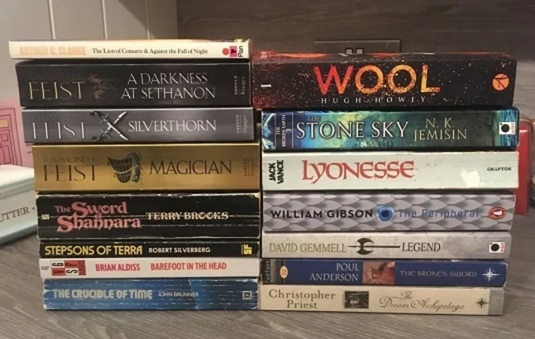
Let's haul some books!. What we have here are a collection of gatherings from my out and abouts, and arranged by format. In the first pile are some ropey-looking As, and the other features better weathered Bs.
Beginning on the left, sitting at the bottom is John Brunner's The Crucible of Time. This involves a bunch of aquatic aliens trying to flee their world as it passes through a (potentially) civilisation-ending debris field. This is SF at its most ambitious as Brunner tries putting together a convincing history of a species. Having recently finished George Zebrowski's excellent - and under appreciated - Macrolife, I'm not averse to epic scale thought experiments. I still haven't read any Brunner, despite acquiring his celebrated Stand on Zanzibar in haul #6, but aware of his reputation. If there's anyone who can pull it off, it's sure to be him.
Next is Brian Aldiss's Barefoot in the Head. Known (to me at least) as an early chill out track, Barefoot is set after a global war in which the primary weapons were payloads of psychedelic drugs. Far out. The survivors are on a permanent trip, seemingly unable to tell the difference between the real and the hallucinatory. The story follows a sober protagonist in a drive across Europe as he slowly succumbs to pharmacological intrusion and psychosis. Published at the close of the 1960s, it's one that could be described as being of its time. But the fact it found its way into the SF masterworks range means there must be something to commend it.
Robert Silverberg's Stepsons of Terra is an isolated colony story. Corwin hasn't had anything to do with mother Earth for 500 years, but desperately want to now as a rising military power has sent an armada in their direction. It's almost as if Silverberg had Dubai ex-pats in mind when he wrote this nearly 70 years ago. An ambassador is promptly appointed and dispatched to Earth to beg for help but, horror of horrors, the home world has slipped into indolence and decadence. As a relatively early novel, I'm not expecting much - but did find his Invaders from Earth from the same period jolly enough.
And then we have a famous/infamous book, depending on where you're sitting. Terry Brooks's The Sword of Shannara, the novel that sparked a trilogy and the huge boom in fantasy publishing that continues to this day. Often decried as a direct rip off of The Lord of the Rings, I've come round to occasionally collecting interesting spells-and-swordplay silliness. Given its importance, I couldn't pass it up after spotting it for a couple of quid.
Continuing the theme, going for a song in a local second hand bookshop was Raymond E Feist's Rift War trilogy, which is the first in a seemingly endless sequence of 30 novels. A portal is opened between a Middle Earth-type world and all sorts of perils come spilling out. Inspired by playing Dungeons and Dragons with his mates, apparently - just like Shannara - there are some unacknowledged and "accidental" homages. In this case to the setting of another early role playing game that subsequently influenced D&D. Nevertheless, The Magician is well thought of and now I have it, I'm duty bound to read it.
Sitting atop the pile is an Arthur C Clarke double bill, The Lion of Comarre and Against the Fall of Night. These two short works share a similar theme: that utopias are boring. Lion sounds like a centrist fantasy. The world is governed by wise politicians and technology can pinpoint and take care of citizens' needs. With everything taken care of, the best and the brightest choose to enter politics. Richard Peyton rebels because he wants to become an engineer, and he gets mixed up with some robots' rights stuff along the way. Sounds delightfully naive. Against is one of Clarke's more famous works, and follows Alvin, the last child to be born in 7,000 years. This is immortals-at-the-end-of-time stuff, and everyone is bored rigid. No one can leave the last city of humanity, but Alvin wants to. Cue the story. I don't mind Clarke and, to reiterate, found what I've read so far fairly decent - including more recently A Fall of Moondust. Not expecting literary fireworks, but then that's not what Clarke was ever about.
On to the B pile, at the base is our chum Christopher Priest and his The Dream Archipelago. A collection of linked short stories, here Priest subtly unsettles by offering a series of worlds that are immediately recognisable and familiar, but are off in some way. Something that is done in different ways in each of his books I've so far read - Fugue for a Darkening Island, Inverted World, The Prestige, and The Adjacent. Priest is a bucket list author and one whose oeuvre I plan on reading in full.
We're back in fantasy now with Poul Anderson's The Broken Sword. His sword and sorcery is often lauded in ways that his science fiction isn't, this is historical fantasy set in the time of the Vikings. There's Norse mythology, elves, fights with trolls, and has plenty of limb chopping and blood fountains. Not something you'd expect from the middle of the 1950s.
Then we have David Gemmell's Legend. By the mid-80s the fantasy boom was underway, and Legend offers a bloody vista of medieval warfare. The undermanned fortress is threatened by a half-million strong horde from the north. Hmmm, where has a very similar plot detail turned up in another popular fantasy series? Druss the Legend is the hero of the Drenai Empire, but as the enemy approaches he's retired and contemplates his death. Can he be called back into the fight? There is, as you might expect, plenty of action and siege scenes. Should be fun.
The Peripheral is the first in William Gibson's latest trilogy. Two viewpoints, one in near future rural US and the other in London 70 years after, and is a return to the noirish sensibilities of The Sprawl books. Flynne is a working class woman working on a 3D printer, and Wilf lives in her future where inequality has run so amok that there aren't many people left apart from the 1%. But is it really her future? Is it real at all? I enjoyed Neuromancer after last year's re-read, which I followed with Count Zero. Gibson is also another bucket list author, so will get round to this eventually!
Fantasy again. I read all four books in Jack Vance's Dying Earth science fantasy sequence a couple of years back, and especially enjoyed the middle two Cugel books. But the thing you take from them is the soupy, languid texture of an Earth sluggishly dragging itself through the end of its days. In Lyonesse, Vance's effort at a King Arthur-linked fantasy series, I'll be interested if this sensibility translates. It's high fantasy stuff with princesses and princes, star crossed lovers, and a load of intrigue and magic. I understand Merlin features, because of course he does. Lyonesse appears well thought of, so if I like this I'll pick up the other two.
Speaking of the dying Earth, NK Jemisin's Broken Earth trilogy tap dances on Vance's toes. The Stone Sky is the third book in the sequence, and I can't say much because I don't own the second and haven't read the first. All I know is it's the far future, technology and magic are indistinguishable, and the Earth is shaking itself to bits through a plague of devastating earthquakes. What gives? Each book in Jemisin's sequence is highly rated and collected an embarrassment of awards, so this series won't stay at the bottom of the tbr pile forever.
And lastly, there's Hugh Howey's Wool. Now a TV series, the remnants of humanity are ekeing out a bleak existence living inside a missile silo. This protects them from the dangerous radiation outside. Life isn't great, and there's little sense of what it was like before the apocalypse came. Anyone who expresses curiosity or a desire to go outside are duly obliged. They're expected to clean the external sensors, even though it means certain death. It's very much a YA piece, and I read the graphic novel adaptation ages ago and don't remember being that impressed. But this was practically being given away and so it's here.
Since getting these, I've also grabbed several more piles of books. We'll look at them when the mood takes me.
Have you picked up anything interesting lately?

5 comments:
Thanks for the round-up, good haul there as ever. I haven't read any Christopher Priest, but sounds as if I should! As Gibson's The Peripheral, I felt I should enjoy it more than I did: somehow it just didn't connect with the urgency that Neuromancer, etc did. Maybe it's me given I am reading it 30 years after I first read his "classics". Don't expect too much of Wool and you may enjoy it – simplistic and undemanding, but a relaxing page turner after a hard day of global woe.
I found The Peripheral very good; it isn't intended to have the verve of cyberpunk but is rather about the decay of the US immediately before the human and ecological collapse of the "Jackpot", and the horror of what follows once the global oligarchy survives the holocaust and sets up a global network of competing crime and corruption enabled by robots.
The sequel, the name of which I didn't bother to internalise, is in my opinion a mass of slop. I didn't know that Gibson had written a third, but I'm not optimistic.
Against the Fall of Night is Clarke trying to do what he clearly admired in the 1930s works of Campbell and his acolytes, and I think it comes off quite well although Clarke's rather confused sexuality (to be polite) does come through a bit, something I didn't notice when I first read the book.
Have been rereading old Iain Banks, partly because I'm retiring and trying to take my mind off bureaucracy.
Tell Me An Ending by Jo Harkin - enjoyed v much. Some sniffy reviews out there but her writing is flawless for me.
I recently read Ark by Stephen Baxter, which I quite enjoyed although I felt that he 'ran out of steam' towards the end. Interesting premise though. And maybe the reverse of what is actually happening to the planet.
The Lyonesse trilogy is one of my favourites. I read it many years ago and have returned once or twice. I enjoyed the Shannara series too, but it is very derivative. Still fun. But Lyonesse is. more based on a traditional celtic version of magic and the faeirie world, and has that slight angle to it. The idea that there is a world parallel to ours but with a twist, and that what you say, and how you say it matters and you can never know what might happen or why. Magic is not so much about power, but about intention.
I hope you enjoy it. I enjoyed Feist's stuff too, but it is heavier and more earnest. Lyonesse has a lightness and taps in to older ways of seeing the world that makes it, a little, 'magical'.
Post a Comment