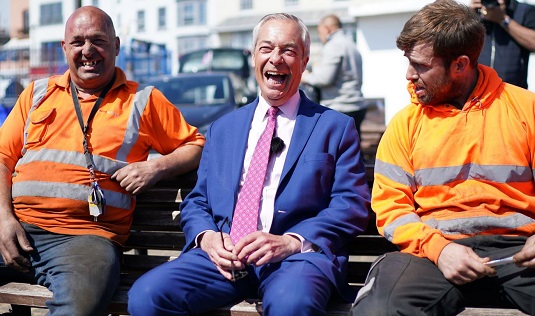
The truth is there has always been a strong right wing bloc among working class people. We're not talking about those patronised by Blue Labourism, but dyed-in-wool anti-Labour voters. This is the section of the class that loyally turned out to vote Conservative, amounting to about a third of the work force. That part of the class where I come from. And this also had a political expression in the labour movement. Informally as, for want of anything else, backers of strike-averse right wing Labourism, and formally as the Conservative Trade Unionists. In the 1970s they were a real outfit that commanded the allegiance of tens of thousands of members. Yes, it's hard to believe now, but the Tories had the sort of trade union clout left groups, with the exception of the official Communist Party, could only dream of. The historic appeal of conservatism to working class people is not much of a mystery, and it is worth noting that the Tories made real efforts from the late 19th century onwards to win over "working men" and were particularly successful in the 1930s, following the granting of universal suffrage, in organising rural workers. Working class conservatism runs deep.
What the Times poll simply shows is a switch. The Tories have destroyed themselves by torching their means of mass political reproduction, and so the right wing sections of the labour movement who might have supported them in the past have shifted allegiances to Reform. An assumption borne out by the figures. Just 14% of 2024 trade unionist Labour voters have switched to Reform, the rest coming from those who either supported Nigel Farage at the time, or predominantly voted Tory.
A case of shrugging the shoulders then? Of course not. As we have seen generally, Labour have paved the way for Reform by trying to out-do them from the right on immigration and asylum, affirming thir talking points and not contesting the politics. And, sorry to say, by and large trade unions matter very little in the day-to-day life of most of their members. Ballot papers, a seldom-read magazine, and that's about all most members see of their unions - a point reinforced by the abysmal turnouts for internal elections. On the one hand, the so-called political wing of the labour movement has cackhandedly encouraged Reform support, while its industrial organisation does not, with some exceptions, do much to discourage it.
Reform might be growing their presence in the trade union movement, but it is a passive reflection of their strengthening support in society more generally, and unlike the old CTU is not organised beyond a handful of pockets. It's well within the power of trade unions to reverse this support and stop them from making further inroads. And, fortunately, Reform itself is probably their greatest ally. In February, Richard Tice was boasting how Reform would just undo the new workplace rights Labour introduced in April, but also would tear up workers' protections. Maximum hours, safety at work, paid breaks, holidays, parental leave, fire at will, scrapping the minimum wage, Reform are promising the sort of bosses' agenda that the Tories dreamed of implementing. So proud are Reform that they call it their "Great Repeal Bill". Explaining what a Reform government means for working class people is the start of it, but that has to come from within the unions, from it being taken up by workplace reps and officials. A charge sheet filed on the union website or nestled in its magazine won't do the trick. Anti-Faragist moves will only be effective if a union is relevant to its members, that if their organisation feels like their organisation, that its moral leadership counts for more than the appeal of Reform's racist scapegoating.
Image Credit

4 comments:
Fascinating. Given the majority of union members are white collar and a majority of them are women and women are less likely (wisely) to support Reform it raises the issue of what unions the Reform voters are members of and what their age and skill levels are. It used to be that it was the 'aristocracy of labour' that were the backbone of Labour support not the unskilled.
It would seem that Disraeli's angels in marble are still susceptible to deference to ones betters, the call of the flag, the heros of the armed forces and socially athoritarian attitudes as guardians against foreigners, riff raff and immigrants and see in Reform promoters of a stable, cohesive, well kept society despite the evidence of its Councils.
The mix of ultra-consrvatism and xenophobia combined with a critique of neo-liberalisms impact on those Reform define as the 'British people' is popular and appealing. It gives supporters a feeling of belonging to a nation, a homeland, a family, a tradition and an understanding of how their insecurity about them all is due to the invasion of foreigners. All you need to do is close the borders and be patriotic.
28% looks a lot like a ceiling, for a party which is quite blatantly anti-worker.
The straight swap of Tories for Reform among the less self-aware of workers (just as in the wider electorate) is one of the two completely unsurprising stories here. The other is the collapse in Labour's support, the difference appearing to now be split between Green and "none of the above".
Deference and racism. Simple.
I hear that these polls had absolutely tiny sample sizes, including that only 14 members of ASLEF were polled (about 350 for Unison). Is there any truth in this?
Post a Comment