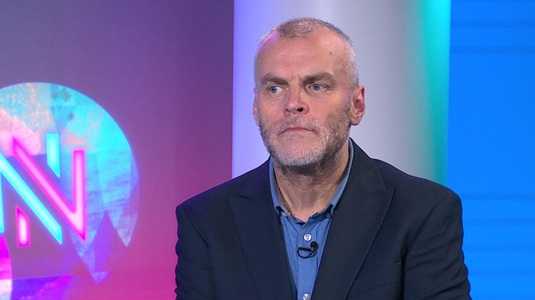
Some might recall his joining Reform in December 2024. And because everyone in the media knows him, he got more coverage for doing so than all the second rank Tory defections - Nadhim Zahawi, Nadine Dorries, Jake Berry. Speaking on Politics Live, Montgomerie said he remained a supporter of the party and made his fanboyish affections for Farage obvious, but argued the party was too unruly. Chief culprit is Yusuf's chaos agent cosplay, for whom the concept of party discipline is an alien notion. He is "supremely talented" and a "gifted communicator" - two phrases that were often uttered by prominent-but-frustrated Tory defectors throughout the conference. But Farage needs to rein him if the professionalisation of Reform is to succeed. Montgomerie also said he told Lee Anderson last week that we wanted to continue to be the party's critical friend and make public his views without embarrassing them, or causing issues over their suspension of him, and so was stepping away. How thoughtful.
Unfortunately for Reform, Montgomerie's resignation is symptomatic of the party's failing bid to replace the Conservatives as the preferred political choice of the ruling class. And that long predates Yusuf and his manoeuvres. Notably, the difficulties Farage has faced - the exposure of their murky funding arrangements, which are now subject to a handful of police investigations, came from the right wing press. And particularly The Times. Obviously, none of this would have happened had Uncle Rupert or another of the Murdoch family said no. The timing then is interesting, and suggests that they think Farage in Number 10 would be detrimental to their interests. For one, the erosion of democratic institutions and press freedoms seen wherever Reform's overseas stable mates have taken office hasn't always been congenial to the interests of media moguls. Fine for those on board with far right governments, but here in Britain the press barons are accustomed to dictating terms to Number 10, not the other way round. Or to put it another way, there are doubts Farage and his government could be controlled.
Second, Reform's programme is hardly congenial to stability. Theirs is an explicit class politics for keeping labour at heel, and smashing up opposition through the demolition of state institutions crucial for sustaining mass stakes in and tacit support for British capitalism. The political moment simply does not require it. Andy Burnham's emollient words nor his programme are hardly a threat to contemporary class relations. In fact, as far as the bottom line goes capital with interests in domestic markets and the near abroad would like to see more stability, especially when the shocks keep coming - war, energy prices, climate disaster. Reform want unnecessary class war when most of British business is content with the class peace they have.
Third, what is the coalition of class interests Reform already has in the van? The most backward sections of capital: coupon clippers from the City who remain Brexit true believers, tax exiles, cryptomongers, myriad petty business people and farmers and, crucially, Silicon Valley "disruptors" bent on aggressive take overs of key sectors of the British economy. People who are smash and grab and have no time for the dependencies the British state and ruling class have built with the United States. Collectively their interests is a minority interest within the minority interest of our betters, and one that sits in tension. A Farage government in these circumstance would be a Liz Truss moment, as far as their politics are concerned.
Montgomerie then, as a respected figure on the right, was something of a canary down the coal mine. If he could thrive more than survive, given his propensity to speak his mind, he might have been the bridge for more of the British right and therefore the interests historically tied up with the Tories to cross over. But Reform can no more move away from their corner of ruling class support than the Tories can from their broader bourgeois base. Indeed, Yusuf's antics can be read as having the consequences of protecting this constellation of interests from getting diluted by more "mainstream" concerns, represented by Tory-supporting sections of capital. Indeed, he has gone out of his way to highlight the differences between his type of right wing politics and conservatism in its British varieties.
To put it more succinctly, Reform has served a purpose in steering politics toward the beggar-thy-neighbour politics of culture war scapegoating, but anything beyond that is not where the bulk of British capital wants to go. At present.
Image Credit

8 comments:
One of the interesting things about the timing is that there are still 3 years until GE D-day. Time enough for the Faragewagon to turn itself around and hope for Murdoch and his like to change their minds.
That might seem difficult, but Reform's core voter coalition mostly care about only two things - brown people, and culture wars (with the latter probably coming a distant second). Continuity capital doesn't really care about those things at all. As you note, it's the circle of characters that Farage has built around himself, the interests which they represent, and the program which they consequently demand, which are the problem for the continuity capitalists. If Nige can shuck those off then there's not much else to stop him keeping most of his voters, especially since they primarily recognise him and not his hangers on.
As it happens, the situation with the debt-to-GDP ratio after Truss means that Burnham has zero rope anyway to go after the things that continuity capital really cares about. On economic matters he is absolutely constrained to fiddling around the edges*, which will win him few votes.
So IF his office has really learned the lesson from the Starmer years - and that's certainly a big IF - then he will go for shock and awe on the things which his own voters care about, but which the continuity capitalists aren't that bothered with. In other words, doing all the things that Reform's core voters (and certain foreign oligarchs) will hate most - i.e. cracking down on far right anti-immigrant activity, and reversing its momentum in the culture wars.
We'll get a very early test with Miliband going toe to toe against the rampaging Zionist lobby. This is the real test for British "sovereignty" - with the Israeli state having enjoyed a controlling interest in UK politics until now, but Labour's natural voter coalition being nearly united in wanting that situation amended promptly. Consequently if Burnham wilts to bullying from the USA and Israel, then he is going to find himself as unpopular as Starmer very quickly.
*maybe he could get away with deflating the housing bubble a bit, since I'm not sure that the big beasts of continuity capital really care that much about house prices either, and Labour's modern voter coalition owns little property.
An insightful article, Phil. Farage was always a mass media pampered creation of a politician. The sheer number of times he was on BBC Question Time. The decade or so lack of serious questioning of the sleazy man with his inflamatory rhetoric by that mass media. He was a safe lightening rod "controversialist Right Wing politician", that the ruling class and their owned mass media could be confident would never rock the boat too much no matter how many flocked to vote for his numerous parties.
But now, with the trades unions completely shackled and stewed in internal corruption , and the Left , as exemplified, by the utter infighting shambles of Your Party, a totally broken political force, they are happy with the NuLabour mk 2, warmongers and permanent austerity implementors , under its new shapeshifter con man Andy Burnham. Under NuLabour and the puppet, Burnham, the crazy UK deep state, and its capitalist class are every day readying us for a suicidal open war with the biggest nuclear power on the planet, and the nation now possessing the most battle-hardened military on the planet, ie Russia, and next ,China, after our mighty armed forces , with NATO have easily crushed Russia !. We are truly soooo fucked.
Well then! The cryptocreeps aren't slow to throw good money after bad, are they? 72m in two days, in the hope of "flooding the zone", and rescuing their vehicle for imposing their preferred world order upon the UK.
It's mighty uncomfortable to find myself rooting for the likes of Murdoch, but here we are.
It's a tired old myth that "On economic matters he is absolutely constrained to fiddling around the edges" especially because of something as meaningless as "debt-to-GDP ratio". This is the usual TINA dirge that all centrists roll out because they believe it even though it has no basis in fact. Of course there are alternatives. What matters is what the money is spent on, and whether that makes a material difference to people's lives.
For example, continuing to leave house-building to the usual corporates will achieve nothing. They don't want affordable housing - they want profitable housing. The two are entirely different.
Another example, all utilities could be nationalised and a huge decentralising of the grid to create a distributed, resilient, renewables and storage based electricity network instituted. This would create jobs, massively increase resilience and future-proofing, and reduce the cost of energy.
Social networks could be reined in by making access to our data manageable by us, so that if they wanted to use it, they would have to pay us. Tim Berners-Lee has a system to do this, it just needs some legislation and funding. AI could be controlled and tightly regulated, and ideally taken out of the hands of the Oligarch sociopath techbros by making it a national security issue.
There are many things that could be done to take the rent away from the rentiers and redirect it to the rest of society. What is lacking is the will.
Sean, to do most of that - especially to renationalise utilities which Thatcherite idealogues and traitors legally booby-trapped, specifically to prevent renationalisation - the government has to borrow to get funds (unless you're suggesting that it simply print money...?)
If it borrows, it has to pay interest. And when debt is equal or greater than GDP, the government's finances are at the mercy of any changes in those interest rates.
Starmer staked his entire premiership on not spooking the markets in order to get those interest rates down; which might conceivably have worked if he had made the right noises on social policy in order to retain his party's natural coalition, and the Democrats had retained the White House. But he was too politically incompetent to do the former, and emphatically lost his bet on the latter.
Burnham has been left with very limited room for manoeuvre indeed, in the short term. He can legislate away, if he has the guts and the nous, just as long as he steers clear of the copious economic tripwires that have been strewn all around over 45 years of entrenched kleptocratic Thatcherism. Anything which might trigger exorbitant restitution payouts to rentier parasites, or spook the bond markets, is out of bounds for the foreseeable future.
Things will get a lot worse if Farage's monopoly money donors manage to actually get him into power! At their demand he will surely repeat Liz Truss's performance in very short order, just as she did at the behest of the special interest groups which got her into the top job (briefly). The cryptocreeps certainly don't care much about that just as long as they can make bank from the chaos. This fact has apparently now made Nige persona non grata with continuity capital and his "politics on easy mode" privileges appear to have been belatedly deactivated; but if the continuity capitalists aren't prepared to outspend the renegade oligarchs in leaning on the political scales, and/or are insufficiently competent in how they do it, then they still might get supplanted. For everyone else it's the difference between bad and worse. To head off this disastrous outcome, Burnham has got to walk a political high wire.
Here's the BBC saying essentially the same thing, for whatever that's worth.
https://www.bbc.co.uk/news/articles/cwp93jp4p7xpo
If Burnham doesn't want the next GE to turn on a knife edge against an unholy Tory-Reform-"Even Further Right Party" pact, then he has to butter up alienated progressive voters, no matter how many Establishment guns are trained upon Reform Plc. And whatever he has to give to them probably isn't going to be coming from Healey.
On cue, the TINAphiles arrive with their "where's the money going to come from" chant they unthinkingly parrot having read something once about bond markets and debt. Where do you think money comes from? Do they mine it? Does it grow on trees? Is it found in bank vaults? What do you think it is? A commodity? An IOU? If so, what is owed, and how can an IOU be paid off with another IOU? I owe you, then I pay with a You owe me? How would that work? Why would you accept it? Do some reading on the topic, then come back and we can have a serious discussion.
Careful there Sean, or you'll have the hysterical MMT-phobes bursting a vein all over you.
If they notice this conversation, that is - since there was no mention of Polanski to summon their attention.
Post a Comment