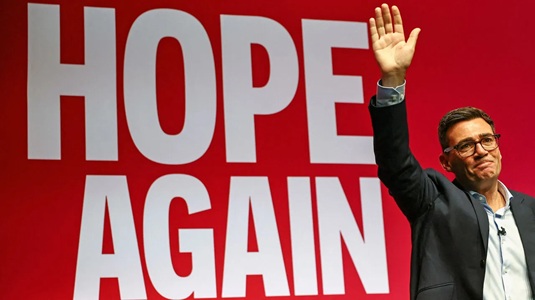
There was something for almost everyone. Andy Burnham's speech at Labour conference was what most of the party's voters were hoping for. It began with a restatement of ambition on housing - more leaseholder reform, a curtailing of right to buy, greater local authority powers over private rental, and the option of expropriating slum landlords and empty houses. Reducing deposits to 2.5% for new builds for first-time buyers, which was pre-announced at the weekend, sounded like it could have been pinched from a Tory prospectus.
On water, there were more hazy promises of "public control". But this time there was more flesh on the skeleton. Repealing the Thatcher-era ban on taking water into public ownership is a symbolic gesture, as that could have been dispensed with by any legislation that took a water company back into state ownership. In the forthcoming water bill, there will be greater oversight and powers of intervention devolved to mayoralties. Bonuses for failing bosses will be stopped, there will be tougher consequences for failure with nationalisation being the ultimate sanction. Something Thames Water customers are likely to welcome. On energy, more home-grown renewables and domestic nuclear is to be encouraged, the unveiling of a national energy grid plan with local input, a new state-owned company called Great British Grid will be launched to enable its renovation, and market reform is coming - above all the speeding up of disentangling energy prices from gas prices.
Burnham moved on to care. Recalling his grandmother's experience with the care system, and the work put in by his late dad's care givers he said, with some emotion, that "I want to speak directly to our care workers: you are not invisible to me." And drawing attention to how the industry has been variously neglected by successive governments, he said "I am sorry my profession has let down yours for so long". The national care service was revisited, and he defined the vision as "person-centered high quality care service that starts in the home", according to the principle of everyone contributes, and everyone is covered. There will be no care charges taken from the basic state pension, and the idea is that people won't find their savings eaten up by escalating costs. Burnham said this would be as significant as the foundation of the NHS.
How to pay for it? The scrapping of the triple lock on pensions was trailed heavily before the speech, and when it came its replacement sounds very much like ... a double lock. The link with earnings after 2030 will be dropped, and instead the state pension will rise with inflation or 2.5%. Though Burnham strongly implied it will retain a relationship to wage levels. Eh? It sounded a bit of a muddle, and it's not clear how this would save money that would be ploughed into the care service.
On young people, there was the usual nod to parity of esteem re: academic and technical routes in education. There's also to be a stronger emphasis on comprehensive education as a means for securing the future. Likewise, his remarks on foreign policy were brief and offered no break with the established way of doing things - Russia, bad; Iran, bad; Palestine, two-state solution.
And rounding the speech off, Burnham riffed off the theme of fixing our broken politics. He said he would work cross-party on as much of his programme as possible, but noted how the Westminster system is the root of much of our problems. Referencing the possibility of a "divisive government" being elected on under 30% of the vote, he announced a national commission on electoral reform with an invitation to all parties to contribute. He also said the next Labour manifesto would have a clear commitment to changing the system. And from here, he moved on to Brexit. Unlike Keir Starmer who wouldn't touch the issue with a barge pole, Burnham was repeatedly scathing about its consequences. He went on to say the upcoming UK/EU summit will be an occasion for laying out the country's long-term relationship with the EU, and he will offer some options for structuring it. A code, as if it needed spelling out, for putting rejoining the EU back on the table.
Burnham began his speech saying it wasn't going to be a traditional conference speech. And really, it wasn't. There was no point scoring against the opposition parties. No lame jokes tied to cheap shots. It was, unusually, an address aimed at Labour's former coalition outside the hall. Everything here, the promise of breaking with 40 years of neoliberalism, the "rewiring of the state", fixing the foundations of British capitalism, the ambitions for the National Care Service, electoral reform, and a closer relationship to the EU, it was taking up the mantle of modernising the state and putting the country on a new trajectory. That's the promise, and - as we have seen - the record since entering Downing Street has been more mixed. But politically speaking, this was crafted to consolidate centre left and left voters, including not a few centrist voters and those on the soft right that like the idea of national renewal and EU alignment, behind Labour. If Burnham follows through and this programme is visibly making headway by the next election, then he may well get to oversee the fruits of his 10-year plan.
Image Credit

6 comments:
The blog reads a programme like a press release. It ticks off promises and asks "will he deliver?", as if the problem were sincerity rather than class power.
Thing is he needs serious economic growth to pay for all of this (per capita GDP growth). Otherwise he's just tinkering, still stuck in the doom loop of trying to squeeze more funds out of an ever shrinking base of net contributors to prop up an ever growing base of net beneficiaries who want ever more free/subsidised stuff. Energy costs are probably the single biggest thing, they underpin absolutely everything in the economy. There should be a serious reset on energy policy and a push back against ideological purity, we can transition to greener sources, but on a pathway that won't destroy the economy.
Yes, indeed, Anonymous, 07:18. taking any of the , always conveniently to be delivered by the NEXT Labour government, Conference promises from the already proven liar and trickster, Burnham, is extraordinary. He , on becoming PM, immediately sold out the WASPI women , immediately backtracked on his verbiage about massive new specifically council housing, immediately, gave the key Chancellor job to Blairite warmonger , Healey, and is surrounded by hard core Blairite advisors. He has made a few vague "apologies" about Labour's previous line on the Gaza genocide ,and the West Bank and introduced some entirely ineffective, bogus sanctions and bans on some military products to Israel , which deliberately have had no effect at all.
He is fully on board continuing austerity - the decision to scrap the Triple Lock on pensions being only a recent example. and, as with every other recent PM, (including Boris Johnson !), he promises to sort out the scandal of Social Care -- but of course AFTER the next election. He is fully supporting the Israeli/US war in the Middle East, and continues the crazed EU/ US rush to open war with Russia by 2030 !
Honestly Phil, get a grip man , regardless of his perfomative ("I'm sooo sincere") tears, and slippery promises at conference ,Burnham is a glib , insincere, hard core creature of continuity Blairism in every way. By the next election the entirely lie-based "Burnham Bounce" will be long dead.
A very generous reading of Mr B's intentions. A bit like the repeatedly abused wife who thinks, 'I'll take him back again. This time it will be different. He's apologised and said he's changed I want to believe him as I've devoted the best years of my life to this relationship and the bruises and black eyes heal.'
It seems the born Labour supporter is like the Farage follower - everything can be forgiven so long as the right things are said and the right people blamed for the conditions.
Elsewhere I'm seeing some strikingly positive responses to Burnham's offering, with some former naysayers changing their tune. So far it appears to me to be mainly those who want more explicitly populist (others would say reckless) promises who remain unmoved.
Delivery matters, but in the current climate it might not be as vital as a meaningful change in messaging. The latter has been so long coming... and the alternatives to trusting Labour to have finally mended its ways are so widely unappealing... that the public desperation for crumbs of hope may now be dominant. That's what Burnham appears to be banking upon; and he probably doesn't have much choice either, due to factors beyond his control constraining any possibility of delivering all that much in the near term.
Now Polanski and the Greens need to keep the pressure on!
Sadly , endless "positive messaging" by NuLabour's more glib new front man, has already been undermined by his reversals on all of his promises made at the Makersfield by election, for those with a memory longer than that of a goldfish. Every day, despite his cynical "hope" messaging, Burnham and his Blairite continuity colleagues from Labour Together, will simply disgust our electorate even more with the facade that is UK democracy. The neo fascist Far Right wont be defeated by cynical hope- filled rhetoric , without real delivery. Labour Together/ Blaire and Mandelson didn't engineer the replacement of Starmer with Burnham to reverse the neoliberal, warmongering continuum.
Post a Comment