Labour's devolved government woes overshadowed a disastrous night for the Tories too. They went from 31 seats to 12 in Scotland, and from 16 to 7 in Wales. A fraction under 12% and 11% respectively, they look increasingly like an utterly spent force. Unfortunately, that's because a great deal of unionist energy is now stored in Reform's political batteries. On 34 seats and 29% of the vote, they are the second largest party after Plaid Cymru and will be the opposition, as well as the standard bearer for continuing the union in Wales. In Scotland they are tied with Labour on 17 seats, thanks primarily to the list system. Here it too is the ascendant voice of unionism, making the link between the preservation of the UK state and right wing extremism something the socially liberal SNP are sure to exploit.
Likewise, in England it was a pitiful night for Labour. Keir Starmer achieved its worst result in English local elections since it became a party of government. The low of 1,300 councillors lost by Jim Callaghan in 1976 was surpassed as Labour gave up 1,496 seats. The party relinquished control of 38 councils, and scored a projected vote share of 17%. No wonder more Labour MPs are finally breaking cover and calling on the Prime Minister to go without waiting for the would-be successors to get all their ducks in a row. As forecast by sundry pundits, councils in the north tumbled in Reform's favour, while right on cue a clutch of London councils fell to the Greens, along with two directly-elected mayoralties.
Though you wouldn't know it from Kemi Badenoch's upbeat countenance, the Tories' performance in England almost matched the Scottish and Welsh disasters. 563 fewer councillors will be paying in tithes to their local Conservative group. Still not convinced that this once-mighty party is in long-term decline?
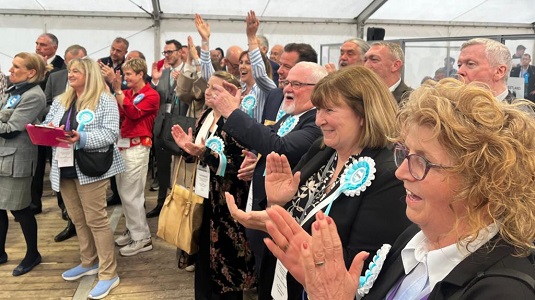
It was, again, Reform's night. A projected 26% of the vote and 1,451 new councillors puts them head and shoulders above the other parties and, thanks to the dysfunctional verities of first-past-the-post, would get them close to an overall majority if this was repeated at a general election. 14 more councils fall under their sway, and undoubtedly deals will be done in other local authorities that will see them govern in coalition with others, such as Tories and/or localist independents. There is no cordon sanitaire in British politics! The Greens inched ahead of Labour and took second place, with a projected 18%, 441 more councillors and five councils - again more or less matching forecast expectations and turning in the party's biggest ever win.
So much for the new state of play, but what about the underlying politics? John Curtice's position, that a decline on last year's vote share would represent a stalling of Reform's chances, regardless of how many councillors they picked up, was borne out on Thursday. Their share is down four points on the 2025 elections. But taking differential turnout into the equation, it's possible these results flatter Reform's level of support if a general election was to be held imminently. Which, of course, is not going to happen.
To restate the argument, polls consistently show that Reform, like the Tories, are demographically dependent on older people for their support. There are several reasons for this. This matters because it is well known older voters and particularly the retired are more likely to fill out their postal ballots or turn up at the polling station than the bulk of working age people. Therefore, the right has an important advantage going into elections. By way of an example, if retired people has stayed at home on EU referendum day a decade ago then Remain would have won. Where second order elections are concerned, most voters believe these "matter less" than general elections. Turnout goes down across the board, but the reduction is disproportionately greater for younger cohorts, strengthening the advantage of the right.
In Reform's case, its 29% in Wales and 15.8%/16.6% tally in Scotland are likely to overstate their real level of support vis a vis a general election. Ditto for England's projected 26%. And yet that figure is roughly in line with what pollsters report from their balanced samples. Does this suggest differential turnout is a mirage? Polls are always models and are, at best, only indicative. They are trumped by votes cast and, arguably, the analysis of those votes. Second, pollsters know this themselves which is why numbers given are caveated by margins of error. Dealing with the effects of differential turnout, I would suggest that the reversion from the right's second order election advantage to the weaker one it enjoys at general elections could reduce the Reform (and the Tory) score by two to three points as other cohorts turn up to vote. Not a massive amount, but one that matters when politics is this close run.
For the same reasons, there is a strong case that in England, perhaps less so in Scotland and Wales thanks to the SNP and Plaid Cymru, the Greens' 18% is an underestimate of where the party actually is. To have scored so highly, outperforming Labour (who suffer a similar disadvantage) and the Tories (who don't) is all the more remarkable considering the Greens' working age/young base is comparatively less likely to show up. A confirmation that Zack Polanski's Green-left populism is the right strategy for the right time.
Obviously, this comes with further caveats. Above all, geographical variation. Reform's 29% in Wales suggests the party is proportionately stronger there than elsewhere. Though looking at it from a right bloc/liberal-left bloc perspective, it's a 41%/58% division, which is wider than the same 43%/51% division for the English local elections (the untidy splits denote independents/others). Seat variation also matters. Bradford, for instance, saw Reform take 23 seats on 26%, but the Greens just seven on 22%. Nevertheless, the direction is clear. We, rightly, hear concerns about the danger from the right, the damage they do, and the atavisms they enable. They could win an election. But the numbers and the political direction shows greater numbers and the greater potential for mobilisation to their left. Reform and the right can be defeated. They are not inevitable.
Image Credit

6 comments:
Surely another thought based on what we saw in the Caerphilly and G&D by-elections is that come a GE, people are more likely to know who their best anti-Reform vote is in their constituency than they are in their ward.
There's something else too, Phil.
The 2024 GE and its loveless Labour landslide informed the right wing that they now have to vote Reform to avoid splitting their vote. They learned then that the Tories are done.
This election should tell everyone else that they now have to vote Green, for the same reason.
Which is why survival for Labour now hinges upon making an electoral pact with the Green Party. By 2029, Reform will have almost completely absorbed the rump of the Tory Party; and Labour will have to make an equivalent accommodation with the new political reality, unless they prefer to dig their nails in and drag the country with them into the abyss.
There is the potential for the Green vote to grow- but they will need a considered strategic plan to make this a reality. I hope they listen to the experienced voices Phil.
Well it might not be inevitable but you need to consider what adjective is most likely to describe the situation at the next election - likely, probable, very possible. I do not think Father Time will have harvested enough voters to stop it being the largest party, though with only 25-27% of the vote. Its daily organs, the 'Mail' and the 'Express' with some support from elements of the 'Telegraph' and GBNews will have gone into overdrive to mobilise its supporters to save the country from
Green/Islamic/Bolshevik/Anti-Semitism. The Greens will have been subjected to heavy bombardment that will put off sufficient numbers to keep them as a significant but oppositional force. And Labour, oh dear, oh dear, will reap the fruits of becoming ideologically monolithic and unable to develop any meaningfully different policies from Starmer. What difference would a Steering, Rayner, Mahmood, Burnham leadership make? The problems don't lie in communications or presentation or effective delivery. It's not that they are not going fast or far enough, it is the policies they are proposing. Scotland wont do well the Football World Cup because the manager isn't capable. It is the approoach and policies of the SFA over the last 70 years. So it is with Labour.
Didn't Starmer give the same speech when Labour lost Runcorn, and then again when they lost Denton.? He really needs a new speech writer or something new to say.
The fact that the Greens under Polanski haven't already been subjected to the Corbyn treatment is worth noting.
Perhaps they have secret friends in high places. Or perhaps the right wing press monolith wants them viable in order to draw support away from Labour. Perhaps both. That support would be abandoning Labour anyway.
It also occurs that a savaging from the right wing press might serve more to endear them to their natural coalition than to alienate them from it. Even if voter X is only considering voting Green to keep Reform out, what does it tell them when they see the Reform-friendly press bursting a vein to demonise the Greens?
Post a Comment