I've long nursed a low-key obsession with 28 Days Later, its sequel, and the brutal universe it introduced us to. On Wednesday, Sony dropped its antidote to the festive mood: the first trailer for 28 Years Later. To be sure, this is one of the best made promos for anything produced this century. I'll never think of The Teletubbies in the same way again.
Showing posts with label Films. Show all posts
Showing posts with label Films. Show all posts
Saturday, 14 December 2024

Friday, 29 April 2022
Wednesday, 28 July 2021
The Military-Directed Entertainment Complex

It turns out this is not the case in the United States. In this excellent video, Owen Jones speaks with Matthew Alford about his work on military interference in film and television production. He estimates that between 1911 and 2017 the military had a had in the direction of some 800 movies. Throw in TV and add the FBI, CIA, and other state security agencies and we're talking about 10,000 scripts. As Matthew argues, this might sound like tinfoil hattery but it isn't - his work has uncovered the documentation to find household favourites like the Marvel Cinematic Universe, the Terminator franchise (from the fourth film on), have been significantly interfered with in exchange for "advice" and "support" from the Pentagon and other agencies. I'm sure none of this would come as a surprise to folks here, but it's well worth hearing Matthew's argument for yourself.
Sunday, 17 May 2020
Operation Wolf for the Sinclair Spectrum
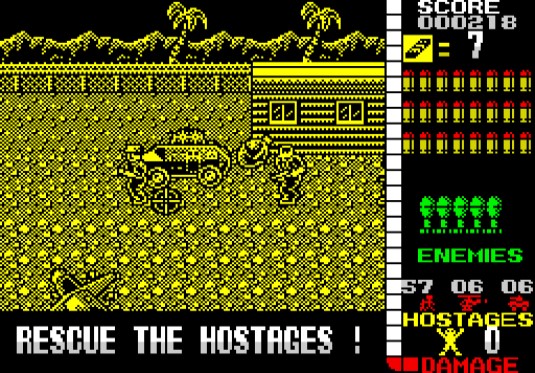
For those not in the know, Operation Wolf was a light gun game released to arcades in 1987 and converted to practically every home machine going shortly thereafter. The premise is you're a commando dropped into the jungle to do over the bad guys and rescue the hostages. A set up not unlike Predator, but minus the hulking alien nemesis. Indeed, you could describe the game as a first-person Arnold Schwarzenegger simulator. The screen force scrolls to the left or right, depending on the level, and an array of enemy soldiers, helicopters, armoured personnel carriers, and gunboats assail you with bullets, knives and grenades. And your simple aim is to kill them all. Literally - there's a counter on the left side of the screen displaying how many ne'er do wells are left. And when they're offed, it's to the next level with you which encompass jungle settings, a concentration camp, and an airport. However, as tempting as it is just to keep your finger on the trigger pressed you have to conserve ammunition and your own grenades, as well as top up on your energy levels. Thankfully potions, bombs, and magazines of bullets fall from the sky and can be picked up by shooting them. Also stilling the itchy finger are hostages and medical staff who decide wandering around a battlefield is a good idea - mow them down and the energy bar takes a hit.
Like a number of Ocean's arcade conversions to the humble Spectrum, they pulled off a technical marvel. You could play Op Wolf by light gun if you had the 128K Action Pack version which, in all honesty, wasn't much cop thanks to the decidedly inaccurate technology on offer. But the standard version supporting joystick and keyboard controls was a sharp delight. With a paltry seven colours to play with the developers wisely ditched any attempt at colourising the graphics and ended up with a crisply detailed monochromatic affair that closely resembled the arcade. And the numbers of sprites packed onto the screen are a sight to behold. Yes, at times it slows down when there's a dozen or so enemies blazing away at you but there is such a satisfying pay off if you can line them up and and hose them down - and with the added benefit of the Z80 breathing a sigh of relief. The fact you don't have the arcade's Uzi to hand doesn't matter, the gameplay and the speed is faithfully replicated. And, amazingly, it was entirely playable with keyboard controls too. I know, that's how I managed to complete it.
Like so many of the most beloved action titles of the 1980s, to say Operation Wolf was ideologically suspect is a matter of stating the obvious. In line with so many hypermasculine flicks of the time, it was the digital sublimation of violent and entirely asocial desires. A celebration of over the top martial prowess against some explicitly anti-American other. Here, it seems you're cast into the Latin American jungle against some awful narco-dictatorship. But as the lead-in tune the Speccie plays before the action begins, there is a certain oriental cast to it. The South East Asian jungle beloved of Rambo II then? It was no coincidence then its sequel, Operation Thunderbolt (whose USP was strapping two Uzis onto the cabinet for two-player co-op) had obviously Arab terrorists as your enemy. But what it also conferred was the super human sense of invulnerability you find in all contemporary first person shooters. The enemies fold as soon as a bullet hits them, including the occasional Arnie look a like who tries getting up close and personal with you. Yet providing you keep shooting those turkeys and potions, can rise above the hail of bullets. Naturally, the individuation of the player, the positioning of them as different to and superior to in-game baddies has been a staple of video games since, well, video games, and embraces all action genres and RPGs from the most primitive systems to today's behemoths. It's only a hop, skip, and a jump from this to the neoliberal commonplaces that even more explicitly crop up in contemporary games.
Is Operation Wolf on the Spectrum worth firing up an emulator for? Or, even better, if you still have an old machine knocking about? Other readers might prefer the versions on alternate machines, particularly if they grew up with the C64 or Master System offering, but for in-your-face frenetic action for the rubber keyed wonder it doesn't come any better than this.
Image Credit
Sunday, 26 April 2020
Twin Peaks: The Return
Then, following the prequel film, 1992's Twin Peaks: Fire Walk With Me it went away for 25 years. After all, upon entering the infamous Black Lodge, Agent Dale Cooper was told by the deceased Laura Palmer that he wouldn't see her for another quarter of a century. By fortuitous happenstance, 2017 was when the long-awaited season three finally appeared, giving the impression this was a plan long in gestation. Reflective of the darker tone taken in culture and politics since, Twin Peaks: The Return is violent, coarse, and disturbing. It thinks nothing of blowing people's heads off, running over a six-year-old child, crushing skulls, and littering the place with mutilated bodies. Swearing is in, sex scenes are in, psychological torture is in. Yet while moving with the times by accepting what is accepted in contemporaneous "serious" television, like its predecessor series Lynch employs tropes and devices that increase the weird quotient, making the whole thing more absurd, contrived, and compulsorily watchable. Its weird is a weird entirely appropriate to the interregnum between the economic crash and the global pandemic.
I'm not particularly interested in providing a plot overview. There are plenty available if a summary is what you require. Instead, I want to tease out a few themes (easily, The Return has enough goodies to fill several learned tomes). The first is its most jarring aspect: the male centeredness of the narrative. In a decade where virtually all the acclaimed TV serials have prominently featured female characters, as brilliant as this is it seems somewhat out of place. Agent Cooper (Coop), his doppelgänger (evil Coop),and secondary characters Gordon, Hawk, Sheriff Truman, Andy, Bobby, even the Fireman (AKA The Giant) and MIKE (stuck in the Black Lodge) are the ones who force the pace, make things happen, move on the plot. Women are so often accessories, showing no more agency than Mandie, Sandie, and Candie, the cocktail waitress attendants to the Mitchum brothers. Audrey Horne is foil for her husband's gaslighting, Tammy is on hand to accompany Gordon and Albert on their investigation, Nadine listens to Dr Jacoby's conspiranoid rantings and is convinced to let Ed pursue his much-frustrated relationship with Norma, and even Judy - the big negative responsible for BOB, evil Coop, and everything bad in the show, seldom features. Her host, Sarah Palmer, spends her life smoking, drinking, watching old TV, and having meltdowns. The only two points of decision she makes is killing a random in a bar seemingly determined to assault Sarah following a diatribe of misogynistic abuse, and spiriting Laura Palmer away when Coop travels back in time (yes) to save her from her murder. This is only partially contradicted by side characters. Janey-E has to care for a semi-comatose Coop/Dougie (of which more shortly), and is able to buy off a bunch of thugs looking to kill him over gambling debts. Lucy shoots evil Coop as he pulls a gun on Sheriff Truman. Even the addition of Diane as a supposedly heavy-weight (and canon-critical) character doesn't break the pattern. Going from the recipient of Coop's daily recordings in the first two seasons, we learn she was raped by evil Coop, turns out to be a Black Lodge construct designed to assassinate Gordon, and when the real Diane is retrieved her identity is erased by her and Coop's passage into the alternate reality (Linda to his Richard), and then altogether from the story as she flees his hotel room following the series' most unsettling sex scene. Only her absence makes Coop's mission to find this reality's Laura Palmer possible.
Since the breakthrough of Blue Velvet, Lynch has been hailed as the archetypal postmodern film-maker. Pastiche, unreliable narrative, the subverting of cinematic convention, over-the-top auteurship, The Return amps up the pomo long after becoming passé itself and yet deploys it so it becomes something postmodernism should never really be: fresh. Albeit a freshness that simultaneously, and paradoxically, invokes nostalgia for the original series and its multiple disruptions. With Twin Peaks you know you're getting a helping of American weird, but here we also get a lot of the mundane. Awkward pauses and silences are in. Sequences where very little happens without any dialogue. Eating, making breakfast, swatting a fly. And scenes that are deliberately uncomfortable and don't go anywhere. Audrey's arguments with her husband are overlong to the point of cruelty, as if to mark off the naive, lively teenaged Audrey of 25 years previously from a fatal outcome of middle-aged disappointment and neurosis. While incidental to the story, Lynch does place Audrey in the Road House to reprise her famous dance. Other stories that don't go anywhere are a persistent feature of most episodes too. The bar is usually the scene for conversations between characters who appear just for a chat, and then are never seen again. Their concerns and gossip are left hanging - a glimpse then into the lives of extras? However, this is Twin Peaks and the background, the unthought and tacit doxa of the everyday is as much part of the characters as it is for the fleshiness and sociality of real life. For example, whereas Shelly was plot critical in the original series here she's still working at Norma's diner and is regularly fleeced by her daughter to support her and her husband's drug habit. As we explore their troubled relationship, which apparently ends after he seemingly shoots himself under a tree, there is nothing outside of it. Their rows and implied domestic abuse is a foil for nothing. It simply is. The same can be said for the benign and hokey back and forth between Lucy and Andy, Nadine's appreciation of Dr Jacoby, and Ben's relationship with his new Great Northern's secretary, Beverley.
Small, unfinished stories hang from the Twin Peaks tree, but Lynch is no stranger to indulging a love for artifice either. Characters come and go whose existence is very obviously just to move the plot along. Freddie fits this device to a tee, and revels in his mysterious destiny. A new face, he's introduced in episode 14 as a security guard at the Great Northern Hotel. He also happens to wear a rubber glove. According to the story he relates to James, he was instructed (by the Fireman) to go to a store and purchase an opened pack and buy the sole glove therein. He does so, puts it on but finds he cannot take it off. It's also conferred him super strength, which he later uses to put two guys in intensive care and bust open his cell door. Freddie is also on hand after Lucy shoots evil Coop and the spirit of BOB emerges. They get into a fight and the glove lets Freddie smash him to pieces. Presumably, Frost and Lynch were wondering how they could kill off the town's nemesis. Why not via a very simple and very obviously grafted-on character?
Perhaps Lynch's most audacious move is what he does with Cooper. Having resided in the Black Lodge for 25 years, Coop falls back to earth and replaces another doppelgänger - the washed up Dougie Jones, an insurance agent in Las Vegas who was created for the express purpose of providing a place holder for Coop's return. The problem is Coop not only loses his memory in the process, as Dougie he is little more than an automaton. The irony, agent Cooper loses all agency. One of the key aspects of poststructuralist thinking is the decentering of the subject, of a stress on how personhood and individuality is an effect of the structures and discourses that flow in certain directions, discipline bodies, contain and channel potentialities and impose an arbitrary order as if it was the order of things. What then happens if you lay bare these minute determinations and put conceptual personae on screen as dramatis personae? The life of Coop for the majority of the season. Made incapable of most things save for repeating people's words and random scribbles, through a series of prat falls and slapstick Coop, now as Dougie, is able to be a better husband to Janey-E and a better father to Sonny Jim. By following prompts from MIKE he wins over $400,000 in the Mitchum Brothers' casino, mindless scrawls on his case files uncovers an embezzlement sting by a colleague and inadvertently ends up reversing a decision on a $30m policy originally denied to the Mitchums, which then see these mobsters shower gifts on Dougie and his family. At every turn, Dougie/Coop has to be prodded and pushed into doing something which, by pure happenstance, leads to positive outcomes but nevertheless sees him reap the credit despite his being a pure vehicle of other people's actions.
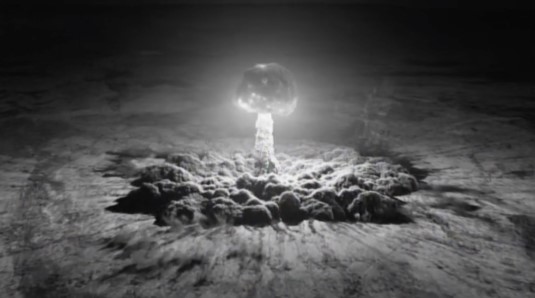
The real agent, of course, is Lynch himself who shared the writing credits with Mark Frost but directed every episode. He was also responsible for the sound design and penning several of the songs to have featured. Additionally, Lynch plays Deputy Director Gordon Cole, an affable and somewhat avuncular comic relief character in the first two series and Fire Walk With Me. In the return his character's stature grows as a leading light in the secret Blue Rose task force, formed after encountering a Black Lodge doppelgänger. Hard of hearing and having his aid cranked up to maximum, he frequently misses what people say and misinterprets. Lynch is also excellent in affecting a permanent bewilderment. In Gordon we have a character hot on the trail of the story and dependent on how events unfold, which belies Lynch's role as actual director and master of ceremonies. This little nod literally explodes in episode eight. For many the standout of this season, this was described as "mind-melting" by the Graun, "one of the greatest hours of television ever made" according to Vulture, and for the New York Times, "There’s nothing to point to in the history of television that helps describe exactly what this episode attempts." These are fair summaries. Most of the episode is a montage of abstract images and crashing, electrical screeching. It begins with the detonation of the first atom bomb, and the camera zooms into the mushroom cloud and subjects us to everything within. Eventually, it resolves to a faceless figure who vomits out a stream of globules, including one with the grinning face of BOB. In a lengthy sequence a convenience store is pictured with blackened woodsmen milling about it in a series of staccato cuts. These events are watched by the Fireman and a 1920s-styled Senorita Dido in their fortress. In a no less abstract sequence the Fireman reposes and levitates, sprouting an orb with Laura Palmer's face which is sent to Earth. Then we shift forward in time to 1956. A woodsman invades a local radio station and kills its inhabitants. Reciting and repeating a short incantation at length, townspeople listening to the show fall unconscious. One of whom is a young woman, whose mouth falls open and a creature - a moth with frog's legs, which we saw hatch and crawl across the New Mexico desert - crawls in.
Asked about this episode, Mike Frost said this was the nearest to an origin story for Twin Peaks we could expect. The furies unleashed by nuclear explosions is a well enough visited literary location, and the suggestion here is this is what birthed the forces of evil. Indeed, it's not spelled out but the young woman was likely Sarah, implying she is responsible for carrying the corruption leading to the abuse and murder of her daughter. The episode is also a signature mark of the Lynchian, having far more in common with experimental cinema and art house than anything mainstream. The black and white presentation heightens the comparison with the surrealist film makers of the 1920s and 30s. But it's also a statement of an artist at the height of their powers. As Bourdieu notes in his conceptual construction of the artistic and literary fields, there are sections of the field adjacent with and closely bound to the structurally dominant fields of the economy and of power. Works produced in this zone of proximity are concerned less with the artistic practice and more commercial reward. The blockbuster film, like Top Gun and its coming sequel, for example. Or the trashy novel, soap operas and sitcoms, the overwhelming bulk of popular music. The further one strays from the proximity of power the more one is concerned with the autonomous stakes of the field, of the cultural capital specific to it. Therefore, the further the trajectory is from the economic the more the disposition (habitus) pursues the profits unique to the art world and subscribes to the illusio of art's for art's sake. The modernist novel and symbolist poetry is emblematic of this: objects produced for niche audiences with culturally specific capital by authors (auteurs) whose works are explicit interventions in the politics and fashions of the field. What Lynch accomplishes with part eight is an act of disembedding. Twin Peaks's reputation is founded on its limited materialisation of postmodern themes: here the limited is freed from its bonds and the indeterminacy of the unsignified and unsignifiable is allowed full reign. Lynch confronts a mass audience with the dark creativity wreaked by atomic blasts, and the commercially repressed creativity of art and image usually the preserve of self-selecting audiences of distinction. And he can do this precisely because his considerable artistic capital is buttressed by a successful career. He uses the rare instance of the confluence of artistic and economic capital to produce something utterly at odds with every TV show convention.
Ultimately, for a many layered and complex show like Twin Peaks it is an episode, a front in the interminable battle between the unambiguously good and the outright evil. This battle, so characteristic of American cinema, kids shows, and its news coverage is the only simple thing about this series. The inevitable elemental conflict ensures there is no closure to the third season, and why a fourth might be in prospect. Even if a sequel is not forthcoming, it doesn't matter. The Return is a fundamentally open work with its many story lines left unresolved and turns inviting speculation and argument. There are any number of rabbit holes for the curious to bolt into. Why not join Twin Peaks fans down one?
Image Credit
Thursday, 26 December 2019
Top Gun
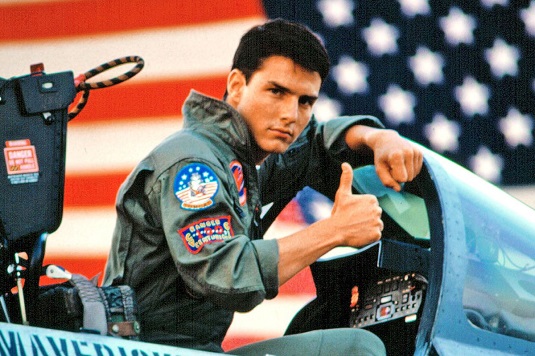
Growing up when it came out, I get why the Library of Congress selected Top Gun for permanent preservation - for a completely superficial movie with more linearity than a slide rule, it was, is culturally significant. Top Gun is one of those films you might not have seen, but it feels you have. The tropes have long been parodied by the likes of Hot Shots and Team America, as well as cheesy 00s dance vids, and when I was a kid the lines were frequently quoted back and forth across the school yard. Much later into the early 90s one of my mates was obsessed with the film and was convinced he could pull by singing You've lost that loving feeling at poor unfortunates his eye fell upon. Curiously, he remained girlfriendless long after we had passed out the school gates. Reportedly, Top Gun led to bumps in recruitment for the US Navy and Air Force, a mushrooming market in bomber jackets and mirrored sunglasses, and queues forming up waiting for a go on 1987's Sega mega hit, After Burner. And it brought us the brash rock anthem Danger Zone as well as Berlin's Take My Breath Away, and was part and parcel of the militarisation of 1980s Hollywood.
The film's plot, such as there is one, is tenuous filler between the action shots of jet fighters spinning around the training ground, and dogfighting with Soviet jets to show off the superiority of American air power. How nice, a big budget rendering of the Brize Norton air show. Nevertheless, as a slick work of marketing Top Gun does not fail. It shows the military hardware, the effortlessly cool lifestyle, the camaraderie (and rivalry) between fighter pilots and, because it was the 80s, the young women airmen could be expected to pick up. No wonder tens of thousands were seduced into signing up. As for the plot, US Navy pilots Pete "Maverick" Mitchell and Nick "Goose" Bradshaw are sent to elite flight school to knock off the more reckless aspects of their flying, and what follows is much machismo and ostentatious masculine displays, the infamous homoerotic volley ball scene, motorcycles, falling in love and jet-on-jet action.
Tom Cruise's Maverick is as brash and annoying as young American men were in films of this era. Arrogant but with something to prove, he bends the rules by disobeying instructions and chasing Charlie (Kelly McGillis), a civilian contractor who is also an instructor on the flight programme. Bearing in mind this was Reagan's America, we could not well have a jock flipping Uncle Sam the bird by disobeying orders and shacking up with someone who was technically his superior, and so a redemption narrative is shoe horned in to proceedings. Throughout the first three quarters of the film Maverick is basically a gifted punk as well as a self-centred narcissist until tragedy strikes. Out on a practice run his jet stalls and goes into an uncontrolled spin. He and Goose manage to eject but Goose strikes his head on the way out and, boom, his life-long friend is dead. The key then changes into some heavy handed introspection where Maverick mopes around, blames himself, consoles Goose's wife and child, and very nearly quits. He is persuaded to stay on and is cleared by a tribunal, just in time for graduation and an end-of-film dogfight with the nasty Soviets and manages to save the day. Hurrah. Goose is avenged and America is safe from the USSR. Even if the last scrap takes place over the Indian Ocean.
Maverick's redemption is interesting precisely because of how he is, for want of a better phrase, tamed and domesticated. Tearing around irresponsibly is not the done conservative thing to do, but what it does is sell a carefree lifestyle that, thanks to the rigours of military discipline and personal tragedy, segues into conformism and responsibility. Despite doing the navy proud and saving the neck of his arch rival, Iceman, all ego is cast aside as he decides to ditch his career as a top pilot and becomes instead an instructor at the academy. He moves back to California where Charlie joins him and, presumably, they spend many decades together basking in golden sunshine and raising the next generation of fighter pilots.
Of course, we can now look forward to Top Gun: Maverick come the summer in which Cruise reprises the role. Sad to say, I'll probably go just to see how far the original can be surpassed in awfulness. Will Maverick be nursing traumas for training the men who dropped high explosive ruin over Iraq, or are we going to see a garish celebration of the latest American hardware and, with a nod to important international markets, a cooperative military venture with the Chinese against some mutual threat? Whatever we get it will be devoid of depth, warmth, plot, and classic anthems. But we might get the volleyball scene.
Sunday, 20 October 2019
The Terminator for the MegaDrive/Genesis
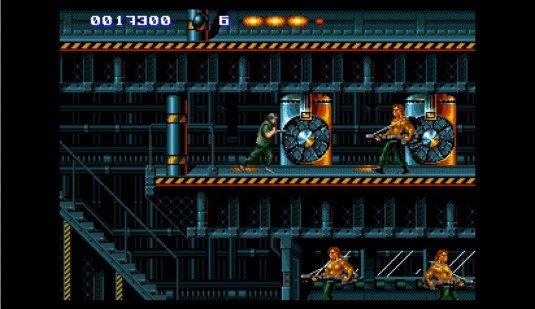
At this point in the film franchise's life, one of the more beguiling aspects of the Terminator films were the very brief flash forwards to the post-apocalyptic machine-infested future. And so to set the first level in this future was a good choice and a nod to the fans. The second smart choice was to have you set upon by the giant tank droid famous for crushing human skulls in the flicks. Armed only with grenades, it's a simple enough battle but one immediately suggesting there lies goodly things within - and it looked very compelling in the TV campaign and on GamesMaster. Once you get inside Skynet's base your passage through the tunnels is blocked by a never-ending supply of terminators. And you, a mere flesh and blood human, shrugs off the hail of bullets as if you were Arnie himself. Thankfully health drops from the ceiling at regular intervals, demonstrating the programmers knew it was too hard but couldn't be arsed to go back and adjust enemy spawning. Eventually you acquire a gun and plough through the terminators with ease. You locate Skynet's core, blow it up and make your way to the next stage.
The ensuing cut scene establishes you've passed through the time hole into 1984, and you have to locate Sarah Connor before the terminator does. This means making your way through some light platforming while avoiding the attentions of bomb-throwing thugs and the LAPD's finest. One curious design decision here was, despite your being armed with a shot gun (and it sounds really meaty as well), the thugs perish as you blow them away but the cops are merely rendered unconscious. It takes four blasts to fell them, then they get up and come after you again. I suppose as the film has the terminator massacring coppers, which is obviously a Very Bad Thing, then you as the goodie can't be seen to do the same. Nor, for that matter, are there many games, certainly at the time, that allowed you to shoot up the police. One of the reasons why the original Grand Theft Auto and, to a lesser extent, Driver proved controversial. Anyway, you make it through the two sub levels to the Tech Noir club to face off against the terminator. Blast him enough and you're able to get past him to rescue Sarah. The next stage is the police station. You break out of your cell and have to race to the top of the station, facing off against the same bomb-throwing goons, the fuzz and, of course, the terminator itself. Please note it departs from the film by not shooting any police. Like the lead up to the club scene the level is quite linear. And then we're in the factory, where the terminator has had all its flesh burned off and its out to get you. This means it spawns fairly randomly whenever it disappears off the screen, but as long as you keep it walking/crawling behind Reese you can lead it straight into the compactor. Terminator terminated.
Sounds like a simple game? Yes. And a short one? Definitely. If you know what you're doing, it takes about 15-20 minutes start to finish. That was unforgivably short by 1992 standards, and one of the reasons why it was panned. The game was passable (indeed, teenage me would regularly return to it precisely because it was a short burst of undemanding action), there just wasn't enough of it - especially for the £34.99 price tag. This reflected the contrasts in the game. At one level it was clever and thought through, appealing to Terminator fans and showing the film due fidelity. On the whole Kyle Reese was well-animated, which was a hallmark of all Perry's 16-bit work. But in other bits, there was a certain shoddiness. The lay out of the second level was pretty unimaginative and the distinct lack of enemy types didn't help, and the spawning on the first stage was ludicrous. Reaching the end of a stage meant a jarring transportation to the score summary screen, and yes, the lack of content is a big issue - unless you're of the sort who likes playing the same competent action-platformer over and over. The fact this was put on a four megabit cartridge and its corners are far from smooth suggest this was a quick money grab, of churning something out that appeared technically proficient and swish to catch the T2 backwash and hit the market before the T2 games landed on home formats. And it worked. The Terminator troubled the charts for months and was a commercial success, and Perry carried his upward trajectory to bigger and more lavish projects.
What to make of this game almost 30 years on. Well, it's not one that often appears on YouTube MegaDrive retrospectives despite the hype it got at the time. In the UK at least. It was turned out as a cash grab, and as such was entirely forgettable.
Image Credit
Sunday, 21 July 2019
James Bond and Fragile Masculinity
I don't know how complainers would cope if they knew the British secret services routinely employs women as field agents, and have done so for over a century. Make them cry harder? Though moaning about women replacing male characters in popular culture is nothing new, we've come to see more of it lately. In fact, it appears to be accelerating. Star Trek Discovery got it in the neck for daring to cast a black woman as the lead character, a few years ago the Ghostbusters reboot received brickbats not for its quality, but because it starred women. As I write there's another meltdown happening because Natalie Portman is due to play Thor in the next cinematic outing for the character (never mind "female Thor" has already featured in a run of comics). It is certainly true we are seeing a greater visibility of women in more varied TV and film roles, and this has especially been the case this last decade with dozens of acclaimed woman-led dramas getting the plaudits and reaping success. So pushback was inevitable. But what is the root of this? Why should the masculinity of some men feel affronted when fictional characters have their genders flipped? Why the abject failure to man up?
It speaks to a certain anxiety in the world. The so-called alt-right with its performative displays of misogyny, such as the desperately try hard sexism of failed UKIP candidate, Carl Benjamin, is a symptom of gendered entitlements in crisis. Indeed, the incels, the Men Going Their Own Way movement, the "perfect gentlemen" who gun down young women, the popularity of Jordan Peterson's self-help manuals, the attraction - to some - of fascism, belies a certain frustration. The gendered codes curled up in our socialisation, and force fed us through multiple streams of media still assume male supremacy. It is the unremarked, unspoken starting point for so much. It assumes men are individuals who acquire their manly status by asserting themselves against the world. Women on the other hand are defined by their relationships and responsibilities toward others, they are part of the world to be asserted against. The problem is that while gendered inequality obviously still exists, and men have the most wealth, the most opportunities, and are therefore more likely to possess the above entitled mindset, the relationships underpinning this are shifting quickly. And decaying.
A lot of this has to do with work. For as long as the bulk of the population have to sell their labour in return for a wage or a salary, class matters, and the forms it takes shape and condition gendered expectations and experiences. The industrial worker, once the hegemonic form of conceiving and being working class (and still is for some centrist-types), dominated the 20th century. Manual work, toil, sweat, dirt, the physicality of working the land, in a factory, or an extractive industry ensured class markers were simultaneously gender markers. Coupled to this elision of strength and manliness were the ideologies associated with the social wage: men were responsible for providing for their wives and families, and the understanding - the tacit social contract between labour movement, the employers, and the state - was the wage provided for all the family. Men then were providers, and as the sole or main income their wages were the material basis for patriarchy at home. However, male dominance is not preordained. Since the 1970s, the social wage has declined and with it more women have entered into the work force; the masculine industries of old have undergone steep decline, meaning these kinds of jobs are increasingly things of the part; men and women increasingly compete for the same kind of jobs. And lastly, the character of new jobs are a lot different from the industrial worker of old. And so as the grounds shift, proletarian patriarchy is destabilised.
These new jobs, characterised by immaterial labour are based around the production of knowledge, services, care, relationships. These do not the use of the body's brute force but our social capacities and aptitudes - intelligence, creativity, empathy - and these are mobilised to make relationships, and profits. This highlights an interesting tension in the way contemporary capitalism works. The individuated masculinity of the industrial worker has been recouped and redeployed culturally, and as a mode of governance in the age of neoliberal capitalism. We are posited as individuals who are, fundamentally, on our own. Gender, ethnicity, sexuality and background are no longer barriers to success. You get out of our meritocratic systems what you put in. You, the individual, is sovereign in ways the masculine classed subject used to be. But there is a glaring cultural contradiction between this consumerist sovereignty and having to submit to the will of others in the workplace, be it the employer directly or the demands of service users and clients. This is where masculinity has particular difficulties. The continuities between masculine and neoliberal subjects renders men at a double disadvantage in job roles fundamentally oriented toward others, whereas these same jobs are culturally more attuned to feminine virtues. Cooperation, networking, caring, empathising, all the facets of emotional labour draw upon and have greater fit with the gender socialised into these mores. Therefore men are more likely to suffer a gendered form of anxiety between their gendered and classed positions, and in a very real sense are at a competitive disadvantage as these kinds of jobs and careers grow - for as long as the gendering of boys and men does not keep up with developments.
What this means is we have a man's world in the process of becoming something else. The sexism of the age of industry was about maintaining separation, of reinforcing a sexual division of labour around highly gendered modes of work. The sexism we see today recalls past privilege, but is fundamentally rooted in relationships in long-term decline. It comes from anomie, of men raised and habituated to a world that only partly exists and is fading rapidly. And so we see a recrudescence of violence against women, of shock value sexism, and the incessant whining about women ruining video games and films. They know the game is up and their privilege is slipping away, and we're left with a dwindling band who were promised the earth, but all they got was a shitty bedroom and a chip on their shoulder.
And so whether it's James Bond, Thor, Star Trek, Ghostbusters, or something else, we're going to have to suffer the wailing voices of dethroned masculinity until the point they dwindle into irrelevance. It might be unpleasant, it might be damaging, but as night follows day they are destined to be crushed under the weight of the fates. Male privilege is under attack, and its survival isn't looking good.
Tuesday, 31 July 2018
Batman Returns for the Super Nintendo
And then, something happened. In 1989 an edgier, darker Batman assaulted the cinema. Out went the campery and tongue-in-cheek humour, in came a tortured Bruce Wayne with revenge issues, a slicker, more menacing look, and a cache of cool coincidentally appropriate for mass market spin offs. Among the cornucopia of chiropteran-coded commodities we inevitably find video games. The home computer versions by Ocean and Sunsoft's outings on the NES and MegaDrive were very well received and, most importantly, did the business in the software charts (coincidentally, all were praised for their soundtracks too). Likewise, Batman cleaned up and so come 1992, Batman Returns graced the cinema. A much better film than the original, in my view, we saw then hot properties Michelle Pfeiffer and comrade Danny DeVito cast as Catwoman and The Penguin. The hype machine cranked up, and out came the games. Sega's iterations of Batman Returns weren't regarded as much cop, except for the stunning Mega CD version. And Nintendo? Handled by Konami, the licence went in a different direction to its prequels and rival games. It went all fighty.
Batman Returns on the Super Nintendo owes more to Final Fight and Streets of Rage than anything else. Here you play Batman (like duh) and scroll from left to right dispensing fisticuffs and kicks to an army of clownish goons. You have an array of thin clowns, a number of fat clowns who try and bounce their bums on your head, and an assortment of weapon wielders. Bomb throwers, jugglers, fire eaters, bazooka wielders, swordsmen, you know, just the sort of personnel no self-respecting crime gang would do without. And can you guess what's waiting at the end of each level? Oh yes, that would be a boss for you to mix it up with. In later stages, as you might expect, you get to square off against Catwoman and The Penguin. All jolly good fun.
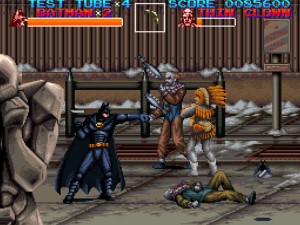
Is there anything wrong? It's single player. And, unfortunately, technical limitations mean there can only be three nasties on screen at once with you. That isn't too bad because the difficulty is balanced in such a way that this doesn't matter, and any more would surely kick your ass. Perhaps it's just me, but I feel Batman is a bit lumbering as well. But in all, these are nitpicks. The game is easy to pick up, the moves don't demand convoluted combinations of button presses, and as a rule the game's aesthetic is consistent with the film. It makes for a very attractive package.
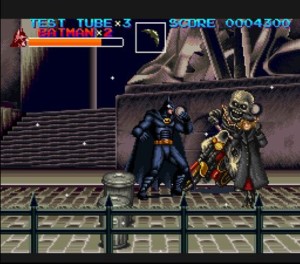
Also, SNES Batman Returns is entirely appropriate to Batman's dark turn at the cinema. Platform games are all very well, but they tend not to confer cool, young adult vibes the films plugged into. Konami's decision to go with a brawler was, in this regard, inspired. The early 90s were the time the mediocrity we now associated with film tie-ins set in and, as a rule, they tended not to offer anything fresh. Batman Returns might look like a Final Fight rip off with a licence appropriate skin job, but by offering destructible backdrops and decent mini-games, they innovated within the beat 'em up genre and successfully pushed the envelope of what a game-of-a-film could be. Recommended.
Thursday, 10 May 2018
Wellred Films: Mass Trespass
Thursday, 22 June 2017
Wellred Films: Carry on Campaigning
Last week I enjoyed the worst train journey of my life. The rush hour choo-choo from Stockport to Sheffield is a busy service that ordinarily serves up four coaches. On this occasion, the powers that be at East Midlands trains decided to put just two on. That meant we were rammed in cheek by jowl, an experience that included being in the middle of a jam of 17 bodies in the vestibule area. Still, the passengers are only "beer-drinking, chip-eating, council house-dwelling, old Labour-voting masses", at least according to proprietor Brian Souter, so what does he care as the subsidies roll in?
No matter. The journey was worth it in the end as the comrades at Wellred films had asked me to appear on their latest show. Evidently, I hadn't scared them off last time despite trying my damnedest.
Carry on Campaigning features Malwina Modrak and Mick Napier discussing the state of politics and the kinds of campaigning/activism theyre involved with, and I'm there to make the numbers up. Discussion-wise the fur didn't fly, alas. Nor was it a Jeremy Corbyn ego-stroking party. Here, see for yourself.
CARRY ON CAMPAIGNING from wellredfilms on Vimeo.
No matter. The journey was worth it in the end as the comrades at Wellred films had asked me to appear on their latest show. Evidently, I hadn't scared them off last time despite trying my damnedest.
Carry on Campaigning features Malwina Modrak and Mick Napier discussing the state of politics and the kinds of campaigning/activism theyre involved with, and I'm there to make the numbers up. Discussion-wise the fur didn't fly, alas. Nor was it a Jeremy Corbyn ego-stroking party. Here, see for yourself.
CARRY ON CAMPAIGNING from wellredfilms on Vimeo.
Monday, 20 February 2017
Abandoned Stoke
An interesting short from the comrades at WellRedFilms, just ignore the talking head saying things about the passing of Stoke's industry. If you would like more, keep an eye on WellRed's profile page here.
Saturday, 24 December 2016
Good and Evil in Star Wars

Like many millions of people, I'm a fan of Star Wars. Not a superfan mind, I'm not into the expanded universe, the novels and comics or anything like that. After all, since Disney prised Star Wars out of George Lucas's decadent grasp, the new overlords of the universe have declared the films canon, and that's about it. Not that I'm bothered. When I first saw the opening of A New Hope (then plain old Star Wars), you didn't need much to tell you who the goodies and baddies were. The Empire are transparently evil, the rebels unambiguously righteous. There are no greys. I grasped this when I was little, and so did the young 'un sat next to me at the cinema who kept saying "yes!" every time an X-Wing offed a Tie Fighter.
This simplicity is interesting because, ultimately, what makes the Empire 'evil'? What makes the Rebellion 'good'? With the Empire, it's easy. Darth Vader looks like a bad 'un, and within seconds of our introduction in the original film he's throttling a hapless rebel soldier. Palpatine's nefarious scheming sees his immersion in the Dark Side of the Force render him a rubber skinned monster. And in Rogue One, the Empire burnishes its evil creds with wanton acts of murderous destruction thanks to the newly operational Death Star. The main antagonist, Director Krennic is effectively a Nazi weapons scientist with Bond villain tendencies, up to and including the tendency to murder subordinates for little reason. Vader is the same, threatening Krennic with a sticky end if he fails him and the Emperor - a nod to the absurdity of The Empire Strikes Back where he kills off imperial officer after imperial officer for their failings. It strikes one that climbing the career hierarchy to earn the privilege of instant death working alongside the Lord of the Sith can't be a powerful motivator.
And therein lies the problem with the Empire. What is it about? Krennic is portrayed as an ambitious bureaucrat, so much so that Vader chides him for it. But there are no values, no matter how twisted motivating his murderous career path beyond personal advancement. And this is the same with Vader and the Emperor. For all their mystical twaddle about the Force and the power of the Dark Side, what's the point? It's power for power's sake. That's fine for individual motivations, but you can't carry a society on it. The expanded universe suggests the Empire has a whiff of Nazi-style human supremacism about it, but apart from their military personnel being either human clones or droids of some description, there is little in the films to suggest xenophobia and racism toward aliens.
Ditto for the Rebellion. We know from the prequels that they see themselves as heirs to the old republic brought down by Palpatine in Episode III, but apart from that, what are their values? Yes, they're against bad things. They don't like and are persecuted by the Empire's goons. Presumably they'd like to see democracy restored in the galaxy, but beyond that there is very little. They come over like many an earnest anti-capitalist activist. Very easy to identify what they stand against, difficult to pin down their alternative. The Force as practiced by dear old Obi-Wan and Luke Skywalker isn't much of a clue either. It emphasises the manipulation of the unseen forces that bind matter together, and Jedi training involves suppressing and rising above the passions through self-mastery. Selfishness, avarice, desire, jealousy, vengeance - all these are paths to the Dark Side. And, again, for what? To uphold galactic democracy and rescue kittens stuck in a trash compactor?
Where the Rebellion does noticeably differ from the Empire is with the integration of alien races. This theme continues in Rogue One with the Mon Calamari (of Admiral Ackbar fame) spearheading the Rebel assault at the end of the film. And throughout the saga, aliens are integral to military operations (though, bizarrely, none get to pilot Rebel X-Wings, Y-Wings and what have you).
And so what we're left with are incredibly simplistic notions of evil and good. The Empire is the grim outcome of indulging the self to the exclusion of all else, and the Rebellion springs from abstinence and the rejection of this-worldly things. Which is ironic considering the cinematic celebration of these values have created the most bankable movie franchise in existence, and fed the gaping maw of profit-hungry production companies, cinema chains, and toy merchandisers for decades.
Sunday, 10 April 2016
Science in The Martian
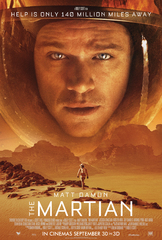
That said, I don't think there's any need to dwell on the plot as it's not a particularly deep film. Set at some unspecified point in the near future, Matt Damon gets left for dead on the Red Planet as a dust storm swoops in on a NASA landing site. The next couple of hours are spent trying to get him back home while Damon has to "science the shit" out of his meagre supplies and technology to stay alive. Okay, scraping up vac-packed faeces and mixing it with Martian soil might not produce the kind of potato crop we see in the film, at least not straight away, but it has enough pseudo-realism for it to be plausible. And puncturing one's space suit to use it for propulsion is a bit iffy, but again, it sounds just about right for it to work.
It goes without saying that the wide panoramic shots of the Martian desert (i.e. Jordan) are stunning, yet the sense of desolation doesn't overcome the film, nor is Mars the "real star". Throughout Matt Damon does a good job of playing Matt Damon, so don't expect much in the way of brooding and existential angst. Thankfully his ubiquity doesn't get tiresome as his adventures in the habitat and on the rover are interspersed with ground control action. Overall it's very watchable. Not a masterpiece by any means, but an entertaining enough update of an Apollo 13 (and an Apollo 13)-style space disaster scenario.
The real hero here has to be science. When it suits, which is often, NASA likes to dress its organisation and its mission up as the repository of all that is best about our species. Its official discourse evokes essentialist notions of exploration, that it is in our very nature to strap ourselves atop a rocket and blast off into infinity. And when it's not reworking old American frontier ideologies, it's presented as an instantiation of the absolute, of a manifestation of reason straight from a late 20th century misreading of Hegel. As such, any film that has official NASA involvement - and this does - the agency has to come out of it looking good. Hence Matt Damon was never in any danger.
Putting that aside, anyone whose politics aren't hitched to the primitivist bandwagon has serious respect for the space science NASA does. Even I follow them on Twitter. And that is shown in the best possible light, here. Matt Damon applies his botanist know-how and astronaut training to grow crops, establish communications with Earth, improvise habitat and suit breach repairs, and lots of other gadgety-things. Meanwhile NASA get their heads together to formulate a rescue plan which, in the best tradition of American schmaltz, a lowly underling at the Jet Propulsion Lab manages to come up with. Whenever a problem presents, all concerned apply ingenuity and the scientific method to arrive at a solution, even if the bounds of credulity take a little stretching.
Nevertheless, this is more than just pro-NASA propaganda. The Martian sets its face against the contemporary wave of dystopian sci-fi that delights in creating misanthropic situations to subject our descendants to. Much harder is to produce a compelling, successful, believable film that ignores the zeitgeist. It shows we have the tools and know how to fix seemingly intractable problems, and that our efforts can be successful. In a world haunted by social problems and looming environmental disaster, give me that message over fashionable fatalism any day.
Thursday, 3 March 2016
Gender and Ghostbusters
Who you gonna call?
It looks very jolly, doesn't it? I'll more than likely head up 'anley duck to watch it come the release.
As you might expect, a few people have had a moan about the Ghostbusters reboot. Some of it is justified (three white scientists and a "street" black woman, really?), but the big whinges are reserved for the all-female cast. Never mind that comedy action family romps for mainstream audiences have typically centered on the antics of all-male gangs, oh no, the moaning only begins when women-led films dare to venture out of the romcom and super serious character study-type flicks. In fact, trying to think of anything in this genre led by a group of female characters and none immediately come to mind. In 2016.
Of course, anyone who's worried about the franchise "being spoiled" by the replacement of male by female characters need to get a life. But I can understand the anxiety while having zero sympathy for it. 1984's original Ghostbusters is a much-loved film. It's funny, has great effects (for the time), a simple goodies vs baddies story line, and characters an audience can relate to. I can remember the publicity back in the day - the scene where Slimer charges down the hallway toward Venkman (Bill Murray) was heavily trailed. But we never saw the sliming itself - that was left for the movie (unlike now where it appears all the best lines and set pieces make it into the publicity).
Beloved and fondly remembered it is, Ghostbusters was very much a boy's movie. Female characters had inessential walk-on parts as the secretary (Janine) and the love interest (Dana). Venkman practically stalked the latter until she gave into his leery advances. She was possessed by a demon called the gatekeeper while another, called the keymaster (groan), had to get together to summon their big baddie master, Gozer the Gozerian. It's all low-level sexist stuff that was par the course in 80s movies, and despite being very entertaining is hopelessly a product of its time.
Nevertheless, this sort of format was ubiquitous in the 1980s. This was years after the sexual revolution, and women were already present in the workplace in large numbers. Perhaps it was an expression of the revanchist tide of Conservatism that rolled over the United States, and did threaten the gains made by women and gay people. Part and parcel of this is a forgotten aspect of 1980s culture, and that's the permeation of film and music with 1950s nostalgia. Cris-crossing the Atlantic we had films based in small towns that had barely moved on since the days of the Great Society, we had Shakin' Stevens and Jive bloody Bunny exercising the record-buying public, numerous superheroes were revived from the 1950s heyday, there was a teddy boy inflection in the New Romantic scene. It was everywhere and it was horrible (except in Back to the Future, but that's for another time).
This 50s nostalgia of twee white families living in twee white houses with their twee fridges and twee Cadillacs spoke of a simpler time where gender roles were rigidly defined and everyone knew their place. Of course, that 1950s was the experience of a relatively privileged number of Americans, but it was they who came of age in the 70s and 80s and started churning out cultural product for the masses, and no wonder they would visit the (idealised) themes of their childhood. Therefore pally blokey movies, which have always been something of a mainstay, became even more ubiquitous as family-friendly entertainment not simply because of the conservative cultural climate which, itself, was conditioned by the turn to the right in politics, but also the cohort of (mainly) men moving into decision-making roles in the entertainment industry. As such, while Ghostbusters wasn't a retread of a 50s B-movie, it did stick with rigid gender lines and character archetypes. Even the car - Ecto 1 - is a 1959 Caddy.
Going from the trailer of the new Ghostbusters, it looks like the ghost of the 50s has been laid to rest. Good.
It looks very jolly, doesn't it? I'll more than likely head up 'anley duck to watch it come the release.
As you might expect, a few people have had a moan about the Ghostbusters reboot. Some of it is justified (three white scientists and a "street" black woman, really?), but the big whinges are reserved for the all-female cast. Never mind that comedy action family romps for mainstream audiences have typically centered on the antics of all-male gangs, oh no, the moaning only begins when women-led films dare to venture out of the romcom and super serious character study-type flicks. In fact, trying to think of anything in this genre led by a group of female characters and none immediately come to mind. In 2016.
Of course, anyone who's worried about the franchise "being spoiled" by the replacement of male by female characters need to get a life. But I can understand the anxiety while having zero sympathy for it. 1984's original Ghostbusters is a much-loved film. It's funny, has great effects (for the time), a simple goodies vs baddies story line, and characters an audience can relate to. I can remember the publicity back in the day - the scene where Slimer charges down the hallway toward Venkman (Bill Murray) was heavily trailed. But we never saw the sliming itself - that was left for the movie (unlike now where it appears all the best lines and set pieces make it into the publicity).
Beloved and fondly remembered it is, Ghostbusters was very much a boy's movie. Female characters had inessential walk-on parts as the secretary (Janine) and the love interest (Dana). Venkman practically stalked the latter until she gave into his leery advances. She was possessed by a demon called the gatekeeper while another, called the keymaster (groan), had to get together to summon their big baddie master, Gozer the Gozerian. It's all low-level sexist stuff that was par the course in 80s movies, and despite being very entertaining is hopelessly a product of its time.
Nevertheless, this sort of format was ubiquitous in the 1980s. This was years after the sexual revolution, and women were already present in the workplace in large numbers. Perhaps it was an expression of the revanchist tide of Conservatism that rolled over the United States, and did threaten the gains made by women and gay people. Part and parcel of this is a forgotten aspect of 1980s culture, and that's the permeation of film and music with 1950s nostalgia. Cris-crossing the Atlantic we had films based in small towns that had barely moved on since the days of the Great Society, we had Shakin' Stevens and Jive bloody Bunny exercising the record-buying public, numerous superheroes were revived from the 1950s heyday, there was a teddy boy inflection in the New Romantic scene. It was everywhere and it was horrible (except in Back to the Future, but that's for another time).
This 50s nostalgia of twee white families living in twee white houses with their twee fridges and twee Cadillacs spoke of a simpler time where gender roles were rigidly defined and everyone knew their place. Of course, that 1950s was the experience of a relatively privileged number of Americans, but it was they who came of age in the 70s and 80s and started churning out cultural product for the masses, and no wonder they would visit the (idealised) themes of their childhood. Therefore pally blokey movies, which have always been something of a mainstay, became even more ubiquitous as family-friendly entertainment not simply because of the conservative cultural climate which, itself, was conditioned by the turn to the right in politics, but also the cohort of (mainly) men moving into decision-making roles in the entertainment industry. As such, while Ghostbusters wasn't a retread of a 50s B-movie, it did stick with rigid gender lines and character archetypes. Even the car - Ecto 1 - is a 1959 Caddy.
Going from the trailer of the new Ghostbusters, it looks like the ghost of the 50s has been laid to rest. Good.
Saturday, 13 February 2016
Dick Tracy for the Sega MegaDrive/Genesis
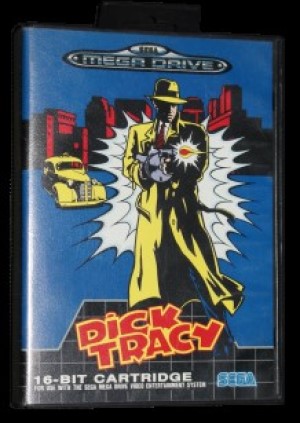
As a life-long fan of the character, Warren Beatty had trailed a Dick Tracy concept around the studios since the 1970s (and he's still at it). For those not in the know, it was a comic strip that began in the Detroit Mirror in the 1930s. Coming off the back of the "golden age" of American gangsterism, pitting a tough-but-honest detective against larger-than-life villains, Dick Tracy has been in continuous print for over 80 years. His box office outing in 1990 came shortly after Tim Burton's Batman sent cinema goers bananas. At the time, you couldn't move for Batmania - but more of that another time. Beatty and Disney hoped Dick Tracy would have a similar impact, and they tried to make a splash with the sorts of promotional tie-ins Batman had. It didn't do anywhere near as well, though the film itself was okay. Nor was it a fantastic hit for the Genesis/MegaDrive, despite Sega giving their interpretation a release in Japan and Europe, and a Master System port. And that's a shame, because it's good.
Yes, there was once a time when tie-in games were often a treat to play. Dick Tracy for the MegaDrive is a (mostly) slow-paced sideways scroller that has you punching and shooting your way through hordes of Big Boy's thugs 'n' hoods. There are some very minor platforming elements, and its design and feel owes a little bit to the original Shinobi and Rolling Thunder, except our Dick is as nimble as neither. One neat and original addition is a splitting of the play area into foreground and background. The former is your standard shooting/punching action, but at various intervals henchmen appear in the background and start opening up. Handily, under that trade mark trench coat Tracy is packing a tommy gun of his own, and you can let rip back. Using the joypad to do this takes some practice, but when you can mow down rows of bodies it does bring a certain satisfaction to proceedings.
As you might have gathered, the end of the level sees you squaring up against a boss. Here, Big Boy's minions from the film take their turn to get killed. These take the form of background shooting as well, and tend not to be terribly onerous once you get the hang of things. That is, until you get to Flattop and then Big Boy himself. It's not that they're difficult - the time limit can be punishing.
And punishing is something the game is. While the bosses are relatively okay, except for the aforementioned, it can get very tricky very quickly. Had I this game 25 years ago, I wouldn't like to think how many hours I would have sunk into it to learn the tricky attack patterns. On the final level, for instance, Tracy is simultaneously assailed by hoods that lie down and jump your bullets, roll in and off screen to avoid them, while coming under fire from the tommy guns in the background. There are the levels where Tracy has to rely on fisticuffs against armed gangsters, and that requires repeated trial and error. And perhaps the most disconcerting are the car chase sequences. Tracy clings to the side of the patrol car while enemies shoot from cars in the foreground and background. I swear there are several motors with a dozen baddies in each. These too require more ducking and a diving than an average Fools and Horses episode. It's a good job that the acquisition of multiple continues via the bonus round is quite easy to do. Nevertheless, I'd go so far to say this is the hardest MegaDrive game I've played that isn't broken. Yet Dick Tracy manages to pull off a gaming experience that, on the surface, should be frustrating but refuses to be.
There is something very arcadey about Dick Tracy meaning it wouldn't look out of place in, well, an arcade. The graphics are well-drawn and follows the aesthetic of the film faithfully. The music is so-so, which is to be expected as North American developers didn't know what to do with the sound hardware, but on the whole it's a fun and well-crafted experience. Plus it has the bonus of not featuring the annoying Kid of the movie.
Coming back to the two play fields that were "accessed" simultaneously, this might have been the first appearance of such in a 2D side-scroller. As it worked well here (and it was received positively by contemporary critics), it is unusual that it didn't make a repeat appearance in later titles. As with Atomic Robo-Kid, also for the Genesis/MegaDrive, Dick Tracy attempts to inject something new into what was already a tired and highly-standardised game format. In this case the gameplay innovation was a fun addition, but that did not prevent it from being something of an evolutionary dead end.
Wednesday, 6 January 2016
Generational Conflict in Star Wars: The Force Awakens

A story. Star Wars was one of the first films I remember seeing. My parents took me to watch The Empire Strikes Back on its original release. Not long after Return of the Jedi hit the cinemas, a pirated betamax also fell into my family's hands. And like many a family in the early 80s, my mum and dad skimped and saved so Santa could leave my brother and I Star Wars toys. The fixation didn't last but it must have helped shape my earliest years in some way, as it did for millions of others. Until watching the trailer last year, I hadn't realised quite how buried it was in my personality as something evocative of nostalgia and memory. Weirdly, there was none of this when the prequels hit the streets. It might have had something to do with them not building on Jedi and filling out the backstory instead, but those badly-acted CGI-fests left me cold. This time, not only did the trailer establish in advance The Force Awakens as a superior effort, it - at least for me - was a direct bridge across 32 years, from now to the cheeky little kid I was when Jedi's credits first rolled. Powerful stuff, and no doubt Disney were counting on it.
That makes writing about the film in dispassionate tones very difficult, so I won't. Force captured the Star Wars feel perfectly, and was everything it needed to be. Yes, it's derivative but no one was expecting a foray into anything else. It was rammed with fan service, cutting edge visuals, stunning cinematography, exceptional acting, and believable, conflicted characters. The family psychodramas are back along with the original cast, the baddies do a fine job as convincing space Nazis and the plot, while nothing new, ties it together seamlessly. It stands with the three original films, and lords it over the prequels.
While I'm sure film theory-types are going to have fun with the familial entanglements and the signifying chains in which new scenes map onto old scenes and subvert them, there's one line of interpretation I want to throw out there. Perhaps I'm sensitive to this as I approach the outer reaches of middle age, but this is a very young movie or, rather, one about thrusting aside older generations for the new. Some tentative thoughts follow, so spoilers from here on in.
First, there's the disappearance of the olds from the scene. C-3PO and R2-D2 are barely about, with the droid honours going to the brilliant and oddly-charismatic BB-8. Luke's off in hiding, Leia's running the show from base, so it's Rey and Fin doing the ass-kicking honours. Han Solo's return doesn't steal the show, but just in case wayward son Kylo Ren goes oedipal and offs him with his fancy light sabre.
The age/generation thing plays out more interestingly with the dark side. Kylo's obsessed with becoming Darth Vader, who also happens to be grandpapa. As the son put paid to Anakin Skywalker, so grandson wants to wreak generational vengeance against his uncle. Though, interestingly, Kylo's internal conflicts is a moment of The Force's many little reversals. Whereas Anakin and Luke are warned by all and sundry about the temptations of the dark side, in this Kylo wrestles with the impulse to be good. He has "forgotten" the travails of his family and rebelled by teaming up with the new empire, who now fashion themselves as the First Order. And this interests me, too. Apart from their "supreme leader", Snoke (who, sadly, reminds me of Gollum), the troops, the lackeys, the officers, they're all young. Chief among them is General Hux, a nasty piece of work with slicked hair, black uniform, and a dark fanaticism that summons every cinematic Nazi of the last 70 years. In the Star Wars universe, it could be a generation determined to re-enact an empire they grew up without. In real life, it might be a wry comment on the absence of historical memory and the kinds of consequences that result.
Overall, there's generational conflict at its heart, and as it pushes out the old and brings in the new, it appeals across generations to get the bums on seats. As far as I'm concerned, it's a must-see; a cultural moment that will be talked about for decades.
Sunday, 20 December 2015
Star Wars for the Sega Master System
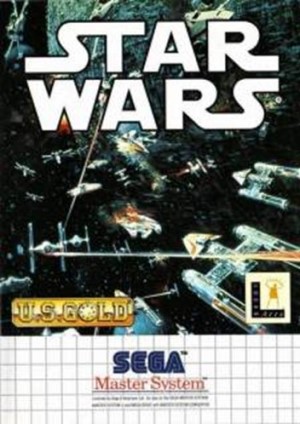
This game and I have a little bit of history. Up until 2012 Star Wars held the accolade of being the only NES title I had ever played, and that was briefly in a long-forgotten computer shop in Derby about where M&S currently stands. Or is it Debenhams? The game also kept me company when my brother borrowed it for his Game Boy and ... I was hopeless at it. Back then it was by far one of the hardest console games around. It had slightly slippery controls, the annoying NES "bounce back" (i.e. involuntary leaping backwards when hit/touched by an enemy - a feature of many 8-bit Nintendo games), enemies with annoying attack patterns, and weapons that were distinctly underpowered.
The game starts you off as Luke Skywalker flying about Tattooine in the old Landspeeder. The aim here is to find Obi-Wan, rescue R2-D2 from the Jawas (I don't remember them wielding huge guns in the film), and pick up bits and pieces before heading to Mos Eisley. This is where you hook up with Han Solo and you're off. Unusually for a film license, the levels, with some concessions to video game design, follow the plotting fairly closely. Once you're offworld you have to guide the Millennium Falcon through a first person asteroid debris field, then it's wander-around-the-Death-Star time, deactivating the tractor beam, rescuing Leia, and escaping the trash compactor (unfortunately, you don't replay Obi-Wan's light sabre duel with Darth Vader). With the platforming done, our heroes escape while fending off Tie-Fighters, before switching to the rebel assault on the Death Star and the final trench run - seen from above. It's a game that, rare for the time, brought together different styles under one roof. Nor was it a quick knock-off to capitalise on the lucrative licence; some thought has gone in to reproducing the film's key sequences.
The Master System port, gameplay-wise, is virtually identical to its Nintendo counterparts. The same "challenging" mechanics are present, except the graphics are spruced up and the soundtrack has received a decent makeover. For a system not known for its audio acrobatics, the programmers did a good job of wringing top tuneage out of the MS's weedy sound chip. And yes, it's bloody, bloody hard. It's one of them you would have needed weeks of spare time and infinite patience to get through 20-odd years ago - thank goodness for save states and walkthroughs.
What Master System Star Wars demonstrates, as well as its brethren on the other systems, is yet another marked shift in game culture. These modern views pan it for some distinctly unfriendly features, whereas upon its release Star Wars was very well received. As we've seen before, tough difficulty bordering on unfair was par the course in yesteryear. Thanks to hardware and memory limitations, games had to be relatively simple affairs. And yet they had to command enough attention to prevent the punter feeling ripped off, so a steep challenge was considered an appropriate answer to the challenge of game longevity. There is nothing in Star Wars that hadn't already featured in dozens of other 8-bit platformers. Irksome movement momentum, leaps of faith, unfairly-placed enemies, this was par the course. For players who either didn't grow up with the demands some games made, or if more mature players have grown habituated to having their hands held by modern interfaces, a game like this can appear downright disrespectful. But no, all it required was patience - if you expect instant pow-wow, you will be destroyed.
Overall, there's a good game here if you're prepared to take it on its own terms. Not a timeless classic, but a worthwhile spin.
Sunday, 19 July 2015
How Rambo Vs ISIS Could Be Very Good

Last week, there was a brief flurry of excitement and incredulity when Sylvester Stallone reportedly announced that he was making a final Rambo movie (dubbed Last Blood) and the baddies he'd be mowing down were to be ... our friends Islamic State. There were a lot of red faces in the news room when a Stallone spinner intervened to deny the announcement. The original source was a spoof news site that ran with the headline "Sylvester Stallone to Employ ISIS Militants for New Rambo Film?". It would have taken but two seconds to note that a) it doesn't actually say IS are going to be Rambo's cannon fodder, and b) that a site running stories like Caitlyn Jenner Innocent; Bruce Jenner Crashed Car, Witness Claims might not be the most credible of sources.
Such touching naivete. Whatever happened to the world-weary cynical hack?
That said, I'm actually a bit disappointed that Rambo V is reportedly socking it to Mexican drug cartels instead, because parachuting John Rambo into IS-occupied Syria might have made for an unexpectedly good movie. Okay, an interesting one. For two reasons.
First, action movies can be a proxy by which audiences vent sublimated frustrations against an enemy - whether real or imagined. Despite IS being on the receiving end of US and UK bombs, there isn't a great deal of news coverage. You can partly understand why when, in north Syria, the Americans are acting as an air force for anarcho-communist Kurdish militias. Hence there is little chance Westerners feel "enough" is being done to curb IS, leaving it free to murder tourists in Tunisia and gunning down Parisian cartoonists. The urge to hit back is understandable, even if misplaced. Likewise, IS feel similarly. They cannot mix it up directly with Western military, hence why they brutally kill hostages. Seeing how Stallone taps into these frustrations would have proved an interesting way into reading Rambo.
What would be much more interesting, however, is if Rambo were to drop into Syria, hook up with someone vaguely palatable to mainstream Hollywood - such as the Free Syria Army. After mucho macho combat, Rambo ends up in a foxhole with an injured IS fighter ... and finds they fought alongside one another in Afghanistan against the Soviets in Rambo III. Together they explore how they went from allies to foes, and it gradually dawns on Rambo that he is but a pawn and his employers - the US government - are unconcerned with freedom per se. They covet regional hegemony. After the Afghan assists Rambo's escape from the predations of Jihadi John, he radios in for a pick up and returns home to raise some very awkward questions.
If Stallone is serious about making a Rambo that is a serious departure from its predecessors, I'd recommend another think about the IS angle.
Subscribe to:
Posts (Atom)