Showing posts with label Stoke-on-Trent. Show all posts

Saturday, 25 November 2023

The Party's Over - Stoke-on-Trent, Friday 8th December, 6.30pm


Of all the speaking gigs I've done since Falling Down/The Party's Over came out, this is the engagement I'm looking forward to the most. Organised by North Staffs Trades Council, which I once had the privilege of being a delegate to, and Stoke's excellent new community book shop, Drop City Books, on Friday 8th December you can hear me talking about the book, the state the Tories are in now, and undoubtedly the conversation will drift on to Keir Starmer and the Labour Party.

This is a ticketed event, and they're available here. Looking forward to seeing you on the 8th!

Saturday, 18 November 2023

A Tour of Stoke-on-Trent

I was there for 27-and-a-bit years, and I'll always have an abiding affection for the place. This video does a good job of providing an outsider's point of view without being condescending or doing crap town gloating. Help unbreak Stoke by visiting!

Also good to see Drop City Books getting a plug. Some more news about that coming up ...


Sunday, 13 August 2023

Stoke Chartist Festival 20th August 2023

For folks in and around North Staffordshire.

This post is from Adam Colclough and first appeared on the North Staffs News site. There is also a link tree for the festival here with all the information you need.

Local trades unionists will join musicians and other performers to commemorate the death of Leek born Josiah Heapy in the Burslem Chartist riots of 1842.

The First Stoke Chartist Festival will take place behind the town hall on Market place, Burslem, on Sunday 20th August and is a co-production organized by New Vic Borderlines and the People’s History Association of North Staffordshire (PHANS).

Support, including the loan of a fire engine converted into a mobile stage previously used when Jeremy Corbyn visited Hanley, has been provided by unions including Unite, the FBU, and Unison.

New Vic Borderlines is an award-winning community arts program that uses theatre to give a voice to those who have been marginalised.

Director Sue Moffatt has written a play based on the events surrounding the Chartist riots and the death of Josiah Heapy that will be performed on the day by members of the community supported by three professional actors.

In keeping with the Chartist theme trades unions active in North Staffordshire will be present to provide information about the work they do to support working people today.

There will also be stalls run by local groups including Period Power, NORSCARF, and community support charity Better Together, as well as craft activities and a display of work relating to Chartism created by students at local schools.

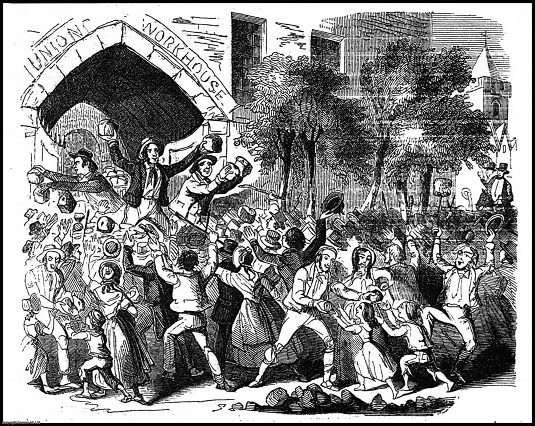
Josiah Heapy was born in Leek and died on 16th August 1842 when troops broke up an open-air Chartist meeting taking place on Swan Bank, Burslem, causing a riot that resulted in damage to several prominent local landmarks.

In the aftermath of the riot 146 Chartists were imprisoned and 54 were transported to Australia.

The Burslem Chartist riots have been described as the ‘Potteries Peterloo’ after the more famous riots in Manchester.

In 2019 a successful campaign saw a commemorative plaque unveiled in Burslem near to the spot where Heapy was killed. A street on a nearby housing development has since also been named after him.

Jason Hill, a member of PHANS who also took part in the campaign to have a street named after Josiah Heapy said the festival will “honour” Josiah Heapy and other trades unionists who “fought for the freedoms that we take for granted today”.

He emphasised the important role played by Heapy and other Chartists in creating the trades union movement in North Staffordshire and nationally.

He believes the festival will “raise awareness of this important episode in the history of Burslem which, sadly, seems to be largely forgotten today."

The festival will feature speakers, including Chrissie Gibson a living relative of Josiah Heapy, music, poetry, and performances of the play at various locations around the town.

The festival will take place on 20th August at Market Place, Burslem, ST6 4AT between 11:00am and 4:00pm.

Image Credit

Saturday, 6 May 2023

Stoke Labour's Council Victory

Well done to Stoke-on-Trent Labour for taking back the Potteries on Thursday. Going into all-out elections with 12 seats, it emerged from the fray with 29 to its name. The Tories were bumped down to 14, which is one less than what they won in 2019 sans subsequent defections to them, and pleasingly the so-called City Independents were put in the ground. They went from 12 last time to just one. It couldn't have happened to a nicer ragtag and bobtail outfit. Needless to say, the revival in the party's fortunes after my leaving the place is entirely coincidental.

Is there room for a bit of gloating in a supposedly serious analysis of Potteries politics? You bet there is. Labour sent CIndie leader Ann James packing in Great Chell and Packmoor. But much more satisfying was the dumping of Tory Janine Bridges by the electorate. Stoke politics watchers will have followed her inglorious career for some time as she skipped from party to party to maintain a pre-eminence on the local council she felt entitled to. Indeed, had she survived Thursday night I wouldn't have given it a week before a text popped up on Labour Group, and now Council Leader Jane Ashworth's phone requesting a tete tete about defecting back. Also gone is CIndie Lee Wanger, marking the first time since 2011 that the councillor roster is free of a convicted child sex offender. With him went Jackie Barnes, who won a by-election after putting out a manifesto that, among other things, railed against cervical smears and in more recent years became famous as Stoke's racist Lord Mayor. Ex-BNP CIndie Melanie Baddeley was also booted out in Abbey Hulton. It's taken 20 years, but the legacy of Stoke's most toxic political period has finally been removed from the chamber.

Along with Bridges, all the recent defectors to the Tories' ranks found their treachery kiboshed at the ballot box. Ally Simcock in Sandford Hill and Candi Chetwynd in Ford Green, both of whom professed to be socialists at some point, jumped to the Tories when their egos were tickled. Thankfully their services were terminated at the first available opportunity by the good people of their wards. I cannot lie that as a former friend, seeing Chetwynd lose has been a highlight. Not least because she spent her time as a Tory councillor palling around with Jonathan Gullis in social media shorts and photo opportunities. A cautionary tale that even politics time servers like me can get taken for a ride.

There were some very gratifying results. The persistence of Mubsira Aumir finally netted her a seat in Fenton East, as did Javid Najmi in Moorcroft and Sneyd Green. I'm happy to see Chris Robinson back on the council after losing by a 10 vote margin in 2019, Sarah Hill after an 11 year absence, Adrian Knapper in for Birches Head, and Duncan Walker as Labour's man in Baddeley, Milton, and Norton. Kudos to comrades Shaun Pender and Andy Platt for making their seats safer. And a shout out to long-time friend of the blog Gary Elsby for coming at the bottom of his poll.

Where did the Tories go wrong? Historically, Stoke's politics have been a bit iffy and tended to introversion, though that began to change at the last local election as local and national trends converged. In 2015 after Labour lost and a CIndie/Tory coalition took over the council, the Tory group under erstwhile Council Leader Abi Brown ensured they controlled the most publicity-friendly positions in their coalition cabinet. I.e. The economics portfolios. They then spent the next four years taking credit for every new bit of investment, every new build, and the renewal of the city's parks. Some of this was what Labour were planning to do anyway, but in office their coalition happily cut down the council's social spend further so a disused boat house in Hanley Park could get spruced up, that the hedges were trimmed and maintained, and monies could be put aside to house the Potteries Museum's Spitfire in a bespoke goldfish tank.

It worked. By cutting services to the bone, the Tories knew they were "only" impacting on people who tend not to vote or would never support them anyway. And what they purchased with their suffering was a simulacra of economic regeneration. With new buildings going up and the parks returned to their Victorian heyday, their changes could be seen. It gave off a vibe of moving on from decades of Stoke stagnation and struggles of trying to reinvent itself. But it was a veneer and could only work for a while. When the double whammy of Covid and the Tories' cost of living crisis came along, the city was put back on its arse. Crowding more people into the city centre with council build-to-lets did not pay off as their disposable income, which was projected to sustain a hospitality-led revival of Hanley, was gobbled up by inflation. And as for the city's other five town centres, at best all they got was a lick of paint.

There were the regen blunders too. In February Dan Jellyman, the Tories' number two - in both senses of the term - resigned from his regeneration and heritage portfolio after he okayed the demolition of a Josiah Wedgwood brick sculpture. This came after a somewhat questionable turn in priorities. Opening earlier this year, the Tories found £15m for a multi-storey car park on the site of an existing under-used car park. If that wasn't enough, in February 2022 the (admittedly dated) but also under-used multi-storey on Meigh Street in Hanley got bulldozed and will get replaced by ... a new £18m car park. As the Tory council in nearby Newcastle-under-Lyme are doing more or less the same thing, we're left to speculate whether a commitment to car-driven regeneration has gripped the two Tory groups or what might loosely be described as off-book incentives. Who can say? It's a matter of conjecture and opinion.

Going from the scores on the doors, the car park fiasco plus the Tories' national malaise are what put paid to their chances. Extrapolating forward to the general election, the results suggest Gareth Snell will take back Stoke Central without much trouble. The good news for watchers of the aforementioned member for Stoke-on-Trent North is that his time in the spotlight will come to a close. I look forward to Labour's David Williams cooking Gullis's expired career on the rotisserie. Stoke South is another story. Despite Labour gains in the south of the city the Tory vote was pretty solid. And on the revised constituency boundaries due to come into force, added to it are parts of Newcastle constituency, Stone, and Staffordshire Moorlands. It would take a massive swing to dislodge Jack Brereton, the sitting Tory MP.

Time for some unsolicited advice. Stoke Labour should bear in mind the key lessons of how the council was lost in 2015. Acting like managers as opposed to politicians, giving the officers too much leeway in determining priorities, being unclear about what the council was trying to achieve and doing things that looked like they were taking the piss not only scuppered Labour's majority, but massively ate into its general election vote. As a fan of the Preston model, of course I'd recommend the Group looks at that and adapts it as a means of delivering its manifesto. This would do a better job than dreaming up a new regeneration project with its pie-in-the-sky promises of loadsa jobs and loadsa knock on investment. But also, ensuring Labour weathers whatever storms are likely to break over Stoke-on-Trent, councillors have to be buried like ticks in their communities. Voter ID is not the be-all and end-all, and while important being responsive, dependable, and most importantly present will go a long way to regrowing the roots that have withered over decades. The councillors will benefit in the long run, and that personal connection can deliver votes by the skip load come general election polling day. Defeating the Tories this time was the easy part. The tough stuff starts now.

Image Credit

Wednesday, 5 April 2023

Rubbish Politics

Back in Stoke, I picked up a Labour leaflet from the doormat. It featured my old muckers Cllrs Amjid Wazir and Alastair Watson talking about the hot topic of the moment: fly-tipping. Tbh, it is an issue around my former stomping ground. A week before we were due to move, from nowhere a pair of brand new window shades - still in their boxes - were dumped next to the house. Knowing that something vaguely useful won't stay dumped for long they were gone by morning. Another was earlier today. In one of the alleyways a pushchair was left unloved. By the time I left at 2pm, it had gone. And the best ever was when a lodger of Alastair's found a cache of Mega Drive games dumped in an alley near his house. £20 later and the crate was mine. But freecycling Stoke-stylee can't and doesn't lay claim to every discarded item, and fly-tipping costs the local authority around £500k/year. What's the solution? Cllrs Watson and Wazir want more resources devoted to cleaning up the city's streets. An entirely reasonable response.

Not Keir Starmer's answer though. To try and inject a bit of excitement into a drab local election campaign, the leadership announced its own plan to combat the scourge: heftier fixed penalty notices and forcing fly-tippers to join community payback-style clean up squads. Ah, there's nothing more satisfying than out-Torying the Tories with a new punitive policy they hadn't thought of first. As authoritarian voters delight in the idea of wrong 'uns getting a good hiding, I suppose it was inevitable Starmer's crew would cook up a wheeze that would appeal to these people, who aren't likely to vote Labour anyway, and be consistent with his own politics. Still, it's the local elections. The voter pool likely to turn out are disproportionately of pensionable age, and it might turn a few of their heads.

Like the discarded bits of furniture and bags of cement cluttering up country lanes and back alleys, this proposal should be skipped. It's another example of inauthentic get-rich-quick populism, which is contributing toward the construction of Starmerism's own scapegoats. On this occasion, it's the shadowy (nay, hoodied) figure of ASBO-begging malcontents he once set up 24-hour courts to deal with. But if this is tough on crime, where is tough on the causes of crime? People don't fly-tip because scattering one's broken and useless worldly goods has become a national pastime. Since 2010, local authorities have been forced to scale back refuse collection and either curtail their bulky waste collection schemes or hugely increase the charges on them. Most councils now collect bins fortnightly as opposed to weekly, and the number of municipal tips have been cut. If, then, someone has say a broken fridge, the nearest tip is many miles away, and the cost of paying the council is too steep, what are they supposed to do? Turn their garden, if they have one, into landfill? A good opportunity to have a go at the Tories for systematically undermining and cutting local government funds you might think, but no. On this score Labour has remained silent. It might imply an incoming Labour government wants to spend money.

And here is the rub. Rather than try and lead public opinion on anything, Starmer prefers to baby the audience. If he's pretending that granting councils more powers, will fix local services without the resources they need to repair shattered public and community infrastructures, then he's taking Labour's would-be voters for mugs. They know the country is in a hole, and while millions are prepared to vote Labour to get the Tories out they are expecting Starmer to do something. That also includes switchers from the Tories. The longer he stays quiet, the greater the political risk.

There is another dynamic at work here. Starmer and the shadow cabinet are keen to hold down expectations for their own craven reasons, but it's not like his cadre of councillors need much persuading. With one or two notable exceptions, local politics are the epitome of dismal politics. Cleaning up the dog shit, filling in the potholes, and pushing whatever regeneration scheme has lately dropped down the consultancy pipeline, local elections are an opportunity to double down on what the bulk of councillors are happiest doing: being petty council managers. What these elections most definitely are not are opportunities for raising wider questions that could actually help empower residents and forge more engaged, self-activating communities. Like what we've seen in Preston and Stockport, or what the Greens are proposing with council-controlled rent caps. It's much harder to be the Big I Am when communities are coherent and have their own ideas about what's best for their areas.

Image Credit

Tuesday, 27 December 2022

On 30p Lee's Ha'penny Mini-Me

A couple of months ago I went to Tunstall. Never the most thriving of Stoke's six towns, my first trip there since before the pandemic found it even more down at heel. The Stoke North constituency, which its "famous" incumbent Jonathan Gullis likes to call Stoke-on-Trent North, Kidsgrove, and Talke to differentiate himself from his lately ennobled predecessor by adding the "and Talke", has suffered horribly under 12 years of Tory rule. More shops than ever are shut and boarded up, with many in advanced states of decay. Save Shelter and the indefatigable Iris's Cats in Need, the local economy is so hard up it cannot sustain more than these two charity stores. It has now been three years since Boris Johnson's famous election victory, and all this part of the Potteries has to show for it is a crumbling town centre, empty purses and wallets, and frightening levels of food poverty.

That's not the only thing falling into ruination. So are the Tories' chances at the next election, and this is something Tunstall shares with nearly all the so-called "red wall" areas. In Tuesday's FT, we learn from one of Gullis's Westminster colleagues that "the red wall is dead. It’s possible we won’t hold any of the seats we won at the last election. Some people are just hanging around for their severance payments." Our mysterious correspondent forgot to add many aren't even waiting for that, with another slew of announcements expected after Tory MPs have spent the festive season reflecting/hammering their contact books.

Perhaps remembering Johnson's broadside against the "doomsters" and the "gloomsters", Gullis looks on the bright side and says the Tories could hold on, but Rishi Sunak has to offer an inspiring vision. The punters need to "see and feel change." The problem is they do see and feel it every time they look at their shrinking incomes and growing outlays. Defending the record in Stoke, Gullis points to a few trifles, such as some funding won from government to improve local bus services. Which was only 26% of what the Tory-run City Council put the bid in for, so don't expect dramatic improvements in time for the general election. Then there are the 500 Home Office jobs slated to arrive in dribs and drabs over the next few years. Taking into account the 120 Hanley DWP staff about to be sacked after years of whittling down the work force, and the hundreds of jobs axed at the local authority, we might just be about breaking even. At least there is the town improvement deal granted to Newcastle and Kidsgrove. While Newcastle Borough Council (also Tory-run) are spending a huge wedge on a new multi-storey, Kidsgrove can look forward to a new ticket office and a (more modest) car park in the not-too-distant. Despite putting on the brave face, Gullis appears resigned; "Rishi has yet to lay out that vision for this area — or for the country, if I’m honest."

If Gullis and Tory MPs like him are disappointed their government aren't delivering, they haven't been paying attention. At the beginning of 2020 and at the height of imperious pomp, writing for ConHome Tory strategist James Frayne argued that the government didn't need to do anything to hold on to their new voters. Apparently, they didn't care about public transport and bus services, want to see social security ground into nothingness, don't mind if their local high street looks like a Depression-era shopping arcade, and want more tax cuts paid for by public sector "waste". With this level of misrecognition over who there 2019 voters were and why they supported the Tories in the first place, it's a wonder they won so handsomely. To be fair to Johnson, he did appear genuine about carrying through the so-called levelling up strategy. He understood that if his party was going to hold on in places like Stoke, they needed to deliver. Unfortunately for him and the political health of the Tories, the do-nothing counsel offered by Frayne was the Treasury orthodoxy, and accepted by many in Johnson's circle. Including Sunak. The Big Dog was effectively brought to heel in Cabinet, and now under the guise of repairing the country from the atom bomb dropped on the economy by Liz Truss, Sunak has made the depletion of the state his overall objective.

There are two ways a Tory politician can respond to a situation where government doesn't care for their seat or the people who live in them. You could try the ubiquitous community thing, like his Stoke Central colleague Jo Gideon is doing. There isn't a crisp packet opening she won't attend if there's a photo opportunity in it. Gullis, billed by the FT as a "restless and popular local campaigner", have mistaken his regular appearances in The Sentinel for appeal. My old friend, former Labour Council Leader Mohammed Pervez, might be available to provide some instruction on this. Knowing Stoke once had a recent problem with BNP support in the City - partly because the Tories used to be too weak to stand in most local elections - Gullis hasn't been shy about scapegoating asylum seekers and commanding coverage for his efforts. Affecting concern about the wellbeing of vulnerable adults, his scurrilous campaign names the two city hotels being used as temporary hostels, fully knowing how publicising them could lead to targeted attacks. Tabling his 10 Minute Rule Bill a few weeks ago to get the flights to Rwanda running had nothing to do with fairness for refugees, or protesting against the government for housing asylum seekers in the Potteries without making resources available to support them, it's his re-election strategy. He's consciously latching onto the anti-woke identity politics. In the absence of undoing the economic and social injuries done to Stoke by his party, he's picking at an imagined wound in in the hope rabble rousing and dog-whistling will save his bacon. Gullis is far from an original on the Tory back benches, and has something of the Lee Anderson about him. 30p Lee's ha'penny mini-me, you might say.

Despite sitting on a decent-sized majority, it's not likely Gullis's efforts will be enough to save him. He'll take his £20 grand "resettlement grant" when he loses, and not give Stoke a second thought beyond a place name he puts on future CVs for safer Tory seats. The division he's stirring up won't, sadly, disappear as quickly.

Image Credit

Sunday, 28 August 2022

The Tories Are Not "Asleep at the Wheel"

Anyone who's been around Stoke-on-Trent for a while will have noticed some changes. Hanley Park, for example, has had serious money pumped into the place. The boat house, band stand, and pavilion restored after decades of dereliction, the grounds regularly tended to and the paths resurfaced. If one wanders up to the city centre via the Potteries Museum, you cannot but notice the giant fish tank jutting out from the building with a Spitfire on display. Elsewhere, heritage features have got spruced up and there's more construction happening now with even more in the pipeline. Nearly all of this has been led by Stoke-on-Trent City Council and its Tory administration. But behind the hard hats and scaffolding is a darker story. One in which social services have been downgraded, where children's services were so poor that Oftsed condemned them in 2019 with the lowest possible rating. And where homeless, domestic violence, and addiction support have been eviscerated. This strategy of putting flower beds before hostel beds is not a result of Tory ignorance. It's not a case of Tory councillors putting money into arms-length build-to-lets because they don't know about the desperate misery caused by slashing services. It's deliberate and done in the full knowledge of the suffering their decisions cause.

How the Tories have managed local politics in the Potteries always springs to mind when I see people complaining about the Tories on social media. A favourite is 'the Conservatives are asleep at the wheel'. This could be forgiven if coming from ordinary punters who don't follow politics closely, but it's a well-mined seam senior Labour people go digging in. Telling the government to "get a grip" on the crisis is a common missive in what passes for Keir Starmer's invective. Claiming the Tories don't have a handle on people's problems, or are "out of touch" is another favourite. And then we have the pretence, in-keeping with parliamentary norms, that Conservative MPs act in good faith. That they enter into public service to help their communities but are just wrong or misguided in their policies.

Time this was knocked on its head is long overdue.

Consider the evidence. Between 2010 and the Covid outbreak, the Tories oversaw crippling cuts to local authorities, schools, the NHS, social services, the civil service, and social security. As they've swung the axe the number of foodbanks and the people dependent on them have rocketed. In the old job we used to handle the consequences of this week in, week out. People with no money due to getting sanctioned. People with no income because they were deemed fit for work. People having to find extra cash that did not exist to cover the bedroom tax. People having to give back huge sums because the DWP had "overpaid" them. The support we could offer was usually quite limited, and only in a few cases were we able to mitigate what were often horrendous situations. Tory MPs would also have had these issues pouring into their inboxes and mailbags, and encountered the same desperation at constituency surgeries. Replying to this correspondence is the bread and butter of their offices. And yet, despite coming into contact with exactly the same stuff we dealt with, they carried on making life worse for the worst off.

"Ignorance" especially does not wash at senior level. When writing to ministers about social security and/or cuts, the responses would always start with "I can't comment on the specifics of the case", before giving the impression that they were entirely ignorant of the consequences of their policies, or that if such-and-such a constituent got themselves a job everything would be peachy. The always awful Iain Duncan Smith during his time as Dave's welfare supremo was a particularly egregious case, with his standard letters waxing lyrical about what wonders work does for individual wellbeing. But IDS did know about the suffering he was causing. No cabinet member can plead ignorance on this score given the briefing notes and reams of stats shoved their way. They can try and ignore it, but when it catches up with them so does the discomfiture - as one particularly memorable occasion on Question Time when Owen Jones brought IDS face-to-face with what he was doing showed.

And we should turn attention to how the Tories handled the pandemic. The lockdowns and the job retention scheme undoubtedly saved tens of thousands of lives, and even more from the disabling consequences of long Covid. Yet the government dithered and delayed, unnecessarily causing avoidable injury and loss of life, and have since enabled infection with the removal of all mitigations, simply because it conflicted with their political priorities. Are we to assume Boris Johnson and friends were ignorant of their drives to normality and repeated disregard of the science, or that they knew but simply did not care - as typified by remarks attributed to the Prime Minister that the bodies should be left to pile high?

This brings us up to date with the two fresh Tory outrages: the dumping of sewerage into the rivers and seas around Britain to the extent they're not safe to swim in, and the energy price spiral. Are we meant to believe Tory MPs, pompously styled as the most sophisticated electorate in the world when their semi-regular leadership contests swing round, haven't got a clue what these mean? Did they think allowing water companies to flood the country's waterways with faeces would have no consequences? That the joke of an energy price cap doesn't spell ruin for millions of people, including those on decent money but manage a fine balance between incomings and outgoings? As Liz Truss affects ambiguity about the energy price crisis, it would do well for naive critics of the Tories to remember that allaying people's worries by coming up with a comprehensive answer that can meet the moment is subordinate to the farce of the leadership contest, and the interests - above all the fossil fuel interests - the Tories happily serve.

To pretend that the Tories don't know what they're doing is to provide them with political cover. As argued here many times, the Conservative Party is a fundamentally dishonest enterprise. Its job is to present the minority interest - of capital and of capitalists - as the universal, popular interest. Every concession of good faith, every criticism voiced that fights shy of the structural underpinnings of the party, its politicians, and its policies, even everything that does not depart the terrain of moral outrage can only ever at best strike a glancing blow. Criticising the Tories has to be about understanding the Tories and what they really are, because without that the challenge of defeating them and ensuring they stay defeated will never be met.

Image Credit

Monday, 13 September 2021

A Man Without Qualities

Perhaps one day I'll write something that congratulates Keir Starmer for doing the right thing, but not today. Reflecting on his relationship with the Labour leader, Len McCluskey has penned a short piece on the deal he and a group of left Labour MPs put together with the leader's office and Angela Rayner to give the whip back to Jeremy Corbyn following his suspension. After negotiations the former leader did what was asked of him and signed a statement drafted by Starmer's team, only for Starmer to row back and start demanding apologies for Jeremy's - correct - claim that accusations of antisemitism were seized upon and used in transparently factional ways to undermine his leadership. The full detail of the sordid story was published by Novara in July.

What spooked Starmer into reneging on his deal? It was Margaret Hodge and the right wing astroturf outfit, the Jewish Labour Movement. As hardened factionalists and sensing an opportunity to give their nemesis the push, both threw their toys out of the proverbial and promised ructions if he was readmitted. As a pathetic weakling Starmer cleaved to their blackmail, fearful accusations of not taking antisemitism seriously would dog him just as they did his predecessor. In reality, both Hodge and the JLM's leading lights need the party label far more than Labour's good name needs them, but Starmer was more willing to risk the undying enmity of the left and a swathe of voters than stand up to right wing factionalism. And it's going to cost him.

Such cowardice suffuses Starmer's approach to politics. As noted plenty of times here before, Labour leaders have two choices. Either try and lead by putting forward their analysis, identify problems, and offer policies for addressing them, or just collapse like a jelly and try and tail public opinion as articulated by right wing editorials. Corbyn and, to a degree, Ed Miliband did the first. Starmer hasn't once, even during the solid gold opportunity offered by the Tory National Insurance increase. There's a path of least resistance, and another of completely keeping your head down in the hopes of squeaking in by default.

This most yellow-bellied politics conditions Starmer's attitude to the party membership. Not only are bureaucrats given carte blanche to harass young working class women at all hours of the night, the leader himself is petrified by the thought of rubbing shoulders with the people who gave him his job. Take humble old Stoke-on-Trent, for instance. His painful interview with Beth Rigby at Stoke Sixth Form College was preceded by his decision to visit the Potteries without bothering to let local Labour members know. For the third time. I understand a senior local activist got wind of the visit and asked about inviting the membership but was brusquely informed that Starmer was on a tight schedule and didn't have the time. It's almost as if he's running scared of someone asking an awkward question out of turn. If he can't handle a tame line of questioning about wealth taxes, imagine if he was asked about the Forde report, the ditching of his leadership pledges, or to account for his pitiful polling? Never has a Labour leader, not even one as under siege as Gordon Brown was, fought shy of the people he expects to campaign for him.

Anyone casting a cursory critical eye in Starmer's direction cannot fail to notice his complete lack of qualities. Authoritarian but thin-skinned, pretending to be left wing when it suited, but now pretending to be right wing in a wrong-headed approach at winning over Tory voters. Haughty, dishonest, untrustworthy, and cowardly, if he had appeared on the scene 10 years ago he would have been mistaken for a Blairite. Mistaken, because at least that caste of MPs have political backgrounds in spadding and bag carrying. Starmer is emptier than even that.

Image Credit

Wednesday, 14 July 2021

From Renaissance to Relapse

One thing about Labour is how endlessly productive it is of reviews, coalitions, initiativism and ginger groups. Off the top of my head, in the last five years we've had Momentum on the left, and on the right Labour to Win, Progressive Britain, Labour Together, the People's Vote, and commissions and policy reviews galore. So why not one more? Announcing its existence on LabourList, Renaissance promises to target research, resources, and activism on the so-called red wall seats to win as many back as possible. Sounds sensible. It also badges itself leadership-loyal and styles itself as helping Keir Starmer "develop his storytelling". An admission, if there ever was one, that he's gone down like a lead balloon in the former heartlands. Can Renaissance pump enough helium to reinflate his chances?

Fronted by Stephen Kinnock with Yvette Cooper and Ruth Smeeth on the advisory board, Renaissance wants to keep Labour out of the "comfort zone" and "reconnect" with "working families". Tipping its hat in a Brexity direction, Kinnock argues that the UK needs to stand on its own feet and it does this by investing heavily in manufacturing, married to the usual gubbins around sound money and kowtowing to the imagined taxpayer. Naturally, a report will come in September focusing on why people who've supported Labour previously haven't and what can be done to win them back. This is England and Wales only. Despite committing Renaissance to the vision of Labour as a Britain-wide project ("whole nation" in wonk speak), they're strangely uninterested in what former life-long voters in Scotland have to say.

Avoiding hard answers, at least where the Labour right are concerned on matters Scottish augurs ill for this new initiative. As does the accompanying puff piece by Ruth Smeeth. She writes how Labour has always been an alliance of workers and the progressive middle class, typified respectively by The Mirror and The Graun. Unfortunately, the 2019 manifesto was lopsided toward the latter. The party lost its ideological anchor and was set adrift in seat after seat as the old base deserted the ship.

If you're interested in understanding a problem, it pays to approach it in full possession of the facts and that your thesis has some evidential basis. Shall we consider them? Smeeth says Labour talked about tuition fees but had nothing to say about meeting rent payments. Turning page 79 of the 2019 manifesto, we find pledges for rent controls by capping them. Local authorities would be granted powers to curb rents further, no-fault evictions ended, the enforcement of minimum standards of habitation, and public funding for renters' unions so tenants can best defend their rights. Sounds utterly divorced from working class interests, doesn't it? Sticking with the Labour right's obsessions with tuition fees, she argues further education mattered more to her former constituents than measures that would benefit students in higher education. Pages 37 and 38 are our oracles here, and they committed Labour to expanding FE provision, reintroducing the EMA grant for FE students, giving people lifelong access to FE (and HE) for reskilling in the face of the next wave of automation, and integrate the whole lot into a National Education Service. Fancy that, tuition fees can be abolished while lifelong learning and FE are revolutionised.

She goes on. Rail nationalisation is nice and Stokies would have liked it, but the appalling state of the local buses matter more. As someone lacking a gas guzzling megamobile to ferry myself around the Potteries, I know this very well. Which is why pages 19-20 went down a treat:
Labour will ensure that councils can improve bus services by regulating and taking public ownership of bus networks, and we will give them resources and full legal powers to achieve this cost-effectively, thereby ending the race to the bottom in working conditions for bus workers. Where councils take control of their buses, Labour will introduce free bus travel for under-25s. We will increase and expand local services, reinstating the 3,000 routes that have been cut, particularly hitting rural communities.
She then criticises the party for failing to address concerns over job security. Talk about a green revolution smacks of change being done to voters rather than working with them. A good job then page 17 sees Labour pledged to invest in heavy industry, including science and research spend for cleaning them up and backed by a Britain-first procurement strategy to stop offshoring. This was in addition to three gigafactories, four metal processing plants, and a package of measures to keep the British steel industry going. Huge sums would be invested in plastic reclamation and recycling, a process the manifesto terms 'remanufacturing'.

The examples Smeeth cites to support her fairy story of a disconnected Labour Party are shown to be false. Or to put it plainly, pure bullshit. If her constituents didn't know these were priorities, then whose fault is that? She had a two-year lead in to tell the good people of Stoke North and Kidsgrove how a Labour government would change their lives for the better. History records she elected to spend her time with the Labour right torching the party's chances instead.

What this also means is the answers from the Renaissance report can be forecast now with unerring accuracy. There will be no findings that contradict the distorted preface Smeeth has offered, no honest accounting of the role Brexit played. Nor, for that matter, how the remain-focused strategy of the current leader properly torpedoed the party - something red wall voters haven't forgot, in case anyone's still bewildered by the poor results from the last two Labour defences. We'll just get a reiteration of the party is too middle class and too socially liberal, which will entirely coincidentally support Starmer's idiotic embrace of Blue Labourism.

It's worth remembering these people think they're the election winning specialists. They're also the people who deny their efforts at blowing the party up had any effect on Labour's reception, are completely uninterested in the character of the voter coalition we currently have and stupidly assume it's going nowhere, and argue pivoting toward social conservatism as the country is trending toward social liberalism is super smart, strategic politics. Perhaps instead of 'Renaissance', they should have called themselves 'Relapse'. This is a prospectus for promise-nothing, status quo-tailing Labourism, a vision so anaemic that you'd have to go back to David Miliband's policy platform in the 2010 contest to find anything so weak. With this shower in the driving seat, Labour's going nowhere - and it's our people who'll pay the price for their failure.

Monday, 24 May 2021

Rebuilding the Red Wall

How do the Tories understand their success in former Labour heartland seats? This is a genre of politics writing the left tend to give the body swerve, which is par the course for our wider political culture. But this is unfortunate, because they often reveal insights that the gatekeepers of the centre left, by accident and design are completely uninterested in. For example, of his increased majority in Mansfield in 2019 Ben Bradley wrote with more awareness about his constituency than anything I've seen the Labour right produce in the last decade. This niche genre of commentary therefore deserves keeping tabs on, and the latest setting out his thoughts is North West Durham's Richard Holden, who famously defeated Labour's Laura Pidcock.

In his piece for Conservative Home, Holden suggests Labour were able to keep the show on the road for decades in seats like his because of the strength of mass working class institutions that sustained a collectivist life in and out of the workplace, a shared religious culture that promoted a uniform social conservatism and was indelibly linked to Christian notions of fairness (and therefore provided trade unionism and its struggles the blessings of divine justice), and "a traditional Labour Party of the people that was both of and in touch with these communities." How did this state of affairs come apart? He lays the blame at New Labour who, he argued, provided little in return for loyal votes. He also points the finger at the "Britain hating far left under Jeremy Corbyn", a man so unpopular with the voters of NW Durham that in 2017 Labour improved its standing by six points and won over half the vote. But, apart from this silliness he also notes the importance of Labour's Brexit positioning, and the long-term legacy of the party returning lazy MPs who simply banked the vote.

Then comes the most interesting question: why does this Tory MP think so many working class seats turned to his party? Flattering his audience, he puts it down to the hard work of Tory activists. But there is something in this: activism ensures the Tories have a presence. It would be easy to overstate this. After all, Labour with its contact rate targets and obsession with heavily scripted, bureaucratised "conversations" regularly pounds the pavements. But, historically, the Tories have tended not to. It's harder to maintain the idea Tories forget about places like Durham when blue rosetted activists are out delivering leaflets, doorknocking, and getting their mugs in the local paper. A trick, as it happens, the Tories here in Stoke have spent the last decade pioneering and perfecting. Holden counsels his more sceptical readers that there are lots of former Labour voters in plenty of traditional no-go areas for the party, and so Tory activists should go out and find them. In other words, because the class cultures that sustained Labour for a century in Durham have melted away, everything everywhere is up for grabs.

A couple of insights don't make a theory, and there's a lot missing from Holden's account of Tory advances in Labour's former core constituencies. The first is how the Tories have managed to detoxify themselves for enough voters. Again, the experience of the Potteries is instructive. After four years of a Labour council that meekly passed on Tory cuts, let the officers do the running, copped the responsibility for an unpopular housing stock renewal scheme that left vast swathes of the city derelict, the building of two new office buildings, and egregiously wasted money by entering the Chelsea Flower Show twice, their replacement by a Indie/Tory alliance in 2015 saw the latter take on all the key outward facing portfolios. Namely regen and economic development, with the then deputy leader Abi Brown fronting up Stoke's City of Culture bid. These were not the Tories of old committed to butchering everything that moved, but leveraged the council's spending power to push their regen schemes (which, in many cases, had their roots in the previous Labour administration), getting new housing developments sorted out, and visibly sprucing the city up with money showered on heritage projects and parks. A lot of this was brought by cuts to services, but the calculation was most people weren't bothered about restricting library services or defunding alcohol and drug support, whereas they would notice new buildings springing up about the city centre and if the city's parks were tidied up and restored. Their reasoning was right, making the switch from Labour to the Tories (via UKIP in many cases) less painful when punters were voting with their Brexit feet. And now all three MPs are Tories, and the council is a majority Tory administration.

We've seen similar repeated on Teeside with the ridiculously huge vote won by Ben Houchen, the Tees Valley metro mayor. A stone's throw from Holden's seat, Houchen has earned serious respect by being a different kind of Tory. Not one who deindustrialises the land and calls it success, but one who nationalised the local airport and has tapped directly into the folk memory by promising to regenerate the dockside via the government's ludicrous freeport scheme. To the casual observer, the Tories are building and creating jobs, they're doing a politics that Labour should have done or be pushing to do. And because the only people who care about constituency and local authority boundaries are politics people and local government geeks, the example of someone like Houchen makes the switch from Labour to Tory that much easier in adjacent seats.

The other issue Holden is silent about is just who are voting for the Tories, but it's there, he instinctively knows who the Tory vote is. Starting off with a vignette about cake with a 50-something small business owner, and talking about traditional Labour voters, these are both figures standing in for and invoking older people. As Labour languishes in the polls with its new core support peeling off to smaller parties or electoral abstentionism (though not necessarily political abstentionism), the Tories have an electoral advantage because older people are much more likely to turn out. And this gives them a real edge in second order elections where this effect is exacerbated, as we saw.

It doesn't have to be this way. Labour can look at its former heartland seats and just accept the political consequences of demographic drift and seemingly competent local Tory officials, or actually start fighting back. Despite Holden's boasts about campaigning, the Tory infrastructure is still much smaller than Labour's, even after a year's worth of membership losses. The party needs to go back to its roots in places like Durham, Stoke, and elsewhere and rebuild itself as a community centred organisation. Hence why scrapping the community organising unit is as daft as it is wrong. Labour needs to rethink its laissez-faire attitude to local government and offer some leadership about what the party should be doing in the council chamber. Preston and Salford, Greater Manchester and Merseyside, the record of delivery in Wales, just as the Tories have been awarded for doing things so Labour has its own good story to tell, and particularly in Preston and Salford where local government and regeneration actively and visibly rebuilds communities and solidarities. Ignoring them is just about the most ridiculous thing the party can do. And it has to think about what the party got right in the last two elections, and particularly how the economic radicalism of 2017 was able to cut through and assemble a coalition the party then spent the next two years demobilising. How it adapts to these political realities is the litmus test for its seriousness about winning.

There are plenty of Tories who think their dominance is next to overweening, and it will continue to be unless Labour understand why it is and what we can do so our party, not the Tories, can be the masters of our destiny. And the initial step can be taken by listening to the strategy and tactics talk of the Conservatives themselves, thinking about them, and drawing up appropriate counter strategies.

Image Credit

Wednesday, 30 September 2020

What I've Been Reading Recently

Another quarter done, another slew of books for show and tell.

Arthur & George by Julian Barnes
Postcards from the Edge by Carrie Fisher
Babylon's Ashes by James SA Corey
The Enchantment of Lily Dahl by Siri Hustvedt
Saturday Night and Sunday Morning by Alan Sillitoe
The Old Wives' Tale by Arnold Bennett
Big Sur by Jack Kerouac
The Field of Cultural Production by Pierre Bourdieu
Damned by Chuck Palahniuk
A History of the World in 10½ Chapters by Julian Barnes

The reading drought of Coronavirus quarantine continues. At the beginning of this in March a months' long vista opened up, not unlike the neverending summer beloved of childhood memory. I'd get so much done, and just think about all the books you don't ordinarily have time for. In the event there was plenty of time for a book: the one I'm writing. Not so much for others, hence the modest extent of this here list.

Quality, not quantity right? I guess so. Both the Barneses were entertaining enough, Damned was good fun in the shock schlock mode Palahniuk affects, and Carrie Fisher's novel (don't call it a memoir) was very Less than Zero/Rules of Attraction. If tales of 80s-tinged celebrity hedonism is your bag, grab it by both handles.

I do want to take this opportunity to pick on Arnold Bennett. Largely forgotten now by the wider discourse, Bennett was a popular late 19th/early 20th century novelist and writer from the Potteries. He wrote some excellent novels, such as Anna of the Five Towns and Clayhanger but also some mediocre yarns too, like The Card. The consensus among the literati who've ever paid Bennett any mind cast The Old Wives' Tale as his magnum opus. A sprawling novel of over 700 pages, it follows 60-odd years in the lives of a pair of sisters. One stays put in jolly old Burslem (or Bursley, as Bennett styled the Potteries' mother town), while the other elopes her way off to Paris. Okay. I tried reading this book about 15-16 years ago when I was part of a local library reading group and gave up after the first eight pages. This time yours truly stuck with it, all the while wishing I'd sunk my time in And Quiet Flows the Don, which has glowered from the shelves these last eight months. The Burslem scenes are tedious, and only come alive when a neighbour is killed off. Paris is more interesting, but we're not talking memorable-level engagement here. There's some promise as the story builds up to the siege of Paris at the hands of the Prussians and at any moment you're thinking, "yes, we're going to have some action set during the Commune." And ... it's glossed over in a single page. What a missed opportunity. Does it make any difference as the rest of the novel goes? I suppose it rubs in the plodding, dreary and boring countenance of the narrative. Why this is received as Bennett's masterpiece beats me. Therefore, take this as a warning. If you ever find yourself wanting to dip into the oeuvre of Stoke's literary giant, this book should be far down the list.

Got some interesting things coming up due to feature on next quarter's list. I (might) have got round to finishing Mandel's Late Capitalism by then, and my copy of Huw Lemmy's Red Tory: My Corbyn Chemsex Hell has arrived and awaits the attention of my economy. No doubt destined to be a cult, pornographic classic of the Corbyn moment. Grab your copy while you still can.

What have you been reading recently?

Monday, 31 August 2020

Stoke Council's Conservative Coup d'etat

Don't write about Stoke for ages and two local politics stories come along at once. Last night, preparations were nearing their climax. Tanks were assembling and reliable infantry units were radioed into place. And then, as the August Bank Holiday got underway, the coup! An email from Council Leader Abi Brown charged into Deputy Council Leader (and City Independent group leader) Ann James's inbox informing her with immediate effect that she was sacked. Cllr Joanne Powell-Beckett, also of the CIndies, was out too. In a rousing show of defiance not seen since Salvador Allende defended the presidential palace gun-in-hand, Cllr James said "We don't have any cabinet members now, so as far as I'm concerned the coalition is over." Note the words as far as I'm concerned because for two of her colleagues, it isn't. Former BNP councillor Melanie Baddeley and the outgoing racist Lord Mayor Jackie Barnes hang on as City Indy councillors pocketing an extra six grand as "cabinet support" members. Curious how Stoke Tories have moved from staying silent about racism to awarding it.

This isn't the first time the Tory leader has made her erstwhile allies look like the grasping fools they are. Save for the BNP and UKIP, nothing speaks of Stoke-on-Trent's civic decay better than the City Independents. United only by a shared animosity toward Labour and a penchant for the most backward, white-washed nostalgia, they couldn't wait to get into bed with the Tories after the 2015 local elections. Despite promising in a rather eccentric and extravagant manifesto they wouldn't countenance going into coalition with anyone, this promise took all of two minutes before the memory hole claimed it. And, straight away, as senior partners to the Tories they telegraphed their stupidity to the world by giving them all the most glamorous, media-facing posts in the cabinet enabling them to front up every good news story about x jobs created, y buildings built, and z public amenities given a lick of paint and smartened up. Then council leader, the incoherent bag of potatoes David Conway, was so unsuited to the job that officers quickly realised they had to go to Cllr Brown to get anything done. It wasn't too difficult then for her to appoint herself the public face of Stoke's City of Culture bid, which was unsuccessful, but gave her the sort of profile any half-decent council leader would beg for. Which says everything you need to know about Conway's political instincts.

Deservedly, Labour's David Williams removed him from the council chamber in an otherwise poor night in the 2019 locals, while the Tories gained eight councillors. The coalition resumed with the Tories having the upperhand, and Cllr James, the new CIndie leader, assuming the deputyship. And since the election, matters haven't been as smooth. Back in March the coalition suffered a major upset and were forced to climb down over attempts to immolate working conditions for the Council's lowest paid employees. They were defeated partly thanks to the refusal of six CIndies to go along with the scheme, including the Deputy Leader herself. With unreliables like this on your team and with terms and conditions to savage, the clock was ticking on the governing coalition. But for how long? Last Saturday gave us the answer with the defection of three CIndies and one Labour councillor. To be honest given the politics of Baddeley, Barnes, and Powell-Beckett it's a wonder they didn't hop on the Tory gravy train too.

Now with 19 councillors the Tories are the biggest party on the council, but are three short of an effective majority. Keeping the racists on the payroll confers them a voting bloc of 21. Arrayed against them are Labour's 14 councillors - former group leader Mohammed Pervez resigned abruptly in May. There are then the six non-payroll CIndies, and then two non-aligned councillors. The Tories have calculated, rightly, that given James's threat to pay Brown back for the ruthless filleting she received by, erm, promising to vote on motions on a case-by-case basis, and the non-aligned propensity to go here, there, and everywhere bar collaborating with Labour, the chances of pulling together a coherent opposition to Tory schemes are slim. It requires Labour shows as much nous as Abi Brown has to get the Tories into this position of dominance.

As with any moment of triumph, the seeds of downfall are also present. The first is gifting two cabinet posts to two of the turncoats. Why should loyal councillors who've gone out and done the leaflet rounds and photo opps, and who stuck with the party during the fallow times between 2011 and 2015 miss out on a £12k post for someone who was describing herself as a socialist as little as a fortnight ago and would go elsewhere if she received a better offer? If Labour were daft enough to offer her a clear run in either Central or North, she'd be back in the fold like a shot. And speaking of seats there is the question of Stoke-on-Trent Central, which went Conservative last December. It's the worst kept secret that local Tories are less than impressed with our new MP, Jo Gideon, who much prefers tending to her hedgerows in Kent than her constituents in Stoke. One can only wonder at what skulduggery and shenanigans might go on behind the scenes should she refuse to shape up. And the scramble for the seat if she's "helped" into deciding one term is enough. Would all the local Tories be tickety-boo to see a dishonest shyster like Cllr Ally Simcock or an unprincipled opportunist like Cllr Janine Bridges scoop their chance for parliamentary glory? One suspects not.

All that is for another time. For now, Abi Brown can take a moment and survey her achievements. The largest party on the City Council with it almost under her complete control, and the three city Westminster seats complementing the Tory clean sweep of the rest of Staffordshire. Enjoy it while you can Stoke Tories, for nothing in politics lasts forever.

Image Credit

Saturday, 29 August 2020

The Moral Turpitude of Cllr Ally Simcock

Stoke-on-Trent Conservatives have got much to be cheery about. A full roster of three MPs (well, two if you discount the always-absent Jo Gideon), the City Council's leadership, and four new councillors. That's right, Stoke's Tories announced yesterday that four have crossed the floor - three (former) City Independents and one from the Labour Party. Eh, what?

Let's look at these councillors more closely. The first two from the CIndies were no surprise. In fact, it was more a case of why it took them so long. Shaun Bennett is a former Tory who was deselected by his party as a council candidate for publicly opposing the 2010-11 grand council coalition the Tories then participated in. He's also happy to defend homophobes, but this is all bygones as far as the local Tory machine is concerned. The other is Janine Bridges, one of the more unprincipled chancers to have taken a seat in the chamber. This is the second time she has left the CIndies, and previously served as a cabinet member in the last Labour administration. Noted then for her right wing views on social security and the NHS, it says everything about the poverty of the local Labour Party that she was allowed to ascend to this level before jumping ship back in 2015. Ho hum. The third councillor, Lesley Adams, is someone I know less about. Loads of grey blurs in the council chamber and only enough hours in the day.

And then there is our fourth turncoat. Councillor Ally Simcock was elected for Sandford Hill for the first time last May on a Labour ticket, but not just any old Labour ticket. Unlike your usual clutch of careerists and place seekers, Cllr Simcock made a big play of her socialist credentials. She apparently gave good interview to the local government panel and spoke convincingly about her Labour and socialist values. Indeed, moving with the Corbynist times she had the pose most appropriate to the situation. She talked up her mining origins and how her late Dad was out in 1984-5 for the full stretch. Indeed, as recently as 16th August this year she wrote on Twitter, "Standing on the picket line aged seven with my dad, fighting for miners around the country and living on the breadline for a year, all to stand up in solidarity against pit closures ... that is what ignited my activism." Funnily enough, that tweet is now deleted. Curiously, despite tweeting on every topic under the sun since yesterday's announcement she's neglected to say anything about her new found friends. If I had dumped on the politics, the values, and the heritage one claims to be proud of, I'd be a bit sheepish too.

Why then? According to the pre-prepared statement given to The Sentinel it's because the local Tories are "doing stuff" and "divisions" in the local Labour Party. It might surprise readers to learn Stoke Labour in 2020 is a becalmed oasis compared to the fun and hi-jinks of recent years. The Labour Group are about to elect a new leader, but the debate can hardly be described as acrimonious. And in all the party is settling into the long haul of winning the city back. In other words, there is no principled reason for her departure. Some local comrades have speculated about the pieces of silver a committee chair or a cabinet position Council Leader Abi Brown must have dangled in front of her eyes to secure Simcock's defection. I'm afraid to say the situation is likely to be worse than that.

Anyone coming into mainstream politics with half a critical brain can't avoid recoiling at the sycophancy and slavish deference some councillors and members show senior people, regional officials and (especially) MPs. All it would have taken for someone like Simcock to cross the floor were the regular cosy chats with the two Tory members, a bit of flattery and ego massage from the council leader, and the chance to hang out in public with these "important people" to bask in their glow. As far as Cllr Simcock is concerned, trading in her "socialism" for the Tories was no more bother than switching a selfie filter. They made her feel good, and ultimately that's all that matters. What the Tories are actually doing to the city's most vulnerable people is something, I strongly suspect, she has given zero consideration to.

It might be tempting to bash Stoke Labour over this, but defecting councillors are a fact of political life. They afflict all parties and happen for all kinds of reasons. Even our old friends the Socialist Workers Party once had a direct defection of a councillor to the Tories, and any mitigation parties can take against unscrupulous peddlers is limited. Considering this particular case, as Simcock was professing left wing politics she hardly ever bothered with actual meetings of the party. And for all the nice things she said about miners' heritage, she was not involved in trade unionism at all. Warning signs? After the fact, yes. But then again there are other councillors everywhere who fit very similar profiles and stick around for years.

For once, this is not a symptom of Stoke Labour's collective failure. Opportunists happen, and Cllr Simcock thinks there are more opportunities to be the Big I Am in the local Tory party. But here's the real kicker, as she will find out soon enough. The flattery will stop and the texts and phone calls will cease. Quickly, life as voting fodder for cuts and ridiculous vanity schemes are going to get routine. She'll never be a prominent face nor, for that matter, fully trusted by her new confederates. Once a scab always a scab, and not a few Tory backbenchers and members are going to be wondering when she'll do the dirty on them. I will not be at all surprised if in three years' time we hear on the grapevine she's been in touch with such-and-such a councillor begging for re-admittance to the Labour Party. It's happened before, and contrary to what the MPs and the Council Leader have told her, she's no one special. Here's then to the next three years before she loses her seat and fades from the memory.

Saturday, 25 July 2020

Protest Stoke's Racist Lord Mayor

Last month featured a a brief post about Stoke's outgoing Lord Mayor, Cllr Jackie Barnes, and her tendency to post up outright racist and dog-whistling pieces to social media. The story made the national media and thanks to the furore her successor, Cllr Melanie Baddeley of the City Independents (and formerly of the BNP), resigned her deputy mayoralty and won't be taking over from her in September. However, Cllr Barnes remains the mayor. According to the statement occasionally sent out by the City Council in response to complaints, she has "self-referred" to the standards committee where there will be a "full investigation". For info, the standards committee does not have the power to suspend or expel a councillor and force a by-election.

Still, within the limits of the system Cllr Barnes should receive the toughest sanction at the committee's disposal. For too long Stoke-on-Trent has had a problem with racism. Those voters who supported the BNP throughout the 00s are still around, and the stench from its dalliance with fascism hasn't gone away. And, of course, if there was any shred of shame and decency in her veins Cllr Barnes would have matched her apology with her resignation from the mayoralty and the council chamber.

Unsurprisingly, Stoke's Black Lives Matter are not impressed. They have been in touch to share their email uniform template they have used to contact Cllr Barnes and Council Leader Abi Brown, which I'm happy to reproduce below. Their email addresses are: jackie.barnes@stoke.gov.uk and abi.brown@stoke.gov.uk


Put REMOVE JACKIE BARNES as subject

I (INSERT NAME) call for the immediate removal of Jackie Barnes from her tenure as Lord Mayor of Stoke-on-Trent. Jackie Barnes has deliberately and wilfully breached Stoke-on-Trent City Council's Equality Policy. Her racist social media posts have caused extreme offence to many people of this city and harmed its reputation nationally and internationally.

I do not trust your Internal Standards Committee to investigate this without bias.

I demand that Jackie Barnes is immediately removed from the position of Lord Mayor of Stoke-on-Trent and her removal be publicly announced by 4pm, Monday 27th July 2020.

Wednesday, 17 June 2020

Stoke's Racist Lord Mayor

Ah, racism. How Stoke has missed thee. Nine years ago the British National Party were banished from the council chamber when, prior to the 2010 general election, Nick Griffin had proclaimed Stoke the jewel in the BNP crown. Well, sucks to be them. But the stench has never fully gone away. Every so often there's an unwelcome waft of the recent past when some councillor or another says or does something. For instance, the City Independents - when it was (ostensibly) the senior partner in the coalition running Stoke - put forward one Melanie Baddeley for the office of Deputy Mayor back in 2015. The problem was she sat for the BNP during their height and, at that point, had never accounted for racist past deeds.

A one off then? Perhaps. If you was feeling charitable, you could put this down to political naivete. There was never anything much holding the City Independents together, apart from the desire to be the Big I Am and antipathy toward the local Labour Party. Not long after Baddeley's appointment was derailed her co-councillor in the Abbey Hulton ward, one Richard Broughan of the United Kingdom Independence Party, made his presence felt after tweeting a "joke" about the deaths of 71 refugees in Germany. Can you guess what happened next? UKIP decided he was too much of a racist liability for them, and out the door he was pushed. Only to wind up sitting for the City Independents. He lasted until finding further controversy as a sex pest and a drunkard. He ended his political career as the sole elected official for Anne Marie Waters's For Britain. Thankfully Labour's Jo Woolner had the satisfaction of taking his seat last May.

Lightning sometimes strikes twice, okay? But how about three times? Cllr Jackie Barnes entered the chamber at a by-election in 2012 after issuing the most ridiculous manifesto I've ever seen. It fulminated against cervical smears, plagiarised crap Facebook memes, and had nudge nudge, wink wink innuendoes about "proper Stokies" littered throughout. Still, it got them the seat and I suppose it was logical it would serve as their programme for the 2015 local elections. Success breeds success, right? Five years on we're still awaiting the promised tea set and package tour. But hey, madcap peccadilloes and weirdo policies are no barriers to getting elected in Stoke-on-Trent. Anyway, to pull things back from this necessary tangent Cllr Barnes, who is presently the Lord Mayor of our fine city has added herself to the City Independents' ignoble record on matters racism.

Our so-called first citizen has excelled herself reposting fake news, sharing the "White Lives Matter" statue bullshit of the self-proclaimed 'Proud to be British' Facebook group, and the meme that did the rounds exploiting the memory of Lee Rigby - one that has been publicly attacked by Lyn Rigby, his mum. The Mayor's feed is peppered with this sort of nonsense, the usual "immigrants should be grateful" and whites under siege idiotics. Again, if one was charitable you could put this down to stupid boomer edgelording flipping the bird to the "you can't say that!" liberal in their heads, but then we have stuff about the golliwogs. When you consider all this together, the manifesto she stood on, and the dubious record of the City Independents on racism, the conclusion is obvious: she is racist.

The question is what the ruling coalition are going to do about it. This is not the first time racist posts and endorsements on Jackie Barnes's Facebook feed have been flagged up, but the City Indies don't care and neither do their Tory coalition partners. There is no electoral price to be exacted one year on from a famous victory, and so the eyes stay shut and the pall of silence seals independent and Tory lips. Pathetic. Damning. And for both parties, most revealing.

Image Credit

Wednesday, 18 March 2020

Farewell Comrade Peggy

Peggy, our indomitable feline comrade and companion, passed away earlier today.

Before coming to us Peggy had led an itinerant life. She was unfortunate enough to have had three prior owners all of whom had to give her up. There was a relationship break up, work commitments, and someone who had to go into an old folks' home all in Peggy's past. And each time she ended up at Iris's Cats in Need, a fine and locally famous Stoke-on-Trent institution comprising a couple of charity shops and a cat sanctuary at the bottom of a garden in Abbey Hulton.

This was where we met Peggy. After the passing of our previous feline overlord, the Brilliant Comrade and Great Leader Charlie, a couple of friends were dropping off masses of his unused cat food at Iris's when one of them sent me a photo. This was of an older cat who'd been passed over for three or four months. This was, of course, Peggy - her already-given name. We went along to have a look and she was so friendly with us we just had to take her home. On the 21st August 2015, comrade Peggy entered the BC bunker. And the rest, until this morning, was bliss.

Within moments of Peggy coming through the door she was purring like an idiot and rolling around. She settled in as if she'd always lived here. And much to my surprise, I never knew a cat could be so affectionate and, well, soft. While Charlie was a little sod always up for a scrap and would bite you when he'd had enough fuss, Peggy was a soak for the good life, a complete decadent. She simply absorbed all the strokes, playing, and tickles - she couldn't get enough of it. She was also very intelligent and apart from an early spree of pissing on the kitchen floor and occasionally missing her litter tray accidentally-on-purpose, entirely remarkable. Peggy was easily the most vocal animal I have ever met. You could say something to her and she would chirp back, and this back and forth could go on and on and on. The only time she ever showed the usual kitty-type aggression was when her toy came out. She truly hated birds, so to have toys flying about the living room that approximated their movements sent her into paroxysms of rage. Yet within an instant, she could go from chewing the living hell out of what she presumed was an evil avian to rubbing around your feet and asking for tickles. She was very much a people purrson and loved our company.

Sadly, given her earlier history she wasn't without hang ups. She hated cars and especially detested going out in her cat carrier, we presume because of her earlier period of confinement for months on end and having got passed from one owner to the next. Thankfully she was spared the stress of a final journey to the vet's, and she was able to pass away peacefully and in comfort at home with her humans attending to her.

So long comrade Peggy, you are much missed.

NBIf you have a bit to spare in these difficult times, please consider supporting Iris's Cats. And if you're thinking of taking on a new feline friend, look no further!

Sunday, 1 March 2020

Stoke Labour's Council Budget Victory

It was high drama over low pay at Stoke-on-Trent City Council last Thursday. For the first time in the council's history, and that of its predecessor authorities, a ruling administration had its budget proposals thrown out. There are lessons here for Labour beyond our city limits, and new opportunities for our party within them.

Despite Stoke's reputation for being a Labour city, during the last 20 years the party has had a less than certain grip on local government. From majority governing to governing in coalition to exclusion from power to coalition and majority again, Labour have been locked out of office since 2015 by a (nominally) City Independent-led coalition with the Tories, and since last May a Conservative-led coalition with the City Independents. Labour's current predicament, with none of Stoke's MPs, was long in gestation and suggests a lengthy and painful comeback ahead. There are no short circuits to this process. Leaflet drops and canvassing are necessary but by no means sufficient. As per elsewhere, the party has to fall back on the movement of which it is part and rebuild its relevance in day-to-day life, be it where our people live or where they work, responding to and leading on the issues that matter to them. Pleasingly, all wings of the party in Stoke have set aside the false opposition of party of protest vs party of government nonsense peddled by some and have taken the right road. Movement and party working hand in glove has meant inflicting a humbling defeat on a Tory council puffed up to the gills with its own arrogance.

Over the course of the last five years, the Tory-led coalition have responded to the budget challenges imposed by their government by cutting services to the bone, directly leading to the condemnation of the city's Children's Services by Ofsted. Meanwhile, money has been poured into a hotel for Hilton, build-to-rent properties (NB not council housing), and making sure the city's parks look nice. Not what you'd describe as a priority, but then again building things and sprucing the place up is central to local Tory strategy. And they mean to carry on as they have carried on. Facing another cut to the local government grant this year, the council were compelled to find ways of making up a £9m shortfall. Which meant, unlike Labour for all its faults when faced with a similar set of problems, the Tories decided to go after the low paid.

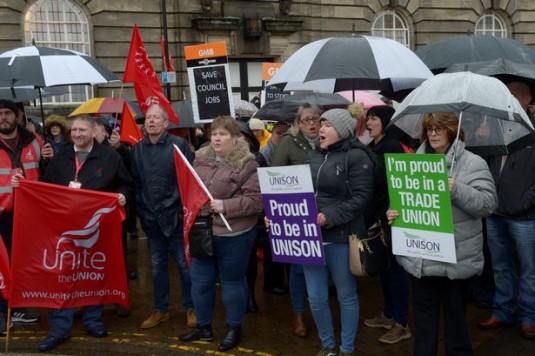
In addition to raising council tax by 3.99%, closing some council-provided services on certain days, and some job losses, a big chunk of the Tory budget proposal was a change to workers' terms and conditions. This would have meant an end to unsocial hours payments on bank holidays, weekends, and evenings. If you were salaried, like the better paid workers at the council are, then this makes no difference. But if you are hourly paid, like most low paid workers are, then this makes a massive difference. According to the local Unison branch, it meant some workers were looking at a 20% reduction to earnings. Considering the social care crisis this country is facing, driving down the wages of care workers even further is hardly going to address the gap. And so for the last couple of Thursdays, lunch time outside the Civic Centre has seen a lively protest of trade unionists backed by Labour. Working together they have come up with alternative proposals that would not mean the council's poorest workers have to bear the brunt of the continued assault on local government. Naturally, the much-hyped blue collar conservatism didn't feature in the Tories' thinking - heeding advice from above to carry on as normal - and stuck to their plan. Perhaps the idea of clashing with the local workforce pushed the buttons of Thatcher cosplayers in the Tory group.

And so we came to the day of the meeting itself. Protesters gathered and councillors were jeered and cheered as they made their way into the chamber. Likewise so many affected workers and their supporters crammed into the public gallery that an overflow room had to be made available so they could view proceedings. Once the debate got underway, it became quite a lively affair. Labour councillors got up and attacked the council for their boondoggle projects, including £117k recently spent on revamping a path at a long-closed golf course. Cllr Shaun Pender attacked the Tories for hammering the living standards of the lowest paid, pointing out some households could lose up to £8,000/year. The Tory response was as all over the place as it was desperate. Council Leader Abi Brown exhorted the assembled councillors to back the plan, otherwise the local authority would end up like Northamptonshire. Cllr Ross Irving, however, outdid himself by arguing that trade unions should not be allowed, and that it was not the council's responsibility that its workers should get by - if they can't afford to live off the wages offered they should get another job. Charming. And Cllr Dan Jellyman, unable to regurgitate that morning's Daily Mail headline or adapt it to fit present circumstances, chose to heckle and raise points of order - but true to form, only when female Labour councillors were speaking.

What electrified proceedings was the split in the City Independents over the budget. Casting aside his undeserved reputation as some sort of soft left-type, Randy Conteh lined up with the Tories to say voting down the proposals would lead to "reputational damage." If only he'd shown similar concern with local authority PR when the council unveiled its desire to fine homeless people £1,000 in the middle of its City of Culture bid. Lord Mayor and purveyor of 20 page manifestos fulminating against cervical smears and refugees, Jackie Barnes, chuntered incoherently about concerns over the terms and conditions but shamefacedly supported it anyway. Meanwhile, deputy council leader and leader of the City Indies, Ann James, was much more forceful in registering her opposition, and was followed in this by her fellow cabinet colleague, Joanne Powell-Beckett, in making the case against. It came to the vote and much to the delight of oppositionists and the workers watching, the plan fell with 19 for and 22 voting it down - six City Indies voted with Labour. Jubilation among Labour councillors was matched by pandemonium among the Tories. Cllr Jellyman confronted Cllr Sabrina Bowers of the City Indies and screamed obscenities in her face, while Cllr Irving berated Cllr Shaun Bennett for abstaining. This was handily edited out of the repackaged stream available online, but one of our members made sure it was filmed for posterity - warts and all.

With their budget in tatters, it's getting brought back again for another try before the 11th March budget setting deadline - presumably with the terms and conditions cuts made up from elsewhere. But this raises some significant questions for Potteries politics. Given the acrimony in the chamber, can the ruling coalition continue? Reading between the lines, it appeared the Tories and City Indies hadn't met prior to the council meeting to hammer out an agreed line. A symptom of the Tories running roughshod over their governing partner as per usual, but also a failure on Cllr James's part for letting them get away with it. Eager to avoid special measures, and the unmaking of their reputation for nous, the Tories will have to offer some concessions. Perhaps another cabinet position, perhaps grovelling apologies for sweary outbursts. Perhaps some cash for the package tour of Stoke-on-Trent.

Their crisis is the Labour Group's opportunity. Having finally proven able to split the independents from their Tory overseers, the party has to know what it wants to do next. We have established a section of the City Independents will go along with Labour when political leadership over contentious issues is provided, and so one would hope the text messages and phone calls have pinged back and forth over forming an alternative coalition. But should Labour? There is one school of thought that the Tories should be left to immolate themselves, carry the can for the mess and damage they're causing, and this puts us in a better position for the next round of elections. This idea is utterly defeatist. If the local party really believes this, why did we bother standing last May? If the Tories are as bad as we say they are, refusing to replace them looks unserious and shows, ultimately, that we're indifferent to the consequences of the bad decisions they make. Yes, the timing is not right. But the timing is never right. Therefore Stoke Labour should work on building a new coalition. It may involve some changes of emphasis and a change of personnel, but if that's what it takes to get the Tories out we should do it.

Simply taking control, however, is not good enough. We need to show we have learned the lessons of our previous stint in office. No more pretending to be managers and letting senior officers steer the authority's priorities, we need to act like politicians and therefore be seen to provide political leadership. This, among other things, involves continuing to shield the most vulnerable - be it council workers or residents - from the worst of the cuts. It means picking up where our old economic strategy left off which, for the most part, the Tories have continued with. Despite their fulminating against it at the time. We need to think about how power can be pushed outward from the council itself, to draw on, draw in, and expand the movement our party rests on. All our current leadership candidates talk about devolving power, so we should think about how we can do it ourselves. We need to learn from Manchester and Liverpool how Labour has managed to keep a tight hold on local politics despite suffering cuts of a similar scale. And crucially, we need to adopt the Preston model lock, stock, and barrel. Under Labour and early in the present coalition, there was a little bit of umming and ahhing about using this to underpin local economic resilience, but little to nothing came of it. This cannot be an afterthought - supporting the local economy has to run through every element of the programme. Are these magic bullets? No. But do they offer the best way of rebuilding the party if we work to split the coalition and form one of our own? Possibly. At the very least, there is nothing here any City Indie would object to.

Within the space of three months, the Tories have gone from all-conquering to getting humiliated by low paid workers working in concert with Labour councillors. There is an opportunity now for Labour to fatally undermine the cocksure confidence of the Tories and boot them out of office, but will the opening be grasped?

Image Credit