Showing posts with label Nazism. Show all posts

Sunday, 12 January 2025

Hyping Farage

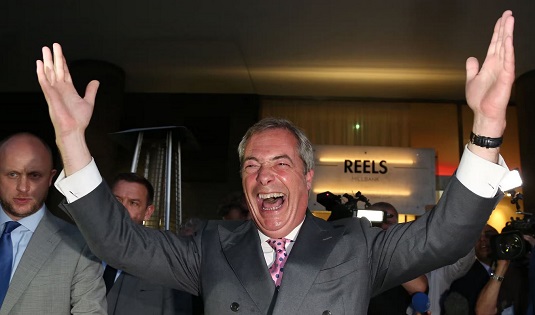
Has the New Statesman got a Nigel Farage fixation? It appears to find Reform's leader/owner beguiling. But there's more to it than that. Their coverage has gone from simply covering what he's saying and doing to (arguably) boosting his project. Before Christmas, the august Andrew Marr was asking, in all seriousness, if Farage could become the next Prime Minister. The latest podcast speculates about the ability of Donald Trump and Elon Musk to destroy him, as if Farage is a figure of equal social weight. And in the magazine since last June, we've had articles like 'Reform isn't going anywhere', 'Reform could haunt a Labour government', 'Reform is Labour's problem now', 'How dangerous is Reform to Labour?', and 'Will Reform win in your local council?'. It's one thing for the right wing press to big up Reform, and quite another for the centre left's magazine of choice to indulge it.

This latest entry in the sub-genre comes courtesy of George Eaton, who has set out to explain "why Farage is turning left". This follows comments Farage made to Politics Joe last week in which he said there was common ground between him and Jeremy Corbyn. They are both "anti-establishment" and critical of the European Union. He said Corbyn's critique of the EU was couched in oppositional terms to big business, a position he happened to share. Brussels is "good for big banks and big businesses and bad for everybody else. Well, he was pretty much right." What Eaton then supplies is evidence for Reform's "left turn" - water nationalisation (cos Labour won't do it), and protecting British steel.

Should Labour be worried? Judging by the panicky anonymous "red wall" MP quotes that accompany such pieces, some are bricking it. And of course they are. Finding a Labour parliamentarian who understands the people Reform attracts is as rare as a tin of Quality Street with a decent amount of triangles. As previously explained, there are hard limits to the extent Reform can become "pro-working class" and adopt left-sounding positions. And when such "policy" is taken on board, they're adjuncts and nice-sounding afterthoughts. Does anyone seriously believe that a Farage-led government would renationalise anything, especially when his City pals benefit handsomely from the private monopolies that own essential infrastructure?

The extreme right have form for tacking left when occasion demands. Reform is not a fascist party, but its antecedents were. The British Union of Fascists, the National Front, the BNP, all had "left wing" positions on economics. So did the interwar continental fascist parties, and when these outfits became governments they turned the state into a straightforward criminal enterprise. The "socialism" in National Socialism was for optics to compete with the socialism of labour movements and mass working class parties. The Nazis, for instance, nationalised nothing. In fact, they were pioneers of privatisation. But the fascists then and the extreme right now can appear "credible" on these issues, despite their record, for two reasons. Putting public distance between themselves and consensus economic opinion underscores their anti-establishment creds, as Farage noted. And second, it's because their core support faces left and right simultaneously. The petit bourgeois roots of the extreme right are riven with status anxiety, and fear being forced down into into the employee class, of having to work for someone else. Downward social mobility can be "caused" by workers demanding too high wages, or expecting entitlements like breaks, sensible working hours, and time off. They are never as reliable as the proprietor. Or workers as an organised collective might be expecting too much from the state, and demand higher taxes on businesses to pay for better public services. Or the petit bourgeois could be out-competed by big businesses who share their market, or screwed over on contracts or suffer late payments. Small business is, from their point of view, where the pathologies of labour and capital collide. They're pushed from pillar to post, and it's why the authoritarian programme of extreme right parties resonate with them. They offer a middle road that puts the two great forces of capitalism in their place and allows for stability. The cypher for that can be the great leader/charismatic personality, the nation, or a menu of tough-sounding promises that would restore order to the world (have you read the 2024 Reform manifesto?).

Therefore, talk of a "left turn" is meaningless. Extreme right parties swing this way and that with the weather. It's in the DNA of their core support, but the moves left are always rhetorical and subordinate to a specific set of political priorities.

The more interesting question is why the New Statesman and Labour Party politicians are hyping Farage when Reform will always pose more of a threat to the Tories. And, I'm sorry to say, the explanation does not lie in "genuinely mistakes" or cluelessness. It's a politics of handling expectations, of Labour not offering too much so politics (or, to be more accurate, class relations) are easier to manage. And one way of doing this is talking up the threat Reform poses the to sort of Britain Labour supporters would like to see. Invoking the threat of a demon opposition is tough when the Tories are bumping along the bottom, but with a comparably more dynamic and more extreme threat, a la Reform, some will stick to Keir Starmer and Labour for fear that something even worse than the Tories is in the offing. What the New Statesman and friends are doing is reminding us of this fact.

Image Credit

Tuesday, 22 August 2023

What Happened to Eva Braun?

A non-tin-foil-hatty account of the anomalies surrounding Eva Braun's autopsy. Anomalies that have never had a satisfying explanation.

Tuesday, 21 December 2021

Conquering the World, Pixel-by-Pixel

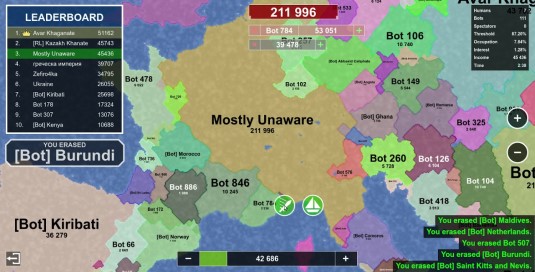
The long-awaited Winter holidays are here! A few weeks of mince pies, tinsel, miseltoe (if you're lucky), and a bit of time to waste. Yours truly is catching up on some reading with Rebecca and What is Philosophy? providing the book-bound entertainment. And for those moments where the brain needs a rest and something less cerebral, there is the new web-based game Territorial.io, by David Tschacher. If there's 10 minutes going spare, why not conquer the world?

Territorial.io is just about the simplest and most straightforward realtime global warfare simulator there is. You pick a spot on the map and your job is to grow out from your pixel to the point where you rule the world. Or enough of it to meet the victory conditions. There are up to 512 others trying to do the same too, so a bit of skill and a lot of luck is needed to fulfil your manifest destiny. By clicking on the map you expand your land holdings. The more pixels under your control, the more rapid your population grows and therefore your army. The latter is controlled by the percentage bar. Expand with low numbers and the more people stay at home to reproduce, but less land is taken in. The higher the numbers committed, the slower the growth in the short term and the greater one's vulnerability is to attack. The same applies when attacking enemies, which will quickly surround you. If you commit large numbers to take out an opponent, you'll have no juice left in the tank to fend off attacks from others. This isn't a problem in single player mode below harder difficulty level. The bots are limited and are easily squished. On very hard though, the bots will attack whoever is the weakest. And as their numbers aren't nerfed like they are at lower difficulty levels, they're going to win. Repeatedly. The trick is to go after the weakest bot on your borders (usually) and make sure you don't expend too many troops, because as soon as your population count goes below a neighbour - particularly in the late game - you're toast.

Single player is good for practice, but multiplayer is where the fun is at. Again, up to 512 human players can descend on one of 14 maps with the numbers made up by bots, and battle commences. The AIs here are uniformly weak and purposely designed to provide population fodder for the humans. Alliances of convenience can then spring up to take down big players, or persistent annoyances or, on several occasions I've seen, players who take on racist or Neo-Nazi monickers (what is it with wanting to cosplay the Third Reich in war games?). There are also team modes in addition to the standard battle royale that allow players to gift troops to one another to help out in fights over far flung corners of the globe, which adds a new layer of strategy. And there are now semi-permanent teams that have emerged on Reddit, and a clutch of YouTube channels going heavy on Territorial.io content. Not bad for a free game that's only existed for a blink of an eye. It is a fiendish game where blunders are shown no mercy, and one cannot believe how stupid other players can be.

Ultimately, games of this sort disproportionately attract Hitler enthusiasts, empire nostalgics, and hardcore nationalists is because the logic of play plugs straight into a key aspect of their imaginary. Just as children up until the 1960s were taught to be proud of the territories shaded pink on the class world map, this helped inculcate a decontextualised, abstract notion of greatness. This elided power with the amount of land a country claimed, so infant patriots might have fancied Britain as the best and most powerful nation because its imperial land area outstripped everyone else. Extrapolated into adult minds, empire maps fixed one's place in the world. Britain is best and therefore I am better than other peoples.

Territoriality plays a similar role in all nationalisms. On the white nationalist far right and its identification with Nazism, the empire Hitler briefly ruled - found on ten-a-penny war maps of Nazi Germany at its fullest extent - speaks not only to the military prowess of the regime, but also the (imagined) historic viability of their rotten politics. If it could happen once and nearly succeed, it might happen again. It doesn't matter that their atrocious view of the good society was utterly crushed by the combined militaries of politically inferior governments and racially inferior communists, the deterritorialised territory lives on in their brains as an inspiration. Squiggles on maps out of time, out of context, and completely divorced from the brutalities that made thoes lines briefly possible.

Territorial.io is an excellent, diverting casual game. Just remember to crush racists and neo-Nazis when you spot them in-game.

Sunday, 8 March 2020

The Women Who Saved Stalingrad

On International Women's Day, military historian Mark Felton brings us the remarkable story of the unit of young women who helped turn the course of the war in the East.

Wednesday, 27 February 2019

Anti-Semitism, Transmisogyny and the Nazi Imaginary

The title of this excellent installment of Politics Theory Other certainly deserves a wide audience. In this interview, Joni-Alizah Cohen looks at the role the value form plays in the constitution of anti-semitic and transmisogynist tropes with the Nazis as her case study. An original and interesting approach useful to understanding how they operate today.

As ever, any support you can give is much appreciated.

Sunday, 6 November 2016

White Nationalism, Conspiracy, and Anti-Semitism

Our last Sociology Research Seminar Series session at the University of Derby saw Andrew Wilson present his recent conference paper, 'The Thematic Preoccupation Governing Meaning Construction on a White Nationalist Forum'. The focus of his research was the infamous hang out of assorted fascists, Nazis, and racial fantasists, Stormfront. Founded in its present incarnation in 1996, Stormfront is the hub for white supremacism/nationalism on the internet. For instance, between 1st April and 29th June this year, it received two million unique visitors and 3,246,612 page views. 51% of its audience are from the US, and ten per cent hail from the UK.

Andrew's previous experience researching apocalyptic cults, conspiracy theory, and fringe beliefs took him to Stormfront in the wake of last year's Paris attacks. He found that by post six (on a thread of thousands) about the incident a poster was already touting conspiracy theories by way of an explanation, which became the dominant discussion theme. What also attracted Andrew's attention was the convergence of this conspiracy mindset, which is a staple of the far right with a certain species of spirituality, or, as Charlotte Ward and David Voas put it, conspirituality. This is important because for the site's participants as their investment goes beyond the political (and certainly the party political). Their loyalties lie in a transnational ethnicism, a quasi-mystical attachment to a contested and variously understood ayranism which, for its part, is held down by sinister conspiracies.

The performance of conspiritual identity requires the adoption of certain regalia. Anyone who's been on Twitter for five minutes will know that overtly political people tend to fix their avatars or festoon them with ribbons. Stormfront is no different. Typical displays include knights, flags, wolves, Norse Gods, weapons, targets, and a pantheon of Nazis. Some were assembled in a manner akin to Dick Hebdige's celebrated notion of bricolage. What Andrew was interested in was whether there was a correspondence between contributors with certain avatars posting on particular topics via the process of discourse mapping. Picking the five most popular discussions - The Holocaust, National Socialism, September 11th, Illuminati, and Reading, which amounted to 28,808 posts at the time of the study, among the 50 most used words and terms were Jews, People, Germany, Nazism, and Holocaust. As there was a chance the result could have got skewed by extended but relatively neutral discussion of aspects of holocaust history, stripping the thread out of the combined results saw Hitler receive greater prominence. Performing a similar operation by discounting the National Socialism thread, Andrew found the terms 'People' and 'Jews' came top. No matter what was left in or taken out, Jews and Jewishness cropped up again and again. He then performed a Latent Dirichlet Allocation, which identifies word patterns, and found Jews were mostly associated with Holocaust, Nazism, and Conspiracy. In the rarefied world of far right conspirituality, anti-semitism remains the core attribute. At the same time, Andrew began to see patterns emerging, of avatars tending to be active across topics that shared common ground with their motif. Further investigation of these patterns would allow a researcher to identify the in and out groups, what terms and values are likely to repeat, what and who gets labelled friends and enemies, and how this work tries to glue together a collective identity.

Questions were then taken about the place of hatred in these conspiritualities - is being against something enough for these identities? The repeated use of avatars with repeated far right themes, which in turn are anchored by the discourses posters contribute to suggests it is necessary but insufficient. Andrew also noted that despite Europe's far right switching to Islamophobia as their public target of choice, there was little evidence Stormfront's contributors were concerned with Islamism, the Islamification of Europe, or other such nonsense: obsession with Jews and Jewish-controlled conspiracies remained the shared focus of paranoia and hate.

This was an interesting opener into work yet to be done, and Andrew raised a number of interesting questions. Particularly with regard to the status of the white nationalism on display on Stormfront. Because of the transnational understanding of race they operate with, the fusion of conspiratorial politics and pseudo-religion, and, of course, the far right's propensity to terrorism, perhaps it would be profitable it they were viewed as a species of extremism not dissimilar to Islamism.

Monday, 24 October 2016

Hitler: The Rise and Fall

Broadcast on More4 these last few weeks is the definitive documentary about the Nazi leader. Bear in mind those are their words, not mine. Like most pieces that try and unpick Adolf Hitler, this claims to get at the man behind the monster by building on insights dredged up by decades of scholarship. And yet, somehow, despite there being virtually nothing that hasn't been said or written about Hitler, TV documentaries always miss the mark. Rather than challenge the myth that he was a political titan in a field of mediocrities, they tend to reconfirm it. In no sense is he analysed in his context, as the head of a social movement and, as such, he gets off as one of history's great (but damned) men. In this respect, I'm afraid to say Rise and Fall is no different.

Despite drawing on academics and experts, Rise and Fall's obvious shortcoming concerns Hitler's rise to power. Obvious, because it is repeated time and again. As even my cat knows, after the Munich Beer Hall Putsch Hitler came to the conclusion that (relatively) peaceful and constitutional campaigning was the way forward for the fledgling Nazi movement. Violence against opponents was ever present, but this took place alongside the work of contesting elections, kissing babies, setting up Nazi social clubs, and so on. After his release from Landsberg prison, Hitler set about reorganising the Nazis and polishing up his image as a dynamic politician. The conventional narrative, which Rise and Fall parrots, is that he got nowhere - despite the celebrity Hitler's trial afforded him - until the Depression came knocking and Germany's economy nosedived. Once this happened, Hitler's assumption of power was more or less guaranteed.

As anyone who imbibed their inter-war history from the teet of Trotskyism knows, matters were more complex. In histories of the time, backed up by Trotsky's excellent contemporary analyses of the rise of Nazism, we were told that Hitler was the fault of Joe Stalin and his minions in the German Communist Party (KPD). The most powerful and well-organised party in the Communist International outside of the USSR, with the onset of economic crisis the official Comintern line declared that a new period in politics had opened up in which revolution was imminent. The time now was to take the offensive and declare war on all capitalist parties, and this included (and especially targeted) the mainstream social democratic and labour parties. In Britain's case, where the tiny CPGB's positioning vis a vis the Labour Party merely reinforced their stillborn status, in Germany the effects were far more serious. Trotsky had rightly identified that the Nazis presented the labour movement a mortal threat, and for that reason the KPD and Social Democrats (SPD) should make common cause to crush the Nazis on the streets and drive them out of politics. They certainly had the combined social weight and large enough militias to do so. And yet, time and again, opportunities for unity were passed up as the KPD pursued the "class against class" line. Rather than seeing the SPD as potential allies, they were "social fascists" to be smashed alongside the real fascists. The fact Stalin's Comintern carried on with this policy to the mutual ruination of German communism and social democracy underlined its bankruptcy and the need for a new revolutionary centre, as far as Trotsky was concerned.

While this was true, Trotsky is a touch guilty of over egging the pudding. Yes, the main enemies were the Nazis, but the KPD didn't pursue the class against class line just because Moscow told them to. The KPD was mainly a young party, but it contained plenty of activists who were around when the Social Democrats in government used proto-fascist militias to murder Rosa Luxemburg and Karl Liebknecht, two of the party's outstanding early leaders. It was the SPD that colluded with the army against the communist government in Bavaria, and summarily executed its key cadre when the Munich soviet collapsed. While history does not excuse the communist failure to unite against the Nazis, it helps explain why many party members swallowed the social fascist line. Meanwhile, the SPD weren't especially keen on forging an alliance against the Nazis with the revolutionary left either - what was taking place on Germany's streets were secondary to its constitutional responsibility toward the republic it had created, and manoeuvring with bourgeois parties to keep the possibility of mainstream coalition government open.

The Nazis were fortunate to face a divided labour movement. By the time they were in government and used the emergency powers contrived by Hitler in the wake of the Reichstag Fire, they were able to roll over both parties without so much as a shot fired. This outcome, however, was not predetermined. Politics are always fluid, and because of the repeated blunders in the face of the Nazi threat Germany succumbed to fascism.

Needless to say, this opportunity to defeat the Nazis was passed over in favour of a narrative of a smooth assumption of power. But the second point, which rarely warrants a mention, is that by the time Hitler was invited to form a government, his party was past its electoral peak. In the July 1932 general election, the Nazis became the biggest party in the Reichstag with 37% of the popular vote (13,750,000 votes) and 280 seats. Come the November election, they lost two million votes and 34 seats. Rise nevertheless portrayed Hindenburg's invitation to Hitler as a natural outcome of an insurgent Nazi party. In fact, by this time Germany was over the worst of the economic crisis and clearly, all it took was a few months for former Nazi voters to get fed up of Hitler's shenanigans and posturing. It was the play of bourgeois coalition politics that elevated the Nazis to the level it could cut liberal democracy's throat. The options were there for yet another bourgeois/SPD coalition, and yet at this late stage the establishment feared the KPD more. In those final free elections it rose to 100 seats and almost six million votes while the SPD's support was spiralling downward. Again, Hitler's rise was not inevitable.

Unfortunately, by skirting over these important historical details they reinforce the Führer myth. As established scholarship has asserted time and again, Hitler was an ignorant blowhard that rendered him entirely inflexible, and was a man consumed by infantile fantasies fed by cowboy novels and Wagnerian opera. He had a talent for rabble rousing, a flare for marketing, and a cunning that could sniff out weakness in others. None of these attributes are signs of genius: they are banal character traits shared by tens, if not hundreds of millions of people. In his rise to power, what is striking is less an exercise of preternatural talents but exceptional luck. Luck that his opponents underestimated the Nazi movement, despite the living example of Fascist Italy, luck that the labour movement was consumed by its own civil war, and luck that the game of government formation made the Nazis an invitation at the moment their support had started to plunge. If you're looking for the last word on this topic, Hitler: The Rise and Fall isn't it.

Saturday, 18 July 2015

The Royals and the Nazis

Who wasn't tickled by this front page? Well, The Palace, obviously. They said it's "disappointing that film, shot eight decades ago... has been obtained and exploited". Disappointing? How so? It's not like anyone seriously believes the Queen has an attic full of Nazi regalia and goes to bed with a signed copy of Mein Kampf. And no one is suggesting that she is somehow culpable for what the Queen Mother and the execrable Edward VIII encouraged her to do. Those for whom sycophancy is the only appropriate mode for treating with and speaking about the royals should neck a bottle of chill pills. Relax, Elizabeth Windsor today remains the same patrician Tory who places herself above big P politics as she was upon her assumption of the throne.

What is, of course, inexcusable is the behaviour of the dear old Queen mum and the empty-headed simp Edward. The Sun tries its best to soft soap the pair, adding that the film should be seen "in context". That "no one" knew Hitler was a bit of a wrong 'un, and that these are just larks because "families of all kinds larked around apeing the stiff-armed antics of the faintly comic character". This is just so much poppycock. The 1930s had mass media. The press had international correspondents. You did not need to follow Trotsky on the rise of Hitler to know the Nazis were violent thugs who routinely attacked opposing parties (eternal kudos to those KPD and SPD comrades who replied in kind). It was also fairly common knowledge that the Nazis singled out and attacked Jews, were committed to tearing up the Versailles Treaty, and was bent on rearming Germany with a view to expanding its borders. For toffs like Elizabeth and Edward, liberal democracy, the rule of law, rights of minorities, and political freedom were so much collateral. Germany had a large and powerful labour movement that could, on paper, have swatted away the Nazis with a flick of its wrist were it not paralysed by internal fratricidal division and hobbled - at least in the SPD's case - constitutionalism. It was perceived as a latent threat to the prevailing social order and required putting in its place, hence why so many aristos and bourgeois-types in Germany and abroad broadly welcomed the Nazis' assumption of power.

As The Sun itself notes, the Queen Mother did her bit once the Luftwaffe started bombing London and arguably atoned for her earlier attitudes. Edward was later to scab on the war effort advising the Nazis to bomb Britain into a quick peace, and until his dying day remaining an unrepentant fascist and anti-semite. Small wonder the royal archives concerning him remain under lock and key.

In all, there's nothing especially new here - though The Sun were right to publish this because it is of historical interest. And comes as a welcome tonic to the usual grovelling and kowtowing we get from the press. In fact, it's Rupert Murdoch's sole redeeming quality that he finds the monarchy as an institution pretty appalling, though it's been a signal feature of his entire business career to put his own political leanings second to News International/News Corp's commercial interests. Apart from that, however, why have The Sun decided to splash on this story now? What's grinding away in the background, is there a surreptitious master plan at work here?

Nah. It's a scoop and it will sell newspapers, ensuring the currant bun features on news bulletins around the world. It needs it as the paper's web presence is but a fraction of its rivals. The Sun's army of readers conspicuously give it the body swerve treatment when they venture onto the internet. But the story will not be without its consequences for how the royals are perceived. Only the most deluded thinks Charles won't follow mummy to the throne - unless she outlives him. Nevertheless, we are reminded that the royals have their views about political issues. Whereas the Queen has always been discreet enough to keep hers away from the prying eyes of the public, Charles is not so fussed. By acknowledging the views of royals past, we may be preparing ground for a monarch who's openly opinionated.

Saturday, 11 July 2015

Review - Look Who's Back by Timur Vermes

A comic novel with Adolf Hitler as the main character? Really? Quite apart from the humourless fanaticism that characterised Hitler and the regime he founded, isn't it still a bit early to turn the most notorious name in modern history into a sympathetic figure of fun? Yes, it is. Or at least it's something that's very risky. As Gavriel Rosenfeld puts it, Look Who's Back flirts with "the risk of glamorizing what it means to condemn, giving voice to racist ideas in the process of making fun of them".

What's the fuss all about? The novel finds Hitler waking up and reeking of petrol on a vacant Berlin lot, which the reader is left to assume was on the site of his famous Führerbunker beneath the Reich Chancellery. Having no clue what has happened and puzzled by the lack of bomb damage and young people sans Hitler Youth attire, he's taken in by a friendly newspaper vendor. He learns that it's 2011 and has to adjust to modern times. Taken for an impersonator that never breaks character, the comedy lies in his entirely inappropriate answers to every situation. And very quickly this Hitler becomes famous. Finding fame on a skit show, a YouTube slot quickly follows along with a dedicated show and a list of awards. One of the funniest moments of the book is where he pays an impromptu visit to the headquarters of the National Democratic Party (NPD), the far right outfit that foreswears but unofficially has considerable continuity with the Nazis. Needless to say, Hitler is far from impressed and hilarity ensues as he unknowingly tries to trap the hapless chairman into admitting their fealty to national socialism on camera.

I don't want to give too much away, except to say Look Who's Back is a very funny novel. It's also perhaps surprising that it originated in Germany where, understandably, Hitler remains very much a taboo topic. Problematically, there are almost moments when Hitler is cast in a sympathetic light, especially when he is roughed up by a couple of Neo-Nazis who take him as a Jew-orchestrated send up of their beloved inspiration. Having read Mein Kampf, which is not an experience I'd recommend to anyone, in may ways Vermes captures Hitler's character well. While not the rasping, ranting demagogue of the newsreels, the monomaniacal self-belief is there and the exceedingly limited racialised way of looking at the world is well-rendered, though understandably without the kinds of terms Hitler would have thought with. Where Vermes goes off-piste with Hitler's character is that the narrative convention of novel writing means rendering the fuhrer coherent and well-expressed. As his semi-autobiographical rantings and musings demonstrate, this was definitely not the case.

Of course, this book isn't really about Hitler. It's not even about standing attitudes toward his legacy. It's about modern Germany. One thing that always strikes me about reading modern European literature in translation is how similar societies over the channel are to dear old Blighty. It's the Americans who are weird. Therefore, Look Who's Back it's about us too. Vermes has the superficiality of celebrity culture in his sights and exposes the impossibility of authenticity under these conditions. Our Hitler is the real Hitler, but his "authentic" offerings can only be viewed as a simulation of the real thing, his declarations for lebensraum, musings on the "interracial mixing" of dogs, and attack on the cowardly lampooning of other nationalities (yes, really) are taken as affectations of an impersonator, his message - which is deadly earnest - a bit of harmless distraction to be laughed at. Like so many offensive celebrities, as per Clarkson and Hopkins, Hitler is allowed to peddle his nonsense because there is money to be made. The consequences, which are a coarsening of public discourse and an evacuation of sympathy and feeling from popular culture always play second fiddle to ratings.

It's also a polemic against the the disappearance of history. No one in the novel takes Hitler seriously, but his reappearance allows for the characters - mainly his media support - to indulge in some dubious recrudescences. Replying "jawohl mein fuhrer!", indulging a mass sieg heil by the production staff, saluting him, and providing him a chat show adjutant replete with SS uniform speaks of the amoral, ahistorical grinding of an entertainment industry that repackages and effaces the past as it sees fit. Even something as disgusting as the Nazi period.

In all, a very funny read. The satire and the criticism isn't particularly cutting edge - it's been done before. But this is about chuckles, not chin-stroking.

Monday, 10 November 2014

Nazi Megastructures

These last five weeks there's only been one place for Third Reich geeks. And that's More4, 9pm Sunday evenings for the fantastically-named documentary series, Nazi Megastructures. At the centrepiece of each programme was a terrible, maniacal, yet ingenious Nazi scheme designed to strike the allies a crippling blow. They were truly windows into this most barbarous of regimes.

The first episode focused on the U-boat threat and particularly the base built at Lorient, on the French Atlantic coast. This structure, built between 1941 and 1942 provided three huge bunkers for the repair, resupply and storage of up to 30 submarines at a time. Encasing them were steel-reinforced concrete walls up to three metres thick and gaps between levels of the structure to deflect away the blast force of any incoming bombs. As the air war turned against Germany, Lorient was attacked many times and hit directly by some of the heaviest conventional bombs at the allies disposal. Fortunately for the U-boats inside they remained unbowed and undamaged. But unfortunately for the town itself, it, the support roads and the rail heads leading to the complex were totally flattened, significantly reducing the operational efficacy of the base - at the price of thousands of dead French civilians.

The second looked at the development of von Braun's V-2 rocket. The initial part of the programme was concerned with the secret research centre at Peenemünde. It describes the factories, test beds, barracks and offices, and the facility's dedicated power plant for manufacturing rocket fuel. Despite the secrecy, the Allies got wind of the the launch site in 1942 and bombed it. Undeterred, the Nazis distributed the manufacture of rockets across Germany. In some cases, it led to underground factories. In others, bizarre and outlandish structures. La Coupole near Calais is typical of this. The Nazis constructed a vast bomb-proof concrete dome under which they excavated a warren of tunnels and chambers. This was an all-in-one facility. It was designed to build rockets, wheel them out on to the launch pad, and fire them. The unforeseen problem, again, was that while the structure was virtually indestructible the land surround it was not. The project was abandoned after bombing raids made supply to and from the site impractical, as well as ensuring the launch area was thoroughly cratered.

The third dealt with Hitler's love-in with supersized tanks. This episode is a history of Wehrmacht tank production, and details the development and deployment of the fearsome Tiger (my late granddad faced these at Anzio - he wasn't a fan). Hitler was though, and wanted to see even larger tanks take to the field. The second part of the programme introduced the Panzer VIII, known as the Maus. This beast was over 200 tons and had armour 19cm thick at its weakest point. As such it was virtually impervious to any battlefield opposition. The problem, however, was its weight, speed, and sheer impracticality. The Germans didn't have an engine small but powerful enough to drive it more than eight miles an hour, had no machine guns to ward off infantry ambushes, and would either have bogged down in wet ground or collapsed any bridge it tried to cross. There seems to be a pattern emerging to these megastructures.

Episode four looked at the development of the notorious Me262, the world's first operational jet fighter. This far outperformed anything in the Allied and Soviet air forces, except the British Gloster Meteor that briefly saw active service. The development of the craft was delayed as both the Luftwaffe and Willy Messerchmitt himself believed/had an interest in continuing the manufacture of piston-driven planes, and thought the war could be won using them alone. By the time the funds started flowing in this direction, the air war was lost and Messerschmitt factories were systematically bombed. Matters weren't helped by an intervention by Hitler who cost development time by insisting the jet be a fighter bomber rather than an interceptor, before eventually relenting. Like the V-2 programme, production was dispersed across Germany. The site of interest to this episode was Walpersberg Hill. Here the Nazis excavated an underground factory/base designed, like La Coupole, to launch machines straight from the production line from a makeshift runway at the hill summit. It was a colossal engineering effort that cost huge quantities of resources, the lives of over 900 slave labourers and produced just 27 fighters before the Americans overran the site.

The final episode looked at the ring of fortifications built around Berlin as the Soviets prepared for their final assault. As such this was about structures rather than a singular construction. It took in the huge anti-tank ditches dug by civilians on the approaches to the capital, the super-bomb proof Führerbunker (not only was it buried beneath the Reich Chancellery, it was capped by a roof of steel-reinforced concrete some four metres thick), and the three flak towers. Constructed in 1940 as anti-aircraft artillery placements during the Battle of Berlin these doubled up as strongpoints and shelters from the fighting. An estimated 60,000 people stayed in them as the war raged outside. Their 11 foot thick walls also proved impervious to Soviet guns and were, unsurprisingly, among the last areas of the city to surrender.

In each case, these buildings and the projects they supported say everything about Nazi Germany. They were all brutally functional to the point of dysfunctionality - time and again the facilities were made vulnerable and inoperable by the 'soft' civilian structures surrounding them to which the Nazis paid scant regard. And all had an element of desperate madness about them. As the war swung against Hitler, his regime preferred to chase wonder weapons that would somehow turn the tide back their way. Yet the V-2, the Me262, the Tiger, all fearsome weapons in their own right showed up too late and in too few number - thankfully. But also how scant resources continued to be poured into these projects right up to the very end of the war says something about the collective madness gripping the Nazis - a flight from a reality their crimes brought down on their heads.

Where Nazi Megastructures was good was it spared no detail about the use of slave labour in these schemes. This was not an indulgent "the Nazis were bad but what amazing engineers they were!" apologetics. The real human costs were shown, as well as the absurdity and pointlessness of the projects.

Yet there was a curious omission. Where was the Holocaust? Surely, the most ambitious, far-reaching, extensive, complex and, sadly, ruthlessly efficient megastructures of all were the networks of death camps, murder factories and crematoria that exterminated between six and seven million people. In terms of resources expended, this monstrous enterprise dwarfed the underground factories, the slave labour assembly lines, the concrete domes and useless tanks. As Third Reich documentation makes clear, throughout the war the wholesale murder of Jews and other "undesirables" were the Nazis' top priority. Not even chronic labour shortages in German factories stopped the killing. The madness and barbarity of the Nazis can be glimpsed in the concrete ruins they left behind. But to see it truly, fully, Nazi Megastructures needed to go where it failed to do so - the dark heart of their largest, most secret, most disgusting project.

Thursday, 1 August 2013

Call of Duty: Heroes of the SS

"Why don’t you just enjoy the fantasy? Games are a special medium, completely separate from our wider culture and any attempt to put them in context is just insulting." So begins a spoof article from last month's New Statesman, but like all good parodies it sends up the kind of reaction anyone - not just feminist comrades - receives when they burrow into the cultural artefacts we produce and enjoy. Some might moan that cultural criticism "spoils" a film, a TV programme, a piece of music; that they're on a hiding to nothing. But such a view is fighting shy of the deeper implications some of our favourite pastimes might have. Like it or not, an episode of Coronation Street is as political as the output of this blog.

But I want to question the forced cultural innocence that says nothing really matters in the fictions we tell ourselves, and especially in the make-believe scenarios that populate our video games. And I want to do this with a thought experiment.

Imagine Activision, with all the fanfare their biggest franchise deserves, were to announce their latest iteration of the phenomenally popular Call of Duty series for the Xbox One, PlayStation 4, and (maybe) Wii U. It's title? Call of Duty: Heroes of the SS.

In this fast-paced, stylish shooter you can, of course, fight intense multiplayer battles in the Ardennes, the Pripet Marshes, Stalingrad's Tractor Factory, or Monte Cassino. But it also comes with two fun-packed, realistic single player campaigns.

The game finds you cast as a raw recruit in the Waffen SS. For the more stealth-minded COD player your career with Himmler's men begins at the border with Holland in the uniform of the Dutch, not the Deutsch. Your task is to overpower a group of border guards so the tanks of the Wehrmacht can roll in before the alarm is raised. There follows a small series of interlinked set pieces that also involves gun battles, raids on airfields, and culminates in the final surrender of the Dutch army outside Rotterdam. From there the action moves to the Ardennes Forest as you quietly assault and "neutralise" scouts of the French army. Meanwhile, had you selected the other campaign you are a foot solider attached to the under-strength SS Totenkopf division. Having burst out of the Ardennes the tanks streamed across Northern France where they meet a surprise counter-stroke from the British. At the Battle of Arras, where the Waffen SS suffered its first military reverse, you have to relieve groups of your comrades caught behind the advance of the Matilda tanks and make it back to German lines. It variously involves commandeering motorcycles, out of action tanks, and culminates in operating anti-aircraft guns Rommel actually used to prevent the British from breaking through.

The two careers continue their divergence after the fall of France. As a foot soldier, you are transferred to play out a series of scenarios and missions stretching from Kiev, the Crimea, the Caucasus, Stalingrad and; after a period of leave, redeployment in Italy on the Gustav Line - culminating in the Battle of Monte Cassino. The stealth missions move to an undercover mission to Lisbon to assassinate a suspected double agent, recruitment by SS-Obersturmbannführer Otto Skorzeny for the rescue of Benito Mussolini and attempted assault on Tito's command infrastructure (the 'Raid on Drvar'). Following a narrow escape from the latter, you are then thrust into 'Operation Eisenhower' - the infiltration of American lines in American uniforms just prior to the Battle of the Bulge. It may involve operating the feared Tiger Tank. And then, with the vice of the Allied and Soviet armies crushing Nazi Germany between them, our protagonist finds themselves in the Battle of Berlin. The infantry man fights house to house, and attempts to lead the old men and boys of the Volkssturm against the advancing Red Army. Our stealth player finds himself in the dying hours of the Berlin Bunker. Hoping to meet the Fuhrer before his end, he is tasked with taking up position outside the bunker to keep advanced Russian stragglers away, as well as covering the escape of Hitler's henchmen.

Call of Duty: Heroes of the SS is a straight forward historical fantasy. The player participates in actual, lightly fictionalised WWII encounters and battles. There are no playing out of actual atrocities, no repeat of Call of Duty: Modern Warfare 2's infamous airport scene. There are no death camps, no killing of POWs, and no racist or anti-semitic dialogue. The difference is one of perspective, of being on the losing side. And, of course, going into battle in a coal scuttle helmet.

This game doesn't exist, of course. And is unlikely to do so outside of a few enthusiastic modders. But why not? If video games are innocent and just a bit of fun, why can't disbelief be suspended as one takes up arms for the Axis Powers? Is it a question of bad taste, especially as it involves shooting American and British soldiers? Could it be that game players might, as they battle the Allies and the Soviets, start developing an identification with the 3rd Reich? Might the omission of the foul crimes committed by the Waffen SS lead to accusations of soft soaping the Nazis? Would it be enough to violate the moral probity of our hysterical press, or be seen as a video game recruitment sergeant for the far right?

If the answer to any of these is 'yes' - however grudging - then it goes to show things like video games are not 'innocent'. They all have things to say, all weave a series of codes and messages that promote, inculcate and diffuse certain sets of cultural mores, expectations, and ideologies. It does not mean gamers playing this hypothetical title would turn into a jack-booted goose-stepping moron anymore than playing official, actual Call of Duty releases would make them uncritical cheerleaders for the American Way. But it is part of a complex of messages our culture transmits all the time which, in turn, conditions our social being and subtly influences it.

Nothing is voiceless. Everything has something to say.

Saturday, 2 February 2013

Remembering Stalingrad

What has the Soviet Union ever done for us? Well, to put it bluntly, the USSR saved our asses. Between 1941 and 1945 three quarters of the armed forces of the 3rd Reich were systematically ground down by the Soviet people at almost unimaginable human cost. Compared to the horror Hitler unleashed in the east, everything we officially celebrate about the Second World War in Europe - the victories in the desert, the Normandy landings, the doomed heroism of Arnhem, these were but sideshows to the bloody main act that played out on the Russian steppe. That's why everyone with a progressive bone in their body should at least spare a thought for the events that came to a close 70 years ago today on the banks of the Volga.

After conquering or subduing all of continental Europe under the hegemony of Nazi Germany, Hitler's Operation Barbarossa was a gamble that aimed to knock out the Soviet Union in a single, almighty blow. It almost succeeded. From 22 June 1941 Germany and its allies advanced deep into the USSR across a front some 1,800 miles long, inflicting almost crippling losses and taking hundreds of thousands of POWs. By December advance forces were poised just 16 miles from the Kremlin. Rumours abound that at the darkest hour, Stalin had his train ready for a quick get away. But fatefully he elected to stay to publicly front the successful Soviet winter counter-offensive. Using reserves fresh from Siberia, it hit the German front lines with all the force of an avalanche and pushed the invaders well away from Moscow.

Come summer 1942 and the scales were already tipping against the Nazis. Having declared war on the United States on the same day Japan attacked Pearl Harbour, it was only a matter of time before its vast industrial potential would come into contention. And so Hitler gambled again. An offensive in southern Russia toward the oil fields of Baku could cut the Soviets off from their primary source (the region was responsible for 90% of the USSR's oil production), capture Stalingrad, and, crucially, shorten Axis fuel supply lines for further military operations. In sum, it could have knocked the USSR out of the war. Case Blue, as the overall operation was called launched at the end of June and, like Barbarossa, was initially successful. But buoyed by this success Hitler modified the plan to give the Wehrmacht additional, multiple objectives - just as lengthening supply lines and fuel shortages began to bite. This operational confusion brought the Red Army crucial time to ship out crucial food and rolling stock resources from Stalingrad, and rush in more reinforcements.

The Battle of Stalingrad proper began that summer as it came under heavy and sustained bombardment from the air. By August's close the majority of the city was rubble. However this ultimately proved the Nazis' undoing. The Luftwaffe's bombs scattered debris across the city's streets, making them impassable to tanks and other vehicles. Partially destroyed and collapsed buildings were also perfect fortresses, and it forced the German 6th Army to engage in house-to-house fighting. Very quickly Stalingrad became an abattoir of attrition. The fate of the 20th century turned upon unknown and undocumented battles in living rooms, across roof tops, in the dank of Stalingrad's drains. Apartment blocks, factories, train stations, all became strategic strongpoints. The city locked two million soldiers in a death grip unparalleled in the history of warfare before or since. Despite this, the Germans continued to make slow progress and by November occupied 90% of the city. But this ultimately fruitless effort marked the high point of the Nazi advance.

As the Germans tried to break the city's remaining resistance the Red Army reserve crashed into their lightly-defended northern and southern flanks. The Soviet attack swept aside the under-equipped Romanian and Hungarian divisions with such speed that it took just four days to encircle Stalingrad. The besiegers became the besieged as some 265,000 Axis troops were cut off from their lines. Permission was sought from Hitler for the army to stage a break out. He refused. Believing Goering's boasts the Luftwaffe could resupply the army from the air, a trickle of supplies were flown in while a German relief offensive to re-open the land route to Stalingrad barely got within 40 miles of the suburbs. With food and ammunition running low, intense fighting continued as the Soviets threw fresh troops into the city. The battle ground on for a further two months but the conclusion was foregone. On the 31st January 1943, the head of the 6th Army, Field Marshal Friedrich Paulus, surrendered as the Soviets closed in on his HQ. On the 2nd, apart from a few holdouts, the remainder of the army laid down its arms and capitulated. Some 22 generals and 105,000 troops went into captivity, of which only about 6,000 ever returned home again. Of the rest, between 25,000 and 35,000 were evacuated before the last air field was overrun in late January. In total Stalingrad claimed 850,000 Axis dead, missing, wounded or captured. Soviet casualties were approximately double at just under 1.7 million.

This was the blow from which Nazi Germany would never recover. There was two more years of the bloodiest, fiercest fighting imaginable between Stalingrad and Berlin but the writing was on the wall. Everything else the Wehrmacht managed in the east, including the thwarted offensive at Kursk, could at best only delay the inevitable. But it was an inevitable whose delay was bought by countless deaths and the devastation of entire countries.

Despite the awful crimes of Stalin and his regime, the barbarity of Nazi Germany was an order of magnitude greater than anything else ever seen in history. Had Hitler been victorious a new dark age would have settled over Europe and, quite possibly, Africa and the Middle East too. The Holocaust was a foretaste of a world of routine industrialised mass murder and the enslavement of tens, if not hundreds of millions. The Battle of Stalingrad ensured this Nazi hegemony, this hellish abyss was not fallen into.

All of us, wherever we are, owe the Soviet people who lived, fought and died battling Germany's military might the profoundest of debts. And we owe it to their memory and ourselves to ensure nothing of its like ever happens again.

Wednesday, 28 November 2012

Hitler, Charisma, and Leadership

The classical German sociologist Max Weber famously wrote about charismatic leadership and authority. Of it, he noted charisma derived from the leader's personality, which in turn inspired their followers to internalise self-discipline and duty. But in a dialectic of mutual exchange, the leader is under constant pressure to affirm their worthiness by performing deeds. Support therefore is conditional on the delivery of promises. You could be forgiven for thinking he was writing of Hitler, had Weber not died three years before the Nazis attracted national attention. Nevertheless, despite bequeathing sociology the basic conceptual tools for unpacking how charismatic leadership works, the way Hitler bewitched Germany and led it willingly into the abyss continues to fascinate, appall and mystify in equal measure. Therefore the BBC series, The Dark Charisma of Adolf Hitler serves as an interesting entry into unravelling the riddle.

Hitler's story of his rise to power and cataclysmic fall is well-known and certainly doesn't need repeating by me at any length. Dark Charisma's first episode deals with the rise of the Nazis, the second on the consolidation of power and how Hitler's charismatic leadership persuaded the overwhelming bulk of Germans to assent to a war of conquest, and finally what happened when things went wrong and Germany was crushed between the vice of the Allied and Soviet armies.

The early part of Hitler's career, between joining the far right movement in Munich as an army spy in 1919, to the renewed upturn in the Nazis fortunes during the Depression, Hitler and the Nazis established the cornerstones of his leadership. Firstly, there was Hitler the person. Here we had a man with a dead emotional life, a burning hatred of his self-defined enemies, an inability to make friends, iron-certain self-belief, overweening ambition bordering on the delusional, inflexibility, intolerance, and a knack for rabble-rousing. Upon joining the far right German Workers' Party, Hitler very quickly made a splash in Munich's nationalist scene. He possessed a simple message that explained Germany's defeat in the Great War, provided a scapegoat, and condensed the sorts of qualities the Kaiser and his underlings lacked. This was his mission, and his inability to brook other views was not a weakness, but a strength.

After the fiasco of the Beer Hall putsch, Hitler's views were recorded in all their rambling posterity by his dutiful lapdog, Rudolf Hess, and later published as Mein Kampf. Anyone who's actually read the dreary tome will know it as an incoherent and seemingly endless monologue about blood and soil, foreign affairs, reminiscences, Social Darwinism, the Jews, the Slavs, lebensraum, and the manifest destiny of the German people. Mein Kampf reads like a series of fanatical sense impressions. There is no justification or argumentation supporting the beliefs - they are held by Hitler to be self-evidently true. Here we have the authoritative articulation of his vision, albeit one that was left deliberately vague and unclouded by the petty detail of policy.

Following his release from prison, Hitler worked on himself as an agitator and public speaker. He had a number of photographs taken to study and perfect his oratorical mannerisms (example) and took on board a number of manipulative interpersonal tricks. He was said to have trained his gaze to look at someone directly for longer than is normal. Many a German described it as if he was looking straight through you and deep into your soul. He used flattery and simple confidences, and was adept at having his immediate circle compete among themselves for his favour. These personal cues combined with a carefully crafted public performance allowed Hitler and the Nazis to project a figure into which all manner of hopes and desires could be poured, while simultaneously (and contradictory) offering stability and certainty. This was the foundation of Hitler's connection to the population at large.

The foundation stones of Hitler's charismatic leadership - mission and strength, vision and appeal were all in place before the Depression hit. Small wonder that the narratives and solutions offered by the Nazis were received sympathetically by millions of people groaning under the weight of hyperinflation and unemployment. But this was not enough in and of itself. Charismatic leadership requires popular deeds. With the economy and politics in chaos, attempts by the mainstream right to cut a deal with Hitler and have him as part of a governing coalition were rejected by him. His refusal to get drawn into intrigue underlined his integrity, and in holding out for the chancellorship the faith of his followers was awarded when the machinations of von Papen handed Hitler the keys to state power.

Over the space of the next couple of years, the Nazis used the state to cement Hitler's charismatic leadership. In the first few months he abolished all other political parties. He ruthlessly cut out the "unruly" SA, which in reality saw real and imagined rivals in the Nazi movement physically liquidated. You had the myth-making factory of Goebbels' propaganda ministry cranked into production. Cinemas were full of Leni Riefenstahl's paean to fascist totalitarianism, The Triumph of the Will. The indoctrination of the young began in earnest in the schools and the Hitler Youth movement. And Hitler's claims to providence were given religious cover by the Deutsche Christian Movement - the national socialist wing of the protestant church.

Hitler said he would take power. He would clear out the other parties. He would put the German economy on an even keel. He would bring stability. And, above all, restore the nation's pride in itself. All of these Hitler achieved, as the Nazi propaganda reels never ceased showing. But as we know, this was not enough for Hitler. The problem he faced was persuading a seemingly content populace to risk everything on an aggressive war of expansion.

Hitler's first big gamble (bizarrely, not covered in the documentary) was the reoccupation of the west bank of the Ruhr - a zone demilitarised under the Versailles Treaty. This emboldened him two years later to march into Austria without so much as a shot fired. Instead of resistance, the Wehrmacht were greeted with ecstatic crowds. Hundreds of thousands turned out to see the Fuhrer visit Linz and Vienna. The tanks soon rolled into the Sudetenland and then what is now the Czech Republic occupied and Slovakia set up as a puppet state. At each step, the Hitler myth, his charisma grew as his vision and certainty were seemingly confirmed by events.

Initially Nazi Germany's 'peaceful' conquests were cloaked in the language of liberal internationalism, of self-determination of peoples and as revisions of an unfair, unjust peace treaty. Who could possibly disagree? And to his inner circle, Hitler's personality was as, if not more, mesmerising. He would typically spend long periods alone to brood on a decision. This reinforced the view that his inner conviction had been divinely cultivated as time and again his choices proved correct. To a degree, this distance Hitler kept from his cronies fed into the projection of his leadership - the day to day particulars of Nazi administration was not the Fuhrer's province. His person floated above the cares and concerns of ordinary Germans. "If only Hitler knew" was a refrain that greased the wheels of what was actually a creaky and often chaotic administration, and helped keep the whole thing going.

Through these series of foreign policy triumphs, Hitler was able to soft-pedal the inexorable slide to war not as conquest but as restitution. Restoring the Danzig corridor to the Reich was presented in exactly the same way, as a question of "fairness". Hence the invasion of Poland wasn't a war of aggression and Britain and France's declaration of war was an unjust defence of the status quo.

The apparent ease with which Poland was crushed, and then in turn how quickly Denmark, Norway, the Netherlands, Luxembourg, Belgium and France fell to the Wehrmacht confirmed the faith millions had placed in Hitler. The belief in Hitler's leader cult was confirmed in the glory of easy and almost unbelievable victories.

But what happens to a charismatic leadership when the dialectic between faith and deeds break down? Up until the Winter of 1941, the Nazis and their allies appeared to be winning. Hitler's empire stretched from the Pyrenees to the suburbs of Moscow. All was driven before the Nazi juggernaut. But the Wehrmacht suffered its first serious reverse as Red Army reservists from Siberia took the offensive and drove the Germans back. Hitler ordered his troops to stand firm and fight to the last bullet - against the advice of his generals. By chance, this prevented a complete rout. The Germans were battered but nowhere were they broken. Again, Hitler was proved right.

However, this was less a question of military cunning and more an expression of the inflexibility of his personality. As the fortunes of war turned, again and again Hitler turned to the stock order of 'stand and fight'. Precarious situations turned into unmitigated military disasters in Stalingrad, later in Kursk, Belarus and Northern France. The inflexibility that was an asset as the Nazis rose to power and the 3rd Reich began its conquests had become a millstone around Germany's neck.

As the lands contracted, the gulf between the vision and the promises on the one hand, and the reality of around the clock bombing and defeat became apparent to the most fanatical. The dialectic of faith and delivery was increasingly substituted by the fairy tales of propaganda and Gestapo's knock-on-the-door. Belief in Hitler gave way to despair and fear of the future.

Come the end of the 3rd Reich in a bunker beneath bombed-out Berlin, and with the Red Army closing in, Hitler's final testament showed exactly the same personality traits and deluded self-belief as Mein Kampf. The documentary concludes that while the basic elements of what made Hitler a success were still present, the structure of perceptions around him had literally been snuffed out by unparalleled destruction.

Unfortunately, while Dark Charisma is at pains to demonstrate there was nothing mystical about Hitler's appeal, it does skip over some necessary detail. I'm sure some readers would have been outraged that the disunity between social democrats and communists were glossed over. Some liberties can never be avoided but for an introductory piece the account offered of Hitler's charisma between the debacle at Stalingrad and the battle for Berlin falls short - and this is surprising considering the script consultant was Ian Kershaw, author of the definitive two volume biography of Hitler, and the masterful The End: Hitler's Germany 1944-45.

As we saw earlier, despite having a clear racist vision of a new German empire and standing for a set of unambiguous principles, Hitler's charisma was the deposit of hope and aspiration. But in a society denuded of all other ideological resources, and strained by internal terror within and military defeat without (Kershaw estimated from July '44 to the end that Germany's dead were piling up at around 330,000 every month), Hitler's leadership became something else - a crutch. For millions of Germans the dialectic had broken down into a talisman that they clung too. The leadership cult remained because there was nothing else, and, strangely, was strengthened by it. Pathetic hopes that Germany had something in the bag, that somehow everything would come good if it hung on long enough wasn't just something spewed out of Goebbel's ministry - it was an attitude, a way of making sense of the awful everyday that had been inculcated down the years. How else to explain situations, described in Kershaw's book, of "traitors" being summarily executed in German towns scant hours before the arrival of British or American troops?

The person of Hitler was more than 'just Hitler', it was a social force in and of itself. It was a movement, a key organising principle of a society, but one in which a single individual had stamped his will more so than any before or since - except perhaps for the dictatorships of Stalin, Mao, and the North Korean monarchy. Hitler was the focal point of the 3rd Reich and Nazism. Without him as a figurehead for the social forces drawn in his leadership train, collapse was inevitable. And because of that, because of how deeply rooted Hitler's person was in German society, by the latter part of the war the only way of crushing Nazism was town by town. The Second World War was of a savagery we can barely conceive of today. But ultimately, it was absolutely necessary regardless of the motives of the powers ranged against Hitler.

Despite Dark Charisma's flaws, the show offers a way into a properly materialist way of understanding Hitler's appeal.

Saturday, 23 May 2009

Utopian Bodies

At the regular Keele sociology seminar on Tuesday, Mark Featherstone presented a condensed version of a book chapter looking at utopian bodies. Mark has written extensively for the burgeoning field of utopian studies, which has proven to be an insightful and interesting branch of ideology critique. Utopian thinking and utopian politics has a long pedigree in Western thought stretching right back to the ancient Greeks. This history has seen all manner of weird utopias proposed but they all share two key principles. Utopias are spatially and temporally closed to the outside world, and internally they are socially identical, which is enforced by overt regulation or an implicit ideology. Furthermore utopias come in two flavours: the conservative (i.e. rigidly hierarchical) or egalitarian.

There is a further assumption undergirding utopian thought. As perfect communities utopias rest upon an orderly person with their orderly personalities. In pre-modern utopias this was part of Aristotle's great chain of being, of uniting the micro with the macro scales in one essential unity, which is exemplified by DaVinci's sketch of the Vitruvian Man (pictured). However this cosmic unity (which was carried over into mediaeval thought) started breaking down with the advent of modern thought. Rather than one vast ribbon tying all the elements of creation together, science, philosophy and sociology disassembled social phenomena and demonstrated how it was constituted out of the social relations obtaining between people. This argument can be observed most forcefully in
Emile Durkheim's sociology, and particularly his The Division of Labour in Society. Durkheim was not the first to use the body/organism metaphor to describe society, but (along with Marx) he was a pioneer of theorising the consequences of the growing division of labour, a process leading to greater social differentiation, a decomposition of 'traditional' relationships and the formation of new norms and values. However the rate of breakdown can and does outpace the speed of recomposition, leading to outbreaks of anomie.

Contemporaneously Freud's development of psychoanalysis undid the essential unity of personhood and offered an explanation of ordered and disordered bodies. Personalities were not coherent wholes, they were made up of the chaotic and impulsive id, the tyrannical ideal personhood of the superego and the mediating element, the ego. Later on
Jacques Lacan reinterpreted these core Freudian concepts - the id became 'the real', the feeling, the phenomenology of one's body that cannot be communicated. The ego was translated into the imaginary, combining the functions of ego and superego and presenting a representational sense of self-image. Therefore the id and real denote the unrepresented (and unrepresentable) while ego and the imaginary refer to (internal/external) representations of the unified self.

This is where utopianism comes back in - the ego and the imaginary represents a utopian body form shaped by the ideologies, discourses, hegemonies and technologies of the body circulating around society. In the West this has always involved a privileging of order of disorder, male over female bodies and the ideal body beautiful as opposed to the real lived body that breakdowns and dies ('excremental bodies', as Foucault put it). To show up the persistence of utopian bodies Mark turned to their treatment in ancient Greece (and their representations today), the New Testament, the French Revolution, Soviet, Nazi and the contemporary capitalist body.

Beginning with the Greeks, Plato's
Phaedo describes the death of Socrates, which emphasises the transient nature of the flesh and the transcendental soul. But the more familiar image of the classical body is handed down to us from the Polykleitos sculptures - the Doryphoros, Discophoros and Diadumenos and which more recently has resurfaced in 300. In this images the Greek body is always upright - it is a phallic body but is denuded of sexuality thanks to the diminutive nature of their genitals. Instead the phallus is transferred to the utopian (male) body, and is distinct from the feminised depictions of Dionysus, women and slaves.

Similar themes appear in
The New Testament. Mark's reading of Corinthians has distinct parallels with the Phaedo. The body is to be disciplined by the soul to ensure, upon death, communion with the mystical (utopian) body of Christ. Here the soul is the source and guarantor of purity and self-identity whereas the body is both corruptible and corrupting - hence the reason for eschewing the flesh altogether.

The utopian body of the French revolution drew on all these themes. It was incorruptible, upright, virtuous and selflessly dedicated to the revolutionary public. Common imagery of the time depicted Hercules locked in combat with the Hydra - Hercules' utopian body condenses revolutionary value, the Hydra symbolises the multi-headed aristocratic conspiracy. The enemies of the revolution were variously portrayed as feminine, as animals, and as feminised animals promiscuously engaged in sex.

The imagery of the USSR under high Stalinism incorporated these themes. The explosion of new art in the early soviet republic (for example, El Lissitzky's
New Man) conceived humanity as an abstraction, rejecting the constraints of lived bodies. It was the art appropriate to an industrial utopia in which mechanism exists as a possibility. But as the power of the bureaucracy consolidated its hold over post-revolutionary Russia, these artistic sensibilities became married to the new technocratic order. The body as abstraction became the body as motor, the robot worker unencumbered by fleshy limits, the worker that founds its propagandistic expression in the figure of Stakhanov and the Stakhanovite movement. The flipside of the Stakhanovite body was 'Oblomovism' - the decadent, indolent, work shy and idle bodies that were said to represent a cultural threat to socialist construction. The corrective mechanism was the gulag.

If Soviet utopian bodies were geared around work, Nazi bodies were all about combat. For example, the neo-classicism of Arno Breker's
sculptures emphasise the martial qualities of the (male) utopian body. The conservative German writer, Ernst Junger chimed with prevailing Nazi hegemony by writing about near-painless superhuman soldiers that in many ways prefigured Terminator cyborgs. This celebration of hyper-masculinity and glorification of war was the Nazi and conservative response to a perceived masculine crisis of the Weimar years, both in terms of a flourishing cultural liberalism and the emasculation of the Fatherland at the hands of the allied powers. These utopian bodies were actively differentiated from the feminine and the decadent, corrupting bodies of the homosexual and Jew.

Post 1945 liberal democratic political culture embraced human rights and explicitly committed itself to saving excremental bodies. This however is undermined at every turn by the relentless exploitation of workers' bodies by capital and the hegemonic status of the body as worker, consumer and marketing device. The contemporary utopian body is ageless, flawless, cybernetic and networked. The excremental body of now is not eliminated, but is to be pitied (recipients of charity, impoverished workers overseas) or condemned (chavs, the overweight).

The most interesting point fleshed out in the discussion was the place of gender. All of Mark's examples are conspicuously male bodies - are there female utopian bodies? Does utopian thinking demand they are disciplined in similarly gendered ways? Mark replied these representations tended to fall into either 'mother' or 'loose', but required more thorough investigation both in and of themselves and their interaction with male utopian bodies. For example, how does this play out in pornographic culture? Does it uphold the utopian body? Another interesting point was on the depiction of utopian bodies throughout history - they are a-relational. They stand alone because the utopian body fights shy of contagion - individuals relating to one another, especially outside sanctified structures, run the risk of degeneration. Hence the proliferation of cultural organisations under the 20th century's totalitarianisms.

Returning to gender, on reflection there is an important point that comes to mind. Utopian studies offer a interesting angle to begin a sociology of the body throughout the ages, but the gendering of women as an undesirable other to the male utopian body is a theme long explored and critiqued by feminists. For example, is utopian studies really saying anything new when it talks about the marginal status of female bodies in ancient Greece and Nazi Germany?