Showing posts with label Economics. Show all posts

Friday, 20 February 2026

Reform's Toryism

There are fewer people in politics worse than Robert Jenrick. So a plague on Nigel Farage for accepting his defection to Reform, and then installing him as their economics spox. Because the party is still ahead in the polls, when Jenrick now gives a speech we have to have some awareness of what he has to say. And on Wednesday it was Reform budget time. What would Farage in Number 10 mean for economics and public spending? And the answer is ... we've seen it all before.

Top of Jenrick's pops was the restoration of the two child benefit cap. This had already been trailed by Farage, with him suggesting earlier in the month that he wants the cap brought back so punters can save 5p a pint down at Spoons. Performative cruelty for pocket change? The most spiteful sections of Reform's support would lap it up. But how this sits with Matthew Goodwin's view that women should be fined/taxed punitively if they don't have children, and the generalised panic on the right about birthrates is anyone's guess.

Also on Jenrick's agenda was a pledge to keep the OBR, and the supremacy of the Treasury in state spending matters. And with that, the continued "independence" of the Bank of England. Something the establishment would be happy about, seeing as the symbiotic and interpenetrating relationships these institutions have with each other and the City of London are a crucial nexus of class power in this country. He also committed Reform to a low inflation strategy, which - as per previous governments - would be wheeled out as a technocratic wonky argument against increasing public spending. Which, funnily enough, never applies to splashing out on the military.

There wasn’t much else to Jenrick's speech, but as with such things it's the silences that are pregnant with meaning. Wanting to force hundreds of thousands of children back into poverty, dressed up as instilling "some realism into this business" could have come from any speech of George Osborne's during his time as chancellor. Indeed, one might expect Reform to go down the path of the Tories' 'austerity populism'. The arguments the Tories deployed in the run up to the 2010 general election that successfully persuaded enough people that the crisis in state finances was caused by public spending and social security commitments, and not the global response - largely led by the British government - to bail out the banks. Blaming the poorest for Britain's woes would be right up Jenrick's street. There has never been a group of vulnerable people he didn't want to punch.

This also definitively kills any suggestion of a "left turn" on Reform's part, which was always a stretch, despite Farage toying such a position for a bit of attention-seeking. Likewise, combine Suella Braverman's rants as their education spox against universities and mickey mouse courses. This is the completion of a movement back into the Reform leadership's preferred policy diet, a menu of foul tasting warm ups from the last decade. As the party's position as the main political force on the right is consolidated, making an offering that looks like traditional Tory fare might, they hope, extend Reform's reach into what is left of the Tory coalition. And perhaps those softer, more liberal-inclined elements that might otherwise go Liberal Democrat because the liberalism they care about is more of the economic than the political kind.

On the other hand, this comes with a set of difficulties. Reform's success derives from its distance from the Tories, of being the owners of Brexit in our post-Boris Johnson politics and the scapegoaters du jour of a range of powerless people. Reform aren't about to drop their racism, their anti-environmentalism, nor their soft anti-vaxism and conspiracy theory dog whistles, but sounding identical to the Tories on economic matters and getting former Tories from the last, failed government to front it? That's like exposing a swathe of ankle and renaming themselves Achilles. The populist posturing starts looking just like that, a poor cover for a programme that made life more difficult for significant sections of Reform's volatile voter coalition when the Tories were last in charge. There are political costs to positioning Reform as a racist mk II Conservative Party, and it could be a move that is already starting to depress their polling numbers.

Image Credit

Sunday, 4 January 2026

Playing the Supplicant

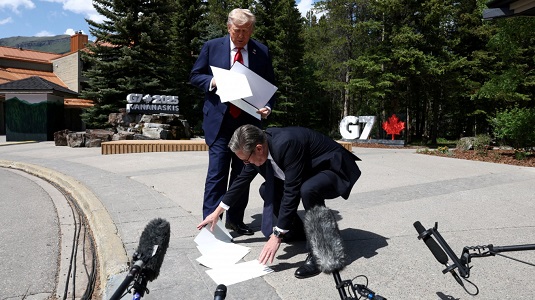
Every time Donald Trump commits an outrage, he causes a comms nightmare for Downing Street. Keir Starmer cannot and will not ever risk publicly criticising the US president, never mind condemn his criminality. But even he's enough of a politician to realise that The Donald is less popular with the British public than he, and so backing Trump openly makes the chance of a polling come back even less likely. As such, Labour finds itself repeatedly in a horrible no-man's land. Starmer not only confirmed that the UK had no part in kidnapping Maduro, but that he hoped" to "have a phone call" with Trump to talk about it. "We need to establish all the facts", he said. Taking this as the cue, the always-annoying Darren Jones toured to TV studios to push the new improbable line. I.e. We care about the "international rules-based order", but it's not a government's job to pronounce on breaches of it. That's what the courts are for. The charges of hypocrisy almost write themselves.

Having lost their chief Trump whisperer to disgrace, nothing can be done to jeopardise cordial relations with the White House. In an uncharacteristic moment of honesty, the Prime Minister spelled it out on Sunday morning. That is the special relationship is maintaining Britain's status as Washington's favourite supplicant. The intelligence apparatus and the military are so thoroughly integrated into US operational command that, to all intents and purposes, the British state does not have sovereignty over deploying its forces. It always has to "inform", or to be accurate, ask the Pentagon for permission before taking action. Funny how the right in this country have never complained about this infringement of our independence.

Sundry liberals got a bit excited early in 2025 after Trump's initial bouts of rudeness. European governments realised that America was an unreliable ally and EU/NATO countries would have to look to themselves to fend off Russian subversion and aggression. This slice of cringe did numbers on social media as there was talk of "going alone" and positioning a nascent European superpower as the real bastion of liberty. But there were practical questions of collective security and these apply to Britain as well. Starmer's trumpeting of increases in military spending is a crowd pleaser to the Stop Russia Now sliver of elite opinion and allows them to believe Britain is heading in the same direction as the rest of Europe, but this is not so. There is nothing in the government's actions or comms to suggest they're looking at even slightly untangling themselves from the US "partnership".

The dominant section of the British ruling class - the commercial and financial capital of the City - is also closely intertwined with its US counterparts, and a plurality have long hitched their interests to the US as the guarantor for open markets around the world. It was therefore no surprise, considering his proximity to these parts of the British establishment, that Nigel Farage said "The American actions in Venezuela overnight are unorthodox and contrary to international law — but if they make China and Russia think twice, it may be a good thing. I hope the Venezuelan people can now turn a new leaf without Maduro." And, as we've seen, where the right goes Labour follows. Supplication and slavishness to the US is embedded in UK bourgeois culture, and that finds an echo in the common sense of "Atlanticism" in the Labour Party. And there are no crimes even the most extreme, reckless, and right wing American president in history can commit that would cause our country to step away from its subordination to Washington

. Image Credit

Sunday, 21 December 2025

Labour's Cost-of-Living Turn

We all like a happy Christmas, but it's unlikely Keir Starmer is in for much festive cheer. Polls are regularly pointing to less than a fifth of the popular vote, his personal ratings have shot out the bottom of Antarctica, and pretenders to the Labour crown are hardly discreet about their aspirations. Ahead of the new year, the Prime Minister, Morgan McSweeney, and others wedded to this disaster have got to be thinking about how to turn this around.

Writing at the end of last week, court chronicler Patrick Maguire had some useful advice to proffer. Labour should do what its right wing normally does, and look Down Under. A victorious election earlier this year, and polling that still puts them ahead of the Coalition is not to be sniffed at. Despite the rude intrusion of expenses scandals, they appear to be doing something right. Maguire reports that Bridget Phillipson has spent some time with the Labor Party, and she was impressed. Their secret? Bear down on the cost of living. Her behind-the-scenes advocacy for lifting the child benefit cap, and advocacy of cash transfers for parents instead of funded child care places are what she's brought to the table. And there's more!

We learn that the cost of living will be the focus of Starmer's big January speech, and the emphasis will be on what Labour has done to put pounds in people's pockets. Which, to be accurate, is what last month's budget is forecast to do. There will be more forthright language as well - Wes Streeting's "frustrations" with wonk-speak have been heard, it appears.

Could this herald a new spring for Labour? There are two problems. The first is that the party are skirting around the problem. Another big boost to the minimum wage and lifting the cap are welcome, and last week's interest rate cut also provides some relief to mortgage holders. But on price rises themselves, wages are still catching up with 2022's inflation spike. The increase in the median wage reported in April did outpace inflation, but for many people the ticking upwards of the food shop, rents, domestic energy bills, and insurance premiums makes it feel that the cost of living is too high. If Labour want to be seen as serious on this issue, they need to get more populist in their rhetoric and table legislation targetting profiteering and landlords. Measures I am sure they will never introduce.

The second is more explicitly political. The government completely lacks credibility. If the cost of living was prioritised at the beginning of Starmer's premiership, Labour would now be in a much better position. Instead we got a penny pinching move against pensioners' winter fuel payments and ministers demonstrated they could be just as entitled - and as sleazy - as the Tories by glutinously grubbing in the freebie trough. It's been downhill ever seen, except they've brought forward more policies and initiatives that have dispersed their support further. Are people in general going to start listening as government talking heads complain about the cost of living, while trumpeting their tinkering around the edges? Will the progressive support base Labour has ceded to the Greens and the Liberal Democrats get won back when other parts of the government are briefing against equalising the minimum wage, and Labour Together want to undo the thrice watered down workers' rights package?

Unfortunately, the May-time massacre in local government is nailed on, and most have already made their mind up about Starmer. But still, his replacement - provided they break with the backsliders on the right - would inherit a set of positions that might cause punters to reassess. A fresh face fronting a recognisably Labourish set of priorities could work. The Prime Minister though, this is all a bit too late for him.

Image Credit

Wednesday, 26 November 2025

Postponing the End

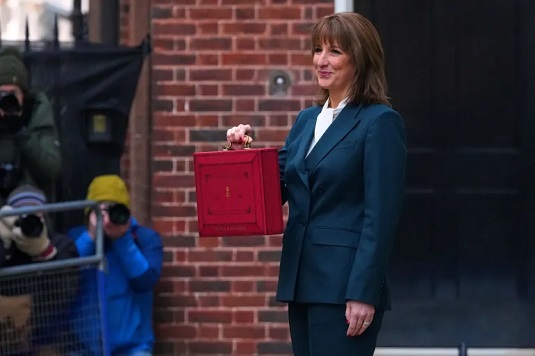
After a bad time of it, what with rumours of plots and a seemingly rudderless approach to state finances, bar the preservation of the wealthy, by this government's standards the budget Rachel Reeves delivered on Wednesday was a good one. Obviously not for those of us who want to see huge inroads made into wealth, or the crisis in underfunded public services and state institutions addressed with the seriousness their decrepit conditions warrant. But a good budget for warding off a leadership challenge. A mix of mild but welcome social democratic measures, above all the well-received abolition of the two-child benefit cap, helps ensure that Reeves and Keir Starmer can have a relaxing Christmas knowing their Waterloo has definitively been postponed until after next May's local elections.

As for the rest of the budget, I'm content to let Owen Jones and James Meadway do the heavy lifting on what the rest of it means.


Image Credit

Monday, 24 November 2025

The Joy of Wealth Taxes

With the budget set to land on Wednesday, there's been a wealth of speculation and, of course, several leaks. Tax has frequently come up in discussion, thanks to Rachel Reeves herself holding an early morning press announcement suggesting she might break manifesto promises. Something Labour could have pulled off, had the government not spent the last 18 months pouring political capital down the drain of stupid and obviously counter-productive policies. Yet debate in more polite circles than this disreputable corner of the internet have focused on taxing wealth, seeing as Zack Polanski and the surging Greens have made headway - and put on polling numbers - partly thanks to pushing this point.

There has been some pushback from centrist sensiblism. Duncan Robinson, writing as Bagehot in the regular Economist column attacks wealth tax populism as a measure that won't raise a great deal, and certainly not as much as Polanski supposes. It peddles the myth that the refurbishment of public services can't be managed without taking more tax off most people. As such, this is irresponsible politics. If this was put to the test, the measure would fall short and state revenues would have to be found from elsewhere. This is a recipe for political damage and disillusionment if the Greens or the left or whoever tries flying in the face of fiscal realities. That, and it would scare the wealthy off. In short, Polanski is promising "a world of common good without sacrifice; a vision of socialism without society."

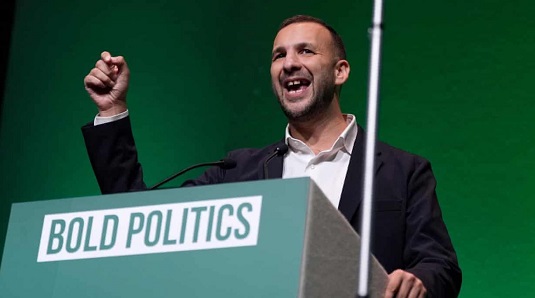
Two points are worth mulling over here. Polanski and the Greens are absolutely correct to push for a wealth tax. It's a demand designed to shift the political direction of travel away from the right, both in terms of the oligarchical economics the main parties embrace and the racist gutter politics of immigration and asylum. That the political establishment, from the mainstream to the far right have united against wealth taxes is a sign that the Greens have hit a common sensitive spot.

The second point is on what taxes are for. The Economist, as the bourgeois house magazine, deals in common sense. Their common sense. The state's finances are like a household budget, and taxes go into its "current account" - the consolidated fund, which is held by the Bank of England. Like any normal account, its income and outgoings have to be managed and it's not great if the latter exceeds the former. Hence the need for more tax revenues if we want to fund more things. Leaving aside well-worn critiques of this, such as the state being able to borrow from itself, having the power to structure its own debt, and how public spending can boost the tax take through multiplier effects, there are other ways of looking at tax. Chris Dillow, for example, makes the case of using tax to reallocate labour to priority areas. Another way of looking at it, the socialist way, understands that tax isn't about balancing the books. It's a tool for remaking society.

In addition to tax measures that disproportionately hit the wealthy as helpfully outlined by Prem Sikka, if anything Polanski's wealth tax does not go far enough. Steeply progressive income tax, graded rates of employers' National Insurance Contributions based on staff levels and turnover, taxes on dividends, City capital flows, levies on rental income, punitive multiple property ownership taxes, measures aimed at high end luxury consumption, action against offshore wealth repositories under British jurisdiction, and so on. This would be accompanied by tax incentives to encourage cooperatisation, democratise workplaces, the meeting of certain social, civic, and environmental objectives, etc. The concerns of such a tax programme is not primarily about raising money, but lashing capital in chains, abolishing the super rich, removing power from the unaccountably wealthy, and making inroads into the private ownership of the means of life. Obviously, such an approach to tax can't stand up on its own. It needs a mass movement behind it, concerted activity with others across the globe, and a political understanding that they would meet fierce elite resistance - and a programme to defeat it.

In other words, tax needs to be recognised as a weapon. The establishment knows it can be used against them, just as they've used it against us. And for that reason, the left, regardless of its party colours, should keep pushing for wealth taxes.

Image Credit

Tuesday, 4 November 2025

Preserving the Wealthy

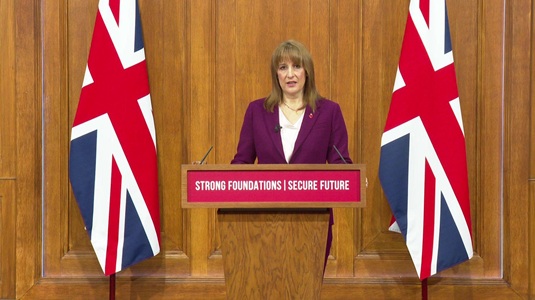
I doubt Rachel Reeves wanted to lecture the country on the state of the public finances over their cornflakes, so what she had to say must have been important. Right? Her curious little speech on Tuesday morning, flanked by sharply folded Union Jacks in the Downing Street media room, basically said tax rises are coming - without explicitly saying tax rises were coming. Her warning was coded under layers of "years of failure", "difficult circumstances", and "poor productivity". This matters because one of the promises Labour made in its otherwise throwaway manifesto was no taxes on "working people". A promise made, a promise about to be broken.

Contrary to what politicians think, most of the British are electorate are not mugs. They are also quite capable of listening to justifications for unpopular or painful policies, and accepting them if they believe there is no alternative and they trust the government of the day. So limbering up to break tax promises wouldn't automatically put a black mark against the Labour's name, provided most people thought they were doing an okay and competent job. Unfortunately for this government, this is far from where the public are.

On the mess Labour inherited, most people would agree the Tories made a hash of things. In the abstract some would even accept the "tough choices" Labour promised to get matters fixed, albeit that pledge had less to do with getting the economy chugging and was more about managing political expectations. What the public weren't and aren't prepared to accept were self-evidently cruel, stupid, and counter-productive decisions. For instance, in her Tuesday morning address Reeves rightly attacked the Tories for their austerity programme, which led to crumbling public services and sucking demand out of the economy. Yet isn't the latter what she did with her Winter Fuel nonsense, and what would have happened with her plans, now largely abandoned, to hammer disabled people? Labour's stubbornly catastrophic polling shows that, as far as the electorate are concerned, they have traded away their right to look serious, and no amount of grown up cosplay and wittering about fiscal rules will change their mind. Their minds look made up, and Labour inhabits the same political place of pain John Major did after Black Wednesday, Gordon Brown after the election-that-never-was, Boris Johnson during Partygate and Pinchergate, and Liz Truss following ... Liz Truss. That is until the party retires its leadership. Then it might claw its way back to prominence.

The other problem is that, just like the Tories that came before them, Labour is seemingly determined to make "working people" pay for the country's difficulties. Leaving aside the fiscal rules, even if state finances resembled household finances, there was no hint whatsoever that Reeves was preparing to make further inroads into wealth. Be it propertied, sitting idly offshore, zipping through the City's speculative circuits, or materialising as dividends or rents. She might want to raise tax receipts to "modernise" the state, but at base what her speech previewed was a scheme for preserving the exact same class relations that exercised Nigel Farage's foray into economics.

Image Credit

Monday, 3 November 2025

Nigel Farage's Tory Economics

That Nigel Farage, he's proven himself a dab hand at politics. Having replaced the Conservatives as the main party of the right, at least in the opinion polls, he said he was coming for Labour. And a number's been done on them too. Their figures are the worst ever while Keir Starmer's personal ratings sit somewhere between Liz Truss's and Vladimir Putin's. Even more unbelievably, it's only recently that the very clever politics brains the Prime Minister employs have come to the conclusion that challenging Farage's politics might be a good idea. Having spent the last few years caving to his framing. The result? Farage riding high on a bubble of popular support. Sure, Reform are stealing a march on the politics of anti-immigration and race, but can they convince as many people that they - the party that successfully defended the sovereignty of sterling - care about the pounds in their pockets?

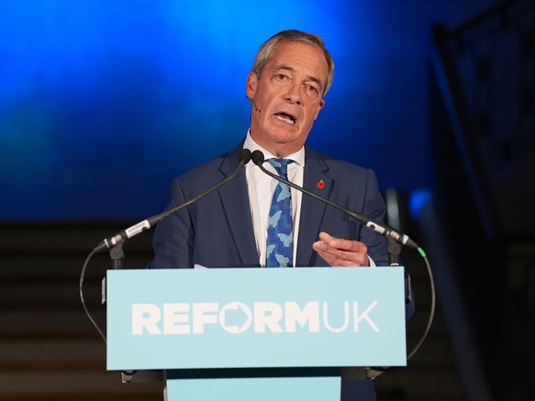
It's telling, but not surprising that the champion of Brexit chose the City as the venue for his big economics speech. The symbolism will not be lost on the oligarchs who are now assessing Farage's suitability as the political custodian of their interests. And it's these people, not the downtrodden little men that comprise his usual audience, he wanted to address. The most eye-catching item in his list of promises was not the rowing back of the ridiculous tax cuts promised previously ("they were only ever aspirations"), but his desire to put the screws on young people. "The minimum wage is too high", and poor businesses are suffering. Cutting it would boost aspiration. Either that, or employers' National Insurance Contributions should be cut by lifting the cap at which they should be paid. It's a good job Reform's imaginary army of enthusiastic young people are imaginary, otherwise they would be in the process of evaporating.

Farage said he would abolish George Osborne's - and now Labour's child benefit cap. But only for British nationals, and only if both parents were working. In other words, those most in need would lose out. He also wouldn't be drawn on whether to keep the triple lock on pensions, which usually indicates that yes, they are thinking of tinkering with it in some way. A reminder that the state pension here is still weaker than it is in Ireland, Germany, France, Denmark, etc despite the upratings the lock has delivered these last 15 years. While we're on pensions, having consumed many a Telegraph editorial, Farage thinks he can clamp down on spending by attacking the "gold plated" schemes public sector workers apparently enjoy. Also, disabilities are "over-diagnosed", so more penny pinching and cruelty is being plotted against the most vulnerable people in our communities.

Gruel for the little people. But treats for the rich. The pledge to reverse Labour's land tax on the rural rich made the cut, as did a promise to abolish inheritance tax on family-owned businesses. He argued that Britain operates a punitive tax regime that drives successful people abroad. Out of the ether, he pulled the example of £100k/year "young professionals" leaving these shores. He knew none of his adoring stenographers would ask him how those fleeing abroad would take those jobs with them. There were the ritual assaults on net zero, and he took aim at diversity and inclusion policies. Recalling his time as a metals trader during the 1980s, he said no one cared about race, religion, or gender on the famously diverse commodities floor. There were, after all, blond white men, bald white men, dark haired white men.

What is striking about his speech is the dropping of anything approaching the populism, however you define it. Farage has made a solemn vow that regardless of the rhetoric and the chaos, he has no plans whatsoever to reshape Britain's political economy. Which isn't a surprise, seeing as his party are as much affected by the crisis in mainstream politics as the rest. What he presented is pure and simple Tory economics, a programme openly dedicated not to driving GDP growth, increasing employment, and doing the things responsible helmsmen of British capitalism are supposed to do. This is the economics of strengthening class relations by throwing more people off social security and onto the job market without support, while driving down the wages and conditions of young people who subsist on the minimum wage. It's not difficult to work out who benefits from this. The political of Farage's economy also owes more to the miserly managerialism of Rishi Sunak than the bombast of fellow "populist" Boris Johnson. As per the last Tory government, Farage is promising a smaller state not to meet his ideological peccadilloes but to try and manage the politics. People demand less if the state is underfunded, run down, and barely works. For all intents and purposes, Farage has stolen the Conservatives' prospectus. Reform is set on becoming a Tory home from home.

At the same time, this leaves Farage vulnerable. We've seen in recent weeks that overt racism can damage Reform. Most of the public aren't on board with his anti-Net Zero drivel, and Farage's murky finances and penchant for Russian talking points are hanging round his neck like a 300lb albatross. This City speech is also a political liability, as he unambiguously paints which side he is on. And it's not the one most of his support think it is. Pathetically, both Labour and the Tories have attacked his plans as "unworkable" and spun a weave of boring, technocratic reasons why they won't work. But Farage has made himself uncharacteristically vulnerable by painting a target on his rather large weak spot. He's conceded populist ground where, should they choose, the Greens, the left, and the labour movement can have him.

Image Credit

Monday, 6 October 2025

The Unreality of Tory Economics

How was your lunch time? I spent mine catching snippets of Mel Stride's speech at Tory conference. He's the shadow chancellor in case you've stopped listening/watching the doings of the Conservative Party. But I couldn't resist. Some people collect stamps. Others tour the country visiting every Wetherspoon's on the map. Me? Seeing if there's any sign the Tories have become conscious of their worst ever crisis and if they've cobbled together a ladder that can get them out of their hole. If Stride's address is anything to go by, my advice to the Tories would be to start furnishing said pit. They are going to be there for a long time.

If Kemi Badenoch is supposed to be doing the showy stuff, then Stride is the unglamorous details man. Suspend your disbelief and buy in to the science fictional conceit that the Tories can win an election. Their next government would make £47bn worth of cuts. £23bn would come from cutting sickness-related social security support. Stride has decided that people with mental health conditions like depression, ADHD, and anxiety merit deserve no support at all. Presumably, work is the silver bullet that would vanquish these illnesses. Our old friend civil service cuts are back for another tour of duty, sacking 132,000 people and returning the state bureaucracy to the size it was in 2016. You know, when it was so stretched it famously did less planning for Brexit than the Japanese government. This represents an "evolution" of Badenoch's deep thoughts, who last year was merely interested in more efficient admin. This would yield £8bn in "savings", with the rest coming from reducing overseas aid further, tying benefit eligibility to citizenship, cutting environmental commitments, and scrapping hotel accommodation for refugees.

And this hodgepodge pays for what carrots? The reversal of Rachel Reeves's increase in employers' National Insurance contributions is front and centre. Allied to this is a promise to scrap business rates up to a limit of £110k/year for retail, hospitality, and leisure. Taken together I'm sure small independent traders would welcome this so don't be surprised if Labour half-inches some of this, especially nearer to the next general election. And what about young people? The Tories have spent years scratching their heads and wondering how to attract layers of younger people to whom they are repulsive. And their answer is ... a £5,000 cash hand out. This would be a tax rebate for new workers in their first job. What would have been NI payments can be cashed in after five years and spent as they see fit. Don't ask what this could mean for state pension eligibility later on.

At the end of his speech, Stride got a bit overexcited, castigating the doom-mongering of the other parties and claiming the mantle of hope for the Tories. Which was as audacious as it was a waste of time, seeing as no one was watching. While Badenoch and co. have gone off the war on woke deep end, the shadow chancellor has stayed firmly on the ground of traditional Tory economics. A little something here for small business, an eye-catching bribe for a wider constituency - in this case, young people. And all paid for by robbing the futures of the beneficiaries of this policy, stripping out state capacity, and promising to govern like Rishi Sunak. If you remember him. Unfortunately for the Tories, conservatism here means being out of step with political realities. British capital needs a stronger, more reliable state that can do things. And despite the best efforts of Labour to dampen expectations, this is what its diminishing support and expanding former voters want to see. As does the bulk of Reform's support when the racist circus orchestrated by ringmaster Farage isn't at the forefront of their minds. The Conservatives are nowhere near where the punters are.

You could make the case that Stride's speech was as much about consolidating the Tory base as whatever rubbish Badenoch has stored away for her main conference address. But all the same, while the Tories are party to the racist and anti-democratic consensus uniting Labour and Reform on immigration and "social conservatism", they are outsiders on the economic questions of the day. So no, Stride didn't offer any credible salve for his severely wounded party. Compounded by an inability to see how and why the Tories are broken.

Image Credit

Monday, 1 September 2025

How Not to Cover a Reshuffle

The new parliamentary term began today, and Keir Starmer led it off with a small reshuffle. Darren Jones has moved from the Treasury to 'Chief Secretary to the Prime Minister', a new position in charge of "delivery". Baronness Minouchie Shafik, having previously done stints at the IMF and Bank of England is now Starmer's chief economic advisor, and Tim Allan - former Blair lackey and founder of the Blairite comms firm, Portland, is confirmed as the sole head of Downing Street's PR machine. Gone is Liz Lloyd, another Blair era appointee, to make way for Jones. Politically, does it mean anything? Does it signify a fresh start? No. The government remains the same slow motion car crash it was yesterday.

That hasn't stopped some from trying to read significance into these mainly managerial moves. In some of the most tenedentious commentary I've read recently, for the Telegraph associate editor Gordon Rayner declares this was "a power grab" that shows Rachel Reeves is on borrowed time. The evidence? Moving Jones to Number 10 leaves the chancellor "publicly humiliated". Mindful that Prime Ministers who sack their next door neighbours aren't long for this political world, this is apparently an element of a low-key campaign to make her life impossible and force Reeves's resignation after her multiple misfires in office.

This, alas, is an exercise in right wing wishful thinking. A point underlined by the additional comment provided by John Redwood. For one, if the framing was true there would be "insiders" touting anonymous briefings. Maybe Rayner's contact list has a dearth of Labour numbers, so he couldn't find anyone to give him the inside track. But nowhere else is running the line that this is a constructive dismissal effort. Not even the gossip mongers at Guido, who prefer to dwell on how Jones's appointment takes some responsibilities off Pat McFadden. If displeasure underpins the reshuffle, one could make a more plausible case for it being at the expense of his brief, not Reeves's.

Since Reeves's appointment, there is some truth to the notion that she has blindsided Starmer, particularly with last summer's debacle over winter fuel payments. One might suggest Starmer had no choice but to stick by his chancellor so early in the new government, but her initiative was consistent with the Labour right's approach to social security. And it proved to be the jumping off points for further attacks, most of which have been blunted or abandoned. These cannot be layed solely at Reeves's door. The Prime Minister nodded every one on, and his unelected henchmen were greenlit to do their worst "persuading" opposition-minded MPs to back the line.

There is no truth in the view that Starmer and Reeves are in tension, let alone at splitting point. He has accepted her outlook, conditioned as it is by the Treasury/Bank of England/City nexus as the commonsense view on matters economic - reinforced by Shafik's appointment. This reshuffle is business-as-usual and more of the same. And Rayner's Telegraph piece? A case study of forcing the facts to fit a baseless conclusion. Which just about sums up the entirety of right wing politics in the moment of Conservatism's collapse.

Saturday, 26 April 2025

Data as Bourgeois Morality

Data pervades everything. For those of us whose employment does not produce data, our consumption does as phones, computers, televisions, and our purchases capture our activity and feeds that into vast datasets. Here, the ghosts of our agency are carved up into distributed fragments, which are utilised by the business models of the platforms to sell advertising, and shape our attention through algorithmic selection of content that will catch our further attention.

But for those who work with data broadly - not just the digitised kind - it is embedded in the job description. Data is a system of concretised ethics enforced by the employment relation, in the first instance, and horizons of credibility, of social conventions based on the the affirmation and demonstration of evidence. As I am an academic, the concern for data determines the character of the presentation of research, the marketing and student experience efforts that cover my programmes, and must be invoked to justify changes to course content and assessment, the launch of new degrees, and the business case for taking on new staff. This is the lot of other education workers, particularly teachers with the vast trail of paperwork cataloguing their practice as educators, and also civil servants, mid-level managers across the public and private sectors, buyers in retail - every job that requires making decisions about the delivery of a service or the provision of a product.

And it directly governs. Since the emergence of modern wage labour in the English countryside, targets have been one tool among many used by employers to individuate and atomise workforces to enable their management. Today, when immaterial labour predominates and is simultaneously being attacked and deskilled, targets as a method have proliferated into a matrix of performance indicators for managing post-industrial labour. The worker, from the lowest paid to the relatively affluent are subjected (and subjectivated) by streams of algorithms and targets that measure aptitudes, define productivity, and determine the character of one's tasks. They shove (rather than nudge) labour along prescriptive circuits. The data points workers are judged by are often conjoined with those outside of their control - such as market conditions - and they are held to account against them.

Data as employed in capitalist societies is not just a practice/technology for managing workers, it has the characteristics of a moral code. Of, more precisely, a bourgeois morality. Like religion, the moralities of law and order, and the explicit statements of bootstraps neoliberalism, their subjects are the objects of exploitation. Bourgeois morality marks the bourgeoisie's innumerable, multitudinous others, and works to govern them. They themselves are, by and large, left unmarked. The neutral term. The starting point. That natural way of the world. Therefore, moralities spiritual and secular do not apply to them. The same is true of data.

How many CEOs "abbreviate" the evidence-based decision-making they enforce on their employees? How many politicians are impervious to the data-heavy briefings handed them by civil servants when they push particular policies? The further up the hierarchy one travels, the employment of data becomes more episodic, and its status as a tool of governance becomes all the clearer. These exalted levels operate with different sets of priorities: not what data tells them about what decisions would bring the greatest benefit to the greatest number, nor even in the narrower terms of using data to prioritise economic growth. No, data plays second fiddle to the politics of class maintenance. The successful exercise and preservation of class privilege and class power requires flexibility and opportunist nous. The realpolitik of our rulers depends on instinct and the feels in the first place, and the enforcement of decisions that reiterate their power-over. In these mundane circumstances of capitalism's everyday, data that shows they're wrong is simply noise.

Image Credit

Sunday, 6 April 2025

Hard Talk from the Soft Left

In February, Anneliese Dodds jacked in her international development brief following Keir Starmer's decision to raid overseas aid for weapons. It was significant in that Dodds's resignation represented the first overt rebellion by a soft left figure against the government's direction of travel. Therefore, when she spoke in the Commons on Thursday in criticism of the leadership's strategy Dodds wasn't just speaking for herself - she was giving voice to the rumblings of disquiet across the parliamentary party.

Being the soft left, and therefore the most loyal of oppositions, Dodds pointedly eschews finger pointing and goes for a very politic, almost Delphic critique. Mirroring her resignation statement, she said the world is "in flux" and government lacks "muscle memory". Hold on, I'm stopping this right here with a necessary digression. No "muscle memory"? Starmer wasn't in government until this year but, like the rest of us, he lived through Covid and the unprecedented interventions that crisis forced on the Tories. Indeed, he had a ringside seat and headed up an obsequious, spine-bending "opposition" to Boris Johnson's disastrous management. Before that, Starmer navigated the rough seas of Brexit to his political profit, came through Labour's internal wars against Jeremy Corbyn unscathed, and prior to entering the Commons led the Crown Prosecution Service through a period of Tory-imposed resource rationing. Readers here are unlikely to endorse how Starmer approached these challenges, but it's simply untrue to say he lacks experience dealing with "unprecedented crisis". Rather, it's been the default context since Starmer's career catapulted him into the upper echelons. If Starmer is carrying on with a business-as-usual mindset, it's not that he's an untested naif - he's choosing to. But as the soft left's role is to prick the conscience of the right rather than offer a distinct alternative, it's too much to expect Dodds to pick him up on that.

Dodds then raised her concerns about democratic backsliding and how liberal norms are being eroded, unwilling - of course - to acknowledge how these have been wrecked in the Labour Party which, after all, is as much part of our constitutional set up as acts of parliament and the House of Lords. This was why, for Dodds, we need to buddy up with other liberal democracies with UK-EU defence partnerships. But perhaps the most pointed of criticisms, which will undoubtedly be taken as a slight by Rachel Reeves despite the sugar-coated delivery, was the need to dump the "shibboleths". These are the "fiscal rules" and taxation, because "the very best-off have seen so little impact on their well-being from economic headwinds." Ouch.

From the point of view of mainstream politics, Dodds is right on the politics and the economics. To get around the costs of Donald Trump, the UK needs to turbocharge its domestic market. Reeves might not have any ideas of her own, but she did partially recognise this in her January infrastructure announcement. The problem is that stimulus policies are half-cocked if government is also sucking demand out of the economy, which it is with disability cuts and the increase on employers' National Insurance contributions. Our model for Dodds should be Germany and the huge spending splurge it announced to turn around its chugging economy. Seems quite sensible.

And ... it appears Starmer himself might be coming round to this view. Writing in the Sunday Telegraph, his paper of choice for strategic announcements, he talks about the trading relationship with the United States and the possibility of a trade deal, and says "We stand ready to use industrial policy to help shelter British business from the storm. Some people may feel uncomfortable about this – the idea the state should intervene directly to shape the market has often been derided. But we simply cannot cling on to old sentiments when the world is turning this fast." People can read into that what they like, and Labour supporters hungry for the thinnest of gruels undoubtedly will. He adds "...these new times demand a new mentality. We have gone further and faster on national security, now we must do the same on economic security through strengthened alliances and reducing barriers to trade." A new speech on the British economy has been slotted into the grid, bringing forward a raft of announcements scheduled for the summer.

A vindication of Dodds and the soft left? More a case of fortuitous timing and the soft left being more in tune with economic realities, but whatever comes out is not going to be straightforward. "Protections" in Starmer's iteration of Labourism have to walk the tightrope of delivering the goods without empowering the workers and frightening capital-at-large. Whatever agenda comes means that the left have also got to adapt its politics to match - otherwise, why bother listening to us?

Thursday, 3 April 2025

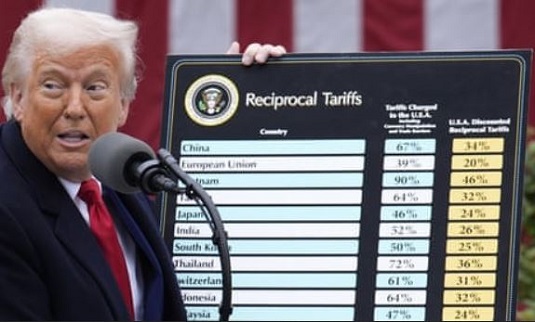
The Class Politics of Trump's Tariffs

Wednesday's announcement of tariffs by Donald Trump was styled by the President as "liberation day". A set of measures that, if the markets are anything to go by, liberated trillions of dollars of value from the largest and most important US companies. As measures go, tariffs - like everything else the Trump presidency has done - can only compound his country's relative decline by encouraging trading flows that eschew the United States for more reliable and stable markets. Like those offered by the European Union and China, for instance. These tariffs constitute the most extraordinary act of self-harm. This is pound-for-pound worse than what Brexit was for the UK, and could be as disruptive to the American domestic economy as the traumas East European states went through following the collapse of Comecon and the restoration of capitalism. Why set out on a course that can only impoverish the country? What is Trump trying to achieve?

Two very quick points looking at this from the perspective of bourgeois interests.

The first is the Liz Truss argument. I.e. What Trump has done is to short the market. The announcement leads to market turmoil and devaluation, and down in the dip the most short-termist sections of finance and commercial capital hoover up cheap assets which they can sell when stocks inevitably recover. Which depends on Trump rowing back on some tariffs, which seems likely given his erratic behaviour. Would some sections of capital be happy to see US capital as a whole take a hit for their profits? Absolutely. We saw some of their British counterparts do this two-and-a-half years ago during Truss's brief stint in Downing Street, so why not again? There are sections of American capital who are totally on board with libertarianism as a strategy for class politics. I.e. Blow up anything that amounts to a social or legal obligation on capital accumulation, even if it's against the interests of capital-in-general. Giving credence to this reading is the "idiotic" way the tariffs have been calculated, and to whom they've been applied - including uninhabited rocks in the middle of the ocean. The slap dash approach indicates a desire in engineering an outcome, not a serious policy orientation.

But supposing it is a turn away from global trade, what does the US stand to gain? It's worth remembering that capital is not unified, and there are competing perspectives within it regarding assumptions about the ways of the world, what policies are appropriate to it, and what strategies are best for advancing the interests of sections of business, and/or capital as a whole. For instance, Trump's slimy relationship to Vladimir Putin is entirely rational viewed in the context of this framework. I would suggest the tariffs are bound up with securing the oligarchical interest on the home front. While trade unionism is hardly in rude health across the sea, the street rebellions around Black Lives Matter and Palestinian Solidarity are read by hyper-class conscious oligarchs as trouble at t'mill; that something is shifting. The proxy for this is the elite's war on woke. They (rightly) discern that the take up of diversity and inclusion policies by big capital is a form of appeasement, of capital responding to the expectations and aspirations of labour rather than laying down the law. After all, how awful it is for business owners that workers resent their aptitudes and identities being used against them. It is a far sighted recognition that the becomings of immaterial labour presents a long-term threat to the stability of class relations. The development of so-called AI is one technique whose application is to head this off, but equally the reconstruction of the federal state as a decrepit do-nothing institution with no purpose beyond enforcing the power of the executive branch can also serve as capital's reply to this existential challenge, albeit one that is crude in its methods and brutal in its outcomes. Trump's new isolationism is a disengagement from US responsibilities and dependencies and is explicitly asserted in sovereigntist terms - Make America Great Again. But what the real consequence will be is not the much-promised economic renaissance, but the reconsolidation of the bourgeois power some class fractions feel is slipping away.

Saturday, 15 March 2025

Labour's Enthusiasm for Artificial Intelligence

30,000 jobs are set to disappear with the closure of NHS England and its merging with the Department of Health and Social Care. Echoing the Tories, tens of thousands of civil service jobs are on the chopping block. And this planned massacre of livelihoods were presided over by a grinning Keir Starmer and Wes Streeting and presented to the media as unalloyed goods. This is set to cut down on duplication and save lots of money (£45bn, apparently). But something else is also on the cards: the replacement of jobs by Artificial Intelligence. In his enthusiasm at the prospects of jobless service provision, Starmer gushed that "No person’s time should be spent on a task where digital or AI can do it better, quicker and to the same high quality and standard."

This is the umpteenth speech in which the Labour leadership have espoused their enthusiasm for AI. For Starmer and his project of authoritarian modernisation, the technocratic attractions are obvious. A state that is neither bigger or smaller but works better is enticing, particularly when previous attempts at digitisation have been hit by delays and costly failures. Those long in the tooth will recall efforts at harmonising the NHS's IT systems, and the huge problems rolling out Universal Credit encountered. But the prize is the speeding up of the state's mundane activities, like answering HMRC inquiries and sorting out driving licences quickly. AI is part of Starmerism's answer to the crisis of government legitimacy. If the bureaucracy can be automated and the discharge of its functions be made as rapid as placing and receiving an Amazon order, belief in the efficacy of government and, possibly, the standing of politics could improve - to Labour's benefit. If only people could forget about winter fuel cuts.

Those are the good reasons. What are the real reasons? The PCS response argues that new innovations should be introduced and embedded in cooperation with staff and be used to enhance working conditions and job security. A position likely to have gone in one ear and out the other. This is because AI's promise speaks to the dominant pole of (right wing) Labourism: its relation to "working people" not as working people, but something far more passive and politically innocuous: as consumers. The ultimate aim is impeccably Blairite: the depoliticisation of politics, and the reduction of choice between the parties that offer the best value, best quality services. This alignment with Labourist assumptions is more a coincidence of congruence. As ever, it comes down to interests.

On plenty of occasions, Starmer has staked out his intention to transform the UK into an AI superpower. This does involve infrastructure like building the first reservoir for 30 years, which handily is earmarked for land not far from the planned expansion of data centres in Cambridgeshire. But more importantly, he's leveraging the state as the anchor customer for AI services and innovation. There is nothing particularly innovative about this. In the Blair years outsourcing, Public-Private Partnerships, PFIs, etc. were used to provide guaranteed markets for everything from cleaning companies to construction firms. The aspiration was to tie the interests of those firms to the largesse of New Labour ministers, thereby expanding the party's base among capital's exalted circles. When the crash came and Gordon Brown's government became a busted flush, they were happy to carry on accepting these sorts of contracts while transferring their allegiance to the incoming Conservatives - who continued with the same practice. Streeting's love-ins with far right tech oligarch Peter Thiel, the enthusiasm for using AI in patient-facing interactions, and the endless promises of using the private sector to "help" with the NHS are part of the same piece. This is the mood music designed to entice Silicon Valley and giving them a stake in the British state, while generating a home grown ecology of expertise around innovation and application. Something that could have the happy by-product down the line of sheltering the UK from Trump's tariffs, and making Labour - on paper, the political antipode to their brand of freakish authoritarianism - their preferred political partner this side of the Atlantic.

Everyone wins, right? No. Supposing AI can fulfill the grandiose claims made for it, the British state is being used as a test bed for, to borrow a recent phrase, feeding jobs into the wood chipper. The purpose of generative AI is not to make things more efficient, but to deskill and digitise as many of the properties of immaterial labour that are feasible. I.e. The social competencies that capital accumulation increasingly depends on can, after a fashion, now be separated from workers and therefore tip the balance of forces further away from labour. To all intents and purposes, as per previous waves of automation what the government are promoting is a power grab at capital's behest. If these schemes are successful, the next targets are millions of jobs across private industry for the benefit of shareholders. And Labour ministers who fancy themselves as future consultants on implementing AI "solutions" in large organisations when they're done with politics. Just like the Thatcher years, Britain could pioneer a new class settlement. And just like the 1980s, unless the left and the labour movement gets its act together it will be our class who loses.

Image Credit

Thursday, 13 February 2025

Rachel Reeves and Dishonesty

The Chancellor might have delivered a budget that won wide support among the wealthy and, crucially, has done nothing to upset the class settlement bequeathed Labour. But you can't please all of the people-who-matter all of the time, and the knives are out for Rachel Reeves. Not so much in her own party, but a section of the media would like her scalp. And today, it's the BBC's turn to have a pop.

In November, Guido ran several stories picked up by the media about how Reeves had "massaged" her CV prior to entering the Commons. The right had fun exposing her claim that she worked as an economist for HBOS as bogus and delighted in reporting that Reeves was actually a manager of a retail banking complaints team. Thursday's BBC report looks into her career further, finding that Reeves also exaggerated the amount of time she worked at the Bank of England. Having previously said on several occasions that she'd worked there for a decade or the "best part of a decade", her BoE period was actually five-and-a-half years. Shorter than the six Reeves had put on her LinkedIn profile. Potentially more serious are allegations that while at HBOS she and her colleagues were accused of fiddling expenses by signing off on each other's claims. This was no idle tittle-tattle - it resulted in an investigation in which dozens of pages of evidence was submitted. This was, apparently, to "fund a lifestyle". The submission was compelling enough for the Internal Audit department to conclude there was enough evidence of "wrongdoing" and was referred to the next stage of the process. But there the investigation stalled and Reeves was not interviewed, which was at odds with procedure. Reeves left afterwards but there's no evidence this was because of the allegations. Indeed, the BBC report indicates she was not aware that a suspicious eye had been cast in her direction, and far from leaving under a cloud HBOS allowed her use of a company car for a further six months beyond the end of her contract. Also, in the interests of accuracy, it does appear that spending the bank's money on gifts for subordinates and superiors was part of the works culture. Her infractions were not that she'd done wrong per se, but that the cash was splashed a little too readily.

Considering Covid procurement and how Boris Johnson normalised institutional corruption during his tenure, Reeves palming a few gifts here and there before she was an MP is the smallest of beers. But that isn't to say this doesn't matter, because with the Chancellor it fits a pattern of behaviour. She's lied about her career, lied about political opponents, and has lied about her latest book - which is full of other people's work. Her political approach to matters economic is an exercise in deceit, and her elevation to Number 11 is off the back of the most dishonest Labour leader since ... forever. Reeves, Keir Starmer, and the rest of the lying bunch are well suited to one another. And will undoubtedly come undone together too.

Let's not kid ourselves that those having a pop at Reeves are motivated by ethics in political life. It's interesting that the BBC decided to publish their expose on the day the revised growth figures for the last quarter were published. News that was expected to be bad but were, in fact, just about positive. An attempted hit job you might say. But why when Starmer and friends have done everything to bend over backwards for capital? It's still worth noting that while most of the British ruling class are on board the Starmerist project, such as it is, there are those who are not - a nexus of the disgruntled rich that parasite off labour intensive, landed and financialised interests. For this hyper class conscious section of British capital, whose views are usually amplified by the right wing press, Reeves has committed the deadly sin of taxing unearned income. Closing inheritance loop holes and increasing employers' NI contributions have shattered the taboo of looking in this direction for revenue raisers. And conceding improvements to workers' rights, as watered down these commitments have become, opens the door to a slight tilt against capital's collective class interests. For them, at a minimum Labour need curbing to ensure they don't go any further down this road. What they perceive today as a slightly edging out of their interests is extrapolated forward to further grabs at the expense of their wealth and class power. If preventing this means destabilising a fundamentally weak government by blowing up low level misdemeanours into full on felonies, this is among the least of what they'll do.

Image Credit

Wednesday, 29 January 2025

Living Her Best Life

Rachel Reeves hasn't had a good time lately. From the left, she's been (correctly) pilloried for putting the screws on pensioners. The right are upset about her increases to employers' National Insurance contributions, and were making hay when gilt yields reached danger levels ... before they receded again. But the economic growth figures are anaemic and unemployment is moving in the wrong direction, so while she was never in any danger (she and Keir Starmer stand and fall together, at the moment), Reeves needed to turn the page. Which is where her big speech on economic growth came in.

On Wednesday Reeves made an avalanche of infrastructure announcements. Heathrow's long-awaited third runway, the Oxford/Cambridge silicon corridor, the redevelopment of Old Trafford, reservoirs, airports, train lines, houses, new towns, a tunnel!. There were changes to planning rules that are meant to speed things up, which include "investment zones" that bypass some regulations (as per the Tory freeport idea, which has been retained by Labour and is now as much their idea), yes as the default position for new homes in the vicinity of railway stations, changing pension rules for allowing funds to make productive investments, and a more can-do attitude for infrastructural development outside the South East. Reeves was living the best life of every managerialist politician: the privilege of announcing dozens of megaprojects and basking in the resultant glow.

In all, the speech was a confident performance. On businesses concerned about NICs, Reeves was asked if there was going to be any wriggle room here. She said no, but added her October statement was a once-in-a-generation event. Stability was back in the public finances, and it was there in the economy too. Business can take it as read that, notwithstanding some disaster, they won't be charged for further contributions while she resides in Number 11. It was a theme Kemi Badenoch picked up on in Prime Minister's Questions as well, but going harder on the £5bn "cost" of Labour's employment rights agenda. Reeves and Starmer sang from the same hymn sheet when asked separately about it, but they might have gone further and said this estimated figure doesn't simply disappear from business balance sheets. It's extra confidence and extra money in workers' pockets, which will feed through into growth via their improved spending power.

The combined effect of these projects are bound to put figures on GDP. The IMF's growth forecast, which has uprated the economic outlook for Britain, specifically says this is the case. But there are some issues. Having observed Donald Trump's bravado, there were some Trumpesque flirtations - though Reeves didn't quite say make Britain great again. Government is a knight on a white charger, hacking away and doomer attitudes, nimbyism, and unnecessary regulation that has held the country back for decades. A pseudo-populist construction of a serious party, on behalf of working people, doing battle with an unnamed, sclerotic and complacent elite. But that was not all. Having paid lip service to net zero in the context of the third runway announcement, and new developments at Doncaster and East Midlands airports, she specifically declared bats and newts persona non grata in the new planning regime. So much for Karel ÄŒapek's warning about going to war with the newts. And so, despite saying many times there is no contradiction between the environment and economic growth, Reeves's habit of showing herself up struck yet again.

There is an additional serious problem. On top of this, the government has already set a target of 1.5m new build houses by the end of this parliament. If you tour around Derby, for instance, it's a hive of building activity and a microcosm of what Reeves wants to see. Two housing estates have started, five or six huge blocks of new flats are due over the next few years, more offices and new homes around the railway station, a hotel and leisure complex to replace the derelict Assembly Rooms, and new university buildings due to start on the outskirts of the city centre. Great stuff, you might say. But where are the workers and the engineers going to come from to meet Labour's plans? We know Liz Kendall wants to expel as many people as possible from health and disability-related social security and getting them into work, but they're not going to fill the shortfall in construction. As PBC Today observed last summer, construction workers fell by 14% between 2019 and 2024 and there would need to be an extra 250,000 workers, more or less doubling the workforce, in the next five years to meet the government's ambitions. Training can only make an impact toward the end of the target date, so this means immigration - something Starmer has stupidly caved to the right on and will face some degree of punishment seeing as he's pledged to get the number of new arrivals down. A political problem needlessly of their own making.

Ultimately, as far as British capital is concerned, despite the chuntering over taxes on unearned income the common affairs of the bourgeoisie are happy with what Reeves had to say. The CBI have endorsed it. The big finance houses, foreign investors, and domestic property development are on board. The FT gave it a warm write up. The promise of guaranteed state money and the later productivity boost improved infrastructure is forecast to bring offers a bonanza of profit-making opportunities. Reeves doesn't have to worry about the press whispers about her position. She's safe because she's inviting all and sundry to partake of the public trough, which leaves to the Tories and Reform the most unrepresentative and backward-looking sections of capital. For now.

Image Credit

Saturday, 16 November 2024

Trump's Tory Fifth Column

Already a veritable industry has sprung up advising Keir Starmer how his government might cultivate the second coming of Donald Trump. Should he pivot toward America, get the trade deal signed, and attempt to mitigate the White House's dysfunctions and excesses through the offices of the special relationship? Should the Prime Minister seek instead a closer relationship with the EU, considering the tariffs Trump has vowed to impose on imported goods to tackle inflation helped win him the election. Or should Number 10 try both these things at once, as the Bank's former chief wonk Andy Haldane counsels? Wherever Starmer steers to tread, he has something else to contend with: the yapping of the Tories and the other runts of the right.

Despite suffering their worst result ever, what should have felt like a cataclysm has been received by the Tories as a slap on the wrist by the electorate. They were buoyed up by the fact Labour's popular vote was far from spectacular, and have convinced themselves that to win again they have to turn right and scoop up the support lost to Reform while watching Labour combust in government. The consequences of which will take care of the rest. But one way Labour's immolation might be sped up is by the Tories stirring mischief and trying to cultivate difficulties for Starmer vis a vis the White House.

Not content with destroying Twitter, for some time now Elon Musk has criticised Starmer and Labour. For instance, inside the last month he's said Rachel Reeves's closure of the agricultural land tax loophole is "wrong", and of the investigation into the Telegraph's Allison Pearson over an alleged racist tweet said "This is insane. Make Orwell Fiction Again!!”. Obviously ignorant that the probe is under the direction of social media legislation drafted and implemented by the Tories. Nevertheless, this presents them with an opportunity: lever Trump into opposing UK government policy to undermine its credibility and room for manoeuvre at home and abroad.

An example is the "debate" about the sovereignty of the Chagos Islands. In the summer, the government announced it was formally handing the islands over to Mauritius. The United States would sign a further lease with them on Diego Garcia for its strategically useful air base. In other words, to all intents and purposes nothing changes. The Tories, however, are opposed to the transfer despite negotiating it in the first place. And so, the Telegraph reports, Tory peers are looking at blocking it in the Lords so Trump can come in and veto the decision, thereby thwarting China's schemes for the region - apparently. The real reason is to put Starmer at loggerheads with Trump and force a humiliating climb down that the Tories would politically profit from.

This is how it's going to be for the next four years. For all the froth about "sovereignty" that underpinned the "long-held" and "genuinely felt" principles behind Brexit, and the denunciations of "foreign courts" and the European Convention during the Tory leadership contest, this goes out of the window for the Tories and their cultivation of Trump. Yes it's hypocritical and, in conservatism's own terms, arguably anti-British if not treasonous. But this isn't because of ideology, of a congruence of ideas between the Tories here and the extremism of Trump's Republicans. More important is the perceived commonality of interests.

Trump is set on shredding the federal state for the profit of America's oligarchs, and his appointments - as irrational and as crazy as they appear - reflect this ambition. The sum total of all "small state" politics is the same: run down state capacity in everything but law and order and the military, force people to provide for themselves if they can or somehow survive if they cannot, and the horizon of politics is levelled down. Why demand anything from the state if it simply cannot deliver what meagre social responsibilities it has left? This was Rishi Sunak's project, and is now Trump's. Though this being the USA everything has to be bigger. While Labour with Reeves in Number 11 is never going to nationalise the top 100 monopolies nor, for that matter, break with business-centric politics, for the Tories her taxation of unearned income is a step too far. It's not that the people the Tories represent can't afford it, they fret that any measure, no matter how modest, that touches the core of class relations in British capitalism can only lead to more demands. If capital gains tax is increased now, what's to stop if from going up tomorrow? And having implemented one set of tax rises, what's going to stop Labour from introducing more aimed at property, share income, rentals etc. in the future? That way, they fear, lies a shift in the balance of forces that the Tories have done so much to right after the shocks of Brexit, Corbynism, and Covid.

Let's not over egg the pudding. Most of business are broadly supportive of Starmer's modernisation project. But the rump Tory party, the most conscious, far-sighted, but paranoid section of their class worry that Labour might uncork all manner of genies with political consequences that will echo down the years. That's why this government has to be brought to heel. If that means constantly sucking up to and petitioning Trump and his allies to do Britain down, put pressure on diluting or abandoning the mildest of social democratic policies, and showing up this country's claims to sovereignty as a joke, this is what they will do. The national interest, their national interest demands no less.

Image Credit

Wednesday, 30 October 2024

A Typical Labour Budget

"This is not a budget we want to repeat", said Rachel Reeves of her Autumn statement this Wednesday afternoon, but if past behaviour is any indicator of future behaviour then she'll make similar choices again and again and again.

I won't wear anyone's patience by raking over the minutiae line by line. Yes, on balance this is a budget in which the most privileged will be coughing up a fraction of the huge gains they banked under the Tories. Hence the absurdity of the 'Comrade Reeves delights the workers and peasants with class war' headline on Conservative Home. This was nothing of the sort, but tallies with what was argued the other day about their hypersensitivity to any measures that strike at unearned income - the lynchpin of class relations. And so, the pips are squeaking as VAT goes on private school fees and business rate relief ends, huge duties are slapped on private jet passengers, capital gains tax goes up (but is still not equalised with income tax), non-dom status is scrapped, the minimum wage increases, and more will be scooped from inheritance and stamp duty.

And where will the money be spent? Commitments have been confirmed on sending HS2 to Euston, reversing the Tories politically motivated cuts. NHS and education spending will increase by 4.7%, a £1.3bn increase in council funding - but that would not meet the demand on adult social care and children's services alone. £12bn was also set aside for infected blood compensation, and £2bn for victims of the Post Office Horizon scandal. There's also a boost to the miners' pension scheme as the government has stopped taking its punitive share of the fund's surplus. And because there's always money for war, while some departments have to cut their cloth the MoD can look forward to an extra £3bn.

There has been some concern across the political spectrum about the increase in employers' National Insurance contributions, which will raise a projected £25bn. These worries echo the Office for Budgetary Responsibility's comment that this will mostly be passed on through lower wages and higher prices. Far be it for me to defend Reeves, but we know that Keir Starmer's programme is premised on a decade-long series of missions. Therefore, a lot of Reeves's decisions have to be considered in the longer view. Where the OBR's assessment of NICs is concerned, also relevant here is Reeves's minimum wage announcement. Following the Tories, she too has agreed to an above-inflation increase, amounting to approx £1,400/year boost from next April. In the context of the rest of the labour market and pay award structures among larger employers, this could ricochet up the pay structure, particularly for those on modest wages and salaries. More money goes into better paid workers' pockets, meaning more consumer spending, and the consequent multiplier effects eventually cover the NICs increase. This appears to be what the chancellor is banking on.

This was also a punitive budget for many on the sharpest end of the income scale. The bus fare increase stays. Even worse, Reeves confirmed she is keeping the last vindictive Tory attack on disabled people with her carrying through their plan (now her plan) to change the Work Capability Assessment so up to 450,000 stand to lose hundreds of pounds per month. There was more money released for supporting disabled people into work, but no recognition that not everyone can, and nothing about winding back the sanctions regime. As Disability Rights UK put it, "At the end of the day, the biggest announcement was one our community had been expecting: more Disabled and working-class people seeing their benefits cut whilst there will be no real difference in our local services."

This budget was high handed, overly technocratic (supported by a cynical framing), and gives with one hand while takes with another. It was Reeves, after all, who said over a decade ago that Labour didn't want to be the party of benefits, and so the preoccupation with authoritarian welfarism continues. There are elements of longer-term thinking here but not match with funding commitments adequate to the challenge. Her settlements do little to nothing to fix persistent social problems and a crumbling public infrastructure. In other words, because of its inadequacies and petty punishments Reeves's effort lies entirely within the envelope of her predecessors in Number 11. This was a Labour budget through and through.

Image Credit

Wednesday, 21 August 2024

Playing Two-Dimensional Chess

Am I the only one experiencing a Rachel Reeves-shaped double dose of deja vu? On the one hand, there is her copying Gordon Brown's "prudent" management of public finances which, in the first two years of the New Labour government, saw him stick to Tory spending plans. And then there is Tuesday night's briefing to the Graun. We are warned that her Autumn statement will include tax rises and public sector cuts. Stuff that she has already said. I suppose plagiarising one's self is a step up from ripping off others.

What does the piece say? Despite the economy puttering along better than expected, state borrowing for July had doubled compared to this time last year. Because it's £3bn over target, "tough decisions" are called for. I thought economic growth was supposed to be our magical cure-all? There are four measures that are being trailed. Raising capital gains and inheritance tax, and keeping to the letter of no new taxes on "working people". Going for a 1% increase in public spending, while expecting some departments to find savings. The child benefit cap is staying in place because the point of hard choices is to look tough and uncaring. And finally, the Bank of England will be excluded from state debt figures.

The last is the most wonkish, but is politically interesting. As we know, taxes are paid into the consolidated fund, which is effectively the government's current account with the Bank. It suits Labour and the Tories to pretend its incomings and outgoings have to be balanced, and that borrowing money from other sources is super bad. However, the money lender of first resort is always the Bank. In 2022-23, the Bank owned 25% of government bonds (gilts), effectively meaning a quarter of the state's debt is owned by the state. According to the House of Commons public finance report published this Wednesday, redefining state debt so it excludes money the state owes itself would depress debt from 99.4% to 91.9% of GDP. An accounting trick that can be presented as Labour's achievement in getting the figures down when everyone's forgot the redefinition, and allows more borrowing from the Bank off the books (as it were).

To underline the point that this means absolutely no relief for the party's base, the FT splashed on Reeves's plans to raise social rents above the rate of inflation. This means "stability" apparently, because it's a 10-year settlement that will allow housing associations and councils to plan and use monies to invest in new builds. A way of diverting housing benefit for those who qualify into the sector, while hammering those who don't. But ultimately, efforts at trying to rebuild social rents by putting costs onto tenants is undermined by Labour's retention of Right to Buy. Why invest in new housing when tenants can buy them at a discount after three years of 'permanent tenancy' status? No wonder councils have put cash in build-to-rents via "private" local authority-owned landlords. They get a return without the asset being sold from under them. And in the mean time the housing crisis worsens.

One might say Reeves is moving pieces around a chess board. Except there are no clever-clever 11-dimensional moves here. The Chancellor is narrowing the range of public debate and purposely pretending her choices are "necessities". Therefore, Labour has "no option" but to throw public money at business, can't do anything about the financial crisis in public services, and demand those at the sharpest end cough up to cover the costs of refurbishing the state. She is presenting a false, dishonest politics, and it's up to the labour movement to expose it as such and push back.

Image Credit