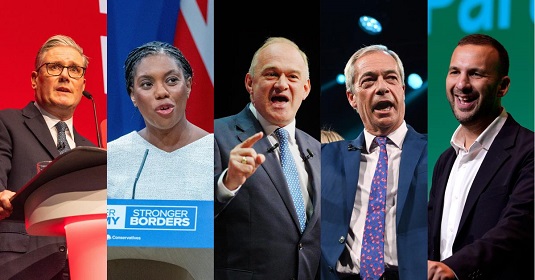
Starting with Labour, Keir Starmer set the bar pretty low in 2025. Labour lost 187 councillors in the context of a projected vote share of 20% - the lowest since the party emerged as an electoral force 120-odd years ago. Readers with memories might also recall Labour's 2021 election outing, where projected share stood at 29%, with 327 councillors and Labour's control of eight councils lost. It has since come out in sundry memoirs and insider accounts that Starmer seriously considered resigning because he thought this result was so bad. Unfortunately for him, Labour are now on course to do much worse than this.
In historical context, in relatively recent times Tony Blair saw Labour lose 1,150 councillors in the 1999 locals. A point when he was at the height of his powers. For even-handedness's sake, he also oversaw Labour's best ever local election performance. In 1995, the party scooped up 1,807 councillors on a projected vote of 47%. But back to the gloom. Labour's worst performance was half a century ago. In 1976, Jim Callaghan notched up a catastrophic loss of 1,309 seats. Surely Starmer will surpass that with ease and enter the record books. But the worst ever performance at a local election by a governing party is a honour that, right now, belongs to John Major. While Blair was celebrating his crushing council triumph in 1995, Major registered a collapse of 2,018 seats, a loss of almost half of all that year's Tory defences with a projected 25% vote share. If you look at the aggregate monthly votes of council by-elections since last August, Labour has only polled above 20% on one occasion - far shorter than the number that brought the Conservatives calamity.
The story in Scotland is less worse. Again, long time readers might remember Starmer ousting Richard Leonard from the branch office so the impeccably right wing Anas Sarwar could be installed in his place. In 2021, that paid dividends as support for the Scottish party slid further to 21.6% for the constituency and 17.9% in the list sections, giving Labour 22 MSPs. Recent polls from Norstat and Moreincommon suggest further slippage, but with their likely getting supplanted by Reform. Again, the previous floor presents itself as an impossibly high ceiling.
Wales is where the true disaster is brewing. October's Caerphilly catastrophe spelled out the doom that's coming: the end of Labour's domination of Welsh politics. So feeble has it become that former Labour supporters in their tens of thousands are sure to switch mainly to Plaid Cymru to keep Reform out. Bear in mind Labour's previous 'worst ever' outing in the Senedd's short history was 2007 when it could muster 32.2% and 26% of ballots cast, this year such a result is beyond Welsh Labour's wildest dreams. Moreincommon polling suggests a popular vote around half the previous nadir, and with a seat haul to match. A century of political dominance is forecast to be wiped out. Losing Wales alone should cost Starmer his job.
No matter the floor, Starmer's Labour is poised to drop through them. But what of the challenger parties? Last year, Reform triumphed, winning 10 councils, 677 councillors, and a projected vote share of 30%. Which is much better than UKIP's popular vote high point, which saw them register a projected 22% in 2013. Crunching the numbers based on current polling, a net gain of 1,401 seats seems about where most pollsters are pegging the Reform advance. Likewise, between 400-500 gains for the Greens is on the cards with a lion share of gains in the London boroughs, and winning between three to five of the capital's councils.
Triumphs in the waiting? For Reform, does a four-digit councillor gain suggest its forward march to Westminster domination has been resumed? As Peter Kellner, the former YouGov polling specialist touches on, it depends on the sort of percentage Reform are able to capture. A seat tally that simply reflects their current standing in the polls would be good news for the party, but doesn't suggest they're advancing. In my view, Kellner does not go far enough. He and most pollsters and commentators ahead of these elections aren't taking differential turnout into consideration.
All of these elections are second order elections. Political scientists have long made the distinction between first and second order elections in that for most voters, first order elections - i.e. general elections - are the ones that really matter because they lead to government formation and policies that affect their lives. For example, the 2024 general election saw a pitiful turnout of 59.7%. But in Scotland, all Holyrood elections, bar the 2021 poll, have lagged below this. The same is true for all the elections so far to the Senedd, and ditto by and large for local council elections. Rare is the parliamentary by-election that matches, let alone exceeds that constituency's previous general election turnout. Whether Scotland bucks this trend for the second election running is something we'll soon find out, but it's likely that the Welsh and English elections won't.
This matters because fewer voters turn up for second order elections. It's well known that the older one is, the more likely they are to (habitually) vote. This is true of the general election. Pensioners and older working age cohorts vote in greater numbers than younger cohorts for a variety of reasons, that we won't go into here. This differential, however, is exacerbated for second order elections. Older people are less likely to vote than they would be in a general election, but the abstention rate for younger cohorts is even greater. This matters because, as pollsters show and as this blog has talked about plenty of times, there's a strong relationship between age and voting preferences. One which, in recent years, older people disproportionately vote for the parties of the right (Conservatives, Reform) and working age people the left (Labour, Greens). Therefore, this structuring of British political opinion means the Tories and Reform have a distinct advantage in second order elections over Labour and the Greens. They can better rely on their support to vote.
This needs factoring into projections. For instance, in 2025 when Reform polled a projected 30% this more or less matched their polling average at that time. But taking differential turnout into consideration, their popular vote tally should have been higher. Similarly, Labour captured a poor 20%, but that was a figure suppressed by the age cohorts who actually turned up. If there was no age-related disproportionality, Reform would have done worse and Labour better.
Why does this matter? Because taking differential turnout into consideration offers a better read on the trajectories of parties. If Reform do win their projected 1,400 gains on 26% of the result, differential turnout suggests their real support in the general-election voting population is lower that that figure suggests. Likewise, if the Greens manage net gains of 450 seats on a projected 16%, because they have taken to the field in an election landscape where their reliance on younger voters is a disadvantage, their real levels of support are likely to be higher. Therefore, to conclude that Reform has real momentum, their vote has to be significantly above their forecasts. Ditto, to say the Greens are on the cycle path to nowhere, the party's vote has to be significantly lower. The same also applies to Labour and the Tories, the SNP and Plaid Cymru. But not the Liberal Democrats, who don't have any meaningful variations in support across the age ranges.
There is one possible objection to this view. Political science also acknowledges that because second order elections "don't matter", people who vote in them are more likely to register a protest. For instance, the 14.5% the Greens scored in the 1989 European Parliament elections didn't translate into an advance in 1992. The Brexit Party winning the same set of elections in 2019 did not convert into seats in that Winter's election. However, there are two things that suggest this skewing of voting intention has blurred. The first will be these results themselves. Labour in Wales, for instance, has withstood past protests against the direction of the Britain-wide party in and out of office. The coming wipe out speaks less of a protest and more a fundamental break in trust. And the second is the erosion of the two-party duopoly, as evidenced in the 2024 election. What we're now seeing is the further development of that trend, in seeming defiance of Duverger's Law and his view that majoritarian electoral systems cluster support around two contending parties, usually of the right and the left. What happens on Thursday is likely to continue this process.
Inevitably, the seats won and lost will command the headlines. That's what matters in electoral politics. But for those wanting to get a deeper sense of public opinion drift, of who is being overhyped or underpriced, it will all be there in the projected vote shares.
Image Credit

2 comments:
Since austerity in 2010 and the hollowing-out of local authority services, there very little scope to manoeuvre regardless of which party takes over the reigns of power.
However, for Reform Ltd, It's an easy message for its supporters who do not enjoy evidence-based argument: get rid of the cycle lanes; fix the pot holes; close the migrant hostels. Bob's your uncle!
If you watched the bbc coverage you wouldn't have to worry about the Green party turnout, or results, as they barely talked about them. Even bloody SKY did a much better coverage, showing maps of the green takeovers of swathes of Manchester. Useful Laura on the beeb said that the greens were "winning a few seats", when it was obvious they were on target for several hundred. If I hadn't watched Owen Jones' clips on his YT channel I'd have come away with a very misleading impression.
BBC Scabs are gonna scab I guess.
Post a Comment