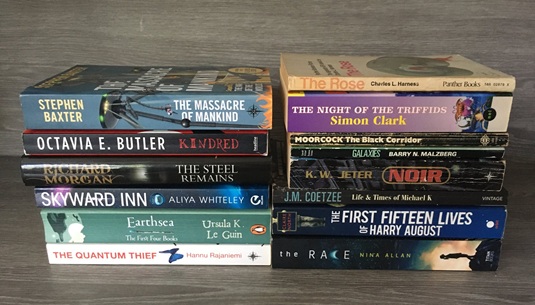
Digging into the B formats first, it's the doyen of British hard SF, Stephen Baxter. His officially endorsed sequel to HG Wells's The Time Machine might just be his best book in my opinion. So what can he do with the Martians? As you might have gathered from the title, The Massacre of Mankind, it's not likely to be positive for humanity. Britain has enjoyed a technological bonanza from picking over the fighting machines left in the wake of the Martians' defeat. With a souped-up military and a planet full of microbes sure to smite the Martians if they come back, the world is reasonably content. That is until the famous green flashes light up the surface of Mars, signalling a new fleet of cylinders are on their way. Yes, this time the Martians have had their jabs. Massacre has earned less praise and comment in the 10 years since publication than The Time Ships enjoyed. Over long and repetitious is the wisdom of the Goodreads crowd, but as The War of the Worlds is my favourite novel I'm sure there's something in here worth persevering with.
The second on the list is easily the most famous of this clutch, Octavia E Butler's Kindred. To my shame, I've not read any Butler yet. The premise here is that Dana is enjoying her birthday celebrations when she passes through a time slip into antebellum Maryland. She rescues a slave owner's drowning son, and here is set up a cycle where she bounces between the present and the past. Each time, she has to save this privileged white boy from scrapes, even though he becomes increasingly monstrous as he ages. Regarded as something of a classic, I've perhaps laid off because novels dealing with American slavery are grim, and packed with trauma and pain. But it has been some years since reading the last one, Colson Whitehead's SF-adjacent The Underground Railroad. It's time, and it'll definitely be read very soon - I've persuaded my book group to read it for September.
Much lighter fare comes from Richard Morgan with the first of his fantasy series, The Steel Remains. Best known for Altered Carbon and its sequels, Remains pitches itself as a "grimdark" fantasy with a gay lead. Fair enough, but having read it I didn't think it was particularly grim. In fact, it's more chilled than Morgan's more famous titles. People who like plenty of choppy, choppy sword play will be satisfied, and some unpleasant experiences befall poor peasant unfortunates, but it runs along at a decent canter with more than a dollop of Dying Earth/Viriconium influences. To be honest, I liked this more than Altered Carbon.
Aliya Whiteley's Skyward Inn was shortlisted for the Arthur C Clarke Award, so what's it about? There has been a war which, apparently, humanity won against the alien Qita. And now a bunch of veterans from both sides have clubbed together to run the titular inn. A visitor shows up asking for assistance, and with them opens a Pandora's Box worth of questions. Some things, it seems, are better left unsaid and unquestioned. Whiteley has steadily been accruing cred over the years, and walked off with the BSFA's novel award last year. I have read her The Loosening Skin, which is an alternate history thinking through the cultural implications of humans shedding their skin, snake style, instead of it flaking off as it does. That, I thought, had a strong opening before tapering off. But seeing as Skyward Inn scooped a nomination, I am hoping this is better.
The next should need little introduction - an omnibus of Ursula K Le Guin's first four Earthsea novels. Really, I bought this for my niece but seeing as I haven't read it yet ... There's a fairly standard fantasy set up. Ged has a gift for magic and gets sent to wizarding school where he becomes a mighty spellcaster, but over the years evil slowly reveals its predictable head. I wonder who got inspired by such a set up? Another series of books that caused Le Guin to expand her trophy cabinet, and one I'll be tackling very soon.
Then down at the base is The Quantum Thief by Hannu Rajabiemi. This does come with a super hard SF warning, the sort that melts the unwary reader's brain with their exploration of quantum effects and the weirdness associated with that layer of reality. As far as I know, this revolves around a protagonist locked in a virtual prison where he undergoes endless cycles of the prisoner's dilemma. He gets busted out, and it gets stranger from there. This book is known for refusing to explain much, and the reader is just expected to get with the vibe, including all the discomfiting future post-human solar system. Not sure what I'll make of this.
Bottom up on the second stack there we find The Race by Nina Allan. Her debut and BSFA-shortlisted novel features an environmentally-ruined Britain and a character study of four equally-damaged people. In other words, this is as slipstreamy as they come. Nevertheless, my expectations are elevated as I enjoyed The Rift very much, which also played fast and loose with its genre status while telling a great story.
The First Fifteen Lives of Harry August is a well-received variation on the Groundhog Day theme. Wee Harry lives his life, dies, and comes back to live it all over again. And at the outset he's done so 15 times, presumably making different decisions along the way to try out those paths not taken. On the last occasion, he's visited on his death bed by someone who knows, and she needs his help in the next incarnation. Harry August was nominated for the Clarke and the BSFA, and North has won a significant following as an SF writer with her recent space opera, Slow Gods, winning critical praise. This one sounds like the sort of science fiction novel you might get away slipping it to your mainstream fiction reading friends.
Last among the Bs is JM Coetzee's Life & Times of Michael K. It's also another borderline novels, a bit like his preceding release, Waiting for the Barbarians. Here our hero has to journey across an alternative civil war-torn South Africa to return his mum to her rural birthplace. Michael, however, has a cleft lip and learning difficulties, and his mother is a servant to a rich Cape Town family. The path is not a smooth one, and the authorities detain him for "reeducation". Apparently, it has more than a few references to Kafka's The Trial.
Diving into the best paperback format, KW Jeter's Noir presents itself. An underappreciated master of SF and Philip K Dick associate, the only Jeter I've read is his Infernal Devices. A steam punk novel from the guy who coined the term, this was incredibly silly with a preposterous plot, but thoroughly entertaining for all that. Noir is a hard-boiled detective novel set in the only industrialised area left in the world. It's polluted, grimy, and dangerous. To make it extra grim, this hypercapitalist dystopia can raise the dead to pay off debts acrude in life. Sounds charming. And for that reason, a book to look forward to.
Sitting atop that is Barry Malzberg's Galaxies. This slender thing is a deconstruction of space operas, dressed up as a schlocky sounding faster-than-light zombie astronaut romp. It's presented as notes towards a novel by a science fiction author, who allows the story to zip along with inserts on the state and status of the genre, and other asides besides. Malzberg's critical reputation as a fine, if unsung SF literary hero is based on misanthropic works such as this.
Michael Moorcock has written so many books that it's easy to come across one you've never heard of before. The Black Corridor is such a title. Civilisation is falling apart (when is it not?), and one man flees from the Earth with his family. They're in hibernation, and it's a five-year trek to their destination. How will he cope with the intense loneliness? And how will this solitary tale tie in with Moorcock's multiverse? Will the hibernators dream of Jerry Cornelius?
Our penultimate title is The Night of the Triffids. Can you guess what this is a sequel to? 25 years have passed on our survivors' Channel hideaways and all is well. The son of our original hero scours the world looking for the means to defeat the Triffid menace, and finds a glimmer of hope in a New York colony. While the original was the first cosy catastrophe novel and was of considerable literary merit and influence, I understand Simon Clark's authorised sequel has none of these virtues. It's - apparently, for I've nto read it yet - more action/horror-oriented with more blood and guts and little originality. Still, Night might be mindless fun.
And the last of this haul's heap is The Rose, a wee find tucked away hidden in a charity shop's book case. Harness is best known for The Paradox Men, a 1950s space opera that won m admirers, including the aforementioned Michael Moorcock. The Rose is a collection of short stories, featuring the award-winning novella of the same name. This, apparently, features mutants, quantum mechanics, and the relationship between science and art.
That's the haul done. Have you picked up anything interesting lately?

3 comments:
Butler is truly incredible. Kindred is fantastic but Parable of the Sower is even better!
What he said! Parable of the Sower is astonishingly prescient and Parable of the Talents is so good too. A big, big recommendation. Do read them.
Ged, not Gont (that's the name of the island he comes from). "1-4" is an interesting bundling; I loved AWoE beyond reason but read Tombs and Shore once only. Tehanu followed much later, and... See what you think.
Post a Comment