In the annals of video gaming, how many titles put you right at the end of the prequel game? A handful to be sure, and the only one parading the stage during our passage through games old and new is Super Metroid. Which is an interesting happenstance, because there are a number of mechanics it shares with another game picking up where its predecessor left off: Wonder Boy III: The Dragon's Trap. Published in 1989 for the Master System and subsequently appearing on the Game Gear, the PC Engine (under a different name) and getting a latter day reskin for the Switch, PS4, and XBox One in 2017, in the pantheon of Sega-sourced mascots the Wonder Boy series of games have tended to get outshone by a certain other character. Nevertheless, the broad consensus among professional reviewers of the day placed Dragon's Trap the nearest the Master System had to a Super Mario game in terms of depth, making it easily one of the best games the machine had to offer. Not to be confused with the light arcade jaunt Wonder Boy III: Monster Lair, Dragon's Trap immediately casts you into said trap. Picking up just prior to the final boss battle in Wonder Boy in Monster Land, you find your way to the room of your nemesis, slay him and ... and ... he curses you, transforming you from a super deformed swashbuckling warrior into a dragon. You escape the castle and your quest begins to lift the curse, change you back into, well, Wonder Boy again. All the while battling to other evil dragons to liberate all the lands from their scaly grasps. Dragon's Trap, despite its cutesy countenance is nothing of the sort when it comes to gameplay. It is a very strategic platformer where you have to think seriously about your next move. Most enemies appear fairly harmless, but a combination of funny attack patterns, occasional dodgy baddy placement, and a propensity to knock your energy bar into the middle of next week can catch you unawares. No curling up into a ball and barrelling through here. Matters aren't helped by your being relatively slow and awkward - at least at first. As you kill more enemies, accumulate more cash, upgrade your gear, and progress further into the game you get a nice treat. Following your defeat of a dragon boss, you are cursed again and assume another form. From dragon you become an anthropomorphised mouse, from a mouse a merman (or, officially, "Piranha Man"), from merman into a lion, and from a lion into a bird. Therefore, in addition to getting access to new equipment to buy you acquire new abilities that unlock different levels. The mouse can climb specially patterned walls, merman can swim up and down and around the screen, lion has good reach with the sword and can smash like Hulk, and I'm sure you'll never guess what the bird can do. As you progress deeper into the game, there are rooms that allow you to switch between different beasties to help clear whatever obstacles are thrown at you next. This is a long game, a very long game. Don't let the YouTube playthroughs fool you. The exploration, getting to grips with each character, hunting down weapons, grinding for cash, seeing what your magic weapons can do, and working out what the hell to do next is enough to head scratch anyone into alopecia. The dozens of hours some would have sunk into trial and error, running back and forth, and beating the game through brute repetition and trying out absolutely everything doesn't bear thinking about. Dragon's Trap is certainly a game, like the best arcade adventures, that makes you work. Is it deserving of its classic reputation though? There are some major annoyances. Tracking backwards and forwards, or proceeding through a level and reaching a boss who's nigh on impossible to defeat because you're not the right animal form is perhaps the biggest gripe. It's bad, because once you reach a certain point in the level there's no turning back and undoing your mistake. Very frustrating. It's also not immediately clear what all your special items can do - without looking at the instructions or a walkthrough, I'm still not sure what the stones you occasionally pick up for your items roster are supposed to do. The major gripe has to be the end of level bosses, though. Once you've got their patterns down most don't offer too much trouble. But the two I hated with a passion is the Pirate Dragon and the Samurai Dragon, both of whom demand pixel perfect precision to take out as well as near endless time to whittle down their energy. Nothing wrong with a strong challenge, but repeat timed buttoned presses for five to ten minutes? It's enough to test the patience of a menhir. Its canonical status in 8-bit Sega circles then rests on standing out from the Master System crowd. Few are the games requiring thought and a significant time outlay, save a celebrated RPG or two. Especially when too many MS games at the time of Dragon's Trap's release were not terribly well programmed, were shallow, and simply weren't very good. This was like a bolt from the blue, and demonstrated the machine could provide the immersive experiences more readily found on its Nintendo competitor. How about now when games past and present are easily available, tastes have moved on, and the series itself has fallen into relative obscurity - though the remake, and its particular success on the Switch and the appearance of Monster World IV on the forthcoming MegaDrive Mini are helping drive interest. Perhaps it doesn't stand up so well. What gamers were willing to accept in the late 80s and early 90s, and what was considered hard and what was considered fair game design has shifted. Getting through Dragon's Trap can be hard work, or perhaps best thought of as a labour of love. Well worth checking out for a challenge, and for geeks wanting to see the adoption and re-embedding of Metroid-style mechanics. Readers looking for accessible retro experiences, particularly on the Master System, might be better off with Sonic or the original wonderful Wonder Boy romp - this one might prove too off-putting.
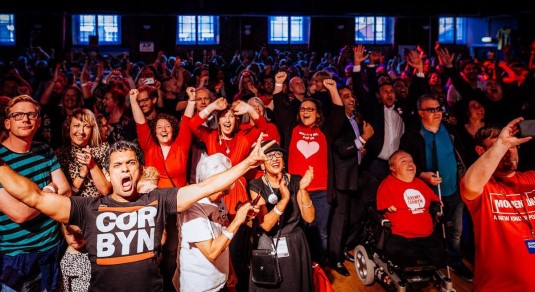
Owen Jones asks why are groups of hard remainers refusing to acknowledge the victory their marches, campaigning, and consistent pressure have won. If you go back to the so-called People's Vote demonstrations, many a speaker called on, nay demanded Labour ditch its ambiguous Brexit position. "Where's Jeremy Corbyn?" went the mischievous chants. Well, Jeremy Corbyn is where you wanted him: calling for a second EU referendum with an option to remain. But it's not enough, never enough. Some have moved the goal posts and now only revoking Article 50 will do. Others have vowed to never vote Labour with Corbyn as leader, even if the only discernible route to their political objective is through a Labour government. You can fantasise about the hard positioning of the Liberal Democrats winning a majority, and I can dream of winning the EuroMillions jackpot. We've spoken about Corbynphobia plenty of times. The very prospect of Jeremy Corbyn entering Number 10, if only to oversee the calling of a general election, requesting a delay to Article 50, or piloting a second referendum through the Commons (which isn't straightforward), is far too much for the likes of Jo Swinson and the "ex" Tories. They know full well that Corbyn as Prime Minister crosses a Rubicon. The sky won't fall in, the top 100 monopolies won't be nationalised, and suddenly he becomes a much more credible statesman figure. Incumbency robs them of one of their most potent, scaremongering weapons. This is not a post about them, but rather the ordinary rank-and-filers who attended the protests, shared the Jolyon Maugham tweets and have kept a shrine to Lord Pannick since last Thursday. And the rest. So where's this non-elite Corbynphobia "from below" coming from? Some of it can be written off as LibDems, but to put it all down to them is as stupid as those who trying explaining Corbynism by mass Trot entryism. Some can be put down to political disagreements with Corbynism. Not of the polite 'I think this policy has problems, old chap' variety, but visceral disagreement that cuts to the bone. On foreign policy specifically, Corbynism reminds some that transatlanticism is not necessarily a force for good in the world, and that you can usually find the British state in the corners of many an unsavoury regime - provided their interests and "ours" coincide. This disrupts the fiction of a rules-based international order that has never existed. If you take Clinton and Blair as paradigm centrists who respected the rule of law at home and abroad, Clinton was not averse to cruise missile diplomacy and bombing medicine factories to generate headlines. And Blair? The word 'Iraq' will suffice. Because Corbyn draws attention to the power relationships under the piffle of high diplomacy, and shows Britain and the US to be as self-interested and cynical as Russia, China, and the other bogeymen of the international order, it grates. This applies to the near abroad, and the EU specifically. Corbyn has long refused to respect the utopian fantasies of sundry centrists for whom the EU is the incarnation of the spirit of reason. Coupled with a long record of scepticism and solidarity with the EU's victims, especially those suffering unnecessarily in Greece, that is enough to cast him into the outer darkness, and especially so if the only two coordinates of your politics are leave and remain. This uneasiness on sacred cow politics is compounded by the successive hit jobs undertaken on Corbyn. Because he doesn't share the same conservative goals as centrism, it follows he does not respect the same rules either. And so the fall out of the anti-semitism crisis, suggestions Jezza is a puppet of Stalinoid functionaries, and every single smear story from the last four years feeds this unease, this angst. It's not that media content brainwashes people, but exposed consistently over long periods of time it sediments into the consciousness. Their frames become your frames, their natural assumptions, without you noticing, become your assumptions. They can be resisted, but no one is totally free of how they condition our outlook. Least of all liberals and remainers and their emotional attachments to the BBC. Therefore for a layer of people, Corbyn is an instantiation of the political instability we've seen since 2015. It does not matter how many hoops he jumps through - a second referendum, cancelling Brexit, shacking up with Guy Verhofstadt, changing his name to Remainy McRemainyface - nothing will ever suffice. Corbyn is a barrier against where they want to be, the past. A place they knew their place and could relax, leaving the business of ontological anxiety to others away from the public eye. Even if Britain under Corbyn ends up staying in the EU and properly funds the kinds of things they affect to care about, they are still out of joint, their heroes dethroned and the cognitive map of their social environs completely skewed, out of time and irrelevant. This is why there are hundreds of thousands of "progressives" who can never countenance back Corbyn's Labour, despite the party accepting the second referendum position. It's more than a question of identity. It is a matter of being at ease in the world. And these people are very uneasy, to the point political realities have melted for them. They can't go back, but trapped in the past they can't move forward either. Stuck, their hard remain stubbornness symptomatic of a paralysing longing for a world doomed never to return. It means their politics are fundamentally reactionary and self-destructive, a mirror image of the Brexit zealotry they affect to despise. Such figures don't deserve your anger or your social media invective, they are piteous and beyond reasoning. Nevertheless understanding the roots of their extremism is useful for getting to grips with weaker forms of Corbyn-scepticism and left phobia, and how we can go about addressing them. Image credit
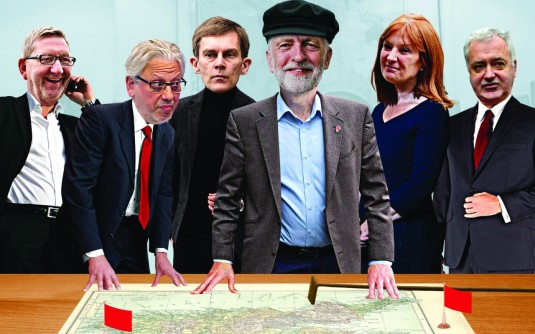
For a brief, beautiful moment it appeared as if the stitcher-in-chief had become the stitched. Unfortunately, it was not to be. Jon Lansman's surprise move at Friday evening's NEC to abolish the Deputy Leader post, and therefore dump its awful incumbent fell. Overnight too many people got cold feet, were spooked by the promise of bad press, and fretted it would push more Labour MPs out of the PLP, so instead of an unexpected but welcome defenestration we got a review. And now we will have to endure another episode of wrecking when Tom Watson takes the stand for his slot on Tuesday. Is he going to thank Jeremy Corbyn for saving his bacon, or glory in a confected legend of seeing off the "hard left"? We know him too well to put the answer in any doubt. In his usual disingenuous way on Radio 4 this morning, he called on the members to decide his fate, knowing full well there is no mechanism to recall him and there being as much a chance of refreshing his mandate as, um, him deciding to refresh his mandate. And we all know why: he would lose. Like many others I voted for Tom Watson in 2015, stupidly and naively thinking his battles with Murdoch might mean he'd be more outward facing and combative versus the Tories. This despite living in the WestMids and seeing shenanigans and dirty tricks performed by the regional office at his behest. As Watson has broken the terms on which he was elected in word and deed, if there was a shred of decency about him he'd tender his resignation. There is no such decency. One of the most frustrating aspects of the Corbyn project is its conciliationism. Initially, Jeremy was right to try and forge a shadow cabinet formed out of the differing wings of the party. As a general rule, talent has to sit with factional balance, and giving your opponents to buy-in is a trusted way of keeping them on-side. But after a year of scabbing, counter-briefing and guerilla warfare culminating in the failed coup, keeping these cretins happy should have ended there and then. No more favours, no more olive branches. The left had the opportunity to sweep wide and sweep hard with Stakhanovite enthusiasm following after the election: then was the time to make the necessary changes. Instead, Corbyn proved magnanimous in victory, which was paid back by MPs in the cynical exploitation of anti-semitism and using Brexit as a wedge between Corbyn supporters and the leadership's attempts to pull politics back to other burning questions. Sometimes, literally burning. Why now then, why make the move against Watson after filleting Labour Students? Well, nothing breeds success like success. A double blow against the Labour right while their main support base, the parliamentary party, are facing reselections. Which, it's worth noting, makes Twitter threats of a leadership contest in response nothing but bluster. Timing then was important, and would be long forgotten in the build up to an election a couple of months hence. How about the suggestion of the left's weakness? The argument goes that some in Corbynism's upper echelons fear defeat at the next general election, whenever it arrives, and this is about getting all the left's ducks in a row in time for the next leadership contest. Possibly. Then again, the left does need a succession plan come what may, whether Labour is defeated at the next election and Jeremy steps down or after a successful period of government. The fear has to be the annoying appeal someone like Keir Starmer has for the softer end of Corbynism, the part of the movement who, despite everything, feel the pull back to how things were when politics was "safer". Faced with the likelihood of him becoming leader next, the left's revolution has to be made permanent should he try unpicking it. Which he will. Ultimately though, while Lansman and Unite backed away and are content with the compromise motion, what this episode underlines again is the historic weakness of the Labour right. When Labour Students was cast into the abyss parliamentary alumnus of its ranks cried publicly and made threats, but nothing was forthcoming. Another prop of the right was annihilated. And had the bombing run on Watson released its payload, they'd have complained to the papers, on condition of anonymity of course, and that would be that. No splits, no action, plenty of chuntering, but uneasy quiescence as MPs attend their trigger ballots. Despite all this, my fear is the left will rue the day the move against Watson wasn't followed through. Sharp pain now would, in all likelihood, avoid torture later on. Instead, and not for the first time, the hardest, most pitted road has been chosen. Image Credit
That moment when you're walking to work and remember a point you were supposed to make in last night's piece. And, perhaps, this is the most glaring error in Bolton and Pitts's Corbynism: A Critical Approach. In their book, they answer previous criticism for their being unconcerned with providing an alternative politics or strategy to Corbynism with a shrug of the shoulders and a dismissive meh. All well and good if you're interested in merely writing things and building careers as soi-disant Marxists with a neat little niche. And yet, their book is explicitly located as an intervention in strategic debates about socialism today. Remember, their argument is two-fold: the left should be in the business of defending its gains and holding the centre against the brutish, populist hordes. It's almost as if their declaration is a rhetorical flourish to try and position their critique of Corbynism from within the left for, well, marketing purposes. The second point flows from the first. If we were to hurl Bolton and Pitts into a Tardis and take in a whistle stop tour of important historical mobilisations from below, like the ragged wretched throngs of St Petersburg who begged the "Little Father" Tsar for bread and were shot down for their pains, the civil rights movement in the US who drew heavily on Christianity and American constitutionalism as the ideological inspiration for their campaign against segregation and Jim Crow, and any number of strike movements in the 1970s motivated by pay and and working hours, how would our worldly wise Marxists have approached them? One expects a screed of some length pointing out the faults in their politics and attacking their movements for insufficient Marxism. In other words, they would be treated as the finished product and not as movements in development with trajectories that could head in radical and, gasp, perhaps even Marxist directions. This is how Bolton and Pitts approach Corbynism. If their failure to situate its emergence in the confluence and recomposition of class politics wasn't bad enough, their pen portrait of it as a fully-formed semi-conspiratorial movement is one of the worst takes on Corbynism I've come across. Perhaps they should reflect on their absurd claim Corbynism operates a substantialist theory of value. That is the treatment of money as magic containers of value instead of its mediator. Their criticism certainly missed the mark, but it is suggestive of a projection entirely of their approach to Corbynism. Instead of a mediator of class interests interacting and struggling with other political forces based on opposed interests, Corbynism is a container of essential qualities - two campism, technological determinism, technotopianism, populism - and can never change. A very strange position for Marxists to take. We saw this before in Matt Bolton's essay, widely circulated at the time of the second Labour leadership contest, that made the entirely stupid argument that Corbynism wasn't properly socialist because it didn't measure up to the tight discipline and (doctrinaire) Marxism of the Militant Tendency as was. Alas, the only thing that didn't measure up was Bolton's argument, based as it was on an incredibly crude and zero-nuanced application of Max Weber's ideal typical method. Lenin isn't the most favoured Marxist round these parts, but he was on to something when he wrote ultra-leftism and opportunism are two sides of the same coin. Bolton and Pitts criticise Corbynism not to advance it, or develop the movement in a more consistently socialist direction, but to justify their own sniffy abstention. How very Marxist of them. Image Credit
In his recent interview on Politics Theory Other about the long-term decline of Conservatives and Conservatism, Andy Beckett suggests incuriosity about Corbyn and Corbynism is a symptom of the establishment right and establishment left's disengagement from political reality. It's a point this blog has made plenty of times. Apart from the ridiculous “explanation” favoured by sundry right wingers that a quarter of a million Trots were waiting for their moment to swarm into the Labour Party as soon as Jeremy Corbyn gave them the green light. But the claim of incuriosity does not apply across the board. Gavin Shuker recently had a go explaining Change UK's failure, an endeavour that, euphemistically speaking, left a lot to be desired. And last year we had published Corbynism: A Critical Approach by Matt Bolton and Frederick Harry Pitts, which claims to be a Marxist critique of Corbynism. For this reason alone it is worth considering. It begins, as you might expect, with an introduction to Corbynism. As a movement it is comprised of a number of currents who broadly fit into two categories. There is a "trad left" of a renewed Bennism, which is one part "personalised anti-capitalism" (of which more later) and "Leninist central planning". This combines with an anti-imperialist thrust, which manifests mainly as "anti-Americanism" and anti-Zionism. This enters the mix with the "radical life politics" Momentum offers(?). Closely allied to this old left is the "techno-utopian" wing of the movement, a communistic youth insurgency interested in the libertarian possibilities of new technologies. This has informed Corbynism's policy agenda around (experimenting with) the basic income and strategies meeting the challenge of automation. Those who have a hard time fitting into these currents but have influence are the SWP via its Stand Up to Racism front (debatable) and other Trotskyist currents (even more debatable), an academic "old-school Cultural Studies soft left", the acid communist milieu, the "self-consciously intellectual" folks around New Socialist, Polanyian Lexiteers, and municipal-level Corbynism exemplified by Preston City Council. Each of these trends significantly differ, if not sit in tension with one another, but holding the project together is a left populism. Corbynism ties up a political collective united by a clear and discrete "us" versus an equally obvious "them". This, as per the work of Chantal Mouffe and her late partner, Ernesto Laclau, establishes a frontier where you and other political currents and political actors are on one side or the other. There is no middle ground for compromise. Therefore this assumes not a structural (Marxist) critique of class politics but a radical moralism, and why for so many supporters Jeremy Corbyn is incarnated as a morally exceptional figure who has consistently lived on the right side of history. This, for Bolton and Pitts, is why Corbynism is deeply flawed. Contrary to traditional Marxist analysis where contradiction and antagonism are internal to capitalism and constitutive of its operation, this understanding is largely absent from Corbynism. As they put it,
For the Bennite and post-capitalist wings of Corbynism by contrast, here betraying again their shared roots in orthodox Marxism, contradiction and social conflict are grasped as the result of external constraints imposed upon a social force itself regarded as innately 'good' - whether it is the 'working class', the productive forces, or post-capitalist potentiality. (p.13)
This implies that everything would be hunky dory if certain barriers could be removed, and therefore those who prevent it - say nasty capitalists, awful Tories, treacherous Labour MPs - are morally deficient and outright betrayers of the common interest. The real sources of contradiction, the structural underpinnings of capitalism, are therefore invisiblised and left unaddressed, replaced by a narrative emphasising the machinations of evil doers. If you swap out the actors and rework the story, these logics are no different from the kinds of politics peddled by Nigel Farage and Donald Trump. There are good people, and they are held back and hurt by the chicanery of self-interested people. This isn't good enough and throughout the book Bolton and Potts counterpose their Marxist alternative, whose superiority is demonstrated to their satisfaction by offering explanations for Corbynism's success and contemporary positioning. It all sounds jolly interesting then. Sadly, no. In the first place they locate Corbynism as a species of opposition to 'austerity populism' - their characterisation of the politics of Tory austerity. What Dave and Osborne did was frame their programme post-crash in explicitly populist terms. The good people here were the hard working grafters (or, in Osborne's parlance, the "strivers") whose livelihoods were put into jeopardy by Labour profligacy. The solution was first getting Gordon Brown out of office, and then undertaking a moral crusade aimed at national renewal. This crusade was their programme of cuts, coded as a country-wide effort of all pulling together and shouldering sacrifices for a better tomorrow. The gutting of the public sector and mass unemployment was regrettable, but it had a purifying quality. Indeed, it was especially framed as such for that section of the British electorate who happily and repeatedly vote for suffering, provided someone else endures it for them. Besides, a bit of hardship will do them some good - so goes the thinking. As Bolton and Pitts rightly observe, because it was framed in terms that appealed simultaneously to the gut and the memory/nostalgia of a nation under siege, it proved impervious to technocratic arguments against it. Ed Miliband, for instance, made precious little headway nor appreciably turned out voters hit by Tory policy who don't ordinarily vote. Therefore, had Corbynism emerged early it's unlikely it would have made much of a dent in the austerity edifice. This argument forgets recent history. Ed Miliband didn't make a technocratic case against austerity, only against aspects of it. The overall "necessity" for hacking away at the state and letting markets and volunteers step in was mostly accepted. Labour had a programme of kinder, more thoughtful cutting - despite Ed's occasional indulging of populist rhetoric himself (remember producers vs the predators?) - it did not cut through, and actively avoided speaking to senses of grievance and alienation. The emotive content of Labour's pitch was left to the colourless One Nation move, exciting no one but the wonks, speech writers. and careerists. Though counterfactuals are ultimately pointless, when Corbynism emerged its critique of austerity politics was inseparable from gut reactions and a widely diffuse sense of unfairness. Where Ed was taking on the Tories under the inspiring banner of their cutting too far and too fast, Corbynism laid the state of affairs at the collective feet of the financial elite and their paid-for politicians. As we know, because of the glue this provided the 2017 Labour coalition the Tory attacks, were they doom mongering or technocratic, simply bounced off. But why did this happen, what was it about the situation that made politics permissive to populism? We don't get a satisfactory answer, because Bolton and Potts locate the populist moment to the EU referendum and its aftermath, despite constructing a chapter around their notion of austerity populism that significantly pre-dated the Brexit vote. Nevertheless what was exceptional about the victorious leave campaign was how anti-EU populism was something of a convergence of the left and the right: the identification of a big bad the people can unite against (the (austerity-enabling) EU), a preponderance of frightening outsiders here courtesy of the open borders it enabled, and the fetishising of British symbolism from WWII to, infamously, the NHS. Therefore Farage's populism was prefaced by that piloted by Dave, which in turn laid the two-campist ground for Corbynism. A case of different characters and plot, but a similar narrative structure, style, and set of ruses. What distinguished Corbynism from its predecessor populisms was the moral exceptionalism of Jeremy Corbyn himself. Despite a long career, he was virtually unknown to the wider public when he rose to prominence in 2015, and the years he spent in the political wilderness positioned as morally pure oppositionist uncontaminated by the rest of Westminster. For instance, his votes against the Labour whip on anti-war issues and against New Labour's attacks on the working class conferred the mantle of the anti-Blair, whereas The Master of course was not only close to business but actively sought their favour. Therefore Corbyn's opponents in the party were utterly confounded, not least because his politics were defined against the mess of compromise and meltism that epitomised theirs. The warnings Corbyn would be an electoral calamity and the rest failed to dissuade the members from supporting him and, of course, left the right disarmed when it came to explaining the unexpectedly strong 2017 general election showing. In other words, because Corbyn offered populism and populism was of the moment, it paid the Labour Party rich dividends. As an explanation of the rise of Corbynism, this leaves a lot to be desired. For the authors to criticise Corbynism for eschewing Marxism, it's ironic they avoid applying it themselves. This is not a hair splitting doctrinal point. Their emphasis on the discursive strategies employed by Corbynism is ... a description of the discursive strategies employed by Corbynism! As such, it misses out a great deal. For instance, curious is the Marxist critique that skips the relationship between political crisis and class conflict, of the compositions and alliances of classes and class fractions articulated and condensed by parties and movements. There is no attempt to address the resonance, let alone explain why Dave's deficit determinism appealed to enough people to allow him to form two governments. Why UKIP's Faragist populism was able to galvanise supporters of a certain age and class background is passed over. Why they proved resistant to Corbynism while the bulk of the working age population found it more attractive than what the Tories were offering, with the workers essentially returning to the workers' party, this merits no attention let alone explanation. It's not as if arguments and discussions addressing these questions don't exist. Coming out in summer 2018, Corbynism: A Critical Approach is preceded by about a dozen books and hundreds of articles and blogs all over left and mainstream media. The materialist analysis is out there, and the failure to engage with it suggests active avoidance rather than plain ignorance. This leaves us with an analysis of the rise of Corbyn that is incomplete, underpowered, and more descriptive rather than explanatory. Having defined Corbynism as a type of populism, Bolton and Pitts move on from treating its insurgent phase to its politics. And straight away, we find ourselves in populist territory again. They argue Corbynism rests on a naturalistic understanding of socialism. Simply put, the material basis for a socialist society readily exists and everything would be hunky dory if we could just remove capitalism. This implies, contrary to Marxism, that capitalism is exterior to the social rather than constitutive of it. Because capitalism it "outside", it means workers have to be coerced and conned to go along with it. To break workers from capital, workers have to be empowered, and this is by putting checks and barriers on capital and hemming it in. For instance, the authors argue the Bennite Alternative Economic Strategy involved tackling the role international finance played in the British economy, and the means for this is conferring the state more powers to enact capital controls and reinforce national borders. Therefore, central to this project is a certain sovereigntism, of privileging the nation state as the ultimate authority above capital, whether domestic or international. Hence it is necessarily hostile to the single market and the EU. As far as Bolton and Pitts are concerned, the contemporary Alternative Models of Ownership policy initiative is a reiteration of the AES, albeit with an accent on co-ops, workers' control and state investment banks than throwing up borders. However, the main problem with these sets of policies are the substantialist theory of value this operates with. Using Preston City Council by way of a demonstration, its approach to local economic policy emphasises anchor institutions (of the public sector) and how their spending should be kept local. For Bolton and Pitts, the substantialism is based on an assumption money is a container rather than mediator of value. Therefore if we can gather all the money in one spot then we shall reap the benefits, while those over there miss out. For instance, when the council was outsourcing services to the Sercos and Sodexos of this world, their capitals creamed off the profits ensuring the local economy did not get the full benefit on the service spend. By contrast, if matters are taken in-house and local suppliers are favoured, the money stays local and big multinational capital loses out. Writ large to a national economy, this is a recipe for disengaging with the rest of the world and risking an impoverished national autarchy. This is a daft set of arguments. Corbynism isn't treating money as a "thing" that can be saved up and held onto. That was the marker of Dave's Tories. Instead, like most bourgeois parties, councils and governments influenced by Keynes money here is understood as a flow. Preston is not "keeping" money, but is trying to increase the quantity circulating in their local economy, and for longer too. An in-sourced council catering service is usually unionised, so pay is better. This puts more money in workers' pockets, enhancing their spending power locally. And some of that will, in turn, end up in the pockets of local businesses thereby stimulating capital accumulation and, possibly, investment in more jobs, premises, and so on, allowing money to circulate again and doing the same. M-C-M' cycling through, expanding its circuit, but taking place mainly in one location (Preston) than surplus value heading south and profits taking wing to the Caymans. Yes, it's capitalism still, but our sages completely miss the point. This isn't about ultra correct critiques of political economy, but the movement for socialism making improvements now. Preston is referred to as the 'Preston Model' because it demonstrates the practicalities of the Corbyn programme, shows there are alternatives to the neoliberal way of doing things, actually provides a way forward for local government caught in the Tory austerity trap, and shows the party of the workers is much better at running capitalism than the party of the bosses. It is redistribution which, presumably, is something our Marxists favour even if it falls short of the abolition of class society. Ah yes, class. It's weird how their Marxism avoids a class analysis for two thirds of the book before bringing it back to critique Corbynism's left populism. As we have seen, Bolton and Pitts classify Corbynism's socialism as naturalistic, as a spontaneous possibility that would magically happen if the productive forces could be set free from their capitalist fetters. Instead, not only is capitalism constitutive of the social, class is everywhere. It is a relation and an irreducible, inescapable feature of the system. It mediates between formally equal persons, and is neither a culture nor identity location but an organising principle powered by the antagonism between those who own the means of production, and those who own their labour power. Fair enough. In Corbynism, however, the two classes of capitalism are not structurally antagonistic and mediated with varying degrees of complexity in and out of work. Rather, it's just goodies and baddies again. For instance, drawing on the work of Ralph Miliband Bolton and Pitts criticise his work for typifying this. In his books and articles, he made the case for the capitalist character of the state residing in the bourgeois connections, upbringing and acculturation of its leading personnel. If a great broom can be swept through the civil service, the state can be wielded as an instrument for socialist change. This being the case, it's not that there are structural obstacles in the way of a transformational politics but rather leaders without the moral rectitude or courage to see through their convictions and carry out the requisite sackings. In other words, Corbynism substitutes moralism for a materialist appreciation of how the state is embedded in, dependent on, regulates, and finally reproduces capitalism. Bolton and Pitts then take aim at accelerationism, which they identify with Nick Srnicek and Alex Williams's Inventing the Future, and implicitly the politics of fully automated luxury communism. Rather than assuming a moralistic stance versus the capitalist class, this trend adopts an uncritical view of technological development and looks to the state as a means of pushing it further. Moar space, moar computers, moar robots, moar of everything accelerates the coming of the new society. Of course, it doesn't do this but that's by the by. This is where things start getting really weird. If you're a self-described Marxist. What both these approaches to class share is treating it as occupation instead of a compulsion to work based on structural dispossession. In other words, workers have to work because we can only live by selling our labour power. We do not own property or capital that can provide an income for us. This is important, because they argue the Italian operaismo/post-Marxist tradition influencing the 'accelerationist' end of Corbynism mistakes the end of occupational categories with the end of class itself. This is abject nonsense. The rise of immaterial labour and shifts within exploitation and surplus extraction are changing configurations of class within capitalism. It poses questions about the balance between capital and labour, how class struggle operates in economies increasingly dependent on immaterial labour, the species of alienation it engenders, and what this means for politics. What it doesn't do is position the working class, immaterial or otherwise, outside of capitalism. A lack of familiarity with the works of Lazzarato, Negri, Tronti, and Dalla Costa perhaps or, again, a studied refusal to engage? There's more in Corbynism: A Critical Approach I haven't touched on. As you can imagine, they extend two campism to Corbynism's approach to foreign policy, and come up with a "Marxist critique" virtually identical to liberalism. They go on to argue that, in fact, it is a species of conspiracism, which helps explain the anti-semitism stuff and the over-exuberance of keyboard Corbynism. They also argue criticisms of their previous work can be dismissed because they adopt conspiracist logics, of accusing them of capitulating to the appearance of phenomena instead of getting at the essence hiding within. How very handy. The truth of the matter is all the faults of Matt Bolton's original essay are replicated in this book, with added arrogance, scholasticism, bad faith, and political paralysis. The success of Bolton and Pitts, if it can be described as such, is bringing together all the prejudices and banalities of liberalism and right wing Labourism, applying the thinnest veneer of Marxist Mr Sheen, and polishing it up into something that describes itself as a critical approach. It's critical alright, but an approach? That would be flattering this dismal effort. To be fair, the dismalism is front and centre from the very beginning. Bolton and Pitts describe themselves as initially supportive of the Corbyn project, and were involved in Momentum and such like. However, once disquiet set in they came to the conclusion that leftist politics should be about defending the gains of the left and "holding the centre" against what is much worse. And that "much worse" is implicitly, Corbynism itself. A pity then they are only able to convince themselves of this by distorting their object, refusing to analyse it properly, and ascribe positions to it and Corbynism's critical fellow travellers that they don't hold. No wonder bankrupt and bewildered centrist hacks love it. And that, my friend, tells you all you need to know. Image Credit
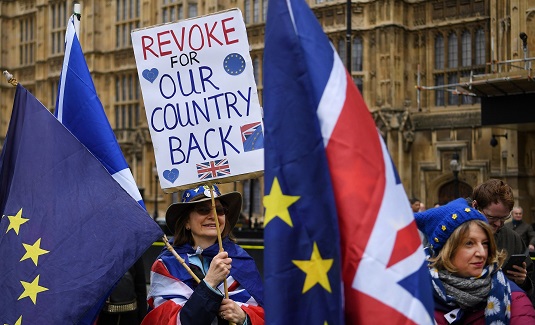
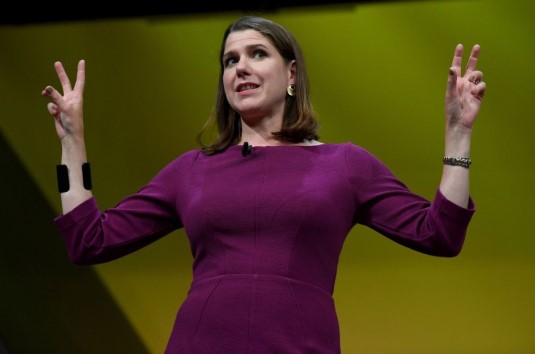
We've heard the declaration. The Liberal Democrats are now the unambiguous party of remain, having junked any pledge for a second referendum for an outright revocation of Article 50. Since getting wrong-footed by Labour, they had to pirouette into Brexit denialism to keep their coveted - and they believe election-winning - title of the most remain of remain parties. Obviously, I think this is wrong. Simply setting aside 17 million votes is not just anti-democratic, it's potentially dangerous. It does have one virtue, though: simplicity. As Jo Swinson has herself said multiple times in multiple interviews, it's about clarity and understanding where the LibDems stand. And yet. One LibDem MP always guaranteed to fluff her media appearance was your friend and mine, Angela Smith. Taking time out from servicing private water interests, she spoke on Victoria Derbyshirethis morning. According to her, the LibDem position is still holding a second referendum on a deal versus remain basis. Eh? Pushed on her "absolutely bizarre" remarks that most parliamentarians would be inclined to hold a public vote on whatever dog's dinner Boris Johnson brings back from Brussels (which, given the state of the indicative votes earlier this year, is by no means certain), Smith denies the LibDems want to cancel Brexit outright. Double eh? We saw redolent confusionism from our mucker Chuka earlier. What has the "shadow foreign secretary" done? Well, I'm not too bothered about all those times he warned against a second referendum, and then endorsed one while he was still a (nominal) Labour MP. As any good careers guru advises, one of the best skills to have in the modern workplace is adaptability and the wherewithal for seizing new opportunities when they present themselves. When you're a careerist sans a career, you might as well be shameless about it. And yet, here he is, posing with a poster calling for a second referendum and not the (now) democratically-endorsed position of his new party. Okay, I'll give it to you. This one's a bit thin. Are you in the mood for a surprise? Smith is in fact right. And she managed it without a racism too! It is LibDems policy to campaign for a second referendum and revoke Article 50. In a classic fudge, the successful motion reaffirms a commitment to a so-called people's vote with the LibDems favouring remaining in any eventual referendum. Fair enough. But in the event of a general election, this commitment is dumped as they campaign explicitly on the basis of exit from Brexit, and will take their assumption of office as a majority government for proof that the public wish to revoke Article 50. In other words, as Smith notes in her interview, the general election becomes a de facto second referendum and its result trumps the 2016 exercise. What we have here then is an approach that isn't simply hard remain, but is nuanced. It's conditional. If X happens or doesn't happen, the LibDems will then do or not do Y in response. Again, I disagree, but this is a perfectly reasonable way of framing your Brexit, or rather, anti-Brexit strategy. It recognises the fluidity of the situation, and how it might adapt. Why then when Labour demonstrated similar nuance and conditionality this was shot down by the LibDems and melt columnists? "Oh noes!", the wailing went, "cannot comprehend how pushing for an election, and if not that a second referendum to stop no deal is possible. It's too complex!" The interior of the National Liberal Club was basically a scene from Scanners, such were the preponderance of exploding craniums. It wasn't just the LibDems participating in performative stupidity, there was too a good chunk of the Labour right for whom Brexit is a factionally convenient wedge issue. And the unlamented Change UK too. The truth of the matter is our politics media is so pitifully poor it is allergic to depth and substantive questioning, privileges the superficial and the gossipy, and is governed by the conceit it must cut the readers'/viewers' food up for them if their content is to be digested. When it comes to something as difficult and technical as Brexit, the politics of reconciling the two irreconcilable positions is impossible to fit within the framing the media consciously utilises. In practice, it means they are amenable to and can be virtually hijacked by a politics with simple messaging, which is part of the story behind the successes enjoyed in the EU elections by the Brexit Party and the LibDems. By deciding to emphasise revoking Article 50 and "forgetting" their policy commits them to a second referendum still just goes to show the cynicism with which Swinson is playing the politics game. Who'd have thunk it from this particular party? The problem for the LibDems remains, well, remain. Ditching a referendum result because they didn't like it plays into every far right liberal elite fantasy/conspiracy the likes of Arron Banks, Spiked, and sundry political degenerates have peddled since the day after. That's the danger, and woe betide any party flirting with it. But the opportunity? It's difficult to determine who exactly this is going to win over, and what would be worth risking potentially violent, quasi-terroristic repercussions? Apart from, say, voters in Swinson's own East Dunbartonshire who might be tempted by the SNP and Scottish independence as a way of staying in the EU? Hmmm. Funny that. Image Credit
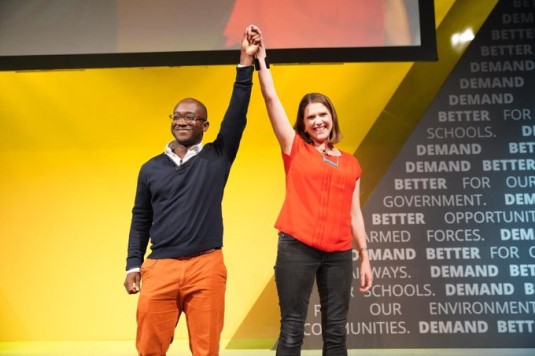
And so the Liberal Democrats have peeled off another right wing MP. After a day heavily hinting their ranks were due to be swelled by another Labour defector, it turns out former Tory minister, Sam Gyimah, was their surprise addition. You might recall he resigned from Theresa May's front bench, and fell out of the Tory leadership contest with zero support. And following his purge during the worst week ever, he's pitched up in the LibDems. He even has the requisite homophobic creds. Reading his resignation note, you find the same crud last polished up back in February. The parties are inhabiting the fringes of political life, and there's this huge middle ground there for the taking. For Gyimah, we need to reject "polarised and divisive politics" and rise to the challenge of "bringing the centre together, through Brexit and beyond". Typical of Westminster people, he is utterly ignorant of the fact parties are responding to real divisions that actually exist, and believes they would go away if the right kind of (centrist) politician and (centrist) party was in charge. To be blunt, we are getting to the point where calling the LibDems a centre party is stretching it. The election of Jo Swinson with her record as Orange Book austerity-enabling former minister reaffirmed the party as the heir to the disastrous economic legacy bequeathed by the Coalition Government and, by extension, taking responsibility for the very material conditions that gave us the leave vote. The party's movement into centre right territory is underlined by the strategy quickly assumed by Swinson; what we might call authoritarian liberalism. On top of retrograde market fundamentalism, we have seen the LibDems pitch to the right to gather up the soft Tory/centre-leaning/pro-EU vote who mostly stuck with May in 2017, but were very positively for Dave in the previous two elections. Having come to the conclusion there were no more pickings from Labour, and totting up the evidence from council by-elections and local elections, it's obvious where they should concentrate their fire. This switch helped win them a by-election, after all. What's this got to do with authoritarianism? We've seen Swinson over emphasise the old anti-Corbyn markers, arguing the Labour leader couldn't possibly command the confidence of the Commons to stop a no deal Brexit because, um, she won't back him. Thereby overriding the wishes of her own membership, who two-thirds support a caretaker deal if it means stopping Johnson's idiocy and a second referendum. The tolerance of homophobia on the basis of incoming MPs peddling remain-at-any-price is another indicator of her elitist distain of the membership. You'll recall a couple of relatively high profile LGBT activists have resigned because of her throwing gay-friendly principles under the bus. But where we go from authoritative to authoritarian is via the party's new position of the EU. During the summer, Swinson was caught off guard by Labour's seizing the initiative of what to do about Brexit. In the common approach all opposition parties have adopted over forcing Johnson to request an extension to Article 50, and denying him a general election has given Labour the mantle of leading the charge against no deal. Having found themselves outflanked, the only place left for Swinson to go was hard remain, and she has done so with alacrity. Asked about this on Andrew Marr, she was very clear those who voted for leaving the EU don't matter and besides, the simplicity of her position meant the whole thing can get filed away as a mistake and forgotten about. A bit like the latter half of the LibDems' name, it seems. While Brexit fatigue is a thing, and Labour should bear it in mind when we head into the general election, this lurch into an outright anti-democratic position is with a view to repeating their success earlier this summer. In a Brexit election polarised around leaving or remaining, she thinks her simple message will resonate. However, general elections are never about just one issue and her gamble could backfire. For instance, while there is a plurality who prefer remain to no deal or a customs union Brexit, that doesn't mean anywhere near the same numbers would like to see the referendum simply cancelled. Recent polling suggests those who voted remain have a greater attachment to the niceties of democratic practice than their leave counterparts. With hard remain going up against another vote, the latter certainly has more swing appeal to leave and remain both than the distinctly un-centre ground and extreme positioning of the LibDem leader. In truth, in recent years our view of the LibDems has been skewed by the turns it took under Paddy Ashdown and Charles Kennedy. They emphasised a weak social democratic-inclined liberalism, and one Nick Clegg paid lip service to, despite the horrors he presided over, along with Farron and Cable. Swinson, by taking the LibDems explicitly to the right in the guise of being the remain party returns them to where they have sat historically, a certain yellow shading into blue. And while her strategy does make sense from a party-building point of view, lurching so quickly and violently to the right to chase those disaffected Tories runs the risk of gaining them at the expense of losing its base of the last 30 years. Let us hope this turns out to be the case.
What is the Conservative Party? Why, for the majority of the left it is the traditional party of Britain's ruling class. And while it has proven to be its preferred vehicle, having dominated the 20th century and holding the title of the most successful party in electoral politics anywhere, it is not and has never been the party of all the ruling class. When Marx wrote about the state as the general committee for the common affairs of the bourgeoisie, it did not necessarily follow that the Tories as a collective political entity were similarly stamped by these "common affairs". As the Conservative Party suffered its first week from hell under Boris Johnson's dubious leadership, we are reminded of the sectional character of the Tories by last week's series of not-hostile articles in the Financial Times on Corbynomics. This involved the not insignificant news of Citibank and Deutsche Bank coming out in favour of a Jeremy Corbyn-led Labour government over a no deal Brexit under Johnson's stewardship. Welcome, comrades! Something strange has happened in British politics to bring about this - previously unthinkable - eventuality. Weird, yes. Unsettling? Certainly, particularly to those looking on in horror on the right. But not entirely unexpected if you grasp the long-term development of the Tories, the recomposition of Labour in response to the rising class politics of the 21st century, and the simple realisation that capital, as a collective, is foremost concerned with preserving the class relations and power dynamics underpinning private ownership - relations that are more nakedly obvious now than at any time since the 1930s. Following John Ross's excellent small book, Thatcher and Friends, the emergence of the modern Conservative Party following the 1832 Reform Act and the splits and controversies of the Corn Laws in the 1840s has seen it be the fractional vehicle of certain sections of British capital. These are finance itself - chiefly the City, banks, owners of large property portfolios, overseas speculators and the like; landed capital, including the old aristocracy, large farmers and food producers, and mercantile capital, the myriad of middlemen firms who fixed up trade routes and brokered deals while creaming off a share of the commerce they affected. You'll note the absence of extractive industry and manufacturing capital. True, there have always been Tory manufacturers and capitalists in the Fat Controller mode who identified with and give money and support to the Tories, people like JCB's Bamford family, but as a whole their support for the Tories was more conditional and episodic. In the post-war period, for example, while the Tories quickly adapted to the Keynesian settlement and were promulgators of a capitalism that appeared more gentlemanly and patrician, at least from our vantage point, manufacturing capital was more oriented toward Labour. In the early 1980s the SDP-Liberal Alliance was also able to win over industrialists. This, again, shouldn't shock when you examine the dynamics within the ruling class. As Alexander Gallas points out in his The Thatcherite Offensive, as the ruling nexus of Keynesian capitalism entered into crisis during the 1970s, under Thatcher the Tories pivoted away from it. What enabled this was the movement into the parliamentary party of so-called self-made business men (they were all men), party hacks, and professionals (above all, lawyers). The old guard of one nationists who looked back aghast at the 1930s, not least because the laissez faire response to the depression ably assisted the emergence of mass fascist and communist movements across Europe, were retiring and getting replaced. The newcomers were the cadres of politicians who had little or no memory of the war, and did not appreciate how the institutional consensus built by successive Labour and Tory governments allowed labour to have a seat at the table and buy a measure of class peace. Until the 1970s, anyway. Not only did this layer hold the post-war compromise in contempt, unlike their predecessors they were not tied to it in the same way. For instance, if your capital was tied up in producing for the supply chains supporting the nationalised industries, it was more immediately obvious how government spending and the commitment to full employment impacted your business than if you worked in or ran a law firm, or worked in brokerage in the City. Because these ties were weaker, because the Tories were traditionally the party of the finance-land/food-mercantile power bloc of bourgeois interests, and the Thatcherites doubly so, they were relatively structurally insulated from taking on the rising power of organised labour. And when they did and unleashed their thugs against the miners the blowback had few political ramifications. Indeed, they went on to win the following two general elections. Pace Tony Crosland, his view a party causing or presiding over mass unemployment would pay a prohibitive political price turned out not to be the case. Therefore come 1992 and with John Major in Downing Street, the Tories had broken the labour movement and taken a wrecking ball to the country's manufacturing base. They continued to do so. The components of their power bloc remained in place, but it was stark how much the party's organisation had collapsed during the Thatcher years. This didn't matter so much as long as the power of the press were on their side, but nevertheless it represented an acceleration of a trend that had begun in the early 1950s. The culprits were, on the one hand, a purposeful and conscious promotion of privatised individuality. Why spend an evening listening to the old bores down the Association bar, when you can stay in and play with your new hi-fi instead? You could nip to church on Sunday, but there's more interesting things you and yours could be doing. But of greater significance was the unwitting attack on its own base. Thatcher and co. were insulated for the moment from the consequences of their open class war against labour, but as she shuttered the nationalised industries and closed down the mines, huge quantities of capital were liquidated. Some of this was able to move into property and speculation, becoming finance capital, but for whole swathes of small and medium sized business it meant ruin. The petit bourgeois and conservative-voting sections of the working class were hit, and turned them toward despondency or political opposition to the Tories. Matters were not helped by the introduction of the Poll Tax, which hit this constituency as hard as anyone else. Attempts to cultivate a new base of support through "popular" privatisations of the utilities and issuing of shares to encourage mass take up, and the selling off of council housing primarily to owner-occupiers did not stymie the sharp contraction of the base. Very quickly, Major's government ran into crisis with Black Wednesday and the UK's forcible exit from the Exchange Rate Mechanism. As the leaves turned brown and fell from the trees, the Tory party was strewn on the ground with them doomed to spend the next five years turning into mulch. Many mainstream commentators date this period as the time when the Tories lost the 1997 general election because they relinquished their mantle of economic competence. There is truth in this, and it's very difficult to see how Labour could have lost regardless of who was leader. But this crisis also marked a sharpening of rumbling divisions in the Tories and their power bloc over Europe. As the ERM was designed to regulate exchange rates between member state currencies with a view to eventual monetary union, Britain's ejection at much expense to the Treasury turbo charged Europe as a factional issue within the party but, more importantly, it levered a split within finance capital itself. While there has always been a difference in capital-in-general between those who are mostly interested in the domestic market, and those oriented to overseas investment the process of post-war economic integration with the near-abroad ensured that within finance capital itself, one was predisposed to greater ties with the European Economic Community and then the EC and EU, while others were focused at home or elsewhere. The death agonies of the Major government, the rising prominence of europhobia within its parliamentary ranks, the stink of sleaze and scandal, and the obvious conclusion they were facing electoral oblivion widened this difference in finance into a split. Tony Blair's famed and, for some, celebrated cocktail party offensive among city slickers and assorted industry captains had the effect of convincing them his New Labour project represented a safe pair of hands. As Blair was going to win anyway, they threw their lot in with him and were awarded handsomely for doing so. Light touch regulation, the treatment of the Tory tax regime as sacrosanct, no state intervention in housing, and no industrial strategy to speak of. It was spring time in Britain for speculators. When Rover hit the buffers for instance, there was hand wringing but no hand outs. Labour left the Tories' restriction on trade union activity alone, with only a minor concession on workplace ballots for recognition and the extension of individual employee rights over and above collective rights. From the standpoint of our class when you consider the size of Labour's majority, it was the criminal waste of a historic opportunity. While the Labour right are of our movement they can ever be relied upon to work against it. Nevertheless, Blair and Brown's policies kept finance onside. More privatisation, a greater liberalisation of markets, the extension of PFI schemes, the stoking of property prices, sub-contracting out parts of the public sector to any willing provider, New Labour bent over backwards to be their party above everything else. And until the global financial system imploded in 2007-8, finance were happy to tickle their bellies. Finance is but a capricious paramour. Gordon Brown saved their system and prevented the crashing stock markets from billowing out into a depression, and the thanks Labour got was finance high tailing it back to the Tories. Just as it was in 1997, it wasn't solely because Labour were on a hiding to nothing for the 2010 general election but what their opponents were offering. The years the Tories suffered in opposition were pretty grim and for those who took part in it, a grinding embarrassment. The politics of the time, in which leading Tory after leading Tory were convinced their way back to the big time was to bang on about Europe and their various moral hobby horses received a humiliating rebuff in 2001, and then it got even worse when the ghoulish Iain Duncan Smith took the reins of the befuddled beast. He wasn't there for very long. As Boris Johnson is reminding us, serially dishonest figures with an unenviable record of disloyalty and backstabbing seldom make for good leaders and steady regimes. And so Michael Howard replaced IDS with a programme that wasn't much different - a bit of racism here, a bit of EU-bashing there. And his efforts awarded the Tories an extra 400,000 votes - an underwhelming performance masked by the dismal fall in Labour's vote. But was this time in the wilderness entirely wasted? While Blair appeared to enjoy outflanking the Tories on the right, particularly on issues once regarded their sacrosanct fetishes like crime and policing and, for a while, immigration, their retreat into Europe and dog-whistle racism could be read as necessary moves to bring together their forces following two utterly shattering defeats. With the emergence of Dave and his heir-to-Blairism, that the fading grass roots went for his "modernising" pitch over the comfort zone fodder from David Davis suggested the mood of the party had recovered from its period of introspection and trauma. Dave's election in 2010 was by no means inevitable. If only Brown hadn't bottled the Autumn 2007 election ... but Dave proved adept at seizing opportunities and making gambles when they presented themselves. And the first major gamble of his tenure was not the hug-a-husky photo opps but the abandonment of Labour's spending plans, and the break with Brown's handling of the financial crisis. Both he and Osborne knew this wasn't a crisis of "profligacy" and public spending, but it suited them to portray it as such so they could come to power and let loose a wave of warmed over Thatcherism. Like Thatcher, they relied on the same sort of arguments about "spending beyond our means" and having to pull together in the national interest. It was crap then and it was crap now. Nevertheless, it gave them ideological coherence and a sense of purpose, even if it was entirely socially regressive. More importantly though it offered that section of finance capital previously aligned with New Labour something in exchange for its return. Brown's recapitalisation and, in some cases, nationalisation of the banks made private debts public debts and at a stroke made government finances look like a basket case, a situation appearing even more dire with the collapse in tax revenues, lending itself to the conceit the consequent public spending deficit represented an unprecedented national emergency. The Tory programme was to keep these debts public and shut down spending by privatising whatever was left of the state, and carrying on with the Blairist programme of marketising everything that moved. In other words, though Alastair Darling was, for Labour, helpfully promising cuts "worse than Thatcher" the Tories were a surer and safer pair of hands. As it turned out, Dave didn't win his majority but the Liberal Democrats proved entirely reliable partners in government, demurring over little save the constituency boundary review and agreeing a further round of social security cuts in exchange for their 5p charge on plastic bags. Thankfully, on this occasion more cuts to the most vulnerable were shelved while the bag tax went ahead. Still, Dave's time in office wasn't a happy one. Despite securing the services of the LibDems, he faced near constant pressure from his backbenches on Europe, and so from day one of the coalition government party management was his overriding concern and day-to-day politics were increasingly subordinate to it. The rapid recrudescence of the EU obsession was an unwelcome reminder of the key division within the core constituent of his class coalition. The EU-facing section of finance might be satisfied with displacing the cost of the crisis onto the shoulders of others, but the others were not - chiefly components of the coalition focused on domestic property or financial services markets, or had interests overseas and long felt the EU was an imposition on their freedoms to move capital willy-nilly. Furthermore the most backward sections of British capital typified by land and food production benefited from their ability to pay EU migrant workers below market rates, but chafed at the free competition of produce flooding supermarket shelves, giving them the upper hand as large buyers versus an embarrassment of sellers. This was the backbone of bourgeois opposition to the EU, a contradictory unity of deregulated market fundamentalism and domestic protectionism. And what's more, some had already drifted into the orbit of UKIP. The most backward of the mostbackward certainly, but for Dave the existence of a semi-viable vehicle to the Tories' right wasn't just about a threat to a handful of seats or the disappearance of much-needed activists, who flooded over in large numbers following his championing of Equal Marriage for same sex couples. It was an instinctive grasp of the threat they posed the class alliance at the heart of the party. Hence the rush to placate the right wingers. The pledge for the EU referendum. The ramping up of two-nation rhetoric. Come the 2015 election, it worked. After a fashion. The EU referendum pledge and the overall tone of deficit determinism was enough for all sections of finance. Especially when Ed Miliband's Labour offered to curb finance, at least around the edges (remember the predators versus the producers speech?). The division within finance capital was papered over and Dave returned to parliament with the Tories' first majority for 23 years. Unfortunately for him, while his coalition partners were eviscerated UKIP still managed four million votes, undoubtedly robbing the Tories of further gains. It was a warning of what was to come unless the abscess got lanced. And so as a means of keeping his coalition together, he made good his referendum promise. And it all went a bit wrong. The leave side and the remain side each had their city slickers, concerned captains of industry, federations of employers, and Tory campaigners. It was very clearly a dispute within the ruling class, whose politics dominated and framed the talking points. The workers' movement certainly had little push in the campaign, with Frances O'Grady sharing platforms with assorted worthies and making a case for remain any liberal-minded politician would have endorsed. The remain and reform line pushed by Jeremy Corbyn commanded little media coverage, getting much more after the fact, and the left wing case for leaving the EU was nowhere. The terms were bourgeois nationalism vs bourgeois internationalism, and by mobilising anti-immigrant sentiment above all leave turned out disproportionate numbers of mostly old, mostly socially conservative voters and swamped the rest. Dave had basically blown apart the division had set out to heal, and off he went to spend quality time in his overly expensive shed. The most backward, uncompetitive and socially regressive sections of capital had led an insurgency and won. But, despite the atmosphere of excitement and despair, celebration and recrimination the Tories patched up the referendum divisions with unseemly haste. The candidates racing to succeed Dave combusted in a fireworks of unforced errors and spectacular betrayal, leaving Theresa May alone to survey the scene. On the face of it, the party united behind her and she was able to project an authoritative image, albeit one determined to reassert the Christian-adjacent one nationism she imbibed in her father's vicarage. It is exactly what significant sections of the electorate wanted to hear as well, and her poll numbers went stratospheric. Early on in her Number 10 stopover, she bid to placate the right ahead of Brexit negotiations by indicating her ridiculous "Brexit means Brexit" mantra meant a hard exit from the EU. i.e. No single market, no customs union, no freedom of movement for EU nationals, and a desire to live by bilateral trade deals (no doubt to be struck with much fanfare and ostentatious backslapping). This was a disaster from the standpoint of EU-facing finance capital, but for the moment there was very little it could do. The LibDems were still busted, Labour was in the throes of a second leadership contest in which the left were guaranteed to win, and May was unassailable. It had no choice but to stick with where the largest slice of the electorate were, and lobby and plead for a tempering of the Prime Minister's approach. It took six years for the wheels to come off Dave's car. May managed it in nine months with her witless calling of a general election. The Tories this time were blind sided by a left wing insurgency in defiance of every mainstream prediction. May's coalition of voters was the largest polled by any party since the record set by John Major in 1992. The problem was Jeremy Corbyn returned the most number of votes Labour had managed since 1997, thanks to the anti-hard Brexit sentiment of anti-Tory voters, the arrogant ineptitude of May's campaign, but mainly thanks to articulating the interests of millions of people hitherto excluded from the terms of reference of mainstream politics. May's government was rendered permanently unstable, while the left's control of Labour proved itself assured. Even more interesting, while May was able to hold together a semblance of a party in the Commons for the time being it was the hard right, the anti-EU sections of capital and their satraps who made the running in Tory divisions. May's position was weak, but the would-be leadership contenders were divided among themselves conferred her a a certain strength and room for manoeuvre. This she did not appreciate until late on, and spent most of her negotiating time pretending she was bowing their way. When it turned out her deal wasn't congenial to their interests, the toys a-flew from the pram and she suffered vote after humiliating vote. Meanwhile, the other side of finance capital grew aghast and started looking for alternative avenues of influence. Chief of which were the astroturf outfits of the continuity remain campaigns and the silly (and doomed) centre party project fantasies of Blairites and Cameroon Tories. Ultimately, Theresa May's efforts ran the party into the ground, but more than that it demonstrated the party had become even more sectional and beholden to the most atavistic beasts of British capital. This was confirmed by the ease with which Boris Johnson won the subsequent leadership contest, and helps explain how utterly reckless his approach to Brexit has been. Not only has he sacked the MPs most closely associated with the now departed wing of finance capital, he has further insulated himself from a core constituent of the bourgeois interest and why he would go full no deal if push came to shove. Meanwhile, those same interests are abroad, flitting hither and thither. A rejuvenated Liberal Democrats? Why not. Throwing more money at continuity remain? Sure. Flattering and pushing the "dissident" Tory MPs? Fill your boots. And this is where Corbyn's Labour comes in. So egregiously bad the Johnson government is proving to be that certain sections are thinking the unthinkable. It was one thing for finance capital to go for Tony Blair's Labour. After all, the only red he countenanced was on the carpet he rolled out for them. What's happening now is entirely different. Despite Labour's economic programme, which promises curbs on the City as well as other measures aimed at redistribution and, crucially, tilting the balance of power away from capital to labour, it is obvious some would prefer this than the calamity of a no deal Brexit. They're coming to Labour not on their terms, but ours. No doubt they hope they'll be able to persuade and smooth some of the edges of the next manifesto when it comes to implementation, but it is quite a turn around when, for entirely self-interested reasons, wodges of finance capital are eyeing us up. Us, a left wing Labour Party. Who ever would have thought it? This more than anything underlines the possibly terminal crisis of the Conservative Party. If it wasn't bad enough that your mass constituency was in long-term decline, and your pandering to their interests pitted you against the rising tide of the new class cohort of younger voters, it is surely symptomatic of The End now the core bourgeois component is hopelessly split and one wing is entertaining Corbynism as a port to shelter in. Can this split be resolved? Of course it can, should its class interests become seriously imperilled. All forms of capital have more in common than with labour. What is uncertain is thanks to the deep and widening split in finance capital is whether the Tory party will be the scene of its inevitable reconciliation. One thing is sure, whatever the end point is its journey is sure to be back with immolation, pain, and disintegration. It would be rude not to watch. Image Credit
This Wednesday morning was going to be less than normal as far as British politics is concerned anyway. A reverberation of discontent after the final day on the farm, a routine scabby intervention from Labour deputy leader Tom Watson, and Scotland's Court of Session virtually certain to turf out the legal challenge brought by Joanna Cherry and others concerning prorogation. What happened next was your reminder that there is no such thing as certainty in these febrile times. The judgement handed down by Lords Carloway, Drummond Young, and Brodie was as astonishing as it was damning. Beneath the legalese of the written decision (full verdict will be released on Friday), the judges agreed with the litigants that Boris Johnson's prorogation of parliament was unlawful. The stated reason his government put forward, to effectively clear the decks so Johnson can have his Queen's Speech and unveil his legislative programme was bunkum. Instead, closing down everything - remember, prorogation involves shutting down select committees and other parliamentary business, not just the chambers - was a measure "to stymie parliamentary scrutiny" and an example of "failing public authority standards". Though it isn't spelt out in blunt language, the judgement suggests Johnson lied to the Queen when he asked for prorogation. As well known lawyer David Allen Green puts it, "For the first time a court - and not just any court, but the highest court of one of the constituent nations of the United Kingdom - ruled that the Prime Minister had knowingly misled the Sovereign." And if next Tuesday the Supreme Court upholds this verdict, Johnson is toast of the most carbonised kind. On The Andrew Neil Show this evening, Kwasi Kwarteng was wheeled out to bat for the beleaguered government to castigate the judges for "interfering". As if the venerable judges of Scotland's highest court were interfering because they felt like it. Nevertheless, there are interesting politics about why this was brought to the Court of Sessions and, to use the vulgar language of everyday managerialism, it was always going to be a win-win for the SNP. If our bewigged adjudicators had found in Johnson's favour, the SNP were in a position to criticise the unionist establishment for backing an undemocratic decision against Scotland's interests. Because they backed Cherry's petition, it can now be spun as Scotland vs the UK government. If the Supreme Court say on your bike next week then it's the UK establishment giving Scotland the brush off, and if they find in favour the SNP get the kudos of engineering Johnson's downfall. If you're interested in bourgeois politics played well, the SNP are worth more your time than any cosplay Malcolm Tucker haunting Portcullis House. But, but Phil, doesn't this play into Johnson's hands and Dominic Cummings's elaborate master scheme? After all, we know their desperation to provoke a general election has seen the most calamitous recklessness, and this fits into their people versus plan. Which they think would give them a handsome majority when the election does materialise. Does today's decision give them the advantage Cummings has supposedly foreseen? Of course it doesn't. The hardened Brexiteers will lap up the grievance gruel, but it's not particularly likely to win over new people. In fact, the specifics of the case - the lying to the Queen thing - won't exactly endear the Johnson project to the pearl clutching, Hyacinth Bucket end of leave opinion. And there's the problem. If you want to do the populism, introducing division into 'the people' you're organising sets your project up for failure.
Ah, and yes, the Queen. "He lied to the Queen." Which of course is Very Bad. But let's not pretend we're dealing with some ingenue here. She's been the family firm's gaffer for 66 years and has piloted the Windsors through choppy waters and significant cultural change, to the point where she and the institution have recaptured some measure of reverence and are barely questioned by mainstream politics. The Queen herself is a smart operator, and is in receipt of the very best legal and constitutional advice available. We are then expected to believe this woman, the beating heart of the British establishment, didn't have any idea Johnson was pulling a fast one. That she and her flunkeys were unaware of his character, the chatter in the press and internets, and the transparent obviousness that prorogation was anything other than a ruse to avoid scrutiny is cobblers. Thanks to convention she wasn't in a position to knock back Johnson's request, but neither should we be making excuses either. How much did she know? What was the "advice" Johnson dispensed and was in turn dispensed by her advisors? We are told she "serves" the people, so don't we have a right to know about her deliberations on an issue this crucial?
There we have it then, another day and Johnson's grip on Number 10 has got looser again, and caught the royal household up in his flailing. How delicious. At the weekend, I asked what happens after the worst week? Well, the Prime Minister has supplied the answer: an even worse week.