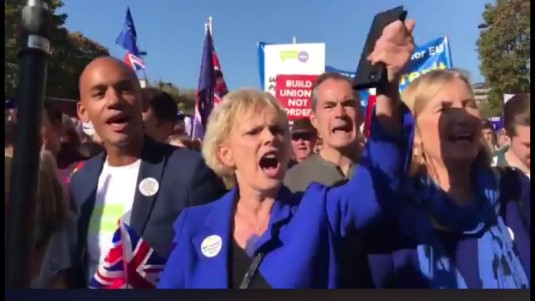
Can anything more be said about the so-called People's Vote march in London that hasn't already been noted elsewhere? According to the organisers, there was anywhere between half a million and 750,000 on the streets. Not content with nicking A to B marches off the left, they've half-inched the revolutionary inflation as well. And what's more, some of Britain's wealthiest reached into their pockets and laid on coaches down to the Big Smoke. For instance, Peter Coates of Bet 365 fame here in The Potteries was one such benefactor. By their friends shall ye know them is a useful compass for navigating around politics, for where certain initiatives, policies and positions attract and cohere certain interests this says something about the character of that politics. In Richard Seymour's take down of the people's vote campaign, he notes continuity remain went "from being a campaign of the establishment, by the establishment and for the establishment, [and] they’re now styling themselves as a populist insurgency. Or what a PR agency might think a populist insurgency looks like...". While true, especially when their propaganda oozes smuggery, he is wrong to suggest the movement can be reduced to astro-turfing - if it was the case money could buy turn outs for demonstrations, Arron Banks and the Kremlin would have mass mobilisations of Brexiteers macrhing up and down Whitehall every weekend. It's worth recapping what centrism and, given the degree of overlap, liberalism is. Cast off the identification with liberal ideas, in the main it is a social movement. In Western societies, it always was first and foremost a bourgeois movement, an alliance between the well-heeled in business, in the professions, and in emergent state bureaucracies. In its train liberalism has always dragged some degree of mass support, but with one or two exceptions it was eclipsed by the maturation of the workers' movement. An elite movement liberalism remained, but one increasingly subordinate to (and cannibalised by) conservative forces and the rising elites of the centre left. It's what Bourdieu called a dominated dominant location - here understood as a subordinate position within the scheme of bourgeois politics (think the LibDems in coalition with the Tories), but dominant vis a vis the rest of society. Also like all bourgeois politics, it is in crisis. Though the character of this crisis is different from that afflicting the Tories. Theirs is a slow burn death of a dying electoral base, ruling class fragmentation, petty ambition, and Brexit paralysis. Liberalism's is a case of mounting irrelevance. Liberalism is effectively locked out of Parliament. The LibDems have collapsed and their vote share at the last election went backwards, despite posting record membership figures. Liberal Toryism has been dead in the water since Theresa May moved to carve out the Cameroons, and they are overrepresented in Parliament but defeated in the Labour Party - virtually by their own hand. And Brexit, of course, cuts them off from the liberal utopia over the water, and is all set to damage the the economic interests they are closest to. For if the Tories under Dave were the repository of political choice for the most backward sections of capital, the shiny doyens of liberal politics are aligned to interests tied up with the single market, with manufacturing, the creative sector and the tech bros of Silicon Roundabout - it's no accident Nick Clegg landed his gig with Facebook. What continuity remain and its network of slick fronts are is a condensation of this movement of elites outside of Parliament. It's a symptom of their weakness that they have to come together this way. Nevertheless, our liberals are mining something of a rich seam. Had the left pulled off a demonstration of yesterday's size, breathless SWP internal emails would be emphasising the opportunities it opens up and all the usual leftist suspects would be hailing it as an earthquake. Clearly, the closer we inch to the EU departure date the more angsty remain voters were going to feel. And given the practical collapse of talks this week they're right to feel anxious. As we have explained before, the pro-EU marches are different reactions by different sets of people to the same problems bedevilling Western societies: generalised insecurity. Always the lot of the poor and the downtrodden, the consequences of austerity effectively destroyed prevailing politics by polarising them and, of course, delivering the Brexit vote. It brought home to millions of relatively privileged people, and not a few elites, the incertitude only other people - not them - are supposed to feel. This helps explain some of the movement's key features: its crass elitism, the over preponderance of white middle class people, the zero understanding of how we got into this predicament, and the strictly limited character of its politics. This latter point is particularly important. It's telling that the most active forms it assumes on social media is virulently anti-Labour, and anti-Corbyn. The denunciation of Tory incompetence is secondary. Why? Because this liberal project is fundamentally conservative. It is, on the surface, seeking to prevent the dislocation and hit to living standards an exit from the EU is bound to entail regardless of the flavour of Brexit on offer. But in real terms, this translates into the preservation of an austerity that is far from over, despite what Theresa May is saying. Secondly, but most importantly for those leading the movement - Peter Mandelson, Alastair Campbell, and, yes, Tony Blair - they know their People's Vote posturing is a load of old nonsense. For them and the Anna Soubrys and Chuka Umunnas in tow, it's about restoring their position. They know at the next election the bulk of their movement is going to vote Labour, but by using Brexit they're trying to drive a wedge between as many of them as possible and Jeremy Corbyn's leadership. This makes winning an election harder and in the event of another loss, easier - they think - for them to resume their prominence in and control over the Labour Party. Their antagonism isn't directed at the Tories because Brexit isn't their main concern; it's concentrated at Corbynism because the mass political participation it represents is their main obstacle to a return. The People's Vote or whatever continuity remain are referring to themselves today are a social movement, alright. A bourgeois social movement. Its objectives are about protecting the interests of a more internationalised and forward thinking section of capital, and the political positions and places its continued health depends upon. The anxiety over Brexit provides the perfect opportunity for them to reach a mass audience but, true to their elite approach to politics, the masses of people who turn up at the demonstrations are not invited to participate further. They have a walk-on part, they are bodies to be used as leverage in the media air war with Corbynism and under no circumstances is their movement allowed to open out to address other concerns. Such as the roots of Brexit in austerity, and the role the EU plays in enforcing similar politics across the continent. The way to counter this is not give in, nor to reply to the pathetic anti-Corbyn baiting we see in kind, but continue developing our programme and appeal directly to the mass of people attracted to these marches in the language of interests - just as the 2017 manifesto began to do.
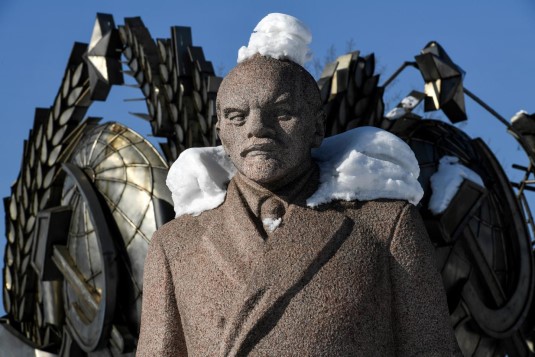
History does a fine line in irony. When Francis Fukuyama suggested in his famous 1989 article, followed by The End of History and the Last Man in 1992 that history is coming to an end, it was destined to be a foolish boast, a proper hostage to fortune. And viewed from the perspective of the close of 2018 it sounds faintly absurd, a historical curio, one for the professional historians of ideas and connoisseurs of concepts that never went anywhere. Even Fukuyama himself has intimated this is the case. Yet the end of history was, for a time, very relevant. Even on the left. Fukuyama's basic thesis wasn't that history as such had stopped. There were still people and events, dear boy, events, but that certain big political questions had been settled. The collapse of the Soviet Union and its client regimes in Eastern Europe coupled with the spread of free market capitalism and the wave of (liberal) democratisation suggested that the most optimal, most agreeable social and political forms - how we should organise our societies - had been achieved. Liberal democracy had seen off its fascist rivals in the 1940s, and come the late 80s the spectre of communism was unmasked as a feeble, broken system that could barely meet the basic needs of its citizens. History understood as competing visions of the good society was dead. As it was put on the sleeve of Fukuyama's book:
The end of history will be a very sad time. The struggle for recognition, the willingness to risk one's life for a purely abstract goal, the worldwide ideological struggle that called forth daring, courage, imagination, and idealism will be replaced by economic calculation, the endless solving of technical problems, environmental concerns, and the satisfaction of sophisticated consumer demands. In the post historical period there will be neither art nor philosophy, just the perpetual caretaking of human history.
Of course, even back then there was a certain audacity to Fukuyama's claim. If one was wedded to a particular teleological reading of Marx, i.e. history was unfolding according to a certain logic with an end point down the line, it was supposed to be communism understood as a super-advanced society of free producers that marked not the ending of history, but rather the cessation of our species pre-history. Only when a society is fully conscious of itself and in which the free development of each is the condition of the free development of all, a social arrangement permissive of individuality, creativity and new ways of being human can flourish without the bite of hierarchy, class and oppression can we say history has truly begun. Fukuyama's argument airily dismissed that and in rolled his tanks on communism's lawn not long after Chinese Stalinism let theirs loose on Tiananmen Square.
Fukuyama's was more than just simple assertion, there was some hokey philosophy underpinning his scheme. Namely that human history is a struggle for recognition as a human being, and by way of Hegel with a dashing of Nietzsche the liberal state is the end point, ideologically speaking, for this struggle for the humanity of humanity. Citizenship, the separation of powers, the law, private property, all give us a stake in society and enabled us to recognise ourselves in others. In the richest societies the middle class is the standard to aspire to. However, all is not well after history. Big risks for the "last men" of this period comes from ennui - if everything is sorted, what is to stop boredom from setting in and subsequent problems arising from thrill-seeking behaviours? Politics and market economics can capture this, but then there are the twin dangers of social stasis, and new social conflicts arising from bordeom, new oppressions, and begin the whole cycle of struggling for recognition back to the beginning. One needn't subscribe to the liberal Hegelianism of Fukuyama's piece to accept his basic argument was on the money. A number of leftists agreed that the game was up and capitalism with liberal democratic characteristics was the only show in town. Of course, it was less the force of Fukuyama's rhetoric and more the collapse of the Soviet bloc, the repeat defeats of the workers' movements in the West, and the explosion of consumerism and attendant cultural fragmentation that read the rites. New Labour was one result of this end-ism, but it persisted well into recent times. In the context of UK politics, those who would be heirs to Blair have politics bounded by liberalism and capitalism. Even under Ed Miliband his pale version of social democracy was couched entirely in a 'variety of capitalisms' argument, and in crucial respects remained as committed to "economic calculation ... and the satisfaction of sophisticated consumer demands" as his immediate forebears. I read The End of History and the Last Man when I was an undergraduate. It was the Autumn before New Labour won its famous election victory and remember thinking, like many others, this really was the end and the best we could hope for were telegenic grins and stealing policies from the Tories. Though even then I understood enough about Marx and how class struggle works that nothing is forever, and what seems permanent at one moment reveals itself as transient in the fullness of time. In his New Statesman interview Fukuyama concedes that some inroads into private property is not only probable but desirable, but while discounting a return of communism (at least as he knew it) he does accept that Marx was right about capitalist crisis and its tendency to periodically slip into them. To give him some credit, he has noted the world has changed and has altered his views accordingly - which is more than can be said about some. The truth of the matter is history is back. Authoritarian politics is on the rise around the world, liberalism is disarmed and in a state of collapse, Third Way politics is dead, and mainstream conservative parties are in trouble. But there is more at work than gloom and dystopia. Corbynism here. Bernie-ism over there. The rise of Melenchon in France, the example of Podemos in Spain, these are beginnings pointing to a rising international of new class forces. History then is offering a choice between reaction and hope, what is - with added brutality and nightmarish accoutrements - or what could be. The period Fukuyama described and hailed is gone, and it's not coming back. What comes next depends on the side you pick.
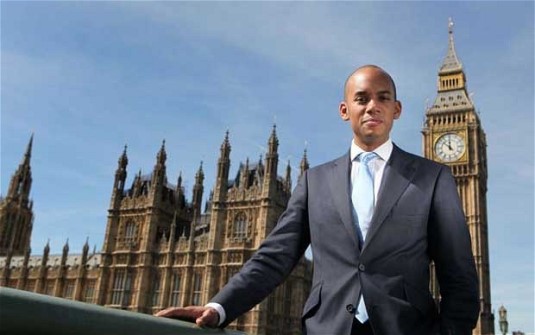
They call it the fish hook theory of politics. Imagine if you will a line. On the left is, well, the left. Travel in an easterly direction, going past the centre, at some point on the right the line bends and curves back to the point where the so-called far right hangs poised back above the centre. Self-indulgent nonsense by lefties taking jabs at their centrist rivals? Well, it would be if the evidence didn't bear out the observation. Starkly, in Brazil, not only has the centre collapsed it has fallen in behind the racist, authoritarian politics of Jair Bolsonaro instead of the centre left Workers' Party. However, it wouldn't do to suggest all centrist politics and politicians are predisposed to a moral collapse of this character. Even if they do have a not-at-all disturbing longing for a strong, liberal hero to come and sort everything out. As we have seen more times than I care to mention, centrism is obsolete, out of touch, and can't get past the certainties of 20 years ago. In an age of crisis, the situation demands radicalism and fresh thinking, not tinkering around the edges and steady-as-she-goes. It's for this reason I read with interest Chuka Umunna's latest piece, declaring "the return" of progressive politics. What would be this new dawn? A new political party? A bold new manifesto fizzing with new ideas? No. A think tank. According to Chuka's piece, centrism believes in "reciprocity", the "balancing of power between capital, labour, and the consumer" (as if the last two are not one and the same), "rigorous competition" and "playing by the rules". They believe in the importance of where people live, "communitarian ideals", the value of work but, get this, life outside of work too. Stirring words to be sure: don't ever let anyone ever accuse centrism of vacuity. Chuka moves on to address the collapse of the centre left, acknowledging the difficulties of the SPD, the Democratic Party in Italy, and the the shambles in the Netherlands. You could also add the virtual destruction of the Socialist Party in France, as well as Hillary Clinton's abysmal performance against Donald Trump. But it wouldn't do to rub it in, and Chuka's not about to belabour the point. He argues there is hope for centrists like himself because Justine Trudeau and Emmanuel Macron. These are fab 'n' funky progressives who've moved with the times and done nice things, though quite how Macron's plan to "handle" asylum applications in Libya - well away from French shores - is in the same league of Trudeau's welcoming more refugees is something of a puzzle. Which is probably why Chuka doesn't bother to consider it. Meanwhile, political debate in Labour is in a decrepit condition, framed between the left and Blairites, and metropolitan remainers and salt-of-the-earth Brexiteers when in fact it could be so much more. Chuka here does have a point. If perhaps the leadership and the membership didn't have to fight off constant bad faith attacks, mischief, disruption, and outright scabby behaviour then the level of political discussion might be a bit more substantive, nuanced and illuminating. As we saw before, the idea of the 'foundational economy' Chuka pushed for all of five minutes wasn't a bad one, but he needs to start thinking about what is happening to Britain, the changing nature of class, and what it means for politics. That is, of course, if he wants to live up to the radical mantle all centrist politicians covet. Still, having done spade work sufficient for his own satisfaction he unveils the latest knight on a white charger. Or should that be a unicorn? That would be Progressive Centre UK. Billing itself as a "non-partisan, next generation ideas lab" it says, well, not a lot. I know centrist politics is thin, but surely if you were launching a self-styled super-relevant think tank into the political world you'd want more than Chuka's Indy article and a few photos of earnest discussions from a recent shindig in Montreal. Like liberalism more generally, with which it overlaps, centrism is effectively dead, but doesn't know it yet. The social forces that traditionally animated this politics are defeated, deflated, and effectively squeezed out of relevance by polarisation. Without wider purchase, it turns inward and speaks only to itself, using wonky language, terms of reference, and revealed truths only they themselves find convincing. Unfixed and without much in the way of social ballast, launching new think tanks is about all centrism in the UK has left.
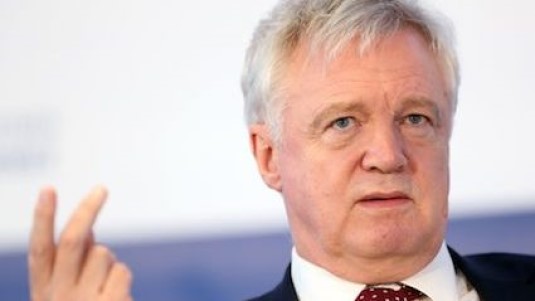
Sad times for Theresa May. At the height of her powers in the summer of two years ago, she must have known that Brexit was going to be tricky. But with Labour nowhere in the polls and would-be leadership rivals in total disarray, she must have thought this was all that she had to worry about and there was a chance for building a legacy that went beyond leaving the European Union. The one nation stuff, for instance. That's not how the Conservative cookie has crumbled. This weekend there's a possibility of defeat over fixed-odds betting terminals, growing calls to do something about the poverty causing horror show of Universal Credit, more rumours of ministerial resignations over May's current Brexit positioning, indications May's DUP partners preparing for a no deal Brexit, and David Davis calling for the cabinet to move into open revolt. The self-styled "bastard" doubles down on his criticisms of May's Chequers deal, arguing that May's indefinite backstop plan to keep the UK in the customs union with the EU until the Irish border issue is sorted is unacceptable. To be fair to Davis and his ERG comrades, the issue isn't insurmountable. As they argued at their recent press conference, you don't need a hard border or an invisible barrier in the Irish Sea. It would however mean extending existing arrangements where goods not currently subject to EU-wide rules are logged and dealt with by, effectively, a custom border in the cloud. However, where the sensible shades into the completely batshit is an assumption this can be put into place overnight. As well as the small matter of cross border traffic. It has escaped Davis's notice that there are people who commute into the Republic for work from the North, and into the North from the Republic, as well as cross border travelling of friends and relatives visits, shopping trips and nights out, and other leisure activities. Hence, for once, Theresa May is being sensible in ensuring something approaching the status quo is preserved for as long as it takes to settle the issue of the Irish border. Why, as far as Davis is concerned, is May's position "unacceptable"? Part of Davis's beef is the backstop deal that was negotiated between the EU and UK late last year, which ensured Ireland would become what Davis and the bampot Brexiteers dub a stumbling block. I don't know, I'd have thought getting arrangements right at the one land border the UK shares with an EU state and where economic and social integration between it and Northern Ireland is much closer than any other mainland region should be a priority. And, also, I know a week is a long time in politics let alone 10 months but who, pray tell, was the Brexit minister at the time this settlement was negotiated? Why, it just so happened to be one David Davis. Davis argues that May's preference for an indefinite holding position is bad for two reasons. It prevents Britain from signing free trade deals outside the EU, and could lead us staying in the EU's orbit by hook and by crook for ever. Well Mr Davis, I hate to break it to you but the fact the UK is an integral part of the economy of north western Europe - itself the horse power of the EU engine - and that the bulk of the country's trade is done with the huge economy right on Britain's doorstep, the idea we can pull away from the EU as if it doesn't exist is fanciful bobbins. No matter what you say, decisions made in Brussels will have consequences for UK trade from this point on without the UK having any input into them. You can pretend deals to import chlorinated chicken from the United States, or signing the UK up to the Trans Pacific Partnership is going to compensate for this, but it won't. A look at the map of the world will tell you why. Second, trade deals aren't a magic bullet. If, say, the UK outside of the EU strikes a trade deal with China, that doesn't put it at a competitive advantage when already it lags far behind German exports there, despite them doing so from within the EU. Though it might mean the Tories get to hand over more crucial infrastructure (and taxpayers' cash) to Beijing. Further, despite the flattering self-image of Britain as a great trading nation its productivity is poor, and has long imported more than what it sells to the world. That is not the fault of the European Union but of successive governments, Tory and Labour, refusing to address the country's long-term structural problems. This was beginning to dawn on Gordon Brown's beleaguered administration when the credit crunch hit, and it forever damns the Tories that they have exacerbated these weaknesses further. And that's before even mentioning Brexit. A trade deal with South Korea, for example, is not going to alter this in any way - not least because the first tranche of deals will merely replicate the kind of market access the UK already enjoys through its EU membership with third coutnries. We're going to hear a lot more of this during the course of this month. It says everything about Davis, the Moggites, Boris Johnson, the wavering ministers and the DUP that they can make announcements on Brexit and make Theresa May look like the sensible, level headed one. More proof of the terminal sickness afflicting the Tory party, but one whose symptoms could easily drag the rest of us down with it.
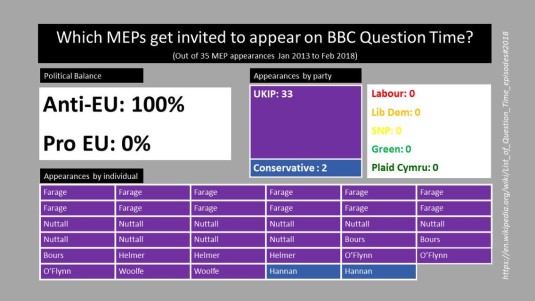
The BBC is biased toward establishment politics. As Tom Mills points out in his excellent BBC Myth of a Public Service, it has always protected establishment interests and is now a thoroughly neoliberal institution to boot. That doesn't mean, however, the political leanings and assumptions underpinning the culture of BBC journalism are on show at all times. Part of the corporation's professional ethos is a standard of impartiality and balance, and while it often falls short I've met enough BBC journalists to know this is taken seriously by thousands of its employees. For those of us interested in reforming and remaking the BBC along more democratic lines, critique of the BBC has to be tempered by efforts at winning over those who work there as well as the millions who think public service broadcasting is, in principle, something worth defending. Therefore something like the table above is unhelpful as well as being a load of rubbish. As someone who has more of a familiarity with Question Time than most (scholarly papers on the demographics and political balance of the show coming soon), as an attempt to portray bias on the programme this is almost as crude as over enthusiastic Labour people moaning about the odd Tory councillor who turns up in the audience as evidence of plants. For folks' information, Tories on social media act in exactly the same way when they turn up a Labour activist in the assembled. It's pretty clear what the author of this chart and those who have shared it are trying to do something similar: that because all MEP guests since 2013 have been anti-EU, Question Time is obviously biased. Um, no. There are definitely biases in the composition of the show's guests. The progressive and almost total erasure of trade unionists while business's representation is undiminished is a particular bugbear of mine. Women continue to be underrepresented (with only one season, 1995-96 if memory serves, in which they provide more than 50% of total appearances), and not all regions are catered for equally as the show travels around the UK. However, Mentorn - the show's producers - do at least make an effort. The two main parties are more or less equally served when it comes to representation going back to the 1979-80 season, and the LibDems and its forerunners also got an appearance quota roughly consistent with seats/polling. Since their collapse at the 2015 general election and the SNP becoming the third party of British politics, their appearances have increased roughly in line with their parliamentary prominence. In earlier times, other parties like the Greens, Respect, the BNP, and way, way back the old official Communist Party have all contributed guests. Some of them were MEPs, others councillors, and not a few had no elected position at all. The Green Party's Natalie Bennett was no stranger to the panel, for instance, despite her not holding elected office. And this brings me to UKIP. You might argue they were overexposed, though the producers would counter they have received coverage proportional to the size of their support. And that appears true enough. Yes, that even includes the 29 times Nigel Farage has appeared since his debut 18 years ago. However, what is clear is all those UKIP MEPs featured on the show were there as party representatives, there status as MEPs were not the primary criteria. And we know this because Douglas Carswell also went on as UKIP's rep after he became their (then single) MP. Neil Hamilton has gone on as a member of the Welsh Assembly. Cllr Lisa Duffy represented the party during their leadership contest in October 2016, and last but not least we had the lamentable Henry Bolton. Again, whatever the rights and wrongs of their being given a platform, Question Time applied the same proportional(ish) formula to them as a small party on the rise as they have done with other minor parties. Of course, what makes the claim of anti-EU bias even more foolish is the no shortage of pro-EU voices. Despite being backbenchers, Chuka Umunna and Anna Soubry are regulars, as are other MPs who advocated a remain vote, as well as other guests - like Alastair Campbell - who are not reconciled to the Brexit vote. As a measure of bias, this table is junk. It's a piss poor attempt to kick up a stink where none exists. Perhaps the guest range should be broadened to include more politicians from outside of Westminster, including those in local government who do not have a national profile as per Andy Burnham, but this is not the point our meme mongers are trying to make. Question Time accepts whoever the parties put up to represent them. It hasn't and doesn't care whether they're MPs, MEPs, councillors or whatever, it's the label that matters - as the show's records attest.
Some quick thoughts about what's happening in Brazil. 1. Polling 46% is extremely rare for a hard right populist outfit, and tends to be the exception rather than the rule. Not even the Nazis managed this feat in their crooked March 1933 election. The question then is whether support for this kind of politics is about to enter a new dangerous phase, or is something proper to Brazil that doesn't travel beyond its borders. 2. The Brazilian economy has had a trying time. Like most major countries Brazil took a hit over the course of the crash but it bounded back very strongly. GDP was in negative territory only for the last three quarters of 2009 and by the second quarter of 2010 it already managed to climb above its pre-crisis peak. However, in 2014 economic activity collapsed and unemployment doubled from just under seven per cent to just shy of 13% by 2017. While the recession was sharp, growth - albeit more anaemic - has resumed and unemployment is falling more slowly. 3. The Brazilian economy's rapid expansion in the 00s was not of the same order as India and China's, despite often being bracketed with them. At an average GDP growth rate of 3.3%, it compares favourably with the decades immediately before and after, but is feeble vis Brazil's own post-war boom that saw average growth rates in the 1950s, 60s, and 70s of 7%, 6% and 9% respectively. Nevertheless, there was a real erosion of poverty with the incomes of the poorest increasing at a rate faster than the rest of the population. 4. This latter period of growth was overseen by the Workers' Party, which grew up in opposition to Brazil's military dictatorship. Unfortunately, like social democratic and official socialist parties elsewhere its economic programme was thoroughly neoliberal. Free capital flows, operational independence of the central bank, and prudent public expenditure. Where have we heard this story before? Accompanying the first term in office was public sector pension reform and putting up indirect taxes, hitting modest incomes the hardest. However, like Britain deepening the neoliberal infrastructure went along with some investment in public services and social security. In the PT's second period office we saw a lurch to a more hands-on industrial strategy with funds put into state-led programmes of housing, road and rail building, port expansion and electrification while, again, leaving markets supreme. This, if you like, was Brazil's 'Milibandist' phase. Then, latterly, with the third term and as recession started biting there was a retrenchment of neoliberalism - profit taking brought deindustrialisation, and state-led development was curtailed. 5. The 2014 crisis destroyed the PT's reputation for economic competence. But it was more than just the fact of crisis itself. Like all the other recent disastrous experiences social democratic and labour parties have had in presiding over the neoliberalisation of their economies, such as France's Socialists and The Netherlands, the pursuit of market fundamentalist policies always results in the same: the political immiseration of the constituent base of workers' parties. In the PT's case, what was a movement of opposition became part of the apparatus of governance. The anti-establishment became the new establishment, and the PT actively worked to demobilise its support as financialisation and privatisation did the rest. Unfortunately, like the old establishment too many sections of the PT became inured to the perks of position, which in Brazil means egregious corruption. A case of looking from pig to man, and from man to pig ... 6. Never let a good crisis go to waste, and since the PT's Dilma Rousseff was turned out of office in the 'constitutional' coup in 2016, the presidency was taken up by Michel Temer of the Brazilian Democratic Movement. Policy-wise it was the same old same old - cut public spending, curb workers' rights, attack pensions, and go on a privatisation spree of the infrastructure built up during the PT government. 7. According to our old muckers Deleuze and Guattari, capitalism is characterised by smooth and striated spaces. What this means is, in the first instance, social flows are unfixed, rapid, disembedded, decoded. In the second social relationships are pinned down, structured, manipulated, repressed. To simplify them, corresponding to the former are the dynamic movements of the economy, the latter the stabilisation of class relationships by the state. The move from neoliberalism to developmental neoliberalism and back again are simultaneously shifts in the politics of class management. Economic growth followed by an industrial strategy sucked in more labour, subjecting them to the striated space of the work place. But downturn and "freeing" the economy evacuated millions of people from employment and subjected them to the smooth space of dislocation: the radical uncertainty of joblessness and a collapse in incomes. 8. The relative absence of the solidarities the PT grew up out of, the association of the PT with corruption and economic incompetence, and their consequent implosion in the first round of the presidential elections leaves the scene convulsed by crisis but without a credible pro-worker alternative capable of filling the void. 9. Any political conjuncture marked by uncertainty begets a yearning for fixity, a striated space of ontological security and knowing one's place. And all too often it assumes authoritarian forms - as we've seen enough in Europe. Jair Bolsonaro is little different from the demagogues that have rode to popular attention elsewhere. His programme - reasserting fragile masculinity in face of the growing political strength of women, attacking gay people and non-straight sexualities, attacking ethnic minorities and indigenous peoples, singing the praises of the old junta, threatening bloody violence - appeal to petit bourgeois people, the millions lumpenised by recession, the posh constituencies who found the PT's "inclusivity" too much to bear, the land owners worried the PT could always come for their property, and significant sections of the bourgeoisie whose interests are bound up with seeing neoliberalism through. Here we have a toxic coalition of the usual material who comprise fascist formations, exacerbated by social dislocation and significant numbers of bourgeois party voters (centrist and conservative) falling in behind Bolsonaro as an anyone-but-the-PT candidate and a promise to "restore order". Even if that order means curtailments of democracy and a return of state-sanctioned torture. 10. Brazil is the eye of a perfect storm for a far right breakthrough. The sorts of difficulties contributing to Bolsonaro's rise are not unique to Brazil, but how they have fallen together are. We've seen centre left collapses in Europe but these have mostly been well after the crisis point of the economic crash. In Brazil, growth might be back but unemployment is still incredibly large - a particularly fortuitous moment for an ambitious rabble rouser like Bolsonaro. But what Brazil has that we haven't seen elsewhere, except in the US and Hungary, is a collapsing of traditional bourgeois politics into the far right train. Despite serving their interests faithfully in 13 years of government, significant sections of business - an alliance of mostly landed interests and those tied up with finance and the internationalisation of capital - would rather see a violent and threatening authoritarian in power than the mildest of social democratic governments. That underlines the political bankruptcy of the Brazilian ruing class, but comes as a warning to the rest of us. If they can, the rich and powerful elites of Western nations could more than live with such a political settlement.
New left media consistently offers a higher standard of analysis and better arguments than you can expect from the mainstream. But it is expensive. Good comment costs good money. My favourite podcast is Politics Theory Other by Alex Doherty. Not only does his Twitter feed require a quick bump to push him over a thousand followers, his work needs financial support. Since setting up shop in April Alex has explored hot button topics with a number of left activists and thinkers. These include Adam Tooze on the economic crash, Sophie Lewis on TERFism, Jeremy Gilbert on Lazarrato and immaterial labour, and Wendy Liu on Silicon Valley. He's even had some Phil BC bloke on talking about the Tories. Politics Theory Other has proven to be essential listening because of the way complex issues are discussed and broken down. It certainly contributes toward clearing the theory gap we have on the left. However, to carry on Politics Theory Other needs putting on sounder financial footing. At the moment it's all done in Alex's spare time. With a liveable income from the podcast more can be done and his valuable work will continue into the future. The patron total isn't far off goal, so please become one here for as little as a quid a month on Patreon, as well as support Politics Theory Other via the usual socialmedia. Giving Politics Theory Other your money is certainly a better bet than dabbling in what you can find described below.
Here's a rare occasion. Less than two months since the previous round-up and enough new left blogs have appeared on the horizon. As this is the first Sunday of the month let's do this. 1. Double Down News (Unaligned) (Twitter) 2. Philosophy of Education (Unaligned) (Twitter) 3. Centre for the Analysis of the Radical Right (Unaligned/anti-fascist) (Twitter) 4. Reknr (Unaligned) (Twitter) 5. Socialist View (Socialist View) 6. The Left Bible (Unaligned) (Twitter) If you know of any new(ish) blogs that haven't featured before then drop me a line via the comments, email, Facebook, or Twitter. Please note I'm looking for blogs that have started within the last 12 months or thereabouts. The new blog round up appears when I have enough new blogs to justify a post!
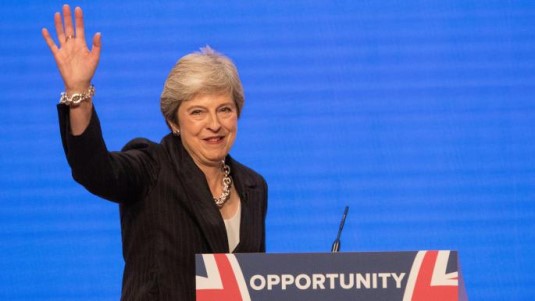
Theresa May thinks Labour voters should instead vote for the Tories. In our time of recurrent political shockers, can you recall a more unexpected revelation? Writing for The Observer, of which more shortly, May channels her maiden speech and riffs off those one nation Tory chords almost as if she hadn't presided over soaring homelessness, food bank use, and the deporting of British people who've lived here for decades. Continuing one of the themes of her conference speech, she wanted to drive a wedge between what she has started dubbing the 'Jeremy Corbyn party' and 'decent' Labour supporters whose politics are firmly aligned with the mainstream. Leaving aside the obvious point that political convergence between the Tories and Labour were key contributors to the rise of UKIP and Corbynism in the first place, May asserts that hers is a patriotic and moderate party that offers proper, reasonable answers to the questions Corbynism raises. And what are these? A good Brexit deal, more NHS cash, driving up school standards and an economy that "works for everyone". May repeats this nonsense with such regularity that she clearly doesn't bother reading her briefing papers properly. But ... there is a but. She recognises that her economy for everyone doesn't, um, work for everyone. To make sure it does we're seeing an energy price cap, a policy the Tories previously attacked as "Marxism" and up there with the storming of the Winter Palace. The Tories are going to build more houses, and allowing councils room to borrow to build council homes too. There are also whispers this morning of introducing a help-to-buy scheme which would incentivise private landlords to sell off houses to their (long-term) tenants. I wonder how many Tory MPs are going to avail themselves of what will be a taxpayer subsidy for flogging off their property portfolio? On the cost of living there's her fuel duty freeze and, um, redubbing the minimum wage the 'national living wage'. She also promises more money for public services after Brexit (news to Hammond). And last of all she has an industrial strategy, it's "stepping up to its proper strategic role in the economy". That's all very well, but what is this plan? Where is it? I don't think May's article is about to win over many Labour voters. Not only that, it's not about winning over Labour voters. The audience for this piece are the people sitting behind Jeremy Corbyn on the opposition benches - the Corbyn-sceptic Labour MPs. As reported in the Graun on Friday, the Tories are on a charm offensive. To get their Brexit deal through the Commons, and it's looking like it will probably be a softer version of May's Chequers compromise, the government needs to win over a clutch of Labour MPs. She has clearly realised, at long last, that by annexing some disgruntleds on the benches opposite she can afford to thumb her nose at the hard Brexiteers. Therefore the purpose of embellishing her one nation creds, indeed her whole conference speech was framed with this objective in mind. And lastly, a point on The Observer itself. Some people have expressed surprise that they, effectively the liberal-left paper of record, have afforded the PM space. You wouldn't expect The Mail or The Telegraph to allow a pitch for similar from the Labour leader or John McDonnell. Given the Graun's own survey of its readership, the majority of whom are supporters of Labour under Jeremy, this seems like commercial suicide at a time when hard copy readers are sliding and t'internet page views yield negligible income. The truth of the matter is as the liberal wing of the establishment, its editorial office (and not a few senior journalists) is hostile to Corbynism and, by hook and by crook, what to stay in the EU. For them, securing May's tack to a soft Brexit and the continued decline of the Observer/Graun are the lesser evil to a politics that challenge threatens establishment interests, whether liberal or conservative.