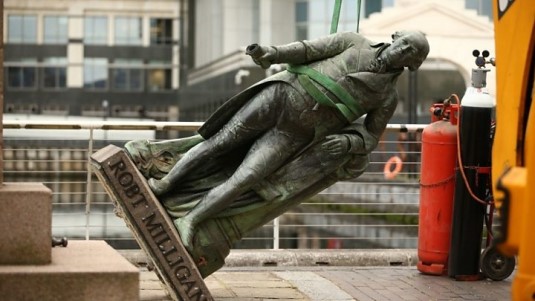
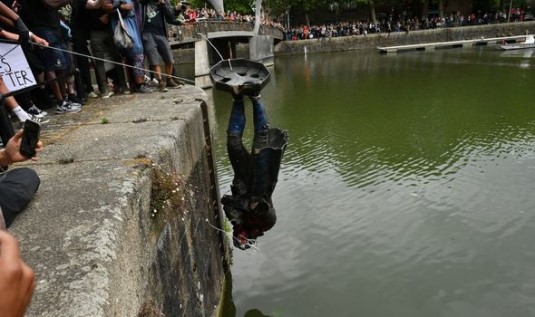
Our precious history is getting lost! blubbed Sarah Vine in the pages of the Mail. On the contrary, the unceremonious dunking of Edward Colston has done more for a full reckoning of British history than any number of government programmes. Indeed, if Vine was concerned with the warts and all story of this bloodied sceptred isle, she might have a word with her significant other who tried his damnedest to limit the national curriculum to kings and queens. Well, given their bookshelf might we expect anything different? Still, Vine's jitters represent well the unease rippling through Tory England. The Black Lives Matter protests have opened up the possibility of a street movement focused directly on racism and policing, and as those with a memory might remember, the two have come together in riots that play out roughly every 10 years - 1981 in Brixton and Toxteth, 1991 in the Midlands and south, 2001 in northern England, and the 2011 London riots. A bit of urban unrest usually helps the incumbents look tough, but with trust eroding thanks to the Tory mishandling the outbreak there's no telling what the political consequences might be. One reason why Bristol plod took the very sensible decision, from an operational point of view, not to intervene in Colston's bath. The Tories need a story to tell themselves, a narrative that can help cohere the base. Boris Johnson has gone for the old "protestors have a point but violence undermines the message" shtick, which was entirely predictable and, if anything, the standard liberal stock response, but another strand of Toryism wants to concede nothing. Daring to raise questions about the thin blue line, and using mob rule to impose a subaltern order on public space. Well, it's unconscionable, isn't it? Writing for Conservative Home, Charlotte Gill thinks so. For readers of this blog, Sadiq Khan is not a name readily associated with radicalism. He's hardly blazed a trail for local government in the way, say, Labour-run Preston has, and yet the Tories can't stand him. Despite his snoring boring creds and ensuring London is open to business, in both senses of the term, the way the Tories carry on you'd think he's conniving to set up a revolutionary tribunal. Yet, hilariously if you know anything about the man, Gill has Khan at the head of an extra-parliamentary statue-bashing movement, where he's allied himself to "Twitter" and radical left. And now, weeps Gill, after Calston other monuments are getting targeted. She fears a toppling of "male statues" and an intolerance toward past deeds, "Any discussion of moral relativism, an important feature of examining the past, has been abandoned", she writes, channelling her inner postmodernist and demanding the nuance and understanding she;d never concede to others when the record of her class is up for discussion. Perhaps then she might want to think about the actual context Colston's statue was erected in, for instance, and then get back to us. We then devolve into straightforward ranting. Campaigning against statues shows Sadiq Khan's censorious instincts! Don't you know he banned bikini bodies from London Underground advertising hoardings? Doesn't he know some of these statues are symbols of national grandeur? Doesn't like the display of women's bodies and has anti-British tendencies, you say? Nudge, nudge, wink, wink. If this mayor-sponsored foray into cancel culture is allowed to carry on, don't you know tourism might also suffer? Heaven forfend. She ends by calling on ministers to "stand up for what's fair." The government, after all have a huge majority, so why don't they use it? Ah yes, the totally healthy hunger for the smack of firm government, as long as others are on the receiving end. Still, even Gill's hyperbolic screed wasn't enough for some, and if you want the measure of the party the comments are always a good place to look. On this one we have one commenting on "the far left" destroying "our heritage." Another whingeing about the "lies about slavery" and, hilariously, the "anti-British communist Sadiq Khan." And topping it off, another commenting on George Floyd's coffin with the oh so funny "The schwarzers love their bling...". No responses, no challenges, it's almost as if the Tories don't really care about racism, especially among their own supporters. Ultimately, this isn't just about public order, it's about who gets to define and control the symbolism in public spaces. Statues of bourgeois patriarchs are there to remind passers by who are the sanctified and celebrated, whose history and experiences are valid and who doesn't matter. An act of erasure and smothering, petrified in stone. Monuments to forcible forgetting. From the point of view of the Tories, if the state can't determine how space is organised and used, if it cannot defend the symbolism that helps confer its power legitimacy then its authority is diminished. For them, these are the stakes - and it doesn't come much more important than this.
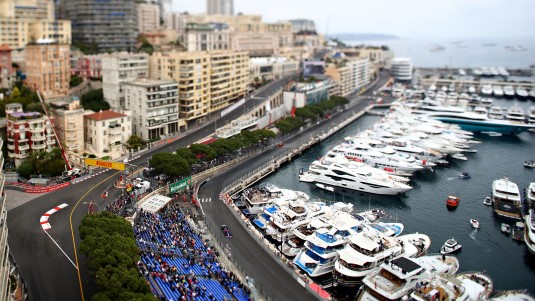
If you're a working class kid, a playground is a sprinkling of swings, a slide. a roundabout, bench, and climbing frame. If you're born into megabucks a playground is, well, something like Monaco. With the world convulsed by economic cataclysm, itself the unwelcome by-product of the health crisis, for the BBC to screen a documentary about the world's most opulent micro-state seems, well, not the most appropriate of timings. Still, there is a curiosity to be sated. What is a place like when the one per cent make up 30% of the people? Insufferable. There's little need to go into the ins and outs of the baubles dangled before the viewers' eyes. Supercars with ostentatious paint jobs, petty competition between billionaire yacht owners for ever larger vessels, palatial rooms at the Hotel de Paris going for 15,000 Euros a night, and the zero income tax that, as the narrator put it, helps "protect the substantial family fortune." Then we have the exclusive parties, the invite-only gatherings up at the Royal palace, and the master of ceremonies himself, Prince Albert II of Monaco - the only absolutist monarch on history in possession of an American accent. It's the sociology matters, the glimpses of the principality's power relationships. Albert affects a patrician if avuncular presence at odds with his and Princess Stephanie's hard-living reputations from the 80s and 90s, but his word is law. There is a no photography rule in Monaco, and professional photos or filming requires written permission - hence no paps, another bonus for harried celebrities considering residence. He also gets to decide who can become a Monegasque citizen, of which there are 9,000. The programme makes much of the elaborate hoops one has to jump through to tick the boxes, but it's very clear the (unspecified) rules are a complete sham - Albert decides all applications, and if your face doesn't fit you're not coming in. Citizenship does confer advantages though. Even a state given over to the indolence of the leisure class needs workers, and a relatively generous system of subsidies are available to citizens. As one air traffic controller observes, his citizenship means he pays 700 Euros per month for his apartment whose market rate would ordinarily be €4,000/month. Monaco however is entirely dependent on the circuits of the globe-trotting rich, as well as the sufferance of the French state. Revenues are funded by the 20% VAT the state levies on everything, which makes spectacles like the Monaco Grand Prix essential money spinners. But there is a problem: with the rise of the likes of Dubai as another luxurious hold out for the rich, how might the principality stay competitive and keep the cash flowing? Princess Camilla, consort of the Duke of Castro and one of the claimants to the long abolished and disputed throne of the Two Sicilies is determined to "preserve tradition" and come up with new ways of making Monaco relevant. Her wheeze? Influencer awards. For a micro state whose social basis rests on discretion, inserting Monaco into the overexposure of the attention economy can bring in the next generation of money bags. By getting the images of the awards and the lavish hospitality out to tens of millions of followers, Monaco hits the aspirational imaginary and the whole grift can carry on indefinitely. Monaco's opulence is grotesque and, not at all coincidentally, showcases the poverty of bourgeois success. The dream of capital is accumulation without workers nor the responsibility for their maintenance. The dream of power is control without accountability, and therefore responsibility. Monaco marries the libertarianism of the super wealthy with the arbitrariness of absolutism, and they are shown to be the conditions for one another. The other two key tax haven states, Dubai and Singapore, have near identical set ups - the only real difference being the degree to which they ratchet up the authoritarianism. And this, ultimately, underlines the pointlessness of wealth. Fortune liberates one from economic necessity, but the freedom excessive money buys is luxury behind closed doors, a berth in a rarefied society of artifice and superficiality. When you consider all the crap the ruling class inflicts and the destruction of human beings their system affects - just so they can recline in the bounded universe of gilded gated communities - doesn't it make you feel sick?
It might not be ideal weather for a swim, but neither was it ideal for a statue of Edward Colston, Tory MP, philanthropist, and dealer in slaves, to have stood in Bristol these last 125 years. And now his copper bottomed facsimile reposes on the bed of the Avon following a Sunday outing with Black Lives Matter protestors, the decades-long debate about the status of the statue is settled. The reaction, as you might expect, has been mixed and we've seen three broad responses emerge within "the discourse." There are those who celebrated the statue's demise - the argument we'll call for the purpose of this post, the right one. Just as the American south is littered with Confederate generals, many a plinth on these islands supports a questionable encumbrance. A slaver here, a pirate there, invaders, occupiers, butchers, the whole gamut of 18th and 19th century conquistadores from Britain's imperial past. Their misdeeds bracketed and their person commemorated by likenesses of granite and cast iron, their continued and unremarked presence in officially sanctified and maintained spaces denotes a society ill at ease with what its forebears have done, and so either likes to pretend it never happened or concentrate on the two World Wars (and one world cup). Even Britain's atrocities since the war, such as Partition, the war in Malaya, the Mau Mau rebellion in Kenya, and its "police actions" in the late 20th and early 21st centuries barely register as things we should learn from, let alone atone for. Always happy to demand contrition from Germans, and affecting astonishment that Japan adopts a studied amnesia when it comes to its occupation of and crimes committed in Korea and China, the British state, its leading parties, its mass media and press, the entire establishment refuses to consider the global trail of dead as far flung as its empire once was. The George Floyd/Black Lives Matter solidarity protests here in the UK would not have tapped a deep well of resentment and exploded if we didn't have similar problems. The British police are not as overtly violent and racist as American cops, but people of colour are likelier to be stopped, searched, roughed up, and banged up. Black people are twice as likely to die in custody than whites. This is compounded by a division of labour that is heavily racialised, with black people - women especially - disproportionately located in the lowest paid, precarious, and in these Covid times, dangerous occupations. And despite the official ideologies of anti-racism, anti-black racism in particular is not taken seriously. Under the carpet it goes, along with blood flecked sweepings of imperial history. It's time racism in this country was treated as a social and a political problem, a structural feature of capitalist societies, albeit in our case with particularly British characteristics. The unceremonious trashing and dumping of Colston's statue might change the terms of the debate as other statues and historical legacies come under pressure. However, there are people, powerful people, who'd prefer racism to remain a moral issue for, well, very political reasons. The Home Secretary Priti Patel is one such person. As a politician from an Indian background, her overtly right wing takes on issues - like threatening the Irish Republic with food shortages, tough on refugees, egregious chumming with right wing Israeli politicians - are attempts to endear herself to the Tory grassroots, a good chunk of whom very grudgingly accept BAME MPs and ministers. Showing more concern for a rusting statue of a centuries-dead slaver ("utterly disgraceful!" she wittered on Sky News) than any victim of racism, her careerist instinct is to be seen being tough on anti-racism. This is more than her getting accepted and easing a path to future higher office, trying to make the Colston dunking a criminal matter avoids having to address the substantive issue. And for good reason: any reckoning with police racism and imperial history means lifting the lid on Tory racism. Remember, as recently as, well, December's election the Tories promised a crackdown targeting travellers. As the wheels come off the clown car and difficulties mount, an insurgent street movement targeting imperial heroes is an unnecessary distraction, and a potentially damaging one for Tories who might be drawn to the empire's defence. There's another establishment response too, and once seen pushed by assorted Blairy types and paragons of centrist virtue. Rob Marchant Of Labour Uncut, for instance, whinges about "mob rule" and "vandalism", and mentions democracy. This is pretty much the response you can expect from Labour's front bench, if they venture into these waters at all. A wide ranging and thorough discussion of racism and imperialism doesn't suit the present leadership, because party history is up to its neck in it. We like to hear about Clem Attlee, the crusading reformer. We never hear about Clem Attlee, the overseer of Partition, father of the bomb and colonial anti-insurgency, and the man who soaked our African possessions to pay for Britain's post-war recovery. And, well, Black Lives Matter shines an unwelcome spotlight on current party practices. The racism uncovered by the leaked report, the systematic failure to take complaints seriously, the repeated targeting of black MPs by the right of the party, the factional preoccupation with only one form of racism, offering arguments about process and the proper way of doing things avoids having to reckon with what BLM and solidarity movements are saying. Black Lives Matter has a mass following in Britain not simply because racism exists and we're sick of it, but because the establishment in its Tory and Labour guises are complicit. The Tories are happy to whip it up for electoral purposes, and Labour are much happier pandering and addressing "real concerns" than challenging racism, whether it's on the doorstep, in the press, or comes out the mouths of their right wing opponents. This time, however, something has changed. BLM and the solidarity protests will die down in due course like all movements do, but the issues raised are not going away. The days of depoliticising racism as a personal failing are done: its relationship to politics and power are clear for all to see.
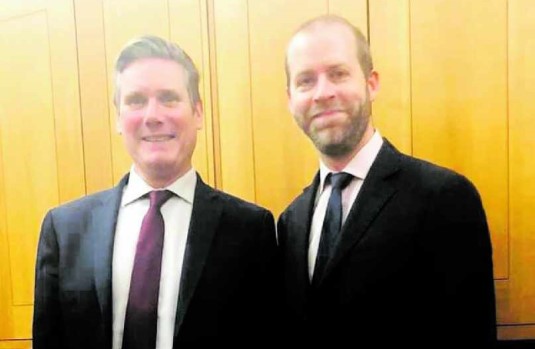
I'm going to tell you a story about social security. After leaving university I went on the dole. The advisor at the job centre handed over a huge wodge of paper work to fill out. Because I was living with my girlfriend, the advisor told me to put a claim in as a couple. For the next few months I went along to the job centre showing proof of my interviews and job applications, and each month the letter would come through saying my dole was being cut. It went down to £50/week, then £20, then five quid, and finally the utterly princely zero pounds. Thanks to receiving this generous entitlement I didn't bother going to the Job Centre again, and to top it off they sent me a letter saying they were terminating my receipt of sweet Fanny Adams because I hadn't abided by the rules. Why the reductions? Because, occasionally, my significant other would do more than 16 hours a week working in a local pub. The perversity of the system, brought in under the Tories but left alone by Labour, meant zero help for me and the millions of other young people who've experienced unemployment for any period of time. Therefore when a politician, someone like Jonathan Reynolds who holds the shadow work and pensions brief, for example, says they want to do something about social security I'm listening. Because there's no beating about the bush. Labour under Blair and Brown not only failed our people when it came to welfare, they happily kicked those dependent on it in the teeth. The workfare policies they criticised the Tories for wanting to implement when in opposition got a new lease of life with the so-called New Deal of the late 90s, and the demonisation of people on benefits passed into the common sense of Blairism and the Labour right. MPs like the thankfully defenestrated Caroline Flint, who wanted to throw unemployed people out of their council homes, Rachel Reeves who said Labour was not for people on benefits, or Harriet Harman's failure to oppose cuts to benefit caps and child benefit, all of whom would be stains on the parliamentary party if it wasn't already stuffed to the gills with people who are as bad. And in some cases worse. And so we have the first problem when it comes to popular support for social security: the Tories and Labour have spent 40 years thinking up ways of excluding people from the system entirely. This strand of policy thinking, a term used lightly here, on the Labour right is driven by pure triangulation. Kick those on benefits because they don't vote anyway/have nowhere else to go, and we might win over a few Tory voters jealous of the Wayne and Waynetta Slobs living a life of riley on £117/week in their heads. Not the wisest given how the party needs to win back seats with high levels of welfare dependency next time, this approach to social security by the last Labour government compounded the problems of social security: its inefficiency, its failure to be even a residual safety net, its punitive and disempowering character. There is, however, another tradition on the right. Which is where Jonny Reynolds comes in. The much-discussed, to put it euphemistically, interview for The House magazine sees him set out some principles and thinking about welfare. He would like to see the £20 increase to Universal Credit brought in by the government at the onset of this crisis continue and have it apply to Jobseekers' and Employment Support Allowance too. The five-week wait for benefits should also be abolished - a move originally introduced by Dave and Osborne to try and force claimants to accept any job as they suffer an income-free gap between application and receipt of payment. He also thinks the case for limiting child benefit and the cap on support has been destroyed by the crisis. A positive move, albeit one sounding more like the contact with everyday reality seeping through rather than a more principled position. He would also like to see the expansion of statutory sick pay and it increased by an unspecified amount. Where's the controversy?
“When you’re looking at how you design or change the system going forward, certainly I feel if you have made greater contributions to the system, there is an argument that you should receive more out of that system. It doesn’t mean that you will ever be leaving people without support or leaving them destitute. But I simply feel that that lack of a connection between what you put in and what you get out has become a major problem of social security and the political support for it.”
Ah, there it is. There's this thing a bit like the internet's wayback machine called memory, and digging deep you'll find the last time this was floated. In a major speech to try and cohere the Labour right behind a political critique of Corbynism back in 2015, Liam Byrne set out his stall. Among which was the application of the contributory principle to welfare. Leaving the problems with this for a moment, it was something he flirted with under Ed Miliband as part of a limited attempt to rethink welfare and results from trying to stand on two horses. One wants to gallop toward helping people in need by providing a new settlement worthy of the name 'social security', and the other is merrily cantering toward appeasing the (contrived) public appetite for walloping scroungers. Despite their antagonism, the idea was about giving everyone a stake in the system, which is a sound principle for building any welfare system. That's why generous and universal benefits are the way to go. One reason the progressive removal of universalism and going down the route of residual welfare didn't attract major protests or thrust a militant claimants' movement to the fore wasn't just because of the accumulating weight of scrounger rhetoric, but because the payments were pretty poor in the first place. Unfortunately, Jonny's preference for reasserting a contributory principle introduces a division between deserving and undeserving claimants. This would lend itself to a new round of divide-and-rule politicking by the right around benefits, and therefore undermines the universalism of the non-contributory floor. ABC stuff, you would think. And far from simplifying matters, it creates more admin as new sets of means tests are introduced and it stores up rows over eligibility, leaving Labour open to the accusation it wants to impoverish middle class people by setting the criteria too stringently and the payments too low. A whole world of political pain awaits that, in the end, won't do much to build a consensus around the sort of system we need. Again, it's not perfect but a generous and unconditional basic income is the simplest way of building a welfare system in which jobs are under permanent threat from automation and, without a decent programme of state-led investment, where the UK labour market has a miserable history of low paid and insecure jobs. Knowing that the wolf will not be at the door if your job evaporates would transform the life chances of millions, improve the take up of education and retraining, and a whole host of other benefits besides. As an ideas man, Jonny has shown interest in the basic income in the past though others on Labour's right hate it so much they have to lie about it. Yet even if this is a non-starter in these days of ever-so-responsible opposition a Labour position on welfare has to ask itself two questions. Does it adequately support our people because, contra the likes of Caroline Flint, the poorest are our people and, duh, Labour has a clear political interest in consolidating our constituencies. And does welfare help collectively empower our people in the context of a wages system in which the pressure on incomes from employers is structurally downward. A contributions-based system, even if it is grafted on top of a universalist system and affords special privileges to those who've worked longest or have paid more tax thanks to higher salaries cuts against the second principle, and sets the stage for an attack on the first.
Sometimes, other people simply say it better. What the world doesn't need right now is a white bloke miles away from the action offering their take on all and sundry, and doubly so on the American rebellion against police violence and structural racism. We should be hearing from black people. It's their experiences that need centring. It is they who deserve, need to be listened to. In this episode of TyskySour, the Novara team interviews Nelini Stamp, an activist with the Working Families Party in New York about the police, racism, and why protest has exploded right across the the country. Well worth watching.
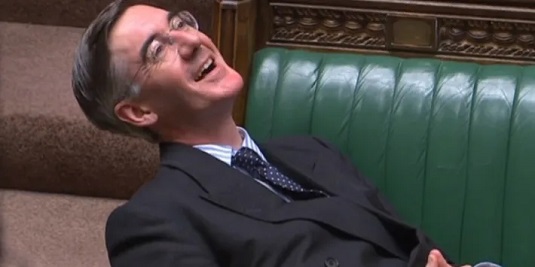
I've lost count over the years of the things that have made mainstream politics a laughing stock. It's good to know then, in serious times like these we can still find something that beggars belief. Take Jacob Rees-Mogg's insistence that the Commons returns to normal, for instance. Westminster watchers know how parliament has, sensibly, been ticking over at reduced capacity for the duration of the lockdown. No more than 50 MPs in the chamber at a time, two metre physical distancing, screens so other MPs can participate from home and electronic voting. The latter has raised a few eyebrows as technical difficulties has seen Rishi Sunak vote against the government, and Rachel Reeves rebelling twice against the party whip. This for Rees-Mogg is too much, however. These emergency measures must be dropped forthwith. Under the cloak of democratic accountability, the Leader of the House believes parliament's functions can only be discharged properly if honourable members are there in person to challenge the government. After some pressure, he put forward a motion that would allow MPs to ask urgent questions and make statements remotely but rule out electronic voting. The result? An easy win for the government's plans to open parliament by 261 to 163 votes, but not before the absurdity of over 400 MPs standing in a socially distanced queue snaking its way around the estate. The vote took 36 minutes and, again, made a mockery of the so-called mother of parliaments. Obviously a stupid scheme, plenty of MPs have talked about their unhappiness. Tory MP Robert Halfon on BBC Breakfast Tuesday morning said Rees-Mogg was uninterested in his own difficulties - he's presently shielding due to underlying health conditions. Margaret Hodge has complained for the same reasons, and Valerie Vaz has criticised the plans for being discriminatory. You have to ask why the government are so wedded to this absurdity. We know accountability is poppycock. If Boris Johnson took it at all seriously he wouldn't dive out of Downing Street Covid updates at every given opportunity. Nevertheless while this is farcical for everyone concerned, with potentially deadly consequences for some MPs, there are real political logics behind the move. Moves that will advantage the government. The first is keeping up appearances. With MPs spread about the chamber, Johnson looks isolated and all at sea when he addresses the assembled. Even though Keir Starmer's questioning is quite restrained the Prime Minister has had trouble coming up with convincing answers. With most workers still at home and more watching PMQs than usual, Rees-Mogg knows having his boss floundering without the encouragement of his satraps, the look is not a good one. To enhance the optics, as they say, the government are happy to risk the health of hundreds of others. Well, it's all of a piece. Then we have the issue of authority. The standing of the government has come under strain of late thanks to the Cummings affair, opposition to easing the lockdown, and U-turns on NHS charges. There was also a mounting rebellion of MPs against Johnson's refusal to let Cummings go. Picking a fight to enforce something petty, pointless and going against all reason is a useful reminder of who is in charge. It won't do anything to restore the government's good fortune, but a quick Commons win will assure some jittery supporters worried it's all starting to run away from them. And then we have the main reason, at least where Rees-Mogg is concerned. The move to remote sitting and electronic voting is something of a Trojan Horse. Not because he's fondly attached to parliament's absurdities and mind-boggling traditions, though he's more than happy to cultivate the country gentleman fondly attached to custom and ancient ritual. This is all about power. The convenience of something as basic as push button voting would speed up proceedings, meaning more time for debate and a pressure for more private members' bills - plenty of which are never to any government's liking, and has potential to put it in difficult positions. But more than that it's the thin end of a wedge. If electronic voting, where might the change-minded end? Sittings at reasonable hours? More powers for back benchers and select committees? Electoral reform? Someone as hyper class conscious as Rees-Mogg wants to preserve parliament as is because it is a bastion of class privilege. The stupidity has the consequence of framing British democracy and its constitution, such as it is, a strange and alienating beast. The building and its rituals affects the private school/Oxbridge atmos, a home from home for generations of bourgeois politicians. The accent on tradition comes before democracy, underlying the political habitus of the British ruling class. It's almost as if representatives of the popular will are unwelcome in the corridors of power and everything about the House contrives to remind MPs of this. Naturally, some find this charming and others the pinnacle of democracy. Labour MPs in particular are prone to this parliamentary cretinism. Tories, especially so Tories from bourgeois backgrounds, aren't stupid enough to fall for these transparently obvious illusions. Nevertheless, Rees-Mogg understands the smallest of changes challenges the established way of doing things, and with it comes a host of unforeseen dangers - as the Tories have found out with their two recent experiments with referenda. Keeping the arcane traditions going throws chains of procedure and pomp around the dangers of the democratic impulse and harnesses it to innocuous and often useless ends. The government then have had their way on this, but again they are storing up trouble. 24 MPs in the current parliament are 70 or over, 11 of whom are Tories. And of those who shielding, we are talking dozens from all parties. By bulldozing its way through opposition in the Tory ranks, Johnson and Rees-Moog are sowing the seeds of ill will. We saw how that undid Thatcher in the long-run and more recently, Theresa May following her imperial phase where she rode roughshod over dissenting voices. Could we yet see a case of history repeating? Image Credit
Worried about the consequences of the coronavirus-induced depression? The next few years are going to be very difficult and are sure to polarise further the class and generational differences that have ripped apart British politics these last few years. But in a number of ways, the developed world is lucky. It has the health infrastructure, strong institutions, and the expert knowledge to pull through the crisis relatively undamaged in the long-term. Assuming their government's aren't incompetent or borderline psychopathic. The challenge in the developing world, however, is much greater. A number of countries lack the technical base or resources to mitigate the consequences of the pandemic and their efforts are further weakened by the debt burden and, if they happen to reside in an oil producing region, the geopolitical games of the great powers. In this interview with Alex, Adam Hanieh looks at the impact of Covid-19 on the developing world and sketches out a bleak picture the mainstream media are simply refusing to cover.
A month has passed into the history books, a month that might finally be seen the beginning of the end for this Tory period in government. Hope springs eternal, so for now let's see what posts troubled the internet-travelling public. 1. Why do the Tories want to Cut Furlough Payments? 2. Yvette Cooper's Miserable Capitulation 3. The Dim Wattage of Thangam Debbonaire 4. Is Boris Johnson Losing It? 5. The Class Politics of Easing the Lockdown May has been a month of Tory failure. They're determined to raise the lockdown while transmission is high, but have suffered important reverses on their initial attempt to cut the furlough scheme - so thankfully May's top post is now superseded by events. For the time being. Then we have a couple of faux pas from leading figures in the Labour Party. The sort of missteps sure to become increasingly common as they try and warp reality to fit their nostalgia-tinted views of the world and the dogma of an obsolescent creed. Remember, opposition is only effective if you engage with how our declining press frame it. And then we have two more pieces zeroing in on the pressures besetting Boris Johnson, pressures culminating in the rapid collapse of the government's polling position. It will go lower. Time for some second chance saloon picks. Who qualifies this month? I'd quite like to see the summation of Tory coronavirus woes get a few more clicks, mainly thanks to the account of Tory statecraft it contains. A useful heuristic in understanding why Johnson is clinging to Cummings (and no, the latter doesn't have to have anything on Johnson) and one I'm finding very useful as I'm writing the jolly old Tory book. And the second? It has to be a look at what militant political science is, a post that came about after chancing upon a tweet from New Socialist editor, Tom Gann. It doesn't pretend to originality, but every so often the basics have to be restated. And, bugger it, here's a third. On the death of the office. What gives next month? You'll have to ask Nostradamus, but I can have a go at forecasting more appalling Tory stories, the public health and political fall out of easing the quarantine early and perhaps, just perhaps, a post on another ancient video game. Image Credit