I've heard this abomination. Thousands of kids have had to sing it. And now it's your turn.
Like many people, I'm prone to ear worms. Those songs that stick in your brain and will not be shaken loose. It's not bad when it's something decent, but for the last two days this ostentatiously patriotic piffle, which all schoolchildren are officially being encouraged to sing on 25th June by the Department for Education, has proven an absolute torture.
Forget the silly Nazi Germany/Hitler Youth hyperbole peddled by more excitable types, One Britain One Nation is the official song of the One Britain One Nation campaign whose explicit aim is to develop a civic national identity similar in character to the 'official' nationalism of the SNP. Comrades fulminating against stormtroopers might want to reflect a bit deeply on the material proferred. Look at the video, it's very multi-culty with dozens of children from black and minority ethnicity backgrounds. Think about the happy clappy lyrics wedded to the trite incantations of our unitied unified nation in unity: not exactly Deutschland über Alles. Check out the guy behind it, Kash Singh. A former copper, he won plaudits for his softly-softly community-based approach to policing in the wake of the Bradford riots. Is it likely the kinds of people booing at footy players taking the knee and exercised by the imaginary evils of the scapegoat-of-the-hour are going to see this video and welcome it? Doubtful. It will be dismissed as lefty crap as far as they're concerned.
Like the Gareth Southgate open letter, Singh's efforts sit in a recent tradition Boris Johnson's government are groping toward: the rebranding of British national identity undertaken by New Labour. Fortuitously for Tony Blair New Labour coincided with several movements, or moments, in British culture: a new wave of guitar rock, the exploding British R+B and club scenes, Brit art, city centres made safe for gentrification, the early internet, and decisive shifts in popular culture toward anti-racism, LGBTQ acceptance, and the bedding down of gains from the second wave of feminist struggle. Blair, as a relatively youthful leader and fresh face, rode the cultural wave of what he self-consciously branded a "young country". He talked about change and modernisation, and with a tired and broken Tory party in office the Blair of the 1990s and, arguably, up until the Iraq War looked the part for enough people.
But it was not enough to serve as an adjunct to it, the desires the moment unlocked had to be harnessed, and Blair did so in a superficial overhaul of how the British state operated. A parliament for Scotland, devolution for Wales, Northern Ireland, and London, and repositioning the monarchy following Princess Diana's death were all of a piece. Central to this was a new official anti-racism. Everyone had a place in Britain regardless of their ethnicity or religion, everyone had the right to equal opportunities and fairness, and the only people on the outside were those who eschewed "British values". Into this hat fell fascists, racists, travellers (of course), and following the September 11th attacks, jihadists and Islamists. One of the leftist critiques of the early New Labour years pointed out this top-down multiculturalism did not foster inclusivity: it effectuated division, allowed for a new beggar-thy-neighbour politics on the basis of communities competing for resources and representation in local government, quangos, public services, social and council housing, and government itself - all in the name of liberal tolerance.
20 years down the line, what was officially promoted is embedded in the everyday production of social life. Social liberalism is the spontaneous common sense of most people, and outright bigotry a minority view. It's understandable how the Tories, this most chameleon of political formations, are adapting themselves to it. Their war on woke puts them on the wrong side of history, and the more intelligent and far sighted Tories know it. Including, despite indulging the odd racism himself, the Prime Minister.
That said, while One Britain One Nation isn't a Tory front, it is curiously out of time and out of joint. Aside from football, British patriotism for most is a modest, unshowy thing. Contrary to what some think, flag waving is not a popular pastime in the red wall or anywhere else. State-mandated displays of national celebrations come to nought, such as the street parties the government encourages us to hold whenever a royal marries, a new sprog is born, or when the Queen reaches another milestone in her reign (looking forward to the Platinum Jubilee next year?). And likewise, so will this song and the hype around it - especially now it has government backing. In all likelihood, some kids will have memories to cringe to for decades to come but at best most parents and people won't notice it, and those who do will see it as tacky and fake. Inventing and pushing nationhood and national identity has to be subtle and worked at, it can't be mandated or condensed into a setpiece event. Whether it's called Our Britain Our Nation day or not.
Wednesday, 23 June 2021

Monday, 21 June 2021
Previewing Batley and Spen
Will George Galloway's intervention in the Batley and Spen by-election spell doom for Labour? One would hope not, but with Labour support crumbling even in seats Keir Starmer is supposed to appeal to it's not looking good. The scale of the problem can be glimpsed via this excellent video from Owen Jones. Well worth watching.
Sunday, 20 June 2021
Evaporating Labour

According to Paula Surridge, what happened on Thursday was a partial detachment of remain/liberal-minded Tory voters from the Johnson coalition. The key factor here was Jeremy Corbyn, or to be more accurate his absence. This layer voted Tory in 2010, supported Dave again in 2015, May in 2017, and Johnson in 2019 because Labour scared them. This was undoubtedly the case when Corbyn was leader, but we should not pretend it's anything unique to the Corbyn period like Surridge does: they responded to the Tory frighteners just as well when Gordon Brown and Ed Miliband were in the chair. Then there is the Brexit factor or, again, its absence. Tory remainers ranged from not being excited by to opposing the prospect of a second referendum. Johnson promised to get on with it, and wanting to move on plenty of remain-minded voters supported him on this basis. Just ask the Liberal Democrats. Now Brexit has happened and the consequences become clearer, the ideological glue sticking this slice of conditional Tory support to their coalition has grown weaker. With the result many were happy to give the LibDems a go in the by-election.
What has this got to do with Labour? Speaking to C4 News, Surridge said one shouldn't read too much into Labour's result, which saw the vote fold by more than 90% on 2019. It's merely a result of tactical voting. Indeed, she went as far to say it was potentially good news for the party because those former Tory voters now feel free to move between Labour and the LibDems. We'll see if there's any evidence for this in Batley and Spen.
I'm not convinced for a couple of reasons. Taking a trip down memory lane, one of the supposed appeals of Keir Starmer was his assumed traction among the southern shire counties. Impeccable hair, suit, countenance, he would be a better salesman for Corbyn-lite policies in such places. Keir is tailor-made for seats like this. Yet the first opportunity voters were asked directly about the Labour leader and where he's taking the party, against the trend of the swing to Labour in the south in the elections just gone, the vote evaporated. Paula is right, there was tactical voting, but if it's the main explainer for Labour's vote disappearing, it has never been seen on this scale before. Was there something unique about the seat? No. And if Paula is right about the scale, why did the Greens' (historically smaller) vote hold up better? Are Labour supporters more disposed to lending their votes and Green voters hard bitten and sectarian? Obviously not.
There is an alternative explanation, and something the PolProfs tend to forget. All demographics are distributed across all seats in the UK. There is unevenness in the concentrations of age, ethnicities, and strata, but everyone is everywhere. A banal observation, but consider Labour's new core for example. It populates the big cities and gave its Labour MPs supermajorities, but they also inhabit Chesham and Amersham, as well as Batley and Spen and Hartlepool. With Labour set on abandoning their interests and distancing itself from their support's outlook, that will provoke a negative reaction wherever they are found. Hence the danger of bleeding votes to the LibDems and Greens, and as Keir Starmer has turned on the party's base, as forecast it's fraying. It stands to reason that in Chesham and Amersham, the story of Labour's collapse was tactical voting and protest voting against the leadership's disastrous strategy.
The question is whether they can be won back, and the answer to that is highly unlikely. With the leader's office concerned only with ostentatiously trumpeting its opposition to the Tories from the right, briefing about how swathes of its support is antisemitic, and signalling how uninterested it is in providing an opposition let alone winning office, carrying on like this there won't be a Labour Party left. Labour politics are rapidly boiling down to a choice between opposing fates: either Keir and the bulk of the right go, or Starmerfication does for the party. There is no middle way.
Image Credit
Friday, 18 June 2021
After the Chesham & Amersham By-Election
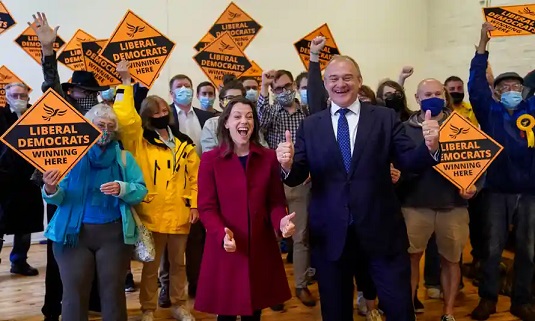
There's some grain of truth in all of them. Yes, even the last one. We know Boris Johnson is taking elements of his electoral coalition for granted. We know local grumbles over things like HS2 are electoral bromides for governments in by-elections where decisions from remote Westminsterland are imposed on locals. And ye, it was a seat ripe for the plucking for the Liberal Democrats. They are a party skilled in opportunism and slippery politics. A one off, then? Nothing to be seen here? Not so fast. Enjoying his moment, when Ed Davey took his orange hammer to break the flimsy blue wall built for this afternoon's photo op, he was right to note the Tories are, in the main, more vulnerable to LibDem than Labour assaults. This has been starkly clear since after the 2015 election when they started picking up council by-election seats disproportionately from the Tories. It was a measure of their cluelessness that Tim Farron and Jo Swinson swallowed the anti-Corbyn demonology and thought pickings were easier from disaffected Labour supporters than the actual evidence of electoral performance. To Davey's credit, on assuming his party's leadership he penned a piece suggesting he'd passed this most basic of comprehension tests.
But was it a case the Tories lost the seat as opposed to the LibDem's winning it? If we accept the Surridge thesis that the Tory voters all stayed at home and the anti-Tory bloc got its act together (for once), then there's nothing for Johnson and co to concern themselves with. It can be put down to a mid-term protest and one that means little as it'll bounce back at the general election. This, typical of the empiricism customary to political science, misses a lot of complexity. As explained many times here before, one of the peculiarities of our age-divided (class cohort and property-divided) politics is how older people are more likely to vote at election time. In second order elections like by-elections this is even more the case. Turn out generally goes down, but the propensity to sort out the postal ballot or turn up at the polling station for working age and younger voters decreases at a much faster rate than the over 60s. Given the propensity for older voters to support the Tories, we are left with two possible outcomes. Either older and retired folk broke with the established patterns of second order elections and stayed at home in greater numbers than younger punters, or they turned out as normal and a good chunk switched their preferences for this contest. I know which one is more likely.
This does present the Tories a problem. From the experience of UKIP and the Brexit Party, we know how these helped loosen the fealties of older Labour voters and opened the way for Tory voting, among other things. If more by-elections occur in the so-called blue wall (or deep blue sea, considering their geographic domination of England), and with the LibDems primed for these sorts of seats, there is a happy danger of a chain reaction unfolding, of momentum building on momentum, and breaking habitual Tory voters from their habitual voting patterns.
But is there wider significance? Contrary to Stephen Bush's argument, I believe there is. It plays out differently (in England) depending on the seat, and that is anti-political establishment protest. Between 2012 and 2015 with the LibDems in government, UKIP became the protest party of choice. It didn't win, except on the occasions of Douglas Carswell's and Mark Reckless's defections and subsequent by-elections, but came second in practically every contest after the Eastleigh contest. They served as the repository of angry brigade voting whether the defending party were the Tories, Labour, or LibDems. These dynamics so conducive to a populist politics haven't gone away, and our most recent contests - Hartlepool and Chesham and Amersham - affirm them. In Hartlepool Labour selected the worst possible candidate in a seat lousy with resentment at being taken for granted. As perverse as it may seem, the Tories were perceived as the best possible protest vehicle for giving an uncaring Labour Party a bloody nose. Hence the much worse result than even 2019 under Jeremy Corbyn. The LibDems opportunistically exploited HS2 grumbles (the party is formally supportive) and the diffuse discontent in Chesham and Amersham, and reaped the reward.
What this also suggests is future parliamentary by-elections are likely to repeat this pattern: a reaction against whoever is seen as 'the establishment' in any given seat. Fortune then is doing anything but smiling on Labour's chances in Batley and Spen. With Keir Starmer announcing on Thursday that Labour is spending the next 18 months determining what its policy is going to be, the party has little to nothing to say except the Tories are bad. Hardly a prospectus to see off a populist challenge, let alone power insurgencies in places like Wakefield (which may become vacant) where the party came second 18 months ago. The Tory and George Galloway's challenges are tapping into the anti-establishment dynamic in the seat, making a comfortable Labour hold the least likely outcome.
For almost a decade parliamentary by-elections in England have seen the populist dynamic deliver upsets and seemingly bewildering results. It's astonishing the combined wit of professional politics, the commentariat, and the wise sages of political science have yet to cotton on.
Image Credit
Thursday, 17 June 2021
Sian Evans - Hide U (Tinlicker Remix)
What happens if you take a drum and bass classic, get the original artist to re-record her vocals and trance it up? In this case, something exceptional.
Want more memories? Indulge the hundred greatest tunes of the 2010s why not.
Want more memories? Indulge the hundred greatest tunes of the 2010s why not.
Wednesday, 16 June 2021
Brexit Trade Deals and the Tory Class Interest
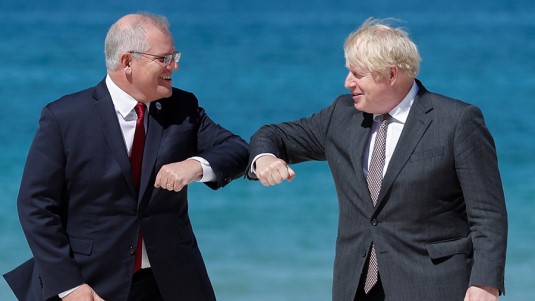
The full details haven't been finalised. This is an agreement in principle, so the trade secretary says. It might be small beans now, but Australia is in that part of the world rapidly becoming the centre of gravity for the global economy. The UK needs to be where the action's at. As Truss is fond of saying, we've got to stop treating current trade volumes - worth some £12.9bn - as a static figure and think about what the numbers are going to look like 15 years from now. Whatever the case one hopes the balance of trade would be somewhat better, considering under existing arrangements the UK imports twice as many goods and services than it sells to Australia.
Still, it's great news for everyone, right? Having tried to assuage UK farmers rightly fearful for their livelihoods seeing recent Tory moves against them, we learn the government are going to screw them. Details the Tories have kept out the press here, the fine print Boris Johnson wanted keeping under wraps has been published in Canberra. Turns out they lied. From day one Australian farming concerns have tariff-free access to the UK market, and the quota designed to manage the transition to unlimited trade places the cap at 60 times present levels. This is a terrible deal for UK farming and for what? There isn't a single discernible advantage for the British economy, but it is bedding in competitive disadvantage. How do we begin to explain the enthusiasm with which the government have embraced this shoddy piece of work?
It comes down to a confluence of a number of things. Brexit might be done and dusted, but for the rest of this government's time in office it has to permanently persuade chunks of its coalition that it was all worth it. Getting a quick and dirty deal done, any deal, plays well in the editorial offices who aren't about to scrutinise the specifics and tell their readers they've been sold a pup. Closely aligned with this is a peculiar but particular species of gesture politics. Sign trade deals, talk bewildering numbers, don't pay EU-stan criticisms any mind, and portray a stuttering recovery from Covid and Brexit as if it's a sovereign, independent Britain going from strength to strength. A deception, but one in full accordance with the hopes millions have invested in this false prospectus. It's easy to believe if you want to believe.
And there are the economics. It's true enough Tories wanted to escape the EU to avoid new regulations curbing tax dodging, and because the bloc was always potentially an impediment to their untrammelled power and desire to push down living standards of a workforce they hold in contempt. But in addition to and cutting across is a lazy perception that British or, rather, City of London interests are best served by making the UK the offshore hub and playground for the emerging powerhouses of East Asia. Hence the government submitted its application to join the Trans Pacific Partnership in January, despite being some 8,000 miles from the ocean. Still, if Australia can be in Eurovision ...
Getting a deal at any price with Australia and, in short order, New Zealand is about telegraphing to Pacific nations that the government will bend over backwards to be let in. It doesn't matter if the terms of trade entrenches a disadvantageous position for the UK because the sorts of interests the government are closest to - commercial and financial capital - have the most to gain. As per Tory custom and practice, levelling up in the context of "global Britain" means advantage for some and free market competition for the rest. But the real prize, the holy grail of the Brexiteers, is still the trade deal with the United States. The UK's admittance into TPP on a supine prospectus, they calculate, makes a transatlantic deal much more likely. And while the standing and influence of the UK is bound to diminish, the position and the wealth of the class the Tories organise and serve grows more secure.
A reminder then that Tory economics are about numbers second. In the first instance, whether Brexit, Covid, trade deals, it's always about class. Their class.
Image Credit
Tuesday, 15 June 2021
Normalising Institutional Corruption

Okay, so what now? Conveniently forgetting her own last minute delay to the report's publication, in the Commons this afternoon Priti Patel said the government cannot and will not ignore the findings. She also said she'd written to Cressida Dick, criticised by the inquiry for throwing up barriers to its work, and asked for a detailed response to the panel's recommendations for rooting out the culture of arse-covering. Worryingly for anyone interested in supposing the thin blue line is whiter than white, the report also criticised the under funding of anti-corruption efforts and singled out budget cuts for the persistence of improper vetting of recruits. Given the popularity of Line of Duty and the fictional penetration of the force by organised crime, that fact alone might make the law-and-order brigade nervous. Evidently, given the multiple failures on her watch Dick should not have the luxury of considering her position. She ought to be sacked.
I'm sorry to say there's little chance of that happening. The Met has always been a compromised institution. There was never a golden age of Z Cars/Dixon of Dock Green proprietary. Honest coppers, bent coppers, all that has changed since the brazen corruption of the 1960s and 70s, when a significant number of police were either on the organised crime pay roll, or were a firm unto themselves shaking down criminals and enjoying a slice of their takings, is the character of corruption. Police on the take appear to be much less of an issue, but the police closing ranks, scratching backs and covering up wrongdoing, as the Morgan report shows, this continues unabated.
Nor is it about to change, because government operates on exactly the same principles. Having successfully shirked their responsibility for 128,000 deaths, the one move to have characterised the Tories since the general election is the body swerve. Rishi Sunak should be out on his ear for last summer's reckless Eat Out to Help Out. Matt Hancock ought to have fallen on a sword - any sword - for PPE failures, the Serco test and trace shambles, and shipping tens of thousands of elderly people into care homes where Covid exacted its grim toll. And Priti Patel for breaking the ministerial code while happily encouraging thuggish policing for straight up political positioning. At the very top not only do we see politicians behaving without accountability, the constant drip drip of Tory corruption is more a summation of the cronyism and back-scratching that characterises the UK's state institutions than anything else.
There will be headlines and handwringing. Perhaps Patel might see if fit to make an example of Dick, but likely not. Either way, nothing will change. Authoritarian policing is here to stay. Since Johnson's rhetorical toying with breaking the law in the lead up to the general election and over ignoring the withdrawal agreement, despite designing as well as signing up to it, the behaviour of Tory politicians are more than ever geared around what looks good and confers the right feels to their expansive and coherent support base. Ethics in politics, always a dubious proposition, aren't even worth lip service. All that matters is stoking the fires of support, and that means no institution, especially if their purpose broadly aligns with the project of an indefinite stay in office, is about to be held to account for incompetence and corruption. Lest it shines more of a light on the Tories themselves.
Image Credit
Monday, 14 June 2021
The Class Politics of the Work/Life Balance
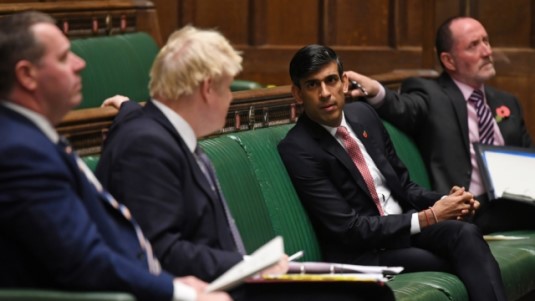
Thanks to Johnson's holding out on adding India to the red list of countries, the re-named Delta variant is in circulation and the government have lost control. Again. Therefore, the foolhardiness over so-called freedom day is to be pushed back from 21st June to 19th July. Some very minor restrictions will be relaxed in the mean time, such as caps on numbers at weddings and funerals provided there is social distancing, but nothing else changes. The good news, however, is the vaccine roll out is driving down hospitalisation rates and therefore deaths. Too late for some thanks to the usual lackadaisical Tory approach and their getting pulled in different directions by the interests they articulate and serve. But amid the gloom, at least Johnson can console himself with the fact public opinion is onside, especially the solid bloc of his core support. There's little sign Covid is chipping away at his edifice still.
High and dry then? Not quite. The problem with a huge majority, an obscene poll lead, and an opposition that's barely noticeable is the absence of a check on one's worst instincts, and thus the will to overreach manifests. Which is where Dishy Rishi comes in. Even though the government have extended restrictions, the Chancellor is determined not to add another month to the furlough scheme. As planned, the furlough scheme starts getting wound up from the beginning of July. The amount the government will pay drops from 80% of salary to 70% of up to £2,187.50/month, and then from August until the end of September it drops again to 60% of up to £1,875/month. However, employees on furlough will still be entitled to the 80% rate and so businesses are going to have to fork out. This means businesses, mainly small businesses, who can't return to normal and start taking cash are either going to collapse, or let go their hundreds of thousands of employees. Local government grants vary from area to area, and so Sunak is bent on unleashing a wave of unemployment and sucking demand out of the economy.
Economic madness, yes. But not if the primary concern is preserving class relations by reinforcing the discipline of the labour market. Since last year, Sunak has been concerned with cutting furlough and ensuring the "most generous package of support in the world" is anything but. Also gung-ho for a return to workplaces while many companies are contemplating a life of substantial home working, he (and a number of other Tories) feel the worry in their bones that things won't quite be the same after the pandemic. More time at home has, it is feared, tilted decisively the mental balance between life and work. The longer the emergency measures bed down as the new normal the harder it's going to be to turn back the clock and refasten the workplace rubber band on staff who want a bit more from life than the daily grind. It means moves by bosses to restore the ancien regime might be met with grumbles, slack productivity and perhaps, just perhaps, the worst thing of all: collective workplace resistance.
Leading Tories are nothing if not hyper class conscious, even if they clothe their interests and stakes in stuff and nonsense. The keenness to throw hundreds of thousands out of work is a play as old as Thatcherism. Pull the rug from under workers by forming a substantial army of the unemployed before going after others' pay, jobs, and industries. Few in the cabinet, particularly the true believers in hard right economics, know nothing restores labour discipline quite like the prospect of job losses. The uppity consequences of furlough and spending more time away from the workplace can be nipped in the bud, even if it means liquidating a small layer of small and medium-sized business.
Can the Tories get away with it? That same layer of the petit bourgeois have so far been kept afloat by the government and their support has been reciprocated in the polls, but now they're being lined up as sacrificial lambs, just like another key prop of Tory support, the question is whether these turkeys will carry on voting for Christmas. For the Tories, it doesn't matter. Heart strings might get pulled when the Daily Mail interviews some Hard Working Mother who has had to close her shire county teahouse, but with the solid block of retirees to fall back on the government feels it has a freer hand to tread on some toes in its coalition if the greater Tory good is served. And the question of keeping labour discipline on an even keel? Nothing, apart from the the persistence of the party itself is more important.
Image Credit
Saturday, 12 June 2021
Gunhed for the PC Engine

I remember my first encounter with Gunhed in the pages of Computer and Video Games. The PC Engine, along with Sega's MegaDrive were the wave of the future. Though it was debatable whether either of the two machines were more powerful than their 16 bit home computer counterparts in the West, the screenshots oozed quality. They just looked better than anything American and European gamers had encountered outside of the arcade. With my humbled clapped out Spectrum at home, the Gunhed screenshots - just like Tatsujin did a few issues later - woke something in me. A desire to have that experience, to be immersed in something way outside my means but also something cutting edge. And what did it were the bosses. Imposing and relatively intricate behemoths, you just knew going up against them in a comparatively puny spacecraft would make for a great digital ruckus. Such were the things to be gleaned from simple screenshots in those halcyon days.
30 years on from these lustful thoughts, how did finally getting my hands on Gunhed compare to the hopes I had for it? All expectations were met. Save one. The ship handled perfectly and zipped around the screen at just the right speed. The enemies came thick and fast, but not in overwhelming waves - provided the ship, the titular Gunhed, is packing the heavy artillery. And the power ups were fine. Anyone who has played a Compile shooter before knows the styles and the system. Different weapons are represented by numbers, which can alternately be powered up by collecting purple orbs. One is a multi-directional shot, two a wave blaster that can be partially directed, three is lightning - which is fun, and four is a crappy shot with spinning barrier balls. This can be complemented by three secondary weapons: a shield, multiples/options, or homing missiles. All of which come in handy. And naturally the more the ship acquires, the more one feels that false sense of invulnerability common to nearly all shooters. When you die you start off with the pea shooter again, which typically means a cascading collapse toward Game Over. Where Gunhed is a little kinder than its contemporaries is getting a bullet down your snout won't always kill you but knock you back a power level. And with plenty of power ups always available one can climb out of the hole relatively quickly. There's also smart bombs to get you out of a tight spot, but they're not great - they don't clear the screen and there is a delay between pressing the 'please blow them up' button and the fairly naff explosion. A shame.
Where Gunhed palls is in the music department. Expecting something pumping and energetic like a Technosoft game, instead the tune is the twee 80s anime-dramatic style, something it shares with Tatsujin and Super R-Type. A shame. The sound effects, however, are very serviceable and fit the action perfectly. Which is just as well, because the game is perfect action. This is definitely for winding down the higher brain functions and surrendering to the advanced reflexology it offers. Difficulty-wise it's perfectly balanced. A novice can get about half way on the first go, but then the challenge kicks in. The bosses, those oh so beguiling bosses are ... not that hard actually. Some are very well designed, but their attack patterns aren't difficult to master. If your ship is armed with the wave or the lightning they won't be too much trouble - what will be are the attack patterns of the minions and the sheer number of bullets that are thrown on screen. A fog of war can sometimes descend amid the mayhem, none of which ever lets up and, testament to Compile's technical virtuosity, none of it slows down either.
It was then, for its time, almost the perfect shooter. That probably explains why Compile more or less remade it for the Super Nintendo, known to us as Super Aleste. The music is better, but still not the rockfest that was standard when it came out. But it did recycle all of its sound assets, the same power up system (though with beefier weapons and more to choose from), and enemies with the same attributes. The core gameplay remains, and proved Gunhed's worthy successor. But now in the 21st century? After years knocking around the Virtual Console and recent appearance on the permutations of the PC Engine Mini, how is it remembered and how does it fare? As NEC's machine never made it out of import here, Gunhed was only really known by the few who had grabbed a PC Engine or followed C+VG. Curiously it didn't seem to influence later titles in the vertically scrolling genre apart from Compile's own loosely connected Aleste series of games. And so Gunhed, around these parts, is very niche. But it does not deserve to be. Not original when it came out, apart from the music it nails every aspect of how a vertical shooter should look, feel, and play. It is the distillation of a genre that still had many years to run, and one seldom surpassed.
Image Credit
Friday, 11 June 2021
In Praise of Deceleration

Then there is the Accelerationism of human potentials. This is a politics immanent to capitalism and its expanse of class struggle. It is of fighting encroachments of commodification and the state, of taking capital on in the workplace and the street, of winding through the fused spaces of online/offline, battling in culture wars, taking positions and holding them and always, always pushing the envelope of the possible. Its standpoint is against capital and its exploitation of our bodies and our souls, and for affirming life against the necessity wage labour. It's a politics of what might be versus a deadening existence of expenditure and waste. It struggles, it dreams of shaking off the chains of social obligation and economic necessity, and looks for those points where the primacy of living labour can be asserted against the phantasmatic dead labour of capital. When it finds them, it accelerates capacities outside of capital's capture in new ways of living, new ways of communing and belonging, it builds on the sum totals of human knowledge to anticipate societies beyond capitalism. Imagining the future is everywhere and always imagining a life lived differently. This species of accelerationism is not a counsel of despair unlike its inhuman counterparts, but a valorisation of our collective powers and it is this, these particulates of resistance and potential that any accelerationism worthy of the name disseminates. Its velocity is not an arrow pointing forward in time, but horizontal, flat, a wave of ever extending momentum. It never crashes, but like a tsunami it washes in and keeps on coming, sweeping capitalism before it.
But what's this, a third form of accelerationism? And one predating Nick Land's sojourn at Warwick's philosophy department by about a century. That is the accelerationism of impatience, or of the voluntarism that has proven as immanent to revolutionary politics as class struggle is to capitalism. Can we describe it as accelerationism? Sure. Just as macro/molar/Landian accelerationism is concerned with strapping rocket boosters to, for want of a better phrase, the "objective" tendencies and flows of capitalism pointing to its dissolution, the old or the first acceleration was a speeding up of politics by bypassing it completely. The most famous example was the infamous "third period" of Stalinism, of the declaration of social democratic parties as "social fascist" to be struggled against with a vigour equal to, if not surpassing that reserved for the existential menaces of mass fascist movements. The attempt to overcome the influence of larger rivals in interwar labour movements was not by making common cause against a common foe, but in the belief communist forces, sometimes quite meagre as per the still born CPGB here, could overcome disadvantage by stepping up activism and short circuiting the process of building class consciousness. Tragedy and farce, this has been repeated uncounted times by Trotskyist and Maoist groups since, as if one more paper sale, one more demo would turn the wheel and the masses wake up. Interestingly, Lenin himself - their alleged inspiration - set his face against the politics of bypass. In the 21st century it assumes new forms, and is typical of the alienation peculiar to the fusion of class and identity politics. Unlike the political subjectivities of openness, connectivity, and possibility pushed by the accelerationism of human or, if you prefer, molecular potentials, voluntarism rebooted is founded on closed subjectivities. This is identity as a bounded location, one shut off and policed. It generates a recursive universe, a lifeworld filled with certainties as long as the real world is kept at bay. By forswearing the outside, its acceleration enacts a double movement: a formal declaration of forward everywhere at all times. And, perversely, a complete loss of momentum. It flounders, lacks purchase, refuses to go anywhere. It's stuck. We see this in trade union elections where only the most left wing candidate will do, even if it means letting in the right. We see it in elections, in the raising of political demands, in the constant churn of internecine struggle and backbiting among those giddy with the speed at which they tear around around the closed circuits voluntarism sets up.
Because the production of subjectivities is simultaneously a vector of capital accumulation, the open apparatuses of regulation and control, and resistance to capital, the state, and the subjectivities it foists on us, voluntarism and its ironic negation of possibility is a temptation and a tendency molecular accelerationism must be alive to. Seminars and sermons on neoliberal identity, of samizdatting sophisticated theory will only ever go so far. Indeed, taking measures to mark off the voluntarist folly and holding out the hope of innoculation runs the risk of making it more, not less likely. Perhaps what might help is a more modest politics? One cannot escape the layers of history and inequality our fleshy bodies carry about them, but perhaps we can think more about how we invest our energies. What is gained, for example, by identifying with and reinforcing an identification with a politician, a party, or a set of policies and/or theoretical positions? That is going beyond solidarity, which is absolutely crucial to accelerationist politics, emptying the object of the relations that place them in the context of the movement and the struggle and instead pouring in self-identification? Perhaps a modest politics has to be a touch more instrumental, a bit more conditional. It also has to be a politics that is active, collective, and necessarily pragmatic. As old Timpanaro reminds us in his rehabilitation of Engels, the power of movement is constrained. All things at all times are not possible, and his advice for the Marxists of the 1970s was to pay attention to "passivity", of how the material contexts of politics always matter. They cannot be wished away.
In other words, a truly useful accelerationism needs an ethic of deceleration. Multiplying the potentials for new life is also about thinking through how this can be sustained, and in ways that empowers, politicises, builds solidarities and collective institutions, and this often means slowing down, taking stock, consolidating, thinking. Deceleration is understanding the world is never always open, and that our efforts, our attempts to accelerate the coming of the new society are, have to be, strategic.
What deceleration isn't is decelerationism. This is the very opposite of what we want to achieve. Decelerationism is bourgeois politics, and its raison d'etre is to make sure the flows and dynamics of capital do not trespass its speed limit. Capital, commodities, workers, their movements and velocities are fine as long as labour keeps meeting capital and producing surplus value, without excess spilling over into oppositional collective consciousness and leftist politics. They are all containers. Conservative politics suggest we live in the best possible world, and radical attempts to improve it lead to ruin. Liberalism and the reformist (or rather, technocratic) permutations of social democracy, labourism, and official communism say we also live in the best possible world, except for. Decelerationism, like its seeming antipode voluntarism, also cannot be screened out. Molecular accelerationism as it goes about its work has to make its case and continually make its case to the point it becomes spontaneous common sense. We're at the stage now where decelerationism and its slow flows are where we need to be. And getting there isn't just about putting one's foot down and rushing forward. No journey is completed without its necessary decelerations.
Image Credit
Subscribe to:
Posts (Atom)