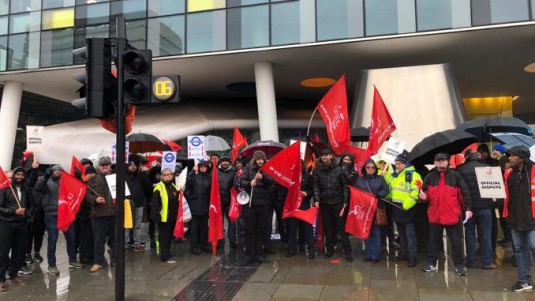
The question before the membership then is what sort of union should Unite be? Seemingly learning his lesson from the absurd campaign of four years ago, Coyne has so far steered clear of personal attacks and hysterical talking points. That's what the friendly rightwingers in the PLP are for. Instead, his website is economism, economism, economism. The six pledges from his manifesto repositions Unite as a service union there to help with reskilling, advice, and more full-timers to support the reps. Nothing about organising, nothing about struggle. Also of interest is a promised "democracy commission" to make the union "less divided" (code for curtailing Unite Community), and an investigation into the union's £98m Birmingham hotel. Save the size and the monies involved, Coyne's platform is no different in kind to election addresses ambitious randoms put together when pitching for a students' union post. It is a step back to the "new realism" of the post-Thatcher period.
And it might work. Trade unionism is political because it challenges management's right to manage, but because it's not immediately, spontaneously big P Politics, the fiction politics and economics are separate is relatively easy to maintain. This is something Coyne understands too well with his promising "an end to messing about in Westminster politics." It's not difficult to think this through. If a workplace branch is fighting to protect existing conditions or is complaining about health and safety, it's not obvious why Unite should be issuing warnings to Keir Starmer about ongoing issues. Whisper it, some don't see virtue in handing the Labour Party any funds at all, a reality that had a mass expression in the past, but these days is more likely to resolve itself into an apolitical stance, cynical about all politicians. An attitude that would suit Coyne down to the ground.
Coyne could be on to something. Pushing the same shtick last time got him within touching distance of the top job, so why not now His success or failure on this occasion is not within his gift: it depends on what his opponents do. Steve Turner has met with the other two left candidates about hammering out a deal so only one goes forward, but no movement at this stage. Given the splash Howard Beckett has made on social media, most of his following are egging him on and basically declaring he should go before the membership regardless. A case, I'm sorry to say, that owes more to stanning and voluntarism than considered analysis and an appreciation of what defeat in Unite means for the left in the labour movement. While Steve Turner is said to be Keir Starmer's second preference, the question Howard's die hard support need to ask themselves is whether our people, from the precarious worker trying to organise their office or depot to branches under attack as bosses foist the costs of the Coronavirus crisis onto them can live with a right winger in the general secretary's chair. To pose the question should elicit the obvious answer.
Obviously there's some distance to go and Steve has rightly said a running commentary on the negotiations would be unhelpful. But there is wriggle room among all three candidates to offer a common programme, and so no reason why politically a compromise cannot be reached. Howard is offering an explicitly politicised trade unionism, Sharon Graham talks tough on workplace organisation and equalities - especially important as trans people are under sustained attack - and Steve has a comprehensive list of priorities for building the union. On all of these issues, Coyne pales. His is a programme for locking the union in a state of quiescent decline and despite what he says, subordinate to the dismal schemes of his parliamentary allies.
As a former T+G shop steward and current member of Unite, politically Howard's pitch strikes me as the most attractive. But practically, what is his chance of winning if there is no unity candidate? Contrary to what some might think, even though the union is growing again it is not being overwhelmed by the newly politicised. The new layers are largely a reaction, a move into the union from workers whose immediate thoughts are clouded by the need for certainty and protection as the economy churns with uncertainty and business collapse. There was no Corbynist flooding of the unions, unfortunately. If Howard emerges as the unity candidate, then fine. The left should back him. But if not, then there is a duty, yes, a duty for leftwingers and socialists to support the best placed candidate to keep the union out of the death grip of the right. And that, at the moment, is the man with the most nominations, including the backing of the largest branches. Steve Turner, in other words.
Image Credit
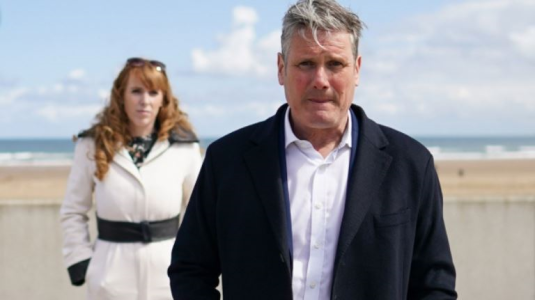
Following attacks on several footy players for showing solidarity with Black Lives Matter, and coming in for stick on social media, in a widely shared open letter Gareth Southgate took on the racists who abuse them. Defending the England team's stance on anti-racism and entirely consistent with the "progressive consensus" multiculturalism of the Blair years, he attacks the racists' sense of Englishness as old fashioned and dying out. With nods to soft patriotic markers of the monarchy, the war, and the "brilliance" of the country, he says his players have every right to stand up for the issues that matter and that all of them have a responsibility to the wider community. The clear implication being the racists are not just on the wrong side of history, they're outside a rebranded inclusive Englishness too.
Not controversial. A gentle nudging, barely even cajoling. It was a piece designed not to make racism a wedge issue but appeal to the better nature of fans who might put their love for the game before bigotry. Obviously not dyed-in-wool racists and dog whistlers like the appalling Tory MP, Lee Anderson. But in this moment on which Labour might capitalise and stand up for anti-racism, even of the most unchallenging kind, where was the Labour leader? Why did it fall to the England manager to defend this legacy of Labourist state building. How could the official inheritor of this tradition only muster a meek tweet of support?
A reminder of the context. The Batley and Spen by-election takes place in three weeks' time, a contest Keir Starmer would do well to win unless he wants a summer of unrest and rightwingers waking up to his lacklustre performance. Amid reports and whispers from the local Kashmiri community that they're minded to sit on their hands thanks to his hamfisted comments about Kashmir last year, and unwillingness to say anything about Palestinians as the Israeli government were slaughtering them by the dozen, even this, a little sign, an intimation of leadership on anti-racism might have helped a little bit. But no. It's almost as if the "grown ups" think they have nowhere to go, and somehow a sympathy vote will see Kim Leadbetter through.
Tone deafness toward an immediate and potentially existential threat to Keir's leadership is, sadly, par the course. The approach to opposition has been weak, from tailing the government and practically patting it on the head at points, to letting others do the oppositional groundwork for him. It was Marcus Rashford who gave Keir permission to start challenging the Tories on school dinners. It was Dominic Cummings's appearance before the select committee that gave Keir the strength to raise the issue of the horrors this government visited on care homes last year. And it was the G7 agreement on the corporation tax floor that encouraged him to start acting like taxing big companies is a good thing, despite Labour's awful rightwing opposition to Rishi Sunak, Rishi Sunak raising the rate. If Gareth Southgate hadn't penned his letter, it's very likely the Labour leader would not have uttered a word.
If this wasn't bad enough, we know the avoidance of wedge issues is purposeful. In his last rare intervention, his Blairness counselled for the avoidance of so-called culture war issues. Peter Mandelson did likewise. Keir did not need this advice from his forebears. By saying nothing it might hoodwink enough socially conservative voters into thinking the plastic patriotism was genuine. Or, alternatively, it clears the decks for Labour's presentation of its economic and social policy agenda. An economism of hoping warmed over Fabianism will do the trick as punters gaze upon the next manifesto in awe, but without actually saying anything now about what Labour would do in office. One might suggest picking priorities and banging on about them until the election might associate the grey blur of Keir Starmer with something substantial, but there's no sign yet this penny has dropped.
It's one thing to accuse leaders of not leading. All party leaders attract these brickbats at some point, but rare is the politician who is so hapless (or mendacious) that their entire strategy appears geared around triangulating defeat and the demobilisation of one's support in every direction. The question isn't whether Keir Starmer can turn it around. It's whether he wants to.
Image Credit
Having gathered a community of interest around the issue, including an eyebrow raising Theresa May, it looked a dead cert that the government would be defeated as the opposition benches joined with the Tory dissenters. The only difficulty, and what ultimately sank it, was the means by which this thoroughly deserved setback was to be administered. With the government's Advanced Research and Invention Agency bill making its way through the Commons, this innovation agency - a brainchild of the unlamented Dominic Cummings and set up to pour state money into radical technology projects - would be forced to make up the shortfall in the Overseas Budget had the rebel amendment passed. However, there was a risk of the Speaker dismissing it because of the lack of connection to the bill before the house. For example, casting our minds back to the parliamentary battlefront during the Brexit wars, when May was bringing her deal to the Commons for the third time, if a sympathetic backbencher had moved an amendment that would see a doubling of honourable members' salaries, this could, and in all likelihood would have been rejected by John Bercow on these grounds.
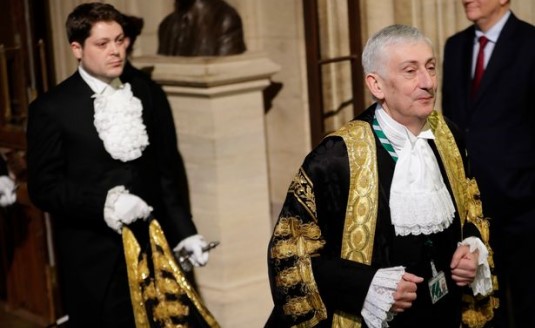
Today, our current Speaker Lindsay Hoyle said no. In ruling it out, he said the government should bring overseas aid to the House so MPs could have their definitive say on it. Fat chance. If he was worth a hill of beans he would have forced the government's hand by accepting the amendment as a means of forcing them to respect the modicum of democracy the Westminster system allows. It comes down to how one conceives the speakership. Should the Speaker try and make up for the advantages the government has by championing the backbench member and empower them so the executive can be held to account? Or is the Speaker the custodian of tradition, the preserver of the constitution, and working to keep the bewildering pomp and obscurity going? Bercow, a Tory, was very much a facilitator of accountability. Hoyle, nominally a Labour MP, a Labour MP clings to process, fetishising the form over the meagre democratic content.
This is not a coincidence. Several summers ago, the crowds gathered beneath Elizabeth Tower to hear Big Ben ring out for the final time for four years. As noted then, it was always going to be Labour MPs who got dewey eyed over the stilling of the bongs. And likewise, Labour MPs tend to be more attached to the ludicrous, alienating traditions of the Commons than their counterparts on the Tory benches. Plenty have commented on the private school ethos of the place, and how its obscure rules and stuffy atmos is specifically contrived to remind MPs from the lower orders that this is not theirs. A lot of Labour MPs, however, absolutely love it. Having secured a seat against the odds, what most would find alienating is actually flattering. They're being welcomed into the most exclusive political club of all, they're there by their sweats and talents, and they've earned it. It might bewilder, it might induce a sense of inferiority, especially with posher MPs about acting like they're very much at home, but because of their election, their elevation, they cling to if not enjoy the traditions and stupidities of the place. It affirms and confirms them as a cut above.
This is why we have such a contrast. The Tory Bercow was the most radical speaker of recent times. He was entirely at home running the Commons, having spent decades circulating around the top of the party's tree and, at one point, training other Tory politicians for their political careers to come. For Labour's Hoyle, he is as conservative and as plodding as they come. Hardly surprising considering he comes from a working class dynasty. A red prince before the term was coined, he entered the Commons just as his dad was kicked upstairs to the Lords, and in the days following her death telegraphed his penchant for sycophancy by calling for a national children's hospital named after Princess Diana. When one has a feel for the game, when it's as much a part of you as you are of it, the rules, the niceties, the ways of doing things can be bent to one's will. When one isn't, unless armed with a class analysis - which some MPs in recent times were - the tendency is to venerate, fetishise, and preserve. And in the case of Lindsay Hoyle, as it is destined to be during his spell in the chair, his first instinct to abide by the conventions and niceties of his holiest of holies will see him back the government each and every time.
Image Credit
If this blog is known for anything, surely it's got to be the decline of the Tories thesis (Falling Down: The Conservative Party and the Decline of Tory Britain is out this September from all good bookshops, plug, plug). But what if this has been the wrong focus? Arguably, it is Labour that have manifested declinist tendencies more starkly than the Tories. A process, you might say, that was confirmed by the 2019 general election and compounded by Keir Starmer's performance as Labour leader.
With a longer post in the pipeline and some serious reading to be done before bed, friend-of-the-blog Alex had a sit down with Jeremy Gilbert about this very issue. In the discussion Jem talks about the size of Labour's core electorate, whether the Greens pose it a threat, the obsolescence of centrist political strategy, and whether the Labour right are interested in winning an election at all? Staples of this place to be sure, but aways good to hear someone else singing from the same hymn sheet.
Please remember to check out the archive and help build new left media by supporting Politics Theory Other here.
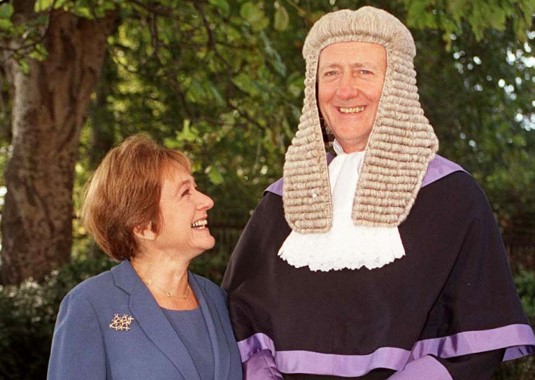
Keir Starmer's Labour Party is uninterested in winning elections because his support base and biggest cheerleaders, the Labour right aren't. This is a statement of fact based on the ample evidence of the last six years. Their primary concern, their sole obsession is neither vote catching nor taking seats. This is everywhere and at all times secondary to their main purpose: the crushing and exclusion of the left.
You never have to wait long for confirmation of this thesis. They simply cannot help themselves. They flatter themselves into thinking they're the professionals and the "grown ups", but they'd much rather bash the left than take the fight to the Tories. Take Margaret Hodge, for example. With a fortune of at least £18 million to her name and major share holdings in a tax dodging steel enterprise, she's been the literal bourgeois in the bourgeois workers' party for decades. With her class interests more closely aligning with the party opposite, is it a wonder she's not in any hurry to see the Tories dumped out of office? And so we find her at the heart of the Labour right's latest vendetta.
Firing off a thread last night, Hodge informed the Twitter-travelling public that she had reported Unite to the police. She wrote,
I have recently seen emails suggesting that Unite top officials have been covertly funding political activities. Keeping this secret from its hardworking members ... In these emails, it appears Unite officials, including Howard Beckett, were deliberately orchestrating the deselection of longstanding Labour MPs ... Both @tom_watson and @spellar were allegedly targeted by this plot meaning they were distracted from representing their constituents and had to fend off underhand deselection attempts. Unite should be focusing on the priorities of its members in the wake of COVID-19. Not the political whims of a few trade union barons.
As per her signature style, she couldn't resist the dishonest flourish at the end. While it's true Unite officials were not supporting members under pressure from Covid-19, that has more to do with the disease, let alone the pandemic not existing at that time. But the rest is the usual bullshit you can expect from this quarter. Tom Watson, readers will recall, was spending more time pursuing his scabby Project Anaconda, subsequently flirting with the LibDems, and attending to his property portfolio than anything resembling opposition to the Tories. And as for John Spellar, when he wasn't ranting incoherently in parliament he held glum Brandhall Labour Club get togethers plotting their take down of Corbyn's leadership. Both men and their following of satraps and temporarily embarrassed right wing Labour MPs had declared war on the membership and would rather the party be a smoking ruin as long as they could be the kings of the ashes.
The real target in all this is Howard Beckett. With Gerard Coyne not looking like he'll get enough nominations to make it onto the ballot (good), their hopes lie in an anyone-but-Beckett winner. Howard Beckett, as readers will know, is pitching for the Len McCluskey continuity vote and has made loud noises about Labour's dismal failures. Most worryingly for Keir Starmer's leadership and a clutch of useless MPs, has pledged to turn off the cash taps unless the party pulls its finger out. He's the candidate to beat with a punchy social media campaign and, as it appears, the momentum. Whether he'll win the general secretary election remains to be seen, but without any political arguments to answer his rise nor any pull in Unite the Labour right can call their own, Hodge has turned to the law in the hope the plod can intervene and derail his candidacy.
There are a couple of things here. We know this is a transparently factional move because she showed no such concern when the misuse of party members' money by right wing party staffers came to light (nor did she have anything to say about their sitting on antisemitism cases for political advantage either). Second, I'm no lawyer but if Unite is utilising money for political purposes, which making cash available for literature aimed at party members is, this is no more unlawful than any other union producing branded material endorsing candidates for selections - or saving sitting MPs from deselection for that matter. Did the unions who idiotically mobilised to save her skin from deselection run it by the members first? The third calculation in play is by making a song and dance about reporting Unite to the police, the right are trying desperately to attach connotations of wrongdoing and possible illegality to his candidature, linking it with the frantic efforts to suggest there was something corrupt about the building of the union's new conference centre.
That Hodge is a party member let alone a sitting MP is nothing short of a disgrace, but it reminds us once again what the Labour Party is. It's not a safe space or a nice place. It's a site of struggle, a stake in and location of class struggle in this country. Someone like Hodge and her fellow rightwingers aren't there to "help people" or win elections to form governments. All they care about is securing their position and protecting their standing, a preoccupation that coincidentally helps keep Labour a party safe for the bourgeois interest, and works to demobilise and break up the collective strength of working people. If this means lying about opponents, and dragging Labour through the mud, they will do it. After all, they're not going to be the ones suffering the consequences of another decade's worth of Tory rule.
Image Credit
New Statesman pieces can be found here.
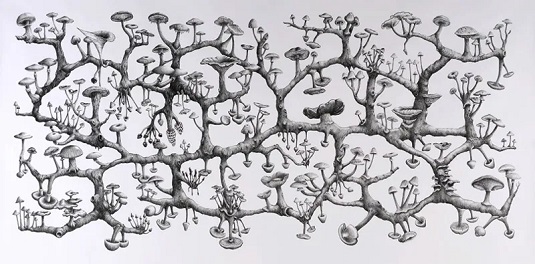
Writing comes with risks, especially when musing aloud on thinkers like Deleuze and Guattari. For philosophers of complexity and the hammers of reductionism, it's fitting anyone reading and commenting on their work can form multiplicities of their own in the eyes of others: the sophist, the erudite, the revolutionary, the clueless, the lost. Sometimes if not nearly always simultaneously. Working through their two chief works, Anti-Oedipus and A Thousand Plateaus is to find books that resist review and easy summary. They are difficult, and reading the latter is not recommended before reading the former. From the off you're hit with their concepts in action before they define them in necessarily fuzzy, dynamic ways. This stylistic move which some might find infuriating cuts to the core of their standpoint. In a world in which everything is multiple, where everything is a configuration of elements in which elements acquire their meanings and nature in relationship to the other elements they are assembled with, a concept cannot be a neat definition with hard borders. Conceptual clarity as a virtue might make for logical systems of thought and pose as the apparent enemy of woolly thinking, but their privileging of certain elements analytically removes them from the contexts that give them form and function, thereby changing the nature of what is being described.
Gobbledegook? Not in the slightest. Consider the academic discipline of political science and make a comparison between its assumption of politics and actually-existing politics. The objects of analysis are political parties, their electoral performance, their relationships with one another (privileging coalition and blackmail potentials), how electoral systems work, strategies and manifestos, memberships, etc. In the analytical world they inhabit, all of these things are removed from the real world forces that assemble and constitute them and are entirely repurposed in a conceptual ensemble that not only distorts politics as it appears in political science, but is the prism through which actual politics are written about and understood, even to the point of providing normative models for political activity. That one has to step outside political science so conceived to understand power relationships, the dynamics impinging in and constituting parties, how politics works outside of formal political systems through social movements and subterranean shifts in mood and opinion is demonstrative of Deleuze and Guattari's point. Oppose what I call militant political science which treats politics and its elements in its multiplicity to the stilted formalism of political science, and it's like comparing day to night. Except the more expansive militant variety is concerned with breaking politics, whereas its academic nemesis is content to commit violence to real dynamics and flows to uphold its intimate relationship with the power it refuses to recognise.
Image Credit
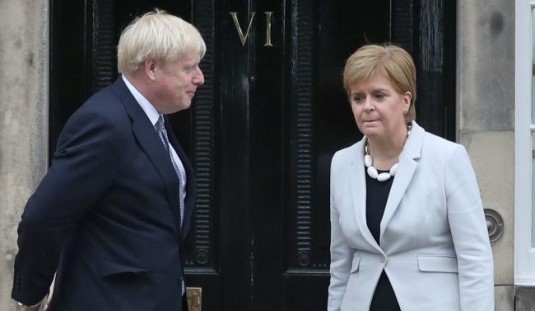
Little noticed because Scottish independence is a niche issue as far as SW1 is concerned, a ComRes poll for The Telegraph reported how English voters are mostly sanguine about it. Among the 57% who have an opinion, 32% are opposed to independence with 25% supportive. Only a fifth of the sample were "strongly opposed" while a third weren't fussed either way. That said, only 31% thought Scottish independence would be a success with around half expecting it to be a failure. This, like all things, hides significant age splits. 51% of 18-24s were confident Scotland would do well while only 19% of over 55s did. For those looking at any signs of grievance or vindictiveness on the part of ComRes's respondents, 35% were okay with Scotland using the pound after independence while 30% were against, and 34% were against increasing spending in Scotland to keep it within the union while 26% supported moves in this direction.
As noted the other day, one aspect of watching and analysing the Tories is scrutinising their strategies and tactics, their imaginary, and how they sell their thinking about the world to themselves and their wider support. It also means being alive to possible disruptions, cracks, and microfissures in their seemingly monolithic coalition. The possible good news is this is these findings suggest yet another.
What the Tories have to constantly work at and accomplish is providing very good reasons to punters to continue voting Tory. Having the right policies is only part of it. The constituencies naturally disposed toward them, like all actual and potential support for political parties, inhabit a structure of feeling that suffuses the social world. Because we're talking about large aggregates of people, at this level certain sections of the population who share similar material circumstances tend toward adopting common views and feelings about the world. We've talked about the class cohorts and age/property enough here to explain the stark polarisation in polling data and voting behaviour to know this is an inescapable fact of British politics. For the Tories and Boris Johnson, their success in 2019 was recognising how large numbers of older people supported Brexit in disproportionate numbers had something to do with the unease and generalised anxiety one feels as one gets older, an angst that multiplies itself many times over dependent on property holdings, investments, income streams, and so on. Leaving the European Union offered a promise of an incohate national renewal, of reasserting the certainty and authority of the nation to make their worlds a more secure, knowable, relatable, and familiar place to them. The risks of Brexit were dismissed because leaving would once and for all address the gaps, lacks, and anomie at the cores of their common social location.
With Brexit done and the Leave constituency largely (but not entirely) shielded from the economic fallout, the Tories are relentlessly searching for other rhetorical devices and performative position takings to cultivate the angst and fears among their support and keep them wedded to their project. For example, Munira Mirza - responsible for the pitiful we're not racist guv report - is employed by Number 10 to specifically articulate the Tories' war on woke rubbish, to feed the scapegoat hungry maws of the Tory press and therefore give their electoral base a supply line of hate figures and troubling cultural phenomena. The urgings of Liz Truss at government departments to withdraw from a Stonewall-sponsored scheme for LGBTQ inclusion in the workplace is typical of this, with trans women in particular cast in the unwanted role of problematic people who threaten the natural order of things.
What has this got to do with Scottish independence? As far as cohering Tory votes goes, the antipathy that can be stirred up against trans women is small electoral beer compared to the possibilities of appealing directly to English (and British) nationalism, as Brexit attests. Playing divide and rule politics, of opposing England to Scotland proved itself as an effective weapon in the Tory armoury in the 2015 general election. Here Dave successfully created a chain of meaning tying together Scottish nationalism with nuclear disarmament and the SNP holding a Labour-led coalition government hostage in exchange for support. But it's not effective at all times, as Theresa May's attempt to pull the same trick in 2017 fell flat in England, but her anti-independence posturing assisted the modest Scottish Tory revival.
As the UK reels from Covid and the Tories want to talk up the recovery there are, on paper, plenty of possibilities for playing the Scottish card. Confrontations between the SNP government in Edinburgh and Tory Westminster might suit both. Ample opportunities for Johnson to cohere his voting fodder and poison politics more with the ugly rubbish of English nationalism. Hence why the ComRes numbers matter. If only 20% really care about keeping Scotland in the union, the use of this strategy comes with some risk. It might ignite the passions in the same way leaving the EU went from a fringe issue to the dominant question in British politics for four years, but equally it could fall flat and never become more than a second order concern or press hobby horse. But what also makes a confrontation with Scottish nationalism potentially hazardous is how Johnson is prepared to throw money at Scotland to provide incentives for staying in the UK. As polling shows little appetite among English voters for sending extra funds, playing the English populism game might find some force willing to articulate the voice of the "hard-pressed taxpayer". As the Reform successor to the Brexit Party is nowhere, there will be more than a few backbench Tories happy to carry the Little England baton for press glory and advancement in the party. The last thing Johnson wants is a coherent opposition to emerge in his parliamentary party that takes the limelight away from him.
Hence, apart from a few jabs and tussles for the camera, it seems the scope for Tory agitation on Scotland in England is limited, caught between the horns of apathy and commitments to "levelling up". And this is a problem, especially if the Tories start copping the political consequences for their umpteenth delayed response to a new wave of Covid-19. None have the potential to tap into the grievance politics of English nationalism quite like Scottish independence and if efforts at corralling support against Nicola Sturgeon and the SNP fail, what have the Tories got left in the tank to distract and divide at a similar scale?
Image Credit

Where have the last five months gone? Why, as sentient beings, are we cursed with a perception of time that accelerates as we get older? It's annoying, but here are five items that occupied more time from more people than any other posts made in May.
1. On Keir Starmer's Stupidity
2. 10 Points on the 6th May Massacre
3. On Entitlement
4. "Shoot the Mad Dogs!"
5. Kuenssberg to the Rescue
Keir Starmer's worst month yet? Yes, it undoubtedly was. Normally accurate forecasts are a moment for smug self-satisfaction, but there is no feeling good about calling his leadership right and seeing the divined outcomes manifest in the most damaging ways possible. If anything, it's appalling. When a sad sack blogger with time on his hands in the evening could see the unnecessary difficulties Labour were likely to get themselves in, then how come the "professionals" and "grown-ups" couldn't see it and, arguably, still can't? Delusion, structural and institutional blindness, wishful thinking, these are responsible for the malaise. And they happen to be the qualities most prized by the new leadership. As for the rest of us disgusted by the spectacle and appalled by the existential peril Dear Keir is dragging the party into, which is the bulk of this place's readership, it's hardly a shocker three posts on this and a supplementary on the Whince of Darkness did the business. And because Laura Kuenssberg always does well on this blog clicks-wise, there she is at the end providing Boris Johnson some BBC-branded cover.
As June is an empty canvas or, as far as I'm concerned, a blank posting interface, who knows what might crop up? Perhaps my piece on immaterial labour, connectivity, and solidarity might get finished. Perhaps, just perhaps, writer's block has well and truly sodded off. It's possible, but moving from Anti-Oedipus onto A Thousand Plateaus could generate some musings in this direction as well. You have been warned. To keep things ticking over, here are a couple of might-have-beens from the May archive for your scopophilic tendencies. Take a look at this peeling back of the Blairist garb. Want more? Go on then. As encore we peer behind the veil of Tory thinking and learn the secret of their success in the so-called red wall seats. At least according to one Tory who thinks he has the golden ticket.
Image Credit