There was vomit, there were fights, there was red wine spilled on the carpet. Sue Gray was unsparing in the detail highlighted in her long awaited report, but when all is said and done Boris Johnson remains in situ. His high risk strategy of kicking PartyGate into the long grass worked. First, Gray was appointed to investigate the goings ons in Number 10 during national lockdowns, giving Johnson breathing space. And when the issue was still hot, he sought to cool if off by getting his mate Cressida to investigate the rule breaking. Unsurprisingly, he was let off with very serious questions hanging over the police investigation. Which are now facing a legal challenge. Johnson doesn't care though. His premiership is safe and the most deadliest danger of his political career averted.
He should also be thanking Sue Gray too. This "unimpeachable" civil servant that Tories have flattered with praise in every interview given since her review got underway also did the Prime Minister a solid. Yes, the detail was excruciating. She did paint a picture of an arrogant operation at the centre of the state behaving as if the rules they thought up and implemented did not apply to them. That the Downing Street's director of ethics brought a karaoke machine to an illegal shindig is almost poetry. There were emails from officials telling staffers not to be seen in flagrante with bottles of wine and party gear. Johnson was present and master of ceremonies at several gatherings, showing without any doubt that he lied his head off from the dispatch box when he claimed "not to know" what was going on. Indeed, he tried the same old shtick during his statement to the Commons this afternoon, pointing out what a warren of corridors and rooms the Downing Street complex is. While Gray reported on the serious failings of the political and official leadership and emphasised their responsibility for this culture, it's hard to disagree with Owen Jones, for instance, that her investigation was anything other than a whitewash.
As with all things, what is not said can be as significant as what is. Like the Met, Gray did not investigate the most egregious case of rule breaking: the ABBA-themed party held to mark the departure of Dominic Cummings. This was organised in the Downing Street flat by Carrie Johnson. It cannot be brushed off as staff exuberance, and the Prime Minister's explanation for his attendance - "conducting a job interview" - is as thin as all his other excuses. But no investigation, commentary, or photos. Gray, who we must remember is a subordinate of Johnson's, steered clear. If one was of a conspiratorial turn of mind, one might link the report's outcomes to Gray's receipt of effusive plaudits.
Johnson is safe for now, and it's unlikely any Tory MP will change their mind once the Privileges Committee delivers its verdict about his lying to the House. But the damage is done. The local election results point to shifts under the surface that could doom the Tories, and a much more serious crisis of legitimacy is gathering strength. To try and put the whole PartyGate business to bed, not-at-all coincidentally the government are announcing a package of measures on Thursday that are supposed to address the cost of living crisis. Which, apparently, will include Labour's windfall tax scheme on the oil companies or something like it. But coming so close and having stubbornly resisted providing help so far, whatever they announce won't erase the memory of Johnson partying while people were stopped from comforting their dying loved ones.
Back in the day, and we're talking back in the day, Militant (as was) looked upon its far left brethren with disdain for all sorts of reasons. One of them was the propensity of other Trotskyist outfits to split all over the place. Taken as evidence of their petit bourgeois composition and orientation, the Revolutionary Socialist League (Militant's "undercover" name) was sturdy and proletarian and didn't do that sort of thing. But then it did and split in 1991, expelling its founder and guru, Ted Grant and his loyalists. In 1997, a small group decamped and set up the short-lived Socialist Democracy Group. Between 1999 and 2001, a group of key cadres from Liverpool were expelled en bloc and were followed out by virtually the entire Scottish organisation. The Socialist Party, as it came to be, helped form the Socialist Alliance, before splitting away from that. In 2009 it formed No2EU with the RMT to contest the European Union elections, which became the basis of the Trade Unionist and Socialist Coalition. Its arch rivals the Socialist Workers Party joined in, before splitting away in 2017. And then in 2019, the SP proper suffered its most damaging split yet in which the vast bulk of its international organisation, including the electorally successful Irish section and important long-standing cadres in England and Wales were expelled as more or less the final act of the retiring general secretary, Peter Taaffe. Just like the right wing Labour apparatchiks he spent years railing against, Taaffe elected to set fire to his entire organisation rather than face criticism and accountability for the mistakes made on his watch.
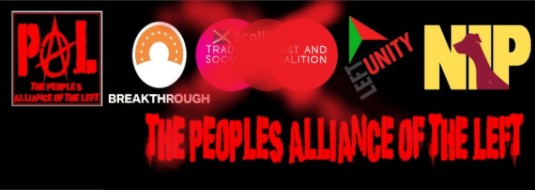
And here we are again in 2022, just three years after the dust had settled with another split. Except this time TUSC has elected to split from the People's Alliance of the Left, a new grouping that was set up in conjunction with the new, so-called pop-up parties that emerged from the debris of Corbynism (the Northern Independence Party and the Breakthrough Party), as well as what was left of Left Unity, the small non-Trotskyoid regroupment project that pre-dated the Labour left's resurgence. And why has this split taken place? Here's the statement from LU's Facebook page:
Statement on the Change of Relationship Between the People's Alliance of the Left (PAL) and the Trade Union and Socialist Coalition (TUSC).
In February 2022 the majority of member parties of PAL (all except TUSC) decided that they could have no formal association with George Galloway's Workers' Party.
This was because of a number of statements by Galloway and the WP on a wide range of social issues (including, but not limited to, women's rights, trans rights and immigration) which demonstrated politics that are irreconcilable with the policy of those parties or the founding principles of PAL. In addition Galloway and leading WP members had made public statements denigrating a Breakthrough member for being non-binary.
Despite this, and in full knowledge of this decision, the all-Britain TUSC Steering Committee has accepted the request by George Galloway's Workers' Party for formal observer status within TUSC and agreed to attempt to avoid electoral clashes where possible. This creates a formal association between TUSC and the WP which TUSC is aware the majority of the other parties within PAL have decided is incompatible with PAL membership.
As a consequence, the remaining PAL member parties regretfully consider that TUSC has, by its formal association with the WP, removed itself from membership of PAL at national level.
We recognise that TUSC is a coalition of different organisations and individual socialists and trade unionis who in their great majority do not share the politics of George Galloway and the WP, although they are prepared to critically collaborate with it as they (TUSC) consider it to be an organisation with origins in the labour and trade union movement. It will remain open to local PAL party members and supporters to cooperate with those socialists at a local level (provided they are not WP members). However, tere can no longer by any national alliance between PAL and TUSC for so long as it has a formal association with George Galloway's Workers' Party.
23 May 2022
This is fair enough. George Galloway is a British nationalist, one of Putin's useful idiots, and an occasional Tory voter. His so-called Workers' Party of Britain is dominated by the ultra-Stalinist Communist Party of Great Britain (Marxist-Leninist) who, when they're not carrying around their giant portrait of Uncle Joe at London May Day celebrations, spend time denying the mass murders of their hero (the Holodomor? Bad weather! The Great Purge? Model jurisprudence! The Katyn Massacre? The Nazis!) and crossing class lines to support reactionary outfits like the Brexit Party and the Canadian "freedom convoy" movement. Given their appalling politics, it shouldn't be surprising that they've swallowed the Tory/centrist line that the British working class are as backward and as socially conservative as them. The industrial (male) worker figures large in their political imaginary, and the everyday politics they push is a nationalist tinged version of post-war Labourism. It's worth noting the last minor party that had some success with such a stance was the British National Party.
The PAL parties are right to want nothing to do with Galloway and his acolytes. Their politics aren't just wrong - in words and deeds they're scabby. But that begs the question, why does the Socialist Party want an alliance with them? It's pure opportunism. The SP has form for ditching its principles to pal around with demagogues if it thinks a political profit can be turned, as per the Tommy Sheridan saga. Simply put, Galloway still has a real depth of support among British Muslims for his - admittedly principled - defence of their community and his consistent stand against the war in Iraq, Libya, and the ongoing occupation of Palestine. The Batley and Spen by-election was a rude reminder to an arrogant Labour machine that these voters won't automatically tick their box. Because of this standing, the SP has designated Galloway a significant personality with clout whose endorsement might see a few deposits saved, and a trickle of recruits come their way, if they can ride on his coattails in future election contests. In other words, the SP is doing what it once took great delight in criticising the SWP for doing when they formed Respect in alliance with Galloway in 2004. It's not principled, it won't get the SP anywhere, and if anything they're cosying up to the most frightful horrors nominally on the left is guaranteed their eternal new workers' party project won't come to fruition. At least not by their efforts, anyway.
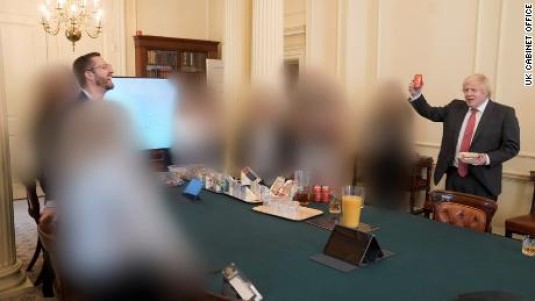
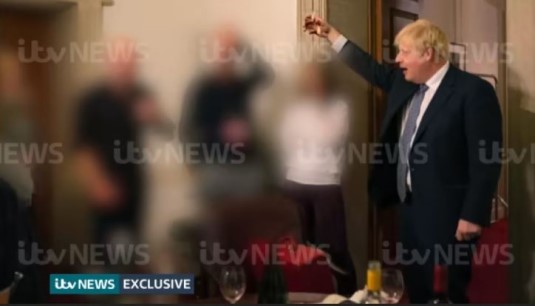
Here's a photo of Boris Johnson at the leaving party of Lee Cain, the former Downing Street head spinner, in November 2020. It took place when parties with people from outside of your household was banned. This shindig was also scrutinised by the Metropolitan Police for possible breaches of the rules and they issued several fixed penalty notices for some Number 10 staffers present. Who happened to escape the fine? The Prime Minister.
When the heat was really on Johnson back in January, he called in the Met so his egregious wrongdoing could, for a couple of months, be hidden behind the veil of "we can't comment while there's an ongoing police investigation." It was a high risk strategy, because everyone could read the reports in the papers and knew Johnson had very obviously trashed the regulations he expected the rest of us to live by. Getting a fine would, conventional wisdom suggested, force him to step down in disgrace. The months went by and when the notice was finally issued, Johnson muttered a non-apology in the Commons and that was the end of it. No resignation was forthcoming because there was no to force the resignation. Rebellion-minded Tory MPs had had their chance and they blew it in January. Another opportunity was passed up by the rapidly diminishing chancellor in April.
What Johnson did was play for time. His cunning calculated that the longer PartyGate could be dragged out, the more it would become background noise. Meanwhile the Tories would show how serious they were by concentrating on Vladimir Putin's invasion of Ukraine and (allegedly) tackling the rising cost of living. The fact he denied there were parties in Downing Street when he actually attended them wouldn't register up against the really weighty issues of the day and on he would carry. And so on PartyGate has rumbled on without causing Johnson too much bother since. Indeed, he and his new, apparently "tighter" Downing Street coterie would have anticipated the publication of his party snaps, And it doesn't change a thing. When he gets asked about this at Prime Minister's Questions, when some hapless minister is selected to do the rounds of breakfast television, the line will be that an apology has already been issued and the police were satisfied all the other gatherings were within the rules. If asked about the discrepancy between junior staff forced to cough up and Johnson getting away with a single fine, this will get batted away as a "matter for them". And lastly the old line about getting on with the priorities of the British people is about to get its umpteenth airing.
The danger, however, hasn't entirely passed for Johnson. The different political circumstances in Scotland means the Tory leader there gets to say out loud what a layer of Tory MPs are thinking. And so Douglas Ross has ostentatiously condemned the images. But he's not about to put his no confidence letter back into the 1922 Committee, and neither are they. Nor is there going to be a stalking horse leadership challenge: William Hague scrapped them in 1998 in case Michael Portillo re-entered parliament and came gunning for his post. It's to Johnson's preternatural luck that the danger he's in is tempered by the constitutional cowardice of his MPs. With no obvious alternative waiting in the wings, it's also a case of them sticking with the devil they know.
But there are other dangers too, dangers older, wiser Tories used to be alert to. Liberal democracy in this country acts as a political outlet, a means of peacefully channelling the interests (and frustrations) of the classes and strata of British society. Its legitimacy is imperilled if the system isn't seen to be working. After the Brexit referendum, the polarisation of politics reversed, to some extent, the idea the political parties were all the same. Before then low turn out and low interest was the norm. With Johnson's appalling behaviour, the lack of accountability and absence of contrition is less a moment of despondency and more a politicisation event, particularly among those who lost people and were prevented from seeing them by Covid restrictions. For many of these it won't be that they hold Johnson and his party in contempt, but the danger is it spreads to all forms of constitutional politics with who-knows-what consequences. Even worse for official society, because Johnson dragged the Met into the fray as his police shield of convenience, their failure to issue more fines despite photographic evidence of his rule-breaking sees the legitimacy of the force decline further. Not among those they police on the streets of London whose opinions don't count, but those middle class and some upper echelons of the establishment the Met does need to have onside.
Before this, the Tories were already in a bad way, but Johnson's lies and antics these past months threaten to spread discontent with the Conservative Party to the institutions of the state itself. If that doesn't give more intelligent Tories pause for reflection and cause for action, nothing will.
The Tory press have imbibed the results of the Australian election and it's sitting heavy in their stomachs. In the land down under, where Labor glows and Liberals chunder, observant Tories can hear the thunder ... of political pain ahead. Looking at the coverage following the Coalition's surprise heavy defeat, the headlines are all about how the Liberals are "in turmoil" and were in disarray even before polls opened. Adding to the pain, Scott Morrison's heir apparent, the (former) Treasurer Josh Frydenberg was among the Liberal cull. The leadership is now very likely to fall to right wing Defence Secretary Peter Dutton.
Drawing its conclusions from these shores, the Sunday Telegrapheditorial frets that a similar reckoning is due. It notes how the Australian versions of the blue and red walls crumbled as a progressive coalition smashed the Liberals in their heartland seats. The Telegraph implies environmentalism and the cost of living crisis did for Morrison's crew, but happily the advice the paper proffers is similar to those hoping Dutton's going to save the liberals: double down on the conservatism. It argues Boris Johnson is busily alienating the coalition of voters that put them into power. This is worth quoting at length:
The Tories have made a stab at challenging the woke advance in the culture wars, but why are our institutions still dominated by the Left? Why is the civil service seeking to erase women? They have failed to deregulate the economy after Brexit, are doing too little to tackle crime, have nothing to say about market-led economic growth and have yet to do anything meaningful to raise post-Covid standards in education. What seem to officials like bright ideas – actually foolish and outdated – are leapt on without philosophical foundation or consideration of the consequences, economic or political. There is a sensible way to address climate change through technology, but instead people are told they must fly less or Low Traffic Neighbourhoods are imposed in suburbs. The cost of government failure is passed on to the voters, and done so with an air of Puritan smugness.
Taking in the round recent Tory vandalism, like privatising Channel Four, the disgraceful Rwandan transportation scheme, taking the butcher's knife to the civil service, and today's floater: banning strike action by transport and teaching unions, you'd have thought the Telegraph would be satisfied. The Tories themselves, which have undoubtedly focus grouped their rancid offerings, think this would go down well with their base - both old and new. But as argued here to the point of writing a bloody book about it, the Tories have misrecognised the reasons why enough voters made the switch in 2019. Just because Brexit as an idea is riddled with reactionary touch points and authoritarianism, it didn't mean everyone who voted for it was. But, as poll after poll shows, the primary reason Johnson peeled away hundreds of thousands of Labour voters in 2019 is because of his pledge to honour their referendum vote. This, however, was coded as a culture war issue in the Tory imaginary, and so the assumption is more war on woke stuff will keep these new supporters onside. The Telegraph thinks nothing less than a full on purge of anyone with a left or liberal opinion from state institutions will shore up those creaking red and blue walls.
What the Tories have forgot is you can't eat anti-woke polemic. Thatcher won enough popular consent for her programme brcause the deal was sweetened with right to buy, cheap mortgages and credit, tax cuts, and share issues from privatising the utilities. Even during the Coalition years, the Tories seasoned their battery of attacks with the pension triple lock and more tax cuts. What are Johnson's Tories offering apart from a feeble council tax rebate, a compulsory loan, and a smack in the mouth? The result of this strategy is becoming painfully clear. They might be looking okayish in the polls, but then again the Coalition beat Labor in popular vote terms. No, what this month's local elections demonstrated was how the Tory vote retreated in the areas won in 2019, and their brutal evisceration in allegedly safe areas at the hands of the Liberal Democrats and the Greens. And given turnout was dominated by older people and the retired, the demographics the Tories do disproportionately well in, this is very bad news indeed.
Inevitably, the question is whether the Tories can turn it around. Looking at their present tactics and the advice of its press allies, Johnson has decided cobbling back together the coalition that won it for him last time might do the trick, while hoping this would be enough without having to win over new voters. It's possible on an outside chance, but the likelihood diminishes the more the Tories indulge their hobby horses and the less time they spend on addressing the catastrophic cost of living crisis. The worse is gets, the more shrill and desperate Tory rhetoric will become.
If you want to glimpse the future of British politics, there's a school of Westminster thought that says we needn't look across the Atlantic. It's Down Under that's our portent of things to come. And looking at the results so far from the federal election, it's difficult not to read British politics, particularly what's happening in England, into the outcome. One cannot avoid how strikingly similar the position takings and the dynamics involved are to what's going on here. This in mins, here are four quick points.
1. The Coalition doubled down on everything that won them office in 2019. There were the lies about their opponents, the pretence that Labor presented an existential threat to Australia (backed, as here, by the Murdoch press), and they put Scott Morrison at the front of the campaign. Thinking he was an asset, after three years of ducking responsibility over increasingly fierce (and frequent) bush fires, absent on climate change, and blundering over Covid vaccines, it was a gamble almost guaranteed to fail. What the Coalition campaign did was emphasise his "strong and stable" qualities thanks to tough lines taken on Ukraine and China. But in the end, for all the pundit talk about his right wing hold on the working class (where have we heard that before?), inactivity on inflation and indifference to the main issues facing Australians helped show him the door.
2. With no programme apart from keeping things as they are and staying in office, the Coalition and their press helpers were enthusiastic wagers of the war on woke. Fooled by foolish commentators and pollsters that they triumphed three years ago because working class Australians recoiled from the social liberalism of Labor and progressive politics generally, the right kept banging the drum with anti-China dog-whistling, with all the racist impacts this has on Chinese Australians, and anti-Green polemic. This was too much for enough Coalition voters in their wealthy seats and, like Tory remainers and constitutionalists here, their votes went elsewhere. Labor enjoyed direct transfers, as did the Greens, but significantly so did the so-called Teal movement - a loose alliance of independents grouped around a desire to take climate change seriously and to clean up politics. They targeted safe Liberal constituencies and were able to pull off several stunning victories.
3. Labor had concluded that its previous manifesto was too expansive and promised too much, which Morrison and the press relentlessly attacked while promising little but "competence" and tax cuts. In contrast the right stood on a minimalist platform that echoed the Tories in 2015, and which they then repeated in 2019. Labor Prime Minister-in-waiting Anthony Albanese ran a tight political ship this time. The four key pledges the party emphasised were making it easier to see a doctor, investing in local jobs, making child care cheaper, and reshoring manufacturing. Throughout Albanese stressed the cost of living crisis, springing a 5.1% increase in the minimum wage midway through the campaign. There was very little here the right could scaremonger about, and because they had no answer to falling living standards Labor's hand was strengthened by its temperate economism. It was enough to take at least nine seats directly from the Liberals, including formerly safe divisions like Tangney, Robertson, and Pearce.
4. Not everything went Labor's way. With some counting still to go, it trails the Coalition in popular vote terms and the Teals and Greens took away a seat apiece, just denying Albanese his majority. That Labor didn't go hard on environmental concerns undoubtedly cost it support, and its general tepid position-taking versus Morrison's scapegoating and woke-baiting did not help either. In other words, left wing and socially liberal-minded voters had somewhere else to go. And they did. Not enough to imperil a famous victory over the right, but one that stymies Labor's room for manoeuvre. Perhaps there's a lesson here.
Before news broke about the arrest of a Conservative MP for rape, the party was having a bad week. An outcry over their civil service cuts, on the hook over Northern Ireland failings and former Gloria De Piero office manager turned Tory MP Lee Anderson arguing that the lack of cooking skills is responsible for Britain's growing food bank problem. Into this very Tory mess we find Home Office minister Rachel Maclean stirring the pot further, suggesting people can protect themselves by "taking on more hours or moving to a better paid job." Even worse, this was for the "long-term" and not about addressing the difficulties many millions face now.
But it's a common refrain. We heard it a lot during the Coalition years. When I used to write complaints against social security cuts, the "advice" back from Iain Duncan Smith would always say that constituents should simply "get more hours". Remarks reminiscent of Norman Tebbit's famous anecdote about his dad getting on his bike and looking for work - as opposed to rioting. It speaks to an entirely voluntarist mind set, as if people who don't have enough hours to get by on endure their situation out of choice. All one needs to do is ask the boss for more work and hey presto, enough money to live on without bothering the DWP and "the taxpayer".
Why is this a repeat offender in Tory discourse? Is it a symptom of the Tories being "out of touch", which is a favourite if ineffectual barb of the Labour front bench? Or just plain callousness and cruelty? Indeed, why do these same refrains turn up time and again, repeating decade after decade? To answer the question is to think about the Tories in context. In Capital, Marx treated capitalists as the personifications of capital. I.e. as vehicles of an exploitative social relationship. They were agents of a process they set in train and, as owners of capital, its beneficiaries. Marx was uninterested in capitalists as individuals and resisted viewing their behaviours through the prism of morality. What mattered were the compulsive character of the relations of production they engendered. Hence cruelty, patricianism, penny-pinching, tyranny, the character traits we typically associate with the ideal typical Victorian capitalist is rooted in these self-same relations. They crystallise the behaviours imposed on the capitalist by the competitive necessities of accumulation.
What has this got to do with the Tories? Extrapolating outwards, for Marx and Engels the state was the committee for managing the common affairs of the bourgeoisie. That is, because individual capitals were responsible for managing the class relations peculiar to their enterprise (whatever that might be), but did so in the context of competition with other capitals doing the same thing, the management of the relations of production by capital-in-general is uneven, messy, chaotic and leaves gaping holes for resistance and counter powers to build. Or it would, if it was not for the state. The state is the institutional condensation of the relations of production, the chief defender of the wage relation and guarantor of the pre-eminence of capital. It is both an instrument of the bourgeoisie as a class, and a site of political struggle. The expansion of the post-war state, for example, typifies this dual character - the growing dependence of the state on immaterial labour was due to having to employ masses of workers to attend to the reproduction of the social by rounding off the hard edged consequences capital imposes on it (unemployment, underemployment, poverty, ill-health, racialised and sexist divisions of labour. etc.) and the expectations of strong labour movements around health services, public services, the institutionalisation of the labour interest, and so on. Unsurprisingly, the extent to which a state cleaves to the labour interest testifies to the strength of the contending classes.
Because the state is an arena of class struggle, parties eventually cohere around the collective movements and constituencies of interests the relations of production give birth to. For example, and perhaps unsurprisingly, the first modern political parties in this country were the Conservatives and the Liberals. Their core social base was the same - capital (albeit, loosely, different fractions of capital) and the political divisions between the two were, crudely, about how best to manage the class relations of their system. The 19th century was when the labour movement formed and its history could be roughly sequenced as machine breaking and protest movements, the development of trade unions and the cooperative movement, and then working class parties - culminating in the Labour Party (and to a much lesser extent, the Communist Party). As a proletarian party, its habits of mind were formed in the attritional battles and small-scale victories of everyday trade unionism, and it articulated the historical but pragmatic aspirations of the class organisations that comprised it. Labour's programme was always a compromise between different strata of proletarians, of salary and wage earners, but one in which the relatively privileged predominated. And, interestingly, from the beginning Labour attracted some fractions of capital, particularly those who spotted and developed a commercial interest in its growing the economic power. Despite the hysterics of some, when Labour has held office it always proved as reliable as the Conservatives and Liberals in managing the relations of production - it worked hard to manage the aspirations of the labour movement within the terms of address afforded by the system, to the point of demobilising and dispersing its own base. And in exchange there was the building of public services, state ownership, and the institutionalisation of organised labour into a haphazard tripartite system - before it was undone in the Thatcher years.
The compromises Labour makes, which are often unnecessary and overly craven, are to be expected. The party exemplifies the tension within the state as overseer of the relations of production and a site of struggle itself, and this manifests itself in the character traits and politics of the adherents the party attracts - often helping explain the contradictory politics often encountered in one person. The Tories are somewhat removed from this. They are not encumbered by a base at cross purposes to the state-as-manager. Altogether, as the one remaining major party of capital its tensions are altogether simpler. Look at recent factional groupings, the Northern Research Group presses for more money for northern constituencies, the Covid recovery group were worried it might give people political ideas, and the One Nation group just want everyone to pull together and for the party to stay united. Hence the personalities that rise to the top of the Tory tree are more likely to reflect capital's traits in a "purer" fashion. Johnson's well known indolence, recklessness, and disinterest in work exemplifies the "laziness" of capital tied up in property. I.e. Capital converted into property only has to sit there to appreciate, which is guaranteed for as long as housing demand outstrips supply and land ownership is concentrated into vanishingly few hands. The Tories who delight in cruelty, like Therese Coffey and her scheme to pile more cruelty onto social security recipients, resembles capitals whose model is about squeezing and intensively exploiting their workforce as much as they can. The arrogance of Tories, like Lee Anderson, who lectures the poor on their competencies reflects the superiority that comes with control over the production process. And bringing us back to the excuse for this excursus, for our Rachel Macleans their pig ignorance of and indifference to the realities of the hoi polloi is what you'd expect from a profoundly instrumentalising process that treats employees as inputs instead of the complex human beings they are.
In other words, the fact the Tories of the 2020s are just like the Tories of the 1990s isn't a quirk of fate or coincidence, it's because they are the flotsam and jetsam of the social flow sloshing through bourgeois politics. The faces change but the personalities do not thanks to the Tories being the pre-eminent party of the state, the state being a crucial nexus in the relations of production, and the fact these relations are an exploitative zero-sum game. For all the dynamism and uncertainty capitalism generates, the line between capital and the character traits of those who espouse its politics is remarkably stable.
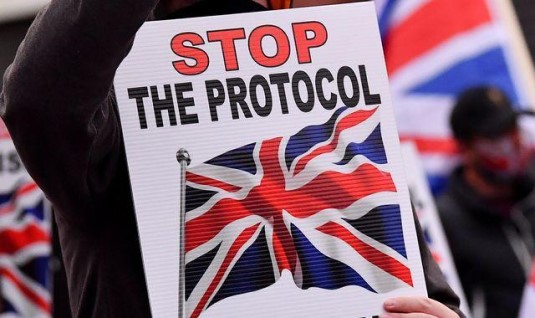
One of the unalloyed goods of last week's elections is what happened just over the water. Thanks to a fracturing unionism, the DUP vote was gouged by their would-be successors in biblical-tinged extremism, Traditional Unionist Voice. And more of their natural vote went to the cross-community (in actual fact, post-unionist) Alliance party. This left Sinn Fein the largest party and Michelle O'Neill the First Minister-in-waiting. A remarkable result. As night followed day, the DUP showed the 'democratic' in their name was mere window dressing as they refused to take their places on the Northern Ireland Executive. Their excuse? The continuation of the Northern Ireland Protocol.
We have been here before. It offers a convenient excuse for the DUP to grandstand, and affords the Tories much the same opportunity. We have Liz Truss, for example, talking loudly about dumping the protocol and sponsoring legislation to undo it. The problem, as they see it, is the European Union are proving too zealous in its enforcement. You see, when Boris Johnson tore up Theresa May's Brexit deal ... only to reintroduce it, no one was meant to take it seriously. Despite saying there would be a border down the Irish Sea "over my dead body" after already signing up to this arrangement, for Johnson erecting a customs barrier was a stop gap, a ruse to make the seemingly intractable Brexit problems disappear for a future Johnson to deal with. The Tories never accepted the protocol they formulated, negotiated, and fought an election on in good faith, so it's jolly unsporting that the EU do. This is the rub.
The victory of Sinn Fein and the crisis of unionism means Johnson has to take it seriously now, simply because it's putting the union under intolerable strain - and Johnson doesn't want to be the Prime Minister known for overseeing the UK's break up. But these real reasons for wanting to wind back the protocol can't be stated publicly by any government minister, so instead we get waffle about standing up for the Good Friday Agreement(!) and the imposition of intolerable barriers to trade, barriers Johnson denied would be necessary if the electorate backed him and his Brexit deal.
What Johnson got through with bombast in 2019, he now pushes with charm. In his lengthy essay for the Belfast Telegraph, the government's intervention to restore power sharing imposes settlements on issues that have divided the Stormont parties - the languages package, which the DUP have vehemently opposed, safe access to abortion (ditto), and an end to blanket amnesties for past deeds. But his remarks on the protocol itself is coded with Delphic tones about a community feeling ill-at-ease with its place. Its "aspirations and identity are threatened by the protocol." He's right, up to a point.
Last year, loyalist mobs took to the streets to protest the economic disruption caused by the Johnson protocol. As Northern Ireland was in the EU custom's area, goods entering it from the rest of the UK had to jump through expensive bureaucratic hoops to square the Brexit circle of ensuring no hard land border reappeared in contravention of Good Friday. The political parties of unionism were on the chopping block too, because they campaigned for Brexit and pushed the same lies as Vote Leave and the Prime Minister during the referendum. The disruption, such as the supermarket shortages, were as much the responsibility of official loyalism as they were the Tories. But a year on and things have changed. Embarrassingly, the north is now economically outperforming the rest of the UK. Manufacturing jobs are growing four times as fast, food is eight per cent cheaper, and while trade with the UK has shrank thanks to the red tape Johnson imposed it has grown with the Republic and the rest of the EU. In a development that could be seen coming a mile off, economic integration across the border has deepened to the general benefit.
And this is a problem for unionism. Its traditional material base among the loyalist community were the marginal benefits it offered around housing, access to jobs, and wages versus the nationalist minority. Its tie to the UK, as per the Scottish base of unionism originally lay in empire and after the war, the industrial compact between labour, capital, and the state. Once deindustrialisation got under way, its foundations began sublimating. All that was tangible were the cultural divides, but because their root was shrivelling the trappings of unionism, its Orange Order bigotry and anti-Catholic zealotry found its grip slipping. It's still slipping. Hence the 50-year rise of the Alliance Party, which grew out of and mainly appeals to unionist communities for whom the old sectarian divisions are past embarrassments. This was the case before Brexit, and now loyalism is in a race against time. The people of the north, republican and unionist alike, are beneficiaries of closer economic ties to the Republic and EU. There is an economic rationale for leaving the protocol unchanged. To protect itself and its political standing, the DUP have gone on strike to make the people of the province poorer - a position of political pain that might stymie the TUV's support, but is guaranteed to lose more to the Alliance and, horror of horrors, Sinn Fein.
The DUP can carry on with their sulk, and Johnson can fiddle with the protocol some more, but the behaviour of both are bringing forward the day when a majority shakes off the six county statelet and unifies with the republic. If the hard Tory Brexit has a silver lining, this is it.
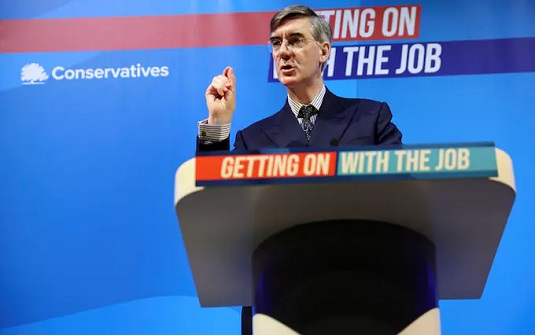
Friday's BBC Breakfast's had Jacob Rees-Mogg on to explain why the government plans to axe 91,000 civil servant jobs. In an arrogance that typifies his entitled ignorance, he batted away questions about workloads and existing delays in discharging services by suggesting "technology" could be brought in to ease the burden and allow for a clear out. To try and downplay its significance, Rees-Mogg suggested we would only be returning to the civil service staffing levels of 2016 and implying that the bureaucracy has got overweening, wasteful and burdensome since. What he failed to mention was how this low point resulted from the gutting of the civil service by five solid years of cuts. This programme, loudly backed by Boris Johnson, would return the state's capacity to a low point of historical weakness.
Why are the Tories keen to do this? Rees-Mogg said the highest calling of a politician is to reduce the taxpayers' burden by ensuring money is spent wisely and efficiently. This, as we know, is premised on a political fiction - the UK state isn't dependent on the tax returns Rees-Mogg's hedge fund does so much to dodge, but that's by-the-by. However, as rationales go this argument is a pretty thin one. It might have stood up in the Thatcher years, and even during the deficit panic the Tories cultivated after the stock market crash, but in 2022 when the government have let billions slide in fraud and, it turns out, helped bung "taxpayers' money" to the failing Tory press? It leaves their we're-careful-with-your-money shtick wide open to attack. This dawned on the Tories as the day wore on, and by lunch time we'd gone from "efficiency" to "saving money to tackle the cost of living crisis". If in doubt, pull on the divide-and-rule lever.
Like most things Tory, the consequences for themselves haven't been thought through. If we are to take their levelling up rhetoric seriously and not with a pinch of salt, then Rees-Mogg's plans don't match up with what Michael Gove and, for that matter, Johnson are supposed to be working on. Central to their rebalancing strategy is moving civil service jobs out of Whitehall and distributing them around the country. In a back-handed acknowledgement of Keynesian multipliers, these jobs would redirect wage and salary spend away from the capital, rejuvenate battered local economies, and provide graduate opportunities outside London and the big cities. Cutting 20% of the civil service workforce somewhat undermines this ambition. But then what does Rees-Mogg, the beneficiary of a lifetime of indolence, know about practicalities? And there are the political consequences too. One can't imagine there are too many Tory-voting civil servants left, but attacking such a huge workforce with its families and dependents isn't smart electoral politics when the ageing Tory base are shrinking and swaying, and the parliamentary party are in a restive mood.
How to go about explaining this self-destructive policy stance? Just because, from our perspective, this appears to be an unforced error doesn't mean Tories see it in the same way. For Rees-Mogg, there are two considerations for pushing this. It raises his own profile as an "effective" minister among the party rank-and-file. If he's able to deliver the cuts, and after all it's much easier to destroy than build something, his future chances of the party leadership or a guarantee of senior posts after Johnson has gone are greater. Second, there's the comfort zone of substitutionist activity. As Brexit has netted no tangible benefits while blighting exports and living standards, rather than have to deal with the mess he campaigned for his pivoting to mass sackings is easier and consistent with his world view. For his pains, or rather the pains of tens of thousands of people due to lose their livelihoods, he'll bask in Tory praise for "tackling waste" which reinforces the first consideration. And no doubt spun as a front in their dreadful war on woke nonsense, it might help cohere some of the more backward sections of their base - but it's sure to put many more off.
This, however, is not enough when it comes to getting to the bottom of Rees-Mogg's cuts obsession and it cannot be separated from a longer-term Tory project aimed at reducing, for want of a better phrase, the state's social capacities. The Tory/LibDem coalition carried through a "classical" programme of austerity by slicing services to the bone and further consolidating neoliberal governance, but since the outbreak of Covid the Tories have shifted gear to something else: the dampening down of demands on government and state to try and shrink the popular political imaginary. What does this mean?
The consequences of Corbynism and the pandemic shifted the boundaries of politics - Corbynism broke decisively with the penny-pinching market fundamentalism of the Dave/Osborne years, and the Tories were forced to adapt to it. Theresa May's one nation rhetoric didn't form in a vacuum. Johnson co-opted this when he ousted May and, again rhetorically, married it to his Get Brexit Done programme to win over those Labour-leaning leave voters who weren't keen on Corbyn, and on Labour's second referendum pledge even less. Thus levelling up was born in the context of raised expectations. Then the pandemic hit and, in what you might describe as a smash and grab, after defeating Labour they adopted Corbyn's pandemic plan. All of a sudden the state had underwritten the wages of millions of people and were keeping business on life support. Since that very moment, the Tories have worked not just to depoliticise their responsibility for the horrors of the crisis, but slam shut the Overton window opened by the post-referendum and pandemic moments.
The Tories went about this by reimposing conditionalities on social security as soon as they were able. Homelessness, which was solved at a stroke, was allowed to return. Furlough was pared back, and significant holes in business support persisted throughout the moments of acute crisis. They stubbornly resisted extending the scope of free school meals during school holidays, progressively eased Covid precautions according to their political, not clinical, timetable. Have not stumped up anywhere near the promised funds for regenerating the English regions, and done nothing to ease the cost of living crisis - apart from a council tax rebate and compulsory loan that won't cover half of the fuel bill rises. The cumulative effect of all this, and an increasingly dominant trend in Tory statecraft, is of active abstentionism and abrogation of governmental responsibility. Rishi Sunak's refusal to do anything to address the crisis, typified by his absurd "computer says no" argument is consistent with their don't-expect-us-to-do-anything-about-it. And this is where Rees-Mogg's civil service plan fits in. It is a prospectus for degrading the state, and so if it can't do anything simple, like processing passport applications, enforcing food and environmental standards, or can't guarantee the receipt of social security support on time, the thinking is the public are more likely to blame state inefficiency than Tory malfeasance for its decrepitude and not expect future governments to do anything. Which, for the Tories, minimises the scope of political responsibility and accountability, and allows for more showboating, frivolous initiatives, and policy that reinforces the interests the party articulates and promotes.
During his rounds of interviews, Rees-Mogg argued his war on the civil service was not a return to austerity. This is certainly a factually accurate statement, and one the left and labour movement should take on board. It's worse than that.
It has taken three years, two months, and one week to get here but we can lay down another milestone. This is the 4,000th post! Arguably I'd have reached this sooner without Covid and if our house hadn't been invaded by an unruly stray cat who decided to stay. But still, 4,000 posts. And what a time this has spanned. When we hit the 3,000 mark Donald Trump was in the White House, and Theresa May faced Jeremy Corbyn across the dispatch box. Brexit was an intractable political mess that would never be resolved, we were ignorant of something called Covid-19, the notion Russia would invade Ukraine was preposterous, and the idea of having a proper book written and published was a pipe dream.
To mark this ridiculous occasion, which was never entertained when I began blogging 15 years ago, in reverse order here are most-read 100 posts since 8th March, 2019:
What would you know, it's not a Jeremy Corbyn fest! Politically, I think the list fairly reflects the struggles and clashes of the last three years: Brexit, Covid, Starmerism, Boris Johnson's Tories. It's all there, along with a smattering of theory pieces, explainers, and character assassinations from a solidly pro-labour movement, pro-working class perspective. But this is not about being a celebratory ego fest. This blog has always been a collective effort, and so to those who occasionally "lend" me their content via freely taken podcasts, videos, music, and guest posts - many thanks!
Whatever next? More of the same, alas! Readers might have noticed a decreasing frequency of posts of late, and so perhaps I'll take things a little easier and read more books, play more games, and do more writing for elsewhere. It all depends on motivation, time, head space, and other demands. But right now, I'd like to thank all readers, the regular and the infrequent alike for giving me the motivation to keep plugging away. Here's to the next thousand!