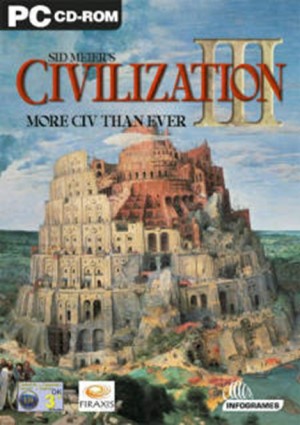
Assuming almost God-like powers over your civilisation, building an empire over 6,000 years of human history can be completely absorbing. Each victory condition requires different strategies to win, and all the opponents are pursuing their particular take on world domination. You might want to build cultural artefacts and great wonders in peace, but you'd better be prepared for enemy armies snaking over your borders ...
What is interesting about Civilisation III are the things it says about the nature of the nation, its gendered division of labour, the character of history and bourgeois consciousness. Who knew computer games could brim over with all manner of not-so-obvious ideological goodies?
Beginning first with gender, the first point of interest is the graphic representation of population in the game. These come under two broad types: the units and the citizenry. The former are characterised by their mobility and manipulability. There are dozens of different units capable of particular functions and tied to a certain level of technological development. Workers and settlers respectively build infrastructure and found cities, while military units provide the means to defend the home territory or attack the neighbours on land, and later sea and air. The second kind of representation is more or less passive. These are the population of the cities themselves. Here the player directs the citizenry to produce whatever is required, be it units or infrastructure that increases the city’s performance. The population is graphically rendered by a row of faces along the bottom of the city screen indicating whether they’re happy, content, or sad. The player has to ensure that the latter do not outnumber the enthusiastic citizens or the city will fall into civil disorder, ceasing production and tax contributions until the balance has been restored. Finally, the player is provided with five advisers whose responsibility is to oversee the domestic, military, trade, diplomatic, cultural, and scientific aspects of the civilisation. Their function is to provide advice.
What is significant to note is that all units are either male or gender-neutral. The settlers are men with backpacks and the workers go from bare chested loin-clothed slaves to men in dungarees. Up until the discovery of motorised transport all land military units are discernibly male, from Conan the Barbarian look-alikes to extras from Saving Private Ryan. Then they come to be replaced by tanks, mechanised infantry, and modern armour. On the sea and in the air boats and planes represent the military. The only female unit to have appeared in the Civ franchise – the spy – did not survive the cross over from the second to the third game. Women however do have equal graphical representation on the domestic front. The gender split in the cities and on the advisors panel is 50/50. Yet it is the positions occupied by women and men on the latter that is most telling. The domestic advisor, alongside the trade and culture representatives are women. The men on the other hand are responsible for the military, science, and foreign affairs. In terms of the game mechanics, the ‘female aspects’ are concerned with the internal operation of a civilisation whereas the aspects that explicitly attempts to provide a competitive edge over rival nations is the preserve of men. Therefore Civ III sets up a privileged binary in which men perform the active and visible role of exploiting the land, conquering new territories whereas women are effectively privatised and invisible, relegated to the boring tasks of advising the player on the budget or recommending the building of more temples. Yet despite this graphical privileging of men over women, the game engine does not deny the importance of the domestic space. A civilisation with a well-run economy, high cultural rating, and happy populace in all likelihood implies a powerful and technically advanced military. The male/female binary operates at the surface of the game, at the level of graphical representation whereas the actual mechanics itself recognises their dialectical interdependence.
There is a more fundamental ‘forgetting’ that is located in the way the game plays: a repression of conflict. At first glance this appears an absurd claim to make. One of the chief pleasures of Civ III is amassing an army and sending it over the border to annex a juicy city or territory, repulsing the counter-attacks as you go. The game encourages this style of play; three out of the victory conditions depend on military action. But what the game does is perform a ruse similar to that found in bourgeois philosophies of history: conflict is externalised. Using my most recent game as the English as an example, it began at 4000 BC with a settler, a worker, and a scout. The first act was to establish London, then found more cities and eventually colonising/conquering a good proportion of the world’s surface. In that time the English went from spear-chucking cavemen ruled over by a despot to a vast metropolitan democracy with a stockpile of nuclear weapons. Despite these dramatic changes, the civilisation was as English in 2000 BC as it was in 2000 AD; it remained orange on the territorial map, and the rule of Elizabeth I was uninterrupted. In other words, the game evokes a discourse of the nation and constructs it as an essential continuity. This is reinforced by the way the player has to relate to their chosen civilisation. Civ 3 positions the player as a god-like manager who has to guide their nation through 6000 years of history, therefore the essential continuity is also established at this level, through the act of playing the game.
What does this continuity have to do with conflict? Earlier it was noted how the player must manage the happiness of their city dwellers otherwise the city would fall into disorder, temporarily suspending the contribution it makes to the civilisation. From the standpoint of game management, when it does occur it is usually a small inconvenience. However, when the player wishes to progress to a more efficient kind of government the whole civilisation tends to fall into anarchy. This is the most threatening moment in the game. Being unable to adequately feed the population, raise money, or build anything; it is a potentially life-threatening situation that other civilisations could take advantage of. Though order is eventually restored and the game continues, the moment of anarchy is where Civ III’s discourse starts to unravel. Despite trying to repress internal conflict by programming it as a transient phenomena and not allowing it to alter the distinct identity of the civilisation, it nevertheless erupts out of this moment and begins to destabilise the discourse of national continuity that the Civ III game engine evokes. It suggests that not all interests are identical with that of the nation and that there are always struggles that cannot be assimilated by a frame that reads history through nationalist spectacles. Therefore from this ‘inconvenient’ moment in play, the beginnings of a repressed history of patternless conflict between classes and groups begins to infect the national-continuity metaphysic, threatening the discursive foundations on which Civ III is based.
Then there is the standpoint of management itself, which is the distillation of the individual bourgeois point of view. As we have seen time and again in the various posts to this blog on Lukacs' History and Class Consciousness, reality confronts the bourgeois individual as an unalterable and alien set of laws that can nevertheless be plotted and responded to to satisfy one's egoistic needs and accumulate capital. All the elements - levels of resources, luxuries, entertainers and specialist citizens, production - are so much objects to be managed. There appears to be no qualitative differences between them. The game engine of Civ III confronts the casual gamer in much the same way as any other computer game - one acquires a feel of the game, an understanding of its mechanics and develops strategies that can makes the best of the situation. But control is illusive (unless you dig into the game code) and there is always a possibility your opponents could turn against your carefully-crafted position, you suffer several nuclear meltdowns, or the world slides into runaway global warming.
All that said, it does not mean one cannot enjoy games like Civ - it just means keeping your wits about you and realising the habits of mind so-called God-games engender ...


