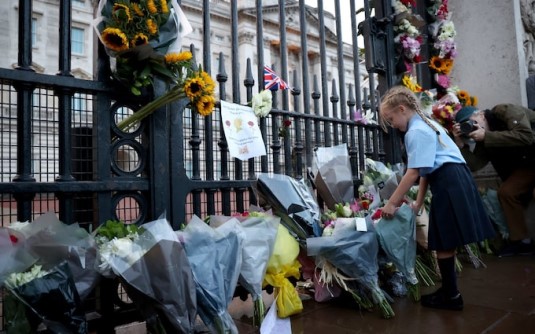
Two days' worth of coverage bears this out as journos hang around Buckingham Palace doing their vox pops. For most, she was distant but close. The Queen enjoyed a luxurious life removed from the lives of those who looked up to her, but that she stared out of the television screens, newspapers, and the occasional photo portrait hanging on the wall meant her presence was felt. And even though the Queen abided by saying and doing nothing apart from the endless round of official engagements, all the while the palace commanded the most sophisticated spinners - aided by the popular media's fawning deference - to weave a narrative of duty, conscientiousness, and loyalty about her person. Even The Crown, the Netflix drama deemed scandalous by self-appointed Royal guardians, reinforces the message. And these impressions stuck even more over the last year. We've watched the Queen become more frail as she carried on her responsibilities even after the passing of Philip. For millions of people, this is what service and dedication looks like.
Which then presents something of an anomaly. Go back 18 months, and there is arguably less state-mandated disruption than was the case following the Duke of Edinburgh's passing. There's certainly more absurdity, with everything from catalogue shops, gay porn websites, and McDonald's self-service counters paying tribute to the Queen. Think They Live, but with every screen and paper carrying Elizabeth II's image. But there are also more avenues of escape. In April 2021 the BBC cleared everything and cancelled programming. In September 2022, BBC1 and ITV1 are wall-to-wall official mourning but everything else is running almost normally. Yours truly was able to enjoy Haddaway, Take That, and Kim Wilde on the Top of the Pops 1993 reruns as scheduled. This is in marked difference to the response to the death of Princess Diana 25 years ago. Granted, her death was sudden and unexpected, but all five terrestrial channels were stuffed full of Diana coverage and tributes for over a fortnight. There was no streaming, and the internet at this point covered fewer than nine per cent of households. There was no escape via the usual means of escapism.
From the state's point of view, the death of the reigning monarch is a bigger deal. Effectively, its official corporate personality and person changes over night and with it the official pomp and apparatuses of spectacle have to be tweaked. Seldom used constitutional gears grind into action, and well rehearsed rituals get underway. But in 2022 it comes with a dollop of uncertainty. Perhaps one of the reasons why broadcast media are more restrained than 18 months ago is because of the backlash it provoked. Complaints to the BBC over the cancellation of programming was a rude reminder to the establishment that there are a lot of people out there who don't share any enthusiasm for the Royals as people and the monarchy as an institution - even it shocks them even more because the indifferent are never reflected in the coverage. Perhaps somewhere, someone has learned imposing grief is not a good idea when popular trust in state institutions is low. That said, the mass cancellation of football matches, festivals, and Southwark recycling centre's open day aren't going to help.
But the other consideration is the growing republican or, to be more precise, anti-monarchical sentiment - something that became even more evident during the Platinum jubilee celebrations. Polling puts republican views at an all-time high. Still miles behind monarchical support, but with an institution accustomed to thinking about its stability in terms of decades and centuries the trend should give royalists some pause. Because the relations that secured the monarchy in the post-war period have corroded, with many communities giving way to privatised individuation, a more atomised population requires more direct messaging to try and induce desired behaviours. Hence the enforced mourning and the multiplication of the Queen's image and the rote repeat of hard work, service, faith, duty. Because it clearly works as millions back the monarchy the solution to winning over the doubters and the haters is double down and ideologically bludgeon its real and imagined opponents.
For the last eight years, official politics has been on a roller coaster. Certainties and eternal truths were found to be nothing of the sort. Because Charles III takes up the throne without the same support or affection enjoyed by his mother, that adds to the worry that change could descend quickly here and, as if taken by a thief in the night, the institution's legitimacy vanishes in the blink of an eye. The passing of the Queen marks something. Not the end of a second glorious Elizabethan age, but the entering of a new period: one in which no amount official days of mourning can hide that with her gone, it has to meet the uncertainties ahead without its most stalwart and respected advocate.
Image Credit