Sunday, 20 December 2020

Postmodernism: A Defence

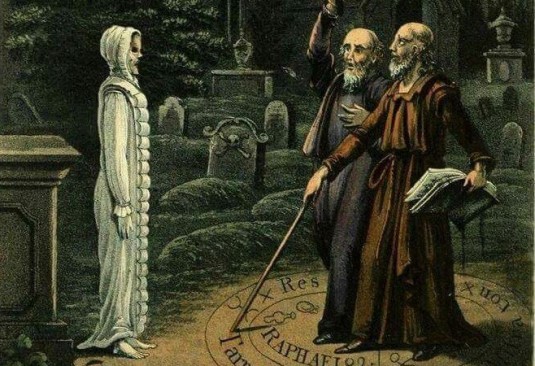
Feeling honour bound to defend postmodernism? As if 2020 couldn't get weirder, and yet here we are. In a week where naked men in panda masks ride the New York free way, a signal of possible alien origin from Proxima Centauri is under investigation, and Keir Starmer did some opposition at PMQs, the discourse was enlightened by the sudden trending of one Michel Foucault. The enfant terrible of the French academy and San Francisco bathhouses, it's only taken him 36 years since his premature demise to become a trending topic. The occasion was a throw away line in a lazy, terrible speech by Liz Truss, signalling how the Tories intend to target "wokeness" as their Brexit substitute seeing its days as their ideological firmer-upper de jour are numbered. Foucault got namechecked as a trendy denier of truth/champion of relativism. As night follows day - no schizoid lines of flight here - our dear old friend postmodernism crackled around the circuits of social media, dropping confusion bombs and 280 characters' worth of denunciations. Ho, ho, what an incorrigible trickster our neon nihilist nightmare is. One of the intensities it charged up to the point of attracting the flitting moths of the attention economy was Paul Mason's thread, so why not ride the 90s PoMo vibe a bit further and look at what he has to say.

Paul tells the story (not a metanarrative) about how his entry into politics in the 70s found him among feminist, anti-racist, and LGBTQ activists motivated by the fight for equality, and who took their theoretical bearings from Marxist and Marxisant New Left figures. From this they derived their sense of (in)justice. The point being the comrades active at the time didn't need our fashionable French trendies or anything remotely postmodern to get on and do their politics business. Paul writes "Postmodernism was the slave ideology of neoliberalism; a justification for our atomisation; the denial of objectivity and a profound anti-humanism." This is as much a hatchet job as saying Marx was an economic determinist who forecast absolute immiseration or, worse, was a devout Hegelian with communist verbiage. Postmodernism is much more than a desktop folder kept purposely adjacent to the trash for theory one doesn't like. Indeed, it's debatable whether PoMo is an ism at all - at least where philosophy and the social sciences are concerned.

Taking cues from Jean Francois Lyotard and Fredric Jameson, it's worth thinking about postmodernism as more a feeling and an imaginary than an 'ideology'. Lyotard called his book The Postmodern Condition and Jameson subtitled his Postmodernism with or, the Cultural Logic of Late Capitalism. It is also worth noting hardly anyone ever referred to themselves as a postmodernist. Foucault said he didn't know what postmodernism was, Deleuze didn't like it, Baurdillard and Derrida hated it. Were the thinkers most closely associated with "the postmodern" being tricksy and playing silly language games in foreswearing all responsibility? No. Their philosophy was not relativistic let alone nihilist. It was about uncovering the complexities of a social world accustomed to peddling stories, narratives and, if you will, ideologies, that smothered and denied this basic fact. If others wanted to write popular guides and introductory texts to postmodernism to hit academic publishing quotas while distorting the positions of poststructuralist thinkers, well, that's hardly the fault of our Kristevas and Guattaris.

Time for a brief look at the postmodern according to Lyotard and Jameson. In the Postmodern Condition (which, interestingly, Lyotard dubbed his "worst book") he noted society had moved into "postmodernity" characterised by the mass media, computers, and the post-industrial economy (as opposed to the modernity of factories, mass (uniform) production, and the dominance of industrial (physical) labour), the shift from material to the production of symbolic and linguistic goods, and the reconfiguring of culture into a confusion of overlapping and multiplying language games. The irreverence and horizontalism of the new cleaved into the old, incorporating some and memoryholing the rest. This anarchic spirit includes science too. As he famously wrote of science's relationship to the stories and myths culture tells itself,

Science has always been in conflict with narratives. Judged by the yardstick of science, the majority of them prove to be fables. But to the extent that science does not restrict itself to stating useful regularities and seeks truth, it is obliged to legitimate the rules of its own game. It then produces a discourse of legitimation with respect to its own status, a discourse called philosophy. I will use the term modern to designate any science that legitimates itself with reference to a metadiscourse of this kind making an explicit appeal to some grand narrative, such as the dialectics of Spirit, the hermeneutics of meaning, the emancipation of the rational or working subject or the creation of wealth … Simplifying to the extreme, I define postmodern as incredulity toward metanarratives. (1984, p.xxiv)
.
After years of assaults on experts, the untramelled propagation of capitalist realism, and the rise of rag tag and bobtail conspiracy theories, does nothing affirm the acuity of this statement more than life since the turn of the century? For his part, Jameson makes similar arguments in his Postmodernism, albeit from a Marxist viewpoint as opposed to a fuzzy hinterland bordering the historical materialist corpus. Simply put, Jameson's diagnosis rests on a symptomological survey. Postmodernism is a culture marked by the collapse of representation, whereby the complexity of the social becomes too much to be straitjacketed in dominant political forms and previously established cultural tropes. This is also a culture of spectacle and surfaces, of subsumption and complete commodification. In otherwords, the endpoint of the culture industry diagnosed by Adorno and Horkheimer - underlined by the complete collapse and erasure of the high/low culture distinction. History is cancelled and the present is everything, buried by the twin eruptions of ignorance and history fictions, which gesture toward the "truth" of the past or offer completely simulated histories without a referent. This leads to a culture that is neither stratified nor sorted, but one open to and exercising schizophrenic relationships with itself. Ideas of boundaries are hopelessly obsolete, and the very notion of depth or hidden meanings is naive. And as if underlining the two-dimensionality of the postmodern, much of its movement can only be experienced on the flatness of the screen. For Jameson, this comes with a new emotional register: an emphasis on and privileging of intensity. Any moment is open to flashes of pain, joy, offence, and mourning, sustained by a culture of incessant overstimulation, the public display of feeling, and an injunction to share. This proceeds to the background thrum of machinery and processing power, allowing for new combinations, generation of, and reproducibility of culture, in turn covering and smothering everything with the postmodern sensibility. The postmodern then is glitzy and kitschy, garish and fabulous, unoriginality chasing the new, the eternal return of nostalgia, and an irresistable, unconscious tendency to the unserious and parodic. For Jameson, the postmodern is pastiche.

As a broad brush overview of the culture of the 1970s onwards, it's hard to say this is not the case in the advanced industrial societies. Lyotard and Jameson are not arguing for relativism, but are simply noting it's a facet of everyday life. Therefore science is not impossible, but is perceived as one discourse among many. This, the whole phenomenon of the postmodern condition, is not the responsibility of The History of Sexuality or Anti-Oedipus, or doing the deconstruction do to scientific texts - as the arrogant and ignorant Intellectual Impostures by Bricmont and Sokal suggests - but the outcome of social development. Which brings us to Paul Mason's second gripe with "postmodernism" - its anti-humanism.

Anti-humanism is not the same thing as anti-human. It is rather the philosophical position, and the default commonsense in social science in the 21st century, that human beings - sometimes referred to as bodies - are socially and historically constituted. There are no essences endowing people of particular "types" with pre-social characteristics of the spiritual, biological, or psychological kind, and what human beings (or, to be in more tune with Deleuze, becomings) think, feel, and do have histories and are always, at all times, conditioned by the complex of social relationships bearing down, structuring, and enabling their agency. This is further muddied by the fact what is "human" is, as per Lyotard's and Jameson's remarks, is mediated by technologies and transformed by them. For those Marxists who find this unconscionable and too close to Althusser's notion of history without a subject, think about Marx's position on commodity fetishism: how relations between people appear as relations between things and, ultimately, how one thing - capital - has a horrifying efficacy of its own, compelling billions to act as if it is alive and driving social development. Humanism, on the other hand, is an ideological and essentialist excretion that clings to materialist theory and needs scraping off - not because close readings of Marx and the operations executed via For Marx and Reading Capital are fun times, but because humanism distorts and obscures social analysis. As Andrew Collier pointed out in Socialist Reasoning, the crimes committed by sundry Stalinist regimes were given ideological cover by their victims not matching up to some idealised proletarian, or the standards expected of socialist citizens. We see it in less tyrannical forms on the left too with the privileging of the ideal worker/activist and how those who fall short of the virtues projected onto them, such as working class Tory voters, are somehow not working class, or how raising criticisms makes a comrade a renegade. Humanism so understood is the application of a set of values or positions to groups of human beings prior to the work of analysis and, from the standpoint of generating useful social theory that might guide action, is utterly useless for doing so.

All said and done, the postmodern condition is with us and, if they must be referred to as postmodern theorists, the legacy of trendy French thinkers remains. But this is good. Considered in terms of social theory, was the emphasis on difference and multiplicity such a bad thing? Of course not. Inseparable from the postmodern condition in philosophy and the social sciences was the breakthrough into mainstream debates of voices and experiences hitherto excluded from them: women's voices, postcolonial voices, diasporic voices, LGBTQ voices, disabled/impaired voices. The ground zero for many of these interventions were feminist debates in the 90s, where this reconciling of difference with a politics of liberation was taken much more seriously than the self-appointed guardians of Marxism, who mainly ignored them. And what has been the result of this engagement? The resurgence of an open-ended feminism. It was reconciled because of the foregrouding of experiences. Talking up differences brought out the commonality of women's oppression and, particularly, the systematic inequalities enforced by patriarchal power - hence the feminism of the new wave is relaxed about issues of difference because the movement knows what it is against and what it is for. A similar sort of thing is happening now with the politics of class. The predisposition of the rising class of workers to socially liberal values largely innoculates them against the divide-and-rule identity politics of the right, while a conscious awareness of their collective interests are forging bonds of commonality. Corbynism in this country and new left movements elsewhere, combined with new patterns of becoming show this process is still at its beginning, but one pregnant with imminent potentialities. Why else are socialist and, whisper it, communist politics coming back if not symptoms of an emergent collective consciousness?

Postmodernism, in as much as it is a thing, or a trend in social theory has cleared the way for a new materialism and hosed away metaphysical schemes bound up with and supportive of prevailing patterns of domination, power, and capitalist realism. It might have been difficult to apprehend this at the time, but from the perspective of 2020 with its stark inequalities, pandemics, and looming climate disaster the first returns of postmodernism are now banked and we can get on with understanding the world in all its complexity. Otherwise, how can we hope to change it?

Image Credit

Saturday, 19 December 2020

Boris Johnson's Tier Four Fears

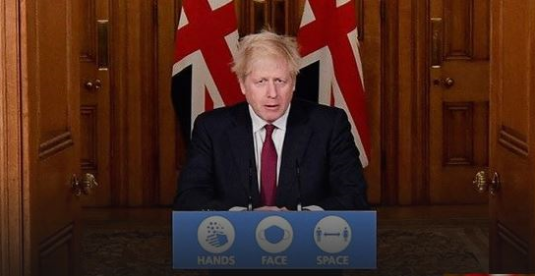
I've given up trying to fathom the depth of my hatred for the Tories. Every time Boris Johnson opens his mouth, the antipathy sinks deeper and deeper, and this was no less the case with this evening's press conference. Having traded barbs and banter with Keir Starmer at PMQs in which Johnson accused the Labour leader of wanting to cancel Christmas because, sensibly, he was calling for tougher Coronavirus restrictions, now Johnson has gone cap in hand to the nation for forgiveness. Thanks to surging infections in London and the South East, tonight will see a new tier introduced along the lines of November's second lockdown. Irony of ironies, the Prime Minister finds himself horned by his hubris as tier four means no unnecessary travel, the closure of non-essential retail, and no meeting up for Christmas. So much for all those plans he was encouraging people to make.

Why are we here then? The rapid dissemination of the new variant Covid-19, which is up to 70% more infectious than the "original" strain but, thankfully, appears to be no more severe nor more resistant to vaccines, is to blame. This is what's driving a huge tick upwards in infection and necessitating a tougher approach. What Johnson conveniently fails to mention, which naturally the stenographers and courtiers of the loyal hack pack did not pick up on, was how the second lockdown was full of holes and the existent three-tier system is pretty anaemic. Insisting on keeping schools open, when the teaching unions were spelling out how this was preparing the grounds for a public health disaster, undermined the efficacy of the lockdown. Opening up colleges and universities, and letting students circulate around the country while insisting on a minimum of in-person teaching sessions was a case of precipitating catastrophe. And allowing pretty much everywhere outside of tier three to open themselves up following the second lockdown, unsurprisingly, saw infections shoot up.

Will the introduction of tier four work? Despite the problems of the last lockdown, infections were suppressed up to a point before plateauing and charging again. By limiting mobility at a time of mass migration out of the cities to here, there, and everywhere visiting families for the festive period, Johnson is going to be calling on the luck of all the talismans he can muster that this pushes the R number down. After so many rash promises, neither the Tory base nor many in the marginals are likely to be impressed. The tier four zone covers London and the Home Counties, and naturally if people - especially young people - can't fan out from the capital this will have knock on effects on Johnson's popularity everywhere a family were expecting loved ones. Having escaped accountability for the government's actions so far, hiding behind the new variant and pretending it's responsible for the sudden about-turn was the most natural and predictable course of action. Whether it works, time will tell. But useful to note Johnson announced this after the last pre-Christmas Saturday shopping spree took place.

As said many times before, public health has played second fiddle to the politics of public health. Since the first lockdown, the business support schemes, and the furlough programme - now extended to April on the last day of term - the Tories' primary concern has been the preservation of labour discipline and rentier capitalism. Those falling outside their "generous support package", so genereous this is repeated at every possible juncture, are left to the mercies of destitution and food banks with no recourse to help or, in some cases, the pathetically inadequate Universal Credit. Where the life and limb of millions have brushed up against the interests of the miserable sectional concerns of the Tory base among employers and landlords, the latter have won out each time. And yet even here, there might be trouble at the mill. Despite Johnson serving his class and their petit bourgeois hangers on, junior lieutenants on the backbenches rumble with grumble. Even here, there's only so much foolishness and incoherence they can take. Might this be the final straw then, the moment where finally the Tory coalition starts cracking? An awful shame it's taken a terrible toll, much of it preventable, to bring us to this point.

Thursday, 17 December 2020

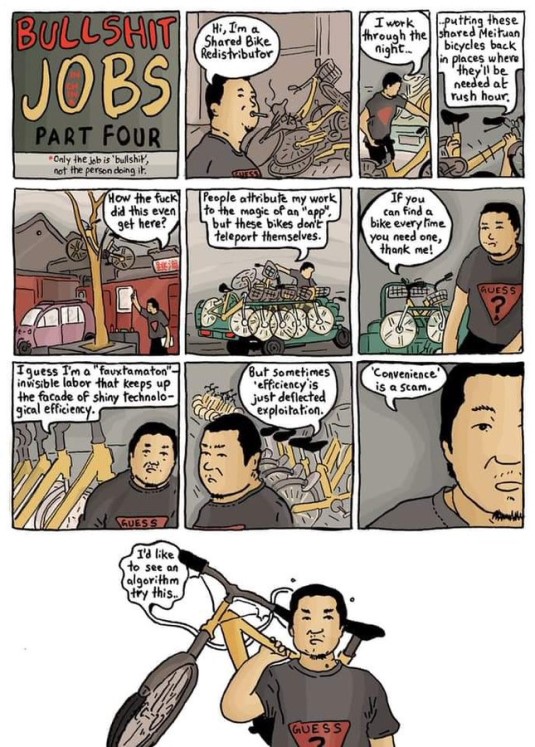
More on Bullshit Jobs

A great short strip on the realities of work in the hi-tech economy by @krishraghav

Wednesday, 16 December 2020

The Tory Dark Arts

In his most theatrical Prime Minister's Questions so far, Keir Starmer waved a Conservative Party-branded paper at Boris Johnson. This piece, produced courtesy of Wellingborough Tories, provoked a handful of end-of-term laughs and crowned yet another pitiful performance from the First Lord of the Treasury. Yet why the sudden interest in the utterings of Northamptonshire Tories, and how did its revelations provide for another uncomfortable, disassembling moment for Johnson?

Doing the rounds on the internet Tuesday, our mysterious master of the dark political arts put pen to paper and dispensed advice about the ways of the political world. Aspirant politicians were urged to emulate Donald Trump, noting how a "lie can go around the world before the truth gets its boots on." Fake news is less a scourge and more an opportunity, because it pushes "honest politicians" from the front pages. Saying the first thing that comes to mind doesn't matter, as one's opponent will then be scrambling to catch up. Riffing off Trump, our writer adds "If someone tweets ten dubious claims per day and it takes you a week to disprove each one, then you are doomed." It then goes on to fulminate against "wokeism" and how racially discriminated against white people are.

People who actively try cultivating a reputation for cornering the dark arts are, invariably, completely inept and usually don't know the first thing about them. Just to put this out there, assuming the role of a "player" in politics is more than getting sweary, coming up with amusing nicknames for political opponents, and being rude to others. It's not The Thick Of It. In the age of the attention economy, this assumption is understandable. The brash stunts and the, snore, dead cats catapulted by one Dominic Cummings generate excitement and spectacle, and are mistaken for genius moves. Being seen to be a genius means you are one. Photo or it didn't happen. Yet, the real arts remain hidden from view, of pulling the strings and making things happen without notice, getting others to work voluntarily toward your position, of keeping the tricks and influences one has learned to oneself or an anointed few. For instance, according to local Stoke-on-Trent party legend, while John Golding was writing his memoirs - which became Hammer of the Left after his death - John Spellar got wind of this and made his displeasure known. He didn't want the dirty tricks and the fixes, of which these two men were learned exponents and skilled practitioners, getting an airing in public. He needn't have worried. The backroom union fixes that secured the right in the 1980s are largely obsolete in the 2020s. I mean, imagine centrist "modernisers" and rightwingers sullying themselves in the labour movement these days. Still, one wonders what Spellar made of Mandelson's recent "indiscretion".

Back to the beaten track. What was most touching about our Tory initiate in demonology wasn't the affected knowing tone, or the crudity of the Trumpist methods recommended. It was the default assumption, revealed in word after naive word, that the Tories aren't already masters of fakery, spin, and rancid tricks. Cummings had a bull in a china shop approach to Brexit and subsequently, the Barnard Castle farce, but the real genius of the Tories under Johnson is how they've shirked responsibility for pretty much everything. Raging infections? The accumulating dead? The worst economic depression in the G7? Not enough support for workers and the self-employed? The destruction of businesses? Entire sectors imperilled? They're getting away with it.

The Tories lie, which is the very ABC of British politics. Their project, to make the minority interest of their class appear the universal interest is fundamentally dishonest, and they are rather good at it. The fact they get away with this leader after leader, despite all the awful things done, crimes committed and disasters overseen isn't because of the whoppers told or the set piece events. It's the myriad of little things, the manipulations and the framing. These are the real dark arts, and don't let any self-styled municipal mastermind convince anyone otherwise.

Monday, 14 December 2020

On the Corbyn Project

When my friend Lewis Bassett tweeted earlier about how he thought the left "might fare better if it tried to get over Jeremy Corbyn a bit", I winced. Because I knew he was setting himself up for a world of pain. Some of the replies inevitably cast him into darkened recesses from where they hope he may never emerge. Others pointed out that as Corbyn is central to moves against the left, it was foolish and wrong to talk about abandoning him. And others suggested he's not the real target at all - the person of Corbyn is the focal point of a movement he (inadvertently) condensed and gave direction to. Get him, get us. There were also folks saying Corbyn helped represent the unrepresented and for four brief years their concerns forced their way into the mainstream of British politics. All right and true points, undoubtedly.

Just to underline Lewis's intent, he wasn't advocating for the abandonment of Corbyn but his tweet touched a nerve about the British left currenly constituted. That it is still dependent on the personality of one man speaks to weakness. In Corbynism's period of advance it drew plenty in but did little to consolidate the movement around the interests it intersected with and articulated, a point reinforced by the character of much new media that blew up in the movement's wake. And then in the period of retreat and siege from Spring 2018 to the final denouement, there was little political room but for the left to rally round in Corbyn's defence. We often like to say the party or the movement is bigger than any individual, but given the rapid composition of our new left after 2015 this is demonstrably not the case. It remains relatively fragile and precarious.

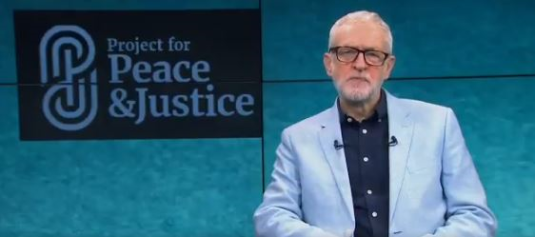
And you know who agrees with this assessment? Why, Jeremy Corbyn does. This ultimately lies behind the launch of his new Peace and Justice Project. Corbyn's legacy, as will be seen in the fullness of time, was not just about shifting politics to the left, but also building a new base for Labour and, in the 2017 election, pointing to the path the party must travel if it wants to stand a chance of winning. But this will become a monument without a movement, and this means turning outwards toward community, workplace, and street politics - something we can do whether we're (still) Labour Party members or not. Understandably, in his announcement Jeremy kept the details vague beyond issuing an invitation for everyone interested to participate on 17 January, but it's worth hazarding a guess what we're going to be seeing.

Readers will know about the community organising units set up over the last few years. The idea was to draw together the cohesiveness of our communities by initiating or assisting existing campaigns around key local issues. For example, prior to last year's election Labour's Stoke South candidate Mark McDonald in conjunction with Labour's community organiser assisted residents in campaigns to save a local beauty spot from housing plans, and fight the corner of council tenants who were missold and effectively strong armed into a solar energy scheme. This sort of activity was sneered at by the usual suspects, and declared a waste of time after the results of a year ago. Which, of course, is wrong. We need to take a longer view. Just perhaps the long-term disengagement of former core working class constituencies from Labour had, among other things, something to do with the shrivelling up of the labour movement and therefore the irrelevance of the party to and estrangement from day-to-day life. The only thing keeping many of these folks Labour was habit, until enough of them died and with them the obligation to carry on voting this way. Perhaps what we need to see is not a quick fix or patriotic virtue signalling no one ever notices to win them back, but a concerted effort to re-root the party among the people it was set up to represent. Just a thought because, after all, working class people to begin with didn't vote Labour spontaneously - the mantle of being their party had to be earned.

It seems to me the Peace and Justice Project would do well to continue the work of the community organisers (not that the scheme was perfect, by any means), especially if Keir Starmer downgrades or abolishes them once the pandemic is over. This way, Jeremy is using his personal standing to divert the energy of activists dissipating their energies on angry internet polemic and whatnot into something entirely positive that the entirety of the left can orientate towards. By working to root the movement as a counterveiling force against atomisation and the privatised lives we've grown accustomed to, there is a possibility of growing ourselves and realising the ambition of making Corbynism more than the works of Corbyn between 2015 and 2019.

There is also a useful byproduct of PJP. It ensures the people lost to the Labour Party aren't lost altogether, but are kept active in and around the wider labour movement. It's far more positive for recent leavers to get stuck in here than wasting their time and burning themselves out trying to build a clutch of non-starter projects who, at best, would cost Labour a handful of seats without winning anything for themselves.

Taking everything into consideration, PJP - please stop calling it the Corbyn Project - has the potential to do good. If anyone reading this falls into the category of cheesed off ex-Labour member but looking for something to get their teeth into, why not join the big meeting early in the New Year?

Sunday, 13 December 2020

Local Council By-Election Results 2020

Overall, 75,113 votes were cast over 37 local authority (tier one and tier two) contests. Obviously, for anyone reading this in the future most local election activity was cutailed by the Covid-19 pandemic. All percentages are rounded to the nearest single decimal place. For comparison see 2019's results here.

Party Cands Vote % Vs 2019 Vs 2018 Average Seats
Con      34
   25,409
  33.8%     +1.1      -1.8
    747     -2
Lab      31
   16,817
  22.4%      -4.9      -9.8     542     -2
LDem      26
   11,250
  14.9%     - 3.9
     -2.7
    433
   +4
Grn      25
    3,919
   5.2%      -0.8
    +0.8     157
     0
SNP*       7
   11,232   14.9%    +11.4    +12.4    1,605     -1
PC**       1
      189
   0.3%      -0.4     +0.1     189    +1
Ind***      31
    6,104
   8.1%     +1.3     +3.2     197      0
Oth****       5
      193
   0.3%      -2.4      -1.2      39
     0

* There were eight by-elections in Scotland
** There was one by-election in Wales
*** There were nine contests with Independent clashes
**** See the quarterly round ups for the results from smaller parties

2020 was certainly a year like no other, and the same was true on the by-election front. A handful of contests were cancelled in March but the scene was totally quiet for the most of the year following the first lockdown, with the exception of eight contests taking place in Scotland between October and November. Why they happened is anyone's guess, but at least they provided some cheer for local govt afficianados.

In all though, the results say very little. The first quarter under "normal" circumstances spoke of Tory success and the bitterness of Labour defeat, and the last quarter reflected the balance of forces in Scotland, albeit in seats Labour weren't about to do well in at the best of times.

This is your lot then for by-elections until next May which, I'm assured, is going to be a bumper affair. Not only can we look forward to Holyrood elections, Senedd elections, London elections, Mayoral elections, Police and Crime Commissioner elections, and postponed as well as scheduled council elections, there are currently 280 vacancies across 275 wards. Sadly, a number bound to grown as the pandemic exacts its grim toll. Whatever the number, yours truly will be on hand to tott the numbers up and stick them in a badly-drawn table for posterity.

Image Credit

Saturday, 12 December 2020

Quarter Four By-Election Results 2020

This quarter 27,280 votes were cast over eight local authority contests in Scotland. All percentages are rounded to the nearest single decimal place. For comparison you can view Quarter One's results here.

  Party
Number of Candidates
Total Vote
%
+/- 
Q1
+/- Q4 2019
Average
+/-
Seats
Conservative
          6
 7,239
   26.5%
 -11,5
   -12.2
 1,207
    0
Labour
          7
 2,525
    9.3%
 -20.6
   -20.3
   361
    0
LibDem
          6
 3,147
   11.5%
  -5.4
    -2.7
   525
   +1
Green
          6
 1,689
    6.2%
 +1.5
    -0.6
   282
    0
SNP*
          6
10,334
   37.9%
+36.0
  +34.5
 1,722
   -1
PC**
          0


    0
Ind***
         11
 2,270
    8.3%
 +3.1
    +3.1
   206
    0
Other****
          3
   76
    0.3%
 -7.7
    -1.1
    25
    0

* There were eight by-elections in Scotland
** There were no by-elections in Wales
*** There were four contests with Independent clashes
**** Others this quarter consisted of
Scottish Libertarian (16 votes and 42 votes), and UKIP (18 votes)

Heavens be praised for letting us have a clutch of by-elections in Scotland, which will be the only vote slip ballot box action we'll get until next May, Covids and vaccines permitting. Condensing the results from the two month's worth makes horrifying reading for Scottish Labour. True, these might not have been especially auspicious council wards, but come up. It was just six years ago that Labour dominated the landscape north of the border, and now they're a pathetic also-ran scrapping with the Tories for the declining remnants of the unionist vote. And losing. by contrast the SNP remains, by far, the most dominant party - a position unlikely to change with an unnecessarily damaging Brexit in the offing, and a seeming reluctance by Labour to try and win their former voters back. What a shambles.