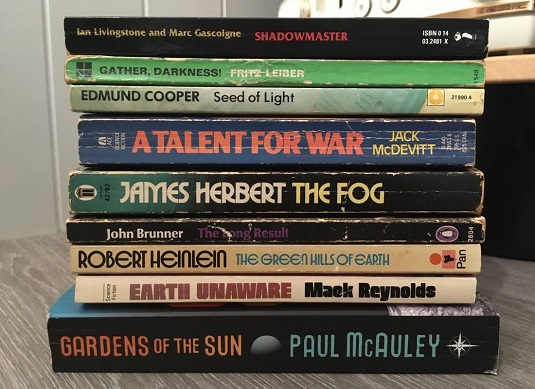
Without any further ceremony, starting from the bottom we have Paul McAuley's Gardens in the Sun. This is second in his Quiet War quartet and deals with the aftermath of the events in the first novel, The Quiet War. No spoilers here in case you haven't read that, but it made my top ten of last year's best SF reads. Imagine a near-future solar system that has become something of a powder keg, and there's real tension between the earthly powers and the outer colonies. If this sounds a little bit like The Expanse, that's because - I'm convinced - this series "inspired" the later mega hit. Except this is much more intelligently and better written, with great characters, and no silly, pulpy elements. The Quiet War is on my best science fiction of the 21st century list, and I've got no reason to believe that this sequel won't live up to its predecessor.
Next up is Mack Reynolds's Earth Unaware. In case you didn't know, Reynolds was for many years a leading cadre of the US Socialist Labor Party and was expelled for fostering illusions in capitalism or some such. Therefore, much of Reynolds's work has a sort-of Marxist/utopian bent to it. Of his books, the first I'd heard of this one was when it presented itself on the shelf in front of me. According to the blurb, a self-proclaimed prophet and, its words, "his sexy young daughter" use telepathy to wean the human race off the mass media. Does no television mean instant revolution? The answers to this question lie within this slim volume.
My bad with the Heinlein. I originally picked this up as a Baen omnibus with The Menace from Earth a few weeks ago. Ooops. The Green Hills of Earth is a short story collection from early on in Heinlein's career. They centre on a blind engineer who's a poet and a musician, and goes about the solar system singing, performing, and fixing things. I've had tricky times with Heinlein in the past, and only one of his books so far - Citizen of the Galaxy - have ticked the okay box for me. Perhaps I'll find this collection more agreeable.
John Brunner's The Long Result has some good news and some bad news. The good? Racism is dead. The bad? It's now applied to species other than humans. Earth had colonised two extra-solar worlds when we're approached by intelligent folks from Tau Ceti. They want to set up a meeting, but the extremist The Stars Are For Man League want to sabotage the occasion to demonstrate humans are the galactic top dogs. Obviously, a very clever move destined to go entirely to plan, and with the desired outcomes. Not normally considered a major Brunner by those conversant with such things, but even that would rank this book above the usual fare.
The Fog! A horror book! Or, to be more exact, an SF-based horror book. This James Herbert classic has some meaning for me. When I was a nipper, my Dad had a book case full of horror paperbacks at the top of the stairs. Herbert was his favourite author, and this was among the collection. I never read it, but do remember someone bringing their dad's copy into junior school and reading aloud the grim gym scene. Over the years, I've got through a handful of his books - the last one being '48, an alternate history after which Hitler has unleashed a deadly plague. That was great fun, as have been all the other Herberts I've read. This version - the 1979 printing - is, I think, the same one Dad had. Maybe he's still got his library in the loft?
A Talent for War by Jack McDevitt is also another book with some meaning attached. I remember my mum buying a random collection of paperbacks from the local primary school's annual May Fayre. Among them were Larry Niven's Ringworld, the 70s film tie-in of Dracula, James Herbert's Sepulchre, Nikolai Tolstoy's The Coming of the King, and this. I read it and found it more interesting than the, to my 14-year-old mind, frankly weird Ringworld. Christopher Sim is a legend who fought off the alien Ashiyyur while Earth and the main colony planets were twiddling their thumbs. But what if this is a load of nonsense? It's undemanding stuff, and made me a bit of a fan of McDevitt's work. Unfortunately, my original copy was let go during a huge book clear out we had. So there is a vague, vague chance that the copy I picked up today could be the same one from back then.
Our next one is Edmund Cooper with Seed of Light. I still haven't read any Cooper, despite owning several of his books. Somewhat noted for being a grump and not a fan of feminism, the SF Encyclopedia says that this title, from the late 1950s, is a touch optimistic. The Earth has been wrecked through environmental catastrophe and war, but the launching of a generation ship marks the possibility of a hopeful new beginning. We could all do with that.
I took a risk with Fritz Leiber's Gather, Darkness! considering how much I disliked The Big Time. Originally serialised in 1943, the blurb supposes a fantastical society in which science is suppressed and everyone is at war. Magic is in frequent use, and devils and angels are in the mix too. Yet not even a theocratic dictatorship can defy the laws of social dynamics forever, and a revolution breaks out that brings the edifice crashing down.
The last book is also holds some meaning. Before computers grabbed me, I was dipping my toe into role-playing games. But without enough interested friends, solo adventures were the way to go. As a fan of the Choose Your Own Adventure line, my mate Jay lent me a Fighting Fantasy game book and from that point I was hooked. I assembled a collection of the first 39 books, plus the Sorcery! quartet, the original rule book, and the two source books about FF monsters and Titan, the fantasy setting for most of the series. I still have them all and most are in very good nick. Anyway, I remember there being a trilogy of straightforward novels written by different authors from the FF stable. They followed the adventures of the strangely-named Chadda Darkmane and began with Steve Jackson's The Trolltooth Wars. Itself a rare book, I was able to happen upon it several months back. It turned out to be terrible, even for a kids' book, and has one of the worst endings I've ever read. But of the two sequels, I knew nothing. Until I chanced upon Marc Gascoigne's Shadowmaster today. The concluding book of the trilogy, Chadda teams up with FF recurring character Yaztromo the wizard to see off the forces of chaos. As the middle book typically goes for about £120, I don't fancy my chances of randomly picking it up cheap like I did with this. But still, it's nice to add something to my own FF range.
Those are my latest pickups. Have you bought anything new and interesting lately?

1 comment:
Of these I have only read The Long Result; I'd definitely argue that it's a very minor Brunner. To me it is caught between his pulpier earlier work and his later tract novels, lacking the fun of the former and the thought-provoking quality of the latter.
I have read a couple of Cooper novels; The Cloud Walker (1973) I enjoyed very much, a thoroughly solid adventure based on that durable theme, the slow return of technology in a fallen, post-nuke world.
Post a Comment