Thursday, 22 February 2024

A Reliably Loyal Servant

What is the point of political commentary? In my view it should try to explain what's going on in politics, explain the stakes, the tactics and strategies deployed, tear asunder its self-serving illusio, and make plain the interests that work in and through politics. A million miles away from the stenography of establishment-friendly "analysis", but one that might become increasingly redundant. For as the shenanigans in the House of Commons on Wednesday have shown, politics is relaxed about operating in the open. By that I mean its pursuing of vested and minority privileged interests, and being brazen about the arm twisting and unconstitutional tricks pulled to ensure they're served. If there is no mediation, if the truths of politics are immediately visible to anyone who glances at them, we return to the opening question. What's the point of political commentary?

Obviously, there is still a point because even now the naked contempt for democracy is too much to bear for those paid to write and talk about politics. How the SNP's correct and genuine motion calling on Israel to stop bombing civilians cowering in tents became a seemingly arcane dispute about Commons procedure shows how the institution works to blunt the pointedness of politics when it is aimed against the interests of British state power. A useful lesson for anyone working and hoping to bring about radical change in this country.

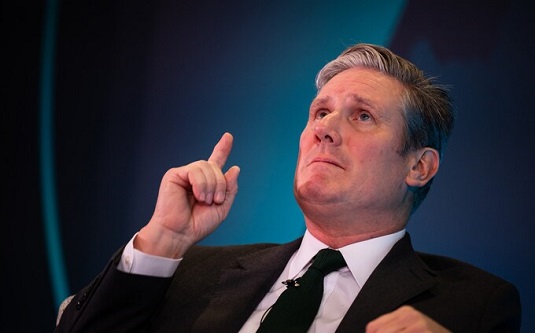
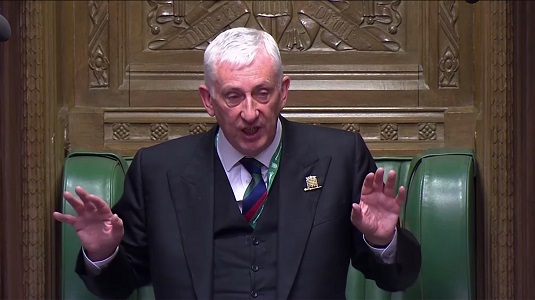
What happened was a disgrace, but it was what we should expect. Lindsay Hoyle is not an impartial speaker, he's one that has always kowtowed to power. When Boris Johnson was the ruler of all he surveyed, Hoyle worked the Commons to his benefit. Now the Tories are heading for a deep dark hole and Keir Starmer can look forward to a mega majority without much extra effort, his loyalties naturally gravitate toward the centre of coming power. Whether Hoyle was threatened with defenestration after the election if he didn't select Labour's amendment to the SNP's opposition day motion, or if he was moved by pressure exerted by Starmer about dubious but politically convenient terror threats to MPs is, in one sense, significant. Because it was, in full public view, seen to ride roughshod over parliamentary procedure it means the independence of the Speaker was also seen to be fatally compromised. Whereas John Bercow's twists and turns over Brexit were driven by his own concerns, Hoyle has given every impression of caving in to a mix of persuasion and threats. Exactly the carrot and the stick the whip's office forces on the party's would-be rebels.

However, given Hoyle's pedigree it's likely he would have made the same decision even if there were no dirty tricks, and Starmer hadn't dropped by his office for a personal visit. As a loyal servant of establishment politics and beneficiary of Labour nepotism, there was absolutely no chance he would have allowed the next government to be torn apart before it had even taken office. Starmer's project - authoritarian modernisation - requires a concerted if not cross-party effort at restoring trust in state institutions whose popular legitimacy is under question. It's not a totally ridiculous proposition. The death of the Queen showed there is something of a constituency who want to believe and are comforted by the presence of a strong but fair state. Hoyle's job is to see this succeed because his first and only loyalty is to the state in which he sits as an exalted functionary. If this means ignoring parliamentary conventions as well as rubbing the SNP up the wrong way and annoying our pitifully weak government, that's a small price to pay if it secures stability and the politics of business-as-usual in exchange.

Image Credit

Saturday, 17 February 2024

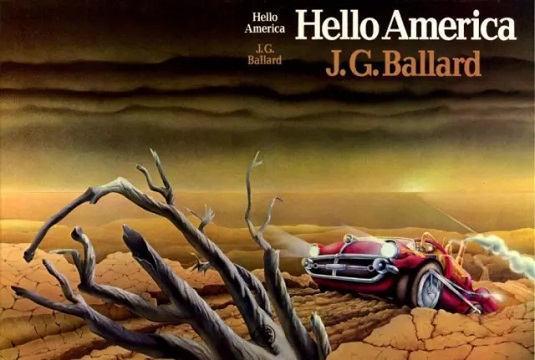
Hello America by JG Ballard

As far as Hello America is known, it's commonly regarded a minor Ballard. Theoretically, it should be of interest what with this post-apocalyptic tale being his last pure science fiction novel. The premise sees North America abandoned after an energy crisis, social breakdown, and changed weather patterns that sees the Sahara come to the East coast. A century later an intrepid group of European explorers in their steamer, the Apollo, chug into New York harbour to investigate anomalous radiation readings. According to measurements from the other side of the pond, they are consistent with atomic explosions of some description. Is someone testing nuclear weapons in this empty continent? Are long-dormant reactors spewing their poisons into the air? What's going on?

Despite Ballard's deserved reputation as a serious writer, a keen sense of the absurd suffuses his most celebrated novels. His classic slipstream of the 1970s all feature it. The far-fetched subculture of car smash fetishists in Crash, the feral descent of nice middle class people trapped in their ultra modern skyscraper in High-Rise, and the Robinsonade survival of a man stranded on the liminal wasteland between busy highways in Concrete Island demand suspension of disbelief, and they work. Hello America initially reads as if it could be considered as part of their feted piece. That the United States would wind itself up is a nonsense, but no dafter than other conceits in the Ballardian oeuvre. And this works for half of the book.

The descriptions of dunes spilling between Manhattan's towers, the sand blasted suburbs, and New York's animal residents observing the arrivals fresh off the boat are pitch perfect. This is the ultimate Ballardian terrain: the imagined desolation of the world's most famous skyline. For example, describing city life smothered by desert and reclaimed by nature,

On all sides was a secret but rich desert life. Scorpians twitched like nervous executives in the windows of the old advertising agencies. A sidewinder basking in a publisher's doorway paused to observe Wayne approach and then uncoiled itself in the shadows, waiting patiently among the desks like a merciless editor. Rattlesnakes rested in the burrow-weed on the window-sills of theatrical agents, clicking their rattles at Wayne as if dismissing him from a painful audition (p.35)

We are quickly introduced to the new native Americans - the few thousand left behind after the scramble for the boats. All are hunter/gatherer tribes modelled on Americal archetypes. The Executives ride around on their camels bedecked with ties. The Gangsters carry guitar cases, while its female members apply peroxide in imitation of the molls. The Divorcees are reputed to be a tribe of women occasionally partial to the odd, unwary young man. And of the Executives our explorers meet, they're all named after brands. All very silly and not the most subtle commentary on the US. But if the novel stayed in this vein as the characters started making their way into the dust bowl interior, it could have been another triumph. But then, just as we reach the jungle around Las Vegas, Hello America goes completely off the boil.

It's hard to put a finger on what goes wrong. The changing pace from road narrative to sitting around and waiting for things to happen? The abrupt resolutions of two complex and potentially troublesome characters. The self-proclaimed president of the USA styling himself as Charles Manson. Theatre performances of robot Frank Sinatras and Dean Martins in front of mechanical audiences. A parade of androids of presidents past leading an assault on a casino. And the revelation bombs are getting exploded over deserted American cities to keep the contagion of people away. Taken together it's too clunky and too on the nose. Yes, we know the office of the American presidency is structurally psychotic so why not have a noted sociopath in the chair? But more than this, it commits a sin one does not normally associate with Ballard's books. It becomes dull. Expertly written, but tedious. Hello America left me wanting to say "goodbye America".

Perhaps he got fed up writing the book. Perhaps it was too much a purist throwback to his genre roots. Or that he had an engaging premise, was able to go to town on the scorching desertification of America's suburbs, but not much of an idea to do with the rest of the tale - not unlike what happened with Lost. And lost Hello America certainly is. Technically, there's a lot to like in the first half. But when all's said and done, there's a reason why this book is something of a forgotten Ballard.

Friday, 16 February 2024

The More They Stay the Same

There was a lot of cope around the Tory party today. Reflecting on the largest collapse of an incumbent party's vote in 90 years and the biggest swing from Conservatives to Labour since before the war, all Jacob Rees-Mogg could do was pretend Keir Starmer is not on track for a big general election win by pointing to how Labour did not win more than 50% of the vote in Wellingborough. Likewise the Tories were brushed aside with ease in Kingswood too. The loss of these seats, which are as Tory as Tory can be, exposes the rot that's eaten away at the Conservatives' support base. If only someone had been banging on about this for years.

Labour's triumph and the Tory catastrophe reinforces the existing trends in establishment politics. These results can only have a stabilising effect on the strategies, rhetoric, and positions takings of both parties between now and the general election.

For the Tories, the old excuses have come out. Their supporters "stayed at home". This is the line of Lord David Frost, who has never been near an election and can almost be forgiven such naivete. Or Tory supporters are lending protest votes to Reform UK. This is what the so-called New Conservatives are saying, and this finds a reasonable echo on the Tory benches. Calling for Rishi Sunak to resign (again), Andrea Jenkyns sums up the right wing position: stop immigration, strafe the boats that brave the Channel, double down on anti-woke politic, and push back against the green crap. This is the path to electoral success. It obviously isn't, but there is an infantile logic at work here. Tot up the Tory vote, tot up the Reform vote. Unite the right and Labour wouldn't have won. At least not in Kingswood. Unfortunately for our back bench factions, it's not as simple as that.

How is this going to play out for the government? More Tory bellyaching and impotent grandstanding from yesterday's people. And Sunak? A pretence that everything is fine, that he's delivering for Britain - despite falling short of his own meagre targets, and hoping Rwanda and dumping on trans people in the earshot of a murdered girl's mother can swing it for him. Have the Tories ever been in as abject a position?

Labour, as we know, has had its own difficulties this week. Support among Muslims and other sections of its core electorate have taken a dive and it's looking increasingly likely that George Galloway will rub Starmer's nose in the political consequences of his depravity over the ethnic cleansing in Gaza. And so those who fancy themselves the political brains of the Labour operation are going to be over the moon with these results. No blowback for being soft on Israeli genocide. And no sign of a revolt over Labour's scaling back of its green ambitions. Though it's worth noting the Green vote increased enough in Kingswood to save the party's deposit - their best ever result in the seat. Their obvious take home is going to be that while Labour's core support are unhappy, jettisoning popular policy while advertising one's moral vacuity are no barriers to winning seats in Tory areas. Why not move on and water down those awkward pledges on workers' rights to win more of them over?

Here are the contours of the dying months of the Tories' 14 year stint in power. They have boxed themselves in to thinking policies that are the priority for a small minority of the electorate is the key to victory, when all it can do is hold a rump together. And despite Starmer's exhortations that Labour "shouldn't take anything for granted" and needing to "fight as if we're five points behind in the polls", never before has a party approached an electorate so sure of victory that its politics are shot through with the laziest complacency.

Tuesday, 13 February 2024

From Rochdale to Botchdale

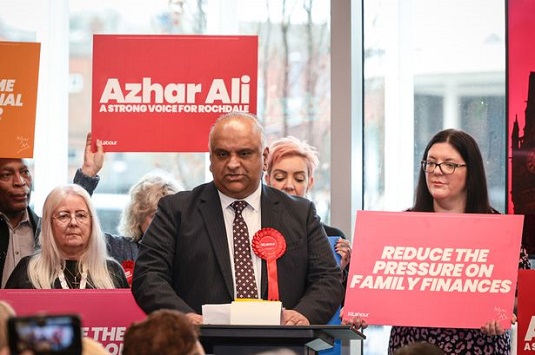
Labour has got itself into a spot of embarrassing bother over the Rochdale by-election. With news breaking at the weekend that the party's candidate, Azhar Ali, was recorded at a meeting making "antisemitic comments", leading lights on the Labour right, such as the Jewish Labour Movement's Mike Katz, and recent returnee Louise Ellman took to the media to defend him. And, having done so, the party turned around on Monday evening and disowned Ali's candidacy. If he's elected on the 29th Labour have said he won't ever take the whip. A mess, certainly, and one that has provided the Tories some cheer while boosting George Galloway's chances of taking the seat.

And then Tuesday took a turn for the worse. Graham Jones, hoping to get back his old seat in nearby Hyndburn, was recorded at the same community meeting that nobbled Ali saying that British citizens fighting for Israel should get locked up. The JLM said this was unacceptable and antisemitic and, like clock work, the party handed down a suspension. At about the same time, The Times scooped on complaints against Sue Gray. You'll remember the frisson of impropriety on occasion of her appointment and recall how the rules about employing former senior civil servants didn't apply to Keir Starmer because she was the best of Whitehall. Turns out she undertook an investigation into leaks surrounding the leadership's dithering over the £28bn/year green new deal commitment, and did not afford staff their right to union representation or respect for the rules of workplace conduct. Phones were confiscated and searched for incriminating messages without following procedure. The GMB branch representing party workers are unhappy and have lodged an official complaint. And to think Gray was the woman brought in to professionalise the Starmer operation.

Apart from the occasional criticism, rare are the Labour leaders who've enjoyed such a benign press climate. In fact, Starmer is doubly fortunate that as the Tory party heads down the tubes, their key institutional supports are facing crises of political influence too. And yet Labour are all over the place, determined to compete with the Tories for the mantle of the most disarrayed. Of course, the Labour right have only themselves to blame for their predicament. As the Starmer-commissioned Forde report found, the Labour Party operates with a hierarchy of racism and accusations of antisemitism were peddled for nakedly factional reasons. A point underlined by Labour initially protecting Azhar Ali, because what matters is not tackling racism but the politics of those so accused. The problem is if you promote a politics based on falsehood and hypocrisy, you yourself will get poisoned by its legacy. With the Tories badly flailing, if the Labour right turns a blind eye when its people make dubious comments the government are going to seize the weapons they fashioned and used against the left. It's obvious. It was always obvious.

Does this really matter as far as the general election is concerned? Not really. Labour's difficulties in Rochdale aren't about to swoop down and save the Tories from their oblivion. Even if Galloway does win the by-election, the mood is resolutely against the Conservative Party. Likewise, the slate of independent left candidacies hoping to give voice to disaffected supporters - as well as they might do when the general election swings round - aren't going to change the outcome. But what does matter and what this episode of ineptitude is indicative of is how Starmer's Labour behaves in government. If their operation is thrown into chaos thanks to unforced error, how will Starmer manage when faced with the inevitable lobbying scandals, cash-for-access scandals, and donations-for-favours scandals? Because if the party behaves as it has these last couple of days - try to tough it out, get the ministers and senior MPs to burn political capital defending the indefensible, and then screeching to a panicked u-turn - then the authoritarian government Starmer wants to lead will rapidly discard its authority.

Image Credit

Sunday, 11 February 2024

A Rude Reminder

I watched some proceedings of last week's Popular Conservatism conference as part of my duty to the labour movement. And it was a dull affair. Nothing different was said that we hadn't already heard at 2023's National Conservatism conference. Or at the virtually identical contemporaneous gathering of the Conservative Democratic Organisation. Or any of the other overlapping and interlocking Tory factions multiplying like rabbits on the back benches. It was the convinced serenading the converted, as we heard about the evils of wokeism, unelected bureaucrats, the left's long march through the institutions (if only!) and how, as far as Lee Anderson was concerned, coal is a renewable resource because it comes from plants. Not even Liz Truss's third stab at the pitch she gave during her last two comeback speeches ticked the worthy-of-attention box.

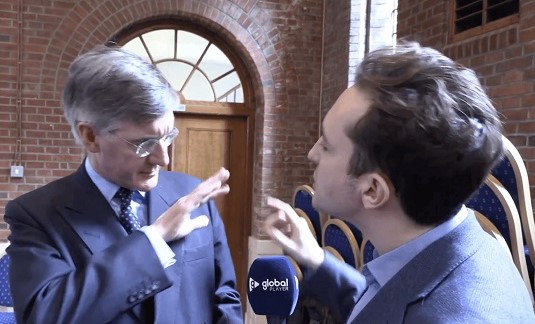
What did, however, was a viral exchange between Jacob Rees-Mogg and former Newsnight journalist, Lewis Goodall. After giving a speech railing against elites Goodall asked whether, given his millions, Rees-Mogg was part of the same wealthy out-of-touch elite he had just been attacking. He exploded. Goodall was shook by Rees-Mogg's furious reply that denounced him as a "left wing journalist" whose impartiality was in question. Reflecting in a piece for the New Statesman, he mused this was symptomatic of the Tory love-in with Trumpian "post-truth" politics. While that describes the contours of the PopCon/NatCon/ConDem alphabetti spaghetti of Tory factionalism, it does not, in fact, provide a satisfying explanation for why Rees-Mogg's studied politesse came apart after a relatively innocuous question. What does is the fact Goodall unwittingly broke the golden rule of politics.

Writing about the dynamics of cultural production, Pierre Bourdieu argued that it's best to understand music, art, film, the theatre, and literature as fields structured not unlike economies. Participants compete with one another over the stakes, accolades, and economies of recognition particular to them. In other words, what is at stake is the accumulation of cultural capital. The more one has, the greater their clout within that field, the greater their interests are synonymous with the continued legitimacy of that field, and - sometimes - the greater the possibility of converting cultural capital into economic capital. That is to say, in the non-Marxist sense, money. For Bourdieu, each field has an ideology that goes with it. This is the illusio, which determines what can and cannot be said and done. Transgressing the illusio, such as suggesting writers of literary fiction owe more to (and have an interest in) the commercial imperatives and viability of their work than disinterested concerns with artistic fashions is about the biggest faux pas one can commit. Art for art's sake as an explanation for the writerly preoccupation with auratic works remains as much the illusio of middlebrow and high literature today as it always has.

It applies to British politics as well. The Westminster illusio has it that parliamentarians are motivated by service to their constituents and their country. Regardless of their views, everyone is united by their respect for the constitution and that they will do what is best for those who voted them in. When you look at the career of someone like Rees-Mogg, we (ostensibly) see a preoccupation with parliamentary sovereignty. Indeed, that was the topic of his turgid speech that prefaced his snapping at Goodall. We can disagree with him, but - as the illusio goes - one cannot question his sincerity or integrity. He's motivated purely by public service. Goodall's question inadvertently pressed a pin into this balloon of pompous nonsense. British politics, like all politics, is a struggle between interests. The reason so many wealthy business people, like Rees-Mogg and like the Prime Minister enter into politics is not for something to do in their dotage. It's a case of securing their class interests.

Despite his landed gentry countenance and the baubled family tree to match, Rees-Mogg's money comes not from the exploitation of 15th century serfs but the financial alchemy of hedge fund management. He is a creature not of the country sets and the boxing day fox hunt, but more properly of the City. And it's this, just like Rishi Sunak, that overdetermines his politics. The firm he co-founded, Somerset Capital Management, specialises in 'global emerging markets' - a euphemism for leeching off some of the poorest and most exploited workers on the planet. This was preceded by a career in the City. Given this pedigree, is it any wonder he's long lined up with that section of finance and commercial capital that was (and is) enthusiastic about Brexit? And that for all his seemingly archaic concerns with parliamentary sovereignty, this specious rhetoric is nothing more than a cover for an authoritarian politics that brooks few checks on the executive by the courts, by subordinate state institutions, and by supranational organisations and treaty obligations. There is a direct line between Rees-Moggs's politics, filtered through his webs of archaisms, and his very capitalist class interests. There is not one thing he has ever done nor will ever do that might compromise his understanding of doing right by those interests.

And this is why Goodall had to be shot down without the usual etiquette. The profusion of Tory factions might seem mad from the standpoint of what he calls the ""unthinking" centrism in politics", but it's tied both to a particular interpretation of where the Conservatives see themselves now, and the fact the party has allowed itself to become tied to the most backward sections of the British ruling class. A fraction whose hyper consciousness can't stop them worrying about what Keir Starmer and Labour might lead to, are concerned they're not going to have significant political power for a very long time, and are flailing about in despair as their politics lose purchase on the minds of the electorate. But even now, these class dynamics have to be denied. The illusio of politics must remain in play because if it's suggested that Rees-Mogg, the PopCon farce, and all the ferment on the right of the party is rightly seen as the last gasp of a discredited and diminishing class fraction, it could be the last gasp of a discredited and diminished class fraction.

Image Credit

Friday, 9 February 2024

The Anomaly by Herve Le Tellier

Many things have been written about Herve Le Tellier's The Anomaly. One of those pesky science fiction novels passing itself off as a mainstream literary novel, it has attracted flattering remarks over its originality, its fidelity to the Oulipo school of French writing, and for being a good read. While quibbling the claims to newness - doppelgangers have been an SF staple since Poe's William Wilson - Le Tellier's scratching of an old groove produces a melodious work. It has the page turning quality of a Michael Crichton, centring the scientific/military inquiry into/protection from the unknown with small character studies of everyday folk thrown into an unbelievable situation. But what reviews and other commentary has tended to neglect is The Anomaly's polemical thrust.

Spoilers below.

In March 2021, an Air France airliner lands at JFK airport. The passengers and crew disembark and go about their lives. In June 2021, the exact same plane with the same crew and passengers appears in US air space and is escorted by fighter jet to a US Air Force base. What's going on? The duplicates (or are the ones who landed in March the duplicates?) have experienced no lost time, and have to come to terms with a world where their niche is inhabited by their other selves. This poses a problem for Blake, a hit man, who has no intention of surrendering his shadowy life to a double. But not so much for struggling novelist Victor, whose alter ego finished writing a book of aphorisms - entitled The anomaly - and promptly took his own life. This catapults the book to the top of the best seller charts for Victor to more or less pick up where he left off. What duplication means for relationships, for people's standing in society (or at least those who come out publicly), and the arrangements some characters arrive at to assure their co-existence is all deftly done.

How to explain what happened? Eventually, the leading hypothesis is that our world is one of many simulations ran on an inconceivably vast computer by a super advanced civilisation for reasons unknown. The duplication of Flight 006 is a test of some kind, the insertion of an unknown variable to see how us little computer people would go about reacting to it. There is some suggestion it could be existential. If our response is wrong then our simulation will get turned off. The White House invites representatives of several religions for their take on what happened and where the creation of over 200 duplicated people might sit theologically. A consensus of sorts is arrived at that if they were abominations, then God would not have given them life. The Devil, after all, cannot create.

For my money, The Anomaly is a polemic against what Le Tellier sees as the real anomaly - the unending eruption of unreason in culture and politics. The US President, who is never named but is obviously Donald Trump and has a deal of trouble following the explanations and recommendations offered by his advisors. Published in France in 2020, Le Tellier didn't have much faith in the American people cutting short the tangerine dream's bid for a second term. That's and his two-faced dealings with Macron are the light relief appetiser. The polemic hits hard toward the book's end. One of the young women from the flight appears on The Late Show with Stephen Colbert with her doppelganger. It's all wholesome with the sympathetic liberal audience. They're slightly gawky and awkward. The one who landed in March has embarked on her first hesitant romance with a boy. They couldn't be more unthreatening. But outside the studio is besieged by Christian fundamentalists drawn from America's religious redoubts. As the pair leave in a company car, they're caught up in a traffic jam caused by the protest. By chance one of the zealots spot the pair giggling in their seats, and convinced they're Satanic spawn he shoots them to death. The theological positions put out by at the government's behest count for nothing as his mind is consumed by religious ecstasy.

And then, the end. In October 2021 JFK airport is radioed by a third Flight 006 seeking landing permission. The action cuts to the cockpit of a fighter pilot querying his orders. They've come straight down from the President himself. The flight must be destroyed. The missile streaks towards the helpless jet and in the seconds before impact, everything stops. The world feels a shudder, and the text breaks up and collapses to a point. The obvious implication being that we, or rather the unreasonable order of an unreasonable President have failed the experimenter's test and our simulation gets shut down.

The warning is clear. The anomaly of unreason is an existential threat, but not an insurmountable one. If the right people made the right decisions. If the crazed and the stupid were not encouraged and empowered, we might stand a chance.

Image Credit

Monday, 5 February 2024

Remembering Christopher Priest

Only just heard that science fiction author and literary giant Christopher Priest passed away on Friday. I'm sharing a couple of video interviews he had with his long-time friend Stephen E Andrews. He talks about his career, a modest appreciation of his role in new wave SF, his influences and, among other things, the success he had with The Prestige.

Sunday, 4 February 2024

The Labour Right's Political Strategy

Labour wants a "bomb proof" manifesto. In practice, that means junking anything a Sun editorial might find irksome. Today, Keir Starmer's earnest promise to abolish the House of Lords is filed under the never never. Though to be fair to Starmer, I think this is about the third occasion he's announced his abandonment of the pledge. Then at the end of last week, the £28bn/year green transition fund has been scaled back following manoeuvrings and whispering campaigns. Rachel Reeves's arbitrary fiscal rules come first. And coincidentally, they repose in conformity with Bank of England/Treasury/City orthodoxy. The very nexus of class forces that have brought nothing but plenty to the people of this country.

Apart from a few nice-sounding policies around the edges, the only logical argument for supporting Labour is voting against the Tories. And millions undoubtedly will do so, despite Starmer offering much less than what Tony Blair promised. What a pitiful state of affairs. But what, if anything, do his latest slew of retreats signal? The analyses and comments doing the rounds about Labour's cowardice, the institutional capture of the party by the City tendency, and not wanting to scare the right wing press all have something to recommend them. But added to this is the internalised logic of the party's right wing establishment. Their capitulation is so craven because their strategy swims with the stream of bourgeois politics.

There are three "pragmatic" arguments to this, neither of which are separable from Labourism itself. Scaring the City, the bond markets, the international "investors", and upsetting "business confidence" are absolute avoidables in the Labour right's operations manual. Apart from inviting attacks from the right wing media when Labour is seen out of step with these interests (NB the Tory press will do it anyway - the clue is in the name), the reasoning goes that if the markets are becalmed Labour will have an easier time in office. It doesn't matter that the price paid is burying the chance of fundamental reforms, because the thought of implementing any never crosses the Labour right's imaginary.

This foregrounds the Starmerist "don't offer anything" strategy. If you don't offer anything, you can't be held to account for not following through. The proof of this "wisdom" was demonstrated when the Australian Labor Party won its election a few years ago. Their manifesto said precious little, which gave the Coalition nothing to attack. Instead they jumped off the anti-immigration, anti-woke deep end. And they sank with nary a trace. It looks like history is going to repeat itself with the Tories, convinced as they are that their right wing fetishes will be a bit of what the electorate fancies. Why interrupt your opponent while they're tanking themselves?

But the other element of offering nothing is summed up by a mantra Ed Miliband was fond of during his leadership. At a party event in Birmingham early in his tenure, he said Labour were going to "under promise" but "over deliver". This is super clever politics for LOTO's galaxy brains. Your government isn't on the hook for anything but when it does something it can be trumpeted from the rooftops for its mould-breaking brilliance. The passive electorate will be suitably wowed by the policy largesse dispensed, accustomed as they are to nothing but Labour's very super serious pragmatist managerialism. Carry on like this and the second term is in the bag.

And there we have the contours of the Labour right's governing philosophy. Do nothing for most of the time, and bury themselves in laurels when some minor improvement rattles off the legislative conveyor belt. And, here's the best thing for those steering HMS Great Britain. Not only do they get to enjoy a decade's worth of dinners at the captain's table, there will be handsome launches waiting for them as thank yous for services rendered when the voyage pulls into harbour. Climate emergency? Demographic ageing? Care crisis? Crumbling public services? Falling living standards? Productivity lag? Decaying political legitimacy? With any luck they can get brushed under the carpet as our plucky Labour ministers strive with determination toward the gilded life awaiting them at career's end. Labour is the party of aspiration, after all. Theirs.

Image Credit

Friday, 2 February 2024

Leigh Bowery on The Clothes Show

For no reason whatsoever, here's Leigh Bowery doing his thing.

Thursday, 1 February 2024

Five Most Popular Posts in January

2024 has barely got underway and already we've burned through January. Mind you, as per December's announcement this blog has taken things at a more leisurely pace. But enough stuff appeared to make a round up of what was hot last month a go-er.

1. The Sun's Attack on Keir Starmer
2. Stirring Up Apathy
3. The Opposite of Necessary
4. The Tory Politics of Immigration
5. On the Green Party's Four for 24 Strategy

Talking about Keir Starmer usually commands the numbers, and 2024 is showing no break from this tradition. In at one was the hatchet job The Sun did on him over his pre-politics record opposing the death penalty overseas. A rare highlight in a career marked by establishment obsequiousness, I asked why the paper - now Labour has pretty much capitulated to right wing common sense on all issues - is having a go. The second post is about his new year speech. It's all about the vibes, man. Coming in third was a small piece mocking Steven Moffat's desire to do a British West Wing. Hot on its heels is my take on why the Tories are tearing themselves apart on immigration, despite the fact you can't get a credit card between the two opposing camps. And lastly is the long-promised meditation on Green Party strategy ahead of the general election.

Second chance saloon? As I said in December, part of the blog wind down is a desire to write and think about different things. One of those is a turn into science fiction commentary and criticism. I offered up three such morsels, and here are two of them. A piece excavating conservatism in Dan Simmons's Hyperion, and another on Frederik Pohl's award winning Gateway. Fill your boots!

What to expect for the month ahead? I still fancy writing something about Socialist Appeal's "communist turn", and I'm sure there will be politics aplenty to think about. Expect a slice of skiffy to help it go down. As ever, if you haven't already don't forget to follow the monthly free newsletter, and if you like what I do (and you're not skint), you can help support the blog. Following me on Twitter and Facebook are cost-free ways of showing your backing for this corner of the internet.