Monday, 28 May 2018

Can the Tories Appeal to Young People?

Imagine a hole. Imagine a very deep and very wide hole, a hole so, so wide you can't see the sides. A crater so vast that its inhabitants can convince themselves they don't actually live in a hole. After all, they can see the sky and the horizon is clear. Said hole is the current abode of the Conservative Party. Among the matters to have located them there are internal disunity and their making a complete pig's ear of Brexit. If our electorate wasn't polarised the polls would register the hurt they're doling out. But because we do have a polarised country, there's no hiding from the fact Tory support is drawn disproportionately from declining sections of the population. Some Tories have been brave enough to scout out from their camp and, to their horror, discovered the sides of the hole cutting them off from the rest of the world. And realisation is dawning that it's going to take an awful lot to climb out.

This is the context the Centre for Policy Studies released their latest publication, New Blue: Ideas for a New Generation. This booklet has the brightest among the new intake offering policies they think (hope) will enable the party to connect with the rising generation of voters. As Robert Colville points out in his opening chapter, while 44% of 18-24s say they're certain to not vote Conservative, their attitudes aren't hostile to what he regards as Tory values. They are more likely than older age groups to believe in equal opportunities trump equality as a virtue, a plurality think government tax and spend too much, support the principle of paying for university, support zero hours contracts, and the freedom to of companies to make profits and pay their CEOs high salaries. Leaving aside any criticism we may have of the questioning underpinning the research, on the face of it the Tories are not facing millions of dyed-in-the-wool Corbynists - a point Labour people should also heed. The Tories might have a chance to win enough of them over to keep going.

What are the ideas on show? If you were expecting bold announcements and breaks with current practice, forget it. Don't take my word for it. On housing, for instance, the perennial Tory vote killer among the young (and, increasingly, the not-so young), Bim Afolami weighs in with a land value tax to be paid by landowners whose land has been earmarked for housing development. The monies raised would go to the local community, who would determine how it's spent. A bribe for NIMBYs, if you will. Lee Rowley, seemingly aware of the growing importance immaterial labour calls for "soft skills", collaborative working and critical thinking to be embedded in the curriculum. Helen Whately and Alys Denby note the rising incidences of mental illness among university students and calls for universities to take it more seriously with appropriate support staff, clear signposting of mental health services, and so on. Paul Masterson argues for the introduction of means testing for pensioners, and increasing the floor contribution working people make to pensions to 12% of salary. Nick Denys wants to see a new employment act that clearly defines employer, contractor, self-employed, etc. and wants to link worker representation on company boards to the "depoliticisation" of trade unions. Simon Clarke argues for more community ownership of renewable energy sources (wind, solar) and wants to scrap the effective ban on new on-shore wind turbines. Dolly Theis wants to see a more paternalistic approach to public health, Alan Mak (remember him?) wants to incentivise the move to a paperless NHS, Isabella Gornall wants Clean Air Zones in our cities, Luke Graham revives the idea of regional stock exchanges to facilitate access to capital, Emma Barr wants more mentoring for women to encourage them into politics and, um, on-the-spot digital fines for bad behaviour on social media. And my personal favourite, from Andrew Bowie, is the setting up of digital trails to rebalance the tourist economy away from London. Though, disappointingly, the Potteries do not feature in the plans he provides.

A right mixed bag of ideas, then. Taken in themselves, some of them aren't bad. Yes, you heard me right. Regional stock exchanges isn't, in and of itself, a mad suggestion. Especially alongside regional investment and development banks proposed by Labour. I'm all for deepening immaterial labour, and so yes, teaching soft skills is a very good thing. The state taking a more active interest in public health, encouraging alternative ownership of renewables, addressing the mental health crisis among students, measures to clean up polluted cities, even the trail idea all have something to commend them and are worth nicking where Labour doesn't already offer something better. That said, there are three problems with this collection overall.

The first is the presentation. Look at the contents page and what do you see? A list of authors (mostly new MPs) and the page numbers. To find out what they've written about requires you to go and see. This could just simply be an odd design choice, but it does lend itself to an impression that these essays are profile-raising exercises more than actual contributions to policy debate. The second problem is, well, how safe all the suggestions are. Take mental health and students, for instance. What it doesn't tell you is that all universities, whether they have a comprehensive wellbeing set up or not, find their mental health services massively oversubscribed. Asking institutions to provide more support staff and training is all very well, but in a cutthroat market in which there are plenty of providers but not enough takers - partly thanks to the Tory government's idiot approach to overseas' students - where are the resources coming from? This question can be asked of every single contribution aimed at improving something. IT in the NHS, joined-up public health strategies, bedding down relationship-centred education, you can't do this with a little bit of an incentive here and a target there unless government steps in with cash. And because these are ambitious, young MPs, they're hardly likely to use their introduction to the Westminster policy community by setting their face against the Treasury.

And the last thing, which will surely disappoint Tories concerned about the fate of their party, is the absence of any ideas appropriate to a strategy to reverse the long-term decline. Suppose all these things get in the next manifesto, suppose the Tories are able to limp back into government after the next general election (regrettably, not impossible), none of these policies will appreciably effect their fortunes. These essays do an excellent job of avoiding the predicament they're in and what the Tories need to do to offset oblivion. And that is a policy agenda that is not a race to the bottom, does not expect young people to be cheap and expendable wage slaves, actively builds its way out of the housing crisis, invests in public infrastructure. And, for the Tory party itself, a thorough detoxification that unambiguously embraces social liberalism and casts its hard right into the darkness. Effectively, for the Tories to save themselves in the medium to long-term, they have to stop being Tories. The chances of the party turning their cheek against the Brexit hard right and EU obsessives, the union bashers, the anti-immigration chunterers and assorted other pinheads are next to zero, but that's the direction political necessity is tending. What's it going to be? Is this a reinvention too far?


Sunday, 27 May 2018

Marx and the Fragment on Machines

This, I suppose, is a fragment on fragments. Those bits and pieces of jottings, letters, notes to self, first drafts and other ephemera that accumulate as the debris of writing. When someone, a novelist, thinker, leader, is canonised careers can be made arranging and debating the detritus deposited in a personal (and oft disorganised) archive. Indeed, the very process of establishing somebody as a somebody often draws on this backstage of their careers, giving them weight and significance, dressing them up resplendently, before thrusting the spotlight upon these private thoughts. Few have suffered this more than Marx, of which a veritable industry (now a growth one again) has grown out of his work. As our Blue Marxist friends put it in their Fabians essay, "Marx’s work is unfinished, fragmentary, largely posthumous and received in translation, and accordingly is both rife with misinterpretation and open to radically divergent readings and applications." An opinion all Marxists would, at some level, share.

The extent of Marx's work is vast. From journalism to philosophical polemic, from popular manifestos and resolutions to the unsurpassed achievement of materialist social theory, what was published in Marx's life time was the tip of a vast ice berg. Since his death, almost everything he wrote has been published. The second and third volumes of Capital edited by Engels, the supplementary Theories of Surplus Value, the important Economic and Philosophic Manuscripts of 1844, The German Ideology, the Theses on Feuerbach, The Grundrisse, and the voluminous correspondence between Marx and Engels, their comrades, contemporaries, and enemies. This has been combed through by amateur and professional quote mongers, and was crudely pilfered by the Stalinists to justify their dictatorships and grotesqueries. As texts were released and became available in translation, so new audiences discovered them with their own theoretical concerns in mind. In Marx, they found pre-emptings of their position and confirmation they were on the right track, or brought Marx's thought to bear on problems he did not consider in depth, and/or could not consider. Plenty wrote books emphasising some aspect of his corpus over others. Humanists and Hegel fans found his youthful drafts of 1844 congenial. Louis Althusser and friends, on the other hand, excommunicated these and all Marx's writing prior to the German Ideology as part of scientific socialism's "pre-history", and that historical materialism, understood as the material analysis of the movement of concrete social dynamics, dated from 1845-6. This was the period in which Marx, well, became a Marxist.

Why this matters to us is because the new left has dipped into Marx's back catalogue itself. In his 1979 book, Marx Beyond Marx, Antonio Negri makes the case for The Grundrisse as his most revolutionary work. It is certainly a pivotal moment in Marx's career because here, in rough form, we find drafts and notes for what were envisaged to be Capital's six volumes, including what would be books on the political economy of the proletariat, the world market and the state. There is some debate about whether he stuck by, junked, or incorporated some or all of this into the volumes that did appear, but that's one for the real Marx geeks. What Negri does, among other things, is introduce the concept of the socialised worker (awkwardly translated as 'social worker') and ties it to the now famous fragment on machines (a fair summary here). To do his argument a little bit of violence, as mechanisation pushes up the rate of exploitation fewer workers are needed, but these workers cannot simply be left to rot without work. Employment in actual factories subsides and the social factory and its reproductive labour picks up the slack. Waged and salaried labour, regardless of its employment by companies, the public sector and, increasingly, the third sector, becomes concerned with the production of information and social relationships.

Marx's Fragment suggests that the machinery of production appears to take on a character all of its own, that machines become involved in automated relationships with one another in which humans are reduced to waiting on their needs, a state of affairs whose origins can be traced to Marx's earlier theory of alienation. As more machines are introduced to increase the rate of exploitation and more workers are squeezed out of production, the amount of labour time it takes for a particular good to be made is driven down. And this is a problem because the average amount of what Marx calls socially necessary labour by humans that goes into a commodity is the basis of its value: it is the key lynchpin of how capitalism works. Therefore capital's drive to raise the rate of exploitation, to increase its share of surplus value is, over the long-term, driving value down. If production becomes entirely automated then no labour time is necessary, and value itself collapses. The problem is as automation gathers pace, so immaterial labour and its production of intangible commodities involves an acceleration of this decline of value. As Paul Mason points out, the information and intellectual properties that are hitherto growth areas for investment and profits see necessary labour time rapidly fall to zero. It might take Ed Sheeran a year to throw out an album. It takes you little time and no labour to download it and send copies to all your friends. Imagine what happens once 3D printing technology matures: the fall to nil labour time can only spread to material goods. Value, therefore, is in deep trouble. Not because technology has reduced labour time to zero across strategic sectors of the economy, but because capital's drive for profits have, even though it's undermining its fundamental, foundational relationships.

You can read this in two ways: that capitalism is doomed and it will collapse under the weight of its contradictions. Or it won't. I'm in the latter camp. It does probably mean that the most dynamic period of capitalism lies in the past, at least where the advanced, metropolitan West and Japan are concerned, and a future of low growth and stagnation is something we can look forward to. The tendency to zero labour time can be offset and struggled against through the elaborate development of intellectual property and licensing laws, as well as emergent forms of value capture, but to go beyond capitalism, to build a society after capitalism requires conscious organisation. In other words, politics.

This brings me back to the curious objection Jon and Frederick make in their Blue Marxism piece. For them, because the Fragment was unpublished, what counts for more is what Marx did publish, which chiefly means Capital. While anyone who aligns with Marx's project would agree that these volumes offer the basis for "any wider politics capable of confronting the issues around value, money and commodification", it has to be said Jon's career as a Labour MP is not noted for taking these issues on. Corbynism on the other hand has smashed the accursed Overton window and allowed for them to be considered by a mass public, introducing large numbers of people to what Marx had to say. Secondly, you can't simply discard rough work without a convincing argument. The Grundrisse after all translates as 'outlines', and what is it outlining? Arguments that made it into Capital and plans and insights that didn't. As Gilles Deleuze put it, "You have to take the work as a whole. to try and follow rather than judge it, see where it branches out in different directions, where it gets bogged down, moves forward, makes a breakthrough: you have to accept it, welcome it, as a whole." (Negotiations, p.85). To continue with the theme and give Marx's overall oeuvre a Deleuzian twist, they are an assemblage of published and unpublished texts that stand in tension, connect at times well, at times awkwardly with one another, but as a system of differences they are pregnant with lines of flight that overspill the intentions of the author, and anyone who tried turning Marxism into a straitjacket. There's a very good reason why, in the USSR at the height of Stalin's reign, reading Capital alone was disallowed.

Ultimately though, Jon can call on Frederick's Marxological services as much as he wants. The position of The Fragment in Marx's work is, if you'd pardon an on-topic pun, immaterial. Had The Grundrisse never made it to the Moscow archives and thence Progress Publishers, or The Fragment ended up as kindling to light the hard-up Marx family's fire, it doesn't matter. Using Marxist analysis to work out what has happened to capitalism over the post-war period, the growing dominance of immaterial labour and the production of intangibles, the tendency for necessary labour time to trend toward zero because of the intensification of exploitation and with it a decline in the law of value, this would have been discerned sooner or later by Marxists and in Marxian terms. After all, non-Marxist and bourgeois writers and economists have cottoned on to these trends too and made sense of them within their own schemas. Ultimately, fixating on the provenance of The Fragment and whether it is or isn't properly Marxist is for the birds. What matters is the situation Marx foresaw is now with us and the job of the new left is to do what the new left is doing: analysing it, critiquing it, creating new concepts to deal with it, and assembling a new left politics that can confront it. The new left is using Marx as a guide and an inspiration, not an excuse to sit paralysed, nostalgically pining for a class politics and a pure Marxism that never existed.

Saturday, 26 May 2018

Local Council By-Elections May 2018

This month saw 117,437 votes cast over 63 local authority (tier one and tier two) contests. All percentages are rounded to the nearest single decimal place. 12 council seats changed hands in total. For comparison with April's results, see here.

Party
Number of Candidates
Total Vote
%
+/- 
Apr
+/- May 17
Average/
Contest
+/-
Seats
Conservative
           63
 46,074
    39.2%
 +0.3%
      -1.8%
    731
    -2
Labour
           57
 44,326
    37.7%
+27.7%
    +10.0%
    778
   +3
LibDem
           44
 17,826
    15.2%
  -9.0%
      -3.9%
    405
     0
UKIP
            6
    683
     0.6%
  -0.1%
      -3.3%
    114
    -2
Green
           20
  5,825
     5.0%
  -1.6%
     +0.9%
    291
     0
SNP
            0


     0
PC**
            0


     0
Ind***
            6
  1,694
     1.4%
  -5.3%
     -1.6%
    282
   +2
Other****
            2
  1,009
     0.9%
 +0.9%
     -0.3%
    505
    -1

* There were no by-elections in Scotland
** There were no by-elections in Wales
*** There was only one Independent Clash
**** Others this month were Loughton Residents (655) and Farnham Residents (354)

May is always a messy, busy month for council by-elections. What with so many being held over until local election polling day and the, of course, trying to discern the by-elections from the normal run elections. But here they are and what do we find? The continuing story of the last 12 months: polarisation. UKIP have crashed and burned, but at least in the locals neither the Liberal Democrats or the Greens are squeezed as much as national polling would suggest.

There are those who say with x, y, and z going on that Labour should be miles ahead in the polls. Either those people haven't bothered looking under the hood or are idiots. Yet there is something interesting that comes up time and again from these local election round ups. Despite Labour voters traditionally not turning out as much as Conservative ones, and the latter somehow find someone to stand almost every time despite the shrinking activist base, Labour usually do better on the vote average tally. The Tories have to stand in more places each time to 'win' the by-election popular vote. That's a thought worth pondering.


3rd May
Aylesbury Vale DC, Quainton LDem gain from Con
Braintree DC, Bocking North Lab gain from Con
Braintree DC, Hatfield Peveral & Terling Con hold
Cambridge BC, East Chesterton Lab hold
Cheltenham BC, Leckhampton Con hold
Cherwell DC, Cropredy, Sibfords & Wroxton Con hold
Cheshire West & Chester, Ellesmere Port Town Lab hold
Daventry DC, Walgrave Con hold
Epping Forest DC, Loughton Broadway Oth hold
Epping Forest DC, Moreton & Fyfield Con hold (unopposed)
Epping Forest DC, Waltham Abbey Honey Lane Con hold
Gateshead MB, Ryton, Crookhill & Stella Lab hold
Gosport BC, Leeslands LDem hold
Great Yarmouth MB, Central & Northgate Lab hold
Halton BC, Halton View Lab hold
Havant BC, Hayling West Con hold
Hertfordshire CC, St Albans North Lab gain from LDem
Kirklees MB, Birstall & Birkinshaw Con hold
Leicestershire CC, Stoney Stanton & Croft Con hold
Liverpool MB, Knotty Ash Lab hold
Milton Keynes BC, Newport Pagnell South LDem hold
North East Lincolnshire UA, Immingham Lab hold
North Hertfordshire DC, Letchworth Grange Lab hold
Oldham MB, Chadderton Central Lab hold
Oldham MB, Hollinwood Lab hold
Preston BC, Greyfriars Con hold
Reading BC, Church Lab hold
Reading BC, Katesgrove Lab hold
Reading BC, Kentwood Con hold
Reigate & Banstead BC, Horley West Con hold
Rochford DC, Hockley Con gain from Oth
Runnymede BC, Chertsey South & Row Town Con hold
Runnymede BC, Foxhills Ind gain from Con
Rushmoor BC, West Heath Con gain from UKIP
Sandwell MB, Greets Green & Lyng Lab hold
Sandwell MB, St Pauls Lab hold
Sefton MB, Ford Lab hold
South Holland DC, Donington, Quadring and Gosberton Con hold
St Edmunsbury BC, Haverhill East Con hold
St Edmunsbury BC, Haverhill North Con hold
Swale BC, Sheppey East Con hold
Torridge DC, Bideford East Con gain from UKIP
Trafford MB, Altrincham Grn gain from Con
Walsall MB, Paddock Con hold
Warwickshire CC, Leamington Willes Lab hold
Welwyn & Hatfield BC, Hatfield Villages Con hold
Welwyn & Hatfield BC, Northaw & Cuffley Con Hold
Welwyn-Hatfield BC, Welham Green & Hatfield South LDem hold
West Oxfordshire DC, Freeland & Handborough Con hold
Weymouth & Portland BC, Weymouth West Con hold
Wirral MB, Hoylake & Meols Con hold
Wolverhampton MB, Graisley Lab hold
Worcester MB, Warndon Lab hold

17th May
Lancaster BC, Skerton West Lab hold
Lancaster BC, University & Scotforth Rural Lab hold and Lab gain from Grn
Suffolk Coastal DC, Leiston Con hold

24th May
Bristol UA, Westbury-on-Trym Con gain from LDem
Broadland, Aylsham LDem gain from Con
Horsham DC, Cowfold, Shermanbury & West Grinstead Con hold
North Kesteven DC, Kirkby La Thorpe & South Kye Ind gain from Con
Stockport MB, Edgeley & Cheadle Heath Lab hold
Tamworth BC, Glascote Lab hold
Waverley BC, Farnham Castle Oth hold

Wednesday, 23 May 2018

Jon Cruddas and 'Blue Marxism'

What does misinterpretation mean, particularly in hard-to-follow arguments about the complex and often counter-intuitive ways social dynamics work? Often, it can be an honest mistake, of not approaching a position with sufficient nuance or not having a complete picture about the theoretical project of which it is part. It can be a result of one's own assumptions, that because term x has a certain value attached to it in your thinking you interpret its deployment by an opponent in similar terms, thereby (unconsciously) distorting the position of the other. See humanist approaches to anti-humanism, for instance. Or you're trying to distort it wilfully to either avoid its ramifications, or to pigeon hole it as a stratagem for discrediting it. What kind of misinterpretation is on show in Jon Cruddas's recent attempts to rescue Marxism from new ideas and fresh thinking is something for the reader to decide, but shot through with error it most certainly is.

The target of his critique of what he calls the "postcapitalist left", both in his Fabian piece and his longer New Statesman essay is the work of Michael Hardt and Antonio Negri; fellas, as regulars know, who have a warm reception in this corner of the internet. And this critique has to carry a lot of polemical weight. Jon's Marxism (or "blue" Marxism thanks to his being one of the brains of the blue Labour "movement"), rhetorically emphasises class struggle at the point of production, talks about the need for a politics of consumption to deal with pesky things like "superstructural relations", and wants to "strike compromises" with the forces of capitalism that constrain our freedoms and aspirations. Leaving aside the peculiarities of a Marxism seeking compromises with capitalism rather than working towards superseding it, I am left wondering how much homework Jon's done on 20th century European Marxism. Leninism in its official communist and Trotskyist variants was never alone in emphasising the importance of workplace action. The Italian autonomism that deeply influenced and arguably made Negri is a different workerist tradition, for instance. Speaking of Antonios, I'm sure Jon has heard of the other one - Gramsci - though his remarks demanding a Marxist analysis and politics of culture suggests not. And if you reject the theoretical advances drawn from the experience of class struggles since the late 1960s, which is what Hardt and Negri (and their important poststructural precursors and forebears, Gilles Deleuze and Felix Guattari) do, the Marxism you have left has cut itself off from nourishment and innovation. Perhaps calling it 'blue Marxism' is more apposite for another reason, because in Jon's hands it is cold, inert, dead.

Needless to say, the pen portrait Jon (and Frederick Harry Pitts - remember him?) draw of Hardt and Negri is something I don't recognise. Rather than trade quotes, which is dull, it's necessary to break their polemic down into a number of claims they make about the new leftism. These are that the working class is obsolete and "a new urban, networked and educated youth" is the basis for leftist politics, that it is mired in technological determinism ("the implication remains that we must adapt our politics to match the march of the machines, rather than vice versa"), its theoretical underpinnings are derived from Marx's jottings that ended up published as The Grundrisse, and particularly, the fragment on machines, and that the new leftism is teleological: all history was bound to lead us to this point, and will serve up communism in the future. This points to their conclusion, that "orienting a programme for the left around errant theoretical derivations from disputed repackagings of Marx’s work and empirical speculations of a future that may or may not come to pass is unwise and potentially dangerous." Grab yourself a bunker, it all sounds quite terrifying.

There is plenty to say on technological determinism, The Grundrisse and teleology in the future, so for the remainder of this post I'll be concentrating on the claims made about class.

Of course, Hardt and Negri, nor Novara Media, nor anyone are saying the working class is obsolete. Instead, what is obvious is it has changed. There are many approaches to this, but the one underpinning the new leftism are the conclusions drawn by Italian autonomism from the battles of the late 60s and 70s, and popularised by the authors of the Empire trilogy. The direct involvement of the state in capitalist production meant it was then, as now, the primary vehicle for realising bourgeois interests in the class struggle. The golden age of the post-war period saw real prosperity, but also saw the state working hand in glove with employers to discipline, pacify and manage rising working class militancy. Additionally, the state provided essential support to meet capital's functional necessities in other areas. After the war and with the memory of depression in the air, the state started employing increasing numbers of workers directly concerned entirely with the maintenance of, well, capitalism. There were workers engaged in production for individual capitalists, and there were workers involved in reproduction for the collective capitalist. The latter just weren't the growing numbers of civil servants managing the expansion of state agencies, but those also involved in health care, in education, and in social services. Mainstream economics often talks about automatic stabilisers that kick in when the economy goes south. These institutions can be thought of as social stabilisers, as organisations that are part of the state who not only fix the bodies and souls broken by work, but play significant roles in constituting the social relationships and competencies capital, that businesses and so-called entrepreneurs, are dependent on.

According to mainstream economics, these roles aren't productive because they don't yield value and, therefore, profits. But taking a more expansive view reproductive work is productive, it's socially productive because it provides the social infrastructure for our society. Capital, after all, is much more than a sum invested: it is a social relationship. This reproductive labour then is immaterial labour. Whether caring for the elderly, teaching a class of kids, or reviewing planning permission documents, you are building social relationships, producing subjectivities and identities, generating knowledge, and managing abstract processes. No advanced society can operate without a large proportion of working age people doing this work. Think of your idealised 1950s nuclear family. Would the man be able to leave the house and work a full day with his clothes washed, meals cooked, children cared for, house cleaned, and sexual and emotional needs sorted if it wasn't for his wife? The unpaid, unglamorous, unrecognised labour done in the home by generations of women, the familial and social infrastructure they provide, is the microcosm of what reproductive labour, formal and informal, does for capital.

From the late 1970s on, particularly in Britain and the US and later followed elsewhere, immaterial labour was increasingly privatised. Sometimes it was a case of literal privatisation with public services put out to tender from providers who offered the taxpayer the best "value for money". But there was a shifting focus in capitalism itself. The confluence of consumerism and the invention of the teenager in the middle of the century, coincident with, feeding off, and spurring on rising individualism, and the cultural consequences of movements fighting for women's liberation, anti-racism and gay rights and sexual freedom forced capitalism to adapt. On the one hand, immaterial labour mushroomed in business to sell identities, to track fashions, to market mundane products. Along with them came an expansive range of service industries around the maintenance of the body, of providing lifestyle services, of flattering consumers and selling experiences. Meanwhile increasing social complexity and the need for businesses and government to engage in ever more elaborate planning found their solutions in fast developing information technology. The growth in computer usage, the coming of the internet and its unexpected, unanticipated spin offs (like social media) created new growth industries, and new avenues for more immaterial labour, this time around the production of information and data. While not immediately in the business of producing social relationships, this is work made possible by new forms of collaborative working and social cooperation thanks to networks. For millions of people, the work day begins with the inbox.

For Hardt and Negri, the archetypal worker of late 20th and early 21st century capitalism is the socialised worker. Immaterial labour not only transforms what we do, and how we do it, but it transforms us, too. Far from any section of the working class being obsolete, almost all of us engage in the immaterial labour of social production in our lives outside of work. Not just in terms of the time we put into family responsibilities and tending friendships, but connecting to and spending time with the network, or the social commons. Regardless of what we do, few are the number who do not have a supercomputer sitting in their handbags or pockets, and are active in some way on our digitally-mediated commons. This has a number of consequences, one of which is the nice irony that as our division of labour grows more complex, the basic characteristics of the socialised and networked worker grows more universal.

This is the working class of the new leftism, a becoming of a new unity through variegated multiplicity. It encompasses hip, young gunslingers podcasting from shipping containers somewhere in London. But it also takes in retail workers, couriers, engineers, traffic wardens, brickies, car workers, hospitality, and warehouse workers. Their work and the networks that bound their days might be intangible, but as a mass, the socialised workers of immaterial labour certainly are not. Please, tell me, what is "unwise and potentially dangerous" about orienting your political programme to the experiences and emerging interests of a large and growing majority of the population - unless your politics is uninterested in and afraid of organising them politically in the first place?

Tuesday, 22 May 2018

Calvin Harris and Dua Lipa - One Kiss

Got something in the works on Jon Cruddas's polemic against the new left, but it won't see the light of day, um, tonight. Here then is a top summery tune for your consideration.

Monday, 21 May 2018

There's the Decency, Kenneth

I'm glad Ken Livingstone has decided to quit the Labour Party because I agree with his resignation statement. He writes "The ongoing issues around my suspension from the Labour Party have become a distraction from the key political issue of our time – which is to replace a Tory government overseeing falling living standards and spiralling poverty ... However any further disciplinary action against me may drag on for months or even years, distracting attention from Jeremy’s policies." Yes, his repeated remarks were a distraction from what the Labour Party is trying to achieve. And you know who's to blame for that? The former Labour Mayor of London, one Ken Livingstone.

Is Ken anti-semitic? I don't believe he is, but it's easy to see why others might have drawn this conclusion. When you have, on the record, compared Jews to Nazis, made out Hitler was some sort of Zionist "before he went mad", and stubbornly, repeatedly talked up collaboration between the Third Reich and the Zionist movement, and carried on once it became a major political scandal, you do start to wonder. Normal behaviour is to try and get out of the hole you're in, not calling in the earth movers.

The problem with Ken and, unfortunately, many politicians and activists is he thought he was bigger than the party. And in Ken's case, when you've been a prominent figure on the left for almost four decades, and won an election as against the full weight of the New Labour machine at the peak of Blair's imperial majesty, you can understand why. But, unfortunately, there is a culture on the left of a certain radical narcissism. This is characterised chiefly by the adoption of provocative position-taking, behaviour that is shrill, shouty-shouty, self-aggrandising and downright annoying, and a studied refusal to ever put the collective interest of the politics, party or movement one is ostensibly committed to before their ever-so-important selves. Ken fits this like a glove, but there are others. Our "friends" Tony Greenstein and Jackie Walker, for whom bringing Labour into disrepute is a price worth paying as long as they can carry on acting like overgrown children. Gerry Downing of Socialist Fight thought it was fine and dandy to rhetorically support Islamic State, and write about a transnational "Jewish bourgeoisie" exerting a malign influence on world politics, slap bang in the middle of an anti-semitism row. That "Dr ACActivism" fool who dashed onto the stage this year's Eurovision to shout a muffled "For the Nazis of the UK media, we demand freedom" is another example. And there are our old favourites: George Galloway and Tommy Sheridan, though the less said about them the better.

There isn't anything particularly radical about radical narcissism, and it's no different from what we can find on the right. There's nothing necessarily political about it either. In a world in which we are exhorted to be responsible for our actions, to pull up our bootstraps and be masters of our own fates without assistance or support from others, it is we - individuals, ourselves - who are the supreme authority and arbiters of efficacy. Discipline, optics, persuasion, none of these thing matter. The individual is everything. The movement, the politics, nothing.

By removing himself from politics and putting the party first Ken has done the decent thing. Ironically, by resigning his Labour membership he became a better Labour and Jeremy Corbyn supporter and left behind him his hitherto primary loyalty: the Ken Livingstone Party. But now life after politics beckons he should spend his time repairing his reputation, and avoid the temptation of the broadcast studio and the inevitable questions about Hitler and Jews.

NB Image courtesy of Jewdas.

Saturday, 19 May 2018

On the Lewisham East Shenanigans

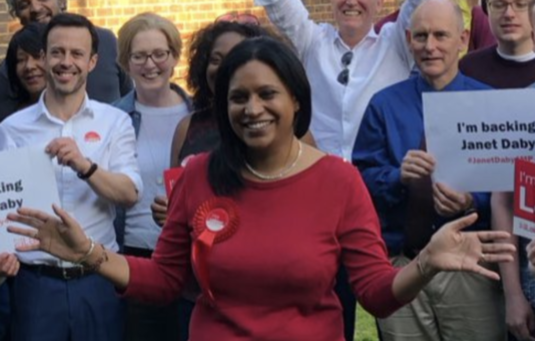
It's going to be a match made in heaven. No, not the Royal wedding, but the solemn and holy contract made between Lewisham East Labour Party and their new Prospective Parliamentary Candidate, Janet Daby. Winning 288 votes to Sakina Sheikh's 135 and Claudia Webbe's 35, Janet's win is convincing. Not even a united left or a second preference deal struck beforehand would have been able to see her off. Yet, thinking about it, did the left actually lose? Well, no. Apparently not. Forget the backslapping and what have you from the usual suspects online and consider that Janet voted for Jeremy Corbyn in both leadership contests, which is more than, ahem, some Corbyn supporters can say. It would be a real stretch to describe her as a right wing figure, unless wanting to keep Britain in the single market post-Brexit invalidates one's left credentials. Instead, consider it like this: how screwed must Labour First and Progress be when they're forced to endorse a candidate with impeccable pro-Corbyn credentials. This is not a loss for the left, and more an underlining of the right's weakness.

The selection did threaten to descend into farce, however, when Unite stumped up evidence of Sakina's alleged involvement with Take Back the City, a campaign group who stood candidates for last year's London Assembly elections. Immediately she was suspended and within minutes put back on the selection shortlist. What a farce. Not at all coincidentally, Unite had endorsed Claudia for the seat and so sat on this information, which was not disclosed to the NEC's shortlisting panel, before springing it at the last possible moment.

Unfortunately, Unite have form for what you might call bureaucratic bulldozering. As the largest affiliate to Labour, the role the union has played in clearing out Labour First's administrative power base in the West Midlands, and its bastions of power inside and around the leader's office, Unite has a certain weight, and it's not averse to using this to get its way. Having got the union's fingers burned in the particularly clumsy intervention in Falkirk a million years ago (remember that?), its seems the Unite's respect for subtlety has not grown alongside its clout. Replacing politics with administrative activism, to give it a euphemism, is the wrong approach to take. Corbynism will not succeed if it's merely an exercise in replacing a right wing bureaucracy with a left wing one. But quite apart from what Corbynism and the Labour Party might become, it's embarrassing and makes Labour look like some tin pot outfit as opposed to a party serious about government.

More worryingly, there's an element of recklessness here. The right in Unite got a right old clobbering after Gerard Coyne's failed run for general secretary. And rightly so. He ran a disgraceful campaign. Readers who have followed the saga since will note Coyne and his band of ne'er-do-wells have petitioned to overturn Len McCluskey's victory by going on about process and procedure, not that they ever bothered his campaign while the election was on. I digress. But just ask yourselves this. If you're going to be in and out of court over the next year against an opponent seeking to rubbish you and the structures of your union and for whom bureaucratic abuses is part of his case, is it smart politics to be seen publicly, in the full glare of the anti-Corbyn and, yes, anti-Unite media, to be pulling off egregious dirty tricks and attempted stitch ups?

No. Let Lewisham East be the end. The new politics can never be victorious if they rely on the old ways.