
Thursday, 5 December 2013

Wednesday, 4 December 2013
2121 by Susan Greenfield
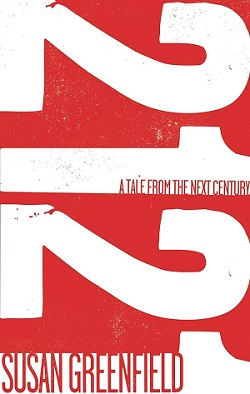
Just so you know, this isn't really a novel. It's a thought experiment and polemic dressed up as one. Set in the eponymous 2121 (itself, a pun on 20:20 vision - one that Greenfield had to explain in the postface), human society has schismed. On the one hand you have the Neo-Puritans, a group of dull, grey bureaucrat-philosopher-scientists who plan everything to the nth degree. Who they marry. What they do for work. How they spend their time at home. For them, the iron cage Max Weber prattled about is less a danger and more a security blanket. And over the mountains exist others or, rather, Others. Theirs is a technologically advanced society that sees everyone plugged into their own personal VR space near enough from birth.
The two societies are irreconcilable. The NP's are dedicated to pursuing personal (and social) growth through the power of thought. The Others exist in worlds of their own, living lives of pure sensation.
The plot, such as it is, involves the NP's sending their top man - Fred - over to study The Others. The powers that be are concerned that the existence of The Others is the greatest threat to the human race. As creatures of the moment, the grey beards back at home want to know if an Other can be prised away from their technology and develop normally. When Fred arrives at a nearby Other settlement, we are told they live together in domed Dwellings (capital D). One or two are designated carers by the faceless automative mechanisms that holds their society together, and a handful of the women are tasked with giving birth (via IV treatments). But crucially, everyone barely has anything to do with one another. So addicted are they to their VR machines that they haven't the time to build any kind of social relationships. Nor is there any wish to.
The lead character on the Other side is Zelda. A middle-aged Other who can remember a time before the all-immersive VR came along, we're often treated to reminiscences about her grandparents who, as teachers, were made obsolete by advancing technology. But unlike the other, um, Others, because she has a memory and was brought up "the old way" she retains a sense of self, albeit a melancholic one.
The third protagonist is Sim, Zelda's birth-daughter and object of her maternal affections. Sim is a typical Other. She is fully immersed in the daily barrage of digital sensations, loud music and flashing lights. She is but a bundle of narcissistic sense-impressions. It is only when Fred latches on to the pair that his experiments begin and slowly, over time, Sim's cognitive abilities are boosted and a sense of self starts coming through. Yet in the mean time, Fred's isolation from NP Land sees him slip from the ingrained puritan routines. The loud music, the flashing lights, the bright clothes, the Others' "Yakawow" slip their nihilistic tendrils around his mind. Like a Ying and Yang metaphor covered in fag burns and then dragged through a hedge backwards, everything balances out as one new person is born and another is destroyed.
I don't know if 2121 is a parable of the author's own addiction to Twitter. But her account has vanished of late, so perhaps. Yet, Greenfield has form. Rather than using her celebrity science status to investigate the issue scientifically, she has inveighed against the danger our media technologies pose toward the young. Too much sensation, apparently, bludgeons and destroys young brains. The Others are merely an extrapolation of what's happening to our kids today. Since the Walkman started out on its quest to inflict humans with premature hearing loss, technology has entered into increasingly intimate relationships with us. At the risk of sounding like an extropian surfer dude, our society has long been a cybernetic one; a vast community of humans and machines that depend on each other as condition of our mutual survival. Though, of course, machines aren't self-aware. Yet.
So, yes. This is yet another trip into Terminator/Matrix territory, but without killer robots and genocidal computers. It's a warning of the sinister potentialities inside every innocent-looking Wii U, Kindle, and iPhone. As Arthur and Marilouise Kroker might put it, Greenfield's vision is the end point of a civilisation in recline. But what is at risk is not the obliteration of the planet or even of our species. It's our souls that are up for forfeit.
It's cobblers, of course. There is absolutely no sense of agency in Greenfield's book. Fred meets his demise because the loud music and flashy colours are too much. They relentlessly dissolve the boundaries of his sense of self until he becomes an indistinguishable twitching body swathed in technology, his consciousness wrecked by the sensations pouring into his mind. Likewise, Greenfield's premise is devoid of it. Society splits between those who don't want owt to do with "the screens" and those who carry on Facebookin'. There is no sense of the social uses to which we put technology, how it is and always has been used to create new experiences, enjoy life, educate, and make new connections. Yes, in the age where social media is on its way to becoming the hegemonic way we use technology to mediate our relationship with the world (as papers, radio and TV have done in the past) it is amazing that Greenfield's Others have withdrawn into pure sensation, when communication is the most ecstatic pleasure of all.
On another level, Greenfield's novel does annoy me. The NP's are dull bureaucrats. The Others are mindless hedonists. But no thought at all has been given to the sociological basis of these societies, or the social processes that drove her great schism in the first place. Well, nothing more than lifestyle choice which, sadly, is a much-invoked trick science fiction authors like to call upon when speculating about the future divisions of the human race. In his otherwise super-hard SF Eon, Greg Bear has our descendants falling out over the use of technology. Inexplicably the technophobes refer to themselves as 'Naderites'. Yes, after that Ralph Nader.
What Greenfield lacks, like so many other scientists and sci-fi authors is a sense of the sociological imagination. Scrupulous attention can be paid to the science (be it speculative or otherwise) of space travel, of astrobiology, of computing, biomedicine and, in Greenfield's case, neuroscience; but the naivete when it comes to the understanding of social dynamics, social forces, and social formations is inexcusable. It's so lacking it's embarrassing. And on all three of these levels, 2121 shows its ignorance on page after turgid page.
Marx on the Power of Money
That which is for me through the medium of money - that for which I can pay (i.e. which money can buy) - that am I, the possessor of the money. The extent of the power of the money is the extent of my power. Money's properties are my properties and essential powers - the properties and powers of its possessor, Thus, what I am and am capable of is by no means determined by my individuality, I am ugly, but I can buy for myself the most beautiful of women. Therefore, I am not ugly for the effect of ugliness - its deterrent power - is nullified by money. I, in my character as an individual, am lame, but money furnishes me with twenty-four feet. Therefore I am not lame, I am bad, dishonest, unscrupulous, stupid; but money is honoured, and therefore so is its possessor. Money is the supreme good, therefore its possessor is good. Money, besides, saves me the trouble of being dishonest: I am therefore presumed honest.
- Economic and Philosophical Manuscripts of 1844. Harmondsworth: Penguin, p.128
- Economic and Philosophical Manuscripts of 1844. Harmondsworth: Penguin, p.128
Tuesday, 3 December 2013
Dave and Energy Bills

And in the week the government have been exposed for trying to redefine fuel poverty, the Tories have unveiled what they think is a masterful counterstroke. The average £120 increase on bills this year will be cushioned by a £50 bung from the government to the energy companies, which will be passed on to the consumer. That's right, you won't pay on the bill but you will pay for the "discount" via your taxes. They have also announced a £1,000 green grant for new home buyers to help towards insulation and other energy-saving costs. How helpful.
The problem for Dave is the Tories are still seen as the party of the rich. Most people think he and his party kowtow to big business, and his gyrations over energy prices bears this out. He appears determined to protect the Big Six from any measure that will reduce their profits, even though four of the six are foreign-owned. But as far as consumers are concerned, people who are fed up with seeing their bills go up while pensioners die from the cold; they want to see the energy companies punished.
This is why Labour energy price freeze has resonance. Because it will hurt the likes of British Gas and EDF Energy. Dave's jiggery-pokery with tax and green investment doesn't wash because it keeps the Big Six in the sphere of non-punishment.
Sunday, 1 December 2013
New Left Blogs November/December 2013
New month. New blogs.
1. Ancient Ribs (Unaligned)
2. Andrew's NUT Blog (Unaligned/NUT)
3. Carter the Blogger (Unaligned)
4. chekov.org (Ireland - Unaligned) (Twitter)
5. Democratic Revolution Syria (Unaligned/Syria Opposition)
6. Keep Our NHS Public South Warwickshire (Unaligned) (Twitter)
7. Left Blog (Ukraine - Unaligned) (Twitter)
8. Left Unity Milton Keynes (Left Unity)
9. London Campaign Against Police and State Violence (Unaligned)
10. Raised on a Diet of Broken Biscuits (Unaligned/Feminist) (Twitter)
11. Social Abjection (Unaligned) (Twitter)
12. Socialist Project (Canada - Unaligned)
13. South London Anti-Fascists (Unaligned)
14. South London Communists (Revolutionary Communist Group)
15. Trade Onion by Jon Bigger (Unaligned) (Twitter)
16. Trudie McGuinness (Labour) (Twitter)
17. Useful Nuisance (Unaligned) (Twitter)
That's your lot for November/December. If you know of any new blogs that haven't featured before then drop me a line via the comments, email or Twitter. Please note I'm looking for blogs that have started within the last 12 months. The new blog round up appears on the first Sunday of every month, and is also cross-posted to Socialist Unity.
Five Most Popular Posts for November
The five most read posts of the month were:
1. It's Time to Scrap Pairing
2. How London-Centric is Political Blogging?
3. Stoke Labour and Political Crisis
4. Day of the Doctor - Review
5. Capitalism, Asperger's and Autism
Nice to see some political commentary rise to the top in November. But what has left me non-plussed is the inexplicable popularity of the piece about Stoke-on-Trent's local politics. Well, perhaps inexplicable is the wrong word. We're not talking flying saucers or anything. I hypothesise that either the audience for blogs about Stoke's political scene is bigger than I thought, or, since Stoke North MP Joan Walley announced her retirement, would-be successors from across the country are treating it as a crash course in all things Stokie. Who knows?
Two plugs for those that missed the top five, just because I can. The first is Campaign for a Permanent Labour Majority, which isn't as trite as it sounds. 'Politics and Social Engineering' would be a more accurate title for the piece. The second is Stupid Empiricism and the Conservative Party.
Saturday, 30 November 2013
Whither Left Unity?
Let's be blunt. Unity initiatives on the far left have a chequered history. It got to the point of absurdity when the two main Trotskyist outfits - the Socialist Party and the Socialist Workers Party - had their own unity/recomposition projects. Off the top of my head, since 1996 we've had the Socialist Labour Party, the Scottish Socialist Party, the Socialist Alliances in England and Wales, Forward Wales, Respect, The United Socialist Party, Socialist Green Unity Coalition, Campaign for a New Workers' Party, Solidarity, Left List, No2EU, and the Trade Unionist and Socialist Coalition. This does not count fringe-of-the-fringe projects like Republican Communist Network, Campaign for a Marxist Party, and Anti-Capitalist Initiative. There's probably more I've missed. The point is all at best were still born or worst fractured, ironically leaving the constituent parts at a further remove than was the case at the outset.
If the best indicator of future behaviour is past behaviour, the odds are stacked against Left Unity breaking the sectarian mould. That said, there is something slightly different about LU that gives them an edge over these failing and failed projects.
The cpgb argues that if the revolutionary left practiced democratic centralism Bolshevik-style, i.e. open factions, open platforms, open debate and discussion, but unity in action, then the intractability of far left sectarianism would be resolved. Remember what I said about latter day Leninists unwilling to use Marxism to look at themselves? Sectarianism exists not because everyone bar the cpgb have misread Lenin's writings, but because they negatively express the outlook of the petty apparatuses/bureaucracies each far left organisation possesses, the material imperative to compete against revolutionary Others in a small but crowded marketplace, the strategic orientations to the different milieux they target, and the need to main discrete party identities. Sectarianism is deeply rooted in the far left's conditions of existence, and is reproduced unreflexively in a party's outlook. One can easily pay lip service to overcoming sectarianism, while obliviously reproducing that sectarianism. Hence self-decribed Leninist organisations share slight variations on a 'party-first' theme that structures their activity. This is why "unity" between different parties ostensibly standing for exactly the same thing has always come undone, and is never likely to be superseded.
LU is immediately at an advantage because it avoids this. The SWP aren't interested, not that anyone would have anything to do with this increasingly depraved cult anyway. And the SP think their self-important TUSC front is a significant step toward a mk II Labour Party. If only the misleaders of the working class and Elvis could be shoved aside. LU therefore can't be turned on and off at will by unaccountable cliques of ultra-correct revolutionary leaders. Smaller Trot outfits like Workers Power are in, and will no doubt make a pain of themselves in the LU branches they live in, but they are very much a minority - even in a membership as low as 1,000.
Neither is LU beholden to a Galloway-like figurehead. Ken Loach might make films lefties hold dear, but a man with the populist touch he isn't. And to be fair he has not sought such a position. He has used his platform to cohere a regroupment process that has led to today. He does not claim to be the leader. He has no wish to stamp the new party with the semi-Trot politics he holds. Despite the grumbles of the cpgb and the various tiny platforms recognised prior to conference, LU appears to break fundamentally with two key drivers that have wrecked unity projects of the past.
Well, perhaps not fundamentally. From casually observing LU's comments section on occasion, and seeing who gets named in Weekly Worker reports, there's more than a few folk involved who've been through the sorry experience of unities past. Most are veterans of the left, of activists without an abode to call their own. And had either the SWP or SP been involved, I'd have bet my bottom dollar that many would not have touched LU with someone else's. The second point regarding sectarianism is that LU is now a proper "player". It might have the ambition to reach out to the great mass of working people, but along the way it will have to compete with the Trots who are doing the same. Especially the SP's TUSC, who despite mustering tiny of handfuls of votes think they're The Most Significant Thing Ever because Bob Crow every year convinces RMT conference to endorse them. It will mean clashes in council and parliamentary votes, and perhaps a jostling for position on future demonstrations.
Nevertheless, as tenuous a bureaucratic relationship the SP's TUSC has with the RMT, on paper it does have that labour movement link. What of LU? Among its members are union activists, branch secretaries and so on. Yet, as the SP might argue, they represent no one but themselves. The party is a coming together of atomised lefties and micro-Trots. But then again, unlike TUSC, LU exists for itself. There is a possibility, however remote, that it could become something other than it is. That will never be the case with the SP's electoral vehicle.
Ah, prospects. Ruminating on the prospects of a 'left UKIP' earlier this year, I then argued there is some political space to the left of Labour. It is much tighter than was the case during the Blair/Brown years, but a constituency of pissed off ex-Labour voters and leftish anti-politics types does exist. Typically this manifests itself in the 1-2% you can expect to vote for far left candidates at election time. And as the Greens, BNP, and UKIP have shown, if you can sort out unity among your milieu you can face outward instead of inward. There's a few more percentage points to be grabbed and theoretically LU could build up a presence equal to the Greens.
This is only if it plays its cards right, and at present the new party holds only dud hands. To make its mark it has to exhaustively contest as many elections as it can, but unlike TUSC LU has to work them consistently to build up a base. To build its profile it has to work systematically in the labour movement and the procession of protest movements that come and go. To be fair (again? What's up with me?) there is no suggestion from what I've seen that they anticipate nothing but a slog.
But the single biggest thing, the challenge I think LU will find insurmountable is, as always, Labour. Only the most blinkered pretend the party is fundamentally the same beast as it was in 1997, 2001, 2005 and 2010. It might be more complex than the rigid schemas of the far left allow, but Labour has shifted back to social democratic politics. It has cottoned on that living standards are being hammered and, as a result, the party is the only one addressing those concerns. When the two main parties find themselves on opposite sides on the bedroom tax, NHS privatisation, house building, energy prices, apprenticeships, economic strategy, care for the elderly, breaking up the banks, and workplace rights, it's obvious who should form the next government. And while LU is something looking to become something else, so is Labour. Who, for instance, is going to listen to LU when Labour has a realistic chance of putting its policies into practice? Who will be tempted to support LU when it will be massively squeezed by the next election's high stakes?
Ultimately, while LU has got the potential to be much better than its various Trotty forerunners, as far as its prospects go the most it can ever hope for is minor party status. And I don't think it will ever come close to UKIP levels of support. If so, then what is the point?
Friday, 29 November 2013
By-Election Results November 2013
Party | Number of candidates | Total vote | % | +/- Oct | Average/ contest | +/- Sept | +/- Seats |
Conservative | 23 | 8,491 | 20.5% | -1.6% | 369 | -36 | 0 |
Labour | 21 | 14,203 | 34.2% | -2.1% | 676 | -39 | +2 |
LibDem | 20 | 3,823 | 9.2% | -4.1% | 191 | -146 | -1 |
UKIP | 19 | 6,135 | 14.8% | +4.3% | 322 | +89 | 0 |
SNP* | 1 | 546 | 1.3% | -8.0% | 546 | -694 | 0 |
Plaid Cymru** | |||||||
Green | 12 | 849 | 2.0% | -0.3% | 70 | -33 | 0 |
BNP | 2 | 152 | 0.4% | +0.2% | 76 | +38 | 0 |
TUSC | 5 | 211 | 0.5% | +0.5% | 42 | +21 | 0 |
Independent*** | 13 | 4,201 | 10.1% | +7.9% | 323 | +217 | -3 |
Other**** | 7 | 2,863 | 6.9% | +3.7% | 409 | +288 | +2 |
* There was one by-election in Scotland.
** There were no by-elections in Wales.
*** There were independent clashes in four contests.
**** 'Other' this month consisted of Wear Valley Ind (360), Harrow First (173), It's Our County (987), Elvis (31), City Ind (861), Its Our County (429), SPGB (22)
Overall, 41,474 votes were cast over 25 individual local (tier one and tier two) authority contests. All percentages are rounded to the nearest single decimal place. For comparison see October's results here.
The low variance in Tory and Labour vote shares and averages might indicate an underlying stability about those figures. Though always remember, these are second (or perhaps third) order elections in which local issues tend to come to the fore. The dramatic increase in performance by Independents and, to a lesser extent, the Others and an improvement in UKIP - without undue extra media exposure this last month - points to a combination of local political scenes and anti-politics protesting working its way through to slightly depress the vote of the traditional main parties.
Subscribe to:
Posts (Atom)