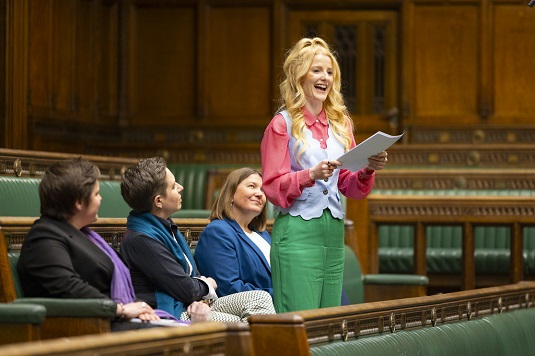
Friday's Graun article from Hannah Spencer upset some people in politics. Reflecting on her first few weeks in the Commons, she suggests MPs - above all Labour MPs - are out of touch. And it struck a needle into a raw nerve. Stafford MP Leigh Ingham called it "insulting and oversimplistic" and accused Spencer of making "populist slurs" and "feeding anti-trust in politics". Economics prof Jonathan Portes thought it was "deeply depressing". His conclusion is that it was "lazy soundbites and bad economics".
Spencer is not wrong, though. If any of them read beyond the headline, I imagine these lines sat awkwardly.
I don’t think that’s something most MPs understand – not really. They might think they do, they might say they do, but they don’t properly know what it’s like; how it feels in your bones.And
The Labour government has finally bowed to pressure and is set to bring in new measures this month that it says will help people with the cost of living. But the reality is its plan isn’t good enough.That much is true, but if anything Spencer is too kind to the honourable members. Today, for example, changes to Universal Credit means that applicants for extra support for disabilities face lower payments than those already receiving them. The projected saving for this is £1bn over the next three years, a sum so low that one can only conclude the cut is being made for punitive reasons. Something the government themselves admit, albeit behind the usual rubbish about "increasing the incentive to work". It begs the question that if MPs are "in touch" like they claim to be, then why was this allowed through following the disability cuts rebellion last year. Have costs gone down for people living with severe impairments?
There are several things that work to estrange MPs from the electorate. Their salaries and perks put them in the top one per cent of earners. They are flattered and feted by parliamentary and party hangers on, and important people enjoy treating them. Like the £3k of hospitality our hardworking Leigh Ingham enjoyed from Google at last year's Glastonbury. The experience of dealing with constituents has a similar effect. Most come seeking some form of assistance, and so the MP has a 'power-over' position from the start. This can lead to a certain arrogance. I.e. A belief that they know what people want better than anyone else, particularly the weirdos that come to branch and constituency meetings. And, in some cases, contempt for constituents' concerns. This forms an insulating barrier against everyday life. And enables so many to get sucked into the doings and frequent dramas of Westminster - the work they want to do as opposed to the stuff they have to do.
This can be mitigated, and it's worth remembering that left wing MPs, though not immune to customary entitlements, do better than most. Not because they're superhuman or uniquely moral, but usually thanks to the strong links they have with their local party, community groups, trade unions, and social movement mobilisations. Whereas the freebies, business lunches, and VIP trips give those who avail themselves of them an altogether different grounding. And readies them to cater for the interests of those who must be kowtowed to.
Spencer then is absolutely right to call MPs out of touch, because their realities are far removed from most ordinary people's. Everyone knows MPs live a rarefied life, and it's farcical to pretend otherwise.
Image Credit

13 comments:
This reminds me of a comment I once saw, in reference to Frank Field and poverty I think, that many people end up hating those that they start out meaning to serve.
But how will she & GP MPs mitigate seeing they dont (perhaps yet) have that organic link to groups you mention?
Not the topic of the article, but on the economic reality of the present moment, worth checking what Gary (of "Gary's Economics") has to say about it. Sobering, and hammers home how backed up to the wall that the outgoing neoliberal regime really is.
Implication is that big collective sacrifices are coming in the near term no matter who is in Westminster, and "being in touch with the voters" is probably the only real currency that politicians are going to be able to trade in for the foreseeable future.
Spot on.
Whilst this is interesting in itself , though surely oft covered as a topic, the rather larger issue facing us in the UK, and globally , is that at 1am , UK time, on Wednesday morning, under the crazed President Trump's orders, the guaranteed refusal of the Iranian government to surrender their sovereignty will provoke unlimited US/Israeli bombardment of all key infrastructure across Iran. In guaranteed retaliation Iran's huge remaining missile stock will in turn destroy all the vital desalination plants and oil and gas installations across the Gulf states and Israel. The entire globe will then be convulsed in mere weeks by a critical energy crisis, a financial crisis, and eventually vast refugee population movements from the Middle East and elsewhere as mass starvation grips the global South.
Still, let's just focus on the relative trivia of Westminster politics.
This week we learned that the total contribution to the Government's funds from income tax is about the same size as the welfare bill.
Are you happy with that? Do you think the welfare bill should be, say 10% higher than the income tax take? 20% higher?
Do you think it is feasible in an economy with zero growth to borrow to fund welfare payments?
TACO.
And, equally consistently, Israel has already broken and tried to detail the ceasefire.
We can tax the rich more? Governmental income is not just restricted to income tax either (or borrowing), so you are making a false argument.
Fans of the outgoing era sure are exuding a palpable sense of desperation nowadays.
Cutting welfare to the bone means that people die. If you want other people to die to fund your lifestyle, have the guts to admit it openly.
Of course, if the government can't borrow cheaply, and has to raise taxes to fund infrastructure development to produce growth, you can always sod off to live in Dubai and avoid paying them! Be very nice to the Iranians (but not so nice that you draw the attention of Mossad).
You can’t just keep taxing the rich more. They were already paying a large proportion of the total income tax. why would anyone bother trying to become rich if you are just going to take all their money? How are you going to fund welfare once you’ve taken all the rich people’s money or they’ve all fled abroad?.
This sounds like the argument which a Tory MP has been coaching their young child to make.
Nobody is suggesting taking all of rich peoples' money to fund the maintenance of the country which gives that money its value in the first place. Of course. Merely taking more of it than has been taken over the last half century, during a time when a subset of the rich people have been running the government for their own benefit.
And if they don't like it, they can indeed flee abroad, and leave all of their illiquid assets right here. How's Dubai looking as a des res nowadays?
The proportion of income tax that the rich pay is the consequence of too many people on low wages. Improve the pay of the lower paid in society and the proportion that the rich pay goes down.
It's also been government policy to increase the threshold at which you start paying income tax, which takes more people out of paying it (or lowers how much they pay), which again increases the proportion that the rich pay.
Finally, just because they pay the highest proportion of income tax, does not mean that they are currently overtaxed.
Speaking of being the opposite of in touch with voters...
https://www.bbc.co.uk/news/articles/c05d1ym31jeo
Post a Comment