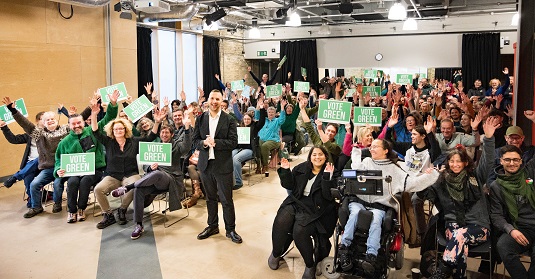
While defections are in the news, there's another that might be worth reporting on. My own. Yesterday I cancelled my Your Party membership and signed up to the Green Party. The local party meets next week, and I'm looking forward to becoming actively involved. For those interested in such things, here's the politics bit.
Binning off Your Party wasn't a difficult decision. Joining that was more a duty than anything approaching enthusiasm. Never has the left outside of Labour been handed such a golden opportunity, only for it to be squandered by prima donnaism and control freakery. Without re-litigating what happened in depth, Zarah Sultana should not have unilaterally launched the membership. The timing was right, but had she acted with the pre-party collective and abided by its ad hoc discipline the momentum would have still been there when it did go live, which was about a fortnight later. But once the die was cast, Jeremy Corbyn and his minions should have swallowed it - just as they did in the summer when Sultana announced that the new party was happening - and rode the wave. Doing so would have avoided bad blood and, most crucially, would have built on the 800,000 that signed up the mailing list. A party of more than 200,000 was in reach ... and Corbyn blew it because his helpers would rather run a much smaller, tightly controlled outfit that guaranteed them a living. Labour Party mk II not in name, but certainly in form.
And things have not improved. Despite handily winning positions aligning Your Party with an inclusive conception of class and democratic organisation, it's as if the conference votes never happened. Exclusions of members of left groups still stand, and candidates for the Central Executive Committee have been barred if they are suspected of paying subs to another organisation. Funny how there were never any complaints when the likes of Michael Lavalette, for example, was travelling around the country stumping for the new party and encouraging people to sign up. This is a violation of the spirit of what was voted on in November, and a big up yours from the unaccountable cabal that runs Corbyn's show to the membership. It now looks like this bar will be affirmed, assuming that Corbyn's slate of loyalists and idolaters sweeps the members' CEC ballot. Which it is likely to do. On top of that, there is the utter stupidity of the party's name, which alone demonstrates Corbyn's lack of political nous. And, let's be frank, Sultana's absence of political judgement. From childishly calling the awful Tory London Assembly Member Susan Hall a "boomer", boycotting the first day of her own conference, wanting to "nationalise everything", and being unnecessarily spiky toward the Greens is just daft. No confidence in the Corbyn clique, no confidence in Sultana, and no confidence in the prospect of Your Party becoming anything other than a shrine to St Jeremy. It didn't have to be this way.
But the Greens? It's doing rather well, and unlike Your Party has not bungled its opening. As the class composition of this country has changed, as recounted in the book, countless talks and podcast interviews, and on this blog on many, many occasions, politics has shifted too. A shift that the Greens are handsomely benefiting from.
Key to this is the growing importance of immaterial labour. In the post-war period in Western societies, the expansion of the state saw millions of workers taken out of private employment. Their jobs were less about producing material goods for private profit, and shifted toward producing services the public consumed. Education, welfare and social services, health care, the administration of the growing state at all levels. To use the old language, large sections of the work force were paid a wage to reproduce the conditions of capitalist production. They were tending to the gaps in the system, paving over the cracks, cleaning up the messes, making people broken or maimed by the system better, looking after those it discarded, and preparing generations of children for life under it. Alongside this the increasing complexity of production and the division of labour created similar roles within businesses. The expansion of management, the need for planners, logistics workers, technical specialists, office workers, cleaners, service-oriented work has come to absolutely dominate most advanced economies in terms of people employed and volumes of capital tied into and produced by services. Alongside this, postwar affluence kicked off mass consumption and the rise of privatised leisure activities. The casualties of this, at least in Britain, was declining church attendances, the withering away of the millions-strong political parties, and an erosion of working class community culture - which accelerated following the Conservative attacks on and defeats of the labour movement in the 1980s. But the expansion of immaterial labour selected for certain traits. In service work based on the production and maintenance of social relationships, sociability, knowledge, patience, and care were the key forces of production increasingly mobilised by the emerging post-industrial economy. Despite the privatisation of many state services and the intrusion of commodification into all facets of life, this "immaterialisation" of labour has continued apace.
The consequence for culture and politics has been profound, but to stop this from becoming another book, there are two key developments that are reaching fruition now. Because the nature of labour has changed with the object of work being the production of social relations, care, knowledge, social roles, etc., which in turn places a social premium on relatedness and sociability, this has resulted in a long-term tendency toward tolerance. Or, in other words, the gradual replacement of social conservatism by social liberalism. Each generation becomes increasingly comfortable with difference as they are socialised into and experience life as an immaterial worker. The generational differences we see in values surveys are not a reflection of lefty schooling or an essential tendency toward conservatism as we age, but a class cohort effect. There is a direct link between class, of being socialised into and working for a living in the post-industrial economy, and accepting socially liberal values as the everyday commonsense. Generation Z are the most radical, most socially liberal generation so far. And are likely to surrender that title to the younger people coming after them. The mores are cumulative, and we're now at the point where social conservatism is a minority outlook, and one that shrinks by the year.
The second consequence of this is overtly political. Faced with a politics that tries screening out the interests of the rising layer of workers, a typical mass response is disengagement and abstention, but for others it's a marked tendency to vote centre left or left. The first coming of Corbynism and, for a period, the rapid passage of the Labour Party from a husk to a true mass party - and then the 2017 general election - was the first mass electoral flex of the political conscious sections of the new working class. Though Corbyn lost badly in 2019, his real achievement, buried under the self-serving rubbish about the worst result since the 1930s, was hitching Labour to a new political articulation of class relationships. And one the party needed to build on for sustainable success. Unfortunately for Labour, it elected Keir Starmer whose project ever since has been to disperse this coalition to the point where his party courts extinction. But that dispersed support doesn't simply disappear. This is not 1997, it does have somewhere to go. Your Party looked like it could have been it, until they derailed themselves. And so, the Greens. A socially liberal party with left wing positions on a raft of issues that speaks to the class interests and outlooks of immaterial workers, stands up against the scapegoating and racism of the mainstream, and being the only party that really takes climate change, energy challenges, and the green transition seriously, Zack Polanski's leadership and his adroit interventions have catalysed and coalesced mass support around the Greens.
As argued here previously, there are two types of Green Party. The so-called realists, who elevate members to high office and inevitably disappoint - much to their cost. Like the German and the Irish Greens. And those parties that go down a Nordic path, that are to all intents and purposes Green-Left radical parties. This is currently the trajectory GPEW is on - the Scottish Greens being their own, somewhat different, thing - and is likely to draw in more members and more supporters on that basis. Far from the petit-bourgeois party as labelled by the little Lenins, the Greens are being taken over and getting filled out by our class, our rising class, and are inhabiting it as an instrument of our collective interest. It is a party that is becoming, a symptom and driver of a wider politicisation. It is occupying the position Your Party could have taken, but rejected. As Labour under Corbyn was one moment in developing the generalised political consciousness of a class, this is another. That task has fallen to the Greens. These are my reasons for joining. And why you should too.
Image Credit

31 comments:
Meanwhile we are all skating on the ever thinner ice of degraded environment and climate breakdown whilst politicians and big business are pulling away even from lip-service to addressing these. I wonder who will be the first politician to say "it's going to be catastrophic" without the current qualifier of "unless we act quickly". This should be the Green Party's home turf. But I wonder.
Delighted to see you make the jump, welcome!
Welcome aboard
Expect I will join soon. Good read.
And to confirm your analysis, we have a by-election coming up in Denton and there is no mention of a YP candidate or discussion of its prospects, and this in a constiuency that has a composition that could have favoured it. At least its rapid life cycle means that some idealistic people will not have wasted too much of their time seeking to build and campaign for it. That said, the many revolutionary vanguards who threw their (light) weight behind it will be disappointed. They can't have recruited many new 'cadre' and haven't had the opportunity to resign on principle or be expelled as martyrs.
For the future, Jeremy can now retire but Sultana is a young woman, what will she do next - on the couch with George Galloway? Join the Greens? Persevere with revolutionaries?
Well, on the sad shambles of Your Party, is it going to ultimately field any candidates? And will they take votes from the Greens, or Reform?
Watching the Irish Greens scuttle into not one, but TWO right wing austerity coalitions (2007 and 2020) was incredibly bleak. the sensible "nice people" have the iGP in a death grip. Even now, down to 1 seat from 12, they show no signs of learning from that experience. They could be forgiven if they'd taken some big swings in those two terms, but it's all tiny thins around the edges. Eamon Ryan, then GP leader, was boasting about Ireland's farms. DATA farms. Christ & crutches.
Welcome.
I was so excited for Your Party. I waited after the initial shit show launch of threats of legal action until I'd seen the leaders speak in person at TWT. After that I joined the Greens. Too many egos in YP. We ain't got time for that shit, the far right are here! I'm scared the Greens don't even have time to mount a defence and they're an established party with much more organisation and structure than YP.
Amen to this. That is excellent news.
Yes we need positive change for the long term.
Moreover, the Social Democrats (centre-left, largely middle-class party) have placed a strong emphasis on environmental policies, and while far from radical, have established a good working relationship with parties on their left, so should avoid the previous mistakes of the Greens and Irish Labour.
They've now been outflanked environmentally by the Social Democrats, who despite not being as radical as the English Greens, have a good working and transfer relationship with parties to their left, and their membership should prevent them making the same mistakes as the Greens and Irish Labour.
Agree with a lot here Phil.
But for now sticking with Labour.
Not for any deep-seated loyalty (see below) but decent local branch, nice people (on the whole) and more broadly even now there's a critical mass to change the direction of the party. However I'm a realist as each person leaves for the entirely justiifiable reasons you outline thed odds on that happening stretch longer, and longer.
As for Your Party, biggest wasted opportunity in most of our lifetimes. Thosed responsible need to have a long hard look at themselves and then retire from active polticcs.
My core value isn't my Labour Party membership its my pluralism . Those who stay in Labour to challenge Starmerism have a huge amount comon politically with those who leave to do thatin the Greens. And vice versa.
Which means in practical terms as the Greens won't form the next government, Labour may or may not, shaping ways for both parties to work together, from the bottom up, asd partners not opponents.
Staying in a Party, Mark, whose entire Leadership, and most MPs, are actively assisting or supporting, or facilitating, and justifying, the most widely documented genocide in history in Gaza, takes a a lot of mental gymnastics to justify staying in the now utterly corrupt and pawn of Big Business and US imperialism, Labour Party. But then you get to meet "nice people " at branch meetings - who also canvass for this Party directly engaged in this genocide ! Get out now mate and save your very soul.
I don't think Labour will join any coalition with the Greens due to their belief that they are the party that should lead. I think a genuine coalition would be valuable for the country in the mid to long term. Alas I doubt this will happen. Going forward I fear for those young people who don't have family money in a country with such high inequality. What a future.
There is a flat zero prospect of any cooperation between Labour and the Greens. For more than one reason, but most obviously because, for the faction which fought with great determination to regain their absolute control over the party, its viability as a vehicle for them to access power and privilege depends absolutely on there being no party to its left projecting electoral credibility.
Just as they attacked their own side to prevent Corbyn from being successful, they will burn everything to the ground rather than concede an inch of mainstream legitimacy to the Greens. They are welded to the "it's us or Farage" strategy no matter what its real chances of success appear to be. As far as these creatures are concerned, if they can't have power themselves, then Farage might as well have it - just so that they can gloat at the misfortunes of the rebellious peasants who refused to vote for them, and lecture them about how they should know better next time.
Almost needless to say, any local Labour branches which are found out by HQ to be cooperating with the Greens can expect to be censured in very short order, and might even invite retribution through channels external to the party. Never underestimate what ruthless narcissists will do if they feel crossed.
Well... C'est la vie when a parasite infestation gets out of control. If the Starmerites can't be ousted, then the country will have to suffer a Farage victory in the process of removing the Labour Party's infested corpse from the field; and then hope that the proto-fascists can't make their rule permanent.
Now that you're on the inside of the Green Party, Phil, do pay close attention to who is manoeuvring into the positions of real power within its apparat. Who administers and counts the votes? Who decides what can be voted upon in the first place? Who decides who is allowed to vote? And who chooses the occupier(s) of those positions?
Polanski, and the party he now leads, is very much the plutocracy's backup plan if Farage doesn't work out for them. But Polanski's acceptance by their media friends telegraphs that he is part of their plan. These are people who, as the saying goes, plan for three generations. (A saying which probably credits them with far too much actual competence, but at least we should assume that they try to plan quite some way ahead, and that their thoughts never stray far from their class interests.)
Very true anonymous 22:07. It should be obvious from outer space that , looking at Polanski's entire , variagated, career background, that he is a state asset opportunist. But then it was too with ex DPP , Starmer. But they fell for his Ten Pledges con. Will the Left stop falling for it ? Apparently not.
Would be interested in hearing your more detailed assessment of the Scottish Greens
Corbyn's Labour were subjected to endless internal subversion by the security state, but the apparently just as radical Greens are not.
Something not quite right here, folks.
What a delight - not one, but two conspiracy fantasists in the comments! Both, predictably, Anonymous. After all, the deep state is monitoring Phil's blog and logging every opinion in its databases. They have a, checks notes, three generational plan which can be seen from space (can't be very secret then). They carefully selected Polanski, designed and built his whole career, all directed to the day he could assume his position as the Hope of the Left. His obviousness as a "state asset opportunist" (that seems a bit oxymoronic, or at least, the latter bit) makes him perfect for the job. They knew that Starmer's Labour would eat itself from the inside, and the Corbyn's schism would make itself irrelevant before it began. The clear choice for a long term plot to take over the Left was to infiltrate the Greens. Everyone was saying so. But their real goal was to entice our Blogger into joining them. A remarkable and devastating coup that can only bring the Rapture closer. Apparently.
So are you on the Rachel Millward privately educated posh wing or the Mothin Ali Harehills grim-up-north back-to-back terraces wing?
The mere idea that the state security establishment would plant ' false prophet' Lefties in the political system to sew up and steer any potential radical Left break-out from the two party monopoly ! Sean, your pompous Guardianista naivete is touching, but rather tragic.
Starmer himself , as a member of the US run Trilateral Commission, and former DPP , and US State department lackey , with his bogus Corbynite radical Left "Ten Pledges" was one such placed state asset FFS . Security services worldwide have always done this . Remember all those special branch infiltrators in the UK animal rights and anti nuclear movements over many years in the UK ? For history fans, remember Czarist police agent ,Father Gapon, during the 2005 Russian Revolution ? It is standard practice everywhere laddie.
It's an achievement to post something that is prolier-than-thou while reeking of anti-working class snobbery. Well done!
Calm down Sean, calm down. I realise that you were attempting hyperbolic satire, but none of what you just wrote actually follows from anything that was written above, not even in spirit. Even the complaint about "state asset opportunist" is unjustified (I took it to mean an opportunist whose opportunism leads them into the position of being somebody's asset, either explicit or de facto. The part that I would quibble with is "state".)
For members of a class which feels its position threatened by the left in general, it would not have required any great forecasting of details to predict that the Greens would eventually supplant Labour as the target of progressive votes. Nor would they need to have picked out Polanski much ahead of time. People like him are not that hard to find in politics, are they? I'm sure that "cometh the hour, cometh the man" works much better in practice for cynical vested interests seeking to stifle and pervert inconvenient mass movements, than it does for the rest of us. But of course, having leverage or influence over Polanski alone (or merely feeling that he is "our sort of guy", i.e. that he can be bought) is not enough, because he might get replaced. Hence why some of the more anonymous controlling positions within the party would be important to target.
Having seen with your own eyes how the Labour Party was parasitised and turned into an arm of the rentier class, why wouldn't you expect the Greens to be at risk of exactly the same thing, for exactly the same reasons?
once again a simple question that meets with a non-answer.
I fully understand why you have, like many others have given up on Your Party. And I wish you luck in trying to turn the Greens into some sort of ecosocialist outfit but having been a member of the Greens for 5 years and having left out of frustration a couple of years ago I cannot see the Greens ever being that radical.
And they are not necessarily that nice! The party is dominated by a group who have all the hallmarks of control freakier that bears a marked resemblance to the faction clustered around Corbyn in Your Party.
They are not going to give up power easily as they seek to maintain the cross class alliance that sustains their MPs in both rural Herefordshire and trendy Brighton.
I do think they could win in Manchester and I hope they do. And if they do it will be seismic for the Greens to win against Reform and in the north.
And if they do win that will consign Your Party to the dustbin of history.
But have no illusions and the limits of what has won. A Liberal Party in disguise. And we know what that means, ask Nick Clegg!
Thanks for this Phil, some of the best democratic socialists and Marxists locally have joined the Greens, many of us are in YP, a tiny few still in the LP, effectively supporting the maintenance of a “soft left” through Mainstream. To steal from Jeremy Gilbert, because of the volatility, the uncertainty it makes sense for democratic socialists and Marxists to be in all three scenarios (although I really couldn’t be in the LP, I nominally stayed in to campaign for Faiza Shaheen until she was dumped by Starmer). I’d urge people to build local coalitions with community campaigns, Greens, trade unions, YP and any LP lefts. In my area such as community coalition has developed a small set of demands for local elections, and is endorsing candidates who pledge for these demands (Greens, YP, independent socialists, pro-Palestine and community independents), and making principled agreements about what seats to contest.
The security state has clearly done its job well, at least on the folks commenting here. Every positive political movement is actually a psyop, apparently...
Today a very important - and topical for this blog - pair of sentences were published in an unexpected place...
"Every established area of human endeavor has created filters, pipelines, and structures to replenish and direct the human capital on which it depends. Industrial capitalism calibrates the potential of people through cadres of assessors disguised as educators, and offers various places on the spectrum of survival to status as motivation."
(Source: https://www.theregister.com/2026/02/09/the_linux_midlife_crisis_thats/)
The really striking thing about that snippet is that while the first sentence is uncontroversially true, the second no longer is so. For decades education has been despised and denigrated by the capitalist class, and now it's under open attack from their would-be usurpers on the far right. At the same time, there has been much wringing of hands lately by the self-appointed soothsayers of industrial capitalism over how thoroughly demoralised (in a workplace sense) that Gen Z is: having no expectation of the rewards offered to previous generations being offered to them in turn, they are embracing doing only the bare minimum. So the replenishment pipelines appear to be in a desperate state of repair...
Post a Comment