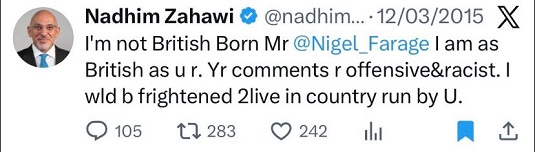
So frightened was Nadhim Zahawi, that 11 years on he shook Nigel Farage's hand and joined Reform. For Farage, bagging another (former) leading Tory is always a coup. It attracts favourable coverage in the right wing press, encourages more ex-MPs who'd like to have another crack at Westminster to think Reform is the better bet, and for everyone else it confers the impression that the momentum is still with them. The only time Nigel is likely to say no to a petitioning defector is if they're a big personality/loose cannon. Which is why the door remains firmly shut on Suella Braverman.
Zahawi though. He's always been a bit of a no mark. Serving for two whole months as the chancellor, he distinguished himself there for calling on Boris Johnson to go without resigning. And later he got sacked by Rishi Sunak for dodging tax while threatening to sue journalists for defamation. A pity it never went to court as the self-inflicted humiliation would have been delicious. Anyway, for a man even Keir Starmer mocked as a lightweight, the reasons for throwing in with Reform are predictably vacuous. The country needs a "glorious revolution" we're told, we're reeling under an avalanche of illegal immigration, and the Tories are likely to cease trading as a national party before long. One wonders when he reached these conclusions. Was it before or after Kemi Badenoch rejected him for a peerage?
Looking at the list of notable Tory-Reform switchers, they all have something of the second-rate about them. Nadine Dorries, Jonathan Gullis, Jake Berry, Danny Kruger, Andrea Jenkyns, all at best were side characters in the Tory dramas of recent years. Despite strenuous efforts at courting notoriety or having public tantrums. Legends in their own lunch times they undoubtedly were, but they are anonymous to the public at large. And Zahawi fits right in, a non-presence who'll be a stranger to most Reform members, let alone its more disengaged support. Which begs the question, does Farage actually benefit from providing a bolt hole for Tory mediocrities and failed politicians?
A lot of it depends on who's doing the pointing out. From a Labour Party perspective, the numbers show that Reform's claim on its 2024 voters is scanty indeed. For this marginal group of voters, highlighting how Tory faces from Boris Johnson's tenure are popping up in Farage's supposedly anti-Tory party might be supposed to be a killer argument. If Labour hadn't kicked off its first year in office with attacks on elderly people while unapologetically helping themselves to the spoils of office. For this layer, their perception of little difference between the Tories and Labour in power is unlikely to dissuade them from giving Farage "a chance", even if his party is fit to bursting with Tory turncoats. If the Liberal Democrats and Greens are going to talk about it, then perhaps they can stymie that small proportion of Labour's vote tending to the right, but it will be they who benefit from residual anti-Tory feeling attaching to Reform, not Labour.
But could the wave of Tory defections put off Reform's existing supporters? It's doubtful. The lack of big personalities, competence, or shred of intelligence between them means no one is about to upset the Nigel show. If a new arrival was to get into a pickle, like problems with taxes, too-strong racism, or a good old Tory sex scandal, it won't be a problem for Farage to shrug it off. Or them, if necessary. Charges of school boy racism, dodgy funding for his home, collusion with Russia, and buddying up with Trump haven't unduly damaged him. So difficulties involving next-to-invisible trophy minions won't either. He knows this, and so more defections are likely to come. And more of them will get nodded through.

2 comments:
Two things about Zahawi are far more notable than any others.
First, the founding of YouGov. If we extend our imaginations to suppose that he has both understanding of and access to the minutiae of his company's activities, then that probably puts him closer to the political pulse of the country then any human outside the day-to-day operations of Five Eyes.
None of which would mean that he necessarily likes what he sees there, nor can do any better a job of interpreting it than the desperate bumbling incompetence of other neoliberal relics would suggest is the state of the art. Doing his bit to support Herr Toad's ascent to power could be either an attempt to move with that pulse, or an attempt to push back against it. He also might be reading far more obvious tea leaves - like the strong possibility that a nasty white supremacist dictatorship in the USA would install a similarly racist regime here - and hoping to fawn his way out of the firing line.
Secondly, his responsibility for the COVID vaccine rollout - one of the biggest success stories in the history of British state activities. Implying that he may have some capacity for genuine competence... but probably not in matters of politics, given his support of the Truss leadership bid towards the end of his stint at the political top table.
Genuine competence is a very double-edged sword these days. Farage is right now losing some COVID vaccine conspiracy theorists from his fan base.
Post a Comment