A modest pinch of nostalgia is alright. Who doesn't enjoy kicking around the memories of yesteryear? But it is paralysing when it comes to politics. Others might treat it as a game, as they recall such-and-such a speech or get all gooey over BBC replays of past elections. Indeed, for some it is a game populated by the tribal affiliations of blues, reds, yellows and greens. Politics, however, is deadly serious. It's a constant battle, the ceaseless ebb and flow of power and resistance. Behind the theatrics (and the hysterics), the arcane rules and bad faith, the skulduggery and stupid grandstanding are the processes, the relationships, the coming together and becoming conscious of collectives of people. It is the terrain interests clash and crash upon, a politics of management vs a politics of the unmanageable, the forces stretching every sinew to keep things fundamentally as they are, against the inchoate, at times silent and restrained, at times cacophonous and vital forces pressing, pushing, breaking through the limits imposed on them. It has always been thus, and will always be thus until capitalism is superseded by something better, or we find ourselves overtaken by the quietude of the grave. Casting an eye backwards must always be with a view to learning, to understand the present, to advance.
And so when approaching the 2017 general election, apart from the feels, the new MPs, and wrecking what was bound to be another ruinous and decadent Tory government, what did it achieve? As Alex Williams and Tom Gann suggest, not a lot. At least where leftist politics outside of the Labour Party is concerned. Is this the case? Unfortunately, the answer has to be yes. The number of trade unionists and labour disputes reached a new nadir last year. The tragedy of Grenfell Tower elicited widespread sympathy rather than anger, and street mobilisations are no more frequent nor larger than at any time in recent years. The UCU pensions' dispute and McStrike offered glimpses into what might be possible, and will surely help ensure this year's strike figures will not be as low as the last, but the former ended in compromise and left a severe schism between the members and the apparat, and the latter is as yet unresolved. Sadly, hate crime stats are up, and the far right are taking to the streets yet again with only smaller numbers of anti-fascists out to oppose them. How?
Regular readers know my argument concerning the constituency powering Corbynism and the transformation of the Labour Party. If not, here it is again. The even shorter version is Corbynism and the Labour Party successfully appealed (and appeals) to the growing section of waged and salaried workers - those engaged in immaterial labour. The object of their work is not the making of tangible things, but of so-called intangibles. Stuff like knowledge, data, care, service, relationships, and subjectivities. For example, except for a spell in a factory every job I've done - shop assistant, "security" (yes, it's true), supermarket dogsbody, sessional lecturer, editorial assistant, bag carrier, and now lecturer/bureaucrat - all of these are examples of immaterial work. Additionally, these jobs chiefly involve mobilising our social competencies and knowledges that are mostly acquired (and enriched) outside the employer/employee relationship. Therefore, immaterial work is not only immediately cooperative, just like it always was in the capitalist work place, but is not possible minus the social infrastructure of socially productive, socially cooperative relationships all of us are embedded in. We are simultaneously socialised workers, and thanks to the way computers and telecommunications technologies have sunk into and enable our social vistas, we are networked workers too. In the initial formulation of this idea in relation to the Labour Party, I argued the only possible way it could win is by doubling down on this constituency, appealing to its concerns, and using the power of its connectivity and mobilising on this basis. Forget triangulation and going a little bit racist to catch older UKIP voters. Going for the former is exactly what the party did, despite the best efforts of some MPs and candidates convinced Corbyn was an albatross rather than an asset, and lo the Tories were robbed of their majority.
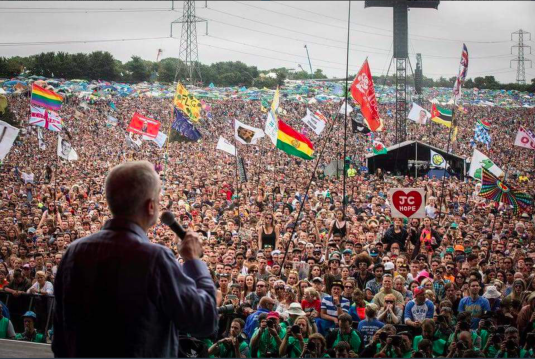
To answer why this hasn't led to a wider political advance means understanding the characteristics of the socialised worker as they actually exist. In the full throes of Corbyn scepticism in the run up to the first leadership contest, I argued there was something formless, rootless about the support he was attracting to the party. This was true, but what we were seeing was the composition of a social movement, albeit consolidating in the most unlikely bosom of the Labour Party. Here, the figure of Corbyn was a lightning rod, an attractor for the anger and frustration that had circulated in wider society but had not found a political expression for itself. As per the networks of the socialised workers, his candidacy snowballed and drew in incredible numbers of new people, just as the failed independence referendum in Scotland mobilised tens of thousands to join the SNP. We know what happened next and what is still unfolding inside Labour. This mobilisation and politicisation, however, was on a very narrow basis. Corbynism as an organised movement has hardly spilled over into trade unions, street campaigns and other causes. The transformation of establishment politics has left its fundamental characteristics untouched - it's still a representative affair in which one group of party elites (the leader's office and allies) do battle with another group of elites within the party, and the Tory elite on the government benches. The problem isn't people wanting to create and believe in a cult of the personality around Corbyn, it's that far too many see their activism fundamentally as a support role. It's liberal democratic politics replicated, albeit with new actors.
This radicalisation of the narrow range is entirely understandable. As socialised and as networked our rising constituency is, as capable, educated and skilled it is, as it retains every potential of becoming conscious of itself as a collective, politically speaking, and seemingly contradictorily, it is atomised. Surely networks plus atomisation equals a nonsensical combination, an incoherent assemblage of opposites? No. There are two intertwined reasons for this. The first is the absence of political collectivity in popular social life beyond the parties. The taming of the labour movement under Thatcher and the subsequent diminution of street-based collective politics, the failure of extra-parliamentary mobilisations since the Poll Tax to put serious pressure on governments, the disappearance of collectivity as an acceptable category in mainstream politics, the atomisation of communities thanks to housing policy and privatised forms of entertainment have all had their part to play. And winding around, reinforcing these and feeding off them is our old friend Neoliberalism. Not as a policy orientation re: economics, but as a mode of governance. Or, a way of addressing and responding to people, the acceptable and accepted way of being, well, a human being. With an absence of popular collective traditions and identifications (apart from the nation and the royals), is it surprising Jeremy Corbyn attracted hundreds of thousands of people who responded to his politics as individuals? That they bypassed the existing labour movement, activist and community groupings, poured into the party and, well, stayed there instead of fanning outwards to alternative avenues of political activity? That while left wing and socialist ideas have won new adherents and audiences, this is marginal to the dominance of spectator politics? And that the politicisation that has occurred has fuelled polarisation, but not given the hundreds of thousands in the Labour Party and the millions more who voted for it a sense of collective confidence and power?
Hence why, outside of Labour, the left have appeared to have stalled. And it's not just a Labour thing. Where a similar process occurred in Scotland, it too is stuck in the bind of representative/spectator politics, albeit with an independent nation acting as a catch-all attractor. The fault for this state of affairs does not lie with the leader's office. Sorry Trots, it's going to take more than the "correct leadership". The process of constituting our class as an active participant in politics cannot be short circuited, but it can be helped along. This is why the democratisation of the party is so vital. Not because of the possibility of getting rid of PLP no marks, but because enabling mass participation and bottom up democracy can catalyse a deeper round of politicisation. It's a means of our class learning to organise itself around its own interests, and from there the potential to revitalise itself as a collective by building new institutions and transforming old ones. The narrow, almost passive radicalisation we've seen so far is not the end point but the beginning of a journey, and one that can transform everything for the better.