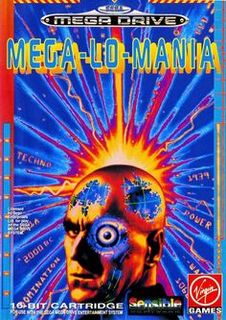
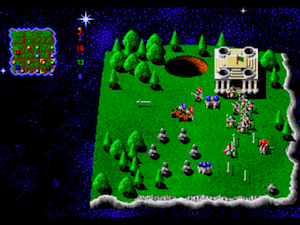
God games. Oddly, there were a few knocking around for Sega's all-singing, all-dancing arcade conversion monster. Mega-lo-Mania started out life as a title from Sensible Software on the 16-bit home computing formats of the early 90s (Atari ST, Amiga), proved a bit of a hit (as well as scoring rave reviews) and made its way over to the consoles. For reasons unknown, the publishers decided to change the name for its North American Genesis release to Tyrants Fight Through Time, presumably as they believed it was beyond the ken of yanks to reach for a dictionary. Even weirder, for the Super Nintendo release they reverted back to the old name but gave it a ghastly sonic and graphical overhaul. If it ain't broken ... Mega-lo-Mania is a God game. There's some piffle about worlds coming into being bearing intelligent life, and how the universe's deities cluster around and fight for the right to control it. The plot is hardly serious, but then it's not meant to be. Each level has three islands to conquer, and the player is endowed with a small pool of computer people to begin the task. Any left unused carry over to the next level, which is handy for the later stages where time is of the essence. You are then awarded a base, or tower, from which to direct your operations. You can assign folks to mining, designing technologies, forming armies and what have you. The aim is to develop weapons and grow your population so you have a hefty enough army to invade your neighbours' square until, in the words of the game, you've "conquered the sector!" Simple, right? The problem is you're squaring off against up to three opponents who are all trying to do the same and, terror of terrors, not all squares are as equally well endowed with resources. You might merrily and painstakingly build up a mine and a factory to manufacture cannon only for your base to be invaded by 50 spear men. The result is curtains for you.
The core game is simple. It's a matter of allocating numbers of people and growing them, and as you proceed through the game the rate of technological advance picks up. You start off in prehistoric times where the cutting edge technology of the day are rocks, and the game finishes nine levels later with Strategic Defence Initiative lasers and flying saucers. It's the later levels where things start getting tricky and you need to have saved some people over from earlier on. Levels seven, eight and nine are where nuclear weapons become available. It's usually a race to who can design and manufacture them first. If you win the production race you get to nuke your opponents and win. If not, you become the nuke-ee. A further consideration the player must bear in mind is the end game. When your tower has reached 2001 (it was the future, once) and provided you either have other settlements or an army deployed somewhere, you can send your peeps into suspended animation. They wake up on the island of Armageddon at the end of the game to do battle with lasers with any opponents who also packed their folks into cold sleep. Generally speaking, because the AI isn't great the opposition are rubbish at doing this. During my playthrough 36 of my guys (out of 200+ who went into storage) survived. Only one other bothered earlier on in the game, and they must have had less than a dozen people to play with. The final battle was more a massacre than the promised mother of all battles, alas. As an early real time strategy game, it is designed for quick play, of piling up your designs, manufacturing the most advanced weapons and taking it to the enemy. But when I was a little 'un determined to get full value of the £39.99, I quite liked playing long games, of slowly building up empires and military and toying with the much more stupid opponents. If you were the kind of kid that enjoyed tormenting ants, then Mega-lo-Mania is the game for you. Mega-lo-Mania was noteworthy for a number of reasons. First, in a period where speech in video games was relatively rare, this was positively verbose and came packed to the gills with samples. Diplomacy, which began and ended at the striking of military alliances, was mostly a jovial affair. Of the four demigods you could play as/against, Madcap and Scarlet sounded quite gruff and serious. Cesar was every inch the comedy Italian with an overblown accent. And everyone's favourite was Oberon, who in his best Carry On camp voice would ask "do you want to be on my team?". And if he was turning you down, there came a very John Inman-esque "no, I don't think so". As he shared his name with Shakespeare's fairy king, perhaps camping him up sounded like a good idea at the time. The MegaDrive, oft noted for not having a fantastic sound chip, nevertheless rendered all the speech as clear as the Amiga version. The second point is its importance to real time strategy games in general. When it came out, the roost was ruled by an ageing-looking Populous and the first Civilization game on PC. The former was an RTS but relied on growing your population to overwhelm your opponent, while the latter was turn-based but was organised around a tech tree. Mega-lo-Mania married the two and was able to prepare the ground for the likes of Command and Conquer, Warcraft and Starcraft, which went on to dominate the RTS genre.
Thirdly, Mega-lo-Mania was important for a less celebrated reason: console optimisation. The 16-bit computers lent themselves to quick-thinking RTS thanks to the mouse interface. Point and click was and is much less cumbersome than pratting about with a joystick or pad. For instance, the MegaDrive's iteration of Populous wasn't so optimised, meaning it was a pain slowly dragging your hand of God from one end of the screen to another. A good job that it isn't a fast paced game, really. While the problem isn't eliminated entirely in Mega-lo-Mania, each pad press automatically places the cursor on a control pad icon - a system much simpler than the ugly-looking menu system inflicted on the SNES version. Still, in both cases it demonstrated there was no reason why strategy games couldn't be modified to suit consoles, and today - though perhaps thinner on the ground then they once were - games of this stripe now all draw on the lessons learned then. This begs the question, if Mega-lo-Mania was a big deal at the time, if it was an important milestone in the evolution of RTS games, and if it played a crucial role that influenced how control schemes need to work for strategy console releases, why is it largely forgotten? It could be that its creators, Sensible Software, met their demise at the close of the 1990s and so has sank into history as an orphan. That it never received a sequel, that the American name change nonsense damaged its ability to solidify a following around a brand identity. More likely, unfortunately, was while the game is very good it is relatively short and doesn't offer the kinds of variety Civilization and, to a lesser extent, Populous did. Whereas they required a variation in strategy and tactics (of sorts), you can complete Mega-lo-Mania by building quickly and attacking in overwhelming force almost every single time. Only the nuclear weapon levels offer a slight variation on the theme. And that is a real shame, because Mega-lo-Mania does, if you'd forgive the clumsy allusion, deserve its place in the video game pantheon. It doesn't need worship, but its importance demands recognition.
Hoping for another sunny, balmy Saturday was too much to ask for. As Labour's canvassing teams went door-to-door in the Stoke-on-Trent Central by-election last week, it was under clear skies and dry weather. Those same teams today went out in biting cold and a snow so desultory it couldn't be arsed to leave even a light sprinkling. Still, neither work as meteorological metaphors for the reception we found on the doors. Understandably, a lot of people want to know how it's going. The bookies more or less have Labour and UKIP level pegging, and despite almost two years of UKIP decline at the polls there are people in the media happy to talk the purples up. Typical of this was Polly Toynbee's latest missive, which reckoned Labour is hanging on by its finger tips. Perhaps had she done some politics rather than just write about it and joined activists door knocking she would have found a different story. For sure, while canvass returns are rightly staying under wraps there are reasons to be cautiously optimistic. Having spoken to folks who've been out many more times than me, the talk of a UKIP surge is just that: talk. While, obviously, Labour is finding UKIP voters there is no evidence of a mass transfer away from either ourselves or traditional Tory voters. Our support is holding up, and so are the Conservatives. For my part, I've been out on three sessions and can look forward to a couple more next Saturday and then all day polling day. My doorstep adventures took me to neighbourhoods where Labour doesn't have the sitting councillors. The district our team was in this morning has always been a bit tricky - detached and semi-detached housing built in the 1980s, no real community focal point, a history of returning councillors from all the main parties and none. And so my expectations weren't great and, indeed, our returns weren't fantastic. But what we did find was Labour were staying Labour, that don't knows and previous againsts were generally warm and friendly, and that Conservative and UKIP voters weren't afraid of identifying themselves as such. The law of averages indicates that among the don't knows and won't says are people who aren't supporting Labour under any circumstances, but the phenomena of shy Tories and shy kippers isn't likely to be as pronounced here as it might be in other parts of the country. As one of my comrades reminded me earlier, when the BNP were a going concern in Stoke, their support were not afraid of telling you who they were voting for at election time. If you're not embarrassed about declaring for full-bodied fascism, would you be shy to endorse fascism-lite? As I said, last week we were out in areas that have traditionally been problematic for Labour, and the returns were very encouraging. If anything, there was a small but discernible swing to us. For some voters will undoubtedly be voting Labour to ensure Nuttall is sent packing. Campaign-wise, everything's going fine. If Labour somehow loses the by-election, it won't be because of strategy and activity. Each day sees new people pile in to Garth Street's GMB offices. Each day teams of leafleters and canvassers pour onto the streets. Each day the contact rate on our database ticks up - never before has the local party had as clear a picture of where its support lies and where opponents' votes are concentrated, all of which are boons for targeted leafleting and social media messaging before polling day. What can be said of the other campaigns? While there are claims the Tories have written Stoke Central off, the local association deserves its due for at least trying. Never before have I been out canvassing anywhere and bumped into a Tory door knocking team, but that has happened twice now. Today it was three posh women looking bewildered and wondering how anyone could possibly cope with one garage. They might not be mobilising nationally, but they are drawing in their people - one of them told me she'd driven for an hour-and-a-half to be here today. As noted previously, the local Tories are an ambitious lot and if they can turn in a creditable performance here - perhaps even knocking UKIP back down to third - then that will be a feather or two in their caps. The LibDems are banging out typically dishonest leaflets (sans the bar charts, alas) but don't seem to be mounting much of a campaign, but we'll be expending a post on them very soon. The Greens are also missing in action - the disgrace to have befallen their de facto local leader has probably contributed to their dismal profile. From a campaign point of view, UKIP's is proving to be very poor indeed. For reasons known only to himself, and to the bemusement of locals, Paul Nuttall has assumed the countenance and trappings of a country gent. If he is aping Nigel Farage and his sartorial choices, the penny is yet to drop that what might be appropriate for Thanet isn't necessarily so for Stoke-on-Trent. Still, as the honourable member for Lichfield reminds us, looking stupid is no bar to public life. Politically, Nuttall's unforced error over his house (which he has now moved from) was compounded this week by additional stupidities. On Radio 4 and on the local 6 Towns Radio, he was asked and couldn't name the six towns that make up the city. Small beer for outsiders, but this is the most basic of basic knowledge of anyone who's living in Stoke. He's been forced on the defensive again about his lies. Apparently the whopper about him "being there" at Hillsborough is really true, guv, and people who don't believe him are "total scum". And yesterday in a hustings organised for young voters by one of the local sixth form colleges, Nuttall didn't turn up and sent a lackey from the London Assembly to fill in for him - he was apparently in the capital doing some meejah. Overall, their campaign is turning out to be a shambles. UKIP may boast about having 500 activists out on the streets last weekend, but all we see are the same old faces traipsing around with their dirty macs and well used Sainsbury's bags-for-life. But because UKIP are running a poor campaign is no counsel for complacency. The general tone of political debate pouring out of the broadcast media and jumping off the pages of the press does their job for them. Nuttall and his coterie of toerags and losers don't need a super slick campaign because they're swimming with the stream. Every Daily Mail, Daily Express, Daily Star, and Sun sold in Stoke-on-Trent Central does a more effective job of making UKIP's case than UKIP itself. This by-election is an opportunity, perhaps the only opportunity we'll get of stopping this crap in its tracks before it inflicts even more damage. If you haven't already, come to Stoke, come to Garth Street, and be part of the moment the labour movement said "enough!".
Local government finance isn't the sexiest subject in politics, but it should be right up there. Councils provide the services and maintain the infrastructure all our communities, whether heavily urbanised or scattered across the countryside, depend on. And the demented cuts the government have foisted on councils have stripped services to the bone, and most noticeably precipitated an adult social care crisis that has seen the displacement of vulnerable people who should be managed by social services into hospital wards reeling under the impact of staffing and resource shortages. Under the late and unlamented Dave, local government was in Tory sights from the off. The appointment of the execrable Eric Pickles to the Department for Communities and Local Government saw him hailed as the first minister determined to make his portfolio obsolete. Rather than straight funding cuts to the block local government grant, they went down the route of fiddling with the formula that determined monies to be dispensed. It shifted from a formula that allocated resource with an appreciation of different levels of need per locality to a scheme that funded authorities by head of the population. On paper, it looked like the Tory/LibDem plans offered a "fairer" settlement as grants were shared out per head. In the real world it saw authorities covering some of the most deprived areas of the country, such as Stoke, lose money while some wealthy areas in the South saw an increase in their grant. All in it together? The overall Tory objective was and remains to make local authorities entirely self-sufficient. They want to abolish the grant completely and see it replaced by a mix of council tax, business rates and council housing rent receipts. The Darwinian dream is for councils to fight it out to offer low council tax and rates to attract residents and businesses. It's sink or swim, with areas with high deprivation and correspondingly smaller private sectors disadvantaged from the outset. But because these were the Tories, and because Osborne's much-hyped but missing-in-action political genius couldn't resist, the government introduced council tax caps to prevent big rises to make up the shortfall. Initially this was through one-off bribes to keep rises down that were not guaranteed from year to year, followed by a rule change whereby councils would be required by law to hold local council tax referendums if they wanted to levy more than whatever that year's arbitrarily-determined threshold was. This, Osborne and Pickles reasoned, would wallop Labour councils. They had pressing financial needs, and win or lose they could be singled out by ministers as more proof of Labour profligacy. Funny how things turn out. Because of the pressing crisis in adult social care, Dave allowed for bigger rises in council tax: up to 2.99% for general revenue and a further 2% on top to go to adult social care. It was a belated recognition that social services were left badly damaged by years of unrelenting cuts, but was also an amount that fell well short of the monies required to make things good. This is where Tory-run Surrey County Council enters the picture. Like many county authorities, the government are expecting them to make big cuts. For the financial year 2017/18, they were budgeting for savings of £93m. To help pull this otherwise wealthy county out of the mire, the council had approved a 15% rise in council tax and were all set to put it to a referendum as per the Osborne/Pickles trap. In the words of council leader David Hodge, the council simply couldn't cope with cuts of this scale without the shortfall getting made up from somewhere else. Everything in place and then, boom, to everyone's surprise the referendum was off. The tax rise had been scaled back to the permitted 4.99% after much singing and dancing. Also interesting to see the sudden disappearance from the council's website of criticisms of centrally-imposed cuts. Hmmmm, what had happened? All was unveiled in a zinger of a Prime Minister's Questions. Texts accidentally sent to Newcastle's council leader from Hodge showed a deal had been hatched with Whitehall. No details, but it meant the referendum would go away. According to Channel 4 News this evening, it looks like Surrey was "coincidentally" selected as a pilot area for a new scheme aiming to integrate health and social care. How handy. The government, clearly, had no choice but to cave. They were about to be caught in a trap of their own making. Seeing a Tory council ramp up council tax by such an amount would have damaged the party's claim to fiscal responsibility and cost them votes in a county area playing host to senior ministers, like our friends Jeremy Hunt and "call me" Philip Hammond. Secondly, win or lose it would have drawn media attention to an area of policy the Tories would rather not speak about. In short, it lays bare the inadequacy of present funding arrangements. By making the referendum disappear, the crisis can be swept under the rug for a little longer. It might be left to Jeremy Corbyn to raise it at PMQs but, they reason, few pay attention to what he has to say anyway. And thirdly, if this can be headed off now it might, with a stroke of luck, be a Labour council next time who puts a referendum to its people, allowing the government to jump in with both feet and make the cheapest of political points. In all, this is one of the most tawdry spectacles this government has put on. That even now, despite the shared society idiocy and, more importantly, the full blown crisis in A&E and winter beds they are quite prepared to shilly shally around with political games than provide the support the situation demands. Even if everything else was tickety-boo, this alone damns them. But with everything else going on, their lazy attacks on doctors and their stated preference for Wrexit, this should - and they deserve to be - damned all the way to oblivion.
Channel 4 are having a week "celebrating" the latest bête noire: fake news. As the mass media has always been treated as an instrument of propaganda by hands-on owners and governments, it's interesting that official opinion have taken so long to wake up to the knowledge that news outlets do more than report the news: they make it. But I want to take it a little bit further and introduce the notion of fake history. That is history that spins and disregards facts because they do not fit the narrative. For example, More 4's recent documentary on Hitler falls into this camp. It's not a matter of interpretation when key facts are omitted and the supposedly preternatural talents of modern history's most damnable man are talked up. I suppose fake history is easier to get away with when the events it describes are a long time ago and those with first hand experience are passing away. But in the age of internet information overload, it's very easy to "misremember" recent history. Liberalism's latest hero, Ken Clarke, has done just that. Writing in The Times about Brexit over the weekend, he said:
I compare it to the Iraq War. That was the last time I stuck my neck out in supporting a really unpopular cause - 70 per cent of the British public were in favour of the invasion and most of the Conservative Party was in a patriotic fury but I aligned with Robin Cook in opposing the war. Within 12 months you couldn't meet a member of the public who had ever known anybody who was in favour of it.
It's one of those moments where either you have fallen down the rabbit hole and are suffering from the Mandela Effect, or the venerable member for Rushcliffe is wearing well-heated underwear. Readers might recall that between the the Summer of 2002 to the actual invasion in 2003 that there were a few more people than our Ken and the late Robin Cook who were opposed to what was happening. Even in Parliament. This was the period George Galloway - for good and ill - rose to public prominence. Even on the Tory benches, Nicholas Soames took time out from the tea room to address anti-war rallies. Yes, rallies. The strength of feeling was such that the largest demonstration since the days of the Chartists clogged up London's streets, coinciding with huge protests in Edinburgh and across the world. Now, we know that there is a world of difference between people turning up for a march and what the wider population might think, though a good rule of thumb is if you're pulling between one and two million out onto the streets, you've tapped into something. Nevertheless, from my memory of the time opposition to Bush and Blair was pretty solid. I was, however, informed by others via the Twitterly medium that I was in fact wrong. Some pollsters consistently showed majorities against, and others displayed support for the war drive. Is my memory playing tricks? According to YouGov, I'm in the wrong. Between the invasion and for the remainder of 2003, a majority (54/38) believed it was the right thing to do, though asked 12 years later in 2015 about their views at the time, the sample reported a slight majority (37/43) saying they did not support it. Eagle-eyed readers may have spotted a problem with YouGov's evidence, though. Their measurements began at the moment sorties were launched and troops started moving in. This was not at all surprising. Regardless of the rights and wrongs of any conflict Britain wades into, public support for active service trumps all other considerations for a lot of people. This, however, is taken as backing for the war per se, which it was not. An altogether different picture emerges if you look at polling in the run-up to the invasion. This contemporary analysis of eve-of-war polling looked at those by ICM and Ipsos MORI, and found varying support for a number of prompted scenarios - but overall majorities opposed both military action and Blair's handling of the crisis. This opposition was certainly evident just before the big anti-war demo, and accelerated after. What is interesting is the difficulty of tracking down YouGov polls prior to March 2003. It is worth noting, however, that opposition wasn't uniform. According to ICM, it peaked in August 2002 and fell back to 37% after the Bali atrocity, and again started growing afterward. A case of fake history then? This time, probably not. It's a question of emphasis. The statement that the majority of the British public backed military action is true. The statement that the majority of the British public opposed the Iraq War is also true. Honest accounting of those times means acknowledging the huge levels of opposition prior to the conflict without pretending it didn't exist, a la Ken. And it also demands lefties stop wearing rose tinted specs about those times and note how a good chunk of the opposition vanished when the war began.
Housing is a major sticking point for the Tories. They know it, we know it, and the public know it too. On their watch, first with their LibDem friends and now alone with a majority thinner than a major donor's tax return, the bottom fell out of the house building figures. Cash strapped councils made poorer by a deliberate attempt to destroy local government services had no readies to produce social housing. The Tories curbed housing association building plans by announcing the extension of right to buy to their tenants (plans now quietly dropped). They left towns and cities across the Midlands and North scarred by cancelling Labour's housing pathfinder renewal scheme while, perversely, stumping up the cash for demolitions of "undesirable" housing stock. And have sat by while buy-to-let and second home ownership took off for the fortunate few. Indeed, their Mayor of London encouraged international capital to park its cash in property with deleterious consequences for ordinary house buyers. This paralysis can be put at the foot of a generous reading of Tory motives. Because they believe the private economic activity is always the preferred provider for any service, allowing the state to retreat would encourage the magic market pixies to step in and make available provision instead. It's nonsense, of course. The state of the market discriminates in favour of those with piles of cash and/or easy access to equity. It responds to property investors over young people trying to get on the housing ladder, driving prices up. And this is ably assisted by limited supply. Why should developers try meeting market demand for housing when deliberate under-building ensures greater returns on investments? No, these economics are so obviously distorted and broken that the usual ideological idiocies about the market serve only to highlight the situation's absurdity. As with all things in politics, it's the interests, stupid. Under Dave and Osborne nothing was done because the property developers, the landlords, the home owners whose assets inflated under galloping house prices were and remain key cohorts of Conservative voters. This layer of petit bourgeois owners shading into the big landlord chains benefited from low numbers of new builds and the restrictions on social housing. Likewise, under his Blessed Blairness New Labour did bugger all to stymie the degeneration of the property market in the name of aspiration, of wanting to capture the Kirstys, the Phils, and the Sarah Beenys in the nice swing seats. Unfortunately for the Tories, this situation cannot continue. Locking millions permanently out of the housing market while core supporters carry on coining it stores up social and political problems. The party that, in the 1980s won over layers of working class people by giving them a leg up into property was in danger of becoming the party that denied their kids and grand kids similar help. How then to sort the problem without going "full communist" by building 200,000 new homes a year, as per Ed Miliband, without causing average house prices to fall and hitting the investments and asset prices of its nearest and dearest supporters? In their new white paper, Housing Minister Gavin Barwell has come up with an ingenious solution. Forget affordable housing, let's have affordable renting. What Barwell proposes is a recasting of the rental market. In a move redolent of working towards the leader, he proposes the introduction of long-term tenancies that provide stability for renters and landlords alike. A system not unlike the lengthy lets that are par the course in Germany, in fact. It reiterates the guillotining of letting agents' fees, but also hints at "government help" (i.e. bungs) for developers to build homes for "affordable" renting, something the House Builders' Association have dived on with alacrity. On all the Sunday talkies, Barwell ritualistically reiterated the commitment to building a million new homes before 2020, but it was said with the kind of enthusiasm reserved for policies destined for disposal down the memory hole. It goes without saying, but I'm going to say it anyway: this policy is a load of rubbish. It does little to address the housing problem. It does next to nothing to solve the shortage in social housing stock. But, then again, one shouldn't be mean about young Gavin's efforts: he can't well be expected to solve a problem he didn't set out to tackle. Secure tenancies certainly make for touchy-feely one nation vibes, but expanding the buy-to-let market - which is what the government are signalling - provides more opportunities for landlords and developers in such a way to stymie the numbers of new builds entering onto the open market for prospective owner-occupiers and first-time buyers. Prices therefore remain largely protected. As for the problem, well, it gives the Tories the appearance of doing something, except this something, as always, is about protecting the interests of their own.
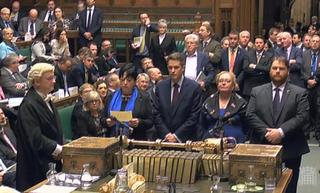
Taking a sneaky from things Stoke-related, it's time to cast an eye over last night's Commons vote giving the government permission to trigger Article 50. Annoyingly, it is not the Tories who find themselves poisoned and split over Europe, like the Lexiters promised. It's Labour. As the government won by 494 to 114, 47 Labour MPs joined the SNP and Ken Clarke in voting against. Like John McDonnell, I have some sympathy for the rebels' position. Some MPs hail from constituencies in which majorities voted for Remain, other believe leaving the EU is a catastrophic act of self-harm. These for me are all valid reasons to oppose Brexit, but to my mind are trumped by another consideration: democracy. Representative democracy at the best of times is inefficient and imperfect, especially so in capitalist societies where economic and political power are more or less separated. The former, formally, is subordinate to the will of the latter and has to submit to its laws, regulations, and other interventions. In practice, it's the other way round. For most of the last 30 years, as learned folks across the political spectrum told us class didn't matter any more, inequality increased, production gains accrued to the owners of capital as productivity was decoupled from wages, and ever more ingenious ways were devised by successive governments to transfer tax monies into private coffers via the marketisation of public services. And coincident with this, educational institutions and popular culture have tried churning out obedient subjects that would meekly accept all this. It's a rare situation to find economics assuming a subordinate role in government policy, but this is one of them. Theresa May's Wrexit trajectory will be profoundly damaging to the British economy, and it's our people who will pay the price. But ultimately, politics has asserted itself. Brexit is a massive pile of shit, as a lately prominent comrade of mine put it, but it must happen. The referendum wasn't sold as a "consultative" exercise, it was clearly and unambiguously a plebiscite on Britain's continued membership of the European Union. Prat about with the turn outs, pull out pie charts proving a majority of people didn't vote to leave, it doesn't matter. A democratic vote was had and the wrong side won, but we have to take the consequences. Because if we don't, the political fall out would have been far more damaging to our people and our movement than a reversion to WTO trading rules post-Brexit. What I would euphemistically describe as unhelpful is how the party, or rather those who rebelled last night, completely conceded this ground to the right. Democracy isn't a free floating idea, it is bound up with interests and it's in the interests of the people our party represents to extend it beyond the realm of formal politics. We have to make politics substantive, and this means economic democracy. By refusing to support the Brexit process, this ground has been ceded to the right. Our rebels have presented the Tories a crock of political gold with a gift tag that reads "unified to deliver the referendum outcome". At this crucial moment in British political history, the Tories have captured the mantle of champions of democracy without so much as a tussle. And that is profoundly damaging to our future political prospects.
And so the finalised list of Stoke Central by-election candidates is out, and 10 folks fancy their chances. And it's a circus, albeit one not likely to produce much merriment. Who then are the lions and acrobats? Which of them is the clown? Naturally, Gareth Snell has roared into action. Labour were all over the constituency from the very moment Tristram Hunt declared Trexit and, as I've observed before, the party has a formidable machine and a real weight in the constituency that will be tough for its opponents to crack. That hasn't stopped people from outside the constituency who can't find Stoke without the aid of Google Earth have tried explaining to me that the local party couldn't have selected a less suitable candidate. Au contraire. Gareth has lived locally for 13 years, worked in a series of part-time, insecure jobs while a student, worked in a local MP's office where he dealt with the full gamut of constituent concerns, has sat and currently is a borough councillor, organised low paid workers as an employee of a local Unison branch and, most topically, defeated UKIP in a council by-election this summer in a ward that voted 80/20 to leave the European Union. His politics, while not Corbynist, are by any measure on the left. And during his too brief tenure as leader of Newcastle-under-Lyme Borough Council, he pushed through a no redundancies, no cuts to front line services budget despite government cuts to the local government grant while introducing the living wage (not the fake Tory rebranding of the minimum wage) to its lowest paid workers. It's worth noting that subsequent Labour administrations have carried on in this vein. No cuts, no diminution of service, no redundancies. In the context of Tory austerity, that sounds like a record any Labour member would be proud of. It seems the objections all centre around Gareth's remain-ism and that he said rude things about Jeremy Corbyn on Twitter. Last thing first, while we all say daft things on social media in the heat of the moment there won't be too many Stokies bringing up Guido's "exposé" on the doorstep. Rather these have been all over his muckraking site and, surprise surprise, the Daily Express to generate social media interest in an attempt to suppress Labour support. This isn't meant to offend their readership, but to ensure the bulk of the new membership have an entirely passive relationship with their party. Why, some would reason, should anyone from Momentum turn out to help in Stoke when the candidate is evidently not a Jeremy supporter? Guido and the Express aren't interested in the truth, but they are interested in using anything to destroy the Labour Party as a going concern. It's sad that this has to be explained to folks who should, by now, know better. The second point is on remain vs leave. The bookies are offering slightly more favourable odds to UKIP based on the assumption that Stoke Central heavily voted for leave and we have a remainer candidate. And that's where the analysis ends. But as noted previously, the record of all of last year indicates that if Brexit is a new political cleavage, an issue around which electoral fortunes turn, then it is a lopsided one. Leave voters have got their way. We're leaving the EU. Some might moan about the pace of the departure, but it's very much a minority pursuit. For most of them when it comes to politics, it's back to the same old same old. If Brexit was blocked it would then be a different matter. Remain voters, however, are more motivated by this issue. For a variety of reasons, they - rightly - believe Leave conned, lied, and stirred up hate on its way to victory. And so when elections come round they are moved to make a point about it at the ballot box. That explains how the LibDems have come surging back in local council by-elections, won in Richmond, and confounded expectations in Witney. It's how you can have bizarre results where the LibDems take a safe Labour seat in Brexit-supporting Sunderland. Had remain won, I have no doubt the terms would now be reversed. It would be UKIP enjoying another wind as the gust of defeat drives at its sails. And because of the song and dance UKIP are making about remain-supporting Gareth, they might be unwittingly helping Labour's chances. Yes, I am aware there are other candidates in this election, so let's take a look. Jack Brereton won the Tory nomination to fight Stoke Central in a contest as foregone as any organised by the Zanu-PF. CCHQ are apparently pleading poverty and sinking all their resources into Copeland, but that doesn't mean the Tories won't wage a proper campaign. The Conservative group on the council are an ambitious bunch who fancy taking berths up in the Commons. For all sorts of reasons, a win is impossible but if they can take back second place and are seen to put UKIP back in their box, 2020 could make for an interesting time for them. The LibDems in Stoke are in a difficult place. I will give their man, Dr Zulfiqar Ali some credit. Rain or shine, he's stood and he's stood and he's stood, be it as a no hope parliamentary candidate, or a no hope council candidate. However, with local students not terribly well disposed toward his party for their tuition fee betrayal, and past LibDem support bound up with local "personalities" who've either retired from politics or now sit as City Independents, where can their vote come from? The same can be said for Adam Colclough of the Greens. Formerly of Labour, he absented himself from the party after the 2010 factional farrago left us with Tristram. But where is their support? Some students, yes. Scraps of votes around the slightly more better off parts of the constituency, yes, but enough to win back their deposit? Moving from the parties to the living dead, this by-election sees the unwelcome return of the BNP. David Furness (who?) was their London mayoral election candidate in 2015, and describes himself as a "practising member of the Church of England". Because nothing advertises Christian values like the membership of a fascist organisation. While another opportunist carpetbagger, Furness's candidacy underlines the weakness of the local BNP. In fact, they have almost no discernible existence. Since we last took a look at Stoke BNP a few years ago, we found them a sad bunch sat in awkward silence over identical McDonald's Happy Meals. I am pleased to report the necrosis has continued apace. Their remaining activists have either dropped out of politics, or followed their local "brains", Mike Coleman, into the Albion First groupuscule/Facebook page. Yet for Stokies who did vote BNP up until 2010, the eclipse and tumultuous disintegration of the party since won't have registered. There will be some who rock up at the polling booth, spot the BNP on the ballot, and place their cross there as opposed to UKIP. In the independent corner, we have two to choose from. Neither of which are associated with our friends the City Independents, of course. Mohammed Akram is a solicitor who has a history in local Muslim welfare organisations. And Barbara Fielding hails from Blythe Bridge on the city's outskirts. Quite why they're standing and what they hope to achieve is a complete mystery - something I often wonder about when independents contest parliamentary by-elections. I'll pass over the Monster Raving Loonies (I await the inevitable "gags" in the comments box, below) and Christian People's Alliance, and head straight to Paul Nuttall. We've talked about him before, and he's given me more reasons to speak ill of him again. Consider this. If you are clever, if you claim "to have a PhD", if you are the leader of a political party and the media spotlight is on you, would you commit a violation of electoral law by declaring a house you've never been to in the constituency as your home, and then admit to it on national telly afterwards? He's been caught telling porkies, just like his time wearing the Tranmere Rovers' jersey and "being there" at Hillsborough. Here we have an incredibly brittle man whose national profile is entirely thanks to Nigel Farage. He knows he has no discernible qualities, which is why he has to make them up. And, I have to say, lying so much about his own biography easily lends himself to telling lies about immigration, about the NHS, about Brexit. And there's the small matter of being under investigation for office expenses fraud as well. Nuttall is a spiv, a fake, a lazy arsed mediocrity whose sole concern is to use politics to feather his bed. He doesn't care about Stoke, its problems, its people. The prize is another £75,000/annum and a few more years as Someone Who Matters, and he's quite prepared to wade in the sewer to get it. And so the choice is pretty obvious. It's between stopping UKIP and their poisonous politics here, in Stoke, and throwing them into a reverse from which they may never recover. Or having them emerge victorious with all the terrible consequences for our politics that entails. It's between a union man who champions working people, and a lying wastrel who can't wait to sponge off the taxes of those selfsame workers. Are you in to stop this shit in its tracks?
The five most read posts in January were: 1. The Left Unity Masturbation at Work Debate 2. Goodbye to Tristram 3. A Political Guide to Stoke-on-Trent Central 4. Paul Nuttall in Stoke 5. Stoke-on-Trent Central Labour Long List It's basically been Stoke month on the blog since Tristram Hunt announced his resignation from Parliament. As I've been saying since this blog's inception, Stoke-on-Trent is the city around which the nation's politics revolve. And now I have the audience to back up this truism. January 2017 weighed in at 133,000 page views, an average of over 4,000 per day. Or, between you and me, this blog's best ever figures. I would be very pleased if it turns out I haven't peaked already this year, but we shall see. Yes, it's my front row seat at the Stoke Central by-election circus that's to blame. And in February you can look forward to further reportage from the campaign trail as well as my analysis of the coming result. Labour are looking strong, but I remember my resolution to cease venturing predictions. The big winner, however, is the republishing of the "classic" Left Unity masturbation at work debate. Truly the most bizarre - and telling - debate certain sections of the left have engaged in in recent years. I won't be letting you off that lightly. Getting the second chance treatment for January is my meditation on Living Dead Liberalism. Seeing so many liberals fawning over Ken Clarke for his speech in Parliament against Brexit sums up their bankruptcy.