I've got two heavy duty blog posts brewing, but I cannot for the life of me summon up the energy to begin writing them this evening. Besides, the footy's on, there's a new Mega Drive game dying to be tried, and I'm halfway through Richard Yates' Revolutionary Road. Bugger it. Let them eat dubstep.
Tuesday, 8 July 2014

Monday, 7 July 2014
Investigating Paedophile Politicians

Firstly, on the face of it the "misplacing" of Dickens' dossier is, at best, a catastrophic error. It is inexcusable that it should have gone missing. Yet that does not automatically mean its contents were of substantive value. As Reuben rightly notes, Dickens was
... a campaigner against witchcraft, and satanism, and against the decision by a previous government to repeal the 1735 Witchcraft Act – which he believed had made it a little too easy for evil to flourish. Of course these things were not unrelated, since like many people in the 1980s, Dickens was hooked on the idea that up and down the country children were being subjected to Satanic Ritual Abuse - a phenomenon now universally regarded as a moral panic with little-to-no basis in fact.This leads me to my second point. At the risk of sounding like Brendan O'Neill, the rising clamour around alleged paedophile politicians has created a constituency who almost want there to be a scandal. Matters are made worse by the crimes of Cyril Smith coming to light. So we have a media wanting something to fill their schedules and pages. And as for the wider anti-politics malaise, it's confirmation of the ultimate corruption of politics - despite mainstream politicians taking the brewing crisis by the bit and acting decisively. The febrile atmosphere leads to another issue. When a list of unsubstantiated allegations are a Twitter search away, when child abuse combines with a culture of lost trust and antipathy, there will be real problems ensuring any future defendants receive a fair trial.
In 1988 he told She Magazine that “up and down the country” hundreds of Children were being “sacrificed” to the devil. Interestingly, he said he was building up a dossier which he hoped would provide concrete proof of the evils of satanism, which he would be handing on to the police ...
In 1983 Dickens called on Brittan to investigate pedophilia at the royal court, buckhingham palace and in the diplomatic and civil services. It is impossible, right now, to know what was in that dossier – was it packed full of credible evidence, or was it dross about witches and satanists. Yet it is worth noting, that Dickens retained his own copy of the dossier, and remained alive for another decade, and was hardly shy about getting in touch with the media, if he felt (often wrongly) that had something credible to offer them.
If the rumours are substantiated, silence has, so far, allowed a bunch of paedophiles get away with it. It would be an awful irony if splashing allegations across the internet and media let them continue to do so.
Sunday, 6 July 2014
Why Won't Ed Balls Renationalise the Rail?

Labour are the natural go-to for renationalisation. It's the one furthest away from the rail companies. It's also the party that has partially broken with market fundamentalism, whereas the others cross their fingers and call it a long-term economic plan. And there's history. It was Labour who ensured the state had a hands-on role in the economy after the war. Yet, despite the record, against the widespread support for the policy (second only to renationalising the utilities), the party leadership prevaricates and fudges. It is expected that this week, rail policy will retain competitive tendering for contracts, but allow a state-owned entity enter the bidding process. Why the studious avoidance of a policy that is a surefire vote winner?
Part of it comes down to the shadow chancellor's cautious economics. Yes, Ed Balls is reputed to be a Keynesian these days. This was the niche he carved out during the Labour leadership contest, and has relied on Keynesian nostrums to oppose Tory austerity ever since. However, the relationship between Ed and JM is one of fleeting acquaintance rather than deep, philosophical commonalities. Basically, Keynes believed that markets tended toward a stagnant equilibrium with little innovation and high unemployment. Ed, however, nods more toward neoliberal common sense. Yes, the government should pursue an industrial strategy. In economics, the state has to be an activist. Yet his preference distinctly leans against direct intervention. The state's role is to create the best possible conditions for markets to flourish. It steps in only when things go catastrophically wrong. It is countenanced as a last resort, as per during the 2008-09 crisis.
In Ed's opinion, the markets in energy and rail aren't entirely broken. Their dysfunctions can be overcome with a bit of tinkering. Hence, having a state-owned company bidding for franchises compels existing contract holders to up their game. And in those bits of the network won by the public contractor will still be disciplined by the market under pain of losing the franchise when it next comes up to tender. It's a classic fudge the front bench thinks would satisfy the clamour for renationalisation, while satisfying Ed's (and Ed's) preference for market-based solutions.
So much for woolly theory. As ever, there's hard politics in play. At the Fabian Conference earlier this year, I asked Ed about rail renationalisation - why not, considering how popular the policy is? The answer was as you might expect; "can't make spending commitments ... it's not a priority ... if any cuts are to be reversed, they'll come before this ... let's try repairing the markets first." The reticence is part hangover from New Labour, in which nationalisation is the N-word never to be uttered. And it sits uneasily with the pro-business offensive the leadership have been making of late. Pledging to nationalise something doesn't go down well in business circles. If the trains go, what other failing markets could be up for state takeover? It's all about securing "confidence" and opposing this to Tory recklessness already undermining "stability". There's also the small matter of the present franchise holders. If they know their number is up, there's zero incentive for them to upgrade and replace rolling stock, improve the service, etc. The state would inherit a dilapidated service requiring the injection of taxpayer cash to make right.
Here's the second point. The Labour leadership are pledged to restore their reputation for prudence by managing austerity "fairly", rubbing out the deficit, and cracking down on public sector debt. Everything is fully costed - the schtick of inviting the OBR to cost Labour's proposals is a nice rejoinder to the usual Tory "tax and spend" nonsense. Nationalising rail via a zero cost phased return is too much of a variable, a potential unknown that could be lumped in with uncosted spending and thereby jeopardise the "sound finances" strategy, and with it a huge pile of Tory/Labour floating voters.
I think this is the wrong approach and further underlines the disconnect between Westminster and the rest of the world. It might be that those floaters in the marginals want a government who's careful with taxpayers' cash. Who doesn't? And yet, the present situation is that franchise holders already get handsome bungs from the government to keep prices down. In reality, that subsidy is basically a profits guarantee. Voters aren't stupid. They prefer renationalisation because a centralised service in a natural monopoly makes sense, and they'd much rather see any money it makes returned to taxpayers' coffers.
So come on Eds, do the decent thing. Do the popular thing.
New Blogs June/July 2014
Want some new(ish) blogs? Of course you do.
1. A Liberal Life (Unaligned/anti-UKIP)
2. Dream Deferred (Unaligned/anti-fascist) (Twitter)
3. Feminists Unknown (Unaligned/feminist)
4. Gender Minefield (Unaligned/feminist) (Twitter)
5. Labour Central Devon (Labour) (Twitter)
6. New Narratives (Unaligned/feminist/trans)
7. Novara Wire (Unaligned) (Twitter)
8. The X-Ray Factor (Unaligned/health) (Twitter)
9. Twickenham Labour Party (Labour) (Twitter)
10. Vixens With Convictions (Unaligned) (Twitter)
11. Young Fabians (Labour) (Twitter)
That's your lot for this month's round up. If you know of any new blogs that haven't featured before then drop me a line via the comments, email or Twitter. Please note I'm looking for blogs that have started within the last 12 months. The new blog round up usually appears on the first Sunday of every month.
1. A Liberal Life (Unaligned/anti-UKIP)
2. Dream Deferred (Unaligned/anti-fascist) (Twitter)
3. Feminists Unknown (Unaligned/feminist)
4. Gender Minefield (Unaligned/feminist) (Twitter)
5. Labour Central Devon (Labour) (Twitter)
6. New Narratives (Unaligned/feminist/trans)
7. Novara Wire (Unaligned) (Twitter)
8. The X-Ray Factor (Unaligned/health) (Twitter)
9. Twickenham Labour Party (Labour) (Twitter)
10. Vixens With Convictions (Unaligned) (Twitter)
11. Young Fabians (Labour) (Twitter)
That's your lot for this month's round up. If you know of any new blogs that haven't featured before then drop me a line via the comments, email or Twitter. Please note I'm looking for blogs that have started within the last 12 months. The new blog round up usually appears on the first Sunday of every month.
Saturday, 5 July 2014
Jumping Jack for the Sinclair Spectrum
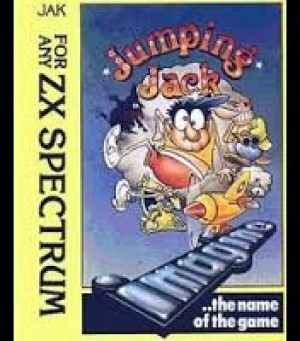
Like all software titles dating from that period, the graphics and sound were rudimentary but functional. The gameplay simple, bordering on the primitive. And yet, horrendously addictive. Us young hip things in the Class of '93 may have poured scorn on the Speccy's abilities. It couldn't hold a candle to our Amigas, our 386s, our MegaDrives, yet lunch time after lunch time we queued up and crowded round our rubber-keyed chum to see if anyone else could reach stage 12. What was the fuss about?
Jumping Jack is a single-screen platform game. Of sorts. Between you and the top are eight moving floors. Travelling conveyor-style in both directions are gaps. The aim is to jump through them to get to the top floor and thereby the next level. However, every time you jump a new hole appears randomly, making your journey increasingly tricky. Not to worry though, should you miss a hole and bang your head on the ceiling or fall through a gap you'll be temporarily stunned. You only lose a life if you fall back to your starting point. Adding to the fun are a number of peculiar-looking enemies. These include a man with a blunderbuss, an airliner, an axe, and a host of amorphous blobs. Here's a sample of them. If they touch you you're temporarily stunned, and it takes Jack a longer to recover from them than a simple fall through the floor. It adds another level of strategy to what is already a tricky game.

Is there anything more that can be said? There's doesn't seem much else to it. Your flickery little stick man hardly condenses centuries worth of dodgy cultural codes. His surreal enemies betray nothing but random, if slightly Pythonesque choices. Yet again, like most video games of a bygone age they resist reading because they're all about the gameplay. While there's plenty to be said about that in and of itself which certainly applies to a culturally "thin" games like Jumping Jack, I'm going to take this in a slightly different direction.
Jumping Jack was published by Imagine, but was not written in-house. Nevertheless, I think the game can work as an allegory of not just Imagine's fate, but the new rapaciousness that consumed business culture in the 1980s. Imagine, set up in 1982, lasted about 18 months before collapsing under heavy debts. It published reams of, at that time, good quality software but the company's cash was blown on salubrious offices, overstaffing, super-flashy marketing (again, by the standards of the day) and luxury cars for the bosses. It lived beyond its means and spectacularly went bust after some daft business decisions - such as buying up much of Britain's cassette-making capacity prior to Christmas 1983 so rivals would be hard pressed to manufacture games in sufficient quantities. It was less risk-taking and more risk-seeking behaviour. It couldn't pay its bills, nor could Imagine pitch for new contracts as its reputation spread. So down the tubes it went.
Jumping Jack, bizarrely, prefigured Imagine's fate in video game form. The first level, without the enemies, is easy enough. Jump up from one level to the next, making note of where the new gaps are and avoiding/utilising them where necessary. On and on it goes until you have five enemies racing across the screen. It requires careful timing, careful jumping, knowledge of where the gaps are and will be a few seconds hence, and the proximity of that bloody dinosaur. One can almost work out a strategy to get you safely to the upper floors, but as the risks multiply a simple misstep can screw you up. There's one floor to go, you jump too early and wham, you're down. A train, a witch, a pencil run you over in short order, keeping you stunned until a gap comes along and drops you to the next level. This dazes you further, another enemy comes along, and ... you get the picture. One slight mistake can escalate into a crisis for Jack. One moment you're at the threshold of the next level, and less than ten seconds later drops and enemies force your right down to the bottom of the screen, leaving you twitching on your back in pixelated agony.
It's fitting Jumping Jack was one of Imagine's last games as an independent entity. The temptation is to cut corners and recklessly dash for the top, but if one doesn't take care hubris is followed swiftly by nemesis. In Imagine's case, it took on the form of bankruptcy. For Jack, it's a blue snake that turns the screen purple.
Röyksopp ft Robyn - The Girl and the Robot
Many thanks to Sarah Ditum for reminding me about this brilliant tune in the week. It would be rude if the Solid Satday Night Disco cooked with anything else.
Friday, 4 July 2014
Austerity and Trade Union "Betrayal"

I have some sympathy with Mark's argument. I said the same sort of things last year when the People's Assembly initiative launched. This from then:
I am tired of what appear to be cyclical motions of activity of the left and the labour movement. It goes something like this.I think Mark and many activists of similar mind make two common related, but fundamental errors. The first point is sort of voluntarist. There is no strategy beyond the set pieces because the "trade union bureaucrats" want to keep a lid on things. The one thing the bureaucracy fears more than a Tory government with a fresh mandate is an active membership pushing for action. There might be an element of truth to this ... if you went back to the 1970s. Nowadays things have changed somewhat. These days your trade union full-timer is less a bureaucrat and more a full-time activist. Unfortunately, as the labour movement has declined paid employees have had to pick up the work once done by lay elected officials and trade unionists. It has increasingly fallen on them to do the representing and the organising. Scared of autonomous rank-and-file activity? Chance would be a fine thing, would come the reply. Mark's argument is premised on the opposite view. That the trade union apparatus is and continues to be a break on action, and that workers would brush austerity aside if only the right leadership were in place. This Trotsky-inspired position reduces all political questions to a matter of working class leadership. Sort this out and the rest will follow.
We start with an issue, say a looming unpopular war, a perceived deficit in working class political independence, or opposition to austerity.
An organisation or group of organisations hold an exciting and energising set of meetings. These are usually along the lines of a massive speakerthon in London - typically at Friends Meeting House or ULU. And followed by local launches elsewhere that often see leading figures of the new movement feature as special guests.
The immediate objective laid out by the Steering Committee is a big set piece event, such as a demonstration, a day of action, or a general election campaign.
Once that objective has been met and a Herculean effort pulled off by all concerned, the next target appears - a local mobilisation or another large set piece such as another national demo, another day of action, another set of elections.
For some, especially those who were tempered by the initial 'heroic' phase of the movement, start getting disillusioned. It might be because there's other things going on in their lives, or they're feeling a bit burned out, or their activity is appearing to have little appreciable effect, or, all three.
As disillusionment sets in for large numbers, people start dropping out of activity.
Those remaining, who by this point are inveterate protestors of all types and self-decribed revolutionary organisations, typically turn in and blame each other and the SWP for screwing it up. "If only the right leadership were present."
If only it was that easy.
I'm not going to go into great depth about the changed political economy of the working class. I've banged on about it for yonks. But when you have a whole class of wage and salary earners who are mostly outside of their trade unions, and those who are in them display low levels of combativity, political opportunities for big-P politics industrial action are somewhat circumscribed. If you want to talk about the less-than-optimal outcomes of most labour disputes, always pinning it on the "sell-out" antics of unspecified bureaucrats is an abstention from analysis - and for the Trot groups who should know better, betrays an infantile approach to industrial politics.
"Hold on a minute, you might be letting the trade union leaders and full-timers off the hook. Aren't you excusing inactivity? If the TU tops got their fingers out and showed a fighting lead, we can organise a fightback. Look at the late Bob Crow!" The most crucial resource trade unions have is solidarity, the capacity that when push comes to shove, members will respect the ballot decision and abide by it as a disciplined collective. When you lose disputes, the confidence underpinning solidarity erodes. Hence full timers and officials are relentlessly pragmatic. They know it is not a resource to be squandered. And this is doubly the case when we live in an era of industrial peace conditioned by labour movement weakness. If disputes are routinely patchily observed, if membership densities are low, if ordinary members' participation in union structures remains historically depressed, then you can understand why general secretaries pay zero heed to calls for immediate general strikes and indefinite action - let alone using trade union power as a weapon on issues not directly related to members' workplaces.
Sorry to be such a gloom, but disempowered working people and the restricted political opportunities this allows feeds into the treadmill of demos, one-day strikes, more demos, etc. It's not an inability to absorb lessons as such. Yet I remain fundamentally optimistic for a resurgent labour movement. Things cannot and will not stay the same forever. There is something in the air, a sense that the old ways are found increasingly wanting, that politics is disconnected and that working people are getting a raw deal. Presently UKIP and the anti-politics brigade are reaping the benefit, but why not our movement too?
Thursday, 3 July 2014
Inequality and British Capitalism

What does inequality mean to British politics? Everything. There are many kinds of inequality out there, but in Britain, the world's first capitalist nation, its politics has long reflected the class relations capitalism produces and depends on. The Conservative Party was - and still is - a coalition of land, business and finance. And Labour, basically, a coalition of everyone else. The former represents money made from the labour of others, the latter the labourers who make money for others. So when it comes to the question of inequality, where do the parties sit? How do they address the problem?
Well, the Conservatives do not. We are told the Tories have a long-term economic plan. Dave and co are eager to utter those words at every available opportunity. But do they, really? More on that another time. For now, whether in possession of an economic plan or not, they certainly do not have a programme for addressing inequality. In fact, is it even recognised as a problem? Clearly not. For them, inequality is good. Rip out the social security safety net and you have a mass of people who, of necessity, will queue up for the latest zero hours, minimum-wage offering down the dole office. And this is a good thing. If you're ever fortunate enough to receive a ministerial letter from the DWP, they wax lyrical about the mental a physical health benefits of being in work. Low paid work encourages employees to graft harder, to work their way up the greasy pole. It demands discipline and self-responsibility. Best of all, low wages are attractive to overseas investors. Where else in Western Europe can you find a benign corporate tax regime, excellent transport links to the continent, and an educated work force on the cheap?
Previously, I've mentioned, from the standpoint of British capitalism, how dysfunctional the Tories are. They are, but that's because they pursue the short-termist logic of individual capitals. Every business strives to produce commodities at minimum cost, thereby reducing the risk each commodity represents when it goes on sale and maximising the potential realisation of surplus value (see point nine, here). Examples of how businesses go about this is the introduction of labour-saving technology, IT systems, greater surveillance and supervision of the workplace, forcing through temporary and zero hour working. We could be here all day listing the means by which individual capitals wring every bit of surplus value possible out of their employees. And, of course, they have an interest in keeping the work force as individuated and atomised as possible. Disorganised workers do not challenge management decisions. Disorganised workers accept whatever pay and conditions are thrust upon them. So trade unions, wherever possible, are a no-no. The Tories are basically governing Britain as if it was Amazon or McDonald's. Grind the workers down, pretend there are no long-term structural problems, and celebrate inequality not just as a virtue, but a selling point.
Labour is different. Forget the far left fairytales you might have been patronised with, Labour has always been a party of capitalism. Let me repeat that. Labour has always been a party of capitalism. Yet, because it is a labour party, it has a varied and patchy batting record for the interests of working people. Working people here is everyone who, of necessity, works for a wage or salary in all the possible jobs you can think of. And interests are their particular and general interests as they exist within the system. Also, as a party of labour, it is suffused with the potential to become something more than just a better manager of British capitalism. But more about that another time too. As big business abandoned Labour prior to the 2010 general election, it has become more dependent on affiliated unions and cash raised by party members. The party's circumstances may be reduced, but it is much clearer about the problems British capitalism faces. Look at the emerging party programme. Decentralisation of government, 50p tax, jobs guarantee, attacking land banks, no EU referendum, reversal of NHS marketisation, higher minimum and living wages, ambitious house building programmes - even the maligned training or no benefits for the young unemployed - they slot together as scaffolding around a creaking, tottering capitalism stubbornly stuck in relative decline. Ed Miliband talks an awful lot about inequality, and has even mentioned the S word. This, of course, is not socialism. It's a vision of a managed capitalism different to the 1945-79 Keynesian consensus, but not entirely dissimilar. It's a vision in which inequality is eroded, in which the power of the state breaks capital's collective investment strike, and gives stability and security to millions of people without it.
It is the party not based on capital that can see the general interests of British capital most clearly. Trotsky's theory of permanent revolution is seldom spoken of these days, let alone used intelligently to shine a light on capitalism's guts, but an occasionally useful tool it remains. For those not au fait, it's basically the thesis that nascent capital in colonial or semi-colonial countries were not capable of leading anti-imperialist revolts and developing a national capitalism because their immediate interests were too bound up with those of the occupier's capital. Only proletarian-led forces, which are free of those interests, have the capacity to take power and get development moving. Whether that has been confirmed or refuted by subsequent history need not detain us here. Yet, surprisingly, it has some purchase on the position of social democratic and labour parties in the advanced countries. After the war, as British capital lay exhausted and its bourgeoisie rudderless, in six short years Labour restructured the system. It could not be any other way. The Tories through a million and one ties of friendship and kinship were bound to the old, inefficient and exploitative way of doing things. From an existential stand point, they were incapable acting as Labour did. And so it is the case today. We scorn at the prospect of Dave ever standing up to the hedge funds, the fossil fuel lobby, private health, because they're his mates, his bedfellows, the bedrock of the Tory Party. The Tories cannot enforce the sort of reforms endorsed by Labour because acting in the interests of capital-in-general means going against the interests of the capitals-in-particular they are heavily dependent on. Labour's different social base allows it, compels it to act differently.
With the fall of the Berlin Wall, we've had to endure 25 years of triumphalism, of dog-eat-dog capitalism being the only game in town, of scorn poured on claims of socialism's superiority to capitalism. Yet the historical egg could be on our ideologists' faces. Marx is very clear that socialism is a real movement, a real tendency in really-existing capitalist societies. Trade unions and labour parties are vehicles and incubators of that movement and, in Britain, is the only political force capable of saving British capitalism from itself. What a lovely irony.
Tuesday, 1 July 2014
Effacing Rolf Harris

There are two wider, slightly related points I want to make about Harris and celebrity abusers. There is the monstering of sex offenders. They – rightly – inspire visceral loathing. In the case of Harris and, to a far greater degree, Savile, this gut reaction is all the more potent because of the esteem and trust in which they were held, and that their crimes, their abuses, often took place in plain sight. Yet sex offenders, though guilty of monstrous things, are not monsters. Writing that line tastes like ashes in the mouth, but they are human beings too. They were not born sex offenders, they are not a species apart. Like everyone else, these men were made. We might not do it under the circumstances of our choosing, but all of us make our own way in life. For Harris and Savile, there was no especial trigger that flipped their abuse switch. Understanding them does not lie in a putative paedophile gene – the reason anyone chooses to abuse is rooted in their biography, and how this is formed and constantly reformed by choice and circumstance. In Harris’s and Savile’s cases, fame conveyed upon them an aura. Celebrity gave them opportunities to offend, and a means of silencing the survivors of their abuse. It feeds back time after time, heightening a sense of invulnerability and entitlement. Their offending are early examples of pathological narcissism (Ian Watkins, for example), a state of nihilistic self-centredness in which people – men, women, boys, girls – are so much adjuncts of their wants, their lusts. What was it the First Baron Acton said?
The second is the effacing of the celebrity abuser. Foucault’s classic Discipline and Punish opens with the detailed description of a hanging, drawing and quartering from 1757. The victim, Robert-Francois Damiens had attempted to murder Louis XV. Tortured and found guilty of regicide, his body was obliterated through dismemberment and burning, his house destroyed, his siblings forced to change their names and his immediate family banished from France. In 21st century Britain, the body – if still living – is incarcerated. Yet for the likes of Savile, Gary Glitter, and now Harris, a process of effacement begins. It is impossible to undo the damage their abuse of trust caused, but society can recuperate itself by erasing their position in popular culture. Commissioned retrospectives of the 1970s, for instance, avoid all mention of Savile and Gadd, despite their then looming figures. Top of the Pops retreads are carefully edited to keep them out. The same will now happen to Harris. Reels and reels of archive footage rendered unusable, a place in the popular consciousness unthought. This is replaced with trial images around which the old memories are illustrative flutters. The organising principle for these men from now and for many decades hence is their offending. This is held up to be the truth of their characters, and how they will be forever re-remembered.
Five Most Popular Posts for June

1. Managing Ed Miliband
2. Ed Miliband and The Sun
3. Why BBC News Ignored the People's Assembly March
4. TUSC's Exercises in Self Deception
5. When Men's Bodies Meet Side-Saddle Trunks
Nice for a "proper" political story to top the monthly chart for once. Less surprising is the usual good showing for commentary on the media and the far left.
There's not a great deal more that needs be said. Except, of course, a couple of shout outs to pieces that deserve another look. This month's picks are Politics After Newark, in which I argue that the mainstream commentariat - including respected professors - still do not understand UKIP and what it means for politics; and Intersectionality, Class and Capitalism which, I humbly suggest, is a must-read for anyone interested in identity politics, privilege, and oppression point-scoring.
Subscribe to:
Posts (Atom)