Back in the day, and we're talking back in the day, Militant (as was) looked upon its far left brethren with disdain for all sorts of reasons. One of them was the propensity of other Trotskyist outfits to split all over the place. Taken as evidence of their petit bourgeois composition and orientation, the Revolutionary Socialist League (Militant's "undercover" name) was sturdy and proletarian and didn't do that sort of thing. But then it did and split in 1991, expelling its founder and guru, Ted Grant and his loyalists. In 1997, a small group decamped and set up the short-lived Socialist Democracy Group. Between 1999 and 2001, a group of key cadres from Liverpool were expelled en bloc and were followed out by virtually the entire Scottish organisation. The Socialist Party, as it came to be, helped form the Socialist Alliance, before splitting away from that. In 2009 it formed No2EU with the RMT to contest the European Union elections, which became the basis of the Trade Unionist and Socialist Coalition. Its arch rivals the Socialist Workers Party joined in, before splitting away in 2017. And then in 2019, the SP proper suffered its most damaging split yet in which the vast bulk of its international organisation, including the electorally successful Irish section and important long-standing cadres in England and Wales were expelled as more or less the final act of the retiring general secretary, Peter Taaffe. Just like the right wing Labour apparatchiks he spent years railing against, Taaffe elected to set fire to his entire organisation rather than face criticism and accountability for the mistakes made on his watch.
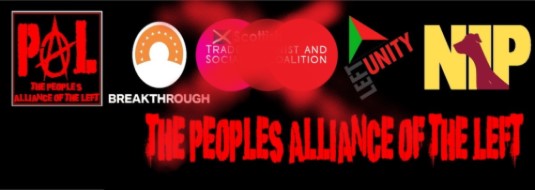
And here we are again in 2022, just three years after the dust had settled with another split. Except this time TUSC has elected to split from the People's Alliance of the Left, a new grouping that was set up in conjunction with the new, so-called pop-up parties that emerged from the debris of Corbynism (the Northern Independence Party and the Breakthrough Party), as well as what was left of Left Unity, the small non-Trotskyoid regroupment project that pre-dated the Labour left's resurgence. And why has this split taken place? Here's the statement from LU's Facebook page:
Statement on the Change of Relationship Between the People's Alliance of the Left (PAL) and the Trade Union and Socialist Coalition (TUSC).
In February 2022 the majority of member parties of PAL (all except TUSC) decided that they could have no formal association with George Galloway's Workers' Party.
This was because of a number of statements by Galloway and the WP on a wide range of social issues (including, but not limited to, women's rights, trans rights and immigration) which demonstrated politics that are irreconcilable with the policy of those parties or the founding principles of PAL. In addition Galloway and leading WP members had made public statements denigrating a Breakthrough member for being non-binary.
Despite this, and in full knowledge of this decision, the all-Britain TUSC Steering Committee has accepted the request by George Galloway's Workers' Party for formal observer status within TUSC and agreed to attempt to avoid electoral clashes where possible. This creates a formal association between TUSC and the WP which TUSC is aware the majority of the other parties within PAL have decided is incompatible with PAL membership.
As a consequence, the remaining PAL member parties regretfully consider that TUSC has, by its formal association with the WP, removed itself from membership of PAL at national level.
We recognise that TUSC is a coalition of different organisations and individual socialists and trade unionis who in their great majority do not share the politics of George Galloway and the WP, although they are prepared to critically collaborate with it as they (TUSC) consider it to be an organisation with origins in the labour and trade union movement. It will remain open to local PAL party members and supporters to cooperate with those socialists at a local level (provided they are not WP members). However, tere can no longer by any national alliance between PAL and TUSC for so long as it has a formal association with George Galloway's Workers' Party.
23 May 2022
This is fair enough. George Galloway is a British nationalist, one of Putin's useful idiots, and an occasional Tory voter. His so-called Workers' Party of Britain is dominated by the ultra-Stalinist Communist Party of Great Britain (Marxist-Leninist) who, when they're not carrying around their giant portrait of Uncle Joe at London May Day celebrations, spend time denying the mass murders of their hero (the Holodomor? Bad weather! The Great Purge? Model jurisprudence! The Katyn Massacre? The Nazis!) and crossing class lines to support reactionary outfits like the Brexit Party and the Canadian "freedom convoy" movement. Given their appalling politics, it shouldn't be surprising that they've swallowed the Tory/centrist line that the British working class are as backward and as socially conservative as them. The industrial (male) worker figures large in their political imaginary, and the everyday politics they push is a nationalist tinged version of post-war Labourism. It's worth noting the last minor party that had some success with such a stance was the British National Party.
The PAL parties are right to want nothing to do with Galloway and his acolytes. Their politics aren't just wrong - in words and deeds they're scabby. But that begs the question, why does the Socialist Party want an alliance with them? It's pure opportunism. The SP has form for ditching its principles to pal around with demagogues if it thinks a political profit can be turned, as per the Tommy Sheridan saga. Simply put, Galloway still has a real depth of support among British Muslims for his - admittedly principled - defence of their community and his consistent stand against the war in Iraq, Libya, and the ongoing occupation of Palestine. The Batley and Spen by-election was a rude reminder to an arrogant Labour machine that these voters won't automatically tick their box. Because of this standing, the SP has designated Galloway a significant personality with clout whose endorsement might see a few deposits saved, and a trickle of recruits come their way, if they can ride on his coattails in future election contests. In other words, the SP is doing what it once took great delight in criticising the SWP for doing when they formed Respect in alliance with Galloway in 2004. It's not principled, it won't get the SP anywhere, and if anything they're cosying up to the most frightful horrors nominally on the left is guaranteed their eternal new workers' party project won't come to fruition. At least not by their efforts, anyway.
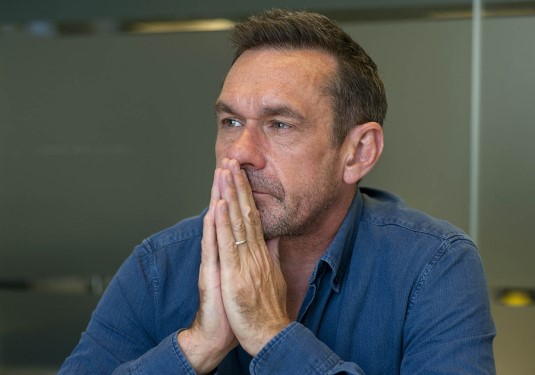
Excuse me, what? He continues,
"Once you can accept that ‘humanity is a social construct’ and that ‘history is a process without a subject’, you can look at the 1,500 dead civilians in Mariupol and categorise them as ‘neo-nazis’". Now there's a spicy take if there ever was one.
Having knocked around the left for a while, I haven't got a clue what he's writing about. Trotskyism and Trotskyists, still the dominant trend on the revolutionary left in this country, are hardly known for incorporating recent developments in philosophy and social theory into what passes for their Marxism. For these people even Gramsci is largely beyond the pale. Stalinism cares even less, locked in its own cycle of anti-imperialist/imperialist goodies and baddies. Where Foucault and Althusser have made a splash in activist circles are very much outside these traditions, with the former finding a welcome reception among anarchists. I'm not au fait with that scene, but as a rule anarchism doesn't go out of its way to excuse tyrants and rival states.
What's his beef? Responding to criticism, Paul says his attack on anti-humanism is elaborated in his Clear Bright Future. I haven't read his book, but on the basis of this and previous comments about postmodernism it appears his definition of anti-humanism differs from its usage in theoretical debates. To cut a long story short, anti-humanism does not mean anti-human. Paul's scary framing of 'history is a process without a subject' is nonsensical. All it means is the starting point for analysis, in Marxism for instance, is class and social relations. Take Marx's Capital as an example. Marx begins with the commodity, and from there considers exchange, capital, surplus value, the division of labour, and so on. We don't start off from human beings endowed by providence with certain attributes, but from how the system we collectively produce moves. This is the point Althusser elaborated in For Marx and Reading Capital, and is so obvious that it should be uncontroversial. Indeed, it is where the bulk of contemporary radical social theory and philosophy now rests, though it tends to badge itself post-humanist as a way of indicating how these debates have been settled and superseded.
What informs Paul's violent rejection of the term is his collapse of anti-humanism into anti-human, as if taking an accurate view of how social processes work erases the special, precious quality of what it is to be human. This is complete bunkum. Anti-humanist theory is rooted in socialist, feminist, anti-racist and queer challenges to how philosophy has condensed, prettified, and abstracted the experience of dominant elites and rendered them in theoretical terms. Their theory constructs a man out of abstract properties that happen to align with bourgeois values, outlooks, and ontology. They might have been radical and revolutionary in the 18th century, but by the late 19th century they obscured and distorted perceptions of the world. The human of anti-humanism is entirely different. It is a creature of history, not of philosophical schematics. Its conception of justice is derived from millennia of being on the receiving end of exploitation, its legitimacy derived from the theoretical working out of the excluded and othered. Its pain is real, concrete suffering. Anti-humanism is the eruption of the wretched of the earth into philosophy, what Althusser rightly stylised as the class struggle in theory. There is nothing more familiar, more human than the anti-human. We are many, they are few, and unsurprisingly they find our theory, our attempts to sketch out an understanding of the world both challenging and frightening.
Celebrated historian EP Thompson made exactly the same arguments against Althusser in his 1978 polemical essay, The Poverty of Theory, as Paul does today. According to Thompson, anti-humanism opened the door to totalitarian thinking, implying there are direct links between the deliberations of the Althusserian school and the Khmer Rouge's killing fields. Replying directly in the 1981 edition of Issues in Marxist Philosophy, Andrew Collier turned Thompson's absurdity on its head. The Cambodian genocide was directed at people who did not fit the Khmer Rouge's ideal of 'socialist man'. Hence the cities were emptied and the populace was forced into the fields to learn the virtues of hard work, of correcting, rebuilding and reshaping 'man' through the "improving" qualities of labour. If millions died, that's too bad. If this doesn't sound like a descendent of humanist ideas, I don't know what does. In Cambodia, there was nothing more anti-human than Pol Pot's image of the human. It's also an irony that Thompson's monumental The Making of the English Working Class is at cross purposes to the philosophical standpoint he ventured to defend. In its pages we find brought to life the daily lives and the struggles of our ancestors, and it's all the more believable and relatable because he treats them as historically constituted beings. Thompson was spontaneously, unconsciously anti-humanist and his work is all the better for it.
Fast forward to Ukraine today. The Stalinists and their fellow travellers hail Putin partly because Ukrainians don't live up to the standards of decent human beings. They're Nazis, they're anti-communist, they're corrupt, they want to jump into bed with NATO. The Putinist propaganda they regurgitate is determined to render the victims of state terror less than human, as acceptable victims, as a people who were asking for it. Their anti-humanitarianism ultimately rests on humanist claims. But at the same time, this is not the motivation behind the invasion but the logic used to justify it.
Professing one's commitment to philosophical humanism is no guarantee of rightness or, as we have seen, political rectitude. It distorts and weakens theory, and makes it less useful for understanding the world and thinking about what we need to do. I'll always have a lot of time for Paul Mason, but his embrace of what is a fundamental weakness means his politics are forever hobbled - until he engages with what anti-humanism actually is.
Image Credit
Smooth here is a relative term, especially compared to the shocking cataclysm that blew apart the former Soviet economy when Yeltsin called in the neoliberal "radicals". In this excellent chat with Isabella Weber, author of How China Escaped Shock Therapy, this episode of the ever-excellent Politics Theory Other the recent economic history of China is explored, and crucially how the party avoided the disaster that befell the USSR and its client regimes.
Please remember to check out the archive and help build new left media by supporting the show.
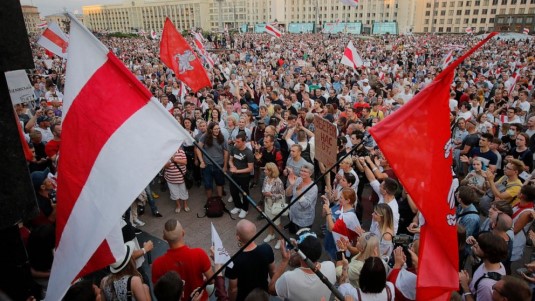
The uprising in Belarus stands on a knife's edge. Following huge demonstrations and strike action that has brought industry to a juddering halt, it's looking like the regime of Aleksandr Lukashenko is on its last legs. Popular consent has evaporated following his rigged election, and there has been some drift from the army and security services away from the state and toward the protest movement. Having got shouted down in mass meetings - he should be lucky that's all he's had to deal with - Lukashenko is looking to redouble repressive efforts, with riot police back on the streets rounding people up and administering beatings. By upping state intimidation and violence now, the president is hoping to ward people off from assembling this weekend in the sorts of numbers we saw last Sunday.
On Wednesday, the EU met and agreed to impose targeted sanctions on key regime figures, has resolved to put out a statement of solidarity with the protest while refusing to recognise the disputed election result, and offered its services as mediator between government and opposition to affect a peaceful transfer of power. The Coordination Council, set up by Svetlana Tikhanovskaya in Lithuania following her de facto expulsion after the rigged election leaves a lot to be desired, politically speaking. Initially calling for people to stop protesting, she has pleaded with the EU to back the movement and has agitated for fresh elections. For the EU, and especially the Baltic states and Poland, ever-weary of Russian revanchism, the removal of Lukashenko and his on again, off again love-in with Vladimir Putin for a dependably friendly government would be most welcome - hence its efforts at steering the opposition and, it hopes, the uprising in a pro-EU direction. For those interested in such things, the UK is following the EU line.
In these sorts of situations, sympathy, support, and solidarity goes to those risking life and limb. If Belarusian leftists are on the streets with the movement and fighting the dictatorship, the very least those of us sat comfortably in rich liberal democracies can do is listen to what they say and amplify their voices. Unfortunately, this is not the case among some who style themselves "anti-imperialist". Having seen what happened in Ukraine all those years ago, and Libya before that, in their imaginations the fundamentally open process of revolt has already been closed down. Because the EU are working to take advantage and bring any successor regime into its orbit, this is the inevitable consequence - if not the essential characteristic of the movement already. It leads to the absurd situation of a nationwide movement pigeon holed as reactionary whereas Lukashenko's disgusting gangster regime is more "progressive", and apparently socialist thanks to the still-sizeable presence of state industry. What can you say, some people are easily impressed.
I suppose it's unsurprising. Coming out of a period where revolts and mass movements were infrequent or easily derailed, and preceded by another stamped by the geopolitics of the cold war, so there are those who see mass mobilisations in countries not seen full in with Western governments as creatures of state-led subversion efforts. It's a fundamentally defeatist attitude assuming a priori the standpoint of proletarian passivity and multitudinous calm while according supernatural agency to our states, up to and including turning the repressed citizens of Europe's last dictatorship into their unwitting dupes. Often times these counsellors of despair and apologists for state terror mistake themselves for revolutionaries when, in fact, they're fundamentally conservative. If we're properly guided by a militant political science instead of tankie nostalgics, then no leftist would be in the position of defending a creature like Lukashenko from a popular revolt. And if you can do that there, think about the strange political contortions that might result here. Such as Britain's most prominent admirer of Stalin looking to cut deals with Nigel Farage and now, a scabby alliance with Scottish Tories.
Thankfully, such people are at the margins of the labour movement and the socialist left. They should stay there.
Image Credit
Seeing as Keir Starmer is gearing up for a confrontation with the left following Rebecca Long-Bailey's sacking and despite what's in the best interests of the Labour Party, debate in and outside of the party has started thinking aloud about a new one. This would be a complete waste of time, whether the objective is to replace Labour with a mass socialist party or something modest like a 'left UKIP', an organisation of limited electoral appeal but viable enough to keep Labour from straying too far from left wing policies. As a wise voice points out, "If you spent the TIG years laughing at how they were going to lose their seats because the name recognition lies with Labour and not individual MPs how do you square that with the desire to have left Labour MPs break away now?" Quite. Let's think this through.
Anyone serious about either projects must reckon with history. The old, official Communist Party failed miserably in elections, only getting three MPs elected under its name in its 70-year history and, at most, a couple of hundred councillors. It was able to build significant influence in several trade unions but this withered as trade unionism changed and went into decline. The Independent Labour Party, which disaffiliated from Labour in 1931, had three MPs elected in 1945 and gained another the following year in a by-election, but they were all swept away in 1950. Militant was later to have success in the 1980s with three MPs, but these were only elected because they were Labour candidates. The Scottish Socialist Party had six MSPs elected in 2003 off the back of the anti-war movement, but that was thanks to the list PR system used to elect half of Holyrood's members. In 2007 these gains evaporated. And lastly George Galloway was able to get himself elected in 2005 and in the 2012 Bradford by-election as Respect's sole MP. This is your lot - it's gone from bad to worse since.
A question of the electoral system? Well, yes. But not the whole story. When you look at the left alternatives and formations of the last 25 years, whatever potential they had were hobbled by infighting and sectarianism. The Socialist Labour Party was strangled at birth by Arthur Scargill's failure to, first, reach an accommodation with Militant Labour (as the Socialist Party then called itself) to break the mould of sectarian politics, and then a subsequent witch hunt against anyone not to his liking. The Socialist Alliance was destroyed by the little Lenin syndrome of each of its two main participants, as was the case with Respect and latterly, the Trade Unionist and Socialist Coalition. This was forbidden from developing any life of its own by its principal sponsor, the SP. Indeed, the two largest Trotskyist organisations on the British left have undergone profound crises of their own - the SWP has its grotesque culture of leader worship to blame, one which saw it embroiled in covering up rape and sexual assault. And the Socialist Party preferred implosion to an honest accounting of, to everyone else, its obvious fallibility. Left Unity, an attempt to cobble something together in the early years of the decade sans the SP and SWP failed thanks to the double whammy of unseriousness and playground trottery. Last of all, the Scottish Socialist Party ekes out an existence doing nothing in particular - Tommy Sheridan's bitter legacy continues to cast its shadow.
Because these failed doesn't mean new initiatives are predetermined to follow their path, right? The issue all these organisations share was a failure to build a mass base. The CPGB, SSP, and Respect were able to acquire some aspects of one but this did not reproduce itself as a stable constituency, nor were these organisations sufficiently rooted to the point where they could shape their base. Leadership matters, of course, but the propensity for sectarian and unaccountable petty elites to emerge grows the more insulated they are from wider struggles. Take the British far left as a case in point: the bulk of their activism is not around workplace struggles, campaigns or what not, but the reproduction of their organisations themselves through petitions and paper sales - which tends to reinforce their distance from the class they aspire to lead as opposed to merging with it. This makes building a sustainable base difficult because this work is always prioritised. If they want to begin breaking out of this ghetto, a fundamental rethink and reorientation of their politics is required - something the far left as a collective have avoided since the CPGB's foundation.
Then we have competitors. I don't believe Keir Starmer or his people understand the composition of Labour's base, its dynamics and movements, nor its trajectory. The Labour Together report doesn't change that, despite the diplomatic nice words said in its direction by the leader's office. As Keir pivots to the right and the base starts fraying, there's an opportunity to intersect with activists and voters left high and dry. Indeed, and the Greens and Liberal Democrats (if they have any sense) are well-placed to scoop them up. They have activists, a proven (modest) record of electoral success, and are superficially attuned to the concerns of a chunk of Labour's new core vote. The SNP shows what happens when Labour loses sight of where its base is. How can a new left party that doesn't even exist and enjoys zero name recognition offer credible answers and be considered a good punt for the extra-Labour curious? Look at the state of the latest new left party, George Galloway's Workers' Party. Consciously a "patriotic" party that attempts to combine Brexity nationalism with Putin apologetics, and an undisguised (and unironic) admiration for Joe Stalin and all his works, it makes you wonder who it could possibly appeal to - apart from aged tankies nostalgic for the time before. It's embarrassing, frankly.
Let's park these issues to one side and consider the strongest argument from history in favour of a new workers/new left party: first past the post has locked all small parties out of parliamentary representation, but this was the case when Labour was founded. And yet Labour came to replace the Liberals as an electorally viable party of government in spite of the high bar of entry. True, true. But how did this happen? It involved alliances of convenience with the Liberals in certain seats and, oh yes, the small matter of a rising labour movement locked out of mainstream political representation. In the 2020s the situation is completely different. Trade unions aren't barred from political entry - most of them are satisfied (at the moment) with Keir Starmer nor is there much grumbling among the now growing membership about him. And besides, the contemporary work force is highly individuated: true, we have a rising cohort of the new working class, but their institutional expression was found in Corbynism. With its dissolution, its attachment to Labour is much more conditional. Good news for a new party, then? Well, no. Because it is more diffuse and harder to organise, even with the coronavirus crisis set on polarising the UK's political economy further. Its less conscious and confident sections are more likely to lapse into despondency and abstention than get angry and organised. We saw it happen last December, and it can happen again. In short, the conditions for a new party for the replacement of Labour are simply not there.
How about a left UKIP instead, effectively an electoral pressure group for socialism? Assuming it manages to avoid all the pitfalls outlined above, how does it move from a standing start to something that makes for sweaty palms in the leader's office? It's difficult to see how. UKIP's success tapped into a consolidating (but declining cohort) of voters largely organised by the hard right press, and tapped into widespread cultural currents of racism, Empire nostalgia, and British exceptionalism. Every five years it also had a set of elections it could easily dominate as a repository of protest voting. Its threat pushed Dave and the Tories to promise the referendum and, well, here we are. What opportunities are available for a left alternative to make a nuisance of itself? Local council by-elections? Elections for the devolved governments in Scotland, Wales, Northern Ireland, and London? Favourable press coverage? Considering the extra-Labour left's record of strategic ineptitude when it's not busy fighting among itself, the chances of navigating choppier political waters and reaching the golden isle range from nil to Davey Jones's locker.
Last of all, what is a new party for? You can look at the existing Labour left and answer this question easily: pushing socialist policies, building an infrastructure for political education and empowerment, drawing more people into politics, holding Labour's leadership to account. Success isn't guaranteed and it's never a bed of roses, but it exists, has a mass influence, and tens of thousands of activists. It's a serious endeavour and one that could retake control of Labour's National Executive Committee this summer. Some might think it's a waste of time, the right have won the leadership so why bother, but being part of this movement doesn't preclude doing things outside the party. Nothing is stopping anyone giving up dull party meetings and getting stuck into workplace or community activism, for example, and many thousands are going to do just that. It is not the be-all and end-all. Compared to this, what might a new party have to offer? Judging by snippets of conversation here and the odd polemic there, those arguing for one desire a space of the like-minded where they aren't sabotaged by their own side and feel it would be a better use of their time. That's fair enough, but let's not kid ourselves here. This is a project for building a social club or, at best, a sect no different from everything that has gone before.
If people want to leave Labour, fine. It's up to them. It is nevertheless better if comrades stay, even if, for totally understandable reasons, they choose not to actively participate and concentrate their energies elsewhere. This is simply a basic fact of the political situation we find ourselves in, this is our reality. A new party at best is an irrelevance, and at worst a means for disorganising the left further.
Taking a break from weightier matters, it's time we turned to one of this blog's more niche interests: how will Britain's band of self-described revolutionaries and assorted extra-Labour left projects fare in the decade ahead? Before we look to the future, it's necessary to reflect on the past. And, well, what can you say. Perhaps nothing better demonstrates what has happened by comparing the spread of the far left's collective general election challenge from 2015 with the meagre numbers mustered in December. Never commanding reasonable votes (with the notable exception of People Before Profit in Belfast), the campaigning collapse has mirrored a political and organisational collapse across the far left. Labour's election of Jeremy Corbyn is some of the story, sure, but is not the last word on what has happened.
Writing at the turn of the last decade, I suggested the far left, and by this meaning principally the Socialist Party and Socialist Workers Party, were well placed to intervene in workplace struggles (particularly the SP, fresh from the role it played in a number of significant disputes back then) and wider campaigns. This was while the space to Labour's left was likely to contract, therefore putting question marks over the viability of electoral vehicles of convenience. However, what could not be foreseen was how the SWP's reputation, already pretty low among anyone who has spent more than five minutes around the labour movement, would be thoroughly trashed. Months into the new decade the SWP turfed out that section of the then leadership who had previously made the running with regards to Respect and Stop the War, who then went on to form Counterfire. Much more seriously, in early 2013 it emerged the SWP had tried dealing with a rape complaint against a central committee member. Surprise, surprise, the case against was heard by a cadre of his mates and long-term comrades and they let him off. If that wasn't bad enough, the crisis was compounded by no small amount of arse covering and, in one particularly despicable case, the harassment of a complainant by SWP members.
They suffered a drip drip of splits as the leadership regrouped around the defence of their handling of the fiasco and, needless to say, the SWP were very badly damaged the point of becoming pariahs. Working under much reduced circumstances, the SWP nevertheless reverted to type and tried to make themselves indispensable as an infrastructure for mobilising street politics. They achieved this best first as a front outfit against UKIP, and latterly as Stand Up to Racism, which still operates as a means of organising conferences and organising demonstrations. And, sadly, one Jeremy Corbyn was never put off.
While the SWP suffered its meltdown, in relative terms the SP flourished. Free from hints of scandal (though the same could not be said for some of its international affiliates), the usual rounds of campaigning, trade union activism, paper selling, and electoral outings via the Trade Unionist and Socialist Coalition saw it continue its recovery trajectory since the doldrums of the late 90s and early 00s. Nothing it did was overtly spectacular, not being as showy as the SWP. It trudged along the revolutionary treadmill, pausing to wheel out the ridiculous No2EU vehicle for the 2014 EU elections, before hunkering down for more plodding up until and beyond the 2015 general election. That's when things started going wrong.
For the best part of 25 years until that point, the SP's big shtick was that Labour was no longer a workers' party and therefore needed replacing. If you were of a leftish persuasion and all you knew of Labour was Tony Blair, it was a compelling position and seemed ever truer as his years in government wore on. This was the key reason why I joined the SP in 2006, and coming to the conclusion this was utterly wrong was why I left and joined Labour in early 2010. During Ed Miliband's tenure, the SP could just about keep up the pretence it was a straight party of capital thanks to the nonsense triangulation and fidelity to neoliberal nostrums. Then Jeremy Corbyn emerged and drew hundreds of thousands to the party. And what did the SP do? Rather than account for the complete collapse of their central shibboleth, they pretended Corbynism was the confirmation of their perspectives. What it represented was the creation of the new workers' party they had campaigned for all along that just so happened to be, um, coalescing in the Labour Party. This was stretching credulity too far for many loyal activists, and in dribs and drabs they drifted away and ended up in Labour. Meanwhile, the appeal of Jeremy Corbyn ensured the conveyor belt of freshers fairs didn't deliver new recruits in anything like the same number as previously. And as the SP stagnated, the fissures started opening up. The crisis first manifested in the PCS, previously the grandest constellation in the SP firmament, where fallings outs with Mark Serwotka and internal strife led to a split and the utter annihilation of their position in a union they once dominated. And then last year, rather than being held to account for a decade of getting it wrong the leadership basically expelled the entirety of its international organisation, the Committee for a Workers' International, as well as most of the SP's young activist base.
Therefore at the start of 2020, the two standard bearers of Trotskyist politics in Britain are respectively reviled, or in disarray. So bad things are it fell to the weirdest and most appalling micro groups to fly the banner in the election just gone. Things then do not look good for either the SP or SWP, the new outfit formed by ex-SP members, nor the rest. Could the 20s then be the decade that sees the far left go even more subterranean?
There are two ways the far left restore their collective strength to how they were 10 years ago. And they're both dependent on what happens in the Labour Party. Whether Rebecca Long-Bailey or Keir Starmer wins the overlong leadership contest, there is going to be some slippage. The cross over between left wing conspiracy theory and anti-Israel obsessive Twitter will be annoyed their chosen one, Ian Lavery, has wisely decided not to stand, and will now be looking for a home. Obviously if Starmer wins it is hard to believe he won't make moves against the left, try and restore the right's pre-eminence, and work to snuff out the movement to democratise the party. And under those circumstances the trickle of stans and sociopaths would open out into a flood of thousands of activists. And Labour's loss might be the far left's gain.
Except there is a new kid on the block all ready to receive. Noticed only by a few, from the ashes of another humiliating election defeat another organisation was born. Following his drubbing in West Bromwich East, Tom Watson's old seat, George Galloway announced the creation of the Workers Party of Britain. Modelled on the view the British working class is patriotic but economically radical, it is suffused with the strident anti-imperialism and pro-Putin politics of its best known figure. Also intriguingly, the new party is committed to "defend the achievements of the USSR, China, Cuba etc." Which comes as no surprise when you see Joti Brar's name attached to the project, and a proud link to everyone's favourite Stalinist sect, the prolier-than-thou Communist Party of Great Britain (Marxist-Leninist). Normally, no one would rate the chances of a party whose members carry huge portraits of Stalin on May Day demonstrations unironically, but these are strange times. It could prove to be a pole of attraction for those who find Labour's new leadership too metro, insufficiently critical of Tel Aviv and, of course, too beholden to social liberalism. However, given Galloway's reputation as a saluter of dictators and fondness for Russian foreign policy it's difficult to see how much of the "patriotic working class" this outfit can appeal to in electoral terms. As a pro-Brexit red UKIP by design, headway beyond a gullible few is unlikely.
Nevertheless, there are things we cannot see. Former Labourites looking for a new home is a cert, but the specifics of the struggles and upheavals coming down the road can only be guessed at. Opportunities there will be for the far left to rebuild. And so while there are few reasons for the left in general to be cheery, things are looking up for our revolutionary brethren. After all, they could hardly be worse.
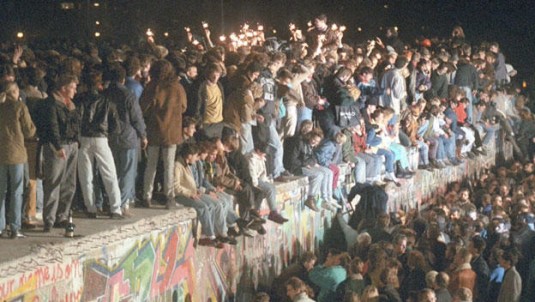
What an amazing contrast. The breaching of the Berlin Wall was greeted by ecstatic scenes right across the Western world. 10 years after and the party was still in full triumphal swing, being a decade into the end of history and a rapidly globalising world of dual sovereignty - capital was king, and markets our monarch. And then 10 years on, in 2009, the commemoration of the collapse of East Germany, or the German Democratic Republic to appease readers with a Stalinist fetish, was more downbeat thanks to the worst economic crisis since the 1929 Wall Street crash. And now, in 2019, events marking the 30th anniversary of the beginning of the end of the USSR and its client regimes are even more sombre. Speaking in Berlin, Angela Merkel chose the occasion to remind everyone that democracy is not a given, and that universal values are menaced from the extremes. In an obvious swipe against the racist right in power in Hungary and Poland, and advancing even in Germany, it was nevertheless fitting in given how the GDR was a totalitarianism born out of the ashes of its genocidal other, which in turn was the (by no means inevitable) consequence of the collapse of bourgeois democracy.
From gloating to shame-faced apologia, that is some distance travelled in a blink of the historical eye. For those who weren't around during the Cold War, it is difficult to convey how different the world felt. For some, the tyrannies stretching from the Elbe to the Bering Sea were misrecognised as zones of workers' control, where capitalism had been suppressed (true) and something better ruled in its wake (not true). It was a comfort and an alternative, and helped keep generations of leftists going when things weren't great. And this suited the captains of industry and their cadres of paid ideologists quite nicely. To most people, including those in the labour movement, the likes of East Germany were a model alright, a model to avoid. For every Communist Party activist the Soviet bloc kept going, dozens, scores, hundreds found the idea of socialism repugnant. If socialism is nationalised industry plus a knock on the door at midnight, we'll stick with capitalism ta.
Yet while, perversely, so-called really existing socialism was a buttress for post-war Keynesian capitalism, the very existence of an alternative system in the East had put our own ruling classes on notice. The Russian Revolution was and remains the largest blow against capital to date, and though the revolution succumbed to isolation, bureaucratisation, and became one of history's most grotesque dictatorships, hard won victory over Nazi Germany and support for communists elsewhere saw Stalinism advance across the world after the war. And where it won, capital was largely uprooted, markets suppressed and and effectively closed to Western capital, with one or two exceptions. In other words, the existence of these regimes struck at the root of and challenged bourgeois property relations and with it the very basis of capitalism itself. For as long as global capitalism faced off against global Stalinism, bourgeois dreams were frequently interrupted by communist nightmares.
And so with the fall of the Berlin Wall, the rapid collapse of the Warsaw Pact signatories and finally the dissolution of the Soviet Union itself two years later, you can understand why Fukuyama's end of history thesis got such traction. Capitalism had been trembling at the very thought of the communist phantom since the 1840s, and all it took were gaudy consumerist baubles and the freedom to speak your mind to exorcise it - permanently. And so when we talk about the triumph of neoliberalism, its spread as the new common sense was greatly aided by the expiration of its collectivist nemesis. The various permutations of ruling class ideologies were "proven" by history, and everything associated with the fallen Soviets and socialism more generally didn't so much fade away as practically drop out of public consciousness altogether. And at the point Tony Blair assumed Labour's leadership, it was almost as if socialism had been uninvented, so thorough was its purge from mainstream politics. Consciousness was thrown back and its only now, with the rise of Corbynism here in the UK are we groping back toward a new class conscious politics.
This was characterised, as my erstwhile comrades at the Weekly Worker used to put it, as a period of reaction of a special type. i.e. One in which labour movements and their parties had not been physically liquidated but ideologically defeated. The decline of old-style industrial working class consciousness pre-dated the Thatcher/Reagan era, as well as the end of the USSR, but were greatly accelerated by both. No Soviets meant no alternative to free market capitalism. Worse, while the USSR and its clients discredited socialism in life they carried on doing so in death. With the brutalist politics to match the brutalist architecture, the Soviet Union committed the cardinal sin of any putative alternative - it failed spectacularly. Nevertheless, that period has come to an end. Political polarisation is a fact of life as the old fault lines push to the surface and burst open all over the world. Even if Labour loses the socialist genie's not going back into the bottle, and any incoming Tory government will have its hands full placating growing disaffection - especially from those at the sharp end of their policies.
As Angela Merkel made her remarks at the designated graveside of East Germany, she did so as her system is imperilled by stuttering growth rates, a long-term swing against the power of capital, the law of value, and the nature of property, an inability to provide a decent, rounded standard of living for millions in the advanced countries, and its systemic culpability for climate crisis. Socialism is back, and communism is more than just sassy memes on the internet. Looking back on the disbanding of the Stasi, the dismantling of the wall, and the disintegration of a superpower bloc from the vantage of 30 years, their passing into the pages of history is starting to look more like a clearing of the air. And this, comrades, means our politics can soar to undreamed of heights without the burden of tyranny weighing us down.
Image Credit
It's worthwhile thinking about the concepts that emerge from the analysis of politics, particularly when it is fraught and strained as per, well, now. And, after all, if commentators are doing their job properly they should be thinking about how to describe and explain what's going on. First up is weak Bonapartism, which is something used here loads of times to describe the situation in the Tory party and the position of Theresa May. It describes how her weakness vis the rest of the party paradoxically gives her room for manoeuvre and strength.
Bonapartism as a concept has a lengthy history among the grey beards. Coined by Marx himself in the articles collected in The Class Struggles in France, Bonapartism refers to the politics in France between the failed revolution of 1848 and 1850, when universal suffrage was abolished. This culminated in 1852 with the founding of the ill-fated Second Empire. Without getting bogged down into the historical detail, Louis Bonaparte (later Napoleon III), the nephew of the original Napoleon, was elected President in 1848. Having been shook by a failed plebeian revolt and thanks to fractiousness between the remnants of the aristocracy and different sections of the rising bourgeoisie, Marx argued the struggle of classes and class fractions had balanced out. The popular masses were no longer willing to be ruled in the old way, but were not capable of exercising power themselves, and likewise the ruling class were disorganised. Into the vacuum the state stepped and assumed political independence from landed interests and industrial capital. It became less a committee for managing the common affairs of the bourgeoisie, as per The Manifesto, and more an organised power for stamping the authority of a single man. The state was strong, the contending classes were weak, and so state authority prevailed. Nevertheless, as Trotsky later observed it was still a bourgeois state because it preserved prevailing class relations and, later on, used government to drive economic development and participate in the European scramble for global markets and colonies.
There have been various adaptations of Marx's concept since. Most controversially in Marxist circles, Trotsky used it in his analysis of Stalinism. In a series of articles written in the 1930s, and most famously in his semi-holy screed (for some), The Revolution Betrayed, he argued what the Soviet Union had become following the October Revolution and its subsequent international isolation an example of 'proletarian Bonapartism'. Again, sparing the details, Trotsky argued that following the revolution and civil war the Russian working class were devastated, the country lay in ruins, and the party had effectively fused with the state as the only organised power in the land. Because the workers and peasants were ruined so were the chances of socialist democracy. And so the organs of direct democracy withered, followed by internal democratic norms in the party itself and the bureaucracy assumed power. However, because capitalism wasn't restored and, indeed, the power of the apparatus flowed from its command over a post-capitalist economy, this dictatorship over the proletariat nevertheless protected the nationalised property bequeathed by the revolution. Hence Stalin's Bonapartism was progressive and marked a gain over what existed previously.
Trotsky also employed Bonapartism in his analysis of fascism in Germany as overlapping categories. Here, fascism started as a mass movement of petit bourgeois reaction against a rising workers' movement, which propelled it to power. Once there, the Nazis turned the organs of the state against their political enemies without and, eventually, within their own movement. And once it was tamed/absorbed into the state it more or less settled into something akin to Bonapartism. Whether he'd have changed this assessment had he lived beyond the early years of the Second World War is a matter of speculation.
In the post-war period there were a number of permutations of Bonapartism. The expansion of Stalinism to Eastern Europe and South East Asia proved/disproved Trotsky's concept, depending on your view of the Soviet Union. For some Trotskyists, the coming to power of De Gaulle in 1958 and the founding of the Fifth Republic was a moment pregnant with Bonapartist dangers. With decolonisation often the only organised body in newly independent states was the military, and often found themselves in situations analogous to, but not as fortuitous as that of Napoleon III, and more recently the army played a Bonapartist role in Egypt's Arab Spring.
Bonapartism then has a pedigree of unpicking the relationship between classes and the state in rapidly moving historic movements and processes. What use could it have for understanding the predicament of Theresa May?
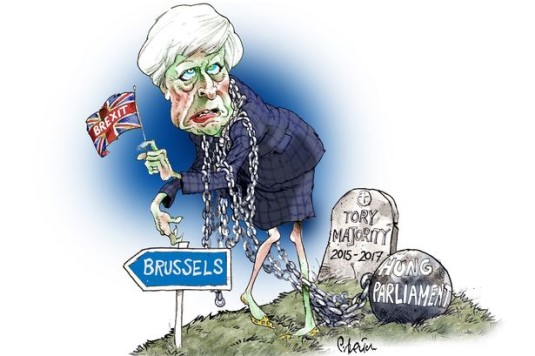
In what you might call the long June since May lost her majority at the 2017 general election, the Tory party has been in a state of stable instability, or permanent disarray. The membership are drifting away or dying, and at the top of the party May's shattered authority is beset by rival factions and ambitious individuals. I guess we've become habituated to it, but we should remember that the spectacle of cabinet members thinking aloud about Brexit is unprecedented and a symptom of May's weakness. Yet thanks to the disunity of the Tories, the awful mess May has on her plate, and leadership contenders balancing one another out, paradoxically the Prime Minister is safe from challenge. After all, if you were an ambitious MP and fancied a bite at Number 10, would you make your move now when Brexit is up in the air and there is still the drawn out process of a trade deal to come? Likewise, would you want it while the party is in the midst of tumult and you're unable to exercise your authority over it? No, and so May abides.
This is where the perverse character of weak Bonapartism is brought out. The central authority is weak, but none of May's would-be rivals have the strength to see her off and replace her. This gives May considerable strength and autonomy, something she only really cottoned on to over the summer. When the details of her Chequers Deal was made public, the likes of David Davis and Boris Johnson could have made a move. But they didn't, preferring to resign and grandstand from the back benches. May also realised that there was no need to appease the hard Brexiteers either, and that if they were able to force a no confidence vote in her leadership she would see them off - a calculation that proved correct. However, weak Bonapartism is an anomalous situation and one that, for May, can't less forever. Should her deal fall at next week's vote, what then? Will she soldier on, knowing no one's about to usurp her (indeed, under party rules this cannot happen until next December), apply for an Article 50 extension, which is the talk coming out of Brussels today, or throw in the towel - assuming she survives Labour's no-confidence vote?
And of weak Bonapartism itself, if May goes in short order her successor will be prey to the same pressures. But weak Bonapartism is so out of the ordinary that I can't think of any other examples or situations where it applies. Any suggestions?
History does a fine line in irony. When Francis Fukuyama suggested in his famous 1989 article, followed by The End of History and the Last Man in 1992 that history is coming to an end, it was destined to be a foolish boast, a proper hostage to fortune. And viewed from the perspective of the close of 2018 it sounds faintly absurd, a historical curio, one for the professional historians of ideas and connoisseurs of concepts that never went anywhere. Even Fukuyama himself has intimated this is the case. Yet the end of history was, for a time, very relevant. Even on the left.
Fukuyama's basic thesis wasn't that history as such had stopped. There were still people and events, dear boy, events, but that certain big political questions had been settled. The collapse of the Soviet Union and its client regimes in Eastern Europe coupled with the spread of free market capitalism and the wave of (liberal) democratisation suggested that the most optimal, most agreeable social and political forms - how we should organise our societies - had been achieved. Liberal democracy had seen off its fascist rivals in the 1940s, and come the late 80s the spectre of communism was unmasked as a feeble, broken system that could barely meet the basic needs of its citizens. History understood as competing visions of the good society was dead. As it was put on the sleeve of Fukuyama's book:
The end of history will be a very sad time. The struggle for recognition, the willingness to risk one's life for a purely abstract goal, the worldwide ideological struggle that called forth daring, courage, imagination, and idealism will be replaced by economic calculation, the endless solving of technical problems, environmental concerns, and the satisfaction of sophisticated consumer demands. In the post historical period there will be neither art nor philosophy, just the perpetual caretaking of human history.
Of course, even back then there was a certain audacity to Fukuyama's claim. If one was wedded to a particular teleological reading of Marx, i.e. history was unfolding according to a certain logic with an end point down the line, it was supposed to be communism understood as a super-advanced society of free producers that marked not the ending of history, but rather the cessation of our species pre-history. Only when a society is fully conscious of itself and in which the free development of each is the condition of the free development of all, a social arrangement permissive of individuality, creativity and new ways of being human can flourish without the bite of hierarchy, class and oppression can we say history has truly begun. Fukuyama's argument airily dismissed that and in rolled his tanks on communism's lawn not long after Chinese Stalinism let theirs loose on Tiananmen Square.
Fukuyama's was more than just simple assertion, there was some hokey philosophy underpinning his scheme. Namely that human history is a struggle for recognition as a human being, and by way of Hegel with a dashing of Nietzsche the liberal state is the end point, ideologically speaking, for this struggle for the humanity of humanity. Citizenship, the separation of powers, the law, private property, all give us a stake in society and enabled us to recognise ourselves in others. In the richest societies the middle class is the standard to aspire to. However, all is not well after history. Big risks for the "last men" of this period comes from ennui - if everything is sorted, what is to stop boredom from setting in and subsequent problems arising from thrill-seeking behaviours? Politics and market economics can capture this, but then there are the twin dangers of social stasis, and new social conflicts arising from bordeom, new oppressions, and begin the whole cycle of struggling for recognition back to the beginning.
One needn't subscribe to the liberal Hegelianism of Fukuyama's piece to accept his basic argument was on the money. A number of leftists agreed that the game was up and capitalism with liberal democratic characteristics was the only show in town. Of course, it was less the force of Fukuyama's rhetoric and more the collapse of the Soviet bloc, the repeat defeats of the workers' movements in the West, and the explosion of consumerism and attendant cultural fragmentation that read the rites. New Labour was one result of this end-ism, but it persisted well into recent times. In the context of UK politics, those who would be heirs to Blair have politics bounded by liberalism and capitalism. Even under Ed Miliband his pale version of social democracy was couched entirely in a 'variety of capitalisms' argument, and in crucial respects remained as committed to "economic calculation ... and the satisfaction of sophisticated consumer demands" as his immediate forebears.
I read The End of History and the Last Man when I was an undergraduate. It was the Autumn before New Labour won its famous election victory and remember thinking, like many others, this really was the end and the best we could hope for were telegenic grins and stealing policies from the Tories. Though even then I understood enough about Marx and how class struggle works that nothing is forever, and what seems permanent at one moment reveals itself as transient in the fullness of time. In his New Statesman interview Fukuyama concedes that some inroads into private property is not only probable but desirable, but while discounting a return of communism (at least as he knew it) he does accept that Marx was right about capitalist crisis and its tendency to periodically slip into them. To give him some credit, he has noted the world has changed and has altered his views accordingly - which is more than can be said about some.
The truth of the matter is history is back. Authoritarian politics is on the rise around the world, liberalism is disarmed and in a state of collapse, Third Way politics is dead, and mainstream conservative parties are in trouble. But there is more at work than gloom and dystopia. Corbynism here. Bernie-ism over there. The rise of Melenchon in France, the example of Podemos in Spain, these are beginnings pointing to a rising international of new class forces. History then is offering a choice between reaction and hope, what is - with added brutality and nightmarish accoutrements - or what could be. The period Fukuyama described and hailed is gone, and it's not coming back. What comes next depends on the side you pick.
Can the worst of enemies become the best of friends? We might find out, given the news Kim Jong-un and Donald Trump are set to have a face-to-face meeting. "I may leave fast or we may sit down and make the greatest deal for the world", declares Trump. Yet, bizarrely, reading past the tragicomic threats routinely made by the North Korean monarchy and the incomprehension establishment commentators approach the Kimist regime and the chaoscracy headed by Trump, the chances of a deal might be good.
On Kim's side, as argued here repeatedly, North Korea is not "mad". Kim is caricatured as some kind of Bond villain with the sinister global designs and weapons to match, but these lazy takes cover for the failure to analyse the North Korean regime, make sense of its internal dynamics, tendencies and power struggles, as well as the preoccupations of its leaders, its position in the international system, and the drivers of the regime's militarism. It is eminently knowable and can be understood in such terms. There are two main concerns Kim has: the keeping of power and its preservation in the long-term. These objectives were shared by pops and grandpapa, and is the main filter through which the regime's actions should be perceived.
Take the nuclear programme and missile programme. An attempt to conquer the world? Or the means of deterring an attack from a cabal of the most advanced and powerful nations in possession of a record of attacking and invading countries without access to such weaponry? For decades, the North has maintained their own cold war frontier against bigger and more sophisticated militaries not by mutually assured destruction, but making certain any war would be prohibitively expensive. Whether it's artillery pieces pointing at Seoul and threatening to obliterate it before American and South Korean air power can take them out, to the extensively booby-trapped border, to over a million personnel on active service at any given time, to nuclear weapons and the means of delivering them, a war would be catastrophic with a huge price due the victors payable in blood. Since Soviet aid was withdrawn in the 1970s, being forced to rely on itself to maintain the stand off has led to a lop sided development of the economy and a huge diversion of resources into unproductive assets. Infrastructure and consumption has suffered - to the point of not irregular food shortages and famine - and only intense repression maintained by an overblown police state has kept a lid on tensions. Yet Kim isn't stupid. China provides a model of a dynamic state-led capitalism, massive growth figures and breakneck development alongside the retention of the party and, now Xi has got his way, one-man leadership for life. This is what the regime aspires to, and going down this road means freeing up scarce resources currently pouring into the army. Nukes and rockets, while initially expensive, over the long-term render obsolete the need for a huge military. Just as Deng Xiaoping struck deals with the People's Liberation Army that allowed them to become a privileged economic actor, so Kim the younger has tried taking a similar approach.
Following this, the overriding objective of North Korean foreign policy is neutralising the militarised frontier. Not that Kim wants to relive the early days of the Korean war, but because taking them out of the equation removes the requirement for the weapons' programme. Therefore it is seeking an accommodation with the US and would like to draw it into a non-aggression treaty. In this it is entirely unremarkable. Much of Trotsky's output in the 1930s was his persistent criticisms of the Soviet Union and its willingness to sell workers' struggles down the river on condition Stalin's regime be left alone with its special shops for the favoured and the gulags for the unpeople. As the broken machinery of state planning in North Korea can't keep the regime afloat indefinitely, especially as new sanctions start biting, including China's capping of petrol exports, it's clear something has to give before the hairline cracks in the regime's foundations become something more serious.
How about Trump, what does he and the US gain from brushing aside the Bush and Obama-era approach and coming to a deal with Kim? There is personal vanity, of course. Defusing the tensions on the Korean peninsula would be a masterstroke of diplomacy and assure Trump goes into the history books as something other than a joke. It wrong foots the Washington foreign policy establishment and enhances his credibility over whatever Beltway insider the Democrats decide to run against him in 2020. Also, because a deal is possible. Trump may be profoundly unintelligent and ignorant, but he knows deal making. He has the sort of low cunning to be able to read the position of opponents vis a vis his and act accordingly. What he sees in Kim is someone not too dissimilar to himself, but is playing a poor hand well. And he knows how desperate they are to come to some kind of arrangement - the threats the regime is famed for compute as cries for help to Trump, but he's savvy enough to realise they're playing the same sort of unconventional game that brought him to the White House. Additionally, the issue just isn't that intractable. As complexity goes it's nothing like Syria, Israel and Palestine, or Northern Ireland before the Good Friday Agreement. A little bit of give, perhaps the phased removal of troops and easing up of sanctions, costs America very little assuming the North reciprocates and they agree to means for each side to monitor the other. Second, there is a real will in the South for better relations. The President, Moon Jae-in, is a popular centre left leader associated with a new "sunshine policy" with regard to the North, and one of his objectives is a formal peace treaty that brings the official state of war to an end. He has certainly drawn criticisms from the right but, as elsewhere, the Democratic Party's key voters tend to be younger and are less amenable to the anti-Kim buttons frequently pushed by conservative opponents. Conservative voters are never going to vote for him regardless, and as his right wing predecessor got sent down for 30 years and another former president is in the dock on serious corruption charges, Moon can afford to sideline the right as so much bleating. Therefore Trump has a willing partner with connections and a good relationship with the regime.
Lastly, there are realpolitik aspects to consider. Detente with the North opens a possible front against China. Relations between China and North Korea grew more strained over the course of 2017, even to the point of the regime declaring Russia its BFF. Cooperating with UN sanctions helps China's reputation as a responsible actor on the international stage, but ultimately they are a weapon to try and bring the North to heel. Beijing prefers having the North as a buffer against the US-dominated South, and is trying to use economic pressure to render them a quiescent if occasionally noisy client. For Trump a US-North Korea deal weakens Kim's dependence on its big neighbour, and could drive a wedge between them in much the same way Nixon used clever diplomacy to widen the rift following the Sino-Soviet split. With a firm if unstable ally suddenly became less reliable, then China might not prove to be as assertive elsewhere - such as prosecuting its claims in the South China Sea. It also gives Washington a lever for inflicting economic damage in the event of Trump's trailed trade war. North Korea might not amount to much with regard to the Chinese economy as a whole, but shrinking trade with them will impact negatively on a region not quite as dynamic as other parts of the country.
Whatever the case and whatever the motives, the prospect of a permanent settlement is suddenly possible. One that serves the interests of an appalling regime, the designs of the world's biggest superpower, and the vanity of the White House's most awful occupant certainly. But there is also a chance of burying permanently the prospect of an ugly, mass casualty conflict with worrying geopolitical implications. An imperial peace is still a peace, and can only open a new period with new tensions and contradictions, not to mention new opportunities for political change.
These days I don't often thank remnants of soi disant centrism in the Labour Party, but credit where credit is due. Were it not for Adrian McMenamin's rubbish column on fully automated luxury communism for Progress magazine, I wouldn't be writing this. The specifics of his piece need not detain us - as polemics go it misfired so spectacularly it's a wonder his keyboard didn't have his hand off. Nevertheless, this phrase, 'fully automated luxury communism', has knocked around for a few years now and deserves a few notes by way of elaboration.
You know it, but I'm going to say it anyway. Communism has an image problem. For decades associated with the mind-numbing bureaucracy and grey tyranny of sundry Stalinist regimes, if communism is going to be reclaimed in the spirit of Marx and Engels then we must do more than talk about the "true meaning" of communism. It's not about repackaging it, but restating what communism always was even when Uncle Joe imprisoned millions: a possible, but nevertheless tangible future immanent in and inseparable from the development of capitalism. Let's take FALC's two propositions in turn.
Fully Automated does what it says on the tin. Despite the fancy propaganda posters trumpeting Soviet achievements, the reality of Stalinist dismalism saw the squandering of resources and environmental despoliation that rivalled capitalism for its inefficiencies. The advances the USSR made in ballistic technology and space travel were certainly impressive, and the latter should be celebrated alongside other key technological milestones. But this was only possible because the state's bureaucratic plan was able to concentrate resources. Following the war, reconstruction was able to improve living standards up to a point, but from the 70s economic stagnation set in. The leading edge of Soviet technology was a simulacra of dynamism, a stand-in for deep seated sclerosis in virtually every other area save the military. Yes, fantastic that you can assemble a fully functioning space station for long-term stays in low Earth orbit, not so great that shoddy housing and shortages were the everyday grind for Eastern bloc citizens.
There is another legacy to be overcome here: the anti-technological bent of a chunk of the left. To one extent this was an absorbing of the Green critique of modern civilisation (note, not capitalist civilisation) and to a lesser extent the postmodern anti-science polemic that located technocratic and bureaucratic modes of power in the original sin of Enlightenment mastery over nature. What this meant in practice was the wholesale importation of neo-Malthusian ways of thinking, of identifying the human race and consumption per se as the vector of environmental destruction and climate change over and above the specific character of socio-economic relationships. It's all about commodification and markets, baby. The left wasn't immune to this, and its adoption by large sections of the left was the radical fringe of a complex mess of irrationalism working its way through popular culture. This broad trend has a wide and deep purchase across all the advanced countries and is symptomatic of alienated sensibilities, of a structure of feeling in which the world has run away from us leaving millions at turns fatalistic and pessimistic, with faith being invested in lotteries and quackery over and above our ability to do something about it.
Fully automated then is about taking back control, to coin a phrase. Or, to be more specific, taking conscious charge of the enormous promise of technology, to reassert the fundamental optimism of leftist politics and rethink technology in terms of how socially useful it can and should be. And what greater use is there, when all is said and done, than enhancing the powers of our species and freeing us from drudgery, and laying the basis of a pleasurable and luxurious life? From each according to their ability to each according to their needs, and the free development of each as the condition for the free development of all. These old phrases of Marx are well within realisation. Technology, if put to socially productive uses, can achieve the rapid decarbonisation of economic activity, switch from harmful and unsustainable power sources to renewables, build and rebuild a sustainable infrastructure to bring up the global standard of living, and diffuse technical know how and the very latest in replication technologies. Luxury doesn't mean indolence, though that should be available for those who want it, instead it means an abundance of choices and working toward a world where drudge is reduced to a bear minimum. Who, after all, doesn't want a better life?
And this is inseparable from the c-word. Communism didn't even get a schematic in Marx's writings, and he rightly argued that it's not the job for revolutionaries to create fantastical schemes and try and force the flow of history into its restrictive channels. That is the path to a new tyranny, which brings back all the old crap - as Marx so floridly put it. All Marx observed about communism is that it is only possible on the foundations capitalist development has laid for it. The technical basis for a society without classes is present, and has been since the Manifesto was published 170 years ago. Not only that, a prefiguring, a becoming of the communist future is present in two increasingly important aspects. Despite free market fundamentalism and increasingly threadbare arguments against collectivism, advanced capitalism in all its dynamism and decrepitude is not possible without planning. The giant multinational companies dominating the global economy marshal resources and plan production across oceans and continents, often paying lip service to competition while using their size to swallow up or squeeze out would-be competitors. And/or one titan can come to an accommodation with another and cartelise whole areas of the economy. It's no accident true competition is celebrated so much by capital's ideologists when it is the exception rather than the rule. Underpinning this all is the agency of the state which guarantees class rule, private property, and routinely arranges and plans economic activity. The second strand is the force of production itself: the working class, the proletariat, the multitude. For Marx it was the gravedigger of capital, the subaltern class that made possible the accumulation of capital (and the private acquisition of riches) thanks to their exploitation by their employers. Their labour power is purchased, but ultimately they are not. To use the language of orthodox economics, labour is an input, but unlike other inputs it is thinking, feeling, living. Thanks to experience, it can become aware that its interests and those of their employers are at odds and, crucially, without their cooperation the whole show cannot go on. With the recent mutation in capitalism with a strategic shift toward immaterial labour, that dependence is even more stark and the balance in the long-term is shifting decisively in labour's direction. How long before capitalism is viewed as an unnecessary excrescence?
Communism then is a becoming. It is not only an alternative form of advanced industrial society latent and immanent within capitalism, its partial materialisation in the present makes capitalism possible. Fully automated and luxury are key identifiers of 21st century communism from its forebears, but they are not mere bolts ons. They are fundamental to the kind of society we should be striving to build.
Karl Marx enjoyed historical ironies, but I doubt he'd have been cheered by this one. The greatest event in human history is simultaneously its most tragic event, a people who reached for the heavens laid low by the harsh, hellish realities of war, starvation, repression and dictatorship. The Russian Revolution, Red October, has met its centennial. An occasion to celebrate or commemorate depends very much on your political persuasion, but what it is, what the whole Soviet experience should be is something too many on the left have resisted: an occasion for learning.
If the 1871 Paris Commune was the first breach in the international order of capital, the October Revolution posed it an existential threat. Not only did it expropriate the aristocracy and emergent bourgeoisie, it lit the touch paper of a revolutionary blaze that fanned outwards into Europe, into the colonies, into India and China and won it a global army of adherents. After the collapse of Imperial Germany the continent came close, very close, to turning red. Alas the revolutionary wave ebbed and socialism's outrider became its sole bastion. Nevertheless the establishments of Europe knew what the revolution represented. It was a warning, an unwelcome intrusion of the masses into history bearing one simple message: that capitalism was on notice. The propaganda aimed against the Soviet Republic, the soldiers and material the colonial powers shipped to Russia to strangle the experiment in its cradle, this was done not to restore democracy or prevent dictatorship. Its simple aim was to drown the revolution in blood. The Russian civil war that raged from 1918-1921 consumed the lives of 10 million people, but even that couldn't break it. Nevertheless the utter devastation - think 1990s Afghanistan on a much larger canvas - saw to its pacification in terms of the international game. Socialism in one country, Stalin's original sin as far as the Trotskyists were concerned, was a break with received Marxist understandings of the global character of revolution, but also a doctrinal adaptation to material circumstances and the rebadging of the old Tsarist bureaucracy as so many people's commissariats.
And here lies the first problem with coming to grips with the revolution. Marxist understandings of the revolution performed in its name are too often bogged down by factional debates and their attendant mythologies. For the Social Democrats it was a case of instant dismissal. They preached against the violence of putschism, fetishised constitutionalism and attacked the Bolsheviks for not respecting the political gradualism they were wedded to. Yet this condemnation was strangely absent when it was a matter of turning guns on colonised peoples or the revolutionary masses of Europe, as was the case in Germany after the Great War. The anarchists were simultaneously hostile for the revolution not being revolutionary enough and located Soviet authoritarianism in a red thread stretching back to Marx's expulsion of Bakunin from the First International for ... wanting to place the organisation under the control of a secret conspiratorial outfit with him as the head. Hmmm. For the Trotskyists everything was fine and dandy until the 1921 party congress banned factions and it was the slippery slope after then, and for your Stalinists (depending on the flavour) things were a-okay until Khrushchev's secret speech in 1956, or right up until the Berlin Wall fell.
Of course, this account leaves out much detail, but the point remains. There is little consensus about what the lessons of the Russian Revolution are, and therefore conclusions, be they scholarly or political, are footballs to be kicked about in the ebb and flow of interests. For much of the Cold War period, despite the prevalence of us-vs-themism, there were contesting interpretations. After the end and the temporary triumph of neoliberal capitalism and governance, the USSR and the revolution that spawned it were an aberration, something to be reviled if it was ever to be talked about at all. As politics opens up again and socialism and communism are once more at large, ambiguity is more the order of the day - of which this post is one of many left wing examples.
The crucial problem, the issue returned to time and again is the erroneous suggestion the Bolsheviks started out as a dictatorial outfit. After all, it's there in Lenin's What is to be Done?, an otherwise obscure pamphlet of boring polemics old Lenners aimed at his rivals and fellow exiles in the Russian Social Democratic Labour Party. Indeed, Trotsky earned his spurs if not his notoriety in these self-same circles for attacking Lenin's "authoritarianism". He was more right than he could have ever supposed when he argued "... these methods lead, as we shall see below, to the Party organisation “substituting” itself for the Party, the Central Committee substituting itself for the Party organisation, and finally the dictator substituting himself for the Central Committee". And yet contrary to the standard interpretation of Lenin and the bureaucratic sects and cults who farcically claim to be repositories of the Bolshevik tradition, "these methods" were not Lenin's argument at all. As the sterling scholarship of Lars T Lih on the life and works of Lenin show, the model he favoured and worked to base the revolutionary party on was actually German Social Democracy, albeit adapted to conditions of Russian illegality. That was a tradition of relating democratically to workers and peasants, it meant a disciplined approach to political activity married to a noisy and dynamic culture of criticism and open debate. The RSDLP, which incubated the Bolshevik and Menshevik factions was never a monolith, and following the final split between the two and the transformation of both into parties, they inherited the characteristics of its defunct parent. The party that led the insurrection was also a party with a democratic culture and with open factions who published their own material. It was formally and substantively more democratic than the Labour Party. There was clearly a qualitative break between the Bolshevik Party of Lenin prior to the revolution and the mockery of workers' power it later became.
How did we arrive at the gulag from this? For Trotskyist accounts of the revolution, the young Soviet Republic was hampered by its narrow social base. Only small numbers clustered in the urban areas and attending the (then) limited transport network could be considered proletarian - the rest were the peasantry. In short, the revolution had to rely on winning over a much more numerous class whose immediate interests were in tension with socialist aims. Complicating this was the revolution coming under siege by internal reaction and the armies of the Allied Powers, who poured in once Germany and Austro-Hungary were put in their boxes. As the civil war persisted the Soviets, the constitutional bedrock of the new order, got sidelined and, to make matters worse, the most conscious and dedicated revolutionaries were killed in the slaughter or absorbed by the bureaucracy in directional roles. This, goes the story, provided the material base for the strangling of the revolution by the apparatus and the subsequent rise of Stalin as its champion and overlord. The Trotskyist account is right as far as it goes, but as anarchist criticisms make clear, the disruption and destruction of democratic functioning was a pronounced tendency from the very start. In her memoirs Alexandra Kollontai recalls weeping as she called in the heavies to disperse protesters at her commissariat, and this was before the civil war got properly underway.
Bolshevist authoritarianism came not from the party but the process of revolution itself. As Engels himself noted in a polemic with "anti-authoritarian" socialists,
... the anti-authoritarians demand that the political state be abolished at one stroke, even before the social conditions that gave birth to it have been destroyed. They demand that the first act of the social revolution shall be the abolition of authority. Have these gentlemen ever seen a revolution? A revolution is certainly the most authoritarian thing there is; it is the act whereby one part of the population imposes its will upon the other part by means of rifles, bayonets and cannon — authoritarian means, if such there be at all; and if the victorious party does not want to have fought in vain, it must maintain this rule by means of the terror which its arms inspire in the reactionists.
A revolution leaves very little room for democratic niceties, as every single one from the English Civil War to the 1979 overthrow of the Shah in Iran demonstrates. For all the fantasies of the cleansing violence of revolutionary action, revolutions have the tendency to consume everything, not least the people who made it, as the French and Russian examples attest. And that, ultimately, has to be the enduring lesson of what happened a century ago this evening. A peaceful putsch - more people were injured during the staged and filmed storming of the Winter Palace than the actual event - was a prelude to a war so bloody that only the Nazi invasion of Russia surpassed it. For Marx, socialism and communism was the immense majority moving in the interests of the immense majority, a position now opening up again by the confluence of rising culture, rising networks, and sharpening politics. Going beyond capitalism doesn't, at least in the advanced West, require an insurrection and civil war precisely because the character of class struggle is changing. There are no blueprints for what comes next, only pointers provided by the directions new struggles takes and what new constituent processes are tending towards. Therefore one should mark the October Revolution, even raise a toast to the comrades who made it, but never forget it's a warning as well.