Showing posts with label Revolutions. Show all posts

Sunday, 8 December 2024

The Death of a Dictatorship

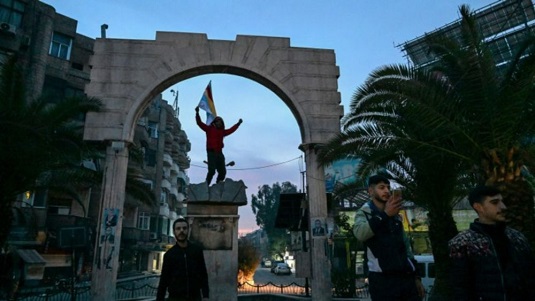
Unless you have a heart of stone or are in hock to a strongman theory of anti-imperialism, you cannot fail to be cheered by the scenes pouring out of Syria. Political prisoners, some of whom have been incarcerated for decades, reunited with their families as rebels open up the cells. The inmates of the Assad regime's torture pits, freed. Civilians flooding the streets welcoming fighters and tearing down statues of Hafez al-Assad. One of the world most disgusting dictatorships is finished.

There are those who are arguing that the fall of Assad is an outcome of US-Israeli activities, and that the rebel movement Hayat Tahrir al-Sham (HTS) - whose offensive drove the final nail into the regime's coffin - is about to consume Syria in the darkness of an Islamist caliphate, with full backing of the US and Israel. But this gives the West and its clients too much credit and reduces international politics and war to their manoeuvres only. Rather, what has happened is the unforeseen outcome of the acceleration of the Middle East's instabilities, which began with the 7th October Hamas offensive and the appalling genocide Israel has carried out in response.

While there are also domestic political reasons why the United States have generously supplied Israel the weapons necessary for the ongoing massacre of the Palestinians, as previously argued the relationship between the two is straightforward. Israel is a tool of US foreign policy, and its reason for existence in the eyes of the State Department is to enforce the US-led global order. As we'll see when Donald Trump takes over, this is likely to include recognising Israel's annexation of more occupied territories so the new administration can present itself as the presidency that brought "peace" to the Middle East. That's for the immediate future. In the present under Joe Biden, the atrocities in Gaza - despite unconvincing hand wringing - are justified because it's a "war" against Hamas, and therefore rooting out an Iranian proxy. Likewise, the Israeli army's confrontation with Hezbollah in Lebanon was far from the one-sided fight it's typically accustomed to, and poor performance on the battlefield is why Israel quickly suspended ground operations. But its programme of air strikes seriously degraded Hezbollah's capacities, and regular bombings of Assad regime targets and Iranian assets in Syria stemmed Hezbollah's supply of arms and the support Assad has enjoyed from Iran throughout the civil war.

Israel meeting the US's war aims is only part of the story. The Assad family have never benefited from popular consent, choosing instead to rely on fear and coercion. At least outside of the Alawite minority. When Hafez al-Assad seized power in 1970 he institutionalised sectarianism, ensuring that anyone who became a figure in the state had to have a power base among this community. Or, to be more exact, its elite cadres. This included non-Alawite Sunni Arabs. Assad also moved Syria away from Ba'athist commitments to (state) socialism. He championed private property and sought development along capitalist lines, which handily enriched his family and those of his cronies. It was the same old story: kickbacks and the dubious channelling of state funds into enterprises owned by the elite. None of this prevented its aligning with the USSR, though ostensibly out of "anti-imperialist" and anti-Israel commitments. The domestic state of affairs exploded toward the end of the 70s with the outbreak of armed opposition, and after 1980 the state cracked down with repression rather than conceding to demands for a non-sectarian state and anti-corruption drives. This culminated in massacres and the levelling of Homs. The repression only loosened by degree for the remainder of al-Assad's life. When his son, Bashir, secured the succession in 2000 there was a brief period of liberalisation in which some of the worst aspects of the regime were shorn, but almost immediately it clammed up again with a wave of further repression. It was almost as if conceding a measure of freedom was designed to flush out pro-democracy oppositionists. This did not stop Syria from pivoting away from anti-imperialism to cosying up with Uncle Sam during the War on Terror. Having previously dealt with one insurgency that was part Islamist, under Bashir al-Assad it, like Gadaffi's Libya, came in from the cold to strike a new deal with the global hegemon. Syria dutifully played its role during the CIA's extraordinary rendition programme - it was a centre for torturing detainees captured in Afghanistan and Iraq.

When the Arab Spring broke out in 2011, mass protests against the regime was met with the customary brutality it had become known for. With ugly scenes filling up television screens, the Assad regime was hypocritically but ruthlessly abandoned by its US patron and condemned. Syria became subject to Western sanctions. As revolution descended into civil war, Assad's regime distinguished itself by killing even more people than its gruesome opposition in Islamic State managed, which had taken advantage of the power vacuum and seized huge swathes of the country. The regime increasingly became paralysed by infighting and passive opposition among Alawites as IS rolled over government troops. This was despite the fact Iran had begun shipping "volunteers" to Damascus to defend Assad from 2012, backed by fighters from Hezbollah. But it was only the intervention of Russia that prevented the regime from falling to Islamist insurgency. This turned the war around, and though unable to reconquer the entirety of Syrian territory the application of psychotic levels of violence stabilised the situation. As a measure of how successful this appeared, it was only a fortnight ago that neighbouring states were engaged in efforts to normalise diplomatic relations. What the temporary victory Putin's forces brought Assad did not bring was a peace dividend. Sanctions and inflation have made the lot of the ordinary Syrian miserable, giving them no material stake in the regime's continuance either. As such, in retrospect, too much repression and too much recession fatally undermined Assad. All it required was a shove.

And that came from HTS. Having operated in an enclave around Idlib for the last seven years, despite its roots in al-Qaeda it has been in running battles with its local affiliates throughout the 2020s. It's this, rather than a desire to appear acceptable to the West or a cloak and dagger master plan to hide Islamist intent that explains their relative moderation, religious tolerance, and degree of pluralism. Its offensive against Aleppo, which seemingly came out of nowhere on the 27th November was like steam-rolling a collapsing barn. Having been softened up by Israeli attacks but sapped by years of internal crackdowns, massacres, and stagnation, the army melted away. Less than a fortnight later from the initial attacks we are here: to all intents and purposes the dictatorship has evaporated.

None of this was expected by the US, Israel, and the so-called international community. It introduces a range of unforeseen complications. Local powers will try and seize the moment to extend their interests. Israel has occupied its "buffer zone" with Syria, and will undoubtedly look to extend it further. Turkey likewise will be looking to guard its "perimeters" in the north of the country, while making life difficult for the Kurds in their US-backed autonomous zone. But both are consequences of actions to which they were bystanders. Undoubtedly, the latter day cold war re-enactment society will be pleased. If Russia's intervention in 2015 was a demonstration of strength and confidence, this marks an eclipse of such ambitions. Attempted air strikes against bridges in the Aleppo region marked its desultory effort at defending Assad's folding regime, and will encourage the incoming administration to play hard ball over ending the war in Ukraine.

But they are not the only ones looking on with glee. The truth is for hundreds of millions across the Arab world, the final reckoning of a hated tyrant will give heart in the same way the eruption and initial victory of the Arab Spring in Tunisia and Egypt did over a decade ago. For Cairo, the Gulf's absolutist monarchies, for the opposition in Iran, and even here in the West, successful uprisings help encourage and embolden movements from below. As establishment figures welcome Assad's fall, and particularly so in authoritarian states, there is always that sliver of fear that they could face a similar fate. That a movement of the immense majority could come and sweep them away.

Sunday, 14 April 2024

The Moon is a Harsh Mistress

Third time's a charm? Having previously read Robert Heinlein's Starship Troopers and Stranger in a Strange Land and wondering why so many people rate him (he was one of the 'big three' of postwar SF, along with Isaac Asimov and Arthur C Clarke), I was hoping his tale of revolutionary derring do in a lunar colony might be an improvement on these earlier books. I'm sorry to report this was not the case.

This is not because of Heinlein's iffy libertarian politics. The Moon is a Harsh Mistress is overlong partly because of the digressions on "rational anarchism" by "the Prof", who's the mentor/Lenin of our Moonside rebels and frequently ventriloquises Heinlein's hard right libertarian peccadilloes. Nor is it thanks to the remote chance of such a politics ever mobilising masses of people to overthrow a tyranny. As experience has taught us, market libertarian world views are confined to marginalised weirdos, billionaires, and pampered think tankers. Having ridiculous views and using a novel to expound them doesn't necessarily mean the book itself is going to be bad, as the work of Michel Houellebecq testifies. The problem here is Moon is straightforwardly poor.

A shocking verdict for an author so celebrated that his society hands out its own hard SF awards? Yes, but is toes have some nuggets of interest. As an engineer, Heinlein is credited with may things. Perhaps the most famous was placing a mobile phone in the hands of a character from 1953's The Puppet Masters. And here, fans of retro hard SF won't be disappointed with some of his forecasts. Is Mike, the colony's sentient computer, the first artificial intelligence character in all of literature? Isn't his manipulation of images to create a video of Adam Selene, a fictional leader of the putative rebellion, simultaneously the first appearance of a social media influencer and of deepfakes in fiction? Doesn't the situation of the three main Lunar cities underground in caves and tunnels pre-empt NASA's present plans for a Moon colony? Yes to all of these.

Heinlein's speculation about future family forms is also of interest. As Adam Roberts noted, there is an uncomfortable gender politics running through the novel - more below. Because Heinlein's Lunar colony was set up for the transportation of criminals, there is a 2-to-1 male/female ratio. There are several solutions to this, such as women having two or more husbands. But for the protagonist, Mannie, he's part of a group marriage that was founded a century earlier and that could, in theory, persist forever. This, apparently, is the best response to the straightened circumstances of life on the Moon. It creates a supportive environment for raising children but, more crucially, the chance for pooling capital where capital is sparse and having a mechanism for passing it on to successive generations. Who'd have had Heinlein down as a proselytiser for the Marxist approach to the family?  Perhaps not. These extended families are a projection of the petit bourgeois pioneer striking out for land in the old West, "updated" with an adapted sexual morality and a hint of Heinlein's trade mark prurience. Heinlein also has a go at imagining the economic relations between the Earth and the Moon, but cannot escape the old pioneer mindset. I.e. He envisages an economy based on the import of machinery from Earth and the export of ... grain. To get around the exorbitant costs he imagines a catapult, or what's now called a mass driver, for flinging produce to the home planet to help feed its overpopulated billions. A picture that was as absurd then as it is now.

All told, I have two big problems with this book. The writing and the plotting. Heinlein commits the cardinal sin of American SF authors of a certain vintage: the lapse into hokey cokey verbiage. Imagine my horror when I saw the fist chapter was called 'That Dinkum Thinkum'. Why did so many writers of this vintage fancy themselves Mark Twain with a banjo? That said, it's not as gratuitous an offender as some. Heinlein also fails at his efforts of introducing a bit of local colour in the form of occasionally peppering dialogue with Lunar pidgin. Generally, made up dialects fall flat in SF, with The Expanse series being a noted exception, but here it's as intrusive and as unwelcome as the odd lecherous observation. Having Mike and the Prof doing folksy turns grates, and people referring to each other as 'cobber' sounds as out-of-place as it did in post-Crocodile Dundee playground banter. The dialogue is as flat as the characters that speak it, and their personalities are non-existent.

In hard SF novels that often doesn't matter and the writer can, more or less, get away with it by concentrating on the science and the sense of wonder. But good characterisation and believable dialogue is essential in a novel about protest, sabotage, agitation, and revolution. Instead we get tedious discussions about strategy, dull and unconvincing political debates, explainers on party structures, using Mike as a revolutionary weapon, and so on. When we get to the actual overthrow of the Earth-imposed Authority, it accomplishes the very opposite of getting the pulse racing. In fact, the sole bit of well written, pacey drama comes when the Federated Nations - the American-led successor to the UN - tries retaking the Moon by force. The action is suddenly clean and sharp, and all over terribly quickly. A glimpse into what life must be like for wildlife phot0graphers on the hunt for the snow leopard. It's obvious that Heinlein hadn't bothered looking at revolutionary literature about revolution, such as John Reed's Ten Days That Shook the World, Trotsky's History of the Russian Revolution, or Sholokhov's And Quiet Flows the Don. All three married reportage, realistically drawn protagonists, and passion in ways that make them compelling reads. Heinlein's narrative badly needed decent characterisation to elicit the reader's sympathy and emotional investment in the success of the Moon's revolution, and because it hasn't the whole thing falls flat. Who cares if the Loonies succeed or fail when their discontent is painted as grey as the Lunar landscape?

One last word on the gender politics. They are, predictably, awful. All women are either married or end up married. Every woman is "beautiful" and their looks are commented on frequently, with Heinlein placing them on pedestals to be admired and leered at. This is particularly jarring when one of Mannie's young junior wives meets her demise in the brief action sequence. We find out she died after being shot "between her girl breasts". Grim. I'm minded to say there are no aliens in The Moon is a Harsh Mistress, apart from the women. Such sexism puts a question mark over the book's title. For whom the Moon is a "mistress"? Is Heinlein thinking about a harsh world to be conquered by its colonists? If so, that doesn't appear to be the case. Any "problems" of survival come from the Authority's stingy grain price fixing. The drilling of new tunnels is routine. The issue of depressurisation rare. This suggests the harshness is not environmental. Perhaps it might be because the federated powers of Earth treat the Moon as its geopolitical bit on the side, and when it's ungrateful for the trinkets and cast offs it decides to rough up with drop ships and H bombs to bring the wayward gal back into line. Or is it because there's scant chance for men to have any mistresses, harsh or otherwise, owing to the gender imbalance and the alleged higher status women enjoy? It's for the reader to make their mind up.

Why Moon enjoys an esteemed reputation is beyond me. The premise of a revolution breaking out and throwing off the yoke of the Earth is an engaging one, but in Heinlein's hands it's a waste of an interesting conceit. The Moon is no mistress, and this "classic" is a terminally tedious read.

Monday, 26 June 2023

The Humbling of Vladimir Putin

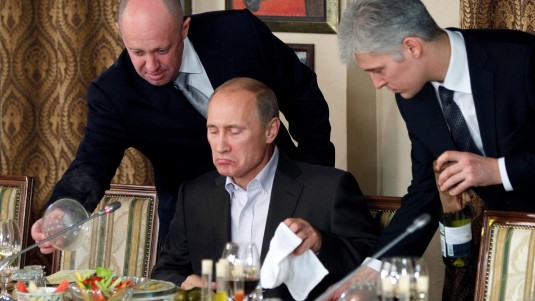
How many humiliations can an authoritarian leader take before his reputation disintegrates and the people's fear of him evaporates? Following the bewildering events in Russia this weekend, we'll probably find out soon. That the Russian state is decrepit and chaotic is news to no one. The institutionalised corruption and general incompetence of Putin's creatures in the Ministry of Defence has turned the so-called special military operation into a quagmire, with all the implications for stability that entails. Therefore, the longer the war drags on the likelihood of discontent boiling over into rebellion becomes more certain. What canot be forecast in advance is the how.

It's fair to say the spectacle of and the rapid demobilisation of Saturday's uprising weren't foreseen by anyone. The tensions on the front between the regular military and Yevgeny Prigozhin's Wagner mercenary forces are well known. Recruited primarily from Russian prisons with the promise of a pardon, Wagner have proven themselves the most effective detachment of the invasion force simply because Prigozhin has ground down Ukrainian defenders in and around Bakhmut with human wave tactics. Like Uncle Joe back in the day, it never mattered how many troops were sacrificed as long as the objective was met. This gave Prigozhin a certain standing among Russia's army of military bloggers and public at-large, and through his own colourful social media outbursts was able to heap calumny onto the heads of Sergei Shoigu, the hapless defence minister, and Valery Gerasimov, Russia's top general, for their abysmal management of the war. Following long-running internal battles that occasionally broke out into firefights behind the lines, on Friday regular army units - according to Prigozhin - shelled a Wagner encampment and raked the area with helicopter gunship fire. This was after he'd received orders to wind his outfit up and fold it into the army. Prigozhin's audacious response was to march Wagner forces out of Ukraine to seize control of Rostov in southern Russia, and declare he was heading to Moscow "with 25,000 troops". As his convoy began heading north, there was panicky footage of plod in the capital setting up machine gun nests, police organising roadblocks, loyal civilians digging up the roads, and a rattled-looking Putin making a national address. And then as quickly as it begun, the would-be coup was all over. Prigozhin announced he was turning Wagner around following talks mediated by the Belarusian hard man, Alexander Lukashenko. The Kremlin, it seemed, had caved in to his demands: the removal of Shoigu and Gerasimov, sweetened by legal immunity for Prigozhin and his cronies. One moment Russia was staring down the barrel of bloody street battles in the capital, and the next the crisis simply vanished.

What this wasn't was elaborate theatre to throw interference in the face of Western intelligence agencies. There were gun battles along the convoy's route, a fuel depot in Voronezh was attacked by Russian helicopters while the city was in Wagner's hands, and their military vehicles were subject to air strikes. For their part, Wagner anti-air assets brought down six helicopters and one command plane, killing 14 experienced air crew. Putin's presidential jet really did fly to St Petersburg when things were getting especially spicy, and given the welcome Wagner received from civilians as the column moved north and piecemeal opposition, it looked like Prigozhin held all the cards. So why not finish Putin off and install himself the new president?

There are claims his family were in danger, and that Prigozhin's forces were somewhat less than the 25,000 soldiers he boasted about. But it's not difficult to fathom why he snatched defeat from the jaws of victory. Forcing Putin from office would have been one thing, but consolidating his grip on the state something else. If we're looking for a useful analogy from Soviet history, it would have been like dumping Stalin for Beria, and we know what happened to him after old Koba's corpse went on public display. Putin has stayed on top because he's been able to balance, in the first instance, the competing demands of the departments of the state and the oligarchs who leech off them. You'll remember this was how Prigozhin came to prominence: as the provider of catering contracts for public bodies, above all the military. Furthermore, Putin's base rests on the shadowy apparatus of the FSB. It's hard to see how any of these would gain from a Prigozhin leadership that they don't already enjoy under Putin. Then there's the issue of Wagner itself. Having a heavily armed group of convicts elevated to the summit of the state doesn't have much appeal, especially if they fancied a slice of the oligarchs' pie for themselves. Between Putin and a band of actual murderers and rapists, the elite were pretty clear sighted about what suited them best. Therefore the most convincing explanation is Prigozhin, who is far from a stupid man, made a similar assessment of the politics. He might have taken the Kremlin, but for how long? With no one but his men at his back, he quickly calculated he was on a hiding to nothing and became more concerned with saving his own neck. Having crossed the Rubicon, he hastily assembled a pontoon bridge back. Hence the rapid about turn and departure to a comfy hotel in Minsk.

What happens now? Despite the deal that was negotiated, it appears Shoigu and Gerasimov are still in position. The mutiny charges against Prigozhin and his lieutenants remain live. Luckily for Putin, the chaos did not bring about sudden changes on the front lines. Ukraine were able to improve their tactical position around Bakhmut and established a modest bridgehead on the south bank of the Dnipro, but there was no generalised Russian collapse as per last year's Kharkiv and Kherson offensives. But the Wagner rebellion was like taking a pneumatic drill to the Putin regime's shaky foundations. In many ways, what happens to Prigozhin now is immaterial. Whether Lukashenko does the dirty and bangs him up, or by a catering mishap he ends up having a bowl of polonium for breakfast, the hard edifice Putin projects is riddled with cracks, and they're multiplying. Putin didn't just beg for his rule to be saved, he was seen to be begging. And short from a purge more extensive and terrifying than anything Stalin mustered, it's difficult to see how he can stay in situ for long.

Image Credit

Tuesday, 1 November 2022

Revolution in Iran?

In the latest Politics Theory Other, Narges Bajoghili spoke to Alex about the eruption of protests in Iran and how such a huge movement seemingly erupted from nowhere. The discussion touches on the regime's response, and how the left in the West should respond to those who opportunistically seize on women's rights for their own Islamophobic purposes.

Give it a listen!


Thursday, 20 August 2020

Cheering State Thuggery in Belarus

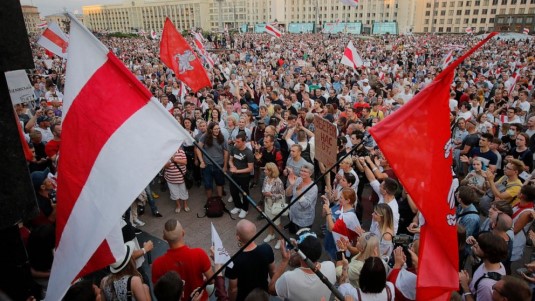
The uprising in Belarus stands on a knife's edge. Following huge demonstrations and strike action that has brought industry to a juddering halt, it's looking like the regime of Aleksandr Lukashenko is on its last legs. Popular consent has evaporated following his rigged election, and there has been some drift from the army and security services away from the state and toward the protest movement. Having got shouted down in mass meetings - he should be lucky that's all he's had to deal with - Lukashenko is looking to redouble repressive efforts, with riot police back on the streets rounding people up and administering beatings. By upping state intimidation and violence now, the president is hoping to ward people off from assembling this weekend in the sorts of numbers we saw last Sunday.

On Wednesday, the EU met and agreed to impose targeted sanctions on key regime figures, has resolved to put out a statement of solidarity with the protest while refusing to recognise the disputed election result, and offered its services as mediator between government and opposition to affect a peaceful transfer of power. The Coordination Council, set up by Svetlana Tikhanovskaya in Lithuania following her de facto expulsion after the rigged election leaves a lot to be desired, politically speaking. Initially calling for people to stop protesting, she has pleaded with the EU to back the movement and has agitated for fresh elections. For the EU, and especially the Baltic states and Poland, ever-weary of Russian revanchism, the removal of Lukashenko and his on again, off again love-in with Vladimir Putin for a dependably friendly government would be most welcome - hence its efforts at steering the opposition and, it hopes, the uprising in a pro-EU direction. For those interested in such things, the UK is following the EU line.

In these sorts of situations, sympathy, support, and solidarity goes to those risking life and limb. If Belarusian leftists are on the streets with the movement and fighting the dictatorship, the very least those of us sat comfortably in rich liberal democracies can do is listen to what they say and amplify their voices. Unfortunately, this is not the case among some who style themselves "anti-imperialist". Having seen what happened in Ukraine all those years ago, and Libya before that, in their imaginations the fundamentally open process of revolt has already been closed down. Because the EU are working to take advantage and bring any successor regime into its orbit, this is the inevitable consequence - if not the essential characteristic of the movement already. It leads to the absurd situation of a nationwide movement pigeon holed as reactionary whereas Lukashenko's disgusting gangster regime is more "progressive", and apparently socialist thanks to the still-sizeable presence of state industry. What can you say, some people are easily impressed.

I suppose it's unsurprising. Coming out of a period where revolts and mass movements were infrequent or easily derailed, and preceded by another stamped by the geopolitics of the cold war, so there are those who see mass mobilisations in countries not seen full in with Western governments as creatures of state-led subversion efforts. It's a fundamentally defeatist attitude assuming a priori the standpoint of proletarian passivity and multitudinous calm while according supernatural agency to our states, up to and including turning the repressed citizens of Europe's last dictatorship into their unwitting dupes. Often times these counsellors of despair and apologists for state terror mistake themselves for revolutionaries when, in fact, they're fundamentally conservative. If we're properly guided by a militant political science instead of tankie nostalgics, then no leftist would be in the position of defending a creature like Lukashenko from a popular revolt. And if you can do that there, think about the strange political contortions that might result here. Such as Britain's most prominent admirer of Stalin looking to cut deals with Nigel Farage and now, a scabby alliance with Scottish Tories.

Thankfully, such people are at the margins of the labour movement and the socialist left. They should stay there.

Image Credit

Tuesday, 7 July 2020

Covid-19, Climate, and War Communism

Yet another excellent interview from the unmissable Politics Theory Other. In this episode, Alex speaks with Andreas Malm about Coronavirus, class, and climate collapse. All the light hearted topics! Here, Andreas argues the reason why lockdowns happened immediately versus the slow burn tardiness of climate change mitigation is because, in the first place, the metropole countries were affected and it was a health crisis the ruling class could not insulate themselves from. I'd certainly agree, but I think he underplays the biopolitical dimension - Western states largely moved before people started voting with their feet and work discipline dissolved. A minor quibble. However, moving on to climate change proper Andreas suggests we need to think of mitigation less in terms of Second World War national efforts and more as so-called War Communism - the emergency measures undertaken following the Russian Revolution to defend Soviet power against counterrevolution and the armies of intervention. In other words, the longer we leave climate change unaddressed the greater the likelihood unprecedented emergency measures will become necessary.

Give it a listen. And don't forget to help Politics Theory Other out via Patreon here.


Saturday, 9 November 2019

The End of Stalinism

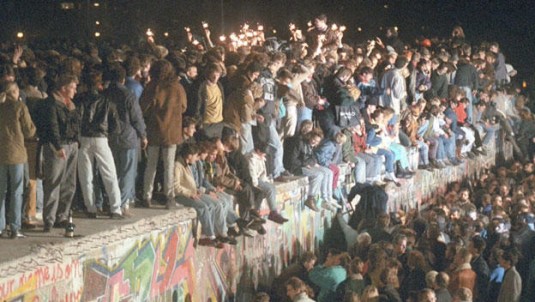
What an amazing contrast. The breaching of the Berlin Wall was greeted by ecstatic scenes right across the Western world. 10 years after and the party was still in full triumphal swing, being a decade into the end of history and a rapidly globalising world of dual sovereignty - capital was king, and markets our monarch. And then 10 years on, in 2009, the commemoration of the collapse of East Germany, or the German Democratic Republic to appease readers with a Stalinist fetish, was more downbeat thanks to the worst economic crisis since the 1929 Wall Street crash. And now, in 2019, events marking the 30th anniversary of the beginning of the end of the USSR and its client regimes are even more sombre. Speaking in Berlin, Angela Merkel chose the occasion to remind everyone that democracy is not a given, and that universal values are menaced from the extremes. In an obvious swipe against the racist right in power in Hungary and Poland, and advancing even in Germany, it was nevertheless fitting in given how the GDR was a totalitarianism born out of the ashes of its genocidal other, which in turn was the (by no means inevitable) consequence of the collapse of bourgeois democracy.

From gloating to shame-faced apologia, that is some distance travelled in a blink of the historical eye. For those who weren't around during the Cold War, it is difficult to convey how different the world felt. For some, the tyrannies stretching from the Elbe to the Bering Sea were misrecognised as zones of workers' control, where capitalism had been suppressed (true) and something better ruled in its wake (not true). It was a comfort and an alternative, and helped keep generations of leftists going when things weren't great. And this suited the captains of industry and their cadres of paid ideologists quite nicely. To most people, including those in the labour movement, the likes of East Germany were a model alright, a model to avoid. For every Communist Party activist the Soviet bloc kept going, dozens, scores, hundreds found the idea of socialism repugnant. If socialism is nationalised industry plus a knock on the door at midnight, we'll stick with capitalism ta.

Yet while, perversely, so-called really existing socialism was a buttress for post-war Keynesian capitalism, the very existence of an alternative system in the East had put our own ruling classes on notice. The Russian Revolution was and remains the largest blow against capital to date, and though the revolution succumbed to isolation, bureaucratisation, and became one of history's most grotesque dictatorships, hard won victory over Nazi Germany and support for communists elsewhere saw Stalinism advance across the world after the war. And where it won, capital was largely uprooted, markets suppressed and and effectively closed to Western capital, with one or two exceptions. In other words, the existence of these regimes struck at the root of and challenged bourgeois property relations and with it the very basis of capitalism itself. For as long as global capitalism faced off against global Stalinism, bourgeois dreams were frequently interrupted by communist nightmares.

And so with the fall of the Berlin Wall, the rapid collapse of the Warsaw Pact signatories and finally the dissolution of the Soviet Union itself two years later, you can understand why Fukuyama's end of history thesis got such traction. Capitalism had been trembling at the very thought of the communist phantom since the 1840s, and all it took were gaudy consumerist baubles and the freedom to speak your mind to exorcise it - permanently. And so when we talk about the triumph of neoliberalism, its spread as the new common sense was greatly aided by the expiration of its collectivist nemesis. The various permutations of ruling class ideologies were "proven" by history, and everything associated with the fallen Soviets and socialism more generally didn't so much fade away as practically drop out of public consciousness altogether. And at the point Tony Blair assumed Labour's leadership, it was almost as if socialism had been uninvented, so thorough was its purge from mainstream politics. Consciousness was thrown back and its only now, with the rise of Corbynism here in the UK are we groping back toward a new class conscious politics.

This was characterised, as my erstwhile comrades at the Weekly Worker used to put it, as a period of reaction of a special type. i.e. One in which labour movements and their parties had not been physically liquidated but ideologically defeated. The decline of old-style industrial working class consciousness pre-dated the Thatcher/Reagan era, as well as the end of the USSR, but were greatly accelerated by both. No Soviets meant no alternative to free market capitalism. Worse, while the USSR and its clients discredited socialism in life they carried on doing so in death. With the brutalist politics to match the brutalist architecture, the Soviet Union committed the cardinal sin of any putative alternative - it failed spectacularly. Nevertheless, that period has come to an end. Political polarisation is a fact of life as the old fault lines push to the surface and burst open all over the world. Even if Labour loses the socialist genie's not going back into the bottle, and any incoming Tory government will have its hands full placating growing disaffection - especially from those at the sharp end of their policies.

As Angela Merkel made her remarks at the designated graveside of East Germany, she did so as her system is imperilled by stuttering growth rates, a long-term swing against the power of capital, the law of value, and the nature of property, an inability to provide a decent, rounded standard of living for millions in the advanced countries, and its systemic culpability for climate crisis. Socialism is back, and communism is more than just sassy memes on the internet. Looking back on the disbanding of the Stasi, the dismantling of the wall, and the disintegration of a superpower bloc from the vantage of 30 years, their passing into the pages of history is starting to look more like a clearing of the air. And this, comrades, means our politics can soar to undreamed of heights without the burden of tyranny weighing us down.

Image Credit

Monday, 13 May 2019

Worldmaking after Empire

A great new show in which Alex interviews Adom Getachew about her new book, Worldmaking after Empire: The Rise and Fall of Self-Determination.

As always, please support Alex's work here. More money = more quality interviews.

Wednesday, 22 August 2018

The Power by Naomi Alderman

22 years ago, Thursday mornings almost always meant a hangover. And yet, somehow, I was able to drag my minging carcass to the class room for a two-hour session on Comparative Social Transformations. Don't let the dry title fool you as our lecturer, Alan Sillitoe (no, not the Alan Sillitoe) took us through a bit of classical sociology, the collapse of the post-war consensus, the debates around East-West convergence and Japanisation, post-industrialism, postmodernism (mind blown - at the time), and gender relations. Regarding the latter, I remember something of a debate in which all sections of the class, well, those of us who actually used to speak in tutorials, coming to a rare moment of consensus vs our learned instructor. Discussing the emergence of the sexual division of labour in prehistory and then the subordination of women to men, he asked why and how we thought this had happened. Remembering our Engels and our Firestone, in our incoherent, semi-inebriated fashion various theories about the emergence of private property were offered, but the chief means of effecting this, of how women were made the first oppressed class on which all other class structures were subsequently erected, was strength: the brute fact that men tend to be larger, stronger, and more physically imposing than women. This was how women were reduced to property and chattel, and were kept there. Over time elaborate social codes and customs justified and naturalised these relations of power, but ultimately, in the last instance, male physicality and the threat of violence polices and enforces gendered inequality. The prevalence of domestic violence by men against women, as well as other incidences of sexual and physical violence, controlling behaviour, emotional manipulation and gaslighting, the pimping and trafficking of women, the mutilation of women and girls, and the threats of male violence remain absolutely central here, in the 21st century, to the second class status of women.

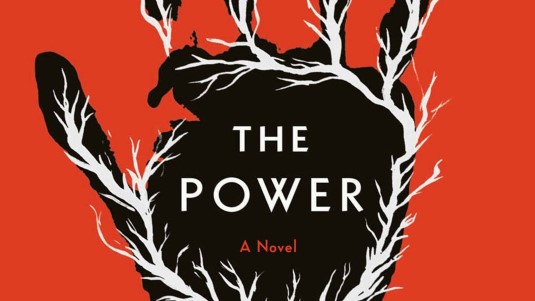
What if patriarchal relationships disappeared overnight? Or, instead of the gradual change we have seen over the last century, what happens if men's "advantage" of possessing greater physical strength vanishes and passes to women? This is the premise of Naomi Alderman's The Power in which young women spontaneously develop the eponymous power, an ability to generate electricity to the point of discharging bolts from their hands. This is thanks to the evolutionary development of a web of muscle - the skein - that grows at puberty between the collar bones in the upper chest. It is a power latent in nearly all women - older women can be "activated" by younger women - and is also something men, apart from an infinitesimal minority, do not have. What would be the consequences of such a sudden and decisive upsetting of the social-physical order of men's and women's bodies? Spoilers: nothing good.

Occasioning the change, we follow the action through three key viewpoint characters. There are a couple of others, but these three are the most decisive. We have Allie, a runaway who killed her abuser when her power manifested, Roxy - the daughter of Cockney crime family, and Tunde, a Nigerian kid whose early videos of the emergent phenomenon go viral and out of which he's able to build a media career. Allie washes up at a convent where she secretly starts developing her powers and eventually takes it over, Styling herself as Mother Eve and egged on by her ever-present internal voice, she starts preaching that the power is a sign from God and one in which She is now emphasising the female side of her character. And so she becomes the locus of a new female-centered matriarchal religion. Meanwhile, Roxy uses her power to kill a rival crime boss who murdered her mum before hooking up with Allie and forming an alliance of mutual convenience. Roxy's firm has a sideline in drug synthesising and smuggling, and it's not before long they're producing their own gak that strengthens the power of its users. But for me, Tunde is the most interesting character because it's through him we most clearly see the change in the new gender order. He starts off as the usual cocky, know-it-all boy and before long he's a grizzled globe-trotter, reporting on the world's most testy flashpoints. He gets caught up in demonstrations of newly empowered women, and in terror attacks by militant men's groups. But then, while covering a confrontation between women and the authorities in India, he barely escapes rape at the hands of a woman. And from then on, his ride through the novel gets progressively rougher.

At the beginning, abusers and all those who profit from violence against women get their just desserts. We're on the streets with Saudi women as this most disgusting of patriarchies is humbled and overthrown. East European women, repeatedly raped while being "softened up" for trafficking to the West, acquire their power and are easily able to dispose of their guards. Summary justice and vengeance, unfortunately, gives way to a darker turn. We closely follow this in Bessapara, a new country founded by women in Moldova that quickly gets bogged down in a drawn out war with its north, where remnants of the House of Saud are hiding. Initially Bessapara was founded to explore new ways of living, and so to have the cutting edge of the new face down the reactionary, patriarchal violence of the old was a nice touch. However, the dream quickly descends into a nightmare. After a series of military reversals, which Bessapara's president blames on traitorous men, a number of "emergency measures" come in. These include an internal passport system in which men have to carry papers signed by a nominated woman guardian, the banning of men from driving, from most jobs, and so on. In other words, a mirror image of its Saudi nemesis in which the poles of oppression are reversed. Tunde is on the scene and we tour a countryside in which men are scared of helping him out, of encountering the tortured and sexually abused bodies of young men, of male sacrifice, and later an attack on a refugee camp. If you don't think a rape scene of a man by a woman can't be brutal and disturbing, Alderman will disabuse you of that notion.

One interesting touch as you make your way through the book are sketches of items from archaeological digs. At first they seem relatively innocuous. Some images of a holy mother, a glove with wires designed to project the power, a device for training young girls in its use. All are suggestive of perhaps the power manifesting itself previously and pre-industrial peoples making use of its rare manifestation. And then we come to figurines of a male sex worker and a rock painting of male genital mutilation - a procedure in which the power is used to render a man impotent and only capable of (painful) arousal through the power's application. Accompanying each is a historical commentary and it quickly becomes apparent that the occasion of the power sees the destruction of human civilisation and that our events are being narrated from the perspective of 5,000 years in the future. Our violent history of patriarchy has been supplanted by a different, but equally violent unfolding of matriarchy.

As a thought experiment, The Power is fascinating and compelling. The narrative is pacey and keeps the pages turning, and it's all set of literary immortality. The TV boxed set, I understand, is in the works. It is a novel that is very now as the basis of patriarchy is diminishing, and we're seeing the growth and spread of toxic masculinities as a result. It takes hold of the anxieties and neuroses of frightened, anxious patriarchy and ups the voltage. One way The Power can be read is as an exaggeration and lampooning of these fears. Alternatively, and more persuasively in my view, it does draw attention to the mundane, physical means by which patriarchal violence (whether actual or potential) is exerted. Tunde and his transformation from a confident, naive kid to a young man who actively avoids eye contact with women in the street is brilliantly realised. Here Alderman confronts the reader, particularly her male readers, with the threat many women have and do experience on a daily basis but is largely invisible to them. And I would also suggest The Power is a meditation on 'the event'. Western culture generally, not just left wing politics, believes in the redemptive power of a key moment - the Godly apocalypse, the revolution, the singularity. Organising your belief system around an event can lead to the postponement of contemporary problems until after it has taken place. For instance, it wasn't a long time ago when revolutionary politics, when it did address matters of gender, race and sexuality, tended not to take them seriously and relegated them to the never-never after the glorious day had come and gone. Social change, including progressive social change, is more complex and piecemeal than a moment in which the slate is wiped clean and there is a before and an after. In The Power the sudden imposition of the radical event does not so much change gendered relations but preserves them through reversal, and leads to a doubling down of the same old crap. Alderman's novel is therefore a critique of the event, of the notion that something is going to come along from the outside and wave its little wand to make everything better. The power of The Power is the challenge it issues: that it doesn't have to be like this, and we have it in ourselves to change it.

Tuesday, 7 November 2017

Hailing and Heeding Red October

Karl Marx enjoyed historical ironies, but I doubt he'd have been cheered by this one. The greatest event in human history is simultaneously its most tragic event, a people who reached for the heavens laid low by the harsh, hellish realities of war, starvation, repression and dictatorship. The Russian Revolution, Red October, has met its centennial. An occasion to celebrate or commemorate depends very much on your political persuasion, but what it is, what the whole Soviet experience should be is something too many on the left have resisted: an occasion for learning.

If the 1871 Paris Commune was the first breach in the international order of capital, the October Revolution posed it an existential threat. Not only did it expropriate the aristocracy and emergent bourgeoisie, it lit the touch paper of a revolutionary blaze that fanned outwards into Europe, into the colonies, into India and China and won it a global army of adherents. After the collapse of Imperial Germany the continent came close, very close, to turning red. Alas the revolutionary wave ebbed and socialism's outrider became its sole bastion. Nevertheless the establishments of Europe knew what the revolution represented. It was a warning, an unwelcome intrusion of the masses into history bearing one simple message: that capitalism was on notice. The propaganda aimed against the Soviet Republic, the soldiers and material the colonial powers shipped to Russia to strangle the experiment in its cradle, this was done not to restore democracy or prevent dictatorship. Its simple aim was to drown the revolution in blood. The Russian civil war that raged from 1918-1921 consumed the lives of 10 million people, but even that couldn't break it. Nevertheless the utter devastation - think 1990s Afghanistan on a much larger canvas - saw to its pacification in terms of the international game. Socialism in one country, Stalin's original sin as far as the Trotskyists were concerned, was a break with received Marxist understandings of the global character of revolution, but also a doctrinal adaptation to material circumstances and the rebadging of the old Tsarist bureaucracy as so many people's commissariats.

And here lies the first problem with coming to grips with the revolution. Marxist understandings of the revolution performed in its name are too often bogged down by factional debates and their attendant mythologies. For the Social Democrats it was a case of instant dismissal. They preached against the violence of putschism, fetishised constitutionalism and attacked the Bolsheviks for not respecting the political gradualism they were wedded to. Yet this condemnation was strangely absent when it was a matter of turning guns on colonised peoples or the revolutionary masses of Europe, as was the case in Germany after the Great War. The anarchists were simultaneously hostile for the revolution not being revolutionary enough and located Soviet authoritarianism in a red thread stretching back to Marx's expulsion of Bakunin from the First International for ... wanting to place the organisation under the control of a secret conspiratorial outfit with him as the head. Hmmm. For the Trotskyists everything was fine and dandy until the 1921 party congress banned factions and it was the slippery slope after then, and for your Stalinists (depending on the flavour) things were a-okay until Khrushchev's secret speech in 1956, or right up until the Berlin Wall fell.

Of course, this account leaves out much detail, but the point remains. There is little consensus about what the lessons of the Russian Revolution are, and therefore conclusions, be they scholarly or political, are footballs to be kicked about in the ebb and flow of interests. For much of the Cold War period, despite the prevalence of us-vs-themism, there were contesting interpretations. After the end and the temporary triumph of neoliberal capitalism and governance, the USSR and the revolution that spawned it were an aberration, something to be reviled if it was ever to be talked about at all. As politics opens up again and socialism and communism are once more at large, ambiguity is more the order of the day - of which this post is one of many left wing examples.

The crucial problem, the issue returned to time and again is the erroneous suggestion the Bolsheviks started out as a dictatorial outfit. After all, it's there in Lenin's What is to be Done?, an otherwise obscure pamphlet of boring polemics old Lenners aimed at his rivals and fellow exiles in the Russian Social Democratic Labour Party. Indeed, Trotsky earned his spurs if not his notoriety in these self-same circles for attacking Lenin's "authoritarianism". He was more right than he could have ever supposed when he argued "... these methods lead, as we shall see below, to the Party organisation “substituting” itself for the Party, the Central Committee substituting itself for the Party organisation, and finally the dictator substituting himself for the Central Committee". And yet contrary to the standard interpretation of Lenin and the bureaucratic sects and cults who farcically claim to be repositories of the Bolshevik tradition, "these methods" were not Lenin's argument at all. As the sterling scholarship of Lars T Lih on the life and works of Lenin show, the model he favoured and worked to base the revolutionary party on was actually German Social Democracy, albeit adapted to conditions of Russian illegality. That was a tradition of relating democratically to workers and peasants, it meant a disciplined approach to political activity married to a noisy and dynamic culture of criticism and open debate. The RSDLP, which incubated the Bolshevik and Menshevik factions was never a monolith, and following the final split between the two and the transformation of both into parties, they inherited the characteristics of its defunct parent. The party that led the insurrection was also a party with a democratic culture and with open factions who published their own material. It was formally and substantively more democratic than the Labour Party. There was clearly a qualitative break between the Bolshevik Party of Lenin prior to the revolution and the mockery of workers' power it later became.

How did we arrive at the gulag from this? For Trotskyist accounts of the revolution, the young Soviet Republic was hampered by its narrow social base. Only small numbers clustered in the urban areas and attending the (then) limited transport network could be considered proletarian - the rest were the peasantry. In short, the revolution had to rely on winning over a much more numerous class whose immediate interests were in tension with socialist aims. Complicating this was the revolution coming under siege by internal reaction and the armies of the Allied Powers, who poured in once Germany and Austro-Hungary were put in their boxes. As the civil war persisted the Soviets, the constitutional bedrock of the new order, got sidelined and, to make matters worse, the most conscious and dedicated revolutionaries were killed in the slaughter or absorbed by the bureaucracy in directional roles. This, goes the story, provided the material base for the strangling of the revolution by the apparatus and the subsequent rise of Stalin as its champion and overlord. The Trotskyist account is right as far as it goes, but as anarchist criticisms make clear, the disruption and destruction of democratic functioning was a pronounced tendency from the very start. In her memoirs Alexandra Kollontai recalls weeping as she called in the heavies to disperse protesters at her commissariat, and this was before the civil war got properly underway.

Bolshevist authoritarianism came not from the party but the process of revolution itself. As Engels himself noted in a polemic with "anti-authoritarian" socialists,
... the anti-authoritarians demand that the political state be abolished at one stroke, even before the social conditions that gave birth to it have been destroyed. They demand that the first act of the social revolution shall be the abolition of authority. Have these gentlemen ever seen a revolution? A revolution is certainly the most authoritarian thing there is; it is the act whereby one part of the population imposes its will upon the other part by means of rifles, bayonets and cannon — authoritarian means, if such there be at all; and if the victorious party does not want to have fought in vain, it must maintain this rule by means of the terror which its arms inspire in the reactionists.

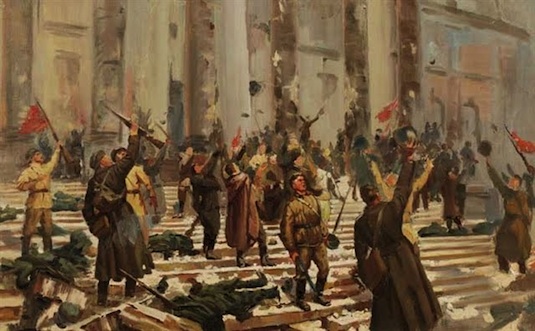
A revolution leaves very little room for democratic niceties, as every single one from the English Civil War to the 1979 overthrow of the Shah in Iran demonstrates. For all the fantasies of the cleansing violence of revolutionary action, revolutions have the tendency to consume everything, not least the people who made it, as the French and Russian examples attest. And that, ultimately, has to be the enduring lesson of what happened a century ago this evening. A peaceful putsch - more people were injured during the staged and filmed storming of the Winter Palace than the actual event - was a prelude to a war so bloody that only the Nazi invasion of Russia surpassed it. For Marx, socialism and communism was the immense majority moving in the interests of the immense majority, a position now opening up again by the confluence of rising culture, rising networks, and sharpening politics. Going beyond capitalism doesn't, at least in the advanced West, require an insurrection and civil war precisely because the character of class struggle is changing. There are no blueprints for what comes next, only pointers provided by the directions new struggles takes and what new constituent processes are tending towards. Therefore one should mark the October Revolution, even raise a toast to the comrades who made it, but never forget it's a warning as well.

Thursday, 3 August 2017

Taking Sides on Venezuela


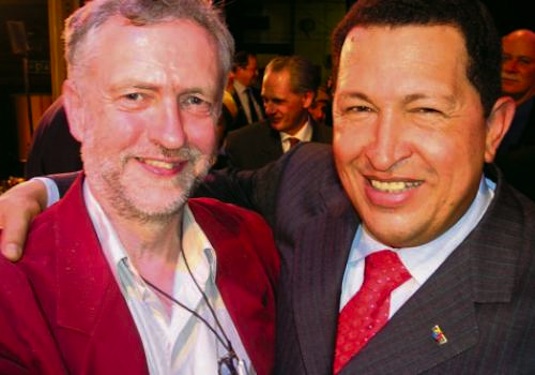
When there is a crisis overseas, you can tell a great deal about someone by how they react to it. In this case I'd like to draw attention to sundry calls on Jeremy Corbyn to condemn what is happening in Venezuela. Ever keen to pressure a leader they remain unreconciled to, Angela Smith and Graham Jones, ostensibly in their roles as members and chair of the all-party parliamentary group on Venezuela, have added their voice to the gnashing of Tory MPs and hostile editorials. Why they are on this APPG after showing scant interest in Latin American affairs during their careers is something I'll leave the reader to ponder.

We know from the recent attacks on Jeremy Corbyn that the Tories, their press, and their helpers in the PLP have determined the best way to turn back the tide is to call his integrity into question. See, for example, how Venezuela concern trolling and its attempts to associate repression with Jeremy is taken further by The Sun's claim the Labour leader faces "fresh questions" over his ties to the Nicolas Maduro regime. What are these ties, exactly? We don't know because they do not elaborate, almost as if the truth doesn't matter. When they have run out of political attacks, insinuation and smear is all that remains. It just so happens Labour's statement is very clear, but that won't do. Some will not be satisfied until Jeremy renounces his previous support for Hugo Chavez and performs the kind of public repentance none of his critics would be prepared to do themselves - or even ask of any other politician.

That isn't to say what is happening in Venezuela isn't worrying, it obviously is. What we see is a pre-civil war situation in which the government and opposition are locked in a death spiral of struggle. Trying to understand what is happening means putting into the bin hyperbolic claims of Maduro's "dictatorship" and coming to terms with what is happening as it unfolds - a project hypocritical Tories and our nominally Labour MPs are utterly uninterested in.

A good starting point would be familiarising oneself with large quantity of current affairs writing available in English, both from the pro-opposition and pro-Maduro camps. As with all analysis, it's a good idea to situate recent political developments in the context of history which, in Venezuela in the post-war period was a history of coups and authoritarian government, and only restricted intervals of liberal democracy. It means understanding what happened to the Venezuelan economy over the same time frame and asking who benefited from its decades-long oil boom. We would need to look at the relationship between the present crisis and the onset of runaway inflation in 2014, the class character of the antagonists, and the role the interference of the United States has played in events. We must also avoid the sort of myth-making leftist accounts of revolutions and civil wars are fond, of playing the epigone Maduro to the saviour Chavez. Matters were better and circumstances different before Chavez's premature death, and while he enjoyed popular support and legitimacy this was in the context of a stronger economy and weaker opposition.

The precipitating factor for the current crisis was the 18 month-long collapse in oil prices, that saw the price fall from a high of $115/barrel to $35. All oil-dependent economies took a big hit, Venezuela included. However, the country's difficulties don't all result from this external shock: the economy had tipped into recession some six months prior. According to the Centre for Economic and Policy Research, inflation was turbo charged by the government's decision to tighten access to foreign exchange. As the dollar is a stable global reserve currency unlikely to be depreciated by inflationary pressures, the government inadvertently touched off a stampede for dollars which, in turn, caused inflation to spiral. The oil crisis further sapped government revenue, and so the money presses were set into motion, which only spurred inflation further. The problem is possible solutions, such an easing of currency exchange rules, are rejected by the government. As a result there have been widespread shortages, a return to arbitrage and barter, and a well-publicised scarcity of loo roll.

The opposition have made hay with this. They took to the streets in 2013 after Maduro narrowly won the presidential election, and have forced regular street confrontations with government forces ever since. They never accepted the legitimacy of Chavismo, even when the economy was booming and their bank accounts fattened on the proceeds, and when hundreds of thousands of private sector jobs were created. The Democratic Unity Roundtable (MUD) is the catch-all anti-Chavista party comprising parties tied to the old elite - conservatives, liberals, and the centre left. Interestingly also signed up is Bandera Roja, a farcical Maoist ex-guerrilla outfit for whom Chavez and his United Socialist Party were/are "social-fascists". As an umbrella and with little policy to unite them, the MUD is entirely an anti-government force. It has nothing to say about the economic crisis except things are bad mmmkay, and would have trouble coming up with a policy platform that could address it - which is why they don't bother. A case of taking out Maduro first and worrying about the rest later is their organising principle. Still, in 2015 they capitalised on the situation and won 112 seats out of 167 in the National Assembly elections, and have managed to leverage their super majority to try and paralyse the government. Maduro for his part acknowledged his defeat, but then announced the setting up of an alternative "communal" parliament ostensibly to draw together representatives from the grass roots communal movement. Think of it as an attempt to formalise a situation of dual power, of bourgeois democracy vs soviet-style workers' councils. The problem for Maduro was its being a transparently self-serving move and the fact the communal movement is nowhere near as numerous or powerful as the soviet movement was in the Russian revolution. The fact it has only met once at Maduro's behest underlined its sham character and inability to circumvent the assembly.

This didn't stop government attempts to squash the assembly. In March, the Supreme Tribunal of Justice, the formally separate judicial body akin to the US supreme court (but also stuffed with Maduro supporters) stripped the National Assembly of its powers and assumed its legislative functions. And then, two days later, went back and reinstated its powers. The Assembly retaliated and began moving against the judges. To head this off, in early May Maduro decreed the convention of a constituent assembly with far reaching powers, including those to rewrite Venezuela's constitution, modify term limits for the president and, entirely coincidentally, the power to dismiss parliament. The election of assembly members was sorted by electoral districts and with reserved positions for occupations and other interest groups, like trade unions and indigenous peoples. This method also meant the MUD parties would have had a difficult time winning significant representation to it, and therefore boycotted the election. This undoubtedly helped keep the turnout low (the figure itself is disputed) and helps put questions of legitimacy over the whole process in the view of establishment international observers. That however is not the only reason. Reports suggest government workers and employees in the state-owned enterprises were pressured to vote on pain of disciplinary measures or dismissal.

Herein lies the problem with what Venezuela's 'socialism in the 21st century' has become. The MUD-led opposition is wide but remains largely passive. The street battles seen on our TV screens are mostly small groups of activists from the wealthier neighbourhoods of Caracas. They are representative of the elite interests arrayed against the government, but are not and have a very difficult time articulating the anger and frustration of the people at large. It's one thing to get huge numbers for A-to-B marches, but difficult to mobilise for active, militant confrontation. Despite the deepening sense of crisis and falling of living standards, significant numbers of poor Venezuelans prefer to leave over finding salvation in the opposition's arms. And this presents a significant problem for Maduro and the PSUV too. In 2002 Chavez was saved by the intervention of millions against the CIA-backed coup to remove him. Come 2017 those masses are missing. This says a lot about the drip, drip draining of legitimacy away from Maduro. Constitutional shenanigans explain some of it, but there is the deadening effect of his attempts to sort the economy out. As we have seen in Europe, governments turning against their constituents' interests is bad for both. The Chavismo programme of nationalisation has rolled back, experiments with special economic zones modelled on China's experience, worker participation has been halted and in some cases, reversed, privileging debt payment over reinvestment, and, of course, feeding inflation by printing money rather than changing foreign currency policy have reduced swathes of their base to spectators. Were the mass enthusiastic and felt Maduro was their president leading their government, the opposition wouldn't even be in contention. But they don't and they are not actively defending the presidency - the crisis has left many fatigued, and the attitude the government has towards its people is almost Fabian in its outlook: the masses should vote and leave the building of Chavismo to the state. If socialism is something that is done to you or for you, don't be shocked if most people feel detached and alienated from the project.

Unfortunately the two likely outcomes do not look good. The MUD might talk a good democracy and profess care for human rights, but the moment they come to power such niceties would evaporate. The remnants of progressive policies are for rescinding and a neoliberal programme of privatisation and marketisation prepped as per Brazil and Argentina, and the only law respected being those governing property. Respect for free speech and assembly would be smashed under a crackdown on Chavez and Maduro supporters. The kinds of powers the Venezuelan government are using now are nothing compared to Latin American traditions of counterrevolutionary violence. Today's street protesters would be the witch-hunters, torturers and executioners of tomorrow. If this happens I have a suspicion the people hand-wringing and using Venezuela for point scoring in the advanced countries would quickly file the country down the memory hole along with the other unpleasant regimes they don't give a monkey's about. Surely then we should stick up for Maduro's government as the imperfect guarantors of what exists? The problem overhanging an uncritical defence is the appalling history of self-described socialist governments restricting and abolishing democratic freedoms, often in the name of emergencies (real and imagined) and then becoming something that is the very antithesis of human liberation. Democracy in a leftist movement and therefore a leftist government isn't a nice add-on for after the time the nasty capitalists have been done away with. It is necessary for the continued health and self-organisation of our class in the process of making a revolution. Chavismo is in danger because it has never allowed the masses to organise themselves, and appeals in this direction may be too late after all that has happened. And so a Maduro government is preferable to the opposition in much the same way, to pursue an idiot Newsnight question, Tony Blair was preferable to the Tories. But that doesn't mean we should be satisfied with, let alone apologise for Maduro's creeping authoritarianism. If people are concerned they should find out what the critical-Chavista movement are saying and finding out about their own attempts to carry forward the revolution. It's with them our sympathies should ultimately lie.

It denigrates the seriousness of the Venezeulan crisis to bring the question back to Jeremy Corbyn and what he should and shouldn't say. The Labour statement is a good starting place and once he returns from his hols he should adopt a critical standpoint. This isn't to appease the press but to emphasise that socialism involves a deeper, more thoroughgoing democratisation of social life. After all, the indispensibility of the latter to the former is the last thing our establishment would like to hear.

Saturday, 26 November 2016

Farewell Fidel

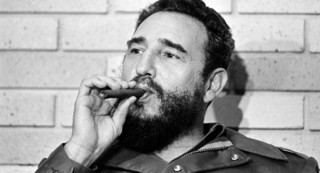
As the world wakes up to the passing of the world's best known revolutionary, coal mountains' worth of electronic comment are already pontificating and positioning. Fidel Castro was a goodie because hospitals. Fidel Castro was a baddie because gay repression. Talking points designed not to encourage talking, and think pieces conceived to shut down thinking. Their contributions hymns to Castro's censorious regime, of its declaration against free flowing opinion. Nevertheless, his was a figure that made the we were born into, and as it passes into the pages of history it is fitting that he too should shuffle off this mortal coil.

Many on the left have a soft spot for Cuba and Castro. He was the best known survivor of communism's heroic period, of an underdog ragtag movement that took on the full might of the US-backed Batista dictatorship and won. For the peoples of Latin America during the Cold War, Castro's regime was a fuck you to the greatest military power the world has ever known - and just 90 miles off its coast. He was and is a potent symbol of revolutionary resistance and tenacity. The victory of the July 26th Movement and the survival of the Cuban state over nearly 60 years goes to show there are alternatives to the Western consensus - and that points stands without having to prettify the regime's repressive character and big it up with the education and health stats.

As James notes, there will be those who try and portray Castro's authoritarianism as entirely reactive, that the original sin lies with the United States and its repeated attempts at undermining and overthrowing the J26 Movement almost from the get go. While true, these material circumstances cannot be waved away either. For one, five years prior to the overthrow of the Batista dictatorship the United States instigated a coup in Guatemala. This was then a liberal democracy that had between 1944 and 1954 returned two presidents you would class as Christian Democrats. They presided over governments that were largely middle-of-the-road, politically speaking. Except in 1952 Jacobo Árbenz undertook land reform, which confiscated uncultivated land and handed it to the peasantry. For Eisenhower, this constituted communism and initiated a terrorist campaign that ended in Árbenz's resignation. Thereafter followed a period of instability, characterised by coups and civil wars. Later again in 1973, the US used the democratic freedoms in Chile to undermine and destroy a liberal democracy that had produced the wrong outcome. With a history of interference behind the United States relationship with the countries to its south, which included the Bay of Pigs invasion, assassination attempts, coastal raids on militia outposts, sabotage and not forgetting the economic blockade, authoritarianism appeared to have much to commend it.

Cuban authoritarianism does have a dynamic of its own though, and these were embedded in the characteristics of the struggle led by Castro. His was not a popular uprising in the conventional sense but a guerilla struggle. Che Guevara's Guerilla Warfare distilled the essence of the J26 Movement as a hyper vanguard of committed communist fighters. The group was the nucleus and repository of the lessons of history, and it would be the active agent that would draw the peasantry behind it. Not dissimilar to Mao's approach to revolution. Here, in Cuba, the masses were conceived of as having a spectator role. The opposition to Batista in the cities, the workers' organisations and the Communist Party (which, bizarrely, supported the dictatorship) were marginal to the revolution rolling in off the countryside. The overthrow was accomplished by military struggle, and the command and control model appropriate to that remained. The absorption of the city-dwelling communists, the transformation of the unions into apparatuses of the state, the clamping down on the media were certainly conditioned by the exigencies of a revolutionary changes, but not determined by them. Effectively, a military movement became a military government, and the trappings of a Stalinist state acquired while consolidating the hold on power was an extension of these governing principles to all aspects of society. One cannot distinguish between the command economy and the state that sat atop it, they were and remain mutually interdependent.

Castro has officially been out of power since 2008. Since then, what you might call the Chinese turn has gathered speed. Rapprochement with the US has got underway, though there's every chance progress could be rolled back under Donald Trump. But necessity demands that the regime continues to open up Cuba's economy and, from its point of view, the more difficult task of relaxing authoritarian rule without the whole thing collapsing a la Eastern Europe. There's also the tricky job of ensuring present elites avoiding having to account for the crimes committed since 1959 too. Regardless of what happens, Castro's position in history is secure. He was a revolutionary hero who inspired millions. Cuba threw off American domination and forged its own path, creating health care and education systems among the best in the world. Castro was also a ruthless autocrat whose achievements cannot be separated from the violence and brutality that underpinned his rule.

Sunday, 9 August 2015

Jeremy Corbyn, Stalinism, and the Cold War Boilerplate

As if proof were needed that stupidity isn't the sole preserve of the right, along comes Jonathan Jones with a new angle in the anti-Corbyn effort. His target is the slight whiff of Marxism surrounding Jeremy's campaign. Because - gasp - the 's' word is getting more traction these days, it's time we "have to face up to what was done in the name of an extreme version of socialism in the 20th century." Quite what the road to the gulag has to do with the Labour leadership contest beats me.

Jonathan's piece, of course, assumes a great deal. Foremost is that no one on the left has contemplated what the experience of the Soviet Union and its demise means for socialist politics. He speaks of this in hushed tones, like he's the first to raise this vexatious issue. It's almost as if social democracy in Western Europe - even in its lefter, statist variants - didn't define itself against the bureaucratic "socialism" of the East. Or that revolutionary socialists and anarchists failed to believe Stalinism was an excrescence of and barrier to socialism. Or that most of Europe's Communist Parties were peopled exclusively by those for whom the USSR was the land of socialist milk and honey. Or that no literature from the Marxist stable tried to come to grips with Stalin and his successors. It makes you wonder what Jonathan would have made of Leon Trotsky, the founder of the Red Army and leader of the International Left Opposition, who pointedly argued the main difference between Hitler and Stalin was that Stalin was more unbridled in his savagery. All this stuff is joined by revisions and reworkings of what Marxism is about, and is easily accessible. We have the internet - the days of hunting down well-hidden radical bookshops are long gone. Is Jonathan ignorant or arrogant? Alas, I'm not in a position to say.

This prefaces Cold War boilerplate which, warmed up 26 years on, smells a bit iffy. You've heard it all before - Marx was a nice man, but his theories led to horrendous crimes and brutal dictatorships. And far from outlasting capitalism, communism [sic] collapsed in ignominy as the young people of the East put commodities before Komsomol, markets before Marxists. Socialism was out and capitalism was in. Is there anything wrong with this picture?

The first is Jonathan's handling of the relationship between ideas and reality. If one holds, for example, that the DNA of the gulag is to be found in Marx's writings or, more properly, Marx's remarks on a temporarily successful workers' uprising in his lifetime; then there's some explaining to do. If Marxist ideas are a rod of iron determining the outcomes of historical processes, why is it the majority of workers' parties that lay claim to his ideas from the late 19th century on became, in all essentials, little different to Labourism in Britain where a) Marxism never had much purchase and b) steady-as-it-goes constitutionalism ruled the day? As one Marxist party went down the route of revolution while all the others stuck with reform, using a logic analogous to the cold war arguments, today's social democratic parties have a stronger claim to the logical culmination of Marxism than what happened in Russia by their sheer preponderance.

As materialists, we know the world doesn't work like that. Marx was a revolutionary democrat. And so were the Bolsheviks. Lenin's April Theses were a call for the Bolsheviks to orient themselves to the workers', peasants', and soldiers' councils that had sprung up all over Russia after 1917's February Revolution. These bodies were more democratic and accountable than the most representative of representatives democracies. The neighbourhood or workplace council elected the next layer of delegates to a sub-regional/industrial council, which elected the next layer, all the way up to the highest council in the land. The Bolshevik programme was radically democratic because it wanted to place power in the hands of these councils. "All power to the soviets" was more than just a slogan: it was a statement of intent, and that it what the seizure of power that October set out to accomplish. What went wrong? Events ...

For people like Jonathan, politics are ideas, debates, compromises, and resolutions. It is those things, of course. But first and foremost politics is always and forever about interests. There are deep philosophical differences dividing the Tories and Labour, for example, but these are symptomatic of an irreconcilable tension between the constituencies these parties ultimately represent. Most of the time these interests compete peacefully, in politics, in the Question Time studio, in the press, on the doorstep, etc. A revolution, however, is the occasion where the clash of interests break into the open and are only resolved more or less through violent means. Either the regime brought to power by the revolution wins, or the counterrevolution drowns it in blood. Understanding how a revolutionary socialist party with a democratic programme and an extremely democratic internal life that allowed for factions and factional presses - a bit like the Labour Party now - became an organisation overseeing the establishment of a totalitarian society around a grotesque personality cult requires a paying of attention to what happened in the revolution and subsequent civil war, and the actions of all the key decision makers. For example, the present character of Iran's Islamic Republic state owes more to the circumstances of its birth and its subsequent history than the holy text it claims fealty to. Similarly one will look in vain for the Soviet Union in the pages of Capital.

Hence there is a fundamental naivete to Jonathan's discussion. A naivete that actually whitewashes Stalinism because he abstracts it from the living, breathing material processes that gave it life. For him, the USSR - the gulag, the forced collectivisation of agriculture, the liquidation of the kulaks - these were examples of what the "far left did to human souls when it actually got a chance to engineer them." In other words, Stalin was brutal but misguided. He aimed to engineer socialist human beings through forced labour and state-sanctioned terror. This is bullshit. Stalin's crimes and those of his underlings were about power. The knock on the door at two in the morning wasn't because people were insufficiently socialist. They were actual and imagined opponents of the bureaucratic apparatus erected on the ashes of revolution. Some even got a bullet or a lengthy stay in the gulag if an NKVD officer took a fancy to their apartment. The kulaks were smashed not because they were a danger to the revolution, but because this class of rich peasants represented a potential opposition to the burgeoning state apparatus, to Stalin's unchecked power, of the consolidation of a range of interests served by running society in a certain way. It had as much to do with molding socialist people as Jonathan's discussion is relevant to Jeremy Corbyn's leadership campaign.

It's my polemic, and I'll cheap shot if I want to. A couple of other points Jonathan might wish to ponder before making ill-advised forays into further red-baiting.

1. You've got to take the smooth with the rough. The markets Jonathan heaps praise on wouldn't be anywhere near as robust if it weren't for the red juggernaut that is China. Yes, the China run by an authoritarian Communist Party, and whose economic miracle rests on the state exercising tight control over key sectors of the economy - including finance. If the Soviet Union is Marx's legitimate child, surely a global capitalism dependent on China's dynamism is as well?

2. Jonathan writes "I am a Labour centrist supporter not out of cynicism but out of principle, because I believe the only ethical politics of the left today has to be moderate, reasoning, and sceptical." How nice. Then please explain how this kind of "ethical politics" sees its latter day saint providing spin advice for a brutal dictatorship? I am entitled to argue the logic of moderation leads one to cashing the cheques of unpleasant despots?

Image: "Stalin's love brightens our children's future."