Showing posts with label Sociology. Show all posts

Tuesday, 18 August 2026

The New Road to Serfdom

Capitalism is a class system, and in recent years billionaires and their retainers have grown more brazen in asserting this basic social fact. Wherever the extreme right have assumed government, the oligarchical interest is strengthened as what’s left of the social state is shredded, and along with them constitutional mores and democratic accountability. Little is done to stymie their growing power by centrist governments, with the weak non-response to Elon Musk’s provocations about UK politics provide a paradigmatic example. Class never went away, but the assertion of class power has seldom been more blatant, more transparent.

What are the dynamics driving this? This is question Jodi Dean has concerned herself with in Capital’s Grave: Neofeudalism and the Class Struggle. Just like the casual overuse of fascism, I normally bristle at applying feudalism to an examination of capitalist class dynamics. Hyperbole is the enemy of clarity, after all. But here Dean makes a compelling case for taking neofeudalisation as a trajectory in and possible outcome of contemporary class struggles. It's not a done deal but the tendencies are there.

Consider the classical picture of feudalism commonly understood in Marxist thinking and scholarship. Peasants are directly exploited by a class of landlords, typically by having to pay over taxes in money or produce, or undertaking some compulsory form of labour in their liege lord’s service. This expropriation is direct and personal. There’s no hiding of surplus labour behind the wage relation. They do enough to reproduce themselves and their household, and the landlord makes a claim on labour that, from their point of view, is unnecessary. The peasants pay up or render their services, or they get a visit from the land lord’s retinue of goons. Dean's argument is that the service economy and its particular forms of labour, what she calls 'communicative capitalism', offers a way beyond capital and capitalism, but by way of regressing back to class relations redolent of feudal social formations. As she puts it, "Italian theorists in the 1960s used the term social factory to describe the relationship between capital and labour in the postwar era. Today we inhabit a social manor. Society isn't oriented toward the production of workers and commodities. It's now an order of personalised service, privilege, hierarchy, and fealty." (p.16).

For Dean, there are two ways in which capitalist class dynamics are undermining themselves. First has been the shift in accumulation that has accompanied the neoliberal turn since the 1980s. This now depends more on rents than the "classical" model of surplus extraction and reinvestment in production. The second is the greater stress on coercion. The idea of peaceful mute compulsion characteristic of Max Weber's accounts of capitalism and some Marxist renderings overlooks the role violence has always played in sustaining capitalism's class relations, and for Dean these are coming more to the fore. Debt, social security conditionalities, police violence, polarising politics, and increasing state authoritarianism in the core sites of accumulation are the flip side of the deployment of violence against the peripheries. Trump's militarism personifies this perfectly. And we see this congealing in the class relations of communicative capitalism. In an extended discussion of Uber, the logic of neofeudalism is laid bare. A driver downloads the app, is connected to customers through it and Uber takes their cut when the fare is paid. However, what happens when the app is the market? Dean discusses how Uber used the vast pools of venture capital it attracted to undercut existing public transport, particularly in the US, to drive out competition and make Uber the only option. A parallel of the very aggressive expansion strategies of Starbucks in the 1990s. With the market cornered fares can be increased and terms dictated to the drivers around working hour expectations, personal ratings, car maintenance, and a reduction in the driver's share. Here, workers aren't dependent on a market for their income. They pay a company for access to that market and are subject to its whims, and without a ready alternative for selling their labour power. "The demolition of urban transport is crucial to its accumulation strategy: it doesn't compete by improving; it destroys other options for riders and drivers. Its fee increases and manipulation of its algorithm to reward drivers who are always on and punish drivers who don't make certain quota further contribute to "supply" by forcing drivers to work more for less. This isn't capitalist exploitation; it's neofeudal exploitation." (p.43).

Having been in a running polemic with Antonio Negri up until his death about the character of contemporary class relationships, Dean reverses one of his key arguments. For Negri and the Italian autonomists more generally, the social has been completely subsumed by capitalism. That is commodification and exploitation have penetrated all areas of social life and, as a consequence, all struggles impact on class relations. There is an irreducible class dimension to everything. For Dean, this simplifies the realities of class relations somewhat. To grasp capitalism now, we need to revive Marx's notion of the formal subsumption of labour to capital. This is where, in a fundamental sense, some arrangements for exploiting labour power exist "outside" of the system. Throughout its history capitalism has been able to make use of other forms of exploitation, such as slavery, indentured labour, and feudal relations outside of the metropolitan core to fuel accumulation. This sort of unevenness, for Dean, is strengthening. The tough borders rhetoric of Western governments, for instance, is patchy at keeping out so-called undesirables, but does racialise the division of labour in these countries, which allows for forms of unfree labour to proliferate. The aforementioned Uber example is another. It's not about innovating, rather its the destruction of a market and substituting it for a command relationship for the benefit of one firm. Musk's transformation of Twitter into X, the so-called "everything app" is a similar effort at monopolising internet communication. Ditto for Facebook. And the deployment of LLMs is trying to do the very same with social competencies. Capitalism is a global social formation that operates many different kinds of class relationships and is continually pushing at creating more exploitative dependencies beyond wage labour.

For Dean, another tendency toward neofeudalism involves sovereignty. Drawing on the work of Perry Anderson and Ellen Meiksins Wood, a chief characteristic of feudalism is the parcelling of sovereignty. Feudalism relied on hierarchies of vassalage and service. The local landlord might be a vassal of a powerful family who, in turn, are enmeshed in webs of alliances and are, theoretically, subordinate to the monarch. These threaten a return as the primary sovereignty under capitalism, that of the state, is undermined by world markets, mobile capital, and the outsized influence global oligarchs exercise over governments. Crucially for Dean, popular sovereignty is also being destroyed through the thinning of social security and collapsing state capacities, with the result being instability and precarity for increasing numbers of people. Another aspect of this shrinkage is the eclipsing of the rule of law as an impersonal entity and the growth of the rule of contract, citing examples from the US where employees are expected to accept arbitrage as a condition of employment. And also drawing attention to international arbitration courts set up and designed to defend private property and exerting the rights of capital against exercises of state sovereignty - when it does not accord with their interests. Governments can be sued for nationalising enterprises, restricting market access, or infringing on property rights. Lastly, the decades-long reorientation of labour markets away from "productive" to service work is a further symptom of neofeudalisation. The proliferation of David Graeber's bullshit jobs are mostly jobs dedicated to servicing the employer in some way. The dominance of task working and the excessive bleeding of work time into free time are exactly what one would expect of this process, with "performance" measured by the fulfillment of obligations set down in contracts, expectations around going above and beyond stated duties, and sanctions/punishments for not meeting them. Sarah Wyn-Williams's memoir of working in a senior role at Facebook/Meta typifies the experiences of millions of workers in high profile and, ostensibly, high-powered positions. Despite being the director of public policy with global reach, she details how Mark Zuckerberg and Sheryl Sandberg treated her and those around them as personal assistants who'd pick up their laundry, sort out childcare, arrange parties, and be always-on regardless of the time of day. Wyn-Williams talks about having to finish work for her bosses while in labour and going into the maternity ward. Far from immaterial labour offering new vistas of freedom, as per Hardt and Negri, this opens a new road to serfdom.

Yet this is not a counsel for pessimism. As a good Marxist, Dean knows emergent (and existing) forms of class domination are pregnant with their opposite. While labour is restructured around servicing the oligarchy, the fundamental insight of the autonomists - that for capitalism and its class relationships to continue, ever greater layers of workers have to be drawn into the work of its social reproduction - is correct. Longer living creates health and adult care pressures. Mental health, disabilities, and neurodivergence generates more adaptability pressures on public services, institutions, and whether they like it or not, employers. These cannot be satisfied by straightforward commodification and marketisation, generating potentially explosive contradictions. Dean writes,
Precisely because care and reproduction can't be fully technologised, precisely because technological development results in an ever-larger sector of servants, precisely because caring for people comes up against real limits with respect to "efficiency", ... a society of servants cannot be a capitalist society. Services require that we think in terms of their use value, not their exchange value." (p.115)
Care workers are therefore at the sharpest end of the class struggle and is its strategic fulcrum. This is the bulk of the working class now, and our class politics have to shift accordingly. At the centre of this is a new vision of communism, and one that rides the dynamic of care. Focusing on reindustrialisation is a nostalgic politics, the production of services - universal basic services - on the other hand is appropriate to our level of development and the contemporary structuring of our class. The neofeudal is not inevitable, but represents an attempt at channelling and frustrating the radical potentials of reproductive labour, a labour that is socially necessary from capital's point of view, in ways that strengthen the class relationships underpinning it. And in so doing, the ruling class becomes less capitalist and more aristocratic. The truth of this dynamic comes from the mouth of the billionaires and their satraps. Their increasingly crude efforts and fomenting division, pushing for "welfare reform" and dismantling what remains of social security, the self-serving offensives against "suicidal empathy", the denigration of femininity because of its long association with care and compassion, all are ideological expressions of material interests at odds with the wellbeing of humanity as a whole. This is how they do class struggle.

Dean's intervention makes a welcome contribution to understanding the forms and stakes of contemporary class struggle, and offers a far superior analytical lens for considering the behaviour of billionaires, oafish presidents, and the politics of extreme right wing parties than the usual liberal rubbish about senility and thick voters. If there are two criticisms I have, it's her overly dismissive attitude toward the radical potentials of immaterial labour and its situation in social competencies. Especially as her argument rests on the potentials of care as a material force in our societies. What is care if it in not already rooted in the social practices of immaterial labour? And while she does employ Lacan to think about the rise of identity politics in its disaggregating and atomising consequences, she does not think about the growth and spread of social liberalism as the de facto common sense of rising generations of workers. There is a strong relationship! The second is her idealisation of the vehicle for prosecuting our class interests - the communist party. While she talks about the collectivity and care arising from solidarity that the party brings (outlined in more depth in Comrade, her previous book about comradeship in the context of a communist party), the organisation she's a member of - the Party of Socialism and Liberation - doesn't exactly fit the political moment, what with its apologetics for North Korea and the unlamented regime of Bashar al-Assad. Nor the inglorious tendency of self-defined communist and/or revolutionary parties, regardless of their positions-takings, to become confessional sects at best, and abusive cults at worst. While the party remains the only institution capable of organising our class interests, it needs to reflect the diversity of the class it organises, and that includes diversity of opinion and not giving anti-US despots a free pass. Nevertheless, Dean has explained the destination of the oligarchic tendency in ruling class politics, the processes underpinning it, and the strategic space we must occupy to throw it into reverse. A useful roadmap for understanding where we are and the direction we're moving in.

Image Credit

Tuesday, 14 July 2026

The Political Uses of Ann Widdecombe

Nigel Farage has used every opportunity to fabricate a persecution complex. Being criticised for pocketing £5m and facing a standards inquiry is the establishment out to get him. Questions about his relationship to a moneyed fraudster and his mother is so much hounding. Having his by-election stunt backfire as all the other parties rightly refused to play his game is an elite conspiracy. The appearance of wounding is central not just to Farage's increasingly unpopular populism, but the politics of the right in general.

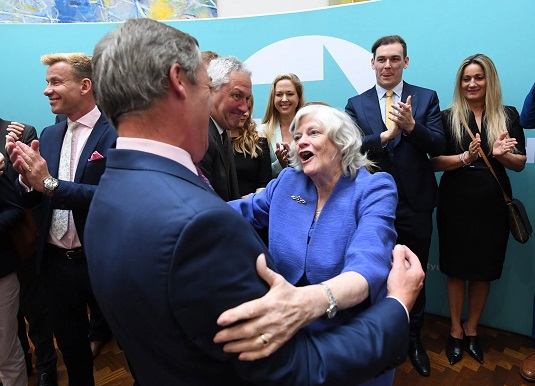
The murder of Ann Widdecombe which, accordingly to the police, now looks like a targeted killing has become an unseemly Reform jamboree because it plays into the victimhood dynamic they continually set up. A photo opp of leading Reform figures laying wreathes, plenty of buddy-buddy photos of Farage and Richard Tice with Widdecombe flooding Reform-affiliated social media, Farage moaning about the lack of security afforded him even though he declined a state-funded package offered him this year, and his claims to receive "300 threats" a month. Widdecombe was useful in life to the Reform cause as an able media performer who played well with a layer of Tory-Reform voters, and she continues to have crude uses in her demise.

Understandably, how Reform have exploited her death has attracted most attention and criticism. But far less focus has resolved on how politics generally have used Widdecombe's passing. You will have seen the tributes. Every leading politician has given the same one. "I disagreed with her politics", they say, before offering some humanising anecdote, or tribute to her energy, or her formidability, or how, once you got to know her, she was actually quite nice and kind. That all these things might be true are beside the point. Their endless repetition constitutes the received wisdom, the illusio of politics. To put it another way, Widdecombe was being treated as if her views were of no consequence, that her opinions were weightless. This is politics as if it's a dinner party, where everyone chips in with a point and position, and are so much colour that might have made for a memorable evening.

But politics does have weight. It does have consequences. Widdecombe's voting record as an MP out her on the wrong side of every single argument over the 23 years of her parliamentary career. As a social security minister and later as prisons minister, she oversaw attacks on the most vulnerable people and, famously, defended the handcuffing of pregnant prisoners giving birth. As a key Reform spokesperson, this ever-so-kind woman spent her dotage building a political party that exploits and tacitly encourages racist violence, and would threaten the limited democracy we have in this country if they form or become part of the next government. But mentioning all this is the height of rudeness, because politics presents as a public service where politicians are motivated by the noblest of intentions. Where they differ is how best to serve their constituents. It cannot be acknowledged for what it really is - the more or less transparent struggle of interests. The illusio must be maintained, even if the only people who really buy into it these days are the politicians themselves.

Image Credit

Sunday, 17 May 2026

Where Now for Politics?


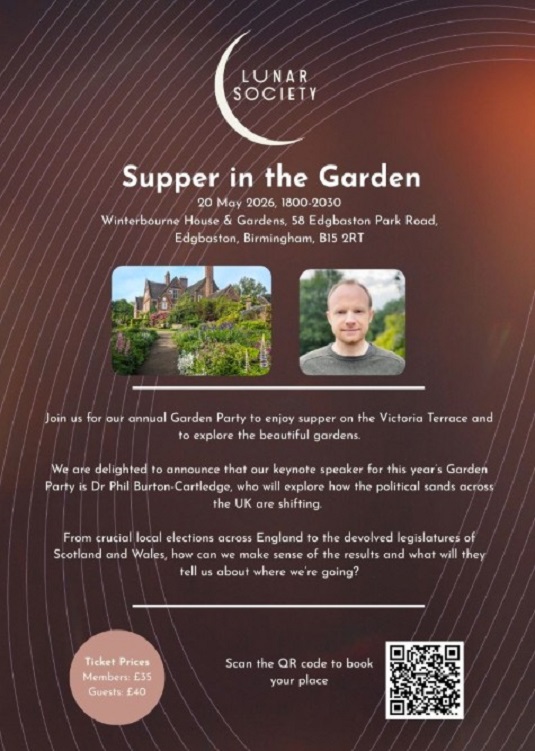
Come and hear me speak in Birmingham this Wednesday!

Saturday, 4 April 2026

Fly Me to the Moon

As of Saturday evening, Artemis II is more than half way along its sally to the Moon. The crew's journey is full of firsts. The furthest human beings have ever travelled from the Earth, the first time a woman, an African-American, and someone other than a US citizen have travelled beyond the orbit of our world. A truly historic mission and one prefacing, at least on paper a landing and then building a permanent base. Unfortunately, what might described as a noble endeavour is somewhat overshadowed by baser events. And when Donald Trump speaks to the astronauts, he's unlikely to gift posterity a dignified address.

Space has long been big business, and it's about to get larger. Elon Musk's SpaceX is due to go public, with a $1tn share issue. This success tells the real story of space industries. Like pretty much every major technological leap this last century, the state has taken up the slack of providing the basic infrastructure and demand to build up new markets. It's not for nothing that Musk is known as history's greatest welfare recipient. Take, for example, the discussions around the replacement of the International Space Station. NASA's partnership with Vast speaks to this model. It trains the company to provide the services it requires, will "sell" them some in-orbit store facilities and supplies, and buy back from them their "scientific samples". This is with a view to, later on, the company providing its own modules for attachment to the ISS that NASA will then rent from them. At each step, there's a guarantee that while employees run risks riding up and down on rockets, no capital shall come to undue harm.

What's the point? The commercial attractions of low and high Earth orbit lie in satellite communications, spying, and scientific payloads. Space tourism as a viable business proposition seems a long way away yet. The space race commentary favoured by the BBC and most mainstream outlets try and evoke something of the US/Soviet space race, albeit with America now facing off against China. But there's more than bragging rights at stake. In the immediate term, permanent presences consolidate national claims over near-Earth space, which is why this particular race is more than two superpowers facing off. India celebrated its own successful Moon mission a few years ago, implying to its neighbours that if they can manage that, it will have a similar technological prowess where weaponry is concerned. Thinking about space's place in the state system should not be overlooked.

Perhaps, in the longer longer term, assuming space stations and colonies become self-sufficient and the significant physiological consequences of living in zero and low-gravity environments is navigated, then perhaps they will provide viable markets for asteroid mining and Luna-based resource extraction. And that could prove to be an attractive outlay for Earthly capital. But that could be a century or more away, and none of us will be around to see it. Except techbro biohackers like Bryan Johnson.

Unfortunately, the existence of the space programme has a stronger relationship to something fundamental to capitalism: waste. And the example of American capitalism is the most egregious. As a global system that has drawn more countries into its rule than at any other time, capitalism churns out a surplus so large that the resources exist to feed everyone, provide safe drinking water and sewage systems, housing, clean power generation and delivery, and so on. It doesn't because it is a class system. Everything, including the expectation that business in general should turn a profit, is subordinated to the maintenance of the class relations that makes this possible: the wage and private ownership. In the age of obscene oligopoly, the realities of class are so obvious that whole sections of establishment politics have given up trying to prettify or hide wealth concentration and its consequences. It is too large, too visible to excuse. And so, instead, we get openly authoritarian parties whose chief, open interest is maintaining these class relations. Donald Trump, Vladimir Putin, Viktor Orban, the AfD in Germany, France's National Rally, and between them the Tories and Reform in the UK are part of this trend.

What has the gravitation pull of capital got to do with space exploration? Since the official inauguration of the civilian US space programme in 1958, space has been an outlet for wasteful spending. That is, by creating spending priorities unconnected to maintaining the standard of living and social infrastructure, governments generate a cost pressure that eats up resources and helps them manage the politics. The military are traditionally the chief beneficiary of this arrangement, and money thrown in this direction can be justified by the bogey of foreign adversaries. The US Department of Defense, in 2026, is set on swallowing 15% of the federal budget. The White House want to increase this for the year ahead, to be funded by cuts to useful spending like social security, health, and education. And, topically, taking an axe to NASA as well. The idea, as per the class politics of small state conservatism, is to divert resources away from social programmes that actually build things so as to manage the demands on the state and, in many cases, discourage them. In an age of sharpening uncertainty with rising prices and wages barely able to keep up, the military and threats from abroad are the Trumpist means for ruling out solutions and heading off expectations. We need to take your food stamps away because the Pentagon needs driverless ground attack vehicles.

As such, this is where space funding fits in. For the state, especially one as colossal as the US, it's chicken feed. But part of the class politics of wasteful spending nonetheless. For Musk and Jeff Bezos, their private space programmes are, after luxuries, their main preoccupation. They have a class interest in funding rockets and Moon landers, because spending money beyond derisory sums on social programmes or bumping up the salaries of their hundreds of thousands of employees cedes a smidgen of economic power to the workers and tilts the capital/labour balance that little bit away from them. That's why Musk, for instance, hates philanthropy. So Amazon-branded space suits are in. Amazon-branded breakfast clubs are not.

That said, given the swingeing cuts Trump and his hyper-class conscious cronies want to make to NASA, it appears - in line with their vandalism of US R&D generally - that having a civilian agency accomplish one of the greatest feats in scientific history is too risky for them. It could open the box to hope, to the wider propagation of scientific literacy and an interest in what might crudely be called intellectual subjects, and on top of that the radical suggestion that resources should be put into things that stretch our imagination, our capabilities, and could promise a better tomorrow. A thrust somewhat at odds with the miserable preoccupation with maintaining an indefensible status quo. For while space spending is wasteful spending, unlike throwing money at smarter guns and smarter bombs, it can lift our vision not just to the horizon of the possible, but beyond it.

Image Credit

Tuesday, 31 March 2026

Iran's Baudrillardian Strategy

As the third gulf war drags into its fifth week, neither the end nor the end game are anywhere in sight. Big bets on the stock market before Trump makes an announcement are now routine. And the President's remarks are as incoherent and contradictory as ever. "We're talking to nice people in Iran" one hour, the next is a threat to smash power stations and destroy desalination plants. He says negotiations are ongoing, while Tehran denies any such dialogue. The bombs keep raining down from Iranian skies, while in return their ballistic missiles and drones prick Israel's Iron Dome hype and thwart US defences to make life at 13 of its regional bases difficult. Here, Keir Starmer castigates the Tories and Nigel Farage for wanting to drag the UK into this war, while at the same time the US Air Force is using these islands, as well as Cyprus and Diego Garcia for "defensive strikes". Airstrip One is very much part of the conflict.

It doesn't take much to bamboozle Trump, but the White House and military planners cannot grasp why Iran is still fighting. The boasts about annihilating the navy and air force are noisy brags, but do contain some truth. Conventionally speaking, Iran cannot hold a candle against the firepower America and its Israeli satrap can field. So why aren't they surrendering? Why aren't they keen to cut a deal? Why haven't Iranians taken to the street to depose the regime? Instead, Iran is absorbing the punishment, following through with promised retaliation, shouting its defiance, and trolling Trump with Lego memes. He was expecting a gift-wrapped victory, as per Venezuela, or perhaps an Iraq-style collapse into barbarism. Something that could be sold at home as mission accomplished and, for the Israelis, the elimination of the one regional power that goes some way to matching them. None of this has happened, nor is it likely to happen.

The inscrutability of Iran, its refusal to play by the White House's rules of war is not new. It was something dissected with precision by Jean Baudrillard over 20 years ago in his famous essay, The Spirit of Terrorism. Written in November 2001 and reflecting on the September 11th attacks, much of what he diagnosed then carries over to the Iran war and the country's - apparently baffling - resistance to overwhelming force.

On the spectacle of the attack on New York, Baudrillard wrote the destruction of the Twin Towers fascinated and appalled because of their position in the global order. It symbolically embodied American-led globalisation. But, at the peak of its power, order begot an internal will to disorder, a dream of destruction fed by the conveyor of Hollywood disaster movies. As he put it, "Very logically - and inexorably - the increase in the power of power heightens the will to destroy it." (The Spirit of Terrorism and Other Essays, pp 6-7). Entertainment was meant to exorcise this suicidal impulse through pyrotechnics and special effects, but instead of dampening it down it readied us for catastrophe, almost to the point of desiring the spectacle of disaster. The West was primed for September 11th long before it happened, and the spectacle of the attack was captivating precisely because it showed the mortality of the world's greatest military power. Trump, as a television man, understands the superficiality of the spectacle. Burning Iranian cities and cratered infrastructure is dazzling to him, and plays well to his base. But far more fascinating are the military reversals - the banned footage of Iranian missile strikes across the Gulf states, the hard-to-find smashing up of US military bases, of Israeli cities mourning their dead and counting the cost of demolished districts.

The spectacle of one's own defeat goes beyond the furtive hunt for concealed imagery. It's seen in the endless reams of punditry. The discussion of how, come what may, Iran can exert its control over the Strait of Hormuz. Of how targeted bombing taking out leading regime figures, past and present, has solidified the Iranian position. How Trump's war is spiralling into global economic chaos. How, despite the severe asymmetry in the respective militaries, the US is on the brink of a catastrophic strategic defeat. The talk is of nothing else. The spectacle is as much about the tarnishing of Trump's star power and how he can lie his way out of the calamity. Like all good reality TV, the audience wants his actions to rebound back on him in abject humiliation.

What makes this more acute for Trump and the US is that Iran are refusing to abide by their rulebook. Baudrillard talks about the singular character of large scale suicidal terrorist attacks. In a system of generalised exchange, which American-led globalisation is, this kind of terrorism cannot be "exchanged" - there is no equivalent of it. 20-odd years ago pundits characterised the domestic terrorism in Europe, be it of separatist/nationalist provenance or rooted in political extremism of the left or right, as entirely understandable. Their goals were within the horizon of the modern, if not theoretically possible within the prevailing system. But suicidal Islamist terror was not. The very thing Western societies try and deny - death as a rude tragedy, as the worst thing that could possibly happen to any of us - lies at the heart of its fundamentalist nemesis. This itself is an inevitable outcome of the free, unhindered, and unbalanced operation of global capitalism since the end of the Cold War. Baudrillard argues that the duality of struggle, of good and evil, or capitalism and communism, are as interdependent as they are opposed. When one triumphs over the other, as the principle of good has in the operation of our system, and capitalism has versus its other, the defeated party becomes disarticulated but autonomous. Resistance to and the rejection of globalisation assumes an unpredictable virality, of which Islamist terrorism was one example. And one that, because its existence lies in the inherent contradiction of the system's victory, appears anywhere and everywhere against which the most powerful society in existence appears impotent.

The virality has moved on since then, but the character of Islamism has not. The Islamic Republic is now the repository of this logic. Iran's defiance attacks the logic of an order based on the positivity of life. By propaganda and by deed, the Iranian state is willing to stake its lives and those of its citizens in what amounts to a symbolic challenge. It knows Iran cannot possibly win a military confrontation, but through sacrificing itself while inflicting damage on the US, Israel, and the Gulf states, it assumes the monstrosity of terrorism, of a fundamentally 'other' foe that will not yield. Faced with such an implacable opponent, of seemingly suicidal defiance, the US is powerless. It can commit troops to a ground invasion, carry on the bombing, see through the promised destruction of civilian infrastructure - but because the Iranian state will offer up any number of lives to maintain this position, the US is doomed to defeat. For Baudrillard, as it was for the 9/11 terrorists the same applies here. For the Iranians are in a duel with the Americans, it is very personal. Their maximalist demands - reparations for damages, closure of American bases, sovereignty of the Strait - dovetail with the "internal" Western desire. Both want to see the US humiliated, not liquidated. Hence Iran's responses to missiles and bombs are missiles and drones, its counter-violence is governed by a symbolic logic, not the operational calculation of x airfields destroyed, and y soldiers and civilians blown up. Trump's empty boasting about victory secured followed swiftly with fire and brimstone is the usual bombast that ordinarily keeps his opponents unbalanced, but Iran has rejected this logic. And that is why underneath it all, panic is the mood among White House insiders, the military, and their allies abroad.

Trump then is looking for the exit ramp, and nothing he does now can look like a victory. More killing and more unnecessary destruction is, sadly, entirely likely. But the strategic defeat has already happened. Iran knows this, and so does the rest of the world.

Image Credit

Tuesday, 27 January 2026

Why I Have Joined the Greens

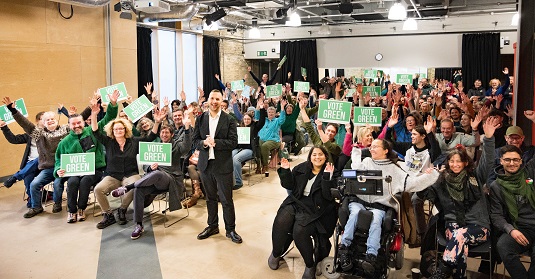
While defections are in the news, there's another that might be worth reporting on. My own. Yesterday I cancelled my Your Party membership and signed up to the Green Party. The local party meets next week, and I'm looking forward to becoming actively involved. For those interested in such things, here's the politics bit.

Binning off Your Party wasn't a difficult decision. Joining that was more a duty than anything approaching enthusiasm. Never has the left outside of Labour been handed such a golden opportunity, only for it to be squandered by prima donnaism and control freakery. Without re-litigating what happened in depth, Zarah Sultana should not have unilaterally launched the membership. The timing was right, but had she acted with the pre-party collective and abided by its ad hoc discipline the momentum would have still been there when it did go live, which was about a fortnight later. But once the die was cast, Jeremy Corbyn and his minions should have swallowed it - just as they did in the summer when Sultana announced that the new party was happening - and rode the wave. Doing so would have avoided bad blood and, most crucially, would have built on the 800,000 that signed up the mailing list. A party of more than 200,000 was in reach ... and Corbyn blew it because his helpers would rather run a much smaller, tightly controlled outfit that guaranteed them a living. Labour Party mk II not in name, but certainly in form.

And things have not improved. Despite handily winning positions aligning Your Party with an inclusive conception of class and democratic organisation, it's as if the conference votes never happened. Exclusions of members of left groups still stand, and candidates for the Central Executive Committee have been barred if they are suspected of paying subs to another organisation. Funny how there were never any complaints when the likes of Michael Lavalette, for example, was travelling around the country stumping for the new party and encouraging people to sign up. This is a violation of the spirit of what was voted on in November, and a big up yours from the unaccountable cabal that runs Corbyn's show to the membership. It now looks like this bar will be affirmed, assuming that Corbyn's slate of loyalists and idolaters sweeps the members' CEC ballot. Which it is likely to do. On top of that, there is the utter stupidity of the party's name, which alone demonstrates Corbyn's lack of political nous. And, let's be frank, Sultana's absence of political judgement. From childishly calling the awful Tory London Assembly Member Susan Hall a "boomer", boycotting the first day of her own conference, wanting to "nationalise everything", and being unnecessarily spiky toward the Greens is just daft. No confidence in the Corbyn clique, no confidence in Sultana, and no confidence in the prospect of Your Party becoming anything other than a shrine to St Jeremy. It didn't have to be this way.

But the Greens? It's doing rather well, and unlike Your Party has not bungled its opening. As the class composition of this country has changed, as recounted in the book, countless talks and podcast interviews, and on this blog on many, many occasions, politics has shifted too. A shift that the Greens are handsomely benefiting from.

Key to this is the growing importance of immaterial labour. In the post-war period in Western societies, the expansion of the state saw millions of workers taken out of private employment. Their jobs were less about producing material goods for private profit, and shifted toward producing services the public consumed. Education, welfare and social services, health care, the administration of the growing state at all levels. To use the old language, large sections of the work force were paid a wage to reproduce the conditions of capitalist production. They were tending to the gaps in the system, paving over the cracks, cleaning up the messes, making people broken or maimed by the system better, looking after those it discarded, and preparing generations of children for life under it. Alongside this the increasing complexity of production and the division of labour created similar roles within businesses. The expansion of management, the need for planners, logistics workers, technical specialists, office workers, cleaners, service-oriented work has come to absolutely dominate most advanced economies in terms of people employed and volumes of capital tied into and produced by services. Alongside this, postwar affluence kicked off mass consumption and the rise of privatised leisure activities. The casualties of this, at least in Britain, was declining church attendances, the withering away of the millions-strong political parties, and an erosion of working class community culture - which accelerated following the Conservative attacks on and defeats of the labour movement in the 1980s. But the expansion of immaterial labour selected for certain traits. In service work based on the production and maintenance of social relationships, sociability, knowledge, patience, and care were the key forces of production increasingly mobilised by the emerging post-industrial economy. Despite the privatisation of many state services and the intrusion of commodification into all facets of life, this "immaterialisation" of labour has continued apace.

The consequence for culture and politics has been profound, but to stop this from becoming another book, there are two key developments that are reaching fruition now. Because the nature of labour has changed with the object of work being the production of social relations, care, knowledge, social roles, etc., which in turn places a social premium on relatedness and sociability, this has resulted in a long-term tendency toward tolerance. Or, in other words, the gradual replacement of social conservatism by social liberalism. Each generation becomes increasingly comfortable with difference as they are socialised into and experience life as an immaterial worker. The generational differences we see in values surveys are not a reflection of lefty schooling or an essential tendency toward conservatism as we age, but a class cohort effect. There is a direct link between class, of being socialised into and working for a living in the post-industrial economy, and accepting socially liberal values as the everyday commonsense. Generation Z are the most radical, most socially liberal generation so far. And are likely to surrender that title to the younger people coming after them. The mores are cumulative, and we're now at the point where social conservatism is a minority outlook, and one that shrinks by the year.

The second consequence of this is overtly political. Faced with a politics that tries screening out the interests of the rising layer of workers, a typical mass response is disengagement and abstention, but for others it's a marked tendency to vote centre left or left. The first coming of Corbynism and, for a period, the rapid passage of the Labour Party from a husk to a true mass party - and then the 2017 general election - was the first mass electoral flex of the political conscious sections of the new working class. Though Corbyn lost badly in 2019, his real achievement, buried under the self-serving rubbish about the worst result since the 1930s, was hitching Labour to a new political articulation of class relationships. And one the party needed to build on for sustainable success. Unfortunately for Labour, it elected Keir Starmer whose project ever since has been to disperse this coalition to the point where his party courts extinction. But that dispersed support doesn't simply disappear. This is not 1997, it does have somewhere to go. Your Party looked like it could have been it, until they derailed themselves. And so, the Greens. A socially liberal party with left wing positions on a raft of issues that speaks to the class interests and outlooks of immaterial workers, stands up against the scapegoating and racism of the mainstream, and being the only party that really takes climate change, energy challenges, and the green transition seriously, Zack Polanski's leadership and his adroit interventions have catalysed and coalesced mass support around the Greens.

As argued here previously, there are two types of Green Party. The so-called realists, who elevate members to high office and inevitably disappoint - much to their cost. Like the German and the Irish Greens. And those parties that go down a Nordic path, that are to all intents and purposes Green-Left radical parties. This is currently the trajectory GPEW is on - the Scottish Greens being their own, somewhat different, thing - and is likely to draw in more members and more supporters on that basis. Far from the petit-bourgeois party as labelled by the little Lenins, the Greens are being taken over and getting filled out by our class, our rising class, and are inhabiting it as an instrument of our collective interest. It is a party that is becoming, a symptom and driver of a wider politicisation. It is occupying the position Your Party could have taken, but rejected. As Labour under Corbyn was one moment in developing the generalised political consciousness of a class, this is another. That task has fallen to the Greens. These are my reasons for joining. And why you should too.

Image Credit

Thursday, 27 November 2025

Hegemonies, Counter-Hegemonies, Anti-Hegemonies: The Theory and Politics of Social Control and Resistance

A call for papers!

The Midlands Conference in Critical Thought will be held on 21st and 22nd May 2026 at the University of Warwick. The call for abstracts closes on 21st January. They need to be submitted via Word, should not exceed 500 words, and should be sent to midlandscritical@gmail.com

Below, you will find the details of the stream I'm convening at conference. The full draft roster of the 15 streams can be found here.

Hegemonies, Counter-Hegemonies, Anti-Hegemonies: The Theory and Politics of Social Control and Resistance

Phil Burton-Cartledge, University of Derby

In an age marked by climate breakdown, stagnating living standards, and capitalist resilience, what does philosophy and social theory have to say about social stasis and social change? Is the 19th century revolutionary project outlined by Marx and elaborated by the tradition that bears his name exhausted? Do the new social movements that emerged in the 1960s still retain their radical force? Has radical politics since been blunted/incorporated by a capitalism of total subsumption that recuperates resistance and repurposes critique as fuel for sign systems, as per the provocations of Jean Baudrillard? Do we live after critical theory, or at this moment of seeming triumph for billionaires, oligarchs, and the states and institutions that serve them, is their system brittle and at the risk of breakdown?

The nature of our conjuncture, of a world where the old are always dying and the new are struggling to be born requires us to constantly ask questions about power and resistance. Especially as our civilisation is menaced by existential risks, environmental challenges, and an oligarchical ruling class uninterested in social peace and human sustainability. If not this, then what?

MCCT 2026 offers an opportunity for activists and thinkers from an array of traditions and research interests to address the question of social change, what a better society might look like, what resources and tendencies are already present that point in this direction, and how we could get there.

This panel welcomes contributions from philosophy, social and political theory, sociology and political science, international relations and social policy, as well as reflections from outside of academia. Papers that engage with the configurations of social control, such as the operation of hegemony, the workings of ideology, the inertia of social momentum and the compulsion of “necessity”, the constitution of governance strategies, and work around social reproduction theory and radical care have a home in this stream. As do contributions on the political economy of class and capital in the age of AI hype, the changing character of party systems, the possibility of cultural and political breakthroughs, capitalist mutations and systemic adaptation, appropriations of radical energies, and engagements within and between different theoretical traditions that grapple with these questions.

Image Credit

Saturday, 22 November 2025

Conceiving the Alien

Caspar Geon (AKA Tom Toner)'s The Immeasurable Heaven set off ripples of interest with its promise of a 100% alien cast of characters. Something few other science fiction authors have attempted. The other thing going for this novel is the utterly luscious, life-suffused universe of Yokkun's Depth - the teeming galaxy of the setting. To convey not just the flavour of a galaxy, but of multiple realities sets a new bar for world building in SF, but is that all there is to it?

Set a couple of billion years ago in a galaxy far, far away, the inhabitants of Yokkun's Depth - humanoidish and otherwise - are long used to a more or less peaceful co-existence. In the heart of every star resides the immensely powerful post-machine intelligences, the Throlken. They have manipulated and shaped the galaxy's biological species for over 300m years, and have given it a common language, a light touch governance structure, and a unified economy. There is no war, nor any violence. For Yokkun's Depth is a hyper-Foucauldian space. With swarms of their microscopic servants inhabiting every litre of air and not a few volumes of vacuum, violent acts are stopped by liquefying the perpetrator's brain.

The galaxy has another feature. A well that leads to layers of reality beneath the surface. These can be accessed by falling into the well, or coating oneself in iliquin, a special mineral that punctures the membrance between realities. Messages can be sent up and down the realities, or phaslairs, and they have been variously colonised by what passes for the powers of Yokkun's Depth. The Throlken, for example, are omnipresent in many of them. But the physics of sliding between the layers is one-way. Someone can travel down, but they cannot come up again. Consternation verges on panic when there is a suggestion of someone, or something, has found their way around the laws of reality and are ascending through the phaslairs. How, and more importantly, why, is a complete unknown. Even the all-powerful Throlken are disturbed and none-the-wiser.

This is the set up. A world that heaps one novum on to another in quick succession. The plot revolves around three people. Yib'Wor, who begins the novel scratching an existence out of and trying to escape a dead world, Whirazomar (Whira), an agent sent to the well to investigate and, if needs be, stop the rising entity, and Draebol, a surveyor of phaslairs and the maker of a map of the realities - something that would be sought after, if it was ever to be put up for sale. They are three characters whose paths are sure to cross eventually.

The Immeasurable Heaven is certainly a flavoursome novel. Perhaps too flavoursome given the funky, gunky habits of many of the species we're introduced too. It's well written and has that good-humoured vibe common among contemporary British science fiction writers. The dialogue is spot on, and there are some memorable characters. Such as Gnumph, a "megaspore" who swallows its passengers and stows them in its stomach as it zips about the galaxy. I do think the plot, however, could have been better defined and it is sometimes lost among the verdant prose. Also in common with much current UK SF, multiplicity has a strong presence. But unlike Adrian Tchaikovsky and MR Carey, the plot does not hinge upon it. While the aforementioned draw dynamism from the struggle between, I suppose, territoriality and deterritorialisation, of trying to force everything into a mould versus live-and-let-live, Yokkun's Depth has none of this. The Throlken police violence and they have fenced off sections of the galaxy, but that's more or less the extent of their contemporary involvement. The rising entity certainly conducts its relations with others through a strictly instrumental lens, but its ultimate goal is not about imposing a straitjacket or a prison on the galaxy.

Geon/Toner is forced to impose some reterritorialisation of his own to make a novel out of his book. The aliens are varied and weird, but their cultures and psychologies much less so. Whether an eight-winged monstrosity, a be-slippered centipede analogue, or sentient parasites inhabiting the nostrils of their host, these characters are very human. Only the Throlken remain inscrutable. Compared, again, with Tchaikovsky whose work can be characterised as posthumanist SF thanks to the level of detail that goes into constructing psychologically-convincing non-human protagonists, there perhaps could have been room here for some similar exploration. Second, for all the wonderful weirdness, the socioeconomic system that unites Yokkun's Depth and other civilised phaslairs is ... capitalism. Characters want to be wealthy. Characters have to buy things. Characters have to rent out rooms (and, on one occasion, a floating junkberg on the edge of a solar system). It's easier to imagine alternative biologies than alternatives to capitalism, to put a spin on Fredric Jameson. As such the world building only goes so far, and not far enough into the truly alien. Lastly, for a seething novel bursting with life forms, the publisher - Solaris - could not have cranked out a more boring cover. Do they not believe in catching the buying public's eye?

These criticism aside, The Immeasurable Heaven will probably benefit from a reread. There is a lot going on here away from the plot line, and there are details that could be savoured on the second trip through. It is a recommend to SF readers, certainly, and it will be getting a nomination from me for the longlist of the British Science Fiction Association awards this year. And I hope there are more adventures and explorations of this setting to come.

Monday, 10 November 2025

Why Won't Labour Take on Elon Musk?

On how many occasions has Elon Musk used Twitter to declare war on Keir Starmer's government? How often has he stoked racism, intervened in British politics, called for civil war, and - not unsubtly - agitated for Labour's overthrow? At this point, enough times to warrant official action and sanctions against his cesspit of a platform you would think. But of the government, there's nary a response. Despite Speaker Lindsay Hoyle urging MPs to delete their accounts because of Musk's repeated failure to tackle abuse and law breaking. Instead, we have a government whose departments, as well as its MPs, continuing to use "X" as if all is fine, thereby feeding its petty hate machine.

Last week, further evidence, as if it was needed, was published by Sky News to highlight the platform's toxicity. Via a content analysis of posts channelled to nine fake accounts set up for the experiment, they found Musk's drivel, and right wing posts generally, elevated by the algorithm. Even when said accounts were crafted as left wing and non-political. Despite these left accounts only following leftist posters, half the material shovelled on to their feeds were from right wingers. For rightist accounts, only 14% of political content came from the left. Non-political/neutral feeds had a two-thirds/one-third split in content, with the right taking the lion's share. They also found prominent left wing posters had nowhere near as much reach as popular right wingers. It's a good piece of work that puts numbers to the algorithmic distortion Musk has built into the system since taking it over.

Yet it's tumbleweed from the government, even though Musk's behaviour constitutes overt interference in British politics that is corrosive of Labour's position. Why aren't they doing anything about it, leaving it to Ed Davey to push back and accrue political capital from doing so? Is it another manifestation of the Labour right's congenital cowardice when challenging racist and extreme right wing politics? Partly. Undoubtedly the politics-free vacuum that is Morgan McSweeney has sucked in advice about not going to war with the press, and especially the right wing press. They will hound you without cease. Inhabiting the zone of non-punishment is what a sensible government should do, whereas attacking editorial lines or, heaven forefend, legislating against ownership concentration in the media is asking for trouble. This courtesy, founded on fear, is extended to social media firms.

There's more to it than that, though. The US right take a keen interest in Britain, and complaints from Trump's team - aided and abetted by fifth columnists of Tories, Farage, and Telegraph hacks - have successfully mounted a serious assault on the BBC. Pushing back against Musk, despite his falling out with the tangerine tyrant, would upset the delicate management of Trump that Starmer has committed his government to. They understand the "special relationship" is all one-way, but cannot do without it. The second more broadly is Labour's relationship to American tech bro capital. They want them to invest heavily in UK state infrastructure because the consequences of doing so helps depoliticise politics to the advantage of Starmer and friends. Embedding such technologies across the state sector also gives that section of capital a reliable partner in Labour on this side of the Atlantic, and - most importantly to the ministers involved - it lets them put "headed up large-scale AI implementation" on their CVs, and from their post-politics opportunities as tech execs, consultants, advisors, etc begin opening up. Nick Clegg's seven-year stint at Facebook is the model, during which he enjoyed a £2.7m annual salary, a £14.8m sum from cashing in his Meta shares, and another £16m of stock he's held on to.

With the chances of netting a similar prize by letting LLM oligarchs run riot with Britain's public services, Labour's curious refusal to enforce the law, criticise Musk, or even take their social media business elsewhere makes a lot more sense than everyday pragmatism. Especially when it's now obvious that the party could reap some much-needed political credibility from doing so.

Image Credit

Wednesday, 5 November 2025

Baudrillard Vs Advertising and Fascism

Folks may or may not know that I'm currently reacquainting myself with the work of Jean Baudrillard as part of a research project around hegemonies/anti-hegemonies/counter-hegemonies. Having recently polished off his The Agony of Power, I've returned to Symbolic Exchange and Death - the ground zero for all his thoughts about simulation, the death of reality, and the end of the social. Not only am I getting on much better than when I first had a crack at it 25 years ago, it's proving itself to be a thoroughly enjoyable and relevant read.

Some remarks may come about the book in the near future, but for tonight I'm handing the reins over to the Acid Horizon comrades as they chew over and have a few laughs with Baudrillard's work.

Wednesday, 17 September 2025

Keir Starmer Vs the Far Right

The other week, a long-time reader of this blog put a question to me. They asked what warranted the assumption that if Keir Starmer did this or that, Labour would be able to see off Nigel Farage and Reform. For example, had Starmer criticised the far right instead of rolling out the red carpet for them, what's to say his efforts wouldn't be ignored in the same way their appeasement and cultivation of anti-immigrant politics haven't stymied Reform's polling? Fair point.

What Starmer says and does with regard to the extreme right matters in two ways. Pandering to their politics in a doomed effort to out-Farage Farage has emboldened other establishment figures to ratchet up the rhetoric. Confirmed waste of space Robert Jenrick, the architect of housing refugees in hotels, would not have had the gall to join far right protests to boost his long coup against Kemi Badenoch. No mark Labour MPs might have kept their counsel. The net result of going down the "genuine concerns" path? An undermining of mainstream politics, and Labour in particular. Had Starmer stood against the tidal wave of filth breaking over British politics would likely have kept more of the Labour base on side. The divisions in Starmer's personal base, which remains the managerial layers of the state, local government, and public sector bureaucracies, would never have manifested and given Labour that little more ballast to face the political head winds. Coming out hard against racism, which the Prime Minister delegated to the King last year, and individual Labour MPs these last few days, could begin winning back the natural support he has so far alienated.

What Starmer does also matters. There has been some criticism of Zack Polanski in recent days for linking the growth of the far right to the consequences of austerity and a starved public realm. The implication being that there is a direct correspondence, and that if Labour weren't committed to broadly the same approach to statecraft as the Tories then none of this would be happening. For example, Richard Seymour has argued at length about the libidinal roots of far right politics, and the spasm of pleasure that is derived from punching down. Therefore a properly funded NHS or, to use the Starmerist lexicon, "delivery" would not see the extreme right off.

Yet there is a relationship. As argued many times here and in the book, the building of the Tory voter coalition in 2017 and 2019, and the failed efforts at reviving it since, was based on an understanding of who the core vote was, how they were structurally predisposed to a politics of fear, and using the levers of government and media propaganda to stoke those fires further. A blend of statecraft, governance, and faceless processes of individuation and atomisation have broken up senses of community, evacuated hope from anticipations of the future, and engendered a wide sense of fatalism, if not powerlessness. A politics that offers some people some certainty, while identifying targets that are symptoms of or causes of the malaise can affect a powerful attraction, especially when it involves performative spectacles of scapegoating or that old trick of saying the "unsayable". If Labour had a different political economy and Starmer was governing as if his leadership pledges mattered, Britain would be on the path to better wages, security at work, an obvious and visible movement of rebuilding public services, making state and politics more responsive, and so on. It's not that dealing seriously with the cost-of-living crisis negates the far right, but consequences of this programme would cultivate social conditions that are less conducive for those politics to thrive. Ontological insecurity is displaced by its opposite. By way of demonstrating its obvious truth, why are Reform next to nowhere with young people? Is it because they're all saintly and see through their drivel? Or does it have something to do with their social circumstances, that there is something about their social being that conditions their attitudes to the world at the conscious and unconscious levels?

Labour are in a position to do something about the rise of the far right, which they are doing. It's not just Starmer and McSweeney's pathetic Chamberlain cosplay that's making life easier for the Farages and Yaxley-Lennon's of this world, but it's the consequences their beggar-thy-neighbour politics, their "fiscal rules", and utter disinterest in addressing this country's long-term problems - because it goes against the interests of those whom they serve - that are doing real damage to our social fabric. This is their responsibility, and there is no doubt in my mind that they will carry on as they are. Until they are either removed, or Farage gets himself into Number 10.

Tuesday, 3 June 2025

Geoffrey Wheatcroft at the End of the Tories

I owe Geoffrey Wheatcroft something of a debt. Before getting hold of John Ross's Thatcher and Friends, which argued that the blessed Margaret's 1983 triumph was symptomatic of a decades-long secular tendency toward decline, there was The Strange Death of Tory England. An irascible and funny condemnation of the Conservatives by one of their own, for Wheatcroft is a Tory journalist. And unusual for his tribe, an honest one. Strange Death was and remains an important book because it tries to get to grips with the party's crisis from the right, and eschews the drivel and comfort thinking of more recent lesser efforts. Having also written a book on the subject, I was interested in what Bloody Panico!: Whatever Happened to the Tory Party? - Wheatcoft's latest tome - had to say.

And the unfortunate answer was ... nothing much new. It is a brisk, short read packed with obscure anecdotes of Tory Party lore, and withering observations of the miserable cadre of Conservative politicians this country has suffered. Particularly of the fraudulent Boris Johnson. But knowing his explanation for why the Tories are facing their final crisis depends on being familiar with the earlier book. Wheatcroft himself dubs Panico as less a sequel, and more a coda or afterword. It reads like one. We are taken on a whistle stop tour of everything that has happened to the Tories since Michael Howard piloted the Tories to a third successive electoral defeat, and with the curled lip of disgust deals with all his successors up to publication in early 2024. Kemi Badenoch is therefore sadly absent. There are insights and tales of scandals to whet the salacious appetite, but without the original book you're left thinking Wheatcroft puts the crisis down to bad politicians being bad at politics.

In Strange Death, the end of the Tories began in the 1960s. This was the period where the interwar generation of patrician Conservatives were gradually displaced and shunted aside by a rising generation of petit bourgeois and professional politicians. This was a cohort that had only known rising living standards and growing affluence, but simultaneously did not see, or as is more likely, did not respect the foundation on which this was built: the compact between capital and a massive, active labour movement. Thatcher typified this trend, hating both the unions and the patrician Tories in the party that "caved" to them. But she was not the source of the Tory sin against reasonable conservatism. What did it was the abandonment of the conclave method of selecting a Tory leader by a ballot of the parliamentary party. The occasion was the fall of Alec Douglas-Home, and voting was brought in as a reaction against his appointment by preferment. In the first exercise of inner party democracy in the Tories' history, Ted Heath came out on top. And as the parliamentary party became more "professional" in composition, the ballot ensured the grip of the Old Etonians was broken. Its future was no longer guided by gentlemen of good judgement, but by rootless MPs easily swayed by faddism and popularity. This more than anything else sealed the Tories' fate.

There is something to this argument, but it is a shame that Wheatcroft didn't recapitulate it for Panico as it might have encouraged some of his more superficial readers to think deeply about the Tory crisis. Instead, all we get is a lament for a decent conservatism that once was. This implies, not unlike Peter Hitchens's frequent criticisms of the Tories, that they're no longer conservative. But whereas Hitchens argues it's because conservatism has been displaced by an amorphous progressivism (if only), for Wheatcroft - though he doesn't explicitly say it - they are a party, standing naked to the world, that supports class power, privilege, and inequality. And no party so exposed cannot last very long.

Panico therefore comes with a recommend, if only for the novelty of a Tory not putting the roots of their crisis at getting rid of Johnson, or not stopping the boats, or letting Brussels rule Britain for so long. But for the full spectrum and dimensionality of the crisis, there is another book and a blog for that.

Image Credit

Thursday, 15 May 2025

Immaterial Labour, Values, and Voting

Happen to be at a loose end in Derby on Thursday 22nd May?

Why not come to The Quad and listen to me speak about a paper I have in the works. For long time readers, the subject won't come as much of a shock: the talk is called Immaterial Labour, Values, and Voting Behaviour. Here is the blurb.

Phil Burton-Cartledge’s research into the changing character of work and class in the 21st century argues that there are reasons to think the future might be a better place. Phil argues that observations around the values differences between generations, which results in different voting preferences as well as tendency to not vote at all, the emergence of gender splits along attitudinal lines, and the decline of anti-immigrant, racist, sexist, and homophobic prejudices are all part of the same process. In this talk, Phil explains and criticises other approaches offered by political science scholarship that have observed the same phenomena, but offer limited and, at times, contradictory explanations that avoid addressing the significant structural changes capitalism in the West has undergone. In contrast, Phil suggests that analysing these changes in their entirety brings out their political implications – which might mean the present resurgence of extreme right wing authoritarian politics could be its last gasp.

This is at The QUAD at 7pm. It's free but booking is recommended - you can do that here.

The Research Cafe is a monthly event where researchers, activists, academics, artists, and authors talk about their work. If you'd like to sign up for notifications for future events, just drop me a line and I'll get you on the mailing list.

Image Credit

Monday, 28 April 2025

How Labour Could Beat Reform

Labour can win the next election without pandering to right wing prejudices. That's not your run-of-the-mill left winger arguing this, but recent work undertaken by Steve Akehurst for public opinion researchers, Persuasion UK. The piece, 'Getting to Know Reform Curious Labour voters' presents lots of useful nuggets that puncture the media-confected myths around Reform's vote and Labour's exposure to them.

For example, 11% of Labour's 2024 coalition fall into the 'Reform curious' category. And if all of them switched their allegiance at the next election, all other things being equal the party would shed 123 seats. Blimey, that sounds serious. In other parts of the country the problems are worse. In seats where Reform came second, 13% of Labour voters are open to swapping Keir Starmer for Nigel Farage. In Scotland, potential defectors are pegged at around 18% of the vote. A case of keep calm, carry on scapegoating the immigrants, and everything will be alright. Right? No. The polling finds 29% of the 2024 Labour coalition are 'Green curious', and 41% are prepared to support the Liberal Democrats under the right circumstances. And those said circumstances cover substantive lurches to the right.

The Reform-curious tend to share similar demographic characteristics with Reform voters at large (white, older, disproportionately male), are more socially conservative than the rest of the Labour base, and for 66% of whom immigration is the key political issue. But these positions are "worn lightly". For example, p.34 shows the long distance between the Reform curious and actual Reform supporters, even though they're on the right of Labour's coalition. For the latter, anti-immigration, anti-Green measures, and their antipathy to "woke" is baked into their world views. For the Reform curious Labour voters, it's more of an inclination.

This is important, because it suggests rightist tendencies within Labour's coalition could be overcome without too much bother. However, capitulating to them would be devastating. The centrepiece of Akehurst's research is an experiment which measured the weighted sample's responses to Labour adopting certain policies (p.67). It finds that leaning right on immigration keeps a few percentage points of the Reform curious on board, whereas the most extreme position - banning all immigration - could reach into the Reform vote itself. But the price paid would be the mass abandonment of the party by left wing voters. And this is after many liberal and left wing voters had already gone elsewhere in 2024. Going right secures negligible benefits at significant cost.

How might Labour avoid this fate? By not shifting right. Akehurst establishes that many of the Reform curious are "economically populist", or in straight forward terms, left wing on materialist issues. Workers rights, tackling inequality, rebuilding public services, and wealth taxes are much more popular with this group than Reform voters at large. And, electorally speaking, it's the sweet spot. Avoiding the ground favoured by the right and pushing populist economic messages against entrenched interests loses no votes to the left, and crucially none to the right either. The study does not look at voters who went elsewhere last year, but as there is a growing progressive majority in this country, such positioning could recapture votes lost and go a long way to secure the party its second term.

Picture the scene when these findings lit up the Downing Street radar on Monday morning. Will Labour alter its policy direction in light of this evidence? Will it change their strategy where the ignominious collapse of the Democrats and its centre left brethren on the continent have so far failed to convince? I'm sorry to say Morgan McSweeney is likely to file this report in the trash folder. This isn't because he genuinely thinks the path to re-election lies through racist posturing, but that his project - and that of Starmer's more generally - is about managing the politics in capital's interest. This means patrolling the political terrain so things like hope and raised aspirations are shot down if they so much as peer out of their foxholes. This government has constructed a fiscal fiction designed purposely to dampen expectations, and is refusing to countenance taxes on capital and wealth because, well, the more class conscious sections of our rulers fear where that might lead. The data is inconvenient, because it's at cross purposes to the government's project. And so into the bin this useful and interesting piece of work will go, while the "Morganiser" carries on laying the foundation for a catastrophic rout four years hence.

Image Credit

Saturday, 26 April 2025

Data as Bourgeois Morality

Data pervades everything. For those of us whose employment does not produce data, our consumption does as phones, computers, televisions, and our purchases capture our activity and feeds that into vast datasets. Here, the ghosts of our agency are carved up into distributed fragments, which are utilised by the business models of the platforms to sell advertising, and shape our attention through algorithmic selection of content that will catch our further attention.

But for those who work with data broadly - not just the digitised kind - it is embedded in the job description. Data is a system of concretised ethics enforced by the employment relation, in the first instance, and horizons of credibility, of social conventions based on the the affirmation and demonstration of evidence. As I am an academic, the concern for data determines the character of the presentation of research, the marketing and student experience efforts that cover my programmes, and must be invoked to justify changes to course content and assessment, the launch of new degrees, and the business case for taking on new staff. This is the lot of other education workers, particularly teachers with the vast trail of paperwork cataloguing their practice as educators, and also civil servants, mid-level managers across the public and private sectors, buyers in retail - every job that requires making decisions about the delivery of a service or the provision of a product.

And it directly governs. Since the emergence of modern wage labour in the English countryside, targets have been one tool among many used by employers to individuate and atomise workforces to enable their management. Today, when immaterial labour predominates and is simultaneously being attacked and deskilled, targets as a method have proliferated into a matrix of performance indicators for managing post-industrial labour. The worker, from the lowest paid to the relatively affluent are subjected (and subjectivated) by streams of algorithms and targets that measure aptitudes, define productivity, and determine the character of one's tasks. They shove (rather than nudge) labour along prescriptive circuits. The data points workers are judged by are often conjoined with those outside of their control - such as market conditions - and they are held to account against them.

Data as employed in capitalist societies is not just a practice/technology for managing workers, it has the characteristics of a moral code. Of, more precisely, a bourgeois morality. Like religion, the moralities of law and order, and the explicit statements of bootstraps neoliberalism, their subjects are the objects of exploitation. Bourgeois morality marks the bourgeoisie's innumerable, multitudinous others, and works to govern them. They themselves are, by and large, left unmarked. The neutral term. The starting point. That natural way of the world. Therefore, moralities spiritual and secular do not apply to them. The same is true of data.

How many CEOs "abbreviate" the evidence-based decision-making they enforce on their employees? How many politicians are impervious to the data-heavy briefings handed them by civil servants when they push particular policies? The further up the hierarchy one travels, the employment of data becomes more episodic, and its status as a tool of governance becomes all the clearer. These exalted levels operate with different sets of priorities: not what data tells them about what decisions would bring the greatest benefit to the greatest number, nor even in the narrower terms of using data to prioritise economic growth. No, data plays second fiddle to the politics of class maintenance. The successful exercise and preservation of class privilege and class power requires flexibility and opportunist nous. The realpolitik of our rulers depends on instinct and the feels in the first place, and the enforcement of decisions that reiterate their power-over. In these mundane circumstances of capitalism's everyday, data that shows they're wrong is simply noise.

Image Credit

Saturday, 11 January 2025

Baudrillard Vs Trump and Musk

It's a while since Acid Horizon product was last featured as a gap filler on this blog, a tradition I'm happy to resurrect on nights where the writing isn't happening. In this episode the comrades use and think against our old friend Jean Baudrillard on the nature of evil. As good Deleuzians, the hypemeister of hyperreality is found wanting. But in addition there are interesting insights into the authoritarian character of the Trumpist/tech bro crossover project - particularly their fondness for the obsolete forms of disciplinary power, which is especially noteworthy as social media platforms are the basic technologies of the control society.

Wednesday, 11 December 2024

The Futility of Chasing the Right

In another disaster class at Prime Minister's Questions, Kemi Badenoch attacked Keir Starmer for not prioritising immigration as one of his pledges unveiled at the government's relaunch last week. Talk about stepping on a rake. The Prime Minister relished the chance to attack the Tories "open borders experiment", following the revision of 2023's immigration figures up to 906,000. As far as Labour strategists are concerned, every time Badenoch mentions the I-word it's gifting Starmer opportunities to own an issue that is traditionally the preserve of the right. The more she bangs on about it, the more Labour will remind voters of "porous borders", record number of arrivals, and promises that the Conservatives failed time and again.

This is not smart politics.

In Anushka Asthana's book about Morgan McSweeney, Labour's chief strategist, she sketches out the thinking behind the strategy. First is the assumption, ironically shared with the Leader of the Opposition, that the Tories lost because they didn't keep their promises about immigration. McSweeney also blames this for the retreat of the centre left cross Europe and why the extreme right are on the march. Where the centre left does well, with Denmark's Social Democrats as his poster child, it's where there are tough entry requirements on the borders and immigration is falling. Reducing the numbers and delivering on the rest of Starmer's modernisation effort will win the re-election, so it goes.

This is the path to disaster. While it is understandable that the Tories should shift right to consolidate their vote after a severe trauma, it makes no sense whatsoever for Labour to do so. They have Reform to thank for disproportionately stealing votes from the Tories and letting dozens of Labour and Liberal Democrat challenges come through the middle, but McSweeney's job now should be about keeping hold of the coalition the party assembled and deepening it. For instance, as this polling by Focaldata demonstrates, there is a big overlap between Conservative and Reform support. Labour and Reform support? It's marginal. To put that in numbers' terms, polling by Compass found that 48% of Labour's voters in July would consider supporting the Greens or Lib Dems next time. The figure for Reform or the Tories was just 23%. Before the election YouGov polling found immigration was the top issue for Reform and Tory voters, but was joint seventh - with education - for Labour voters. And, there are big age gradients when it comes to who finds immigration troubling. No prizes for guessing who the most concerned are.

It doesn't matter how much Labour bangs on about immigration. They can form their anti-immigration caucuses, mock the Tories for being "too liberal", boast about suspending asylum claims from Syria now that Assad has fallen, and put up billboards around the Midlands and the north about how deportations have increased and migrant flows have come down, it won't make a blind bit of difference in winning over reactionary right wing voters. For one, lots are not Labour people in the demographic, sociological sense. And second, it would do Labour well to remember it never had a political monopoly on the working class. Ever since the advent of mass suffrage, it has been entirely normal for significant layers of the working class to support the Tories. Never a majority and perhaps not even a plurality - despite the smoke and mirrors surrounding Boris Johnson's victory - but proletarian conservatism has always existed, has always been hostile to Labourism, and will never support the party that was set up to represent their collective interests. Fast forward to 2024 and these layers still exist. They tend to be older, maler and whiter than average, and they are more likely to be attracted to Reform than the Tories. But that, ultimately, is a problem for Badenoch and her hapless shadow cabinet - not Labour.

There is nothing wrong with trying to win over voters who support right wing parties, but there are ways of doing it. I would suggest banging on about immigration and scapegoating the right's latest folk devils is unwise because it demobilises and disperses Labour's existing coalition. Stopping winter fuel payments is not the only reason why Starmer's ratings have tanked and Labour have plunged to polling scores not seen since the divisions over Brexit in the summer of 2019. Again, consolidating Labour's vote now is the path to victory in 2028-29. The thin election result was a consequence of not doing this from opposition. Refusing to in government is suicidal.

Image Credit

Thursday, 24 October 2024

Speculative Sociology in Children of Time

A book about spiders? Hallowe'en must be approaching. But on this occasion, it's not our eight-legged friends who are the horrors. It's us. Adrian Tchaikovsky's Children of Time might also be scary for those who don't like the contemporary commonplace in SF where postmodern difference sits comfortably with future visions and compelling story. Anyone in that camp are ruling themselves out from one of the best SF novels of the last decade. Spoilers follow.

Children is set several centuries into the future and we've made our way out among the stars. Earth-analogues are non-existent, so we have to make them and terraforming efforts are underway on several worlds. But not all is well. There is a schism on Earth between the relatively enlightened technocracy that runs things, and anti-tech zealotry. An insurgency erupts and civilisation is laid to waste, with saboteurs destroying humanity's off-world presence and vicious malware effectively bricking any advanced technology that is left. The war breaks out as Dr Avrana Kern is about to experiment with accelerated evolution. Her world has been successfully terraformed and has prepared a group of nano-virus infected monkeys that should bootstrap them to sentience within a millennia or two. Unfortunately, her station is destroyed just as she escapes to the monitoring pod. Unbeknownst to her, the poor monkeys are toasted on atmospheric entry but the nano-virus makes it to the surface where it finds an accommodating host: Portia labiata - jumping spiders. As the centuries roll on, civilisation re-emerges on Earth after a war-induced ice age but as the glaciers recede the poisons of the past thaw out and destroy what's left of the biosphere. The survivors are forced to scrape together the Gilgamesh, a generation ship, and head out to find the terraformed worlds hinted at in the 'old empire's' surviving records.

Tchaikovsky isn't the first to imagine a civilisation arising from another species, but perhaps no one has managed it with such aplomb. The world building is among the best that 21st century SF can offer, but this is much more than a latter day The First and Last Men. The narrative is compelling as the spiders climb to sentience and build a sophisticated society, as setbacks on the Gilgamesh reduce the humans to barbarism and, toward the end, bloodthirsty would-be conquerors of the spiders.

On the spiders, they share their world with several other sentient and semi-sentient aquatic, arachnid, and insect species. Spider cities emerge resembling shifting structures of webbing (what else?) based around matriarchal households. Males are, like their real life counterparts, much smaller and endure a second class existence as discards and, sometimes, post-coital prey. There are also significant evolutionary filters the spiders have to overcome. The first is an out-of-control super colony of mutated ants. The nano-virus has developed a non-sentient collective nest intelligence that works like a computer, and threatens to overrun all spider settlements. They are only defeated by employing chemical manufactories to render the ants docile. Thanks to the manipulation of scent the great nest is programmed to serve spider kin. It also has the happy affect of accelerating technological development as the ants had mastered mining and metal smelting.

The other key factor in their cultural development is The Messenger. A small star that whips through the night sky, this is Kern's life pod/sentry construct. From the ants the spiders learn it is broadcasting radio, and as they decipher the utterly alien human language they are driven to develop mathematics to crack the code. Unfortunately, as Kern by this time is a half-mad composite of human, an AI copy of her personality, and the life support system that sustains her she sets herself up as a god and urges the spiders to follow her message. The results are schisms and wars, with the largest city of Great Nest the seat of orthodoxy and its sometimes rival Seven Trees cast as the apostates. Great Nest's armies carry all before it until a wiley male refugee creates a method for programming ant armies on the fly. The religion is overthrown and, as a price extracted for his invention, Seven Trees and other spider cities concede full personhood status to the males.

Meanwhile, things go from bad to worse for the humans aboard Gilgamesh. As they approach Kern's world they are forced to retreat in the face of the sentry's weapon systems. But not before a crash landing and a rescue reveals the planet is infested with oversized bugs. They head off to another terraformed world but find it's a bust. From pole to pole it's covered by an extremely invasive species of fungi. They are able to salvage some useful ancient technology as a sticking plaster, but their only option is to turn back. After internal power struggles they approach the world with their weapons armed for a war of annihilation ... but are shocked to find the spiders have now mastered sub-orbital space flight and have built an equatorial ring (also out of webbing, of course). Who will prevail?

Tchaikovsky's speculative sociology is more or less on point. While the spiders have developed a class society, the taming of the mindless ants provides a material base that means it's a lot less exploitative and conflict ridden than human communities. There is also a stronger sense of empathy among them thanks to the novel way they can pass on knowledge. The spiders discover that some selective breeding allows for Lamarckian evolution. Experiences, behaviour, and "understandings" can be written into the genetic code and passed on. They are later able to isolate this further so one can go to a library and effectively inject a memory, a skill, or knowledge. This all thanks to the nano-virus's mutations. It's this ability that ultimately saves both species. The spiders lead an assault on the Gilgamesh and overpower its defenders through chemical warfare. But this is a passive technology based on re-engineered nano-virus. Exposure to it causes humans to empathise and recognise the spiders as sentient beings, and that war against them is futile and wasteful. If only questions of war and peace could be settled so easily.

Children of Time sits well with Tchaikovsky's SF oeuvre. In The Doors of Eden, only the merging of radically divergent parallel Earths can save the universe. The Shards of Earth sees humanity combining and hybridising with alien species to see off civilisation-ending threats. Dogs of War and Bear Head are about bio-engineered super soldiers that are crossed with animals. And Alien Clay sees an exile from a totalitarian Earth get to grips with the weird diversity of an alien ecosystem. Here, the spiders progress not through the exclusion or extermination of other species but by a benign domestication of their environment. The use of chemicals and scents are central to their symbiotic relationship with the ants, and likewise humans are only able to overcome their declinist, warmongering rut by becoming a companion species comfortable with the oddness of the other. Donna Haraway would approve. The book therefore ends on a hopeful note some decades after the spiders and humans have come together. A signal is received from another world and a multi-species starship crew are dispatched to investigate. Hence the next volume, Children of War, has its jumping off point. Once again, without bashing us over the head difference and multiplicity are shown to be our route to a better future. Those that emphasise oneness, be they closed identities or symptoms of contemporary alienation are dead ends. Children of Time serves as an entertaining reminder of this.

Image Credit