Showing posts with label Strategy. Show all posts

Sunday, 15 December 2024

On the Road to Somewhere

It didn't attract much coverage, but last week The Spectator reported that the co-called 'Gaza Independents' will be registering as a political party in the new year. This follows months of off-again, on-again talks between Jeremy Corbyn supporters, a handful of left notables grouped as Collective, and sundry others. After 30 years of false dawns for new left alternatives, could this be a contender?

A couple of things in the gravy should get picked out before we reach the meat. First, that the political space to Labour's left is so obvious that even the bourgeois press are picking up on it. Patrick Maguire wrote about it for The Times last Thursday, and it got coverage from UnHerd, albeit through the prism of a whinge about religious sectarianism. Because the website's founder would never endorse divisive, extremist politics.

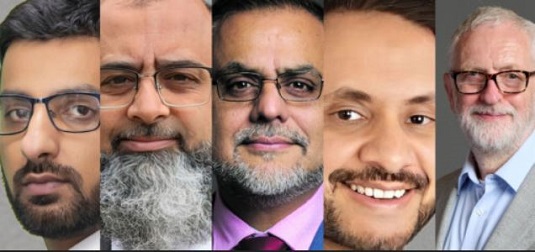
The second point, overlooked by professional politics watchers, is what's happening in the Commons. On 9th December, the Commons Procedure Committee announced an inquiry into the status of independent MPs. This is being explicitly convened to address the formation of the Independent Alliance, the grouping of Corbyn, Shockat Adam, Adnan Hussain, Ayoub Khan, and Iqbal Mohamed. This is to establish whether ad hoc groupings can be afforded the same rights as those sitting for registered political parties. It will also examine the "status" of independents, whether they're elected as such or end up losing a party whip. That the IA announced they were formalising themselves as a proper party the day after is sensible lest the committee finds ways of limiting their access to resources.

Considering the party itself, as noted on other occasions Corbyn isn't overly keen at the prospect of a new organisation, favouring a slow and steady community building approach. The issue with this is its strategic indifference to the political opportunities opening now to build something new. Such as the suspension of seven Labour MPs because they stood up for our people. The problems facing a new left party are well understood and have been covered here almost to death. There's the fractious character of the left and the legacies of bureaucratic manoeuvring and little Lenin syndrome, the Greens' left turn, and the outsized privilege any parliamentarian would enjoy in a new organisation. And this is an issue when you look at some of them criticising Labour's tax on landed wealth from the right, and opposition to banning on first cousin marriage. No party discipline works for the Greens because, among their four MPs, there's a great deal of policy agreement. Among an IA left party it's a recipe for internal dissension, chaos, and paralysis.

If these can be overcome, there is a big prize waiting. Of the Westminster parties, none speak to the reality of workers' lives in the 21st century. Labour doesn't, but its commitment to Blue Labourism seems like an excuse to do right wing things rather than a genuine and serious strategic orientation to the working class. The so-called Workers' Party of Britain seeks to fill the sweet spot identified by political scientists - economically radical but socially conservative. George Galloway has said that the "Arab world is dead to me" following the collapse of the Syrian regime, so that gives you an idea about the direction that project is heading. And then the Greens, economically radical and socially liberal - so the party enjoys congruence with most people's outlooks. But the absence of an explicit class orientation in words and deeds does and will continue cutting them off from the most disenfranchised voters - the people the left need to win and activate as a political force. The new alliance, if it gets the class orientation right, could supply Labour with more than a few migraines over this parliament. But, as ever, it depends on the politics and as they stand at the moment it would be wise to temper one's expectations.

Image Credit

Thursday, 26 September 2024

Time for a Left Alternative?

No time for a proper post today as I'll be in London speaking at the first of the Party Time? series of discussions this evening. If you can't make it or fancy a preview, my contribution will draw heavily on the below. This was first published by Labour Hub earlier in the week.

A Conference for a Party that has won its second highest seat tally ever should be an occasion for celebration. But the partying mood appeared absent from Labour’s annual gathering. The week-long feeding frenzy on ‘freebiegate’ would have come as a shock to Keir Starmer supporters who bought into the ‘Mr Rules/grown-up-in-the-room’ image that has been crafted for him. It would have sent a shiver down the dozens of backs of newly minted MPs in marginal constituencies, whose success lies partly in painting their defeated Tory opponents as corrupt and incompetent.

But there are other worries too. The thinness of Labour’s vote demonstrates the shallow relationship ‘Starmerism’ has with the country at large, a level of indifference that saw Labour’s support dip beneath 10 million votes for the first time since 2015. What should be a moment of supreme confidence is shot through with unease.

This is not helped by the results mustered by challenges to Labour’s left. The returning of four MPs – one at Labour’s expense – and almost two million votes suggest the Greens are poised to be a serious problem for Labour during this Parliament. It’s doubtful the Turning the Green tide event at Conference last Sunday would have calmed many jitters coming from this direction.

But what could amount to a bigger and possibly existential problem is the possibility of a viable left alternative. The victory of Jeremy Corbyn and the unexpected wins by four more anti-war Independents, plus very strong results in some places for other left-wing indies and George Galloway’s Workers’ Party could be a foretaste of difficulties to come. The suspension of seven Labour MPs for going against the whip on lifting the Child Benefit cap also creates an (on paper) parliamentary nucleus around which a new united left party could be built. Are the stars aligning for a viable left alternative?

The space is there, so it behoves the extra-Labour left to make the move. Which is what will be debated at the upcoming series of Party Time? public discussions about left strategy under Keir Starmer’s Labour. But it’s not as simple as simply declaring a party, as the last 25 years of left electoral experiments have taught us. The central question for any new party project has to be ‘What is it for?’

The answer for some of the left is straightforward: a combat party capable of taking on the capitalist class and building working class capacities to the point where a revolutionary crisis breaks out, which the party can then prosecute to victory. For others, it’s the creation of a broader party that is simply about challenging Labour from the left. But here, there are issues around whether it should exist to ultimately displace Labour, or act as a pressure group to keep it honest. These are the three strategic positions likely to dominate debate in a new formation and could easily cause it to fall apart in short order, or bring about an unsatisfying fudge that could enshrine permanent factionalism.

Then there are questions about how it should be built. Jeremy Corbyn has argued for a community-focused orientation. He says the sinking of deep roots across Britain is the prerequisite for building something lasting. The truth of this, he suggests, was shown in his own victory against the Labour machine.

The problem is that while this would be ideal, it overlooks how Corbyn’s example is based on his being the MP for Islington North for 41 years, and hamstrings any effort to make the most of the opportunity now in front of the left. The alternative is some central direction, by someone or a collective with a national profile to take the lead. The seven suspended Labour MPs are best placed to do this. Their views are more in tune with public opinion than the Labour leadership’s, and it’s unlikely most will get the whip back soon.

But this too comes with problems. How many, if any, want to take this lead? Do they think their political priorities are better served by remaining left Labour MPs, and therefore seeking readmission to the PLP? And if any do want to take this role on, does this not replicate the priority Labourism accords MPs over the rest of the party, no matter how formally democratic this left alternative sets out to be? And if this is the case, what role in an electoralist party for those who are involved but are committed to a revolutionary project of some sort?

There are no easy answers to these questions, but they have to be grasped, debated, and decided upon, if the extra-Labour left want to build a new party. The gap in Britain’s political ecology is open, and the left have an opportunity to fill it. But the moment is time-sensitive and if it doesn’t, the Greens almost certainly will. What’s it going to be?

Thursday, 12 September 2024

Where Now for the Left?

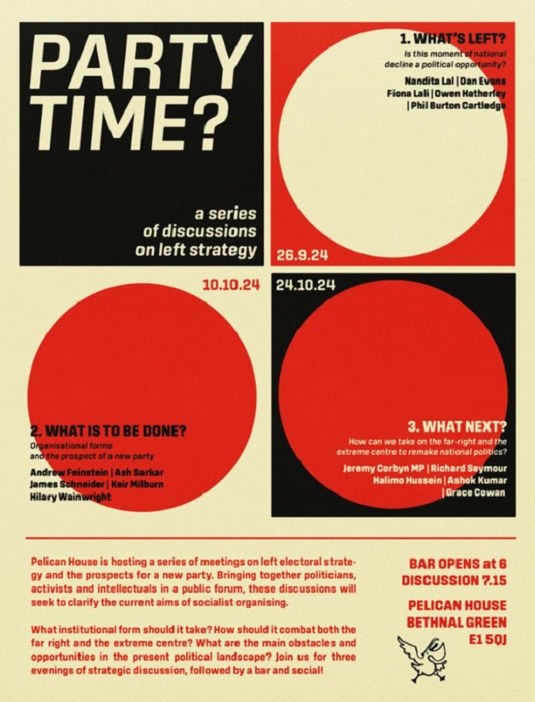
A perennial question for our movement if there ever was one (and one asked here plenty). But instead of contemplating it through a long read of the grey beards, or zero-summing it with tankies on social media, why not come along to this series of public discussions in London town? On 26th September, 10th October, and 24th October at Pelican House in Bethnal Green we have three sessions exploring this vexed issue.

The events are free (donations welcome) but they are ticketed. Please secure your place here. Hope to see you there!

26th September: What’s Left? Is this moment of national decline a political opportunity?
Nandita Lal / Owen Hatherley / Dan Evans / Fiona Lali / Phil Burton-Cartledge

For decades, Britain’s working class has been battered by falling wages, rising poverty and gutted public services. The Starmer government is offering them austerity and authoritarianism, while the far right are attempting to capitalise on the atmosphere of discontent. The left, atomised and fragmented in the wake of Corbynism, seems ready to re-emerge as a national political force. What are its current power bases? Where is it strong and where is it weak? What type of organisation is needed to challenge Labour’s fragile hegemony and remake our rotten system? Join with other comrades who have been asking these questions for the first in a series of three events exploring left strategy today.

10th October: What is to be Done? Organisational forms and the prospect of a new party.
Andrew Feinstein / Ash Sarkar / James Schneider / Keir Milburn / Hilary Wainwright

In 2017, nearly 13 million people voted for Jeremy Corbyn’s radical left-wing programme, demonstrating the viability of a popular mass politics opposed to inequality at home and war abroad. Since then, the establishment has tried to erase that result from public memory. Yet the election of nine Green and independent MPs this year shows that they have not succeeded yet. To capitalise on this historic breakthrough and rebuild our strength at the national level, socialists need a new political organisation. But what form should it take? How should it relate to left parliamentarians, trade unions, social movements and the broader working class – especially outside the major cities? Should it be focused on the electoral sphere, or should it play a more expansive role?

What Next? How can we take on the far-right and the extreme centre to remake national politics?
Jeremy Corbyn / Richard Seymour / Ashok Kumar / Halimo Hussein / Grace Cowan

The long-simmering threat of the far right has now burst into the open. Reform UK elected five MPs this year and came second in 98 seats. Racist riots have erupted across the country, fuelled by an ecosystem of migrant-baiting politicians, media outlets, funders and influencers. With Labour more than willing to mimic the toxic politics of Farageism, a new left electoral project will have to challenge the xenophobia of the entire political class. How can it rise to the challenge? How can those interested in national organisation move forward collectively? What should we do next?

Sunday, 1 September 2024

A Note on Authoritarian Modernisation

In a recent comment on the analysis of Keir Starmer's "tough choices" speech, an anonymous contributor argues that to talk about Labour's "mission" in office is to extend them the kudos they do not deserve. They are straightforward lackeys of capital and puppets of the US state department, and that's all we need to know. This speaks to an attitude I encountered while writing the book. We know the Tories are bastards, we know they are our enemy, so what else is there? That was a profoundly mistaken attitude then, and it's just as wrong about Starmer and co.

Every party develops an approach to statecraft before and during their time in government. This is their strategy to achieve whatever their goals are, which (among other things) always involves staying in power. Consider the lately departed Conservative Party. Their five Prime Ministers had an approach to governing within the shared problematic of managing existing class relationships and tilting the balance of power further away from labour to capital. For Dave and Osborne, deficit determinism and cuts to the public sector picked apart workers' freedoms and subjected ever more social life to the demands of capital accumulation and profit. It was an atomising strategy, and one designed to force millions more into the insecurity of temporary, part-time, and low paid work. Theresa May was most concerned with keeping her party together as the most reliable political vehicle of bourgeois rule under the contradictory pressures of Brexit. For Boris Johnson, it was a chaotic blizzard of half-arsed modernisation, bluster and boosterism, division and authoritarianism, and outright lying. Liz Truss didn't get much chance, but slashing taxes for the rich and hoping it would unleash an investment boom had a governance logic to it. And lastly, Rishi Sunak's depleted state approach was designed to manage political demands with lashings of egregious, Johnson-era scapegoating.

What is the point of knowing this? So oppositions can plan accordingly. If you have a handle on statecraft, you can try and exploit the tensions within it, the blind spots, and those parts of it that could succumb to mass opposition. It's the ABC of any radical or socialist politics.

"Starmerism", or authoritarian modernisation, is no different. Our new front benchers like being front benchers. They want to keep the perks and the ministerial motors. This requires strategy, giving us the approach that has come together during the four years of opposition. Except because they are the Labour Party with different constituencies and different relationships to capital, their approach to their self-preservation cannot be a simple cut and paste from the Tories. Hence instead of running down the state and its authority, Starmerism wants to improve it. Rather than trying to rule what's in and out of politics by undermining the state's capacity to do things, Starmer and Rachel Reeves have set about - via their "missions" - to renew national institutions with a seemingly apolitical and managerial accent. Managing the relations of production is the priority (the Starmerist state is a capitalist state after all), hence the monomaniacal emphasis on "economic growth" - the end to which all aspirations are subordinate. This is not a grand narrative, or even a pseudo-intellectual exercise along the lines of 1990s Third Way piffle. Though if you must the Fabian lines of descent are noticeable. Authoritarian modernisation - the continued evacuation of accountability from our politics, in lockstep with arbitrary and elitist decision-making married to a project of refurbishing the legitimation functions of state and making its institutions "work" - is the strategy of the Starmer government. And understanding this allows its opposition to prepare for where this could lead.

Some more discussion about authoritarian modernisation on this short (£) episode of Politics Theory Other.

Image Credit

Monday, 15 July 2024

Building a Left Electoral Insurgency

Rare are the occasions where parties and candidates to the left of Labour do well out of a general election. Despite having some scepticism regarding the Greens' four for '24 strategy, the concentration of their resources, a bit of tactical and split voting in the Tory seats they took, and a manifesto that was about consolidating a leftist base paid off. One of the few moments when I get things wrong but happy to admit it. As expected, though it didn't seem like it at the time, Jeremy Corbyn trounced the private health profiteer Labour imposed as his opponent. Elsewhere, five other independents were elected off the back of the political establishment's support for the endless massacre of the Palestinians, four of whom could be described as being broadly left wing. And there were other very good results for left independents and, if you must, candidates for George Galloway's Workers' Party.

Thinking back to a forecast given in an academic paper three years ago, before Party Gate, Liz Truss, and the other horrors of the last few years of Tory rule, I argued that the next election (i.e. the one just gone) might have a morphological similarity to what we saw in 2017 and 2019. I.e. Thanks to a soft electoral polarisation, victory depends on mobilising bases and turning out as many votes as possible. This was on the understanding the centre ground, as previously understood, was bifurcated by Brexit and with it the age/class cohort divisions often noted on this blog. It came with a warning. If Keir Starmer was to move Labour to the right, it wouldn't be the case of trading votes in super safe seats for support in the marginals because the people he risked alienating - the new base Labour pulled together in 2017 and largely hung on to in 2019 - existed across the country. If the election was going to be a test of who could get their vote out, putting off our people in the marginals didn't seem terribly wise.

As we know, politics didn't turn out quite like that. Boris Johnson was always going to do himself in, I suppose. And given the composition of the Tory membership, his successor was always likely to be Liz Truss and with it the calamities that were hinted at during the 2022 Tory leadership contest. This changed the shape of the 2024 election. The old triangulation strategy beloved of the Blair years could only work because the Conservatives' position disintegrated. The Tories fought their campaign as if it was a turnout-based election to prevent its base scattering to the four winds. This could not and did not stymie the momentum toward their worst ever defeat. As for Labour, despite getting fewer votes than Jeremy Corbyn's Labour at its lowest the right wing positioning ensured the most benign media environment a Labour leader has ever operated in, married to mass tactical voting - thanks to a tacit understanding with the Liberal Democrats - and the very helpful intervention from Nigel Farage.

This came not without cost. No more Thangham Debbonaire. Adios Jonathan Ashworth. So long Khalid Mahmood. Three big Labour names taken out because, as forecast, pursuing policies and lines that put off one's normal backers has political consequences. The result is a thumping majority in the Commons supported by a historically thin mandate in the country. Evidently, Labour did believe it could trade safe seat votes for swing seat support, and the gamble paid off. Two shadow cabinet members, one prominent MP, a backbencher, and the safe return of Corbyn in Islington for the complete dominance of the Commons was a trade no centrist Labour leader would have passed over. But Labour was lucky. Had Farage not re-entered the fray, the effect of Reform would not have proven so potent. And with a smaller majority, questions might already have been asked about Starmer's leadership.

What the original article sketched out was a logic of vote decay, and the general election confirmed it. Labour cannot repeat the same trick again now it's in government, and holding on depends on building campaign infrastructure and embedding its scores of new MPs. But politics matters, and with the Tories unlikely to bounce back quickly, there is room for the Lib Dems and Greens to capitalise on Labour's difficulties and the general long-term decline of right wing politics (as presently constituted). But what of the extra Labour left?

It's not beyond the realms of possibility that the falling of parliamentary by-elections could see a seat taken by a rooted left wing independent. Or Galloway's outfit. Especially as Labour's continued disregard of black and Muslim communities is not likely to change, if recent behaviour is anything to go by. "Independence", of course, means many things to many people. Not attaching a party label, especially a left wing party label, can in some circumstances improve one's chances. Consider Fiona Lali's 1,791 votes (4.1%) in Stratford and Bow. Would she have done anywhere near as well if she had faced the electorate as the Revolutionary Communist Party candidate? The results for TUSC and the Communist Party of Britain suggest not. Independence typically allows for the projection of all sorts of anti-politics, anti-party, single issue, and localist peccadilloes on to a candidate. Good for saving deposits, but for party building projects? For building something long lasting?

Time for the left independents to pool their resources and call for a new party, a la the perspective long pushed by our comrades in the Socialist Party? Helpfully, Corbyn himself has weighed in on this. Drawing on the lessons of his campaign, he rightly argues it's his community rootedness that saw him safely back into the Commons. This wasn't on the basis of door knocking sessions centred on voter ID, which is the Labour way, but decades of living among his constituents, helping them, being present at community events, campaigning on their issues. Corbyn has attracted, condensed, and become the repository of collective aspirations and gratitude. This is what he tried to get Labour to adopt during his time, and which was immediately axed in Starmer's counter revolution. He's also right. When the parties of the left outside the Greens and Galloway's club have zero recognition and even less of a presence, how to build the left up as a contender? This won't be welcome news to most of the organisations that stood in the election. They are committed to top-down models of party building in which everything is instrumentalised, and whose work fits around the reproduction of their respective organisations. There is certainly mileage in a link organisation that can take on weight and link up community campaigns but, to be honest, if Corbyn simply sets up a new party I doubt he fancies adjudicating between the 57 varieties and the numerous liabilities who attach themselves to the left.

We live at a rare moment in Britain's political history. The Tories and with it, the most reactionary sections of capital have suffered a historic political defeat. Labour's right turn is opening space to the left, and out of the decomposition of the coalition Corbyn's leadership brought about under the party's auspices there are, yes, promising signs that something new could be built. It's not the best time to be a socialist, but it's certainly an interesting one.

Wednesday, 3 July 2024

Vote as Left as You Can

Everyone's doing their voting recommendations. The Sunday Times begrudgingly came out for Labour. The FT were more enthusiastic with their endorsement. And always wanting to associate themselves with success, The Sun are endorsing Keir Starmer too. But ... what about this place? Having spent the last six weeks prattling on about scandals and stupidities, no recommendation has been forthcoming from these here parts.

Before leaving Labour, I was minded to make an argument not dissimilar to that (disingenuously) pushed by the Jewish Labour Movement and The New Statesman in 2019 I.e. No recommendation of a blanket Labour vote. Their positioning was driven by an overall desire to see the left defeated so the right could salvage Labour from the post-election wreckage. This time, there is zero chance of electoral calamity. As always, the left's position should be in mirror image of what they did then. That is mobilising from a desire to strengthen the position of left wing politics.

As we know, Labour are going to win and win big. But the projected low turnout, the Green Party's positioning, the strong challenges from independent lefts in a handful of seats and George Galloway in Rochdale, plus the traction these are getting on social media has led to a few furrowed brows. The higher ups read the same polls as everyone else. Regardless of the coming vainglorious outpourings post-election, harder heads know there's no love for Starmer or "changed Labour". They understand that many of the seats delivered on Friday morning are partly because of a split on the right and the generalised anti-Tory mood. And that the right will possibly be neutered as an oppositional force for a while has led to the finger wagging "if you want change, you've got to vote for it" slogan.

Millions do want change thank you very much, and have absolutely no faith a Starmer government will deliver it. Therefore, as per the arguments made by Owen Jones and many others, under these circumstances Labour needs to feel electoral heat from the left. This begins with rejecting outright calls for a comprehensive anti-Labour vote. It remains likely that the only socialists who will stand up to Starmer on the backsliding from the few decent commitments in the policy-lite manifesto, on his failures over Gaza, on racism, and on climate change are those elected on a Labour ticket. But electing Labour left wingers is not enough, seeing as recent experience has shown they can be cowed by whip removal/deselection threats. So the returning of Green MPs and independent lefts, such as the disgracefully discarded Jeremy Corbyn and Faiza Shaheen, would serve as a reminder that the left has more heft than street mobilisations. In this context and in nearly all cases, votes for socialist/communist/far left groups are wastes of time. Not because I'm an incorrigible sectarian, but because they generally mean nothing to their recipients and don't lead anywhere. Regarding the petit bourgeois and populist character of the Workers' Party of Britain, my recommendation for those contemplating supporting them depends on the political character of the candidate.

What about tactical voting? As left wing votes should be guided by strategic thinking, and that building left pressure in parliament is guiding most of the extra-Labour left's campaigning efforts, that logically entails minimising pressure from the right. To be sure, having the Tories come third won't be a magical cure-all for the baleful influence the right has, but it would constitute a historic defeat of the most class conscious and reactionary sections of British capital. As a rump Tory party gets on with its civil war with Farage's Reform, the greater the opening for left and Green positions to steer oppositional politics to Starmerism. That doesn't just mean putting on the nose peg and voting Labour in the raft of marginals the Tory collapse is opening up, but also doing the same in straightforward Liberal Democrat/Tory and SNP/Tory fights.

Image Credit

Sunday, 2 June 2024

Leaving Labour

On Thursday morning I cancelled my Labour Party membership. It wasn't difficult. Doing the belt and braces thing the monthly direct debit got done first, and the online resignation form was filled out. And that was it. A 14-and-a-half year relationship ended with a few clicks.

I'm not unique, nor am I immune to the political processes I write about. No one stands outside of history after all. The decomposition of Labour's base is real and, just as recent events have accelerated the long-term decline of the Tories, the Labour leadership's support for Israel as it openly commits genocide has increased the rate at which Keir Starmer and his thuggish allies are hollowing out the party. For me at least, the attacks on Diane Abbott and the sacking of Faiza Shaheen and Lloyd Russell-Moyle were the final straw. If you are on the left in Labour, there is only so much shit you can eat and my belly has distended with my fill.

This isn't to say the character of the Labour Party has changed. It remains what it always has been: a fusion of opposites. It is simultaneously a party of selfless sacrifice and careerism, of peace and the enthusiastic advocacy of war, of working class self-help and the prostration before business. Self-confidence and servility runs through Labourism like Blackpool through a stick of rock, but in more recent years, as the internal counter-revolution against the vestiges of Corbynism has gathered steam the party has been remade. Starmer's mantra of "returning the party to service" is returning it to an outright political instrument of British capital. His "country first, party second" mantra is a coded statement to British business that their interests are the priority, and those of labour, which after all Labour is supposed to represent, are relegated to the never never. The right are in the ascendency, and the ability to do something about it within the party is extremely limited.

This is me, I suppose, catching up with my analysis. Years ago we could see Starmer sowing the seeds of his political self-destruction, but I didn't expect them to start germinating so readily. To be able to engage with the process of political recomposition outside of Labour, be it in the street and protest movements, the seeming impetus behind the left independent candidacies, and what's happening with the Greens means, for me at least, that Labour membership is a political encumbrance as well as a moral burden.

What my decision is not is a denunciation of those on the left who've kept their membership and remain variously active in the party. Nothing is gained from rubbish like "you can't be a proper socialist if you're a member of the Labour Party". This black and white approach to politics is common because it's a structural feature of every day life, but is something to be resisted, not embraced. James Schneider in his book Our Bloc, and his recent spot on Politics Theory Other made the obvious and sensible argument that all sections of the left should talk to one another and cohere as much as its able, given competing areas of focus. The left, it is worth remembering, has a mass presence that can set the agenda and make the establishment tremble. It is much more than the caricatured Saturday paper sale and the inquorate trades council meeting. If the future is in the business of being dangerous, then that is the only destiny suitable for the left.

Anyway, I'm rambling. That's the end of the road for me and the Labour Party for the time being. But certainly not an end for me and politics.

Image Credit

Thursday, 30 May 2024

Where Now for the Left?

I've got a few things to say about what's happened in the Labour Party over the last couple of days, and will get them down in black and white some point tomorrow.

In the mean time, here's some sensible suggestions from James Schneider about how the left should position itself over the next few years. As Alex notes, most of this was recorded before Rishi Sunak called the general election. But it remains valid. Or, to coin a phrase, nothing has changed ...

Tuesday, 20 June 2023

Triangulating Trouble

Looking at Monday's speech about Britain becoming a "clean energy superpower", Keir Starmer again focused on the "iron rules" of fiscal credibility. And those rules mean limiting daily spending to the taxation take and getting the public debt falling by the end of the next parliament. It's like we've gone back 10 years and disinterred the "in the black Labour" prospectus that got the wonks hot under the collar. Fat lot of good Labour's adaptation to this agenda did when 2015 swung round. But now the lay of the land is different. After a modest convergence of the polls the gaps after this weekend of partygate reminders have widened again. It appears nothing can stop Labour from winning the next election, which raises the question about why Starmer and Rachel Reeves are not just pushing the fiscal rules line, but are rowing back on a slate of promises. What's in it for them politically?

If we want to take a 4D chess approach, remembering that Reeves is a whizz on the chequered board, being seen to gut Labour policies has a theory of political success behind it. Following the self-serving incantations of electoral wizard Peter Mandelson, if a Labour leader seizes hold of a radical pledge and opens its throat in full view of the public, those voters will beat a path to the party's door. Seriousness and intent is measured not by the desire to implement and deliver a policy, but by abandoning it. This demonstrates ruthlessness and leadership, qualities swing voters apparently are ga-ga for. It shows a Labour leader will not be bound by their supporters, and can be trusted to kick them in the teeth. Even when it's not necessary. Added to this is Ed Miliband's contribution to received Labour thinking. If you don't promise anything, that gives you room to pull policy rabbits out of a hat. This approach of under-promising so one can "over-deliver" keeps the party in charge of the political agenda, its opponents guessing what might come next, and avoids the bad press that comes with making policy commitments in advance. Boris Johnson's 2019 manifesto was a variant of this. Rustle up a thin document, concentrate on one thing (Brexit), and then boosterise every meagre "achievement" afterwards for political gain. We know how well that ultimately turned out.

And there are the elite vibes Starmer has to mollify. The oil interests must be placated. The Tory press have to be assured Labour aren't going to encroach on monopoly property, and our friend Mandy knows it's important to dampen down expectations that government might do something beneficial for the people of this country. The palest red reflection of Rishi Sunak's grim determination to do absolutely nothing. And, in classic New Labour style, there's no political price to pay. Those who were inspired to vote for Jeremy Corbyn's Labour twice aren't about to support the Tories, so fuck 'em. There are no costs for offering a pro-establishment, pro-consensus programme. And the fact their opponents on the left can't lay a glove on them only emboldens their "hard-headed" approach to winning power.

But there is a problem. People who voted Labour recently and are put off by Starmer's shameless abandonment of soft left Corbyn-lite politics do have places to go. It's unlikely they will give Labour the heave-ho in the short-term, but once in office and carrying on in this vein, opportunities will open up for the Liberal Democrats and the Greens. One previously supportive milieu, already disappointed with Starmer's dishonest disavowal of recent history, will use remainism and calls to return to the EU as a rallying cry. Starmer's cowardice on trans rights and pretending to be as "unreconstructed" as a Daily Mail editorial is already seeing millions of people putting on their nose pegs. Once in Number 10, it will be their voting allegiances that switch. Continuing with an authoritarian politics will sap Labour's coalition. And the stalling of the green energy transition will toxify Labour, particularly among younger people, for years to come. The Lib Dems and the Greens will be there, waiting to seize their chances. And those chances will fall and fall regularly.

Image Credit

Tuesday, 4 April 2023

Why Keir Starmer is Polling Poorly

Three years into the job, how is Keir Starmer doing? Labour are enjoying healthy polling leads. The 20 points ahead meme has died as the score is routinely achieved. The Labour leader has also avoided attracting negative press, and what little he cops doesn't stick. The money bags donors are returning too, while the trade unions are relatively quiescent. Unfortunately, not everything is peachy. There is trouble at t'mill. According to Ipsos polling, he and Rishi Sunak are pretty much level pegging on 'best Prime Minister'. Starmer's score is less than what Jeremy Corbyn's was during this point of his leadership, and among Labour voters 48% are satisfied with his performance vs 45% dissatisfied. Not great when this is compared to Sunak, whose scores are 75% and 15% respectively among Tories. If that wasn't bad enough, Starmer's net rating among voters in general is -20 (31% vs 51%). No wonder the Conservatives are beginning to think they can win the next election.

How can we explain the difference? Are Labour voters just harder to please? Don't be silly. For one, Sunak's "record" of "delivery", such as the UK's entry into the Comprehensive and Progressive Agreement for Trans-Pacific Partnership, has focused on crowd pleasers for the Conservative base. The more he's able to pass off the "advantages" of Brexit, attack refugees and trans people, the happier Tory support will be. Though, as the pollsters show, everyone else are not so easily impressed. Starmer on the other hand has done practically nothing, apart from occasionally saying nice things about trade unions. In recent days, we've seen Starmer capitulate to the gender police on trans rights, repeat that public services can look forward to more reform as opposed to more money, has flailed miserably on asylum, and is acting as if Labour voters shouldn't be cultivated, let alone inspired.

There is some logic to this. Albeit a flawed one. Going back to Tony Blair, there is a theory that Labour only earns a hearing if it publicly gets itself into lathers of self-hatred. By distancing the party from anything that seems distinctively Labourist can it hope to win voters over. This typically involves the ritualistic bashing of the left, and eternal vigilance lest they stage a comeback. The big Labour poll leads supposedly prove this contention. I.e. In the wake of the Tories' spectacular implosion, former Tory voters have only turned to Labour precisely because the attacks on Corbyn et al have demonstrated Starmer's "credibility". Possibly, but even these people expect Labour to offer something more than managerialist vibes. They want to know that Labour are going to fix the issues Sunak avoids mentioning, and offer a different way of doing things. Not the same old rubbish in a red rosette.

As I've long argued, alienating loyal Labour voters - particularly the new base built during the Corbyn years - is anything but clever clever politics. Assuming things stay as they are and Starmer's vow of silence on things like hope, making life better, and ensuring people have enough money to live on doesn't change, hoping Labour are going to win by default because these supporters have nowhere else to go smacks of entitlement and little to no understanding of what this base is about. If Starmer persists with his authoritarian rubbish, some might conclude Labour have it in the bag anyway and therefore support the Liberal Democrats or the Greens at the next election. Not enough to endow them with shedloads of MPs, but it could be enough to make a difference in the key marginals. Because one thing the "worst result since 1935" rubbish misses is how Labour's vote tally was relatively healthy (for a losing party), but one that was poorly distributed where FPTP constituencies were concerned. Since then, Covid, the cost of living crisis, appalling house prices and spiralling rents suggest that support is now more geographically dispersed. If Labour is serious about winning, does it really want to alienate this key growing constituency? If the supporters' ratings of Starmer are anything to go by, they're annoyed at present. But how long before ignoring and shafting them turns into antipathy?

Europe is awash with lessons from centre left parties that have sacrificed their base. Only a few have been half-way successful in getting a new one. As we mark three years of Starmer's leadership, the political game he's playing appears bent on liquidating Labour's also - but before it's anywhere near office. This might not matter as anti-Tory feeling runs high, but the Starmer's political positioning risks passing up the prospect of an overwhelming victory while setting in motion the oppositional dynamics to the government to come.

Image Credit

Wednesday, 11 January 2023

On "Advising" Keir Starmer

James Meadway's recent article on Starmerism caused a bit of a stir. Writing in the New Statesman, he rightly argues what Keir Starmer is selling is a reluctant shuffle in the right direction at the moment multiple crises are demanding great leaps. The controversy and social media beef comes over the concluding paragraph. James writes,
Starmerism isn’t a secret version of Corbynism and Starmer is not a closet left-winger. Starmerism’s default setting is managerial and its default mode of address is to the political centre. The project around his leadership could, at this point, easily snap into pure New Labour cosplay. Without a defence of the more radical elements of his programme, as they come under attack from the remnants of Blairism, a reversion to the Westminster status quo is virtually guaranteed. But more than this, in the face of a worsening crisis with a directionless government, there is an opportunity for the left to shape the programme and purpose of the next Labour administration.
The passage has been variously interpreted that the left should be advising the Labour leader. As plenty have pointed out, this is difficult to do when leftwingers are locked out of selections and their position in the party should be seldom seen and definitely not heard. But, as James has responded in the round of argument on Twitter, what he's actually arguing is for the left to use the means it has available to it via trade unions, campaign groups, and street movements to pressure the party to move in a more radical direction. He uses the example of Don't Pay UK. The threat of a mass boycott of energy bills in the Autumn shifted Labour onto adopting an energy price cap, in turn forcing the Tories to do likewise. Though in their case, whether it was Liz Truss or Rishi Sunak, it was designed to shovel more state money into energy provider pockets. The point is where there are openings in Starmerism, the left should push and continue pushing. Like Starmer's commitment to oppose the Tory attacks on the right to strike and undo them. Here's a pressure point the left should, and undoubtedly will push on not just to reverse this attack but recast employment law and the role of trade unions.

This is what shaping Starmerism from the left looks like, and it should be uncontroversial. There are defensive struggles, and undoubtedly there will be attacks on our people from a new Labour government was was the case under the New Labour government. But our offensive struggles, our attempts at advance, can wrestle over meanings of Starmerism's political objectives, contest watered-down policies and use them as a hinge to place pressure and to organise. It's what the left have done with all governments ever since the labour movement became a power in the land, and will continue doing regardless of who the occupant of Number 10 is. However, I want to depart from James's argument. While we can debate how closed Labour is to left wing influence internally until the cows come home, it's still useful to engage in policy analysis and critique and, gasp, even make recommendations. In other words, attempting to advise an incoming Labour government from the left is a worthwhile pursuit alongside all the other things.

Have I taken leave of my senses? No. When we talk about 'the left' we often do so with small groups of activists in mind. But in reality, the left is huge. It takes in significant chunks of the Labour Party, the trade unions, and activist groups of various stripes. Some members of non-labour movement parties, like the SNP, Plaid Cymru, the Greens, and the Liberal Democrats locate themselves on the left. As do the permutations of the far left, and millions of people of no fixed political abode. And the left does multiple things. It cannot be otherwise given its sociological roots. We often talk about how the left should be doing this or that, but the problem is the left is not one centralised body. It's messy, noisy, often dysfunctional and seldom united. The nearest the left has got to unity in recent times was during the independence referendum campaign in Scotland, when most united behind a Yes vote. And in England and Wales during the Corbyn years, where Labour became the main site of struggle. The truth is most people on the left do their own thing, and when an opportunity appears, as per 2014 and 2015-19, by a process of affinity and networking it coheres.

Trying to impose some sort of organisational unity on this, as per the dreams of latter day Leninists, appears forlorn. At present, locked in workplace conflict, much of the left is either directly in dispute with the government or engaged in supportive/solidarity activities of one description or another. But even now, sections of the left are still focused on campaigning in their community, party business (of whatever party), and everything else. And it will always be the case. Therefore, instead of fruitless arguments of who's doing what and how X is deserving of cancellation, why not lean into our multiple fronts of struggle and activity through a comradely live-and-let-live ethic, and work toward a culture of persuasion over denunciation? I'm reminded of the approach adopted by Communist Refoundation in Italy over 20 years ago. The idea that translates awkwardly as contamination, whereby activists participating in different areas of work would rub off on one another for the good of the whole. What the left should be doing is building up these points of contact through our existing institutions and, where necessary, new ones. We all have someting to offer, and we should all avail ourselves of the opportunity to learn.

Where do writing Dear Keir letters sit in this complex? Another of the key advantages of the Corbyn years was it directly posed the left, particularly the radical left, the question of power in ways it hadn't been for decades. Thinking about what taking office looks like in a liberal democracy with degraded characteristics, how to use the state to transform social relationships while delivering the goods, and thinking through the question of ownership and how to meaningfully enact workers' power in the here and now. For all its flaws, not least the failure to take power in the Labour Party seriously enough, it helped orient us toward what we might have done had we won a general election. Pretending the left is going to make an immediate come back in Labour is fantasy, and indeed no leftwingers remaining in the party believe that. Yet what began under Corbyn - wrestling with the practical issues of governing from the left while dispersing state power - is work that should carry on. James's focus, which critically engages with Starmer's policy agenda, is part of what might become an emerging tradition on the left. The centre left has the Fabian Society, whose sole concern is churning out policy proposals. The issues of strategy and (whisper it) hegemony are left to others, but in its own technocratic way inculcates a habit of mind suitable for a certain kind of statecraft. By generating our own policy, or "advice", the primary beneficiary isn't the Labour leader or the shadow cabinet - most of whom would ignore anyway. It's, again, identifying proposals and articulating demands, sometimes in conjunction with, sometimes independently of other left institutions, and bringing that heft to bear. But also its role can and should be educational in the sense of imagining our project in concrete terms, who benefits, how it challenges capital and class rule, promotes more affinities and solidarities, and so on. It is not a substitution for strategic thinking but a necessary component of it.

Perhaps a good place to build this current would, in addition to critiquing Starmer's proposals for modernising this and that, reflect on one thing most of the left agree on - recent successes in local government. Above all Preston's approach to community wealth building - is worth considering in terms of accomplishments, limitations, wider lessons, and how this experience can inform our critique of Starmer's decentralisation proposals, how it could be modified and built upon, and building a coalition to press towards these ends. Is this too reasonable an approach for us to work toward?

Image Credit

Thursday, 15 December 2022

Enthusiasm for Keir Starmer?

Amid the uncertainty and tumult of British politics, some things are drearily predictable. Take Andrew Fisher's recent Graun article, for example. In this piece, he observes there is no fervour for the Labour Party any more. Anything that might be inspiring has come out in Keir Starmer's boil wash, leaving what's left thinner, a little bit more fragile, and paler in colour. This is in contrast to parts of the country where Labour have campaigned for rent freezes (Scotland and London), and publicly backed workers taking strike action (Manchester). With problems mounting in every direction, there's no sign the party leadership are rising to the occasion with the radical answers to urgent questions. Andrew observes, "Can anyone imagine hundreds of thousands of young people chanting “Oh Keir Starmer”, as they did about Corbyn?"

How do you suppose the ranks of Starmer cheerleaders responded to the article? The New Statesman's Ben Walker typified the line: "Pick one: > Having your name chanted at Glastonbury > Beating the Tories on the economy." The "rebuttal" was so consistent you could be forgiven for thinking a secret WhatsApp group somewhere was transmitting the line to the few dozen social media personalities who hawk themselves as Starmer stans. But we don't need a conspiracy. Their refusal to engage with the argument while fixating on a line Andrew added to emphasise the point shows they have no answer to the points he raises. Equally telling is that despite having supremacy in the party, they still feel the need to bite back in this overly defensive and sarcastic way. It's almost as if they don't feel secure in their control at all.

If anyone could be bothered to string together a counter argument, it might be along the lines of "so what?". The days of 39-point poll leads are well behind us, but Labour's lead is firm, even if Starmer's personal ratings are not. But, as the saying goes, one should not interrupt an enemy while they're making a mistake. On strikes, on the environment, on housing, the Tories are on the wrong side of public opinion on practically everything. Rishi Sunak is under siege from the press and the prospects of backbench rebellions, and even loyal papers and his own MPs are breaking ranks on the nurses' strike. Labour therefore doesn't need to do flashy. All Starmer and the shadow cabinet need do is be patient, not give away hostages to fortune, and everything will come right.

This is complacent. It's difficult to see how Labour can possibly lose in 2024/5, but there are dangers. Polling time and again shows that the one demographic stubbornly clinging to the Tories are the elderly (because reasons), and they have a greater likelihood of turning out to vote. Plastic patriotism and right wing posturing won't be enough to erode the Tory advantage among this group. But added to this we have the great Tory gerrymander and attempted voter suppression with the introduction of compulsory photo ID. It's not enough to turn out younger people any more, Labour has to convince them it's worthwhile putting themselves out to meet the stringent new requirements. And that demands inspiration, hope, and something unambiguously positive to vote for. Wonk-friendly constitutional reform won't cut it.

Perhaps I've got this all wrong. We're still 18 months to two years away from the next election. Time aplenty for Starmer to wow us with his policies and vision. But as with all things, the best indicator of future behaviour is past behaviour. One can emote better days ahead without promising a single thing, an affect Tony Blair carried off with aplomb. There is none of this about the Labour leader or the emerging shape of his programme. Soulless managerialism is the vibe, and Labour appears determined to forecast nothing except more grey skies ahead.

Image Credit

Sunday, 27 November 2022

The Left after Corbyn

Reading Mike Phipps's Don't Stop Thinking About Tomorrow is an act of masochism for any left winger. Not because it's bad (it's not) or the arguments tendentious (they're not), but because it's a book about retreat. That is the retreat of the left from its position of strength in the Labour Party to where we are now, having gone through the experience of devastating election loss, the easy restitution of the right, the de facto expulsion of Jeremy Corbyn, and the barring of left wingers from constituency short lists. This all begs the question, where do we go now? Mike does offer some direction, but is it the right one?

Don't Stop is essential reading for anyone wanting a good tour of Labour's pains in the early 2020s. It's also useful for addressing some of the main arguments that have come from within the left to explain what happened. Mike is understandably coruscating of Gabriel Pogrund and Patrick Maguire's Left Out, which was the first book off the starting blocks. As the unofficial counterpart to Tim Shipman's Brexit duology, they explain matters entirely within the purview of he said/she said gossip mongery beloved of politics hacks. Owen Jones's This Land comes much better off because his offers a political critique of the Corbyn period: the leadership suffered because it lacked a coherent strategy and narrative, and Labour went high on policy instead of stooping low and attacking Boris Johnson's character. By way of a reply, Mike observes that had Corbyn gone for personal attacks it would have undermined his standing as an issues man, which had already suffered from the parliamentary manoeuvres over Brexit. Also, somewhat counter-intuitively to establishment and left arguments, Mike argues that Labour's adoption of the second referendum position had less of an impact than supposed. Quoting a contemporaneous poll of 2017 switchers from Labour, it found the Brexit position (17%) trailed leadership (43%). Brexit blaming also plays down the potentially greater losses to the Liberal Democrats and the Greens had the referendum position not been adopted. In my view, the immediate aftermath of the 2017 election was the time to cement Labour's position. That moment passed and by 2019 it was too late - what was adopted ensured a less worse outcome than what could have proven a complete catastrophe.

On Keir Starmer's leadership, Mike isn't likely to provoke much disagreement among his readers. He goes over the Labour leader's capitulation to the government on Covid (which was evident before he took office), which Starmer repeated time and again on undercover cop scandals, abstentionism on military offences, and what could only be described as reluctant opposition to the Tories' draconian sentencing bill. On trade union politics, such as the teachers' arguments against the government's reckless Covid strategy, there was studied silence. And on Starmer's campaign against the left, from sacking Rebecca Long-Bailey as soon as the opportunity presented itself to expelling Corbyn from the parliamentary party, all of Starmer's greatest hits are there. Curiously, Mike fits this into a theme of Starmer caving into right wing pressure. While there is always influence exerted from this direction, it does run the risk of letting Starmer off. For about 18 months, it's been clear that he has a project of his own that is simultaneously authoritarian and modernising, one centred on the restitution of state legitimacy and its efficacy. I think Mike's discussion would have benefited from reflecting a bit more on what Starmer's politics are about, because the idea he's uniquely scheming and Labour's faults stem from his legion of personal faults and habits has too much traction and speaks to a looking-out-for-a-hero politics the left would do well to avoid.

The what next prescription was always likely to be controversial. Mike observes that Labour still has a mass membership, despite the flood of resignations since Starmer won the leadership. As such, the party remains the biggest organised base of socialists and left wingers in this country. In fact, he registers his surprise that the exodus hasn't been bigger. Looking at arguments made by James Schneider and Jem Gilbert against those who've left the party, both have suggested these Labour leavers had a conditional attachment to the party. For as long as there was an accord between their views and the party's politics, they'd stay. Once that had disappeared, they did too. This typifies the "neoliberalisation" of political attitudes and engagement, of effectively getting into politics for a warm bath. Except this is not what Labour is. The party has always been a site of struggle, and therefore leaving is effectively ceding the field to the right. While Mike has some sympathy with the logic of this argument, he does point out that many of the new activists who joined the party in 2015 had previously gone through 13 years of Labour government and all the duplicity and right wing politics that entailed. Not wanting to be around for what many of them regard as more of the same is entirely understandable - but, as Mike says, still wrong. While not adopting the sharpness of the Schneider/Gilbert thesis, he does suggest too much of the left have adopted a defeatist mindset. Giving up struggling in the Labour Party typifies this.

In his own very thorough review of Don't Stop, Tom Blackburn argues that Mike does not get to grips with the book's great unsaid: Labourism. Rightly observing the party is a party of struggle and a party of state, with the Labour right putting loyalty to the latter above all, it can only ever be a compromised political location and one that stymies radical politics. Yet Labourism in its left manifestations cannot and will not face up to its own reality. Appealing to stay in the party, to fight rearguard actions against the right and sponsoring (and winning) progressive policies at conference rests on a fiction that change can come through the party. The experience of Corbynism, which at its best and most radical moments pushed at Labourism's limits have tested the Labour left's assumptions to destruction. Mike does shadow box with some aspects of the critique of Labourism by noting the historically poor performance of left wing parties that run in elections, but doesn't stop to ask whether this should be the criterion of political efficacy. To be fair, Mike does note the axis of struggle is now taking place outside the party, what with the street movements of recent years and the ramping up of serious trade union disputes. But a section of the Labour left have always engaged with extra-parliamentary struggles without offering a theory of political change that challenges Labourism's tenets.

There are no easy or ready answers. Tom, also acknowledging how the extra-Labour left have well-travelled the road to lost deposits, says that an alternative party remains essential for breaking with Labourism. Obviously, Mike thinks differently. Looking at the programme taking shape under the return to right wing Labourism, Starmer's prescriptions are an advance on what is offered by the Tories. Though obviously this comes with certain caveats. It means no change for those crossing the Channel in dinghies, for example. Whether his offering of a rejuvenated state is worth remaining in Labour for is another matter. A modest suggestion, then. As opposed to the defeatist mindset Mike warns against, perhaps instead we should come at matters with an organisers' mindset. That is maintaining the relationships built up during the course of the struggles we are embedded in, while looking to forge new connections and building new solidarities. It's obvious what this means for street movements and industrial action - build support, participate where directly involved, and push their politics on the cost of living crisis, on environmental degradation, police violence, and anti-racism. But doing this in Labour means asking searching questions and the action taken varies depending on where one is, the character of the local constituency party, if membership is a boon or hindrance to participating in wider struggles, and where the party runs councils if the power of local government can make a difference. Such a position does not have the advantage of a mapped out strategy apart from trying to cohere the left, wherever it is engaged, around and in service of current struggles. I haven't got a ready made answer, but perhaps one might come about through more collective action in the situations we find ourselves in.

Don't Stop therefore comes highly recommended. Mike provides an accurate summation of where the left are in the Labour Party, and while not a cheery read it is a necessary one. Changing the concrete situation is only possible if we're equipped with a sober analysis of it.

Image Credit

Wednesday, 7 September 2022

Come to The World Transformed

24th-27th September, 2022. Liverpool. Four days of discussion and debate. The World Transformed.

If you look at the programme, at 1pm on the Saturday in the Black-E Theatre you'll find me putting all those long hours of Tory leadership contest viewing to good use: a session on our new and beloved Prime Minister, Liz Truss.

This will be more of an interview with some discussion format rather than a lecture with PowerPoint - I do enough of them in the day job! Front and centre are going to be the class politics of her energy bill freeze, what else is going on with her political strategy, the internal problems she's courting, the Tories' chances of winning in 2024, and (undoubtedly) whether Labour have her measure or not. Should be fun if leftist Tory watching is your game. And there are, of course, loads of other events on. Each one of them guaranteed to be more interesting than anything official put on by Labour or the establishment outfits that lubricate its fringes.

You can grab your tickets from here. Hope to see you in Liverpool!

Wednesday, 17 August 2022

Losing Members is Bad, Actually

The collapse of Labour's membership from 523,000 to 432,000 between the end of 2020 and end of 2021 is good news. Our helpfully blunt friend Luke Akehurst said he was very happy with this state of affairs. With the party's cash deficit slumping from £1m to £5m over this period and with £3.1m of that loss explained by falling subscriptions, this apparently is a price worth paying for seeing the back end of "100,000 Corbynites". Their contributions "didn't balance out the political damage they were doing." Akehurst knows a thing or two about political damage. He predicted Jeremy Corbyn would lead the Labour Party into electoral disaster - and his faction did everything in their power to make sure it happened.

But I'm not interested in debating with cynics. They've demonstrated their priorities enough times. What I will take issue with is their celebration of a shrinking membership. Through a rightist factional prism, seeing their opposition leave the party makes it easier to win those internal elections and get their people selected for the right seats. Branch and constituency meetings are becalmed oases where the CLP bores can hold forth on bin bags and dog shit, while the careerists and wannabes blow smoke up the MP's arse. Politics proper is exiled to the pub afterwards. Having got their hearts' desires, is this worth it from a Starmer-loyal point of view?

There's the obvious consequence of losing money. The party went through a painful shredding of full-time jobs over the last year, including the junking of the community unit because a) they were "lefties" and b) don't understand (nor want to understand) how consistent campaigning on local issues now reaps electoral benefits later. With fewer people, long-term work becomes harder. It also means Labour has less money for by-election campaigns, and publicity drives for big policy announcements. Such as the recent bill freeze. What does this matter if Starmer can attract wealthy backers? There's little evidence of doing so, and even then their "gifts" (which invariably come with understandings attached) are not as regularised and predictable as members' subscriptions. There's a reason why the last time Labour did this it was perpetually broke. This also leaves the party open to an obvious political attack. For all the bowing and scraping to big business, the fact Labour is running a huge deficit can and will be used by the Tories and the press to attack Starmer as fiscally imprudent and an unsafe pair of hands.

And there is voting. 100,000 is a not inconsiderable number of people. Not because of their weight set against an electorate of 30 million or thereabouts, but because of their experience and networks. One of the main reasons why Labour did better than anyone expected in 2017, and why 2019 could have been much worse is because the huge party membership was an electoral factor in and of itself. Scores of thousands were making the case for Labour every day at work, down the retirement home, at the school gates, in the coffee shop. The party reached the point where virtually every family or social circle in the country had a member, or knew a supporter first hand. That level of embeddedness is what knits together seemingly spontaneous (and unexpected) support. Starmer could have chosen to cultivate these networks simply by not witch-hunting members and publicly dumping his pledges.

The polls report Labour ahead with healthy leads in the so-called red wall. What's the problem? Doesn't this show no one cares about their grievances and their reach is negligible - especially when the Tories are doing a good job of making Labour look better with every passing day? No one should pretend the next election is going to be a cakewalk. For all the times glassy-eyed shadcab members go on telly to say the party has a mountain to climb before winning office, Starmer and his helpers are acting as if it's in the bag. The electoral strategy the Tories are likely to pursue will be an attempted repeat of 2017 and 2019: get together the older, the retired, and the propertied on a culture war campaign reminiscent of Brexit and hope it's going to be enough. It's not a "centre ground" strategy, but one feeding off the polarisation the Tories have done more than anyone to bring about. To win, Labour has no choice but to mobilise and politically monopolise the other side of this equation instead of focusing its energies on Tory supporting pensioners. Every vote counts, especially under the new voter ID system and the new boundaries the Tories have gerrymandered.

Even with the stark polarisation of the cost of living crisis, there's no sign Starmer understands this. Chances are the Tories will move further to shield their base from the worst of it, and with a new face in Number 10 there's the opportunity for reinvention. By driving out the left, Starmer and the Labour right are decomposing the coalition they need to win. A hundred thousand actively using their networks to urge votes for alternatives, like the Greens, or suggesting people should stay at home instead. This could easily be enough to lose tight marginals, and with Boris Johnson gone there's no guarantee the effects of antipathy would be overridden by tactical voting.

Losing so many left wing members isn't a boon for Starmer, but entirely avoidable and potentially a disaster in the making.

Image Credit

Sunday, 26 June 2022

Keir Starmer's Centre Ground

How to celebrate an essential by-election victory? If you're Keir Starmer, you take to the pages of The Observer and claim it as a victory for the centre ground. Was it? On Thursday, Labour and the Liberal Democrats were the beneficiaries of an anti-Tory protest vote rather than a positive identification with either party. Don't take my predictably left wing take on Labour's performance for it, John Curtice agrees as well. But there is a point Starmer makes about "detoxifying" Labour and the role it played. He writes,
... we have rolled up our sleeves and focused on listening to the public and changing our party. We’ve rooted out the poison of antisemitism, shown unshakeable support for Nato, forged a new relationship with business, shed unworkable or unaffordable policies and created an election machine capable of taking on the Conservatives.
Let's retranslate this self-serving waffle. Under Starmer Labour has restated its commitment to the US-led alliance and the national security state, and made great public display out of its acceptance of the rules of the political game. Labour's noted silence on policy, apart from when a proposal swims with the public mood, has (mostly) bought off press hostility. There's no running commentary on anti-black and anti-Muslim racism in the party, no outcry over appalling cases of misogyny, and gone are stories about sending homeowners to the gulag and other red-baiting nonsense. Starmer has done his level best to assure the establishment that he poses no threat to their interests, which is just about the only sincere aspect of his politics, and they have reciprocated with neutral-to-warm coverage. Apart from the hardcore Tory outlets, but even here the anti-Starmer stories are more tepid and less frequent than that endured by his predecessor.

The result? A more benign political environment for Labour, and more voters prepared to give the party a punt. But does this mean a victory for the much-vaunted and forever vague centre ground, as Starmer claims? He writes "That’s not a place of mushy compromise or a halfway house between unpalatable extremes, but a centre ground driven by ethical purpose ... a place that is dedicated to answering the clarion call ... of all those demanding real change." He goes on to say it's the place from which Labour will become a restless, reforming government. It would tackle the "stagnant economy" and the chief reason why it's in the doldrums: "a failure to make the most of the enormous talents and resources that we have here in Britain." Superficial piffle that, in less colourful terms, resembles Boris Johnson's levelling up wheeze. He's good at talking about a modernisation project but is stubbornly and structurally incapable of delivery.

Of Starmer's radical centre, all we've really seen of substance so far is the aforementioned windfall tax and the bastardisation of Rebecca Long-Bailey's Green New Deal, repurposed as a renewable energy PFI by Rachel Reeves designed to lock 'green' capital into Labour's political fortunes. But because most people don't pay much attention to politics, but are nevertheless more likely to locate themselves in the centre than being at any of the "extremes" (regardless of the content of their political views), he's hoping that an explicitly centrist pitch will help along the vibing strategy.

Can this be enough? I doubt it. Regardless of who leads the Tories at the next general election, the only political strategy available to them is to put back together the 2017 and 2019 voter coalitions. In the absence of Brexit and anti-Corbyn fearmongering, this is exactly what their deliberate stoking of wedge issues is all about. This runs the risk of firming up the anti-Tory vote too, which contributed to Labour's better-than-expected result five years ago. But by the same token, if Starmer doesn't offer anything to leftist and progressive voters it's not just the supermajorities in the big cities that will reduce, but also Labour's chances in the marginals. Anti-Toryim can carry Labour in a by-election, but not when power is at stake.

Image Credit

Thursday, 16 June 2022

Being Boring

I can picture the scene. Keir Starmer gathers his lieutenants together for the weekly meeting. Some call in over Zoom. The session begins with Wes Streeting apologising to the shadow cabinet for offering encouragement to rail workers taking industrial action. We hear anodyne anecdote from the front lines in Wakefield - the scores on the door shows the contact rate is up x per cent and Labour promises have long broken the five figure mark. And then the centrepiece of every meeting: Starmer's summing up and lines for the week ahead. But instead of discussing the cost of living crisis and taking the fight to the Tories, he complains about leaks. "I'm fed up of being described as boring", he whinged. What's "boring", he cried, are leaks undermining Labour's chances of getting back into government. "What’s boring is being in opposition", he added in his Partridgesque tones.

He should feel touchy. The focus groups he sets great store by say the same thing. But does it really matter? Starmer thinks so, with his cringing allusions to the popular culture of yesteryear at Prime Minister's Question. Unfortunately, that makes him look try hard and inauthentic, a tag Labour are keen to shake off. Instead, Starmer should lean into it and embrace the grey. Back in the dim and distant, the party thought about capitalising on Gordon Brown's dour and austere image with a poster campaign that declared "No Flash, Just Gordon". One doesn't have to be a Brown fan to recognise this as a stroke of advertising genius, which is why Labour decided not to run it. It preferred to run posters with Dave posing on a Quattro and have Brown smiling awkwardly on YouTube instead.

Starmer's strength among Labour members who voted for him was an apparent seriousness of purpose. He was the "grown up" who would carry Corbynism to parts of the electorate the sainted Jeremy could not. He was boring and the membership wanted boring. It should be an advantage vis a vis the creature of constitutional havoc that is Boris Johnson. Where the Prime Minister lacks honour Starmer has integrity. Where Johnson says the first thing that comes to mind to get through the day's scrapes, Starmer is diligent and on top of his brief. Where the Tory leader lies Labour's leader will always tell the truth. Veteran watchers of Starmer's leadership know otherwise, but the Forde Report, the stitching up of Jeremy Corbyn, and the leadership pledges lost down the back of the sofa aren't well known. It's just internal Labour froth and noise little different to what the public have grown accustomed to since 2015 - and long tuned out.

Starmer could capitalise on this. After all, when the mud slinging starts and the likes of The Mail and The Express suddenly discover his past misdeeds, it's unlikely to land. Inner party minutiae is even more boring than the protagonist of this post. Looking at the polling comparing him to Johnson, he scores higher than his opponent on nearly every metric. Why is he refusing to turn what some see as a weakness into a strength? Because it means committing to something. Brown had his record and heavy weight reputation to rest on. Clement Attlee was a charisma-free zone, but had ideas. Starmer has neither of these. In politics he was previously Second Referendum man. And in policy, it's a Union Jack branded binder with nothing but blank sheets inside. For boring to work, substance is required. One has to stand for something. Which puts Starmer at a massive disadvantage versus Johnson, who has an inchoate culture war and a tepid modernisation project to lean back on.

Whether it's his judgement or the clueless crew he's surrounded himself with, Starmer is refusing to commit to anything. We've seen it over the Rwanda deportations, the train strikes, free school meals, and Covid mitigations. The Tories stole his one policy and there's little left. It appears Starmer is following the path set by Ed Miliband during his ill-fated tenure: stay silent on big ticket pledges, get the public on side with patriotic vibes, and 18 months to a couple of years out from election day start rolling out the policies. Promising nothing now gives the party a couple of years worth of grace so the Tory press can't turn mild mannered pledges into massive wedge issues. When they do pull these sorts of tricks the carefully cultivated vibes will insulate Starmer and co. from attack. So goes the theory, but in practice we're seeing a word more damaging than boring cropping up in poll findings: weak. By refusing to define yourself politically, the Tories will have a go for you. Predictably, the Captain Hindsight monicker has taken off, something Starmer might have avoided had he challenged the government's Covid strategy at the time instead of going along and uttering process criticisms. His silence on the train strikes won't save him from getting depicted as the RMT's marionette. And on it will go. We can write the headlines now.

In conventional political terms, there's never been a better time to be boring. The chaos and division of the Johnson years have produced a large section of the electorate who want to switch off from the antics and shenanigans, safe in the knowledge there's a competent hand on the tiller and things are improving. As cookie cutter politicians go, this should be Starmer's moment. He was made for it. But thanks to political cowardice and an absence of nous, he's trying his damnedest to pass the opportunity up.

Image credit