Showing posts with label Space. Show all posts

Saturday, 4 April 2026

Fly Me to the Moon

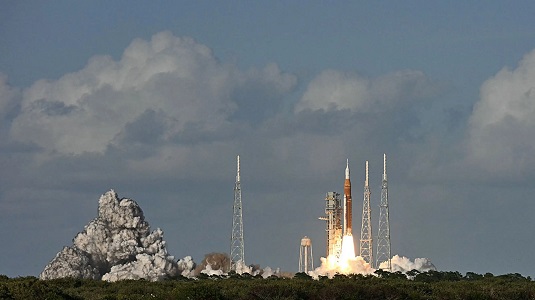
As of Saturday evening, Artemis II is more than half way along its sally to the Moon. The crew's journey is full of firsts. The furthest human beings have ever travelled from the Earth, the first time a woman, an African-American, and someone other than a US citizen have travelled beyond the orbit of our world. A truly historic mission and one prefacing, at least on paper a landing and then building a permanent base. Unfortunately, what might described as a noble endeavour is somewhat overshadowed by baser events. And when Donald Trump speaks to the astronauts, he's unlikely to gift posterity a dignified address.

Space has long been big business, and it's about to get larger. Elon Musk's SpaceX is due to go public, with a $1tn share issue. This success tells the real story of space industries. Like pretty much every major technological leap this last century, the state has taken up the slack of providing the basic infrastructure and demand to build up new markets. It's not for nothing that Musk is known as history's greatest welfare recipient. Take, for example, the discussions around the replacement of the International Space Station. NASA's partnership with Vast speaks to this model. It trains the company to provide the services it requires, will "sell" them some in-orbit store facilities and supplies, and buy back from them their "scientific samples". This is with a view to, later on, the company providing its own modules for attachment to the ISS that NASA will then rent from them. At each step, there's a guarantee that while employees run risks riding up and down on rockets, no capital shall come to undue harm.

What's the point? The commercial attractions of low and high Earth orbit lie in satellite communications, spying, and scientific payloads. Space tourism as a viable business proposition seems a long way away yet. The space race commentary favoured by the BBC and most mainstream outlets try and evoke something of the US/Soviet space race, albeit with America now facing off against China. But there's more than bragging rights at stake. In the immediate term, permanent presences consolidate national claims over near-Earth space, which is why this particular race is more than two superpowers facing off. India celebrated its own successful Moon mission a few years ago, implying to its neighbours that if they can manage that, it will have a similar technological prowess where weaponry is concerned. Thinking about space's place in the state system should not be overlooked.

Perhaps, in the longer longer term, assuming space stations and colonies become self-sufficient and the significant physiological consequences of living in zero and low-gravity environments is navigated, then perhaps they will provide viable markets for asteroid mining and Luna-based resource extraction. And that could prove to be an attractive outlay for Earthly capital. But that could be a century or more away, and none of us will be around to see it. Except techbro biohackers like Bryan Johnson.

Unfortunately, the existence of the space programme has a stronger relationship to something fundamental to capitalism: waste. And the example of American capitalism is the most egregious. As a global system that has drawn more countries into its rule than at any other time, capitalism churns out a surplus so large that the resources exist to feed everyone, provide safe drinking water and sewage systems, housing, clean power generation and delivery, and so on. It doesn't because it is a class system. Everything, including the expectation that business in general should turn a profit, is subordinated to the maintenance of the class relations that makes this possible: the wage and private ownership. In the age of obscene oligopoly, the realities of class are so obvious that whole sections of establishment politics have given up trying to prettify or hide wealth concentration and its consequences. It is too large, too visible to excuse. And so, instead, we get openly authoritarian parties whose chief, open interest is maintaining these class relations. Donald Trump, Vladimir Putin, Viktor Orban, the AfD in Germany, France's National Rally, and between them the Tories and Reform in the UK are part of this trend.

What has the gravitation pull of capital got to do with space exploration? Since the official inauguration of the civilian US space programme in 1958, space has been an outlet for wasteful spending. That is, by creating spending priorities unconnected to maintaining the standard of living and social infrastructure, governments generate a cost pressure that eats up resources and helps them manage the politics. The military are traditionally the chief beneficiary of this arrangement, and money thrown in this direction can be justified by the bogey of foreign adversaries. The US Department of Defense, in 2026, is set on swallowing 15% of the federal budget. The White House want to increase this for the year ahead, to be funded by cuts to useful spending like social security, health, and education. And, topically, taking an axe to NASA as well. The idea, as per the class politics of small state conservatism, is to divert resources away from social programmes that actually build things so as to manage the demands on the state and, in many cases, discourage them. In an age of sharpening uncertainty with rising prices and wages barely able to keep up, the military and threats from abroad are the Trumpist means for ruling out solutions and heading off expectations. We need to take your food stamps away because the Pentagon needs driverless ground attack vehicles.

As such, this is where space funding fits in. For the state, especially one as colossal as the US, it's chicken feed. But part of the class politics of wasteful spending nonetheless. For Musk and Jeff Bezos, their private space programmes are, after luxuries, their main preoccupation. They have a class interest in funding rockets and Moon landers, because spending money beyond derisory sums on social programmes or bumping up the salaries of their hundreds of thousands of employees cedes a smidgen of economic power to the workers and tilts the capital/labour balance that little bit away from them. That's why Musk, for instance, hates philanthropy. So Amazon-branded space suits are in. Amazon-branded breakfast clubs are not.

That said, given the swingeing cuts Trump and his hyper-class conscious cronies want to make to NASA, it appears - in line with their vandalism of US R&D generally - that having a civilian agency accomplish one of the greatest feats in scientific history is too risky for them. It could open the box to hope, to the wider propagation of scientific literacy and an interest in what might crudely be called intellectual subjects, and on top of that the radical suggestion that resources should be put into things that stretch our imagination, our capabilities, and could promise a better tomorrow. A thrust somewhat at odds with the miserable preoccupation with maintaining an indefensible status quo. For while space spending is wasteful spending, unlike throwing money at smarter guns and smarter bombs, it can lift our vision not just to the horizon of the possible, but beyond it.

Image Credit

Monday, 23 December 2024

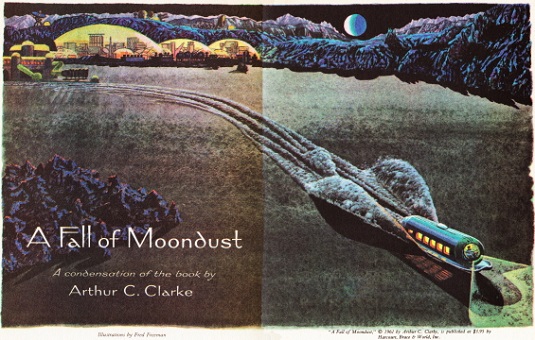
British Collectivism in A Fall of Moondust

While respected for his contribution to science fiction, Arthur C Clarke doesn't have the greatest contemporary critical reputation. His prose is often considered technical and dry, his character work limited, and his claims to hard SF long superseded by the likes of Stephen Baxter (who he collaborated with over the excellent The Light of Other Days, and a couple of others) and Greg Egan. Even his best known works, that includes 2001: A Space Odyssey, Rendezvous with Rama, and Childhood's End are often criticised for being boring and dull. If you want high adventure and drama, best go elsewhere.

My expectations weren't very high for A Fall of Moondust, a Poseidon Adventure-style rescue caper set on the lunar surface. The plot is not the world's most riveting either. With space travel between the Earth and the permanent Moon colony a fixture of the 21st century, space tourism is a thing and punters happily shell out the cash for cruises across the lunar surface. For Captain Pat Harris and hostess Sue Wilkins, the latest foray across the sea of dust in the skimmer, Selene, is another routine sightseeing trip. Unfortunately, as they're speeding across the sea an underground expulsion of gas creates a sinkhole analogue just as they're passing over. The ship is immediately buried without nary a trace of it left on the surface. Facing problems with heat, air, and supplies, can the crew and passengers hold out until they are rescued? On the Moon, is rescue even possible?

Fall is not the most sophisticated novel, but it is a very good one. Shock horror a break with the consensus! The usual criticisms about character apply, and because it's 1961, the gender norms and a quick racial aside dates it. But as a straightforward SF thriller, it works. Taken on his own terms, for Clarke science fiction was the literature of exploration - a thought experiment of fantastic but just-about-plausible scenarios and conceivable future tech within the limits of the science of his day. Fall works as the mapping out of how a disaster might unfold on the Moon, and what engineering challenges would have to be overcome to pull off a successful rescue in hard vacuum. A lot of Clarke's description of the environment and geology was well realised, and perhaps his speculation did have an affect on NASA planners who were worried the Apollo landers might sink into the dust.

But what I took from Fall was a distillation of the postwar zeitgeist. The economic boom, the rapidly rising living standards across the West, the celebration of expertise in popular culture and the can-do resolution of problems through the application of science and technology suffuses the book. It also works as a paean to the lost world of collectivism in the British mode. The Selene's crew are unflappable, not given to panic, and see the safety of the passengers as their first duty. The engineering team that rush to the crash site are protected from the glare of global media interest by the distance between themselves and the TV cameras on a nearby mountain, and the anonymising sun shades of their space suits. There is no hyping up of the individual, despite one of the passengers being a famous astronaut travelling incognito, and life after Selene is not one of celebrity and media deals. This was simply a group of people pulling together and doing what was expected of them with a minimum of fuss, and then getting on with their lives. A reminder that an unshowy, cooperative individualism is a submerged - as if buried under tonnes of Moon dust - part of our cultural present, but still one that comes to the fore at moments of acute crisis.

Is A Fall of Moondust hauntological? Yes, it is. But its modernist impulse, the conception that a better future is possible, is certainly one our time of socio-political and environmental disasters could do with gripping hold of again.

Image Credit

Wednesday, 23 August 2023

Why India is on the Moon

Congratulations to the Indian Space Research Organisation. In managing a successful soft landing at the Moon's south pole, they have won the distinction of ensuring India is the fourth nation ever to land successfully and the first in this tricky region of Earth's satellite. The Chandrayaan-3 probe and its rover are now poised to return a wealth of scientific data about the pole, which holds significant quantities of water ice and other minerals and chemicals that have been of interest to all the space-faring powers for some time. And for those of us who overdosed on too much science fiction and tech optimism, it's another step toward making humans an interplanetary species.

Let's not get too dewy eyed though. Space exploration, which should be for the benefit of all, most emphatically is not. As many a critique of space programmes have pointed out, it's obscene for resources to be expended on mucking about in the heavens when there are so many pressing problems on the Earth. This is especially so in India's case. According to the World Bank, most recent figures (2017) found between 10.4% and 13.6% of the population were in "extreme poverty" (i.e. subsisting on less than $1.90/day). A decline on the rates saw in 2011, but by no means keeping pace with the explosion in GDP. Undoubtedly, over the coming days a Tory MP will appear to question UK state aid to India, which was around £2.3bn between 2016 and 2021. But the point remains, with such levels of poverty in India, which amounts to well over 100 million people, how can a space programme be justified?

It can't in moral terms, but then realpolitik and capitalism don't owe much to morality. As the former president of India, Avul Pakir Jainulabdeen Abdul Kalam put it in his autobiography, "Very many individuals with myopic vision questioned the relevance of space activities in a newly independent nation which was finding it difficult to feed its population. But neither Prime Minister Nehru nor Prof. Sarabhai had any ambiguity of purpose. Their vision was very clear: if Indians were to play a meaningful role in the community of nations, they must be second to none in the application of advanced technologies to their real-life problems."

Following the withdrawal of Britain and partition in 1947, for decades the Indian ruling class were dedicated to a project of national independence. Loosely modelled on the Soviet Union, albeit with liberal democratic characteristics, India followed the path of many industrialising nations. Import tariffs, national infrastructure projects, and efforts at making the country less dependent on global markets dominated by the United States and the West. Under pressure from competition and border conflicts with Pakistan and China, from the early 1960s the Indian government encouraged space research that complemented its rocketry and nuclear weapons programmes, with its first bomb tested in the mid 1970s and the achievement of a range of guided surface-to-surface ballistic missiles by the late 00s. India's announcement about its rocket capabilities coincided in 2008 with Chandrayaan-1's orbit of the Moon, which confirmed the presence of water at the south pole. The development of the space programme after independence was relatively far sighted. Becoming a player in advanced aerospace technologies carved a niche out of an increasingly important sector, especially with the telecommunications revolutions of the late 1970s onwards. Added to that with its position close to the equator India is a sensible location for space launches for third party powers and telecommunications businesses. Decades of investment has produced a world class launch capability and technology that can compete with China, Russia, Europe, and the US. And behind that is the implied strength of Indian arms.

For a coming superpower, which India surely is, sitting out the new space race is not an option. With the US and China eyeing Moon bases, international competition over milestone achievements is a signifier for Indian capability in the space exploration market. As argued before, like military spending monies for space programmes is wasteful but endemic to a class system that puts class relations before the conventional understanding of economic development. But with so many states in the process of building the infrastructure for regular human spaceflight and the colonisation of the Moon, it makes sense for India and the commercial entities spun out of its space programme to be there to profit from what comes decades down the line. Assuming we don't blow ourselves up/drown in rising seas/etc. and there is no significant break with capitalism, it's reasonable to forecast Moon, Venus, and Mars colonies and stations by the end of the century. India's position and, most importantly, the power and wealth of its ruling class would benefit handsomely from playing this pioneering role.

Sunday, 6 November 2022

First Contact: An Alien Encounter

What kind of moment would the confirmation of extra-terrestrial intelligence be? This was the premise of an (ostensibly) intriguing First Contact: An Alien Encounter the BBC aired this week. Unfortunately, as a work of scientific speculation it failed to live up to the exciting proposition because it committed the cardinal sin. The show was boring.

First Contact begins with one of the Voyager probes picking up a narrow band signal, which is a sure sign of an artificial origin. The scenario then plays out over 12 days as the source is revealed to be a 200km-long object approaching the solar system. Oh dear. Grainy images are obtained of 'The Artefact' and it appears artificial in character. Spectroscopy readings shows metals, but the craft is seemingly tumbling in space and out of control. The boffins get to work on tracing its fight path and settle on a star system some 500 light years away, implying the craft had been in transit for over 100,000 years. No wonder it's not taking any messages. NASA direct the new James Webb Space Telescope at the system and finds evidence of a shredded planet, but with traces of manufactured materials showing up in the analysis. Meanwhile, the Artefact sails past the Earth and away. First contact is over.

The story could have been told in a 10 minute YouTube video if I'm honest. But the main purpose was to show off the science, and was therefore seemingly aimed more at a general audience. SETI's infamous Wow signal from 1977 gets its umpteenth showcase. It too was a narrow band signal and was much stronger than the background noise, and it (apparently) moved with the stars - as you would expect anything inbound to - but that was it. The best candidate for contact so far, but it has never repeated. Nor has it been satisfactorily explained by earth-bound or natural celestial phenomena. The question mark remains and may never be resolved. We're also told about how difficult it would be to communicate with aliens anyway, given how different our environments, biologies, and psychologies are likely to be. Just look at our miserable efforts at trying to establish a dialogue with whales(!). And we had to have a wee segment on ʻOumuamua, the first identified extra-solar object that passed by these parts in 2017. What the show skipped over were claims, such as those coming from Harvard's Avi Loeb, suggesting it could be an artificial object.

Surprisingly, while First Contact was humdrum and not a good way to fill 85 minutes it did at least get the sociology right. As noted a while ago, chances are news of an alien civilisation would perturb the froth of social media for a day or two and fade from view. Because this premise is a close brush with some derelict spaceship things are likely to be different. People lighting candles, American shock jocks forecasting armageddon, little kids hoping the aliens would be friendly, talking heads arguing the toss. Social media getting rammed with little green men memes was definitely on the money. And then we have people rioting because they suspected governments were concealing knowledge was a bit of a stretch. Then again, who could have foreseen anti-mask/anti-vax protests as a global pandemic ripped through the population?

When all is said and done, it's difficult to see who this programme was made for. Anyone slightly interested in the topic would be caning the YouTube videos already, and the casual channel surfer wouldn't have found something compelling enough to stick with. Science programming does get a lot of flack, and rightly so given how plodding and simplistic the output tends to be. I can't imagine anyone young watching this and feeling inspired enough to pick up a telescope, which surely is the criteria by which any flight of speculative fancy should be judged.

Image Credit

Tuesday, 20 July 2021

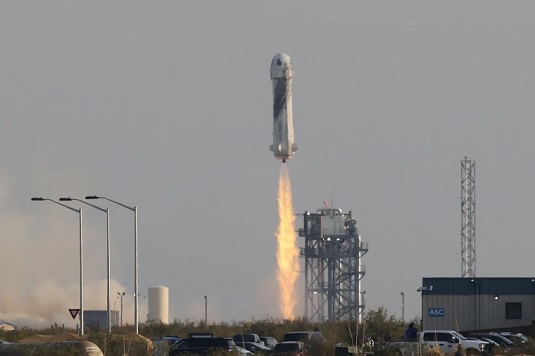
The Billionaire Space Race: A Marxist Note

Why bother with space travel from the point of view of capital accumulation?

There are a several purposes. One of them is the class politics of wasteful spending. There are causes here on Earth that need addressing, with global poverty and climate change mitigation the foremost priorities, and yet billionaires are dumping their money into worthless boondoggles. Jeff Bezos would rather splash cash on a rocket-powered dildo than make sure his workers are properly paid. Why? If we assumed the standpoint of a naive bourgeois bystander, it doesn't make much sense. Give workers more spending power would float the boats of other businesses by having money to spend. Those businesses grow, take on extra staff, and we have a self-expanding virtuous circle of investing and spending.

Capitalism does not work like this. From the point of view of the billionaire class interest giving employees more money than what the labour market "determines" increases workers' economic power ever so slightly versus the plutocrats. That means less precarity, less physical and mental exhaustion, and a small space they can call their own. If workers feel secure in their position, they might start asking for things, and come to see themselves as a collective in struggle against their space travelling boss. And from here, who knows where? A critique of their station? A worked out understanding of how surplus value works? A direct challenge to the employer's authority?

A billionaire fully aware of their interests knows this in their marrow. Whatever Bezos spends money on, another mansion, another super yacht, a Bond villain lair, or a fleet of spaceships, he is disposing of his wealth in an entirely class conscious way. His rocket escapes the Earth's gravity well to keep his workers grounded by the pull of exploitation.

Image Credit

Wednesday, 28 October 2020

The Democrats and the Politics of Space

Making predictions is a mug's game, and didn't practically every pundit get mugged in 2016? Your humble scribe is counted among this number too. But surely, surely the leads posted from nationwide and swing state polling can be counte on and Joe Biden is on course for election. Yet there is one thing that has always puzzled me. Issues about space and space exploration are largely a bipartisan issue, but historically Republican candidates and Republican presidents, 2020's incumbent included, talk up American efforts in space and your common or garden Democrats ... tend not to. On the one hand we have Trump looking forward to new crewed Moon landings in 2024, while all Biden has said ... "We support NASA's work to return Americans to the Moon and go beyond to Mars, taking the next step in exploring our solar system." The space programme doesn't even merit a mention in the Democrats' manifesto documents.

Space exploration isn't a big vote winner, unless we're talking about Cape Canaveral and Houston. And on this occasion Biden is projected so far ahead of Trump in Florida that comparatively few votes around the margins won't matter. It's not a close-run thing. Yet, in 2000, it could have mattered. Ditto for 2004 and, yegads, 2016. For the Republicans, even if candidates give zero hoots about "the science" (as per a certain someone), they are not blind to how space plays to their base and the GOP-curious. For the American right, US technological prowess is inseparable from the selling of its global dominance to domestic audiences. Superiority in all areas is what makes America great and triumphant, and the suspicion among millions of voters, assiduously cultivated by the right and the Trump campaign, was the Democrats allowed this might to be frittered away - a perspective with enough truthiness for those in the mid-west to swallow it in significant enough numbers. Space also has particular resonances in American nationalism, and not just because NASA "won" the space race by popping 12 astronauts on the Moon. The idea of the manifest destiny, of expanding into the frontier and cementing America from sea to shining sea is deeply embedded in national mythology. It justified the near extermination of its native peoples, endows the US with a global civilising mission (always handy when certain interests require military reinforcement), and is also responsible for the romantic allure of the frontier and the popular cultural celebration of rugged individualism and lawlessness. Zombie culture and survivalist video games are not unrelated to this mythologising.

Space exploration is inseparable from the manifest destiny. The frontier becomes the final frontier, and the old goal of opening up the West and colonising the continent is projected upwards and outwards to the bodies beyond the Earth. It's writ backwards in the past too - the essentialist hoohah of the human urge to explore is NASA's rewriting of our species' story, with back edits of our a priori natures with jarring inserts of Americana consciousness. To stay on top and assert power, America's got to be the first back to the Moon, the first to set up a permanent presence, the first to Mars and, well, anywhere else you care to mention. It's a matter of national pride, a matter of America embodying the primordial urge to expand and settle, and also of securing markets of the future.

While the American right happily annex space exploration to their national project, it's bizarre the Democrats are sanguine witht his state of affairs. They're not the "B Team" of American capitalism in the same way social democrats and labour parties are (or were) almost everywhere else. Thanks to the peculiar character of US politics and its two main political parties, the Democrats occasionally reflect popular politics around progressive issues and can, under certain circumstances, be forced to run leftist candidates - theoretically all the way to presidential level. Simultanouesly, the party bigwigs are as establishment as they come. The Democrats are as invested in American dominance as the GOP are, and many of their foreign policy criticisms of Trump - particularly during the North Korea detente - attack him from the right.

Here then is the great dilemma. From a vote point of view, there is nothing to be lost from talking up space. Indeed, from the perspective of winning votes, leaving ceding the field to the Republicans helps cement their authenticity as custodians of national pride and ultimately America's mission itself. Nor are the Democrats squeamish about projecting US power, and invoking the idiotics of patriotism when deemed necessary. It was their martyred hero, John F Kennedy who was responsible for the Moon shot while the GOP under Nixon wound the Apollo programme down, and if protecting American assets mean militarising space, Trump's Space Force will be given the teeth it asks for. Why then do the Democrats de-prioritise space exploration and, to all intents and purposes, gift it to the GOP as one of their wedge issues? It's not often glaring enigmas can be found in politics, but here's one of them.

Image Credit

Sunday, 4 October 2020

Away with the Anti-Semitic Trope

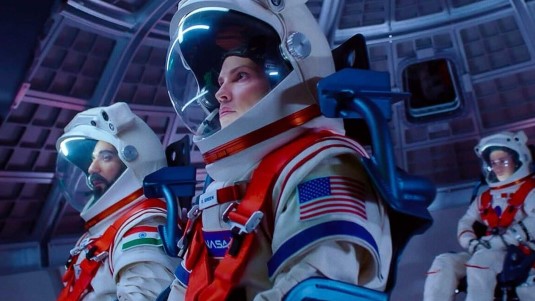
Few things are more exciting than landing on Mars, right? It would be a stupendous technological achievement, the culmination of 60 years' worth of space exploration and a significant step to industrialising the solar system. Setting aside the superlatives, the sad truth is it's probably not great fodder for a Netflix televnovel. There's only so much that can be done with five people in a cramped tin can for six months. The latest Hilary Swank vehicle, Away, proves the point.

10 episodes of overwrought tedium was inevitable, I guess. And the producers of the show have tried getting around this in two ways. Moments of high tension, such as the ship's solar array failing to deploy necessitating a risky spacewalk, and the water reclaimation unit breaking down. Combine this with health issues suffered by our cast of astronauts, cosmonauts and taikonauts, such as space blindness and a nasty, infectious fever. The action is supplemented by family dramas back on terra firma. Hilary's hubby suffers a stroke and spends the season rehabilitating, keeping him away from his very important job at ground control. And her 15-year-old daughter pseudo-rebels by getting a boyfriend, riding dirt bikes and, whisper it, having sex with him. Going for much complex emotional content, one of Hilary's fellow astronauts confesses to having feelings for her just as her friend admits to having the hots for hubby to, um, hubby. Being good Americans of fine moral standing, both spurn the advances. I guess adultery on top of under age sex was too much for the showrunners.

The show does have a handful of commendable features. The production values are very high and they pull off weightlessness convincingly. The crew is fittingly multinational (American, Indian, Russian, Chinese, British) and multi-ethnic. All characters are three-dimensional, with the taikonaut Lu Wang refusing to conform to the wooden stereptypes afflicting Chinese characters. And in line with the wave of woman-led drama the place of women at all levels of the space programme is acknowledged - a far cry from the (admittedly period) Apollo 13 and the pre-2010s centering of men in science fiction programming. Laudable as all this is, it doesn't make Away any good. The space bits are too hackneyed and predictable, and the human interest stories tiresome. Though very different, The Expanse shows both can be fruitfully combined.

Yet there is something else about Away that cannot escape comment: an egregious anti-semitic trope that could not simply be coincidence. In episode five, Space Dogs, Misha, the Russian cosmonaut, attempts to reconcile with his daughter by putting on a puppet show for his grandkids back on Earth. Roped in to assist is Kwesi, the English-Ghanaian botonist. It just so happens Kwasi was raised by, and identifies with his Jewish adoptive parents. Okay, coincidence then? But when you consider Misha is played by Mark Ivanir, an Israeli actor, it starts looking a bit suss. Put it like this: they got the one Jewish character and the one Jewish actor to play at puppeteering. This is underlined in the final episode, Home. At ground control Kwasi's mum turns up in the family room in anticipation of the touchdown. There she is greeted by another character as, um, the "mother of the puppet master."

Hyper sensitivity thanks to recent history? Possibly, but it does seem too much of a coincidence to have these two characters do a puppet show and one of them, in the absence of relevant context, being referred to in terms of a well worn anti-semitic trope. So, as well as junking the opportunity for producing a decent drama, Away carries a big racist question mark with it.

Image Credit

Saturday, 20 July 2019

The Moon and Capitalism

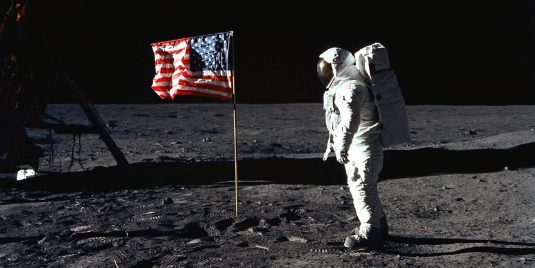
The Moon landing 50 years ago today ranks as the most audacious and spectacular event of the 20th century. Billions watched Neil Armstrong and Buzz Aldrin goofing about the surface, and for a moment it appeared - at least transmitted by retrospective commemorations - that the human race was united in awe. For the first time members of our species escaped the gravity well of our world and took our first steps onto a body other than the Earth. It represented the pinnacle of human ingenuity, and was testament to the courage of the men prepared to risk a lingering, public death had it all gone wrong. Rightly, and despite the motives of the US government who put them there, for as long as there are people the flight of Apollo 11 is and will be celebrated among our greatest collective accomplishments.

We should salute the army of NASA technicians, astronauts, admin and support staff that made the Apollo programme possible, acknowledge the spin offs and engineering know-how - later largely harnessed by the computer industry - and the inspiration it provided tens of thousands of scientific careers. It also has to be stripped down to its bare essentials. The space race was super power politics, of accomplishing an ambitious technical feat that would burnish the victor's soft power around the world, and demonstrate to the other side just what it was capable of. Though even this reading needs picking apart. The USSR were the first to place a satellite in orbit and send a cosmonaut into space, but the competition to get to the Moon was pure American theatre. They needed to be bolder and better than anything the Soviets had achieved. Who cares about the laurels for the first interplanetary flyby if you can land people on the Moon? The USSR, for their part, weren't terribly interested in playing this game. Soviet missions to the surface were robotic and sample return affairs. They were the first to reach the Moon, return images of its far side, and put a mission into orbit, and they did have a secret programme looking at crewed missions but it was never conceived in competition with the Americans, and for the rest of its existence the USSR confined nearly all its efforts to Low Earth Orbit. The race then was non-existent, and the whole premise was contrived in terms of US triumphalism. And, as we know, once the spectacle of the first landing was done the Apollo programme was discarded as an inconvenience by the Nixon administration and the plug was pulled. Nevertheless, in terms of domestic politics because there was a nationalistic underpinning to the whole enterprise, the Republicans have, since the early 80s, positioned themselves as the Moonshot's ideological heirs. Dear old Ronnie had the Strategic Defence Initiative, or 'Star Wars' - a means of militarising space to make safe the American homeland from nuclear attack. Dubya in 2003 unveiled a vision of space exploration for NASA, with the aim of returning astronauts to the Moon by 2020. Um. And Trump and Mike Pence have talked up America's return to the lunar surface with an ambitious target of achieving it within the next five years. These are not people who come in peace for all mankind. They only have the interests of the US state front and centre.

Though now, the context is different to 50 years ago. There are multiple space faring nations. As I write, the International Space Station is crewed by one Russian and two Americans, and will shortly be joined by another Russian, an American, and an Italian. The Chinese Chang'e 4 probe is currently sat on the Moon's surface, and seven spacecraft are operating in orbit around Mars from NASA, the European Space Agency, and the Indian Space Research Organisation. Japan has orbited and successfully landed twice on the asteroid Ryugu with the object of returning samples. And even Israel almost became the fourth country in history to accomplish a soft landing on the Moon. NASA are by far the most advanced of the space agencies, but its dominance isn't what it was. With space getting more crowded, a declining superpower with a paranoid cast of mind might feel it necessary to demonstrate who's boss with another spectacular mission. Who controls the heavens will have the Earth, after all. Yet while space is the new arena for powers great and small, there's a new player on the block: the market.

To get a grasp of the relationship between states and markets, examining the political economy of space while our adventures off-world are in their infancy is a good place to start. During the post-war period, a number of mainstream and radical economists drew attention to the importance of military spending. Indeed, in his final address as President, Eisenhower warned Americans about the power of the military-industrial complex, such was the close relationship between capital and arms. In the US, it was the war time economy that ultimately shook off the doldrums of the depression, and throughout the Cold War period military spending provided a guaranteed market for sections of capital. Between the start of the Korean War and the fall of the Berlin Wall, US military spending peaked at 12% of GDP and (unevenly) fell to around six per cent. These were still astronomical sums, and provided guaranteed markets for defence contractors, strategic industries, and thousands of smaller and medium-sized businesses. The multiplier effects Keynes wrote about, of how public spending puts money in people's pockets which, in turn, put cash in the registers of businesses helped ensure there was a stable element underpinning the post-war boom. We saw similar in most of the other advanced economies, though nowhere near to the same scale, leading some - particularly those associated with Tony Cliff, the guru of the Socialist Workers Party - to argue capitalism was propped up by a permanent arms economy and that military competition with the USSR offsetted crisis tendencies and kept matters on an even keel. For a while at least.

Space programmes, at least in the West, have traditionally been a subset of military spending. The array of NASA programmes are supplied by many of the same outfits you would find competing for defence contracts, and as the technology has become more reliable and costs have fallen, we're starting to see companies muscle in to more areas. Having long built communication satellites, private capital is getting into the launch game. Following the patterns of innovation examined in Mariana Mazzucato's The Entrepreneurial State, the leading space companies - SpaceX, Virgin Galactic, Blue Origin - are based on and refine technologies that are with us thanks to decades of publicly funded research. SpaceX is used to launch cargo to and from the ISS, a market Blue Origin is keen to get into with cheaper and reusable launch vehicles, as well as providing landing craft for Moon missions. Virgin on the other hand are trying to tap directly into crewed missions with a twin track approach of ferrying astronauts to orbiting science facilities and lowering the barrier of entry to space tourism. All, however, depend on state investment and the state-as-consumer for their viability. In and of themselves, even with the billionaires behind them and their visions of setting up shop on Mars, space markets are not viable without state initiative - and this will be the case for quite some time.

Nevertheless, the introduction of for-profit operators adds pressure to cost reduction, which comes with all that implies. Though the customer at the moment is in the position of determining the regulations and standards of space flight. Moving on from Low Earth Orbit to the Moon, driven by state agencies, will nevertheless offer further market opportunities. If NASA's present plans come to fruition - the establishment of a permanent station in orbit around the Moon, followed by landings, and the erection of a base on the surface - these require resupply, new materials, new construction technologies and so on. The state makes and continues to make the strategic investment, and the market effectively works around the edges in tendering for contracts. And once the base or bases are established, a new research and development economy develops. Chief are supplying and extracting resources to live off the land, the building and maintenance of viable biospheres, and the spin offs this can have for settlement efforts elsewhere in space and conservation at home. Also important will be lunar prospecting and mineral exploration. A supposed abundance of helium-3, a potential fuel, is certainly seen as a potential resource by the Indian, Chinese, and Russian space agencies. Though even without a mining bonanza though, the Moon offers an attractive way station for further missions. Its ample water resources for rocket fuel and oxygen production, and smaller gravity well makes it a better location to reach deeper into the solar system than the Earth. All this is speculative, of course, but well within existing capacities, and is possible because several states are stumping up strategic investment.

And the prize? Capitalism needs new markets; it has to accumulate or die. The exploration of space, visiting and settling the Moon, fanning out and spreading the human presence to the planets and asteroids represent stupendous technical challenges, but it is something else. It's about the industrialisation of space. States, with the USA leading the pack, are providing an infrastructure around which new industries and markets can grow, and once the resources of other worlds - be they asteroids or planets - can be mined profitably, then the commodification of the solar system will be rapid and possibly chaotic.

The last crewed mission to the Moon departed its surface in December 1972. If we do return in the next five years, or by the end of the next decade, or whenever, it is very unlikely the Moon will be left to simply abide for an extended period of time ever again. Geopolitics is making our satellite a place of interest, and with big companies scenting big dollar, there is a strengthening of the commercial imperative to get in on the ground floor and shape the markets to come. If the Americans do not do this, then someone else sooner or later will.

Sunday, 10 April 2016

Science in The Martian

The Martian has two very unique features not shared by your average big budget blockbuster. First, it has Sean Bean in it and his character lives. Second, as a science fiction piece it is virtually alone in projecting forward a non-dystopian future in which scientific endeavour comes out smelling of roses. Before you read any further, this review is a touch spoilerific, so stay away if you're saving The Martian up for a rainy evening.

That said, I don't think there's any need to dwell on the plot as it's not a particularly deep film. Set at some unspecified point in the near future, Matt Damon gets left for dead on the Red Planet as a dust storm swoops in on a NASA landing site. The next couple of hours are spent trying to get him back home while Damon has to "science the shit" out of his meagre supplies and technology to stay alive. Okay, scraping up vac-packed faeces and mixing it with Martian soil might not produce the kind of potato crop we see in the film, at least not straight away, but it has enough pseudo-realism for it to be plausible. And puncturing one's space suit to use it for propulsion is a bit iffy, but again, it sounds just about right for it to work.

It goes without saying that the wide panoramic shots of the Martian desert (i.e. Jordan) are stunning, yet the sense of desolation doesn't overcome the film, nor is Mars the "real star". Throughout Matt Damon does a good job of playing Matt Damon, so don't expect much in the way of brooding and existential angst. Thankfully his ubiquity doesn't get tiresome as his adventures in the habitat and on the rover are interspersed with ground control action. Overall it's very watchable. Not a masterpiece by any means, but an entertaining enough update of an Apollo 13 (and an Apollo 13)-style space disaster scenario.

The real hero here has to be science. When it suits, which is often, NASA likes to dress its organisation and its mission up as the repository of all that is best about our species. Its official discourse evokes essentialist notions of exploration, that it is in our very nature to strap ourselves atop a rocket and blast off into infinity. And when it's not reworking old American frontier ideologies, it's presented as an instantiation of the absolute, of a manifestation of reason straight from a late 20th century misreading of Hegel. As such, any film that has official NASA involvement - and this does - the agency has to come out of it looking good. Hence Matt Damon was never in any danger.

Putting that aside, anyone whose politics aren't hitched to the primitivist bandwagon has serious respect for the space science NASA does. Even I follow them on Twitter. And that is shown in the best possible light, here. Matt Damon applies his botanist know-how and astronaut training to grow crops, establish communications with Earth, improvise habitat and suit breach repairs, and lots of other gadgety-things. Meanwhile NASA get their heads together to formulate a rescue plan which, in the best tradition of American schmaltz, a lowly underling at the Jet Propulsion Lab manages to come up with. Whenever a problem presents, all concerned apply ingenuity and the scientific method to arrive at a solution, even if the bounds of credulity take a little stretching.

Nevertheless, this is more than just pro-NASA propaganda. The Martian sets its face against the contemporary wave of dystopian sci-fi that delights in creating misanthropic situations to subject our descendants to. Much harder is to produce a compelling, successful, believable film that ignores the zeitgeist. It shows we have the tools and know how to fix seemingly intractable problems, and that our efforts can be successful. In a world haunted by social problems and looming environmental disaster, give me that message over fashionable fatalism any day.

Sunday, 18 October 2015

Alien Megastructures and Sociology

As you get older, life gets more absurd. Or so it seems. The humdrum is occasionally punctuated by something that's really out there, like the Daily Mail standing up against racism and xenophobia. Last week had one of those moments. It was announced that some of the observations of the catchily-named KIC 8462852, a star some 1,400 light years away, might be congruent with an alien megastructure orbiting it. Yes, you read that correctly. Eric Mack over at CNet notes:
Basically, the star's light curve seems to show some strange stuff passing in front of the star, at irregular intervals and sometimes even appearing to shift shape or orientation along the way - this is very different from the relatively predictable orbits we see objects making around our own sun and most other stars that Kepler has observed.
Tabetha Boyajian, the Yale researcher responsible for making observations of the star doesn't mention the possibility of aliens, and it is extremely unlikely that she and her colleagues have observed the industrial operations of an advanced extraterrestrial civilisation beavering away to capture the solar energy of their star. Having a science head and being extremely sceptical about such things, like Eric I'm sold on the anomaly being an extremely large cloud of comets sent hurtling into its inner solar system by the gravitational pushing and pulling by a nearby star. Nevertheless the doings of technologically advanced aliens remains a remote possibility, and that is very exciting.

Let us make some suppositions. SETI have requested time with a powerful radio telescope they want to point at KIC 8462852, and expect to do so around January time. Boyajian and others in the exoplanet hunter community will be refining their observations. And as infrared emissions are generally accepted to be the signature of advanced aliens, let us speculate that this time next year the observations tally together making bug-eyed beasties the most credible explanation, not the least likely. Should that come to pass, what then?

To be sure, it would be a watershed moment in science. It would arguably be the biggest discovery in all of human history, and certainly where astronomy is concerned. What, however would be the impact on human society, on popular culture, and the way we as a civilisation and a species view ourselves? I don't think it would be as profound as those - science and lay - people really into this sort of thing think it might be. Why?

First, there is distance. 1,400 light years is a mind-boggingly vast distance for 21st century humans to comprehend. If we were to beam a message direct to KIC 8462852 it would arrive there as far away in the future as the Anglo-Saxon invasion of Wales lies in our past. The good news for paranoids fearful of bodysnatchers from outer space is that while our technology may be able to detect them, they can't detect us. Yet. Well, they might be able to note the life bearing signatures of our little blue pearl. They could train mighty powerful telescopes in our direction, but all they would see are primitive folk building new cities in Meso-America and various tribes running amok in Europe sacking and burning established settlements. Because of the distance light has to travel, they would be peering into our past. They won't see direct evidence of our own industrial workings for some time yet. Of course, that's true for us as well - we're seeing the doings around their star as it existed quite a bit ago.

Physical distance breeds social distance. As we're not hooked up the the galaxy's hyperspeed broadband service, the collapse in social distance the internet allows for on our puny-sized planet is just not possible. The simulated immediacy that allows us to identify with complete strangers cannot be transferred to aliens we're never likely to meet, let alone have a long-distance conversation with. And that means the impact on our society will be minimal, it's just too airy-fairy for most people to care about. The day after confirmation will go on like any other day. It'll trend on Twitter for an hour or two, make the headlines, but apart from that? Zilch.

We do have some precedent to go on. Back in 1996, for a short period meteorite Allan Hills 84001, a chunk of Mars that fell to Antarctica some 13,000 years ago, was accepted as the vessel of fossilised Martian bacteria. Bill Clinton made his announcement from the White House lawn and front pages all over the world ran the story. Yet religions did not experience an existential crisis and go into meltdown. Everything carried on as it always has done. Perhaps a more apposite comparison to the confirmation of far away aliens would be the arrival of comet Hale-Bopp in 1997. I have fond memories of a summer staggering home from the pub and seeing it blaze away in the firmament. It was a beautiful sight. But apart from increasing the sales of binoculars and telescopes, getting a few more young people into the astronomical sciences, and, unfortunately, triggering the mass suicide of a Californian-based UFO cult, it passed the bulk of the human race by. It was a nice thing to see, that's all.

Confirming an alien megastructure would have fairly similar effects. A few fringe people would start worshipping it, entrepreneurial tykes might crowdfund a generational starship on Indiegogo, KIC 8462852's exploration appears as a staple in the resurgent space-trading genre of video games, of science fiction movies, of novels and space art, the Pope would probably deliver an encyclical on God's children in the heavens. How about an uptick in flying saucer sightings and reported alien abductions? Sociology-types like yours truly might have a fine old time trying to model the social dynamics of our green-skinned friends. And that will probably be your lot. Our place in the universe has radically shifted, and students of human behaviour would barely be able to tell the difference as far as our social structures are concerned. This is because news of beings around another star would not disrupt the rhythms of social life. It demands no collective response from governments, no shift in policy, no readjustment of the mental horizons of the vast majority of people beyond "that's nice" or "that's interesting". One's sense of security-in-the-world remains fundamentally unchallenged.

If, on the other hand, our aliens were to announce their presence in low Earth orbit, then things would be very different ...

Tuesday, 14 July 2015

Encountering Pluto

It's been a long wait for the New Horizons flyby of Pluto and its system, but what's nine years between friends? At the risk of sounding all Star Trek about it, every successful space mission sending robots to skim, orbit, or land on astronomical bodies are stupendous technical achievements that mark our growing capabilities. They are also important moments in securing our species collective futures. While one should be weary of science fiction that sees space as an escape from the environmental degradation the reckless pursuit of profit is bequeathing future generations, our long-term survival ultimately demands expanding beyond the atmosphere into the cosmos - climate change or no climate change.

That said, no other body in the Sun's family of worlds you'd describe as a des res without significant colonisation and industrialisation. Pluto definitely isn't. A freezing orange-tinged ball of rock and ice wrapped in a coating of sublimating nitrogen, in the far future it may become an extreme holiday destination or staging post for further missions into the Kuiper Belt and interstellar space. It's unlikely to be overburdened with mineral riches, however, and for the remainder of our life times is likely to be little more than a scientific curio. It could be a very long time before another probe swings in for a visit. That's a shame.

Nevertheless, let us glory in the most detailed image so far released by NASA of this tiny world and read into it the possible futures waiting to mark its surface.

Wednesday, 12 November 2014

How Not to Criticise Space Exploration

What a stupendous achievement. The landing of a space probe on comet Churyumov-Gerasimenko 300 million miles from Earth is one for the history books, up there with the first space flight, Moon landing, and interplanetary mission. Sure, the Philae lander might be sliding about the surface a tad but nonetheless this is a triumph of ingenuity and engineering. The gratitude of progressive humanity everywhere is with the European Space Agency team in Darmstadt.

Not everyone will be celebrating, however. There are three leftish critiques sometimes levelled at space exploration. The first, articulated by the American civil rights movement during the Apollo programme was the resource argument: that this kind of expenditure is immoral in the context of unequal societies in which poverty and want remains unresolved issues. It's an argument opportunistically appropriated by the right to delegitimise British aid to India's poorest. After all, as readers know, India recently became the third space faring entity ever to a put a probe in orbit around another planet.

The second stresses the social usefulness of these sorts of programmes. Or, rather, the lack thereof. The Apollo missions exemplify this perfectly. A gaggle of astronauts were dispatched to a lifeless rock to collect soil samples, plant flags and play golf. Was the hefty price tag and effort required justified by the scientific insights gleaned from sticking pieces of the Moon under a microscope?

Ultimately, both these positions support the adage that you cannot have critique without morality, but that morality is no substitute for critique. Space programmes were formerly driven by cold war geopolitics. Now it is the grubby business of extending markets into the heavens. From the point of view of capital, Apollo was a very handy taxpayer stimulus/transfer to the aerospace industry. And from there came all kinds of spins offs that have found applications elsewhere, the most cited example being ... velcro. Today, while the Indian space programme appears as an obscenity the country is now positioned amongst the most advanced space faring states. If the commercialisation of space proceeds apace over the coming decades, its independent capability gives it an edge in the emergent industries. Likewise, as asteroid prospecting is being considered a serious, if long-term investment proposition the ESA have the expertise and track record of landing craft on mountains of ice and rock ambling about the solar system. Even something that appears obviously useless as Richard Branson's Virgin Galactic space tourism/vanity project isn't all that it appears. Ferrying celebrities to the edge of space is an utter waste, but the goal - a cheap and reusable space plane that in later iterations could deliver personnel to orbital facilities is a massive opportunity to the firm that can develop and patent that technology.

Then there is the third strand. Writing of new science fiction blockbuster, Interstellar, George Monbiot complains that this, and by extension spacehead obsessions generally, are about a flight from the Earth. It's more than fantastical escapism, it's political escapism. For all the star-crossing optimism of space ideology, it beds in a sense of despair, of writing off the Earth and its problems and starting afresh. It suggests that the answer to our problems is more and better technology, that human agency should be expended on wonder gadgets rather than politically addressing the inequalities, the environmental degradation, and the profit motive that underpins it all. The strong implication is uncritically celebrating space-related futurity blinds us to the present, rickety, antiquated capitalist mode of production.

It doesn't have to be like this. There is absolutely no need for socialists to be po-faced about space exploration. Our job is to examine the political economy of this industry, to note the interests that lie behind it, the silly myths and ideologies. We have to seize hold of the utopian impulses and imaginative power it inspires and politicise them, not deplore them. Marx's critique of capitalism did not stop him from celebrating its genuine achievements. That attitude is our starting point, not Luddism.

Thursday, 7 March 2013

Dennis Tito's Mission to Mars

Writing of the passing of Hugo Chavez, Pamela Sampson of the Associated Press criticises his government for lifting millions of Latin America's poorest out of poverty. Instead, Chavez should have shelled out on vanity projects. Leaving aside the amorality of their position, Sampson and the AP have got it wrong. Fancy buildings are like so noughties, man. The fashionable super rich with hundreds of millions in disposable income need to get with the (space) programme.

There was a ripple of excitement in medialand a week or so ago when the world's first space tourist, Dennis Tito, unveiled his plan to send a couple to Mars. Sadly, this would not be a landing (others are working on that one) but a circumnavigation of the red planet, similar to 1968's Apollo 8 mission that flew around the Moon. Media interest has focused on the possibility human excreta may have to be used for radiation shielding, and that a middle-aged married couple be recruited as they would, apparently, be best suited to face the psychological challenge a 501-day journey would entail. It's all very risky too - the craft could well become an expensive coffin. Despite the dangers, I expect there will be no shortage of volunteers. Allow me to suggest a few.

Before his skyward trip to Butlin's made him famous, Dennis Tito previously worked at Nasa's Jet Propulsion Laboratory as an engineer. After leaving their employ, Tito went into investment banking and made his fortune from applying the mathematical modelling he worked on at JPL to the markets. So when they say you need to be a rocket scientist to understand the ever-shifting web of stocks and derivatives, they aren't joking. And typical of the 1980s nouveaux riches, Tito was a regular contributor to GOP coffers.

Tito is part of that band of conservatives who strongly identify with the founding myth of America and the frontier. Though, of course, the actual frontier is long buried under continent-crossing highways and air lanes, it still exerts an almost magical pull on the American imagination. As the more overtly nationalist of America's two political parties, it helps explain how the Republicans are the party of religious fundamentalism and anti-science quackery, AND simultaneously the party of Moon bases, space stations and off world colonisation. Therefore for Tito and others it must be endlessly frustrating that the Obama administration - and Democratic presidents since Kennedy - have avoided the pie-in-the-sky space projects of Ronald Reagan and George W. Bush. But more than that, it's an abrogation of America's duty and symptomatic of the liberal decay that grips the federal government. For an America locked into irresistible relative decline AND big government's unwillingness to take to the stars, the frontier promise falls to great men to assert the nation's manifest destiny. The project is even subtitled a mission for America.

As well as tangled with and emerging from frontier ideology, Tito's initiative comes against the backdrop of a burgeoning commercial interest in space beyond the routine launching of communications satellites. Branson's been banging the space tourism drum for a while. There's the current X-Prize race to put a cheap lander on the Moon and return it with a sample. And why not? Plenty of interesting stuff abounds on the lunar surface just waiting to be mined. And speaking of mining, money is finding its way into asteroid prospecting too. A NUM renaissance might be around the corner.

Tito's 'Inspiration Mars' has to meet the technological challenge of manned deep space exploration. If they do, the commercial spin-offs are obvious. The rewards will be massive for those who can patent the technologies the coming industrialisation of the solar system will depend on, provided we don't all die or get raptured first.

As a bit of a spacehead I find this is all very exciting. The long-term future of the human race requires that we spread beyond the atmospheric envelope of the Earth. But at the same time, we need to recognise, scrutinise and challenge the interests driving it. Because if we don't, as I have written before, the crap we're mired in will go to the Moon, Mars, and beyond with us. And I'm not talking about radiation shielding.

Friday, 21 December 2012

North Korea to Conquer Space

That apple of the proletariat's eye, the UK [North] Korean Friendship Association, Juche Idea Study Group of England have conveyed the British labour movement's congratulations to the Korean workers and peasants. The successful launch of the Kwangmyongsong-3 satellite is an earth-shattering feat of technical ingenuity, made possible only by the guidance of respected Marshal Kim Jong Un. This blow for freedom-loving peoples everywhere has gladdened the hearts of class conscious revolutionaries from John o' Groats to Lands End, and shows the correct line of socialist advance can only come through the Juche Idea. Celebrate!

I'm being silly. But what follows is a genuine press release.


DPRK SUCCESSFULLY LAUNCHES SATELLITE!
COMMENTARY OF THE UK KOREAN FRIENDSHIP ASSOCIATION , JUCHE IDEA STUDY GROUP OF ENGLAND AND JISGE


The DPRK successfully launched it satellite the Kwangmysong 3 on the 12th of December at 09.49 in the morning (Korean time). This was great achievement particularly in view of the harsh US sanctions , blockade and pressure. Voice of Russia website stated "launching a satellite is, in any case, an outstanding achievement for any country....., although, of course, on a significantly smaller scale. While South Korea's KSLV rocket is constantly being postponed (the revised launch date, initially scheduled at the end of October, has still not been announced), North Korea has successfully fulfilled its own plan" Wired.com stated "North Korea has joined a small club of 11 other nations that have successfully launched their own payloads into orbit...... a major accomplishment."

Rather than being a drain of resources as some malicious imperialist commentators have tried to assert it will greatly contribute to the advance of the DPRK economy. It will enable the DPRK to scientifically monitor the weather thus opening up the possibility of preventing floods and droughts so as to increase agricultural production in the DPRK thereby improving the living standard of the Korean people.

The launch is a powerful demonstration of the power of the independent national economy of the DPRK as it was built using 100% DPRK resources, funds, materials , labour and expertise. South Korea which has not yet been able to launch a satellite relied heavily on US assistance and even from Russia. The US space programme was heavily reliant on the expertise of Hitler's rocket scientist Werne von Braun.

The launch smashed the sanctions policy of the US imperialist against the DPRK. The DPRK has been the subject of two rounds of sanctions by the UNSecurity Council aimed specifically at preventing the DPRK from launching rockets or conducting nuclear tests. However the fact that the rocket was launched proved that the sanctions had failed. The US imperialists and their "allies" or vassal states plus the UN plus some big powers all put together could not stop the DPRK from launching the rocket.

It is really good that the DPRK stuck to the straight path of independence and refused to listen to the US imperialists and others who tried to either force or deflect them from their goal of launching the rocket. It has now been proved beyond all doubt the rocket carried a working satellite and was entirely there is no need for anyone to condemn or 'regret ' the launch. The UNSC is just a puppet of the US . The fact a number of countries have criticised the launch says more about them than it does the DPRK , it shows that they are puppets and toadies of the US who when the US says jump simply ask "how high sir ?". The fuss made by the US , UNSC, EU and NATO over the launch is hypocritical as in April India launched its Agni V rocket in April 2012 but there was not the hullabaloo there was over the DPRK's launch (despite the fact that India has border disputes with a number of countries).

Days before the launch the south Korean puppets and US imperialists through their Western media mouthpieces had claimed that the rocket launch would be delayed or would not happen. Yonhap on the 11th of December (less than a daysbefore the launch claimed that "Satellite images show the Democratic People´s Republic of Korea (DPRK) seems to be disassembling a long- range rocket" (really ? in their dreams more like!)AP reported that "North Korea's planned launch of a long-range rocket could be delayed for 10 days or more after it reported technical delays". This report was proved utterly false the next day.

What is the secret of the DPRK's success in launching the rocket , how was it able to achieve both a great scientific break though which confounded the so-called experts of the imperialist world and at the same time defy the US imperialists and their followers and some timid big powers ?. The secret is a simple one it is the Juche idea of the great leader comrade Kim Il Sung which was developed and enhanced by the great leader comrade Kim Jong Il which is now carried forward by dear respected Marshal Kim Jong Un. The Juche idea gives the Korean people the power to believe in themselves and achieve miracles. Armed with the Juche idea and the Songun idea the DPRK will now conquer space.

In the socialist DPRK of Juche rockets go up! But in capitalist Britain only prices and poverty go up!

UK KFA
ASSSPUK
JISGE


The Association for the Study of Songun Politics, Juche Idea Study Group of England and the UK Korean Friendship issued the following statement concerning the news that the DPRK have launched successfully the Kwangmyongsong-3 satellite earlier today !

Our hearty congratulations to the DPRK on this great victory !

This is a great victory for the DPRK under the Songun revolutionary leadership of the great respected leader Marshal Kim Jong Un. It is victory for Juche science and technology and shows the superiority of the people-centred socialist system of the DPRK and the might of the independent national economy based on self-reliance. The rocket was made using 100% DPRK resources, materials and labour . It will greatly contribute to building up the economy and improving living standards.

The successful launch of the rocket confounded the predictions of so-called Western scientists and experts who claimed that the rocket would not be launched for another 10 days. Just how wrong they were !

The DPRK stuck to its path of independence defying the calls of the US imperialists and their followers as well as certain big powers not to launch the rocket . The DPRK does not need permission from anyone to launch rockets or pursue legitimate scientific research. We strongly reaffirm our position that it is the independent sovereign right of the DPRK to pursue space exploration. What is regrettable that instead of congratulating the DPRK on its great success the US imperialists and various international reactionary forces have slandered the rocket launch and cried out for sanctions. As for the UN this has no competence whatsoever to comment on the matter. We say that no one should interfere with the DPRK's sovereign right.

Victory to the DPRK led by dear respected Marshal Kim Jong Un! US imperialists hands off the DPRK.

Long live the DPRK!
Long live dear respected Marshal Kim Jong Un!
Long live the Juche Idea
Victory to Songun!

Tuesday, 10 August 2010

Socialism and Space

Stephen Hawking's argument that humans have to colonise space or be doomed to extinction provided a bit of filler for the papers today. He is right of course. The Earth could get blasted by an asteroid, comet or gamma ray burst any second and it will be lights out for everything but a few inconsequential microbes scrubbing an existence out of the sea bed. I don't know about you, but I for one would like to see our species carry on and not perish in some horrific global catastrophe. So building a rocket, travelling to another planet and colonising it seems a neat (if technologically challenging) way of ensuring humanity's long-term survival. But present day space programmes not only fall well short of science fiction's promise, they, like any other technology, offer repressive and progressive potentials.

The argument is often made - as it was during the Apollo Moon landings - that it's criminal to sink resources in technologically sophisticated circuses while so many are for want of bread. That's an argument that can't really be contested: there
is something morally abhorrent about packing people off to space when society cannot meet the basic needs of those at the bottom of the pile. But then, this could imply that if capitalism dumped its space programme it would suddenly convert itself into an altruistic social system. For instance, since that nice Mr Obama dumped Bush Jr's ambitious Moon and Mars landing programme we have not seen the US evolve toward a gentle, Scandinavian-style social democracy. Under the new management American capitalism remains as rapacious as it ever was.

As far as socialists are concerned, it's infinitely desirable monies be directed toward stuff like space probes and rockets than lining the pockets of the rich in tax cuts or, worse, feeding military budgets. Like any other form of state-directed economic activity, space programmes have their multiplier effects. They provide skilled jobs and drive high-tech innovation. Of course, you could say military projects do the same thing. But then again, space technologies provide the sort of use values that could be genuinely useful later on. Whatever spin you like to put on it, military is only good for war, and we know what that's good for. But we shouldn't forget there is overlap between the two sectors. Our friends the Neocons would love to see the planet ringed with orbiting missile platforms to maintain American supremacy and, since becoming a viable option, no US administration has ruled out weaponising space. So while its okay to cheerlead NASA's efforts in mapping Mercury and pinpointing ice deposits on the Moon, such dazzling technological achievements should never blind us to the militaristic uses space programmes can be put.

Then there is space exploration as ideology. Generally, non-dystopian science fiction hasn't moved on from Jules Verne's day. This is best exemplified by
Star Trek. Set in a socialist society that dare not speak its name, we are presented with a technotopian realisation of progress and Enlightenment values. Kirk, Picard, Cisko, Janeway and Archer used a combination of wits, diplomacy and gadgetry to overcome problems, resorting only to force in the final instance. The idea of hope through technology is rammed home in the cringeworthy opening credits to Star Trek: Enterprise. NASA doesn't mind this romanticisation, and the US networks and Hollywood are only too happy to oblige. Whether exploring the solar system, destroying threatening space rocks or whatever, space ideology promises a better tomorrow today.

What is interesting is how space demarcates the (very blurred) political boundaries between the Republicans and Democrats. It was a Democrat who committed the US to the Moon, and a Republican who cancelled the programme. Since the 80s the positions have reversed. Reagan and Dubya were mad keen about all things space related. Clinton and Obama much less so. One doesn't want to read too much into what the former represented, but there is something about the final frontier that appeals to bootstraps/self-reliance conservatism that doesn't connect with the managerial liberalism of mainstream Democrats. Absurdly the party of intelligent design and climate change denialism is also the party of space colonies and interplanetary flight.

Returning to Stephen Hawking's interview, the chance of a meteor smacking into the Earth and causing mass casualties is ridiculously low. But the ecological damage capitalism is wreaking unfortunately isn't. Climate change may not spell the end of our species, but in what sense can we speak of human civilisation if capitalism condemns billions to a brute existence of starvation, water shortages and turf wars over scarce resources? As far as I'm concerned, the starting point for securing our future involves moving beyond this antiquated and irrationally destructive system, and unless we get rid of capitalism we run the risk of taking the same old crap to the stars.

Friday, 6 June 2008

Martian Chronicles

Pictures of sand and rock don't normally excite. But when they've been transmitted across 40 million miles of void, they're something a bit special. The latest Mars lander, Phoenix (so-called because it rose out of the ashes of previous missions) landed on the planet on 25th May. Its mission is to dig into the Martian desert and analyse the soil and ice the scooper unearths. Over the next six months it will gather more data on the planet's geological and climatic history; and spend time prospecting for future colonisation and exploration.

But perhaps most importantly from a scientific point of view is Phoenix will help determine if life ever arose from Mars' rusty landscape. No one's expecting alien imperialists in tripods running around with heat rays (fortunately), but there's a good chance bacteria could be suspended in the sub-surface ice. If they are detected by the on-board laboratory, it is a very significant finding for a whole host of reasons. Leaving aside the philosophical, theological and moral fall out from the discovery of alien life, from a strictly scientific viewpoint the presence of Martian microbes will confirm terrestrial biological observations that where there is water, life isn't far behind. If it turns out the two worlds orbiting our sun's 'goldilocks zone' (the distance from the star where water can exist as a liquid - Mars orbits its outer limit) have life, it is reasonable to assume life could exist on extra-solar planets orbiting analogous regions around their stars. Life's relationship to water will be shown not to be a unique property of the Earth.

At a cost of $386 million Phoenix hasn't come cheap. One could argue space exploration is yet another wasteful and socially useless way of disposing of surplus capital. There is indeed something obscene about people dying of hunger while sophisticated robots are scrubbing around in the Martian dirt. But at the same time, given the balance of class forces existing in the world today, and there being absolutely no chance NASA's budget will be cut to fund US welfare and infrastructural programmes in the immediate future, is it not better to see funds channelled in this direction than more tax cuts for the rich or more cash for the military?

No one believes the immediate interests of our species depends on the colonisation of the Moon, Mars, etc. But you can argue past and present space exploration has continually raised the bar of scientific endeavour. This is not a crude endorsement of RCP-style progress for progress sake. It is important socialists distinguish between space exploration and the militarisation space. However you don't have to be a Trekkie to realise the long-term survival of our species depends on spreading beyond the Earth. But the character of the social system we take to other worlds is up to us.

Saturday, 27 January 2007

Smoke and Mirrors

According to this morning's Guardian the US government is considering whether building giant space mirrors and pumping dust(!) into the atmosphere could be a viable means to combat global warming. The idea is these could reflect away around 1% of the sun’s rays, counteracting the heating effects of greenhouse gases.

This reminds me of the urban myth about the US and Soviet space programmes. Because conventional pens couldn't work in weightless environments, the US spent millions developing one that did. The Russians on the other hand just used a pencil.

And so it is with this latest technological fix. The administration stands prepared to spend billions undertaking complex engineering projects in near-Earth space but refuses to countenance the technically simpler measure of reducing emissions. We can't have business paying to clean up their mess can we? And yet tax dollars by the billions can be found to fund hare-brained schemes, such as these.

Am I being overly cynical to suggest the patent bonanza and potential spin-offs offer greater profitable opportunities than a concerted effort at waste reduction? There are more smoke and mirrors to this story than just the technology.