Showing posts with label Forteana. Show all posts

Wednesday, 3 January 2024

Stephen King's Nostalgic Bloat: 11.22.63

Spoilers below.

Stephen King's 11.22.63 is unnecessarily long. Jake Epping, this novel's Maine everyman drops down a rabbit hole in time that spits him out in September 1958, and under pressure from his dying friend decides to hang around to stop Lee Harvey Oswald from assassinating John F Kennedy. This would change a few things about the present day to say the least. The problem is in a 734-page novel, we don't get to the thwarted assassination until page 659 and it's 700 before we get back to the future to see the repercussions. King's novel is so bloated it could have wrapped The Hindenburg with some to spare.

This doesn't matter commercially. King could put out a compendium of his shopping lists and it would sell. What editor would ever say no? And the fans are not going to complain. His pacey and seductive prose makes his worlds convincing and relatable. The bulk of the novel takes place in Derry, which happens to be the setting of It (and features a couple of its characters and references sightings of a murderous clown), and Jodie, near Dallas. Both are fictionalised emblems of small town America. Derry is insular, unfriendly, suspicious of outsiders, and is pervaded by an undercurrent of threat. Jodie is the opposite. The people live in each others' pockets and pull together in times of tragedy. Its wholesomeness typifies boomer nostalgia: everyone knew their place, everyone was happy, and everyone was white. And it's here, at length, that Epping lives out his life under an assumed identity. In Derry he changes history by saving a girl from a lifetime in a wheelchair and prevents a family from getting murdered by their estranged father. And in Jodie, he becomes a respected teacher and community pillar. He falls in love and begins a relationship, and finds the time to keep Lee Harvey Oswald under surveillance in Dallas.

The vast majority of 11.22.63 is a mainstream novel of neatly mown lawns interspersed with will-they-won't-they romance, heart-stopping action, stalkerly obsession, and flashes of violence. And despite its length, it doesn't seem like a long book. Crafting page turners is a real talent, and to keep this up when nothing happens is indicative of King's power as a storyteller. But just because he can doesn't mean he should stretch everything to the size of a breeze block. I can't help but suspect that its thickness has something to do with pandering to a kind of reader interpellated by the commercial book trade. Someone who wants a lot of content for their money, and takes the page count as a marker of erudition. In terms of the SF element, it doesn't do anything that a thousand other time travel/alternative histories haven't done before. By the end, Epping is compelled to go back and reset the timeline as the fabric of reality - King's multiverse - is fraying toward disintegration. The problem with paradoxes is explained away via threads of time and the effect of the rabbit hole. Those who use it can remember life before they dabbled in time. Handy.

The most surprising thing about the book is King's projection of how poorly a full JFK presidency might have gone. He surmises that he would have downgraded Vietnam and not committed to Saigon in the way Lyndon B Johnson did. Instead he expends most of his energy and political capital addressing desegregation, but was ultimately successful. After his disappointing second term, he was succeeded by George Wallace - the pro-Jim Crow governor of Alabama - who nuked Hanoi to show who was boss. And from there the world descended into chaos with nuclear weapons lobbed around because presidents and prime ministers got out of the wrong side of bed that morning. Today's pin up for liberal constitutionalism and responsible realpolitik becomes unwittingly responsible for its dissolution. This was a surprising conclusion for a liberal/centre left writer like King to arrive at because the imagined consequences are worse than what LBJ oversaw, while conceding ground to rightist arguments that the pursuit of well-meaning policy paves the progressive roads to hell. I'm sure this was not what King intended to convey.

The book focuses in some detail on Oswald's movements, his abusive relationship with his Marina, his wife, and conveying a sense of his character. At one point it's noted that for all his radical and anti-imperialist rantings, he was much more likely to pick up the works of Zane Grey than of Karl Marx. In the afterword, King says his scrutinising of the evidence leaves him 98-99% convinced that the assassination was the confluence of opportunity and the unstable personality of a Walter Mitty character. He can't completely rule out the possibility of conspiracy, but in King's studied reconstruction through Epping's eyes there are no gaps for one to exist.

King is an entertainer, and there is no doubting his standing as one. He serves up the customary thrills and spills, but one that does not use the opportunity of his SF conceit to offer anything more than a romp through the golden age of Middle America. More's the pity.

Wednesday, 13 September 2023

Exhibiting Capitalist Class Consciousness

There I was talking about class and exodus the other day, and how the government's Covid strategy was driven by the preservation of class relations, and then comes along this prick who, on behalf of global capital, says the quiet part out loud.

Tim Gurner sits on top of hundreds of millions of dollars worth of property, and previously went viral several years ago for advising young Australians to stop eating avocado on toast if they want to buy their own home. As a self-confessed "bio-hacker", among his business interests is an anti-ageing clinic that offers its gullible patrons the opportunity to shower in vitamin C-infused water. And have a concierge iron their clothes. This is piloting a concept for roll out in his future luxury developments. For most the hit drama Succession was a satire but for those with the fattest wallets, it was a vision.

It's a point worth reflecting on. The more socially useless and unnecessary a capitalist, the more vicious, uncompromising, and bold they are in stating their class interests.

Tuesday, 6 June 2023

UFO Disinformation as Social Control

UFOs are real and the aliens are here. No, not the History Channel this time but a respected ex-Pentagon official, David Grusch. Coming off the flap of official interest in Unidentified Aerial Phenomena, as the US government and NASA calls it (and following the latter's first formal (public) meeting on the topic), the UFO-curious public were primed for an announcement of this sort.

In his TV interview, Grusch says there's a top secret military programme existing alongside (and pre-dating) official investigations into UFO sightings. This effort is concerned with the recovery of downed alien craft, the retrieval of bodies, and the reverse-engineering of advanced non-human technologies. The US is in competition with other countries who do the same for vaguely defined defence purposes. So far, so X-Files. Why should his tale be given credence when so many others have been dismissed? Grusch has worked for the National Reconnaissance Office and the National Geospatial-Intelligence Agency, both of whom specialise in the production of aerial and satellite intelligence for the military establishment. He represented both agencies on the Unidentified Aerial Phenomena Task Force (now the All-Domain Anomaly Resolution Office), playing a leading analytical role for the NGA. In this capacity he furnished Congress with testimony, briefed witnesses, provided and hundreds of hours worth of interviews and documents.

Grusch, however, does not have first-hand experience dealing with alien technologies and alien bodies. By his admission everything he knows about concealed evidence comes from a variety of unnamed officials who spoke to him about their activities. In his interview he says people approached and confided in him about the numerous landed and crashed craft in US custody. Some leaked him documents and other proof that are yet to find their way yet into the public domain. That proof, Grusch says, cannot be shared for "national security reasons" but does not, interestingly, include photographs. He goes on to say there has been a "sophisticated disinformation campaign targeting the US populace, which is extremely unethical and immoral." And the has been concerned with covering up what the government knows and has. Grusch has peers vouching for his credibility, such as a retired army colonel who was also on the task force, a serving agent who goes by the spook name of "Johnathan Grey", and his representative in this whistleblowing complaint is Charles McCullough III, a former Inspector General of the Intelligence Community. The current office holder is getting petitioned by Grusch over the non-disclosure of alleged alien artefacts to Congress. And his reporter for The Debrief, the (apparently) respected mainstream journalist Leslie Kean, has said his testimony is backed up by the chatter she hears all the time from loose-lipped intelligence officers.

What to make of these "revelations"? Despite there being other similar complaints about the Pentagon and alien tech, everyone would do well to treat these claims with a pinch of salt. What Grusch says that is definitely true is how agencies of the US government undertake disinformation campaigns. We saw rather crude efforts in play in the lead up to the Iraq War. Readers who've been around the block might recall the Gulf of Tonkin incident. This is not to mention how disinformation was allied to subversion as the CIA undermined national liberation movements, communist parties, and Moscow-friendly entities during the Cold War overseas. Intelligence agents and agencies, as well as the FBI, have a similarly inglorious record of quelling domestic opposition movements. Except now we live in a time when disinformation has almost taken on a life of its own as conspiranoia and fake news, pumped out endlessly by centrist and right wing media outlets both sides of the Atlantic, have acquired mass followings.

More likely than Area 51 having grey little corpses on ice is the whole panoply of UAPs and associated whistleblowers being a disinformation campaign of its own. Is Grusch lying? Without Derren Brown's uncanny ability to read falsehood from the twitches of facial muscles, scrutinising Grusch's video tapes don't yield much. But it's entirely possible he believes his testimony is genuine and true. The US defence establishment is highly compartmentalised and operates in silos. Seniority in one area counts for nothing in another, so that he may have been fed bits and pieces from senior, respected personnel over the years is plausible. They might be motivated by a cabbalistic contempt for UFO weirdos, or capturing the dark glamour of the Cigarette Smoking Man, or having a laugh, or pretending to be privy to super secret secrets, or relating misheard rumour other officials have told them, or running interference on the state of secret US military tech. In the labyrinth of agencies that comprise the American security state, it is quite possible no one really knows what's going on - a reality some might find more terrifying than any grand conspiracy theory.

Whatever the causes of UFO disinformation, a conscious campaign cooked up and propagated by intelligence elites or the consequence of a rumour mill, it has definite social consequences beyond stoking audiences for alien-related entertainment and speculation. Chief among them is reinforcing atomisation and paranoia. UFOs and conspiracy theorising have long tapped into a generalised American distrust of government, and that went into overdrive with the Covid crisis, the mass take up of QAnon, and the confusion surrounding Donald Trump's aborted coup. This alienation from state institutions, in the absence of any kind of positive political alternative, can and often does become corrosive of social relationships, social solidarities, and basic community mindedness. Believing the US government is either in league with Extra-Terrestrials or is powerful enough to affect an almost complete cover up of evidence pointing to their existence is discursive shock and awe for those who accept it. Not only does it underline one's pitiful irrelevance against the American leviathan, at best this state of affairs is fatally accepted. It can never be defeated or forced to give up its secrets. Or, at worst, it engineers social antipathy. Joining with others is probably a hopeless enterprise, but they too might be agents of the state working to shut you up about aliens. Trust no one. In other words, by accident and design and irrespective of the truth behind the UFO phenomena, in its consequences on the body politic it has become another, albeit relatively exotic means of social control.

Sunday, 6 November 2022

First Contact: An Alien Encounter

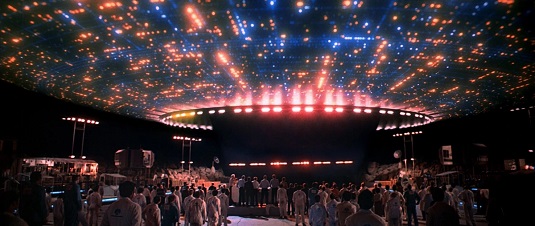
What kind of moment would the confirmation of extra-terrestrial intelligence be? This was the premise of an (ostensibly) intriguing First Contact: An Alien Encounter the BBC aired this week. Unfortunately, as a work of scientific speculation it failed to live up to the exciting proposition because it committed the cardinal sin. The show was boring.

First Contact begins with one of the Voyager probes picking up a narrow band signal, which is a sure sign of an artificial origin. The scenario then plays out over 12 days as the source is revealed to be a 200km-long object approaching the solar system. Oh dear. Grainy images are obtained of 'The Artefact' and it appears artificial in character. Spectroscopy readings shows metals, but the craft is seemingly tumbling in space and out of control. The boffins get to work on tracing its fight path and settle on a star system some 500 light years away, implying the craft had been in transit for over 100,000 years. No wonder it's not taking any messages. NASA direct the new James Webb Space Telescope at the system and finds evidence of a shredded planet, but with traces of manufactured materials showing up in the analysis. Meanwhile, the Artefact sails past the Earth and away. First contact is over.

The story could have been told in a 10 minute YouTube video if I'm honest. But the main purpose was to show off the science, and was therefore seemingly aimed more at a general audience. SETI's infamous Wow signal from 1977 gets its umpteenth showcase. It too was a narrow band signal and was much stronger than the background noise, and it (apparently) moved with the stars - as you would expect anything inbound to - but that was it. The best candidate for contact so far, but it has never repeated. Nor has it been satisfactorily explained by earth-bound or natural celestial phenomena. The question mark remains and may never be resolved. We're also told about how difficult it would be to communicate with aliens anyway, given how different our environments, biologies, and psychologies are likely to be. Just look at our miserable efforts at trying to establish a dialogue with whales(!). And we had to have a wee segment on ʻOumuamua, the first identified extra-solar object that passed by these parts in 2017. What the show skipped over were claims, such as those coming from Harvard's Avi Loeb, suggesting it could be an artificial object.

Surprisingly, while First Contact was humdrum and not a good way to fill 85 minutes it did at least get the sociology right. As noted a while ago, chances are news of an alien civilisation would perturb the froth of social media for a day or two and fade from view. Because this premise is a close brush with some derelict spaceship things are likely to be different. People lighting candles, American shock jocks forecasting armageddon, little kids hoping the aliens would be friendly, talking heads arguing the toss. Social media getting rammed with little green men memes was definitely on the money. And then we have people rioting because they suspected governments were concealing knowledge was a bit of a stretch. Then again, who could have foreseen anti-mask/anti-vax protests as a global pandemic ripped through the population?

When all is said and done, it's difficult to see who this programme was made for. Anyone slightly interested in the topic would be caning the YouTube videos already, and the casual channel surfer wouldn't have found something compelling enough to stick with. Science programming does get a lot of flack, and rightly so given how plodding and simplistic the output tends to be. I can't imagine anyone young watching this and feeling inspired enough to pick up a telescope, which surely is the criteria by which any flight of speculative fancy should be judged.

Image Credit

Wednesday, 30 June 2021

The Pentagon UFO File: A Quick and Dirty Sociology

Before entering the ivory tower, a constituent got in touch concerned about a flap of UFOs supposedly spotted over the skies of Stoke-on-Trent. As a conscientious public servant, yours truly penned a letter to the Ministry of Defence to ask if the top brass could shed any light on the matter. Six weeks later the reply came. They denied any knowledge, and proceeded to remind us that "it does not provide an aerial identification service for members of the public." To be honest, I was wondering what kind of official brush off we'd get and this more than delivered.

Moving to the present day, it's arguable that Donald Trump's inserting a clause into the Coronavirus Relief Bill ordering The Pentagon to report on UFO phenomenon by the end of June was the sole, pitiful positive of his brief tenure. On 25th the goods were ponied up. The report's eight pages say nothing about Roswell, cattle mutilations, grey aliens, moon bases, abductions, men in black, nor cover-ups. This would have disappointed some. After all, an absence of evidence is never evidence of absence. It's a sign of a conspiracy. But for those who reject these ridiculous assumptions, the report is nevertheless a fascinating piece of work as a research programme and a face-saving measure by the US military.

There is the subject matter. To avoid dubious associations and cultural residues of The X-Files, Unidentified Aerial Phenomena is the preferred term. This is more accurate than jolly old UFO which, with 'flying', implies a powered object moving under its own speed. Box ticked for the spinners and taxonomists. The report is also clear it is dealing with real sightings and real objects. It notes, "most of the UAP reported probably do represent physical objects given that a majority of UAP were registered across multiple sensors, to include radar, infrared, electro-optical, weapon seekers, and visual observation." The truth is definitely out there, waiting to be explained.

But what is waiting to explained? Aliens? No. The document puts forward a five-fold classification scheme by which sightings/encounters can be understood. These break into airborne clutter (drones, birds, balloons, and supermarket carrier bags), natural atmospheric phenomena (ice crystals and "thermal fluctuations" that might interfere with radar systems), US government and industry developmental programmes (i.e. experimental craft), 'foreign adversary systems' (technologies employed by foreign powers or non-state actors), and 'Other'. The last is the one for the ET enthusiasts, but the report moves to foreclose the possibility by referring to it is a holding pen for objects where data is lacking. It assumes cases can be allotted to the other categories upon further investigation.

What is interesting is watching an arm of the US state come to grips with the downright anomalous, and this leaves the release riddled with tensions and suggestive silences. For example, in a side note on the challenges for data collection it discusses the taboo pilots and other aviators face in discussing their experiences of UAPs with colleagues. This is undoubtedly reinforced by a rigid command and control structure and a super serious combat culture. Not unrelated to this then is the failure to include what should be an obvious classification of object: misidentified aircraft. This is not a flippant point, as a less excitable analysis of recent Pentagon tapes suggests at least two of the objects touted in declassified DoD footage are exactly this. Creating a false positive category and seeing it fill up with cases wouldn't do the professional image of the US Air Force and navy pilots much good. And so they will be left designated 'other', and be sure to fuel UFO chatter for years to come. Another is how the analytical focus will be on those UAPs demonstrating "breakthrough technologies". I.e. The seeming ability to defy physical laws, accelerating to near-impossible speeds, and exhibition of anti-gravity properties. Something to capture the public imagination, but would undoubtedly boil down to, again, aviators' observational error or glitches in the kit. Also not something Uncle Sam would like to shout about considering the money wasted on military spending. Leaving the gate open for paranormal speculation has the handy by-product of sparing the institutional blushes of the world's most deadly fighting machine.

For alien hunters, there's little joy to be found here. But for American politics watchers, whether homo sapiens or extra-terrestrial observers, the only close encounter in the Pentagon's report is with a clever, below-the-radar exercise in reputational management.

Image Credit

Sunday, 24 January 2021

Alien Interlude

Now for something a little off the beaten track.


Science geeks, astronomy types, and UFO enthusiasts allowed a frisson of excitement to shudder through the collective consiousness as news leaked about a possible artificial signal coming our way from the direction of Proxima Centauri. The closest star to our solar system, for those who don't follow such things. The podcast above talks about the science of the signal (which, in all truth, will probably turn out to be your dad's microwave) and other matters of interest. If you're wondering how humans might react to confirmation of an alien civilisation, then this item from the archives might assuage your curiosity.

Sunday, 22 November 2020

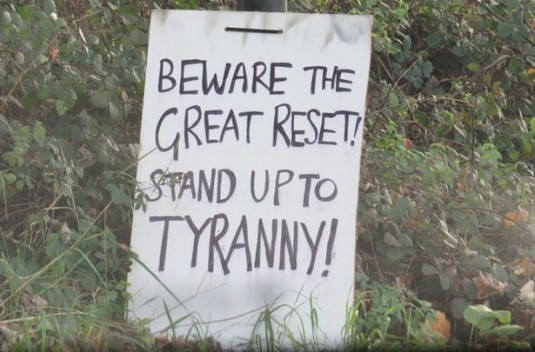
What is the 'Great Reset'?

We've seen the Covid denialism, the playground pettyness of the anti-mask whingeing, and the regular demonstrations of those for whom the lockdown, social distancing, and the coming mass vaccination are tied together by conspiracy theory. Considering the complexity of 21st century societies with looming crisis and political instability set as the new normal, the appeal of such are not difficult to fathom. We might be headed to hell in a handcart, but at least conspiracy theory makes for an immediately relatable and easy-to-understand explanation for the many dooms visited upon us. The newest story doing the rounds, as helpfully outlined by the BBC, does the job of tying the global response to Coronavirus together as a prelude for some form of naked Iron Heel-style direct rule by and for the super rich. Sounds arresting.

Like nearly every conspiracy theory the "Great Reset" is all things to all people. Here we have one hyper-local blogger (remember them?) arguing, in all seriousness, that Boris Johnson has signed the Conservative Party up to a global communist plot. Others see it as a Keynesian conspiracy - led by Prince Charles, no less - to hammer individual freedom and bring the state back into matters economic. Terrifying. So-called Bitcoin libertarians are among those getting sweaty, and another boring bunch of contrarian think-tankers locate it as an authoritarian effort to force green capitalism down everyone's throat. And then we have the "leftist" version, such as the one forecasting a "a fascist transhumanist hell in which freedom has been abolished and humans are merged with robots and turned into commodities for elite profit." Naturally, the piercing dog whistle of "globalists" features heaviliy in the Great Reset discourse.

In this country, most of the running has been done by Neil Clark - litigant in a never-ending dispute with Times hack Oliver Kamm, and an interesting journalistic resume that sees him contributing features for The Mail and The Express while penning stuff for, um, The Morning Star and Russia Today. Of late, Neil's Twitter feed has ramped up the conspiratorial coverage, mixing in genuine questions about half-arsed policy such as the mooted "freedom pass" and concerns about the tier system with baseless claims a global fascist power grab is in preparation. This piece on RT sums up his position well. Using a speech by Boris Johnson in which he notes "History teaches us that things of this [the virus's] magnitude ... do not just come and go. They can be the trigger for economic and social change." A completely innocuous statement on Johnson's part, and completely uncontroversial. Except for Neil. This "trigger for ... change" is deeply sinister, apparently. Along with the green industrial revolution, social distancing is not going anywhere. As Neil puts it, "Working from home is here to stay, with “gigabit broadband,” shopping from home, conferencing from home… in fact, let’s do everything from home. Who needs to meet other human beings? Not that there’d be anywhere to meet, with pubs, cinemas and theatres all closed down due to the never-ending coronavirus restrictions." Never one to enjoy being in the position of defending the Prime Minister, but this is obvious bobbins. The problem with the national lockdown is it's not rigorous enough, and contrary to enthusiastically pulling down the shutters on the British economy the government spent the Summer undermining public health by opening everything up, with bribes to encourage people to visit restaurants, bars, pubs and what have you. Either the British government didn't mean it and was a grandiose distraction techinque vis their true conspiratorial intentions, or the argument is completely groundless.

And yet like all conspiracy theories, an element of truthiness based on some facts does exist. There is something called the Great Reset, and groups of elite policymakers and tech capital have been pushing it - albeit in broad daylight. Perhaps the illuminati are simply brazen these days by hosting a website on the World Economic Forum to allow all and sundry to peruse their schemes. What gives then, what is the plan? According to the blurb global capitalism needs a reset, citing examples of stalling economic growth, rising unemployment, and rising debt - two of these three being the case before lockdowns rolled around the world. The consequence is an intensification of existing inequalities and social problems, as well as opportunities for some governments to scrap regulations and protections in the name of jumpstarting economies. As these problems are global, a global effort is required to address them. As such, this requires scary policies like ... the coordination of tax regimes, addressing the rules of trade, and creating a "stakeholder economy" - fashionable managerial speak for decent wages, full employment and (perhaps/sometimes) a bit of a say over the workplace. The second component of this strategy is stimulus spending so we can bounce back from the Covid crisis, but these should be strategic investments that build for the future - so more green industry, better infrastructure, more responsive institutions, and incentives for private capital to follow this policy lead. Lastly, the final round of objectives is to harness the fruits of the fourth industrial revolution to address the health and social problems the pandemic is leaving in its wake. For anyone paying attention to British politics these last five years, what the World Economic Forum are proposing is little different from the policy menu of the last three Labour manifestos, and the rhetoric of Theresa May and Boris Johnson when a One Nation turn in their speeches were warranted.

In other words, what the Great Reset is is a prescription for fixing the problems global capitalism faces. What a shocker that a bunch of mainstream policy wonks, fancied visionaries, and businesses might band together to come up with a way forward for their system. Like this has never been done by anyone before. Perhaps we should look back at Alvin Toffler's The Third Wave and Nicolas Negroponte's Being Digital as advance warning of the global fascist one-world government we've lived under since the turn of the century. Oh, wait.

Like the most successful of conspiracy theories, the Great Reset idea takes a little bit of reality and runs with it, reliant on the fact most of the people who'll lap it up know little to nothing about what is being described and what is going on. Take the fourth industrial revolution cited by Neil Clark and his conspiranoid friends. This is not a plan as such, but rather the emergence of a cluster of new technologies around artificial intelligence, automation and robotics, genetic medicine, space flight, and much else besides. This is simply an aspect and outcome of capitalist development, and one the left is well aware of and has written a lot about. Any decent political programme worthy of its name would work to inform the public about and consider the social implications the possibilities these new tools allow for. This is exactly what the World Economic Forum and its founder, Klaus Schwab, are doing. It just so happens the key innovation of this fourth wave is the reduction of commodities to information, and the possibility for their endless, infinite reproducibility with zero to very low cost. Thanks to advances in 3D printing even physical goods won't be immune forever, and so the problem for their system and the wonks of the liberal centre and conservative right is not the general betterment of humanity, but how to save property relationships and profits from the fourth wave's existential challenge.

There are two issues here then. Advancing a ridiculous conspiracy theory can blunt serious and necessary criticisms of government policy. Already there have been several occasions of the Tories, for instance, dismissing critique of their measures as Covid denialism - and a stupidly irresponsible intervention from Labour aimed at curbing conspiracies ahead of the vaccine roll out. There's your first reason why anyone pushing the Great Reset conspiracy is a fool or a knave, especially if they claim to be on the left. Fancy another? As the point has been many times before, conspiracy theories are not just false in the sense they are presented, they stand in direct opposition to a real understanding of the way of the world, and particularly how money is made and power configures and flows. In this sense it's much worse than conservatism, which at least tries to deal with the world as it is through a lens distorted by privilege and ruling class interests. Conspiracy theory, like the Great Reset, is fundamentally backward because it refuses social explanation, petrifies the elite relationships it claims to uncover, and ultimately leads to fatalist resignation or the toxic politics of the far right. As we have some experience with.

There is then no 'Great Reset' conspiracy. It is, nevertheless, a collective effort of utter rubbish written from the right, and hyperbolic grifting bullshit from so-called leftists. If one cannot resist a little bit of theorising in this direction, ask what our super brave truth tellers stand to gain. How might rightwingers benefit from pretending opposition to their free market fundamentalism, even of the liberal/Keynesian variety, is a fundamental affront to human dignity? Why would a bunch of Bitcoin stans feel insecure about a global effort to promote green capitalism and socially useful (albeit still capitalist) production? And whatever might leftists without much of a platform accrue from being the voice of a "socialist" version of this pack of lies? Join the dots, as they say.

Image Credit

Sunday, 15 November 2020

Labour's Anti-Vax Social Media Ban

Switiching on the television this morning, up popped Jonathan Ashworth on BBC Breakfast. He was there to explain Labour's latest policy announcement: the need for clamping down on anti-vaxxers online. Or, to be more accurate, introducing a range of penalties to force social media firms to clear this stuff from their platforms. He said this content is "exploiting people's fears, their mistrust of institutions and governments and spreading poison and harm." Can't really disagree. He argued this was not the same as voicing genuine concerns about the Coronavirus vaccine or raising questions of the government's management of the crisis, but with the roll out of a vaccine to begin soon (we'll see) it's imperative something is done to stop the flood of disinformation.

I have some sympathy with the intentions behind Labour's policy. Covid conspriracism is annoying. Its adjacency to QAnon and right wing conspiracy politics makes it worrying. Its mobilisations have undoubtedly spread infections, which is far more dangerous to the mainly middle-aged people attracted to these politics than the summer's Black Lives Matter protests. And, from a public health point of view, irresponsible and potentially dangerous. While the coming politics of vaccination are set to revolve around who should be prioritised, public anger at queue jumping, and how far down the age range the programme is going to reach, Covid denialism and the standard anti-vax "scepticism" is creating a hardened bloc of refuseniks. Some estimates put them at around 20% of the population. They might be protected by herd immunity when everyone else gets their medicine, or they might find themselves hit with another wave of Coronavirus with the added health costs and unnecessary deaths it would bring. And this creates new dangers - Covid-19 is a slow evolving virus, but every infection is an opportunity for mutation and potentially more virulent and deadly strains in the future. This is not idle speculation, as Denmark's mink farm crisis demonstrates. How to prevent this state of affairs?

There are no easy answers, and neither is simply banning anti-vax content. For one, nothing puts rocket boosters under conspiracy theories quite like authorities taking action against their "revealed truth". A social media ban might hinder the denialism, at least intially, but reinforces its key tenets and converts what is stupid into something seductive. The second is, despite the assurances made by Labour's health shadow this morning, we're getting into thought crime territory. The original lockdown was necessary, and it drove the infection rate right down. We'll see what the results of its half-arsed sequel will be, but between March and May the balance between public health pressure and the encroachment on liberty was a mess. Like banning people from visiting the countryside, or the allowance of a single hour outside for exercise and whatnot, or the exemptions enjoyed by recently late of Downing Street advisors. The outcome was more farce than tragedy, but the outcome of a ban might have unforeseen consequences.

For example, if the fining structure accompanying Labour's suggestions are especially punitive your Instagrams, Facebooks, and Twitters are going to introduce pre-screening on a large scale. Done on the basis of key words and key phrases, this means a lot of material discussing the politics of the vaccine are going to get blocked, or held forever in moderation hell until some luckless employee gets to eyeball it. Mission creep therefore is inevitable, embedded in the architecture of compliance each firm devises. With the left in particular having its reach actively stymied by Facebook, we know what this means for critical media. And if the flows of discourse outside the bounds of establishment media is blocked, guess who wins? Why, the traditional news and print outlets.

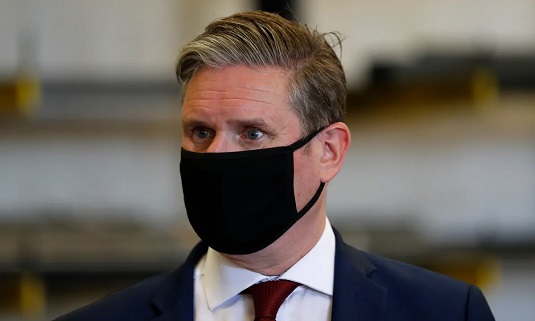
This is not a conspiracy though. Labour aren't part of the "great reset" or some such nonsense, but it does offer pointers about its political direction under Keir Starmer. Speaking on Desert Island Discs, he reiterated his commitment to retaining Labour as a broad church, despite recent events. Be that as it may, Keir's range and style of opposition versus the Tories is quite limited and technocratic, avoiding substantive issues like the roots of Tory incompetence, the corrupt abandonment of procurement rules by the government to shovel public funds into private pockets (family and friends of top Tories, obviously), and a studied avoidance of talking about the dead. This is not just because Keir is looking at improving his standing and wanting to avoid the charge of point scoring, it says something about his politics: he is looking to preserve state authority.

On BBC Breakfast, Jonathan Ashworth said the ban was driven by a desire to restore public trust in institutions. A laudible aim for someone entirely inside Labourism's statist traditions, but also hopelessly naive. Covid conspiracism and the irreverenace it feeds off is inseparable from long-term processes of political disengagement. And yet, it's worth remembering structural forces are not mechanical. As the outcome of social relationships the actions of condensed collective actors, like parties acting through democratic politics, the media, and the state, can steer such tendencies and lay the grounds for their evaporation, or their reinforcement. One such driver is parties saying one thing and doing another, like "forgetting" pledges made or backtracking on commitments to referendum results, or working against the interests of the people who voted for you in the first place. Ultimately disengagement and, by extension, anti-vaxxers are a political problem and need to be dealt with politically. The latest "policy" falls short of this. Not only is the game Labour playing potentially dangerous, it's doomed not to work.

Image Credit

Friday, 2 October 2020

After Trump?

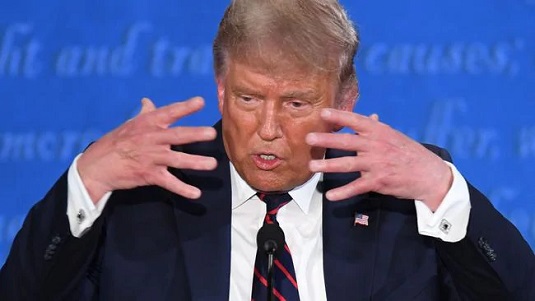
Fate has dealt 2020 a cruel hand, but there's something poetic seeing Donald Trump contract the diease he steadfastly refused to take seriously. He should have taken his own advice and necked the bleach.

I'm mindful of the consequences crowing can have for those scared out their wits about contracting it. But in Trump's case, there is no sympathy here. The worst possible president at the worst possible time, he has encouraged every boss to force their workers back into work, backslapped every Covid-sceptic governor to lift restrictions, made the most ridiculous and harmful public health claims, rendered consistent preventative action impossible, and used the crisis to whip up a racist campaign against China, a campaign that has made life hellish for Americans of East Asian heritage. Trump's recklessness, exceptional incompetence, overweening naricissism and, ultimately, complete lack of regard for the lives of others has put 200,000 people in the ground and left many more with the lingering effects of long Covid. Forgive me if I don't wish the President well.

As Trump's symptomatic condition goes from "mild" to "moderate" to treatment by experimental drugs to an extended "precautionary" stay in a military medical facility, what happens next with the election campaign? Seems Trump and many of his inner circle either have it or, like Mike Pence, were exposed to it. There's concern Joe Biden might also have copped a dose from Trump during the week's live TV debate. As far as Trump goes, the grid is out the window. The opportunities to stir the racist pot to get the support out will be missed and, seemingly, assuming Biden remains healthy he can tour all the crucial swing states without facing the neurosis and the skipful of dead cats emanating from Trump's Twitter account. Game, set, match to the Democrats?

Possibly. There is certainly a level of confusion and despondency among the Trump base. For those who believed his playing down the seriousness of Coronavirus might be wondering how a sniffle and a cough might incapacitate him. Indeed, a tour of his 4Chan fans and the allied networks of white nationalist and conspiracy theory boards shows not insignificant quantities of disorientation, if not despondency. Is it an 11 dimensional ploy? Are his opponents in the deep state bundling him out in a shadow coup? Or is Trump stepping out of public view to more effectively wage his secret war against the nonces, the Satanists, and the Clintons? Whatever happens, an easy conspiracy theory can be moulded to fit the facts and are getting cooked up as you read this.

Yet this is not the preserve of America's unhinged right. There are plenty on both sides of the Atlantic who are spamming Twitter with their own liberal/leftish conspiratorial takes of Trump's illness. These are the same people who believe Boris Johnson's difficult brush with Covid-19 was a wind up job conceived to build support and elicit public sympathy. The thinking goes if Trump disappears from public view, his absence will be taken for Christ-like suffering, and his pain and trevails will magically draw support as American voters rally around the stricken president. This is nonsense. On the sympathy vote argument, while all world leaders enjoyed a bump in support during the initial outbreak, Trump's was the weakest. He also carried on peddling divisive politics in the hope of turning out his white, middle class base. Repeating the trick of 2016, in other words. He cannot be the rallying point for the whole nation, and so a significant sympathy vote inclining to Biden's camp are suddently going to cleave the other way is doubtful. This said, the alacrity with which some liberals and leftists have leapt into conspiracy thinking underlines the anxiety they have about their own capacity to win. They overestimate, as opposed to soberly analysing the strength of reaction Trump has gathered. Trump isn't the antichrist, tangerine or otherwise. There was nothing supernatural about his 2016 victory, and diabolism isn't going to magic a victory from nowhere. No, the unease exists because the initiative has passed entirely to the Democrats. If they screw up now, it's entirely on them and the politics of their new liberal hero.

What if millions get their wish and Trump succumbs to the disease? A fitting end for him, but the possibility of a new and dangerous phase for American politics can't be discounted. Thanks to the hold of conspiracy thinking, QAnon can point the blame at the evil cabal. Others the deep state. Others the agents of China. Whatever explanations emerge and circulate, their great leader's passing would mark an occasion of mourning and despair. Most are going to fall silent until another right wing bandwagon rolls into town, but for some his passing will be experienced as illegitimate, a crime committed by whichever shadowy group believed to be pulling the strings. In this sense, Trump becomes a martyr, someone whose deceased person could inspire more mass murder/mass casualty events - with women, minority ethnicities, and sexual minorities the most likely targets. This, in their twisted imaginary, is vengeance, and it's international. If QAnon can cross the ocean and cohabit with our own covidiocy fringe, why not violence too?

For this simple reason, while I can understand the many, many people wanting to see Trump die at the behest of those he effectively condemned, we need to think carefully about what we wish for.

Image Credit

Saturday, 12 September 2020

Cultural Marxism and Conspiracy Theory

Among the drafts never to have seen the light of day, there is a third-written piece about so-called Cultural Marxism, a favourite and persistent conspiracy theory starting out in the anti-semitic sewers of the far right and has ingressed into more mainstream conservative thought. Rather than spending time dusting it off and giving it the spit and polish treatment, Aaron Bastani over at Novara Media has supplied the goods instead. In lieu of extensive writing from me this evening, enjoy.

Saturday, 5 September 2020

A Cultural Sociology of Mass Stupidity

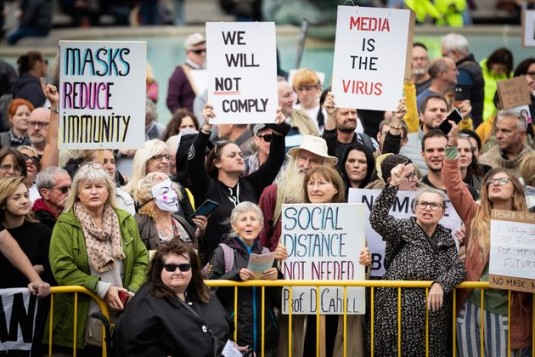
We can now add former Stone Roses frontman Ian Brown to the roll call of stupidity. Tweeting on Saturday afternoon, he wrote "NO LOCKDOWN NO TESTS NO TRACKS NO MASKS NO VAX." Utter bobbins, but remember he did release a song called Dolphins were Monkeys so science was never his strong point. We know it's not just him, though. Last week Piers Corbyn copped a ten grand fine for organising the anti-mask protest in Trafalgar Square, and to him flocked all that is naive, foolish, and downright thick. The banner of the British Union of Fascists made an appearance, and circulating among the anti-maskers were adherents of QAnon, climate change deniers, and assorted far right and conspiracy hobbyists.

When a small clutch of people do something, you can put it down to idiosyncrasy. But when large numbers are involved, with input from right wing politics and celebrity has-beens hungry for the hit of the spotlight, we're talking about a social phenomenon. It therefore behoves us to understand more than the cultural roots of this form of conspiracy thinking, as interesting an exercise that is, but what matters most immediately are the reasons why anti-Coronavirus conspiracy thinking and its anti-mask message has efficacy.

These processes are fairly well understood in general terms, but it's worth spelling them out. Mass stupidity in advanced capitalist societies is not because people are ultimately brainwashed or lacking in the grey matter department, it's a question of how we "become", of what type of human beings we are and why our society has churned our like out for decades. And this is inseparable from the N-word no one ever hears on the BBC: neoliberalism. Instead of conceiving neoliberalism as a set of economic-oriented policies emphasising market fundamentalism, privatisations and, with it, attacks on workers' movements and workers' rights wherever it takes hold, neoliberalism has to be thought about at its most pernicious: as a mode of governance, a diagram for shaping, manipulating, and relating to human beings, particularly at the interface between institutions and organisations as collective entities and people as atomised, individuated bodies.

Let's unpack that a bit. Thanks to successive interventions by the state across all areas of social life, what you might call the consuming self has become the model of citizenship. Think of the prototypical shopper. They go into a shop and choose what they want to buy, and as consumer markets have expanded so have the choices available, provided money is available to take advantage of the array of choices. What someone decides to buy, how much, and how frequently is solely a matter of individual determination, of weighing up the options and choosing. This sensibility was raised to the pinnacle of public policy under Thatcher, and has informed governments red and blue ever since. Education, for example, a matter of parental choice, and this has justified the semi-privatisation of schooling and the introduction of metrics to evaluate schools by. Enhancing the ability to choose between private or public health providers was a long-held Tory policy objective, and enabling patients to make choices about their treatments, who treats them and where, continues to justify the ongoing marketisation of the NHS. And on and on it goes at all level of public service. Yet it is not enough to simply be offered choices. Successive governments were just as concerned with turning out people capable of making choices. This depended on inculcating a sense of the entrepreneurial self.

Consider schooling. At school children are taught about individual self-responsibility. So what is new? That has always been a feature of the education system. But married to this are batteries of test regimens backed by an increasingly authoritarian school culture in which teachers are performance-managed by the inspections regime and fidelity to grade targets set by management. This encourages informal streaming, exclusions, and the move toward screening entrants. In many schools some children are simply told they're not getting entered for a particular examination because their performance reflects badly on the school's reputation, which is measured by league table positioning. While wider culture is tending toward more cooperation, children and young people are addressed as isolated monads thrown onto their own capacities, skills, and resources. Whatever they do with them, however these are deployed is, again, down to choice. No one is responsible for their application or lack thereof than them.

This critique of education of the last 40 years is also well worn. It advantages middle class children, and those who refuse, reject, or find this approach to schooling alien to their background are wheedled out. They chose not to succeed, and it's only a hop, skip, and a jump to suppose they chose (and deserve) the fates awaiting them. But this interpellation of a neoliberal self, which is reinforced by the way public institutions address someone and, depending on the organisation, administer sanctions as disciplinary measures to reinforce future compliance comes with a political bonus. If the institutional landscape is set up to address everyone in a similar way, and everyone has more or less the same shared capacity to access services and abide by expectations placed on them, the micromanagement of everyone by a Whitehall bureaucrat becomes moot. Neoliberal selfhood is the most efficient way of managing populations because governance is overwhelmingly self-governance. Micromanagement in fact mushrooms under such a regime as administrators are needed to track metrics and managers are required to reinforce conformist behaviour, but it immediately appears spontaneous and not directed from the centre, effectively depoliticising the running of the services the state provides. "We do not comment on operational matters" has become a staple of the government lexicon.

The neoliberal self comes packaged with other consequences: on how the individual sees themselves in the world. While this mode of governance is prescriptive about individuality, choice, and responsibility, excludes collectivism (Thatcher might well have said there's no such thing as the economy, only individuals and their families), and reinforces one's powerlessness in the face of the world, it compensates by endowing the neoliberal self with ontological and epistemological sovereignty. Put plainly, I'm all that matters and I know best. If then the cultural accent is on self-responsibility and effort, there is no higher power dictating what is and isn't true apart from your own opinions. If previously "objective truth" resided in the claims of experts and the rules of evidence, the systematic denigration of politically inconvenient authorities by governments and the number of occasions experts have shown themselves to be wrong reinforces the belief of individual discernment. If I want something to be true, then it is. UFOs, climate change denial, QAnon, homeopathy, chemtrails, Rothschilds, lizards. No one can tell me otherwise.

Which brings us to covidiocy as the latest manifestation of the social propensity to stupidity. Primacy of the self involves more than just scepticism of authority: the sovereign individual is anxious the state is out to get them or curtail their fundamental capacities in some way. In other words, its a sensibility of self that heightens a sense of (narcissistic) paranoia. This is the logical end point of the individuated, isolated neoliberal self: an affirmation of their right to choose as it shrinks in terror from impositions of state authority. Therefore, the lockdowns and the partial closure of public life, the insistence on facemasks and bans on large gatherings, these are straightforward power grabs to force people to wear masks in public forever more (why?) and police the conduct of the citizenry. If that is the first concern, then the rest makes sense: Coronavirus isn't more serious than a case of the sniffles, or Covid-19 is a manufactured disease, or is totally bogus. The reality (or not) of the disease is secondary to people, in the absence of collective sources of symbolic belonging/reassurance, clinging to and fetishising the structural principles of their perceptual universe.

This is the how, but what comes next? How to beat this? Politics and hope. Variations of the discussion on the dynamics of mass stupidity can get written and find their audiences, but elaborating this critique and explanation won't dent the potency of these notions. The alternative, the only alternative, is by challenging the position neoliberal governance occupies. And again, that requires critique, but is doomed to impotence if it is not merged with a movement challenging not just the Tories but capitalism itself. This is not a cop out. Ideas can't change the world by themselves. Conspiracy theories were (mainly) harmless eccentricities until millions of people across the globe took them up and began acting on them. The same is true of our ideas too. Writing them is the easy part, making them part of the everyday is the difficult slog. But it's worth it. The struggle opens the way to real freedom where true individuality, not it pale, stunted, neoliberal version, can take wing and soar, unencumbered by authoritarianism and the banshee call of superstition.

Image Credit

Tuesday, 25 August 2020

Acid Communism on The Cosmic Right

Reaction comes in many strange forms, and undoubtedly among its weirdest manifestations is the strength of conspiracy theories on the right. Consider for a moment the spread of QAnon, which now has an anti-paedophile protest outside Buckingham Palace among its first UK success. Conspiracy theory, however, isn't entirely the property of the fringe. In its more mainstream forms, the idea of shadowy people manipulating events is part of the conservative framing of the left and, particularly, their explanation for the young's receptivity to social liberalism and radical, anti-establishment ideas.

In this episode of ACFM courtesy of Novara Media, comrades Nadia Idle, Keir Milburn, and Jem Gilbert look at the crossing over of these right wing conspiratorial trains of thought into new age spirituality and the discourses of "wellness" and wellbeing. We've certainly seen (clumsy) attempts by the right to politicise face masks as harbingers of totalitarianism, and so we can see how it might insinuate into anti-medical establishment "alternative" medicine and associated practices.

Anyway, that's enough from me. Enjoy.


Saturday, 16 May 2020

An Apologia for Racism

Every conspiracy theory is on the lookout for idiots to hoodwink. And the latest, linking 5G to Coronavirus and, by extension, covid-19 isn't as debilitating as the government says has found a (relatively) high profile martyr in the gullibility of Piers Corbyn. He was among a handful of others to have attended anti-lockdown protests in Hyde Park this afternoon, and got carted off by the fuzz for his pains. An outrage right? Well, not really when social distancing exists to prevent the spread of a potentially lethal pathogen. And there is the small matter of his latching on to the so-called Freedom Movement, a cabal of far right fantasists and Third Reich cosplayers who called these protests from the self-isolating comfort of their social media accounts. But Piers is mentally ill, Phil. Quite, but as a rule mental illness doesn't predispose one to going on fascist-inspired protests.

It's easy to dismiss the UK Freedom Movement and the paltry numbers it turned out at its "mass mobilisations" today, but should we? In his recent interview on Politics Theory Other, Philip Mirowski cautioned the (American) left against letting anti-lockdown protests slide. What they represented was the next phase of reactionary street politics on behest of the Koch family and their cabal of semi-fascistic billionaires. The left ignores these movements at their peril. But that is there and this is here, so do the same arguments apply?

Britain's fascist movement is a far cry from what it once was, though sadly less to do with their being smashed to pieces by the left and more their agenda getting gobbled up by UKIP first, and then the Conservative Party. However, the political problem doesn't lie, for the moment, in a new far right street movement tearing up city centres. The danger resides in the spread of their conspiracy theory.

The Coronavirus/5G theory, having inspired a spate of attacks on phone masts, is particularly worrying not because we've grown attached to decent mobile coverage, but because of racism. Sanctified by the moron in the White House, the more catastrophic Trump's handling of the pandemic becomes obvious the more he and his allies will keep blaming China. And in an election year, he's got to rescue those tumbling poll ratings among older voters somehow. Here in the UK, there are Tory MPs and right wing commentators only too happy to jump on the anti-China bandwagon. They might sidestep the ravings about the "Wuhan virus" and its disproven narrative of having got concocted in a laboratory, but the "genuine concerns" argument provides a nice bridge to the demonisation of an alien other. A new spectre to frighten the Tory faithful with. But this is not without consequence. From the moment Coronavirus became global news, racist attacks on Chinese and East Asians went up. Racists don't care about the minutiae of nationality and the truth. As long as there's a group that can be identified and othered, cut off from the rest of society, and victimised with minimum social cost they're up for it.

Can criticisms be made of China's handling of the virus? Of course. And there's plenty to have a go at our own government about too. But the truth is the lockdown is there to save lives. It was insisted upon by the public and continues to enjoy mass support, especially now when its relaxation has already seen an uptick in infection. There is no grand conspiracy to destroy our liberties. Apart from curtain twitchers and overreaching coppers, a Johnson-led dictatorship is not in the process of formation. If anything, it's the tardiness the government showed and its continued willingness to put people in harm's way that's the real scandal. This is where the focus of criticism should be. Anything else is distraction and, as per the pathetic Freedom Movement, can lead to an apologia for racism.

Sunday, 26 April 2020

Twin Peaks: The Return

The original two series of Twin Peaks were good fun. Yes, at the start of the 1990s a series about a dead woman who'd experienced child abuse, rape, forced prostitution and was finally murdered was the stuff of light hearted entertainment. And I suppose this was one of the many layers of commentary on Americana David Lynch wanted to get out there. Subsequently having acquired a formidable, critically acclaimed reputation and widely known for being completely weird, the two seasons of Twin Peaks - broadcast in 1990 and 1991 - every trope of American film, television, literature, and Forteana can be found. The police procedural. Homecoming queens. Leather studded, um, studs. Corrupt business on the make. The diner. Jazz. Civil war re-enactment. Aliens. Social outcasts and jocks. Sawmills. Superpowers. Therapy. The great outdoors. Coffee and cherry pie. Damsels in distress, military secrets, organised crime. You watch Twin Peaks and all of America is there. Or, to be more accurate, all of white middle America.

Then, following the prequel film, 1992's Twin Peaks: Fire Walk With Me it went away for 25 years. After all, upon entering the infamous Black Lodge, Agent Dale Cooper was told by the deceased Laura Palmer that he wouldn't see her for another quarter of a century. By fortuitous happenstance, 2017 was when the long-awaited season three finally appeared, giving the impression this was a plan long in gestation. Reflective of the darker tone taken in culture and politics since, Twin Peaks: The Return is violent, coarse, and disturbing. It thinks nothing of blowing people's heads off, running over a six-year-old child, crushing skulls, and littering the place with mutilated bodies. Swearing is in, sex scenes are in, psychological torture is in. Yet while moving with the times by accepting what is accepted in contemporaneous "serious" television, like its predecessor series Lynch employs tropes and devices that increase the weird quotient, making the whole thing more absurd, contrived, and compulsorily watchable. Its weird is a weird entirely appropriate to the interregnum between the economic crash and the global pandemic.

I'm not particularly interested in providing a plot overview. There are plenty available if a summary is what you require. Instead, I want to tease out a few themes (easily, The Return has enough goodies to fill several learned tomes). The first is its most jarring aspect: the male centeredness of the narrative. In a decade where virtually all the acclaimed TV serials have prominently featured female characters, as brilliant as this is it seems somewhat out of place. Agent Cooper (Coop), his doppelgänger (evil Coop),and secondary characters Gordon, Hawk, Sheriff Truman, Andy, Bobby, even the Fireman (AKA The Giant) and MIKE (stuck in the Black Lodge) are the ones who force the pace, make things happen, move on the plot. Women are so often accessories, showing no more agency than Mandie, Sandie, and Candie, the cocktail waitress attendants to the Mitchum brothers. Audrey Horne is foil for her husband's gaslighting, Tammy is on hand to accompany Gordon and Albert on their investigation, Nadine listens to Dr Jacoby's conspiranoid rantings and is convinced to let Ed pursue his much-frustrated relationship with Norma, and even Judy - the big negative responsible for BOB, evil Coop, and everything bad in the show, seldom features. Her host, Sarah Palmer, spends her life smoking, drinking, watching old TV, and having meltdowns. The only two points of decision she makes is killing a random in a bar seemingly determined to assault Sarah following a diatribe of misogynistic abuse, and spiriting Laura Palmer away when Coop travels back in time (yes) to save her from her murder. This is only partially contradicted by side characters. Janey-E has to care for a semi-comatose Coop/Dougie (of which more shortly), and is able to buy off a bunch of thugs looking to kill him over gambling debts. Lucy shoots evil Coop as he pulls a gun on Sheriff Truman. Even the addition of Diane as a supposedly heavy-weight (and canon-critical) character doesn't break the pattern. Going from the recipient of Coop's daily recordings in the first two seasons, we learn she was raped by evil Coop, turns out to be a Black Lodge construct designed to assassinate Gordon, and when the real Diane is retrieved her identity is erased by her and Coop's passage into the alternate reality (Linda to his Richard), and then altogether from the story as she flees his hotel room following the series' most unsettling sex scene. Only her absence makes Coop's mission to find this reality's Laura Palmer possible.

Since the breakthrough of Blue Velvet, Lynch has been hailed as the archetypal postmodern film-maker. Pastiche, unreliable narrative, the subverting of cinematic convention, over-the-top auteurship, The Return amps up the pomo long after becoming passé itself and yet deploys it so it becomes something postmodernism should never really be: fresh. Albeit a freshness that simultaneously, and paradoxically, invokes nostalgia for the original series and its multiple disruptions. With Twin Peaks you know you're getting a helping of American weird, but here we also get a lot of the mundane. Awkward pauses and silences are in. Sequences where very little happens without any dialogue. Eating, making breakfast, swatting a fly. And scenes that are deliberately uncomfortable and don't go anywhere. Audrey's arguments with her husband are overlong to the point of cruelty, as if to mark off the naive, lively teenaged Audrey of 25 years previously from a fatal outcome of middle-aged disappointment and neurosis. While incidental to the story, Lynch does place Audrey in the Road House to reprise her famous dance. Other stories that don't go anywhere are a persistent feature of most episodes too. The bar is usually the scene for conversations between characters who appear just for a chat, and then are never seen again. Their concerns and gossip are left hanging - a glimpse then into the lives of extras? However, this is Twin Peaks and the background, the unthought and tacit doxa of the everyday is as much part of the characters as it is for the fleshiness and sociality of real life. For example, whereas Shelly was plot critical in the original series here she's still working at Norma's diner and is regularly fleeced by her daughter to support her and her husband's drug habit. As we explore their troubled relationship, which apparently ends after he seemingly shoots himself under a tree, there is nothing outside of it. Their rows and implied domestic abuse is a foil for nothing. It simply is. The same can be said for the benign and hokey back and forth between Lucy and Andy, Nadine's appreciation of Dr Jacoby, and Ben's relationship with his new Great Northern's secretary, Beverley.

Small, unfinished stories hang from the Twin Peaks tree, but Lynch is no stranger to indulging a love for artifice either. Characters come and go whose existence is very obviously just to move the plot along. Freddie fits this device to a tee, and revels in his mysterious destiny. A new face, he's introduced in episode 14 as a security guard at the Great Northern Hotel. He also happens to wear a rubber glove. According to the story he relates to James, he was instructed (by the Fireman) to go to a store and purchase an opened pack and buy the sole glove therein. He does so, puts it on but finds he cannot take it off. It's also conferred him super strength, which he later uses to put two guys in intensive care and bust open his cell door. Freddie is also on hand after Lucy shoots evil Coop and the spirit of BOB emerges. They get into a fight and the glove lets Freddie smash him to pieces. Presumably, Frost and Lynch were wondering how they could kill off the town's nemesis. Why not via a very simple and very obviously grafted-on character?

Perhaps Lynch's most audacious move is what he does with Cooper. Having resided in the Black Lodge for 25 years, Coop falls back to earth and replaces another doppelgänger - the washed up Dougie Jones, an insurance agent in Las Vegas who was created for the express purpose of providing a place holder for Coop's return. The problem is Coop not only loses his memory in the process, as Dougie he is little more than an automaton. The irony, agent Cooper loses all agency. One of the key aspects of poststructuralist thinking is the decentering of the subject, of a stress on how personhood and individuality is an effect of the structures and discourses that flow in certain directions, discipline bodies, contain and channel potentialities and impose an arbitrary order as if it was the order of things. What then happens if you lay bare these minute determinations and put conceptual personae on screen as dramatis personae? The life of Coop for the majority of the season. Made incapable of most things save for repeating people's words and random scribbles, through a series of prat falls and slapstick Coop, now as Dougie, is able to be a better husband to Janey-E and a better father to Sonny Jim. By following prompts from MIKE he wins over $400,000 in the Mitchum Brothers' casino, mindless scrawls on his case files uncovers an embezzlement sting by a colleague and inadvertently ends up reversing a decision on a $30m policy originally denied to the Mitchums, which then see these mobsters shower gifts on Dougie and his family. At every turn, Dougie/Coop has to be prodded and pushed into doing something which, by pure happenstance, leads to positive outcomes but nevertheless sees him reap the credit despite his being a pure vehicle of other people's actions.

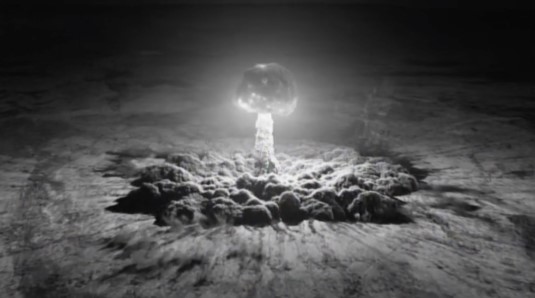
The real agent, of course, is Lynch himself who shared the writing credits with Mark Frost but directed every episode. He was also responsible for the sound design and penning several of the songs to have featured. Additionally, Lynch plays Deputy Director Gordon Cole, an affable and somewhat avuncular comic relief character in the first two series and Fire Walk With Me. In the return his character's stature grows as a leading light in the secret Blue Rose task force, formed after encountering a Black Lodge doppelgänger. Hard of hearing and having his aid cranked up to maximum, he frequently misses what people say and misinterprets. Lynch is also excellent in affecting a permanent bewilderment. In Gordon we have a character hot on the trail of the story and dependent on how events unfold, which belies Lynch's role as actual director and master of ceremonies. This little nod literally explodes in episode eight. For many the standout of this season, this was described as "mind-melting" by the Graun, "one of the greatest hours of television ever made" according to Vulture, and for the New York Times, "There’s nothing to point to in the history of television that helps describe exactly what this episode attempts." These are fair summaries. Most of the episode is a montage of abstract images and crashing, electrical screeching. It begins with the detonation of the first atom bomb, and the camera zooms into the mushroom cloud and subjects us to everything within. Eventually, it resolves to a faceless figure who vomits out a stream of globules, including one with the grinning face of BOB. In a lengthy sequence a convenience store is pictured with blackened woodsmen milling about it in a series of staccato cuts. These events are watched by the Fireman and a 1920s-styled Senorita Dido in their fortress. In a no less abstract sequence the Fireman reposes and levitates, sprouting an orb with Laura Palmer's face which is sent to Earth. Then we shift forward in time to 1956. A woodsman invades a local radio station and kills its inhabitants. Reciting and repeating a short incantation at length, townspeople listening to the show fall unconscious. One of whom is a young woman, whose mouth falls open and a creature - a moth with frog's legs, which we saw hatch and crawl across the New Mexico desert - crawls in.

Asked about this episode, Mike Frost said this was the nearest to an origin story for Twin Peaks we could expect. The furies unleashed by nuclear explosions is a well enough visited literary location, and the suggestion here is this is what birthed the forces of evil. Indeed, it's not spelled out but the young woman was likely Sarah, implying she is responsible for carrying the corruption leading to the abuse and murder of her daughter. The episode is also a signature mark of the Lynchian, having far more in common with experimental cinema and art house than anything mainstream. The black and white presentation heightens the comparison with the surrealist film makers of the 1920s and 30s. But it's also a statement of an artist at the height of their powers. As Bourdieu notes in his conceptual construction of the artistic and literary fields, there are sections of the field adjacent with and closely bound to the structurally dominant fields of the economy and of power. Works produced in this zone of proximity are concerned less with the artistic practice and more commercial reward. The blockbuster film, like Top Gun and its coming sequel, for example. Or the trashy novel, soap operas and sitcoms, the overwhelming bulk of popular music. The further one strays from the proximity of power the more one is concerned with the autonomous stakes of the field, of the cultural capital specific to it. Therefore, the further the trajectory is from the economic the more the disposition (habitus) pursues the profits unique to the art world and subscribes to the illusio of art's for art's sake. The modernist novel and symbolist poetry is emblematic of this: objects produced for niche audiences with culturally specific capital by authors (auteurs) whose works are explicit interventions in the politics and fashions of the field. What Lynch accomplishes with part eight is an act of disembedding. Twin Peaks's reputation is founded on its limited materialisation of postmodern themes: here the limited is freed from its bonds and the indeterminacy of the unsignified and unsignifiable is allowed full reign. Lynch confronts a mass audience with the dark creativity wreaked by atomic blasts, and the commercially repressed creativity of art and image usually the preserve of self-selecting audiences of distinction. And he can do this precisely because his considerable artistic capital is buttressed by a successful career. He uses the rare instance of the confluence of artistic and economic capital to produce something utterly at odds with every TV show convention.

Ultimately, for a many layered and complex show like Twin Peaks it is an episode, a front in the interminable battle between the unambiguously good and the outright evil. This battle, so characteristic of American cinema, kids shows, and its news coverage is the only simple thing about this series. The inevitable elemental conflict ensures there is no closure to the third season, and why a fourth might be in prospect. Even if a sequel is not forthcoming, it doesn't matter. The Return is a fundamentally open work with its many story lines left unresolved and turns inviting speculation and argument. There are any number of rabbit holes for the curious to bolt into. Why not join Twin Peaks fans down one?

Image Credit

Thursday, 6 September 2018

Here Come the Cranks

One of the very first things I learned about radical politics (thank you Class War!) is that your enemy's enemy isn't necessarily your friend. This always comes to mind when Russia is in the news because, in a pathetic echo of the Cold War official CPGB apologias of the old Soviet Union, we find people happy to go to great lengths to prettify or explain away the activities of the Russian state. The naming of two Russian suspects for the poisoning of the Skripals is one of those occasions.

Cast your minds back to March-April time. As Sergei and Yulia Skripal lay ill in hospital, this was seized on with alacrity by a Tory government getting blown from pillar to post by its own internal difficulties. They declared to the world that the Russians were responsible when this could not have existed beyond conjecture. How do we know when we're not privy to the intelligence? Well, we've seen how the scanning of the CCTV and tracking the movements of the alleged perpetrators, and their identification has taken months to assemble. Were such information at the security services' fingertips to begin with, it would have got released pretty sharpish to make themselves - and the government - look good. However, May began with the assumption that it had to be Russia (you don't need to be a Cluedo champion to surmise the victim, motive and method point at the FSB), and they went all out on it for political reasons. Not least because it provided an opportunity to show Jeremy Corbyn up as weak on security issues. Sadly for them, because of the stance he took - and much to the grumbling of Labour's backbenches - the story quickly became entangled with the innumerable and complex ties between Russian money, the City, and the coffers of the Conservative Party. Always beware the law of unintended consequences.

Nevertheless, being distrustful of the Tories, the security services, and the convenience of alleged Russian terror doesn't mean the Russian government is blameless. The left should not simply put a plus wherever the Tories and the spooks put a minus. In all probability, this wasn't a hit ordered by Vladimir Putin. All authoritarian regimes are, paradoxically, chaotic. Even the two most extreme examples from the last century, Stalin's USSR and Hitler's Germany were marred by fractious and sometimes murderous conflicts within the ruling parties. In such chaos, a lot of organisational movement was possible because individuals and groups of people 'work toward the leader'. That is undertaking activities, often on their own initiative, designed to curry favour with the higher ups. The commissar who, at gun point, requisitioned more grain than the quota demanded. The SS corporal who set about murdering villagers and burning their homes to catch a superior's eye, it is more than possible the Skripal hit was cooked up in the bowels of the FSB to earn someone a promotion and a salary bump. Nevertheless, as Putin came up through the KGB and this is his system, whether he issued the order or not he ultimately is responsible - if this likely scenario turns out to be the truth.

Sadly there are sections of the left, and I use that term advisedly, who aren't interested in analysis, weighing up evidence or considering probabilities. Consider ex-diplomat Craig Murray, for example. He has acquired undue prominence in left wing circles for peddling conspiracy theories, which in itself is an indictment of the level of sophistication and political confidence of out movement. In this case, Murray has declared shenanigans for two reasons. One are the photos of the two suspects apparently standing in the same place at the same time, at least according to the CCTV time stamp. As Brian Whitaker points out, this can easily be explain by ... both men passing through two separate gates simultaneously. And, being the helpful sort, Brian provides photos of these short passages. Still, not being interested in fact Moscow is now parroting the same line too. Prior to this, Murray had claimed there was something fishy about the photos of the two suspects when it turned out to be a diminution of quality thanks to the Graun's own scans. Mountains and molehills, etc. And then there is his obsession with where the Skripals are located and why they're not appearing in public - it would appear he's not familiar with the idea of witness protection. These alone should demonstrate why no one on the left should give him credence and why he should be regarded as a crank.

Just because the British state is duplicitous and rotten doesn't make Putin and his works automatically virtuous. Russia is a state like any other, and one that uses its not inconsiderable lobby in Britain to deepen the distrust millions of people have in the security services following Iraq and other debacles. By accident, idiocy, or intent Murray has placed himself in that lobby, along with George Galloway, Alex Salmond and now Tommy Sheridan. I don't know about you, but the world is a messy, complex place and one which the left should try and maintain a critical distance from to try and understand it to, you know, change it. The likes of Murray do worse than hinder, they make our work more difficult. In short, these are friends the left could do without.

Saturday, 23 September 2017

Nibiru is Coming


This is the end, beautiful friend. This is the end, my only friend, the end. There are one of two ways you could be reading this. Deciphered and translated from a charred server drifting among splintered asteroids some millions of years after these words were written. Or as per normal via your favoured internet-enabled device. As 23rd September draws to a close there's nary a rogue planet in sight (let alone the earthquakes and volcanic eruptions that would occasion its approach, though I'll grant you the severe weather ...). Yes, Nibiru, the fabled phantom planet beloved of conspiranoids and Bible code saps was due to wreak devastation upon the Earth today, if not collide and smash us into smithereens. The ways things are going some might regard this as a mercy denied, but I'm not one of them. What interests me is the persistence of such obvious bullshit beliefs like this one.

Social being conditions consciousness. If what you encounter during the course of your own experience runs against the ideas you have in your head, they're going to be heavily modified by or discarded in light of that experience. The pernicious character of conspiracy theorising, however, works because they operate at a level of abstraction and remove from experience. They disregard the rules of evidence and, in fact, take the absence of evidence as evidence of their claims. It makes them nigh-on impossible to refute as counter-arguments merely confirm the original claims, or invalidates the critic as part of the conspiratorial apparatus. Take our friend Nibiru for instance. Despite claims of its imminent coming on several occasions, the planet's studied refusal to bring human civilisation crashing down is merely a consequence of reading the Bible numbers wrongly. Take it from the claim makers, Nibiru exists. Have faith! And ignore NASA and 400 years of modern astronomy who have consistently conspired to keep the truth of its existence from the public.

We've visited the well spring of conspiracy theorising before, that their strength lies in their simplicity. You can take together the complex mess of the social world and weave it into a narrative of manipulation by self-serving elites. A matter of reducing shades of grey to black and white. My friend Andrew Wilson, for instance, researches how fringe-of-the-fringe beliefs have totally mainstreamed, with some ugly political consequences. The fertility of conspiracy is thanks to the context in which we live, one that is marked by great uncertainty and risk, a seemingly rapid (and bewildering) pace of technological and social change, and an emphasis on the individual as the agent responsible for its own fate. If you are told and positioned by the social world as being on your own, you as a subject of that society become the most exalted figure within that individual universe. Your fate is your responsibility, yet you are also the ultimate authority and therefore the arbiter of what is right. Old Lyotard was certainly onto something when he diagnosed postmodernism as "incredulity toward metanarratives". Or, in plain English, the fragmenting of the dominant ideas (religious, political) that guided the understanding of the world for untold millions of people.

The default condition of thought in contemporary societies is therefore not scepticism, but cynicism. Or, to put it more accurately, naive cynicism. This is the assumption that everyone is out for themselves, are self-obsessed and concerned with feathering their own nests, and would happily sell their relatives into slavery if they stood to profit from it. Where this sensibility informs our relationships with institutions, the latter are taken to be untrustworthy, uninterested in "little people" concerns, and conspire with one another to frustrate the individual and bolster the power and cash of various elites. It is the petit bourgeois mindset writ large, a logical outcome of the individuating cultural logics of neoliberalism, aided and abetted by the easy networking the internet affords the like-minded. Living in such times, it would be surprising if conspiracy theory and its truth-denying properties had not become a mass phenomenon.

Hence Nibiru, one conspiracy theory amidst an expanding market for bullshit. The economic, the political and the cultural conditions that comprise the social is permissive of and amplifies conspiracy theory, and shall continue doing so until society is reconfigured into a new set of relationships. That Nibiru doesn't exist, let alone is coming for us doesn't matter. Nibiru is always coming.