Showing posts with label Video Games. Show all posts

Tuesday, 31 October 2023

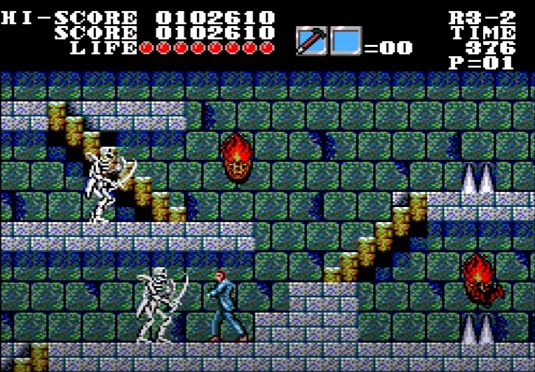
Master of Darkness for the Sega Master System

I am a complete wuss when it comes to horror. Novels, fine. I can handle them. Films, not so much. And video games? You can forget anything modern with their jump scares, creeping tension, gore, and all the rest of it. But things weren't always this way. Some time ago, and I mean a long time ago, in the halcyon days of the 8 and 16-bit era of video games horror was far from horrifying. Unless said title was spectacularly bad. Thankfully, that cannot be said of this Hallowe'en's pick: an entertaining romp that got welcome reviews at the time and now frequently features in the sundry best of lists that clutter up YouTube. Are you ready for the Master System's Master of Darkness?

You are Ferdinand Social, an Ouija board-using psychologist in late Victorian England who has turned to paranormal means for investigating and ending the reign of murderous terror visited on London by Jack the Ripper. And so begins an excuse to travel through five levels of platforming action to stop the murders, uncover the dark masterminds behind them and put pay to the resurrection of an ancient evil. Just the tonic for this time of year.

In gameplay terms, Master is not the most original platformer to have graced the humble Sega but it is certainly among the best. With the Castlevania franchise unavailable in 1992 for either the Master System or Mega Drive (where an instalment eventually landed a couple of years later), there are some "similarities" between the two titles. The destructible hidden blocks revealing energy boosts. Secondary weapons for more powerful enemies. The replacement of lanterns by floating faces with identical functions: the dropping of weapons and other goodies. An identical system of displaying the player character and bosses' energy bars. The bosses being quite redolent of Konami's celebrated franchise. And the fact the big bad you're up against is Dracula. It's all a bit de ja vu.

Except to say Master is more slickly presented than the NES Castlevania games. Rare among Master System games, the floaty controls, sprite flicker, awful music and the overall cheap feel is thankfully absent. Every level is prefaced by a strong narrative linking the plot together. Provided you take every step carefully and not come at it like a bull at a gate, the minions of darkness shouldn't prove much of a problem. Except for the dogs. And the bats. Both are supremely irritating to take out. And because we have respawning enemies, which is rare in a Sega game, that means those bats you previously offed after a painful energy draining encounter will come back for seconds if you have to backtrack. And you do a lot in the final maze level. Boss fights are fairly easy affairs. You can try and learn the attack patterns, but here if you are in a hurry you can slug it out and see if you can wear down the enemy's energy bar faster than your own. Recommended.

In all, there's little to fault in this game. It's a rarity in that some proper effort was put into a late period Master System game and out came a polished and accomplished product. The horror element is a touch twee as to be expected from the hardware limitations but the developers did a good job weaving it into something integral and compelling for the whole experience. And all without jump scares too. Whether Master of Darkness is worth playing today depends on one's taste in vintage gaming. Though well thought of it's not exactly famous, which is a shame. If you fancy a relatively undemanding platformer that's actually good, and you want to see what the SMS has to offer there are few games better.

Wednesday, 9 August 2023

The Pirates of Dark Water for the Super Nintendo

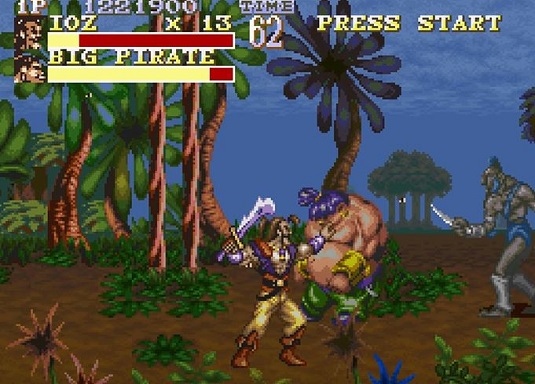
A video game that works better as an allegory than the short-lived allegorical cartoon it was based on? The Pirates of Dark Water was a fantasy series from Hanna-Barbera that aired on Children's BBC at some point in the early 90s. I sometimes occasionally caught it at tea time, though by then my telly of choice was officially Teenage Health Freak and The Word. Because it didn't catch on, Pirates had a very limited run and toddled off into obscurity. But not before it spawned two licensed titles for the Super Nintendo and the Genesis/Mega Drive. The latter was a run-of-the-mill platformer that also got a European release and now goes for silly money on eBay. The SNES version didn't see life outside of North America, and was a completely different game - being a beat 'em up in the Final Fight mode of things. And a fairly good one at that.

The premise of the show was the world of Mer is imperilled by the mysterious and noxious dark water. This substance, said to be leaching from the core of the planet, threatens to envelop the entire world and consume everything. The hero of the piece, Ren, and his doughty band of misfits sail the world seeking 13 treasures that, when brought together, will banish the dark water and make everything good again. As part of a popular cultural effort to raise awareness of climate change, the backdrop of a creeping doom and its link to our travails was more subtle than Captain Planet et al. But having "dark water" as the big bad and it enjoying more than a passing resemblance to oil situated the show well.

The plot of the SNES game is no different. Collect the treasures, save the planet. But as with the cartoon, there are baddies working to thwart Ren's efforts. Namely the crew of pirate captain Bloth who wants the treasures for his own nefarious purposes. This provides an excuse to beat up a roster of enemies, followed by the standard boss guarding the end of each stage. Their defeat reveals a treasure and the completion of Ren's quest is a step closer. On the journey, players can choose one of three characters in solo play or co-op. Ren is the standard character with a balance of speed and strength. Tula, an "ecomancer" and the franchise's token woman is speedy but weak, whereas Ioz is slow but strong. Each have a fairly limited move set that doesn't take advantage of the Super Nintendo controller's extra buttons. They have a standard attack, a desperation attack (which loses your character energy if it connects with an opponent), and a strong attack. Sadly, many an enemy - including some bosses - can be offed simply by spamming this move.

Nevertheless, Pirates is an entertaining beater. The enemies are quite chunky and there is a good variety of them. Despite there not being any more than three opponents on screen at once things can get challenging at times, which makes pulling through with just a sliver of energy left very satisfying. On the whole, the graphics are well drawn and competently animated for a game of this sort, and the sound design is fine. The tunes are appropriate - just don't ask me if they were from the original. There are the unnecessary but SNES signature mode seven interludes, and there is a touch of creativity. Late on the play style flips from brawler to a brief horizontal shooter. Can't say many beat 'em ups do that.

The game is not without problems though. Unlike Streets of Rage 2, it does outstay its welcome. There are too many levels and so the problem attending most beaters - repetition - manifests. This isn't helped by how the roster of enemies are very quickly introduced, so there are no interesting challenges later on. The developers tried getting round this creatively via the shooter encounter, but also relied on old tricks. Such as chasms to jump over, falling boulders/fireballs, and sometimes combining the two. Not especially useful when the jumping mechanics aren't perfect. On my playthroughs this resulted in a few cheap and unnecessary deaths. There are also hazards which can effect enemies as well as you. Because the AI isn't especially intelligent, if you park yourself parallel to on screen flames, spikes, or patches of dark water your opponents will happily run into them until expiration.

Entertaining then, but not exactly a must play. But what is worth revisiting is the allegorical aspect of the game. Back in 1994 it was infused with the climate change zeitgeist, but almost 30 years on the game sums up exactly where we are politically with the environmental crisis. Managing zero carbon and the switch to renewables is a bit of a slog, but as per the game when one batch of opponents are confronted and refuted, the same old names keep coming back with the same old attacks. The "new" just differ in terms of name and image, but their behaviours don't. It's the same enemies, over and over. Despite the global crisis getting worse, there is no putting aside of ambitions, the chance to make money, or interests to tackle the common threat. Indeed, for Captain Bloth the coming disaster is an opportunity for an authoritarian politics. He could be a disaster capitalist. And at the end of the game, with the defeat of the baddies the ship runs aground and the force of the collision catapults the 13 treasures all over the world. They are 'lost' and have to be recovered again, lest Bloth gets them first. This doesn't preface a second compulsory playthrough as per Ghouls 'n' Ghosts, but suggests struggle without end. Thus a firm conclusion is avoided, just as it was abbreviated in the TV cancellation. But it works for our climate change allegory as well. It underlines the necessity to never stop and keep pushing, no matter how repetitive it is. The alternative is something worse than game over.

Saturday, 15 April 2023

Gley Lancer for the Sega Mega Drive

Years ago I remember Dara Ó Briain saying that, as entertainment products, video games are unique because they actively work against the player experiencing the entirety of its content. Which (obviously) differs from film, albums, literature, art, etc. in which the viewer, listener, and reader get to consume everything. Though readers of Joyce's Finnegan's Wake might raise a counterpoint. The video game industry is well aware of this, which is why in the days of blockbuster video games costing almost as much as blockbuster movies to produce, they're made much easier than they used to be. Or, to be more accurate, more accessible. Infinite respawns are available as standard across most modern titles, and the use of achievements are used to incentivise game playing excellence. A game still wants to end you, but there are sanctioned ways of bypassing premature endings to enjoy the full artistry of what's on offer. And the provision of crutches to get a player through a game as quick as they like helps shepherd players onto other titles on the release schedule.

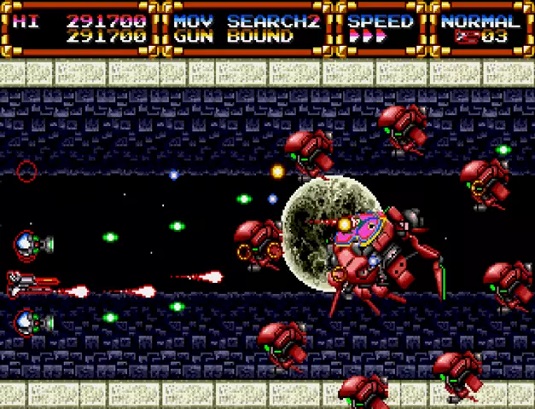
All this struck me as I was playing though Gley Lancer, the 30-year-old Mega Drive shooter recently given a new lease of life on modern systems. As the system was, in its day, arguably the best console for scrolling shoot 'em ups, Gley Lancer stood out from the crowd for several reasons. Its play mechanics, the (mostly) quality graphics and decent sound engine and, a boon or a curse depending on your preferences, its difficulty - or lack thereof. This makes it somewhat unique on Sega's black box considering other entries into the horizontal blaster genre, like Hellfire and Gynoug pack a hefty challenge.

As games go, Gley Lancer brings two new mechanics to the party. The first is adjustable speed. Tradition up to this point had it that one's spaceship starts out as slow as a three-wheeled Lada and becomes zippy through the collection of speed power ups. Not here. The default setting is slow, but a press of the button allows the ship to speed up and slow down. Handy for later in the game when there are flying blocks and platforms to negotiate. The other are the options. At the beginning of the game you're given the choice about how your add-ons should fire. Should they automatically target the nearest enemy? Should they fire in the opposite direction your craft is moving? Should they circle the ship and fire forwards? There are more combinations, and inevitably everyone will have their own preferences. Interestingly, building on this gimmick is what the Switch and PlayStation 5 versions have done. Twin stick controls means the direction of fire can be guided by the second stick, and the patterns can be changed on the fly (along with other mod cons like rewinding the game, and sticking on the scanline shader).

Unlike other shooters, there's a strong focus on plot. For most it's a throw away excuse for framing an exercise in explosions and violence, but here it cannot be escaped. There are cut scenes galore done in the customary anime style in which you, Lucia Cadbrock, absconds with the Gley Lancer to rescue Dad from the evil, anonymous aliens. They can be skipped in-between intervals of levels, but the lengthy sequence at the end of the game cannot. For some reason, games with extensive cut scenes do command a premium on the retro market, and a copy of the original release will knock you back at least £200.

The rest, however, is fairly standard fare. Shoot the baddies, collect the power ups (spread shot, bounce shot, short range powerful shots, lasers, you know the drill), see off the end-of-level guardian. Rinse and repeat. It's very straightforward. Except for the first level, which shades into the annoying. Within seconds you're thrown into a shower of rocks and space debris that are indestructible, all the while the lovely parallax background of more asteroids clips along at a fair pace. This makes discerning objects very difficult. But apart from that, it's plain sailing from that point on. There are some nice-looking levels and stylish bosses, but it's all so very easy. Apart from the end-of-game baddy these bosses are the very opposite of a bullet sponge. If you so much breathe on them they expire, which is a shame as there is potential here for good, challenging confrontations with well-drawn and well-animated bad 'uns. All accompanied by a technically accomplished but a not very memorable sound track.

And this is where we get back to the issue we began with. Gley Lancer is an entertaining enough shooty romp across 11 levels. The two mechanical innovations make for an interesting experience (as well as being left wondering why more successive shooters didn't adopt them), and while not a technical masterpiece it is well-programmed, and the attention to detail is suggestive that it was a labour of love for some on the coding team. And if they've done a good job, why not show it off? The decision to make the bosses super easy, how the player is untroubled, and how higher difficulty levels are available if the game is completed suggests the production crew wanted to put everything they had created out on display. Or if not display, within reach of most players. Therefore, in playing Gley Lancer you'll get to experience all that it offers. The problem lies in whether you'd want to do it much after you've been through it once or twice.

Image Credit

Saturday, 11 June 2022

Xenon 2: Megablast for the Game Boy

Xenon 2 was a game praised to the nines upon its release. The venerable Computer and Video Games granted the Amiga version 96%. The screenshots jumped from the page with their cool, metallic sheen and well drawn sprites, and a sound track - Bomb the Bass's Megablast no less - to die for. When my more affluent mates got copies for their 16 bit computers, young stripling me with my recently acquired Spectrum was suitably impressed. Until I got to play it. The horribly overrated Konix Competition Pro sullied the Atari ST version for me, and on the Amiga I somehow managed to get to third level on my first go. Unfortunately my mate was having his tea so no one witnessed the feat, and he refused to believe me when he came back. Perhaps these experiences jaundiced me. The game was a technical achievement, but the looping soundtrack got older quicker than Bomb the Bass's commercial viability and game itself was so so. A Shadow of the Beast of vertical scrollers.

The developers, the Bitmap Brothers and their publishers, Mirrorsoft weren't complaining. It cemented the studio as noted technical virtuosos on the 16-bit micros, conferring on them a loyal following in the press and gushing reviews to come. And the money made probably stopped Robert Maxwell dipping as deeply into the pension funds as he might. Yet Xenon 2 persisted beyond the Amiga and ST. A conversion to the Sega Master System was next. A curious choice but on a machine not overly blessed with vertical scrolling shooters, an understandable one. It looked good by 8-bit standards but was chuggingly slow to the point of unplayability - but it scored respectably in the magazines and sold reasonably. I guess gamers were a lot more patient then. The Mega Drive version came next, which I picked up for a song early in my retro-hunting career. And it's pretty poor. This port looked the part, but the rendering of Megablast is weak and the gameplay paled against the competition. Without the bells and whistles, the faults were magnified. No autofire function until it's purchased from the in-game shop, and then the rate of fire is so slow enemy swarms simply dance through the bullet streams. Terrible level design, and one of them missing in the MD version made for a pointless waste. Then came the curve ball port: this version.

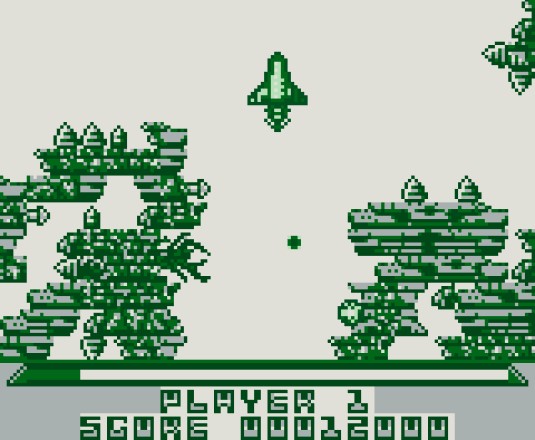
For a game designed to show off the power of 16-bit gaming, it's unlikely the Bitmap Brothers intended ever porting their flagship game to the most primitive, monochromatic hand-held console on the market. But it happened and, if anything, the Game Boy version is the best of the lot. For the uninitiated, the baddies have planted bombs throughout history to wipe lovely humans from the timeline. This was the foil for five stages of shoot 'em up mayhem, where the player has to dispatch legions of trilobite, molluscs, squidgy worm things, slugs and weird pulsating blobs with no correct animal analogue. Except on the Game Boy's tiny screen they're just wobbling collections of pixels. These things also have the propensity to enter the screen from anywhere, so wits are required. The end of the stage features the customary boss, which includes a mine spewing nautilus, a giant spider, a viperfish and an assortment of other lovelies. Pretty standard mechanics so far.

Xenon 2 does enjoy the same original feature in all its versions: a shop. All enemies or enemy waves drop tokens, which can be traded in at the shop for power ups. There are plenty to choose from, with rapid fire, rear and side shots, lasers, missiles, and speed ups being the weapons of choice. However, because this is a British-developed game and the temptation to be a bit naff was too difficult to resist, duff power ups are available. These include the expensive Bitmap Shades which does nothing but dims the screen for a short while. And Super Nashwan Power, which temporarily gifts an arsenal of power-ups. In a triumph of poor game design, this applies for something like 10 seconds shortly after leaving the shop and your ship isn't assailed by anyone. But what is a nice touch, present in all versions, is that power ups are physically added to the ship - extending the sense of invulnerability common to games of this sort, and ensuring such overconfidence will be the death of you. Another feature is you can reverse and force the screen to scroll backwards - except for boss fights. This is essential as daft levels mid-game feature maze-like structures that often resolve into dead ends and lengthy backtracking without any enemies to kill. Edgy design or a simple irritant? You decide.

Unlike the Sega ports, the Game Boy has all the levels and everything else is here. The daft premise, the awful level design, the deep sea baddies, the lot. The game plays better than the other versions because the enemy sprites hit boxes are larger, making for a less frustrating game. But this isn't to say Xenon 2 has shed the Amiga/Atari ST trappings for its quality to shine through. The game is more playable, yes, but it's no masterpiece. Nintendo's early Game Boy title, Solar Striker, is a better blaster. By boiling it down to its constituents the simplicity of the game stands revealed, it shows the cracks the lick of 16-bit paint the developers expertly covered. But also its simplicity is what made it ideal Game Boy fodder. Embarrassed by the riches of so many titles that were pick up and play (though it had its share of rpgs and, bizarrely, god games), Xenon 2 slotted into the console's library seamlessly. And it probably would have been ignored as so many others have fallen into barely-played obscurity, were it not a curio port of a 16-bit tech demo.

Saturday, 23 April 2022

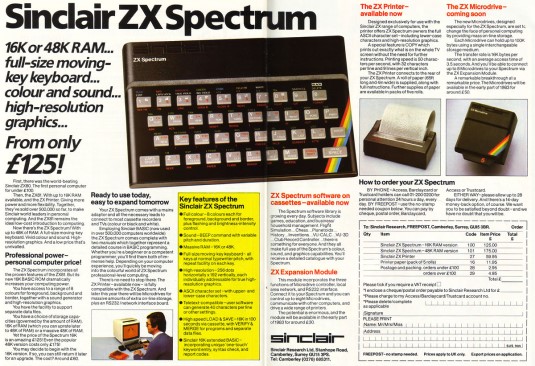
Remembering the ZX Spectrum

Thinking about the first video game I ever played, it was probably either Space Invaders at Heanor swimming baths or Phoenix at the Saundersfoot amusement arcade. But the first time seeing and having a go on a computer? That's a difficult one. I can vaguely recall the BBC Micro appearing at primary school with the Derbyshire County Council logo displayed whenever software was loaded up from the five-and-a-half inch floppy discs. Whether that was before or after leaving infants, I'm not sure. But the other front runner was a machine my comparatively more affluent cousins had installed downstairs in the kitchen diner: a rubber keyed 48k ZX Spectrum. I recall seeing it, playing the unofficial Return of the Jedi speeder simulator, Deathchase, and then not showing much of an interest. That was until a couple of years later when everyone had a computer of some description, except for us. And it was many, many years before a computer came my way.

That computer was the aforementioned Speccy, celebrating its 40th anniversary today. For some reason, the cousins gave it to me and no longer did I have to rely on the willingness of friends to let me play on their machines. My brother and I had our own piece of gaming kit at last, and we would certainly have had our money's worth if we'd actually paid for it. This time was early autumn 1989. The Speccy was still doing well sales-wise, but was looking long in the tooth. A plucky underdog versus the brash American bread bin that was the Commodore 64, which arrived in August 1982, and Alan Sugar's CPC range of computers. But against the 16-bit computers, which arrived in the mid 80s, and the Japanese games consoles which were taking their first steps to market dominance in the UK at the time, the Speccy looked ancient and tired. It was easy to look down on and frequently was, but it sparked a revolution.

Until the Sega Megadrive came along, the Spectrum was the best-selling home machine in this country. It was cheap and, more importantly, very cheerful. Games were inexpensive, topping out at around £9.99 in the late 80s (which is what I got my copy of Robocop for). There were hundreds of titles available at any one time on budget release at the £1.99 - £2.99 price points, and even more for the cost of a blank tape and the use of a twin deck recorder. I may have acquired my copy of Commando through such means. And even though the Spectrum was to other machines what the Sinclair C5 was to the Vauxhall Cavalier, the games were where it excelled. Despite its primitive countenance - a palette of seven colours, low memory and feeble sound chip (the last two getting corrected in the 128k Speccy reboot) - playability-wise its titles stood toe to toe with its C64 rival. The aforementioned Robocop and the adaptation of Taito's Chase HQ were two such triumphal moments in the war with Commodore's machine.

In official history the Speccy is a lot of things. The catalyst for the UK's computer industry, and a distillation of Thatcherism's entrepreneurial spirit. Both claims need heavily qualifying. For one, there were rivals aplenty for the Spectrum's share of the market in 1982. Sinclair's business model involved trying to do everything as cheaply as possible to depress cost, which led to significant reliability problems with its earlier ZX81 and the notorious RAM expansion pack that did not fit the port properly. Had the Spectrum not materialised, there was more scope for the barely remembered Oric and Dragon computers to do well. Atari's 8-bit range was present, the Acorn Electron came just under a year after the Speccy, and perhaps a pre-eminent position for the C64 and more elbow room for Amstrad, who suffered from being the last main micro to market, would have been outcomes of the Spectrum's absence. What the Spectrum catalysed, precisely because it was cheaper than its rivals, was the home coding scene that launched hundreds of companies and the careers of thousands of programmers. This would have happened had other machines filled the void, but differently. Some classic games and starts in the industry may never have happened, and the disproportionate clout British coding enjoys now might not be as expansive as it is. Second, we forget that Sinclair Research, previously Sinclair Instrument and Science of Cambridge, was set up as a parachute company in case Clive Sinclair's Sinclair Radionics went belly up. It did, despite being in receipt of state money, and some of the capital that kept the company afloat between 1977 and its dissolution in 1979 went into the side company, which supported the research underpinning the ZX range of computers. In other words, the state part facilitated this Thatcherite success story.

But what is often not mentioned, amid the business-friendly histories of the machine, is its popular cultural impact. Almost immediately there were the subcultures and playground wars, the fanzines and magazines and their loyal readerships. But more than any other machine it generalised the video game as a cultural form. British kids would have had some exposure to computers thanks to the installation of BBC machines in schools, but for those who were not technically minded nor especially interested in programming the Spectrum opened imaginations to entirely new experiences. That's what captivated me, the opportunity to ride a motorbike, pilot a space ship, defend Earth from aliens, race cars, be a hero, and inhabit completely unique spaces with no real world analogues, such as the platform game, the isometric adventure, the puzzler. These are experiences that were new and only possible with the advent of mass computing. As such there probably hasn't been a machine before or since with the sheer range of games, some of which defined and refined genres while others offered weird and unusual experiences not repeated since. The lawn mowing of Advanced Lawnmower Simulator, the teeth cleaning of Molar Maul, the pranking of Skool Daze are just a few of the hundreds of examples.

It was not just the imagination the Spectrum opened, but an imaginary. Technology frequently conditions outlooks and frames perceptions. How many people think about what they see in terms of how something might look on Instagram, or have a brainwave while having a conversation thinking 'that line would work on Twitter'. Millions do. The Spectrum set up (low) standards of what to expect from the limited power of the machine. Games that pushed at those limits and defied them, or in some way captured the character of conversions from arcades or other, more capable machines, butted against and redefined that imaginary. The ethic of technical virtuosity, whether displayed through graphical trickery or sound or solid, dependable game mechanics, has conditioned the video game imaginary generally. Then there is habitus, an inculcation of a whole set of dispositions, aptitudes, doxas, and preferences that simply did not exist before the home micro revolution. The emergence of genres and mechanic conventions within games are key here. Hegemonic were those who tended to replicate arcade games and this remained the case up until the PlayStation era, but other genres that were distant from those experiences were popular and well received. The Football Manager series, the classic space trading/privateer game Elite, and tactical skirmish games like Laser Squad spring to mind. As game types became more refined, players' expectations grew more structured. Playing new games was never a year zero affair with the acquisition of skill and experience, but with that accumulation of gaming knowledge preferences grew stronger, consciously and unconsciously, and in turned conditioned the experiences gamers desired on and after the Spectrum. In other words, the Spectrum was the gateway for millions into a whole set of practices that are a major component of our culture industry today. Most former Speccy owners are now aged between their early 40s and mid 60s, and there's a very good chance most of them have carried on gaming in some form in the years since.

Eventually, my rubber keyed Speccy went back to the cousins. It is still probably boxed up, stuffed with some other tat in a seldom-visited corner of the loft. It went because it was replaced by a 128k. It was a +2a, easily the best looking micro then on the market with a black case, black keys, and a blood red Sinclair logo. Unfortunately, its built in tape deck rendered it very unreliable. Machine number one broke and went back, as did machine number two. They got swapped for a C64 and after similar troubles, they went back twice before getting dumped completely for a Megadrive. The one I still have and works fine after 30 years. Yet even with games ahead of anything on the Speccy, its memory always tugged at me. The fun with JetPac, the sandbox of Rescue, and the frustrations that came with the Speccy - the awful games, the titles that refused to take advantage of the 128k's increased capabilities, and worst of all - waiting 10 minutes for a game to load and it flat out refusing to work. The Spectrum has long gone to silicon heaven, save for a dynamic afterlife among hardcore hobbyists still developing games and retro gamers not keen on the involved experiences a lot of gaming offers today, but it's still structuring popular culture, albeit our nostalgic reflections of what misrepresents itself as a rose-tinted simpler time.

Image Credit

Saturday, 26 March 2022

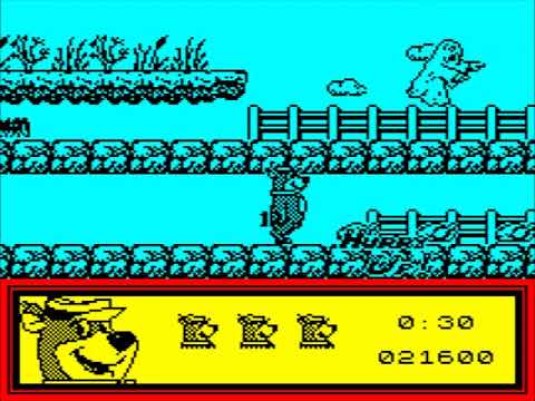
Yogi's Great Escape for the ZX Spectrum

You learn something new every day. Despite first playing this game on its release back in 1990, and then more recently I only just found out it was a movie tie-in for a straight-to-TV feature that came out three years previously. All of a sudden, a lot of the platforming, objects collected, and level themes make sense. But I'm getting well ahead of myself.

Yogi's Great Escape was one of a clutch of Hanna-Barbera licenses released by short-lived budget purveyors, Hi-Tec Software, between 1989 and 1992. In all, 13 such games featuring the likes of Top Cat, The Jetsons, and Hong Kong Phooey were made, and appeared on virtually every home computer format then available. Including the Atari 8-bit line of computers. And befitting the low price point, each game was practically identical apart from the odd graphical or sonic flourish. If you've had a stab at the Amstrad version of one of their games, you'll be able apply the exact same skills to the much snazzier Amiga iteration, for example.

But here we are on the Spectrum, a version that probably spent a little too much time in my +2 of old in the far pre-Covid times. Yogi's Great Escape wasn't exactly a game you talked about in the school yard, especially if one wanted to affect the countenance of a serious gamer. 30 years and after multiple doses of not giving a shit about many things later, I can understand why it was constantly in the datacorder - it was as no frills a platformer you could find on any system. There were no attacks as per Sonic and Mario, nor any puzzles to navigate, nor items to collect and use as in the then unstoppable Dizzy series. It was move right, avoid the traps, time the jumps, and don't get touched by the baddies. A veritable Krypton Factor assault course of a game, but with added pic-a-nic baskets and smarter-than-the-average-bear attitude.

The plot, as if it matters for a platform game, involves Ranger Smith having to privatise Jellystone Park. Presumably for a housing estate or a (then popular) golf course. This means Yogi and Boo-Boo are destined for the zoo, unless they can make a break for freedom. What follows is platforming action across the park, a forest, the wild west, a haunted swamp, and a fairground. The final level, New York City, switches the action up. Instead of platforming one has to navigate a hot air balloon across the roof tops to reach the Empire State Building. It all sounds quite pleasant, no? And if you look at the YouTube playthrough times, they usually range from 15 to 20 minutes. So quite a short piece as well. Heh. What the set up doesn't tell you is how Yogi's Great Escape is brutally difficult.

The first level is enough to try the patience of anyone, but the timings and patterns can be got down soon enough and it becomes something of a simple pleasure. But level two onwards? It's right up there with difficult games who don't owe their reputation to crappy coding. Like a lot of old home micro games, memorisation is key. There's no telling if an enemy will suddenly bear down on you giving no time to jump or react. But once experienced and added to the memory banks, one has to then learn how to get around them with perfectly timed jumps. If that wasn't bad enough, half-way through this stage they start shooting at you. Not cool, but at least true to form for the American tradition of blasting up the wildlife. Matters aren't helped later with platforms that loop back, allowing Yogi's hit detection box to brush against the feet of baddies on the floors above. A bit unfair when Yogi can't duck or anything. And then the final ballooning stage, which deserves originality points of sorts, finds birds inconveniently spawning in one's path. Slow and methodical progress is the only way to get through. Somehow achieve all this and we find the President decides to keep Jellystone open, so everyone can return home and spend more time harassing Ranger Smith. The idea a simple sit down with a politician is enough to undo their neoliberal parks sell-off strategy. Bless.

Yogi's was no technical masterpiece on any system, though the Amiga version does deserve praise for its parallax scrolling - something absent from the Atari ST version. But the Spectrum is where we're at, and the blue monochrome peppered with feeble 48k soundlets hardly push the system. But it never needed to. The controls are precise, the main sprite is recognisably Yogi, and it plays a mean game. Probably too mean a game, considering the demographic likely to have picked it up. I think much younger me barely made the third stage, thinking back.

Worth revisiting without the sepia tinge of nostalgia? Yogi's is definitely an obscure title and one seldom discussed these days, but it was probably the best of th Hi-Tec licenses and does give a flavour of what gaming on a budget looked like before the games consoles forced out the home computers.

Saturday, 12 March 2022

Note on Everyday Digital Internationalism

Are younger generations more pacifistic than older people? Commonsense, as well as evidence would say yes. As discussed plenty of times on this blog, the turn away from social and political conservatism by young people isn't a consequence of "being young" and full of idealism. It's part caused by right wingers of all stripes repeatedly pushing policies that harm their interests, a culture where struggles against inequalities and prejudice have made enormous advances in the last 50 years, and the decades-long reorientation of work around immaterial labour. These processes were underway before the internet became an party of everyday life, but have in significant ways reinforced them.

This short guest post from @catherinebuca sees her teasing at one thread about how online communities among the young strengthens networked social liberalism, and why it irks authoritarians and would-be warlords everywhere.


Been thinking a bit around this lately. Younger generations have far less appetite for war in part because international interconnectedness via social media platforms buffers against the Othering that is required to manufacture mass consent for conflict.

Last month (before the invasion) a gaming community I'm part of was up in arms when EA weren't going to release a piece of downloadable content in Russia because of Putin's stance on LGBTQI+ issues. Russian fans set out in-depth and convincing reasons why this wouldn't hurt the Russian state and instead hurt only ordinary people who, in the case of this fan base, are largely LGBTQI+ supportive. It inspired an outpouring of solidarity amongst players around the world, and as a result Electronic Arts reversed their stance and went ahead with the release.

Platforms and online communities help erase - or at least make less solid - national boundaries and feelings of difference. When people share interests, it's those interests that inspire a sense of belonging and familiarity, and which country or culture someone is from is often unimportant to the point of it often not being known by participants in these spaces.

Severing those links makes sense if you're trying to reinforce nationalistic boundaries and set people apart from one another, creating antagonisms where they had previously been ameliorated.

Banning things like Instagram is done for the usual obvious reasons: economically punishing international (often American) companies, stopping information getting out/in, etc. But it also threatens that no-border solidarity inherent to online communities.

The problem for Putin - and other leaders - is that it's too late. Young people's social worlds are organised through nationless online engagement, where other groupings and identifications are more important. The idea of national loyalty is muddied and confused and no longer adheres to the more stable, traditional pre-social media identification. People still rally around their nationalities, and there's a lot of silly 'my food is better, your pronunciations are daft' stuff, but when it comes to sincere expressions of belonging, our shared interests trump what we see as artificial and arbitrary national divisions that are for the benefit of power.

That's a long-winded way of saying part of why I think this war feels different is because online social interconnectedness is a far greater force than it has been in previous inter-state conflicts, and it's going to be a problem for leaders from now on. We can also (and should try to) expand this to (partly) understand why this same effect isn't apparent to the same extent for Yemenis or others suffering under constant bombardment.

Not all populations have the same access to social platforms, not all have become part of the wider borderless, nationless online social commons. And because of this they are not as co-present. Younger people are still more solidaristic perhaps than they otherwise would have been though, because this has effects beyond the individuals they interact with.

These are rough and indistinct thoughts on the subject. It's basically just to say while there are lots of awful things about the platforms, more broadly they've complicated (in a good way) national identifications, which is having (and will continue to have) a significant impact on the ways consent for war and other types of conflict are manufactured, and ultimately support for an unrestricted internet should be one of our primary concerns.

Obviously, blind support for the companies that own these platforms isn't what we should be championing. Control of these platforms should be in the hands of the users (as per democratic ownership or whatever method you prefer).

Saturday, 19 February 2022

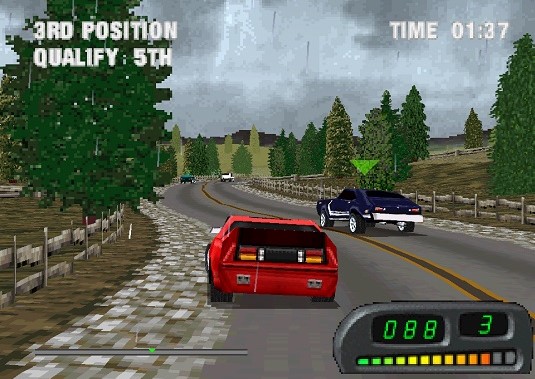
Hooters Road Trip for the PlayStation

It was announced yesterday that Nottingham will no longer be the only UK city playing host to Hooters, the US "breastaurant" concept chain known for employing "endowed" young women as waitresses. Liverpool can look forward to being the second pin in the Hooters' map. Entirely by coincidence, I started playing their officially licensed video game last week, Hooters' Road Trip. Why? Misplaced curiosity, just seeing how a business that revels in its oh-so funny "delightfully tacky, yet unrefined" marketing would translate its concept into a racing game. And the result, predictably, was anything but delightful.

Like practically all racers, there's precious little foregrounding. The aim is to simply pick one of three default cars - up to 16 vehicles can be unlocked - and race from A to B, meeting the qualifying threshold. Which is usually fourth place in most races on easy mode. It's worth noting that the computer-controlled opponents only stretches to five. Manage this feat of Herculean gaming and you make it to the next race and, ultimately, the next stage in the "road trip". That's all there is to it, as simple a racer as can be.

Where do the women of Hooters come into it? Loading screens get poorly digitised images of grinning and posing waitresses in branded gear as the disc spins away, while the old Hooter Owl logo pops up to denote loading. Occasionally, when starting a new race a bit of FMV pops up with a hostess, presumably from the localities concerned, welcoming "y'all" to their neck of the woods. And if one wins a race a bunch of beach-clad women bounce up and down, excitedly shouting "you're number one!". And that's pretty much as far as it goes. Whoever bought this on release in 2002 for scopophilic reasons were sure to be disappointed.

I'm not a forgiving man, so even if this game was a good play I would not have overlooked the misogynistic branding. But this is not a good game. Among the PlayStation cognoscenti, it's held up not just as one of the worst titles on the system but should be lumped in among the fraternity of famously terrible games. I wouldn't go that far as there is much, much worse, but this is a very deeply flawed piece of programming. The first of its main issues are the controls: they are absolutely dreadful. When selecting a car, you are treated to its vital stats represented as bar graphs. The longer the bar, the better it is, one would assume. But choose a car with good speed and good handling and you're done for. The merest tap of the wheel sends the motor barrelling all over the road. For example, you can earn licenses to drive unlocked cars by taking them for a test spin. I picked a speedy-looking beastie with (apparently) good handling and I couldn't keep it straight on a course entirely free of sharp bends. Trying to drive truly is an exercise in frustration. Therefore, choose the car with the stiffest, worst handling and the game becomes more bearable. But despite the rubbish controls, it is still pretty easy to win a race. Even as you careen from one crash barrier to another, the opponent cars are so pitiful no one should have any problem qualifying. On higher difficulty levels they get a touch faster, but that's it.

In other words, Road Trip commits the most egregious sin a racer can commit: it's boring. To be honest, I hadn't been this bored with an "entertainment" product since watching the last Indiana Jones film. It's easy, the tracks are poorly designed with too many short hills and sharp bends (though some of the scenery is passably nice) and the whole experience is so forgettable I'm having trouble conveying it with words. Ubisoft, the publishers, knew this wasn't any good and it was released for $10 in North America. But it is still unforgivable. With arcade masterpieces like Ridge Racer Type Four tearing up the track for three years prior to this on the trusty PlayStation, what excuse does it have for existing? What were the developers trying to achieve?

It seems Ubisoft slapped the Hooters licence on the game to help it shift units. But with the "charms" of internet pornography widely available at that point, it was hardly going to attract the attention of a horny customer base. Taking a more generous reading, you might say it was an attempt to conjoin fast cars with conventionally attractive women - a lifestylist ploy that part-underpinned OutRun's appeal, and sucked deep from the bong of Hollywood chaser movies. But while Sega's arcade hit was questionable and undeniably stylish, the two elements of Hooters Road Trip, the brand name and the bland game, are mushed together with all the subtlety of a pile up. And in this sense, the finished article is true to the spirit of Hooters as a flogger of fodder. It objectifies young women, exploits their labour, and serves up fare that is neither interesting, original, or enjoyable.

Image Credit

Saturday, 29 January 2022

Rush'n Attack for the Nintendo Entertainment System

Here's a title that elicits three game-related memories for me. The first is encountering it as Green Beret, as it was known everywhere outside of North America, on my mate's Amstrad 6128. Lots of pretty colours for a military-themed game. And then a few years later, happening upon it on a tape of copies handed down from my cousins when I inherited their Spectrum 48k. And the third was encountering the Nintendo iteration in, of all places, Crest of the Wave in Ripley, Derbyshire. As part of their marketing strategy in the US and Canada, Nintendo would distribute Playchoice-10s, an arcade cabinet from which gamers could select a range of NES games. What one was doing in my neck of the woods at the end of the 1980s is a mystery I can't fathom. Because of the underpowered hardware, it looked very weak in comparison to the more contemporary games you'd find at the American Adventure and the 16-bit home computers, who were at the peak of their popularity. And, apart from seeing Super Mario Bros in action for the first time, I couldn't understand why it had its own version of Green Beret available to play, albeit under another name.

In the mid-1980s the Cold War inspired militaristic movies, kids' TV programming, science fictions (militaristic and oppositional), and video games. Indeed, Konami eyed Western markets with a money-making glint in their eye and rode the wave with a clutch of military-themed games: Jackal, Combat School/Boot Camp, and Contra (a bit dodge that one, naming a shooter after Nicaraguan death squads). Green Beret was the first of this wave of titles, with it renamed Rush'n Attack for the unsubtle alliteration.

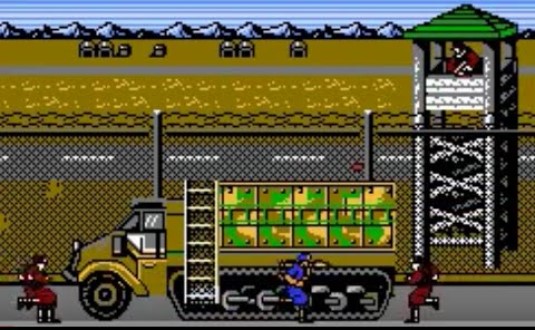
As per military-themed games before and since, the (80s) mediascape full of one-man-army scenarios is the necessary context. A bunch of forces personnel are held prisoner by the dastardly Soviets and they're going to get shot unless they're liberated by a hardy commando. In the arcade game, your protagonist walks from left to right armed with nothing but a knife to stab away the evil communists as they bear down on you. Your antagonists come in three flavours. The bog-standard henchman who simply runs at you and does nothing. Then we have the martial artists who take to the air with a flying kick when they venture near. There is the gunman - you'll never guess what he does. We also have guest appearance from parachutists, dogs, and gentlemen dropping bombs from microlight aircraft. Then there's the power up guy. Stick him with the blade and he drops a weapon. It can be a flame thrower, a bazooka, or a grenade depending on the level. Get to the end and the customary boss awaits. Except it doesn't. Instead, a full-on phalanx of bad 'uns come at you. They're very easy to dispatch if you still have the secondary weapon. If not, fancy knife work is your only way out of the pickle.

NES Rush'n Attack changes this up for the better. For one, the game is longer than the arcade and home ports as Konami added two extra levels. And you should think so too considering how much more expensive it was compared to the others. The music here is better and accompanies the game without wanting to turn the speaker off. The plot has also been changed and alterations made to the power ups. Now, instead of rescuing wayward GIs the name of the game is destroying a missile the Sovs want to launch at the Home of the Brave. And along the way, one can acquire a gun (for a time limited interval) to blow all them commies away. And, it seems, the bazooka and grenades are more plentiful. But, sadly, not the flame thrower. You can have a video game glorifying American militarism, one that sees the protagonist stab hundreds of people to death during the course of a play through, but turning them into pixelated flaming skeletons was a step too far for Nintendo's censorious instincts.

The gameplay, however, is entirely the same as its arcade parent. Except there's more of it. Rush'n Attack involves a bit of memorisation, but not heavy on learning the patterns, except for the end-level confrontations. The enemies come thick and fast, but never to the point of being overwhelmed. There's always a way through. Occasionally, a flying kick soldier will be spawned with a grunt and they'll come at you from the same side at once. Jumping to take out the Jackie Chan wannabe risks falling on the other and dying an inglorious death. Another annoying bug, present in all versions, is jumping and getting caught on a ladder. It means dealing with your high kicking foes has to be timed and take place away from the steps. What is properly irksome is the decision to use up on the direction pad as jump, when the NES convention of using a button was already established by the time of release. It can lead to screw ups because making your dude jump accidentally is an ever present risk, and it happened to me all too many times. But this was the 80s, and little quirks of this character were ten a penny in games. They helped add to the challenge, and they didn't usually attract complaints from computer mag. That's how much they were part of convention.

There are a couple of messages we can take from Rush'n Attack. Overt is the might-is-right nonsense. Getting to the end of the game, taking out the waves of baddies, nicking their bazookas and blowing up the naughty rocket, we are treated to a brief, rudimentary sequence in which the base explodes and our hero flees the scene, underneath the legend "You have saved the world! Congratulations! Peace has arrived at last!". Fighting for peace, you've got to love it. The second is much more subtle, and is about weakness. Admittedly, Rush'n Attack wouldn't be much cop if our green beret (who, by the way, wears a blue beret throughout) was well 'ard and could soak up punishment like a sponge, as per other military titles. The one hit death makes for quite a challenging title for the uninitiated. But doesn't this also say something about the jitters underpinning the 80s Cold War mentality? Here we have a special forces soldier who can be slain by the mere touch of an enemy. For all the advantages the player character has over its computer-controlled opponents: occasional ranged weapons, a knife with decent reach, the ability to learn and apply tactics, no matter how prepped and tooled up our character is, just like Uncle Sam he is fragile and vulnerable and can fail at any moment. And so, a Japanese video game developer watching Hollywood from afar was able to encode the bravado and anxiety of Reagan's America into the game mechanics of an enjoyable and otherwise brainless militaristic slash-a-thon.

Tuesday, 21 December 2021

Conquering the World, Pixel-by-Pixel

The long-awaited Winter holidays are here! A few weeks of mince pies, tinsel, miseltoe (if you're lucky), and a bit of time to waste. Yours truly is catching up on some reading with Rebecca and What is Philosophy? providing the book-bound entertainment. And for those moments where the brain needs a rest and something less cerebral, there is the new web-based game Territorial.io, by David Tschacher. If there's 10 minutes going spare, why not conquer the world?

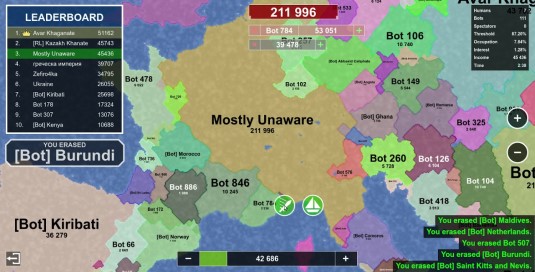
Territorial.io is just about the simplest and most straightforward realtime global warfare simulator there is. You pick a spot on the map and your job is to grow out from your pixel to the point where you rule the world. Or enough of it to meet the victory conditions. There are up to 512 others trying to do the same too, so a bit of skill and a lot of luck is needed to fulfil your manifest destiny. By clicking on the map you expand your land holdings. The more pixels under your control, the more rapid your population grows and therefore your army. The latter is controlled by the percentage bar. Expand with low numbers and the more people stay at home to reproduce, but less land is taken in. The higher the numbers committed, the slower the growth in the short term and the greater one's vulnerability is to attack. The same applies when attacking enemies, which will quickly surround you. If you commit large numbers to take out an opponent, you'll have no juice left in the tank to fend off attacks from others. This isn't a problem in single player mode below harder difficulty level. The bots are limited and are easily squished. On very hard though, the bots will attack whoever is the weakest. And as their numbers aren't nerfed like they are at lower difficulty levels, they're going to win. Repeatedly. The trick is to go after the weakest bot on your borders (usually) and make sure you don't expend too many troops, because as soon as your population count goes below a neighbour - particularly in the late game - you're toast.

Single player is good for practice, but multiplayer is where the fun is at. Again, up to 512 human players can descend on one of 14 maps with the numbers made up by bots, and battle commences. The AIs here are uniformly weak and purposely designed to provide population fodder for the humans. Alliances of convenience can then spring up to take down big players, or persistent annoyances or, on several occasions I've seen, players who take on racist or Neo-Nazi monickers (what is it with wanting to cosplay the Third Reich in war games?). There are also team modes in addition to the standard battle royale that allow players to gift troops to one another to help out in fights over far flung corners of the globe, which adds a new layer of strategy. And there are now semi-permanent teams that have emerged on Reddit, and a clutch of YouTube channels going heavy on Territorial.io content. Not bad for a free game that's only existed for a blink of an eye. It is a fiendish game where blunders are shown no mercy, and one cannot believe how stupid other players can be.

Ultimately, games of this sort disproportionately attract Hitler enthusiasts, empire nostalgics, and hardcore nationalists is because the logic of play plugs straight into a key aspect of their imaginary. Just as children up until the 1960s were taught to be proud of the territories shaded pink on the class world map, this helped inculcate a decontextualised, abstract notion of greatness. This elided power with the amount of land a country claimed, so infant patriots might have fancied Britain as the best and most powerful nation because its imperial land area outstripped everyone else. Extrapolated into adult minds, empire maps fixed one's place in the world. Britain is best and therefore I am better than other peoples.

Territoriality plays a similar role in all nationalisms. On the white nationalist far right and its identification with Nazism, the empire Hitler briefly ruled - found on ten-a-penny war maps of Nazi Germany at its fullest extent - speaks not only to the military prowess of the regime, but also the (imagined) historic viability of their rotten politics. If it could happen once and nearly succeed, it might happen again. It doesn't matter that their atrocious view of the good society was utterly crushed by the combined militaries of politically inferior governments and racially inferior communists, the deterritorialised territory lives on in their brains as an inspiration. Squiggles on maps out of time, out of context, and completely divorced from the brutalities that made thoes lines briefly possible.

Territorial.io is an excellent, diverting casual game. Just remember to crush racists and neo-Nazis when you spot them in-game.

Saturday, 30 October 2021

Dragon's Fury for the MegaDrive/Genesis

Also known as Devil's Crash/Devil's Crush if you happen to be from Japan, Dragon's Fury is what happens if the witches, ghoulies, and evil spirits can't be bothered with trick or treating and instead spend their Halloween inside a pinball table. As made-up premises go it's as good as any. Hailed as the greatest pinball game to have ventured onto consoles at the time, battling Satan and his demonic host, it turns out, requires an oversized ball bearing and flippers. No need for holy water and sacraments.

How to describe such a game? The main table is three screens high with a playfield for each, and each is inhabited by foul servants of the dark lord. The top finds a troupe of cowled acolytes circling a spinning pentagram (in the Japanese version, at least). The middle table, and the trickiest to keep the ball in for any length of time, is home to the eponymous Dragon. Flanked by cadres of Quarterback-costumed skeletons, the face of a sleeping woman becomes more serpentine every time the ball reposes in one of the adjacent pockets. Eventually her mouth opens and a bonus stage awaits. The bottom table is the gateway to death. There's a lot going on here. A skull that laughs every time a ball is lost, another dragon presiding over a clutch of eggs, wandering mini demons, cocoons ready to explode with swarms of flies, it can get very busy, and also manic as the ball zips about smashing our infernal enemies back to hell.

Spicing up the game are the six bonus stages. Their completion changes the ball's colour blue, signifying a time limited point multiplier. But each mini-game is interesting in itself. Yes, they are all variations on using the ball to destroy stuff, but they're not mindless joypad bashers. The many headed dragon, the bat-filled vases, and beady-eyed skulls, these three affairs shouldn't give the novice player or pinball initiate many problems. It gets a touch tougher with the sorcerers. Finish them off and a major demon appears who requires strategic hits to exorcise. Round five offers a grave yard scene with malevolent spirits. Destroy them to light up all the LEDs on the board - it's easier said than done. And lastly, bonus stage six sets up a major confrontation with a huge headed-demon and his fire breathing abomination in a organic-flavoured hadesscape, replete with soothing organ music. It's a battle and a half.

These stages serve more than point accumulating affairs. Completing all six are necessary to purge the table of its diabolical influences. The table explodes, the score maxes out and the ball is transported to the throne room of the Devil himself. He nonchalantly sits on his throne as a couple of minions try their efforts. Once they're done, it's down to the beast himself. A few hits and he reverts to a more authentically Goaty countenance. Destroy him and the forces of darkness are banished back to the pit. Hurrah!

Dragon's Fury doesn't sound much on paper, and indeed it isn't. And yet the game is endlessly compelling. Highly rated at the time, it's one of them that's easy to pick up but difficult to master. The ball's physics are more or less spot on, and the action is always frenetic. There are no penalties for trapping it with a flipper, allowing for pauses for thinking about angles and direction. The graphics are truly excellent and complement the game well, and the sound is nicely appropriate. The main table tune, a nice slice of goth heavy synth, is among the best and most technically accomplished to have issued from the Mega Drive's sound chip. As the game was ported by noted shoot 'em up specialists Technosoft, entering OmakeBGM on the password screen followed by 01 (up to 05) replaces the main tune with a top track from another of their games. A nice touch.

Unfortunately, the digital devilry on offer proved too much for the censorious marketing department at Tengen, who published the game in Europe and North America. They changed the name to something more innocuous and boring. And the Satanic motifs were played down. All the pentagrams became five-pointed stars, and anything smacking of religious iconography was banished. For example, in the original the vase-smashing bonus stage originally featured coffins. A bit lame, but we can't risk upsetting the mid-west fundamentalists. Which is odd, considering the entirety of the game is about destroying demons and putting the boot into Beelzebub. Perhaps if the engine of their destruction was called the Christ ball it might have worked out.

Overall, Dragon's Fury fits perfectly on the Mega Drive. It's a pinball tour de force guaranteed to shake free the cobwebs and get the reflexes moving in no time. A perfect, if oft-overlooked tonic for Halloween video gaming.

Image Credit

Friday, 16 July 2021

Final Fight for the Super Nintendo

Games don't come much more manly than this. Launched by Capcom to arcades gagging for new beat 'em up action, Final Fight was a qualitative leap up the evolutionary ladder from other brawlers. Consider Double Dragon II, which was released in Japan in November 1988. And contrast with what came 13 months later. It's the difference between a King Charles Spaniel and a dire wolf. Everything was ramped up to ludicrous proportions. The sprites enlarged, the levels lengthened, proper bosses with unique attack patterns, and unlike its Double Dragon forebears the player characters had their own move set. The simple smack-everyone-into-next-week gameplay was much more kinetic and satisfying than anything before it, thanks to the great sound effects, and Capcom's tills rang to the pitter patter of tiny coins.

Everyone wanted a piece of the Final Fight action, and in the end practically every home machine got their version. Including the humble 8-bit micros. As Capcom were long-time publishers for Nintendo and had made a few bob from the relationship, the game's first home outing was scheduled for the Super Famicom - then the hottest piece of gaming kit. And ... things did not go according to plan. Eager for killer apps, Final Fight has subsequently been considered something of a let down. Capcom tried cramming as much into an eight megabit cartridge, but it meant some significant omissions were made. The two player option was out. Of the three characters, speedy and nimble Guy was left on the cutting room floor - only Cody and Mike were available. An entire level was excised, and the Japanese version saw the game suffer debilitating slowdown in places. This didn't matter, it looked damn close to the arcade in magazine screen shots. That and the generally positive reviews it got helped Nintendo shift product.

To be sure, as in home as at the arcade SNES Final Fight is hyper macho nonsense of the most ridiculous and gratuitous order. It's the 1990s so, naturally, the inner city is a no-go zone stalked by hoodlums and exploited by organised crime. This is true of "Metro City", which is controlled by the Mad Gear gang. Elected mayor on an anti-corruption ticket, the former street brawler Mike Haggard is approached with a proposition - continue turning a blind eye and his daughter, who they've kidnapped, will be safe. In the American and European version Jessica appears on his TV screen in a red dress. In Japan, to make a rape threat implication clear, she's in just a bra. Outraged Mike meets with her boyfriend Cody and off they go to do battle with all manner of street scum.

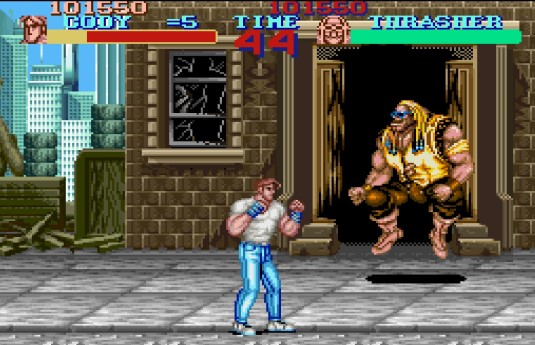
Final Fight introduced lots of basic enemy types, as well as mini bosses, requiring different tactics to deal with. The Andore types, not at all based on the image of beloved WWF wrestler Andre the Giant, would charge at your player character. But stand there jabbing away and he'll run into your fists. The same cannot be said for the Big Bull types. Fat, bald baddies, they can charge under the jabs and so require slightly different handling. Unfortunately, due to the limitations the SNES can only handle three enemies on screen, but this doesn't stop the enemies from crowding you. Here the J types, thugs with puffy jackets and mohawk hair, prove especially frustrating with a tendency to evade punches and sneak up behind while you're mixing it with their confederates. Interestingly, this is where a bit of Nintendo censorship creeps in. In the Japanese version, Poison and Roxy, scantily-clad babes in short shorts and crop tops with handcuffs dangling from their waists because reasons find themselves removed from the Western versions and replaced by Billy and Sid, a couple of punky looking chaps ... also with the handcuffs. Riddle me this. Were they taken out because Nintendo were queasy about their inclusion? Or was having our muscle-bound heroes slapped around by high-kicking women too much for an exercise if digital manliness?

Despite the limitations, SNES Final Fight isn't an easy game. Enemies are frequently cheap, and their attacks often overpowered. Ground breaking as the arcade was, the move set is too limited and frustration frequently sets in. A couple of bosses are a bit too much as well. Take Abigail, the Kiss face paint-wearing respray of the Andore sprite has a long reach preventing the kinds of tactics that saw his forebears off. He also has a penchant for throwing you in the air and knocking about three quarters of the energy bar away. Unless you're well practised and have done the hard yards to learn his patterns, the loss of lives is inevitable. Likewise the end boss, Belger, you expect him to be a bit tricksy and indeed he is. Appearing on a motorised chair holding Jessica against her will, the crossbow comes out and you're getting skewered each time you try and get up from the last shot. Getting close and quickly throwing, or spamming the piledrivers is the way to sort him out - but this can't be pulled off with impunity and getting there will also deplete the life count.

Get through all that, and with father/daughter, boyfriend/girlfriend reunited Cody gives Jessica the brush off(!) Having rescued his damsel in distress, the ending says he can't be with her for as long as evil persists in the world. A lame excuse for his desire to grapple with muscley men if you ask me. Or, if you prefer the more conventional reading, putting his duty to a version of robust city clean-up than fripperies like relationships and caring for someone else. A harsh if fitting analogy for the relationship between games, particularly at this point in time, and their end sequences - the journey, at least in good games, is much better than the prize.

Despite being toned down for the SNES, Final Fight is a good game and well worth playing, even if only for a digital retread of popular manly tropes that cycled through Hollywood in the 1980s. It's one of those games the years have treated kindly: it doesn't look objectionable by contemporary standards, and has the all-important pick-up-and-play quality. But two things I realised, not having indulged the Final Fight phenomenon first time round. The Mega/Sega CD version is much better on all counts with no missing features or levels, options, fluid animation, and more on-screen enemies. With a CD and coming out two years after the SNES version this was the minimum expectation. And second? It's proper shocking how much the Streets of Rage series on the Mega Drive was "inspired" by this game's example. The first game on the Mega Drive had puny sprites owing more to Double Dragon than the Final Fight it was supposed to be Sega's answer to. But there were better moves, an amazing sound track versus Capcom's terrible ditties, and enemies who were directly ripped off from their source material. The Signal types behaved exactly like the J types. Third level boss Abadede combined elements from Abigail, and the level two boss Katana (Sodom in Japan). And, entirely coincidently, the end of game boss Mr X shoots off his machine gun just as Belger was handy with his crossbow. Moving on to Streets of Rage II, the best 16-bit thumper ever with the banging tunes to match, the "inspiration" is blatant. It introduces themes and gameplay elements of its own that leaves Final Fight in the dust, but the substrate is there. Sprite size, sprite types, sprite moves, even the bloody character types owe something to Cody and Mike. Which sort of makes the efforts Sega putting in to publishing Final Fight CD a touch curious - as good a conversion it is, Streets of Rage II improved on it in every single way. It was, to all intents and purposes, obsolete by the time of its release.

Returning to the SNES, Final Fight is worth a blast today, especially if you've spent quality time with Streets of Rage IV on the Switch or whatever and fancy investigating the glory days of the scroll-a-long fighter. Enjoy the absurdity, the button mashing, the inevitable frustration and occasional cheap shot, and the condensation of 1980s action-men tropes, gestures, logics, and absurdities. They don't make 'em like they used to.

Image Credit

Saturday, 12 June 2021

Gunhed for the PC Engine

Capitalism not only revolutionises the forces of production, so said the grey beards, it also places fetters on their realisation. Consider the modest case of Gunhed for NEC's PC Engine. Released in Japan in the summer of 1989, a smart vertically scrolling shooter would be hard pressed to find a better name. It's immediately no nonsense, and the misspelling - lost on Japanese audiences - had a frisson of edgyness about it. One problem. This straightforward shooter was somehow a film tie-in for a mediocre mech flick of the same name. Presumably some marketing whiz thought a substandard B movie would boost the game's chances. Unfortunately, what it did mean thanks to licensing laws was when Gunhed made its way to the States, it became the utterly generic sounding Blazing Lazers. One opportunity among many NEC missed when it was marketing the TurboGrafx-16 to American gamers a bit older than the kiddy-winks Nintendo were, at that point, content to cater for.

I remember my first encounter with Gunhed in the pages of Computer and Video Games. The PC Engine, along with Sega's MegaDrive were the wave of the future. Though it was debatable whether either of the two machines were more powerful than their 16 bit home computer counterparts in the West, the screenshots oozed quality. They just looked better than anything American and European gamers had encountered outside of the arcade. With my humbled clapped out Spectrum at home, the Gunhed screenshots - just like Tatsujin did a few issues later - woke something in me. A desire to have that experience, to be immersed in something way outside my means but also something cutting edge. And what did it were the bosses. Imposing and relatively intricate behemoths, you just knew going up against them in a comparatively puny spacecraft would make for a great digital ruckus. Such were the things to be gleaned from simple screenshots in those halcyon days.

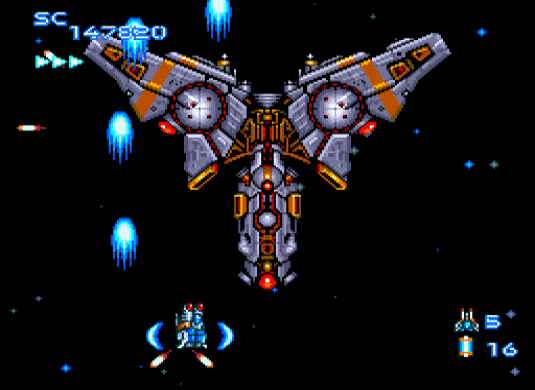
30 years on from these lustful thoughts, how did finally getting my hands on Gunhed compare to the hopes I had for it? All expectations were met. Save one. The ship handled perfectly and zipped around the screen at just the right speed. The enemies came thick and fast, but not in overwhelming waves - provided the ship, the titular Gunhed, is packing the heavy artillery. And the power ups were fine. Anyone who has played a Compile shooter before knows the styles and the system. Different weapons are represented by numbers, which can alternately be powered up by collecting purple orbs. One is a multi-directional shot, two a wave blaster that can be partially directed, three is lightning - which is fun, and four is a crappy shot with spinning barrier balls. This can be complemented by three secondary weapons: a shield, multiples/options, or homing missiles. All of which come in handy. And naturally the more the ship acquires, the more one feels that false sense of invulnerability common to nearly all shooters. When you die you start off with the pea shooter again, which typically means a cascading collapse toward Game Over. Where Gunhed is a little kinder than its contemporaries is getting a bullet down your snout won't always kill you but knock you back a power level. And with plenty of power ups always available one can climb out of the hole relatively quickly. There's also smart bombs to get you out of a tight spot, but they're not great - they don't clear the screen and there is a delay between pressing the 'please blow them up' button and the fairly naff explosion. A shame.

Where Gunhed palls is in the music department. Expecting something pumping and energetic like a Technosoft game, instead the tune is the twee 80s anime-dramatic style, something it shares with Tatsujin and Super R-Type. A shame. The sound effects, however, are very serviceable and fit the action perfectly. Which is just as well, because the game is perfect action. This is definitely for winding down the higher brain functions and surrendering to the advanced reflexology it offers. Difficulty-wise it's perfectly balanced. A novice can get about half way on the first go, but then the challenge kicks in. The bosses, those oh so beguiling bosses are ... not that hard actually. Some are very well designed, but their attack patterns aren't difficult to master. If your ship is armed with the wave or the lightning they won't be too much trouble - what will be are the attack patterns of the minions and the sheer number of bullets that are thrown on screen. A fog of war can sometimes descend amid the mayhem, none of which ever lets up and, testament to Compile's technical virtuosity, none of it slows down either.

It was then, for its time, almost the perfect shooter. That probably explains why Compile more or less remade it for the Super Nintendo, known to us as Super Aleste. The music is better, but still not the rockfest that was standard when it came out. But it did recycle all of its sound assets, the same power up system (though with beefier weapons and more to choose from), and enemies with the same attributes. The core gameplay remains, and proved Gunhed's worthy successor. But now in the 21st century? After years knocking around the Virtual Console and recent appearance on the permutations of the PC Engine Mini, how is it remembered and how does it fare? As NEC's machine never made it out of import here, Gunhed was only really known by the few who had grabbed a PC Engine or followed C+VG. Curiously it didn't seem to influence later titles in the vertically scrolling genre apart from Compile's own loosely connected Aleste series of games. And so Gunhed, around these parts, is very niche. But it does not deserve to be. Not original when it came out, apart from the music it nails every aspect of how a vertical shooter should look, feel, and play. It is the distillation of a genre that still had many years to run, and one seldom surpassed.

Image Credit

Friday, 9 April 2021

Rescue for the Sinclair Spectrum

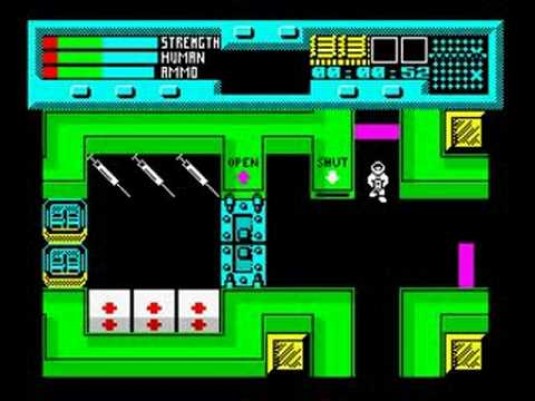
Looking to escape the mawkish coverage of Prince Philip as television enforces compulsory mourning? Why not spend it reflecting on a game that is very far from famous? Indeed, coming after two major megahits, we're slipping down the ZX Spectrum's memory hole to find (perhaps) the most obscure game our occasional featurette has alighted upon. The title in question goes by the innocuous and generic name of Rescue, and it hit Sinclair's rubber-keyed beastie back in 1987 courtesy of Mastertronic.

I remember picking this up in a four-pack of science fiction games from Derby Woolies. If memory serves, the other three titles were the equally obscure strategy game, Invasion (never could work this one out), the terrible isometric shooter Galletron, and the far more interesting giant ant killing simulator, Amaurote. Rescue was by far the most immediately playable and accessible of the lot, and it went on to become one of my brother's favourite games.

The plot was perhaps a bit too detailed for a £1.99 game, but it provided background enough for some arcade action. As the Solar System fell apart following the terrible "Last War", humanity retreated to its enclaves scattered across the moons and planets. Yet out at Pluto some UN scientists developed a star drive that ... might double up as a nasty weapon. Cue the attention of space pirates and all manner of other nasties. The player's job, having docked with their space station, is rescuing as many scientists as possible, their experiments, and stock up on enough fuel to take off. Two problems. The enemies are also roaming the station, and a 30 minute destruct system has been activated. Yikes.

The action is a flip screen affair. Wander around the map locating where the scientists are, shepherd them back to the ship, and kill the enemies. This, however, was easier said than done. There were eight of our lab-coated chums in all but they can't simply be collected. At any given time one would wake up and start running around. The tricky job was blocking off exits and bumping into the panicking boffin to try and force them in the direction you want them to go. Get them in your ship and they eventually run into one of the suspended animation pods. Do this and another scientist somewhere wakes up and starts running around. And so off you go to find them. If this wasn't bad enough, each has a red test tube next to them we should also be returned to the ship. One of these scientists and their experiments is the star drive and its inventor, but the only way of knowing for sure you have them is collecting all eight. On top of this, you need to acquire enough fuel to take off. Without it, your ship will crash and the mission ends in failure.

Rescue is very interesting for a couple of reasons. While some would undoubtedly find the herding aspect of the game irritating to the point of hair pulling, you can forget the main mission completely and go about doing your own thing. The scientists can be killed, so there was some satisfaction to be had from hunting and shooting them all yourself. Rooms can also be blocked off preventing the space pirates from entering, and one thing I enjoyed doing was going to the far room in which the screen is separated by a wall and watching a menagerie of baddies move in and kill each other. It was a lesson in how many decent-sized sprites the Speccie could handle on screen (three), and there was something of a kick from teasing the indestructible tanks - a baddy totally impervious to your fire and only offable thanks to detonating one of the bombs lying around. In other words, this was an early example of a sand box game. It was time limited and there wasn't much to the game world, but it allowed the player a much greater degree of freedom within its parameters then most other arcade adventures on the Speccy.

The other interesting aspect was the degrading environment. If the two main entry points for the space pirates aren't blocked off, then the station can be quickly overrun. This is a problem if there are a few tanks about, but also each enemy destroys the environment. Often entering a screen a baddie will be in the process of destroying a door, a crate, a teleportation terminal or, argh, a sleeping scientist! Because enemies are dumb they'll also have a go at setting off a bomb. And when that blows, everything is damaged. Screens blow out, cracks paper the walls. Ammo boxes, first aid kits, crates, all destroyed. Their capacity for destroying the environment adds urgency to the player who wants to complete the game properly. Go after all the scientists, is there going to be enough fuel left? Put a tiger in your tank first and will the pirates have killed a few snoozing savants and wrecked the experiments? Decisions, decisions.

Rescue is a good game, though it only attracted average reviews at the time. No two goes were exactly the same and it offered a limited environment for experimentation and rejection of the aims of the game if the player so chose. Indeed, playing about, exploring, trapping tanks and treating them like pets, if anything its sandboxy character of enables you to learn the game, understand its enemies and mechanics, and how goodie boxes do more than refill the health and recharge the laser. Knowing its ins and outs and doing your own thing prepares the player for the actual mission, spells out the challenge it presents, and makes them want to do it as a test of skill and mastery over the environment. As such Rescue deserves to be remembered precisely because of its innovative, partially open-ended game design. Crank up the Speccy emulator and give it a go. It's not like there's going to be much on television.

Saturday, 20 February 2021

Ninja Gaiden for the Nintendo Entertainment System

A month has passed since last visiting a notorious Nintendo game, so why not another? Ninja Gaiden, or Shadow Warriors as it was known in Europe in pre-internet days is one of the most praised and feared video games in the NES library. While it never made a splash on these shores, its mix of precise gameplay, stunning sound and presentation (at least for the humble grey box) and the most punishing difficulty was legendary in North America. Its reputation secured the game an appearannce in The Wizard, a Hollywood/Nintendo tie-in to market Super Mario Bros 3 ahead of its release. Before the coming of YouTube, all I knew of Ninja Gaiden was a positive review in Mean Machines. While a canonical game over there, it was a curio over here. Thankfully, it was one of the first games I was able to score for my NES in 2011 when one of the local emporiums was basically chucking retro titles out the door on a three for two offer. My gain was, um, my gain.

The origins of Ninja Gaiden lay in a duff but, at the time, well-reviewed arcade beat 'em up called Shadow Warriors, Having had this game for the Commodore 64 it was next to impossible and an exercise in frustration thanks to crap controls and terrible collision detection. The NES iteration, like many other conversions for the system, opted to use the branding and intellectual assets but were reworked into an entirely new game. The arcade machine, apparently, was about doing battle wth a descendent of Nostradamus determined to fulfill his doomy quatrain for 1999 and raise an evil king to take over the world. A trace of this remains in the NES plot. You are Ryu Hayabusa and you are tasked with preventing a ne'er-do-well from raising a demon for world conquering/being annoying reasons. The name of this baddy? Jaquio, a play on the jacquerie evoked in Nostradamus's riddlesome prophecy. An interesting nugget of trivia, but plot actually matters in this game. One of the most celebrated aspects of Ninja Gaiden is its use of cut scenes. There are 20 minutes worth of panels and animations setting the scene and linking the action between levels to move the story along. This was virtually unheard of at the time outside of role-playing games, and conferred the game a level of narrative depth absent from any other contemporary action platformer. The famed introductory duel between Ryu's father and an unknown ninja, getting blindsided by a young woman, and seeing the baddy's castle at the end of the jungle level pull the player into and along with the game. It wasn't really until the 32-bit generation that this level of presentation became customary.

As for the game itself, most of the time it is as flawless a ninja game you could hope for. Certainly better than Shinobi on the Master System and almost on a par with the MegaDrive's The Revenge of Shinobi. Almost. There are few Nintendo games reporting for duty with controls as precise as these. And, like any ninja game, there has to be magical special abilities because ninjas. These abilities are acquired by picking up magical icons along the way, with other icons that refill the amount of times it can be used. For example, while fire is dangerous at the best of tims for Ryu a set of fireballs can surround him for a limited time, rendering him virtually invulnerable. Very handy for the numerous death runs later in the game. He can fling fireballs too, chuck shuriken, and whip out his sword and make like a whirligig of doom - all used to stunning effect by the game's community of speedrunners. The actual gameplay is very straightforward. Traverse the level from left to right, or in some cases right to left, kill baddies (a mix of thugs, soldiers, dogs, monkeys, birds(!), and an assortment of weirdies, take out the end of level boss and rinse and repeat. All the levels are well laid out. There are no opportunities for getting lost, but some properly test your platforming abilities. Clinging to walls and working out how to jump right, while assailed by birds is, um, a favourite.

And then there is the fabled difficulty. The problem is despite the bells and whistles, the flawless controls, and the hugely gratifying action the game is super hard, and it's because the developers resorted to some very cheap tricks. These include respawning enemies, placing them on narrow platforms you cannot clear in advance, getting overwhelmed by the sheer numbers of running and flying bad 'uns, having enemies come at you when you're vulnerable - like climbing walls/ladders. And some of the late bosses are very cheap as well. They all have predictable patterns, but the penultimate boss cycles through his pattern super quick. Lightning fast reflexes are required. Like a lot of NES games, getting hit knocks Ryu backwards, which means instant death if you're surrounded by bottomless pits. And last of all, die during the end of game confrontation with Jaquio and his subsequent incarnations and you're sent all the way back to the beginning of the level. This was apparently noted during playtesting and was a mistake, but they left it in anyway. Hence why the MegaDrive game edges it out in the best ninja title stakes.

Yet this did not prevent Ninja Gaiden from becoming a hit and something of a sought after cartridge, and there were two things going for it apart from its excellence (after all, not all great games are hits). First, as discussed here many times, the lone wolf action hero was neoliberal masculinity du jour in the 1980s. Forget the constraints society places on you, deal with your enemies as if rules don't matter. As a one-man army (though later, in collaboration with the US security apparatus) Ryu manly enters battle without constraints. Second, following the success of Bruce Lee in the 70s, the ninja trope was built up by film after film featuring martial arts and sprinkled with a flavouring of orientalist mystery. This framing of the East as mystical, traditional and exotic was picked up on by Japanese audiences of Western film (and media), and in turn was re-repackaged and sold back as the premises for hundreds of video games. The second was the theme of urban decay and crime fighting. Indeed, the first level sees Ryu battling with street gangs and their (literal) attack dogs. As acceptably disposable baddies when authoritarian governments in the US and UK were cracking skulls and declaring the war on drugs, the theme of fighting back against the decay, vigilante-style, was very much in the air. This was the time of the Guardian Angels and kids cartoons relentlessly pushing anti-crime populism. The zeitgeist was there and Ninja Gaiden rode it.

Then there is the overall culture of difficulty. Old farts talk about the how hard 8 and 16-bit games were versus most modern titles, but it was not a myth. Games were tougher and demanded they be played on their own terms. Yet the cheap deaths, the respawning enemies, the dreaded knock back, and the tough level of challenge were common mechanics in NES titles. Konami's Castlevania being another notable example. In this sense, Ninja Gaiden's basic unfairness was not a disadvantage as far as its reception was concerned. The meta-habitus of NES gamers had long grown accustomed to similar cheap tricks and they were accepted as part of the gaming scene, just as infinite player respawns are in most first person shooters today.

For the casual gamer is Ninja Gaiden worth a go? Absolutely. As a landmark if not a monument to difficult games, its canonical status is well deserved. And because its ludic qualities are so compelling, it is hard to put the game down. New players might overlook its unforgiving countenance and, who knows, perhaps accept the ridiculous challenge it represents.

Image Credit

Friday, 15 January 2021

Super Mario Bros 2 for the Nintendo Entertainment System

In a year already fraught with controversy, it's aposite to dredge up something of a wedge issue: Super Mario Brothers 2 for the trusty Nintendo Entertainment System. Writing about this game in the 21st century comes with two closely adjacent pitfalls. The first is casting keystrokes over a video game franchise which is the best known, best-selling and, best long-running(?) in all recorded history. Not only is there an aura blazing around it, fizzing with the props for single-handedly reversing the fortunes of video gaming in the United States, its much beloved status, its synonymity with Nintendo, and the respect afforded it by game critics means there is little to be witten and said that hasn't already been written and said. From whence does an original insight into these games spring? Especially when considering any of the original trilogy published on the NES? The second, as folks who know their game history, um, know, are the "controversies" around SMB II. I.e. How this was not the same Super Mario Bros 2 released in Japan and was in fact a reskin of Doki Doki Panic, a Nintendo-produced licensed platformer using Fuji TV characters. Why was this controversial? Because it departed significantly from the core game mechanics the series became known for, earning the game notoriety and, for some, black sheep status among the Mario run of games. A Loki to SMB I's Baldr, or something.

Not having a NES in the olden days meant it was about nine years ago when I first played SMB II, and this was after bagging my long-coveted SNES and acquiring Super Mario All-Stars. Playing each of the games, it was the first and the third installments that attracted my attention. If I'm honest, I found the second game a bit on the bewildering side. And so time passed, got an NES eventually and then a trusty RetroN5 and latterly, a good condition boxed copy of the game. With work in festive abeyance and having had it stare at me from the shelf for too long, it was high time to take a butchers.

Having not played any Mario game for a while certainly helped, which meant SMB II could be apppreciated on its own terms. The main gripe most have, which "un-Mariofies" it, is the abandonment of the familiar jump-on-baddies-heads move to dispatch them to jump-on-enemies-to-pick-them-up. Say what? In SMB II your player character, of which more in a moment, scoops up the enemy and you can carry them around indefinitely. Or, if you like, throw them at another baddy to off them. Picking stuff up and mastering its timing and use is as crucial to the gameplay as bouncing from platform to platform. Each stage has vegetables sprouting from the ground, which the player can pull up and use as objects to throw at bad 'uns besetting you. There are also potions to be found which, if dropped, summon a secret door leading the player to "sub-space", a mirror universe that might (depending on where you drop the door) yield a power up mushroom extending the life bar from two to three hits, and the possibility of redeeming vegetables pulled here in return for coins, which are used on a slot machine bonus stage inbetween levels. Apart from this, it's A-to-B platforming. Make a way through the levels, see off the small end-of-stage baddies where you're greeted by Birdo, who was to become something of a staple in the Mario pantheon, and then move on to the next stage.

Apart from the bonce-bouncing, there are three further significant departures from Mario's initial Super outing. The first of these is the comparative lack of secrets. I suppose some might get their exploration jollies from dropping the secret door potion in different places, but hidden places are fewer in number despite levels, ostensibly, being less linear than its predecessor. The second is far more variety when it comes to boss fights. Instead of variations on Bowser, one faces the henchmen and women of the evil Wart. These, inevitably, involve picking stuff up and lobbing them at the enemy while evading their attacks. Learning the patterns here aren't difficult, though the challenge is uneven from boss to boss, and they only take a few hits - or explosions if you're throwing bombs back at them. The third departure is the choice of character. One can choose Mario, Luigi, Princess Toadstool, and Toad. No rescue-the-princess rubbish this time characteristic of nearly all Mario games. Each of these have their own features - Luigi can jump the highest, Princess can hover a short while after jumping, and Toad can pick stuff up quicker and run super fast if carry an enemy or vegetable. However, as this is 1980s Nintendo we can't well have a female character defy stereotypes and so she's the only one who carries a penalty - she can't pick stuff up quickly because upper body strength is unwomanly. However, interestingly, it's Mario who's the worst character because he has no special abilities at all. So much for the super ... There's also a couple of gameplay changes, which gives it a bit more variety. There's more verticality, i.e. levels mving from down to up rather than left to right, and one can revisit areas in a stage until it's completed. The second is retrieving the key necessary for the end of the level. Braving baddies and picking it up attracts the attention of Phanto, an evil mask who'll chase after you until you put the key in the exit door. It certainly makes for a hurried and different pace to the considered platforming the game otherwise encourages.

All told, SMB II was well received by critics at the time, and they were right in their assessment. It is an excellent platformer featuring well-designed levels, a decent learning curve, the introduction of environments that were to become genre staples (leafy areas, desert areas, arctic areas), and superbly paced gameplay. Few are the blind jumps, and while there are occasions where the player has to pause to think about their next move, it's never frustrating. Indeed, as excellent as SMB I is, the sequel never had me almost throwing the joypad against the wall. On this score, from a gameplay perspective it holds up well as a retro rarity still worth playing, helped by some of the nicest graphics the NES were capable of and an arrangement of classic chip tunes that, for me at least, I never found irritating.

And the controversy? This is almost entirely a feature of the internet age when gamers starting getting on Usenet, bulletin boards, and latterly YouTube. At the time SMB II fitted in because the Mario formula was still in its infancy. Therefore the game did not stand out like a sore thumb as one might suppose, especially when considered alongside Nintendo's other flagship franchise, The Legend of Zelda, and the difference between the first and second games in that series. And when the Super Mario Bros 3 juggernaut rolled out, it combined the best elements of it predecessors - the plentiful secrets, proper power ups, and head boffing action, with the ability to pick (some) stuff up, light puzzling, decent end bosses, and ambitious, properly thought-out and non-repeating level design. That's right, SMB III is the logical progression from both games. Besides, if the main gripe people have with a classic game like SMB II is almost entirely retrospective and there's no real beef with the game itself beyond taste, then at the time Nintendo made the right decision to push this one out the door. It is worth playing again, and again, and again, and this will forever be the case.

Image Credit