Showing posts with label Sport. Show all posts

Sunday, 11 July 2021

We're Singing for England

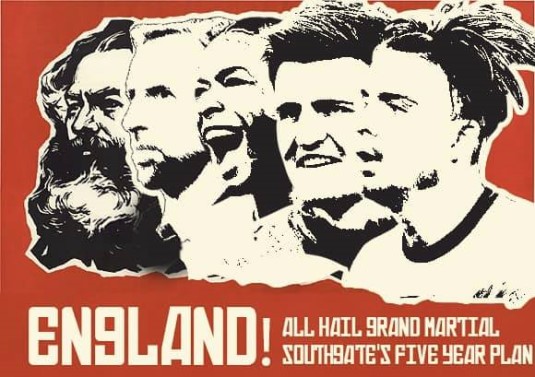
England didn't win, but the campaign on the pitch has brought about a victory in the culture wars. At the beginning of the Euros, rightwingers lined up to attack the England team for taking the knee. The likes of Laurence Fox and Paul Joseph Watson accused them of "surrendering" to "Marxism". And where they prepared the ground, opportunist rightwing politicians followed. Nigel Farage, pretending to be England's biggest fan before the match was straight on the attack with a defence of booing the players. Always looking for a rightwing bandwagon to jump on, Priti Patel likewise defended racism on the terraces, before the inevitable about turn and staged photos of celebrating goals. The only one to stick to his guns was Lee Anderson. Vying for the title of the Tories' most bigoted backbencher, he said he would be boycotting England matches and will carry on doing so. No doubt he'll be pleased Italy won, but don't tell him they took the knee too.

This has made England's run all the sweeter, with the team pushing a soft solidaristic, inclusive, anti-racist politics articulated in these terms, and acuitting themselves with aplomb on the pitch. Meanwhile, the right have overreached and put themselves on the wrong side of public opinion - an opinion that has shifted even more in the direction of England's stand as the tournament progressed. The chance of Boris Johnson, with his flag-bedecked Downing Street, awkward appearances in the team shirt, and its politicians mobilised for the so-called war on woke, being able to identify the penny-pinching miserablism of Tory Britain with a much improved England seems a bit of a stretch. One cannot be associated with attempts to rubbish their efforts and then claim credit for their success. A fun fact repeatedly noted by leftwing Twitter, who have loudly (and no doubt irritatingly, for some) claimed credit for England's success. After all, if we accept the arguments of sundry Tories and rightwing screechers about taking the knee, the adoption of Marxism by the team has produced more success than 55 years of tabloid-powered jingoism.

Surveying the scene from The Sunday Telegraph, David Goodhart argues there has been an appreciable shift among elite opinion as well: "progressives" are singing for England too. This marks a sigificant change from the embarrassed disdain they normally reserve for popular expressions of Englishness. One might recall thw Emily Thornberry/White Van Dan incident all those years ago. Goodhart argues these professional layers have traditionally been estranged from Englishness because there are no unique English state institutions, and the national identity they tend toward is Britishness. There's some mileage in this. Thinking about his social universe of politicians, wonks, academics, senior civil servants, media people, and upper management, their work immediately links them to the British government and other UK-wide institutions, and their spontaneous national consciousness reflects this. Englishness, as filtered through the media and its cynical self-appointed champions is traditionally conceived as something lesser, an atavistic throwback of congealed racism and the EDL that can be mobilised for backward political projects that are a direct threat to their station. Goodhart argues the action on the pitch and in the culture wars off it has made the case for an inclusive Englishness, and one congenial to their liberal attitudes.

Yes, but there's more going on. For one, when establishment commentators write about "the left" this is who they mean. The actually existing left, at least in my decades of involvement, have happily supported England because whole swathes, most of it are footy mad. With the possible exception of Socialist Worker, who in all seriousness wag their finger and affect revolutionary defeatism whenever England plays. Rubbing shoulders with the hoi polloi who invaded their metropolitan Labour branches may have left some populist tastes hanging in the air, making the great unwashed that little bit less alien. The second is the consequence of Britishness becoming more inclusive itself. An idea of 'the British' as a multi-national, multi-ethnic common identity was taken up by New Labour with some enthusiasm, enabling the party to distinguish itself and their rebranded Cool Britannia from the tired and narrowly white Britain of the Tory imaginary. Meeting with the anti-racist and social liberal push from below, equalities legislation and managerial initiative enforced a bureaucratic, 'official' multiculturalism, an inclusivity cemented by quotas, mission statements, and diversity workshops. It was inevitable this would fold into Englishness, what with social liberalism the spontaneous common sense of growing millions and the membrane between Britishness and English identity measured in microns, not miles. The administrators of multicultural Britain aren't leading but following the drift of popular culture and values.

There's another. Just as the left have claimed England for Marxism thanks to the right's excesses, the stupidities of Anderson, Patel, et al has given, to the minds of Goodhart's contemporaries, the permission to endorse and embrace the team and the theatre around it. If the vulgars and grotesques are piling into England for wokeishness, they have effectively relinquished Englishness for someone else to take up.

Am I guilty of overreading a tournament and the hype surrounding England's excellent young team? Events commanding national attention are crucibles for sentiments and ideas. If something is working its way through national life, if there are movements in opinion they can bubble to the surface and code the event with significance, announcing what is already an accomplished fact. England in the European championships is one of these moments. It affirms the advance of social liberalism, and underlines the retreat of conservatism from mainstream values.


Wednesday, 9 June 2021

Abdicating Leadership

There were some successes from the New Labour years worth preserving. One being the legislative spadework done for LGBTQ rights, though a less generous - but accurate - reading would locate this in a vision of "inclusion", of a neoliberal politics premised on equal opportunities and removing unfair and unjust barriers to social mobility. Another, less talked about today, was the consolidation of what we might call bourgeois, or official anti-racism. Going hand in hand with the Blairist project of a superficial modernisation of the British state, the government and other state institutions pushed an official multiculturalism around respecting difference, tolerance, selecting and promoting spokespeople and "community leaders", and rhetorically generating out-groups opposed to the redefined, inclusive Britishness. Islamists and travellers qualified as the undesirables, while everyone else were hard working multi-ethnicity Brits suspicious of extremism and new waves of immigration. Naturally, this wasn't the case. New Labour ministers indulged Islamophobia, and the racism of state institutions, particularly the police, carried on. But all this was cloaked with a blanket of anti-racism and equalities talk, which ultimately increased the social costs of and shrank the tolerance for open, overt racism.

Following attacks on several footy players for showing solidarity with Black Lives Matter, and coming in for stick on social media, in a widely shared open letter Gareth Southgate took on the racists who abuse them. Defending the England team's stance on anti-racism and entirely consistent with the "progressive consensus" multiculturalism of the Blair years, he attacks the racists' sense of Englishness as old fashioned and dying out. With nods to soft patriotic markers of the monarchy, the war, and the "brilliance" of the country, he says his players have every right to stand up for the issues that matter and that all of them have a responsibility to the wider community. The clear implication being the racists are not just on the wrong side of history, they're outside a rebranded inclusive Englishness too.

Not controversial. A gentle nudging, barely even cajoling. It was a piece designed not to make racism a wedge issue but appeal to the better nature of fans who might put their love for the game before bigotry. Obviously not dyed-in-wool racists and dog whistlers like the appalling Tory MP, Lee Anderson. But in this moment on which Labour might capitalise and stand up for anti-racism, even of the most unchallenging kind, where was the Labour leader? Why did it fall to the England manager to defend this legacy of Labourist state building. How could the official inheritor of this tradition only muster a meek tweet of support?

A reminder of the context. The Batley and Spen by-election takes place in three weeks' time, a contest Keir Starmer would do well to win unless he wants a summer of unrest and rightwingers waking up to his lacklustre performance. Amid reports and whispers from the local Kashmiri community that they're minded to sit on their hands thanks to his hamfisted comments about Kashmir last year, and unwillingness to say anything about Palestinians as the Israeli government were slaughtering them by the dozen, even this, a little sign, an intimation of leadership on anti-racism might have helped a little bit. But no. It's almost as if the "grown ups" think they have nowhere to go, and somehow a sympathy vote will see Kim Leadbetter through.

Tone deafness toward an immediate and potentially existential threat to Keir's leadership is, sadly, par the course. The approach to opposition has been weak, from tailing the government and practically patting it on the head at points, to letting others do the oppositional groundwork for him. It was Marcus Rashford who gave Keir permission to start challenging the Tories on school dinners. It was Dominic Cummings's appearance before the select committee that gave Keir the strength to raise the issue of the horrors this government visited on care homes last year. And it was the G7 agreement on the corporation tax floor that encouraged him to start acting like taxing big companies is a good thing, despite Labour's awful rightwing opposition to Rishi Sunak, Rishi Sunak raising the rate. If Gareth Southgate hadn't penned his letter, it's very likely the Labour leader would not have uttered a word.

If this wasn't bad enough, we know the avoidance of wedge issues is purposeful. In his last rare intervention, his Blairness counselled for the avoidance of so-called culture war issues. Peter Mandelson did likewise. Keir did not need this advice from his forebears. By saying nothing it might hoodwink enough socially conservative voters into thinking the plastic patriotism was genuine. Or, alternatively, it clears the decks for Labour's presentation of its economic and social policy agenda. An economism of hoping warmed over Fabianism will do the trick as punters gaze upon the next manifesto in awe, but without actually saying anything now about what Labour would do in office. One might suggest picking priorities and banging on about them until the election might associate the grey blur of Keir Starmer with something substantial, but there's no sign yet this penny has dropped.

It's one thing to accuse leaders of not leading. All party leaders attract these brickbats at some point, but rare is the politician who is so hapless (or mendacious) that their entire strategy appears geared around triangulating defeat and the demobilisation of one's support in every direction. The question isn't whether Keir Starmer can turn it around. It's whether he wants to.

Image Credit

Tuesday, 20 April 2021

The Super League's Own Goal

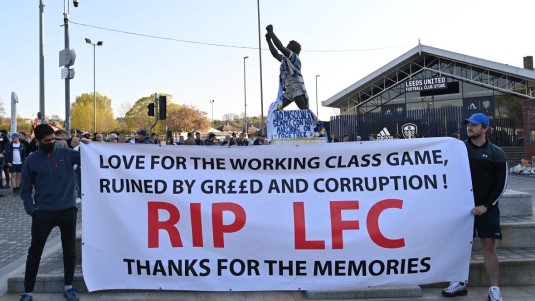
I don't pay football much mind, so you might say I know sweet FA about it. But I do know about capitalism, and plans to form a break away European super league is a salutary reminder of one of its most destructive tendencies: the undermining of its own basis. The decision of billionaire-owned clubs to set up their hermetically-sealed league has provoked a massive outcry, with even the Tories briefing their preparedness to take Corbyn-flavoured action against the teams. Former England captain Alan Shearer bluntly told BBC Breakfast that the six English clubs concerned - Arsenal, Tottenham, Chelsea, Manchester City, Manchester United, and Liverpool - should be expelled from the Premier League, and Gary Neville, not a name one would normally find in militant circles, has called for the billionaires to be booted out of the game.

One of my comrades who follows men's footy has often said England's sub-par performance on the pitch is because the national side fields a team of millionaires for whom there is no consequence nor incentive to do well. What the new super league promises is the formal institutionalisation of this dreary state of affairs. The league is not a response to grassroots enthusiasm or competitive pressure, except to say it's an attempt to generate a new round of broadcast rights and sponsorship deals which won't be shared with other top flight teams. The billionaires who see their clubs as nothing but cash cows arrogantly assume the mass audiences for European football in Africa, the Arab world, and East Asia - the key emerging markets - will still be interested even if domestic fans desert the clubs.

Your Glazers, Kroenkes, and Abramovichs might think the punters don't care, but this misrecognises the appeal of not just footy but sport generally. The action of a game or match is just part of it. The excitement lies in the fundamental uncertainty, of the risk of failure and the fickle play of luck and chance. Even sports entertainment that is totally pre-packaged and scripted, like wrestling, relies on contrivances that make it appear as if no bout is a foregone conclusion - even though the audiences themselves are in on the fix. Wining and losing have consequences: trophies and titles are always aspirational, but the struggle to maintain one's standing in the rankings is the meat and gravy of football. Games might always be games, but it's the stakes invested in them that matter, which probably helps explain why friendly matches never generate as much of a buzz. The super league might have its own title, but there is no price for failure. Coming at the bottom of the league does not mean relegation, nor are there any routes into the league. It is entirely closed up, a hermetically sealed panic room insulating self-styled elite clubs from the competition. This is nothing other than an attempt at an oligopoly.

On paper, capitalism is based on a free market where firms compete with one another for sales and customers. In practice, businesses are parasitic structures whose drive to accumulate demands certainty. This conditions the authoritarianism if not despotism within the firm itself as it struggles to control all the factors under its purview, and its relationship with similar firms and the state tend toward softening the edges of competition and creating a more benign environment for its operation. The impulse toward certainty means where capital invests in activities left up to chance, like sport, we see huge investments in training and coaching, facilities and marketing, and the splashing out on star players to give their property a competitive edge and a greater guarantee of the profits. But inevitably, the fabric of the game suffers from this ingress. The relentless pressure for results can demotivate players, while around the edges efforts are made to rig the system to keep the profits flowing. The super league is one such strategy, an attempt to guarantee profits for the billionaires while removing the threat of consequence.

Naturally, no one is forcing our billionaires to do this. The super league is not the sum total of Europe's top flight clubs. But we see similar behaviour time and again, of the personifications of capital undermining the basis of their own system. Whether it was the Conservative-Liberal Democrat coalition sucking demand out of the economy with their programme of public sector cuts, causing the recovery from the 2008 crash to take longer than was necessary. Or hip-happening neighbourhoods emptying of residents as holiday let businesses market them on the basis of the dynamic and captivating local culture an destroying the original attraction in the process, or indeed capital's search for profits undermining the basis of life on this planet with climate change, deforestation, and mass extinction. Money grubbing has long threatened the people's game, and will continue to do so even if the super league is seen off.

Image Credit

Tuesday, 10 July 2018

It's Coming Home!

What a summer 1996 was. It had the tunes, it had the footy. Well, you know what, this summer's going to be even better. No time for a proper post tonight for tomorrow we make history!

Thursday, 19 June 2014

Uruguay 2, England 1

They're coming home, they're coming home, they're coming, England's coming home.

What a shambles. Let's remember a happier time.

Saturday, 14 June 2014

New Order - World In Motion

Party people, it's Saturday night. The Solid disco pick for the evening is topical but has somewhat melted into the half-forgotten soup of memory. I am of course talking about one of the finest footy records ever written. So crank it up and let your street/block/country estate know who you're singing for.

Monday, 5 May 2014

UKIP and English Nationalism

Let's look at some recent research by Edinburgh University. While UKIP are basking in the warm glow of favourable polling, north of the border, Edinburgh's polling finds them stuck on 10%. Respectable certainly, but not a political earthquake. Interestingly in Wales their support stands at 20% - a good nine points clear of Plaid Cymru but trailing 19 to Labour. As for England UKIP are on 29 to Labour's 30, a score mirroring (trailing) recent polling. If you look at voting intention by self-reported national identity, 'English Only/More English than British' identifiers are 42% for UKIP. The party and Nigel Farage win a plurality of 'who best stands up for England', followed in short order by 'no party' and 'no one'. On the EU referendum, 40-37 would have us out in England, where in Wales and Scotland it's 39-35 and 48-32 to stay. And lastly of English only/mainly, 55% would vote to leave, and just 26% are for staying (the terms are almost reversed if one identifies as British only, or mostly British).

This will come like a bolt from the red, white and blue for precisely nobody. Except perhaps UKIP's support in Wales. Nevertheless it is fair to say UKIP, among other things, is a lightning rod for English nationalism. And, again, this leads us into the murky waters of what Englishness is and how has got attached to a party that touts United Kingdom in its name?

Nationalisms at one level of remove are, of course, fictions. They are less a body of ideas and more certain structures of feeling that have emerged over time, often quite consciously. They do not stretch back into ancient history. There was no Roman or Carthaginian nationalism. Our ancestors who lived and farmed the north German plains were not suffused with English sensibilities. The idea a nation has certain essential and inviolable attributes different to other nations is completely modern. They are as much a unique property to our period of history as factories, bureaucratic rationality, and capitalism. However, just because nationalism is a fiction doesn't mean it's fictional. It is very real. Imagined communities have the habit of coming alive if people behave as if they exist.

Attempting to define the properties of a particular nationalism is a tricky job. Is it emergent or established? Is it the nationalism of a former colonial power or the formerly-colonised? Is it a nationalism that intersects with the nationalism of a "family" of nations, or a diaspora of people dispersed about the globe? If that wasn't complicated enough, what role ethnicity, gender and class? Whose nationalism is it? And who does this nationalism define itself against the most - who is its primary Others?

Englishness is messy. If it has a unique character, it lies in its being overlaid and intertwined with a "multi-national" nationalism: Britishness. A dynastic and then an imperial project, Britishness is now less about empire and bovver boys and more (officially at least) at ease with liberal secularism, diversity and inclusivity. Scottish, Welsh, and Irish nationalism defines itself against Britishness, though it has crept into their souls too. But, witness the independence referendum campaign in Scotland. The Other being set up isn't the huggable civic Britishness of London 2012 but the arrogance and austerity of Tory Britain, of the long years - still ongoing - of a nation ruled by a coalition government that holds less than a fifth of Scotland's Westminster representation.

As Britishness has changed, become something of a brand, and now has a section of the "family" wanting to pull away from it, what of Englishness? What does "being English" mean and why is it an emerging political factor?

The main problem with Englishness is its invisibility. That might sound like a strange argument to make. Every two years the Cross of St George flutters from cars and bedroom windows all over the land as we do battle in the European or World Cup. That I don't even have to say what sport I'm referring to shows how embedded the England team is in our collective psyche. Yet, is that it? Footy? Think about British virtues - 'keep calm and carry on', the stiff upper lips, reserve and understatement, tea and tiffin, royal reverence, fair play and rooting for the underdog. Yes, they're all a bit aristocratic, but they are entirely English too. So if one rejects a British identity in favour of Englishness, what is one rejecting? UKIP's persistence supplies part of the answer.

Britishness - and by extension Englishness - has a weird quirk in its character. Conquering the largest empire in history has left a deep stain. You cannot understand racism in these isles without grasping the imperial overhang. But if a national identity is more so a structure of feeling than a set of ideas, another of the empire's orphans is an inchoate sense of entitlement. This manifests less as strutting, post-colonial arrogance, even if there are plenty of Colonel Blimps haunting the Telegraph's comment pages. Rather, it congeals into a sense of Britain, or now the Scots want out; England vs the world. We are the part of the little island that dared. We deserve respect and we are at all times quite prepared to face down insurmountable odds. Group of death in the first round? No-hope entry in Eurovision? Standing up to Brussels? Being the disadvantaged little guy (yes, nationalism is imbued with masculinity) with only your wits and resourcefulness to rely on, that's what Englishness is about.

This is where UKIP comes in. It is a middle-aged man standing firm with his middle finger raised against the onrush of history. Everything its support doesn't like get the gesture too: the gays, the East Europeans, the (whisper it) blacks and Asians. The out-of-touch politicians, the scroungers and the shammers, the benefit and health tourists, the people who don't speak English in town, the lack of jobs, opportunities and housing for "our people". The European Union is the convenient bogeyman for all this, the German-run communist beast straight out of Revelations. The continental abomination who would pave over England with red tape, Romanians and mosques. UKIP's standing up, being counted. Doing what the people of this sceptred isle have always done. This is the secret of the party's appeal. It says the unsaid and does what needs doing.

At least that's how UKIP likes to see itself. In practice, it attracts plenty who define themselves against official inclusive Britishness too. If you bang on about immigration being the root of people's problems, don't be surprised that dredging the sewer turns up a few turds. No, rather than being the sort of figure UKIP's dear leader cuts, the party is a nervous wreck of a man. It is fearful, distrustful, and hostile to a world its generation ultimately made. It doesn't stand firm. It wants to retreat. It wants to cower behind the White Cliffs, shouting "go away!" at passing shipping. UKIP is the very opposite of how it presents itself. 

How to counter this appeal? A new elite project of Englishness won't fit the bill. UKIP have articulated a stance, a feeling embedded in the national psyche. It's almost impossible to undo, because it has always been a part of Englishness. There's certainly no harm in trying to promote a civic, inclusive nationalism but ultimately cultural/national insecurities of culture usually mirror insecurities elsewhere. Interesting seminars and fine books on English nationalism have their place, but more important is for people to feel secure in their lives, that they have a sense of place and know where they and their children are heading. And only a programme of thoroughgoing political and social change is capable of achieving that.

Friday, 11 June 2010

Our Friends in the North

The England flags are out. Cars are festooned with the cross of St George. It can only mean the four yearly football jamboree of the World Cup is here!

An accident of birth means it would be churlish for me not to wish England well, especially as I've cheered them on in the past. But as an internationalist, anti-imperialist, and a socialist there's only really one team worthy of unconditional but critical (military) support:


Thursday, 18 March 2010

Extreme Sports and Sociology

Time AVPS returned to brass tacks and started blogging again about sociology. A few weeks ago your humble scribbler went along to a paper given by James Hardie-Bick on 'Flow, Enjoyment and High Risk Autotelic Experiences'. In everyday plain language, this was a presentation on the sociological understanding of skydiving.

To make sense of why some people go in for skydiving and other extreme sports, psychology and sociology have put forward a number of explanations. The former suggests that the desire to risk life and limb for fun reflects certain personality types. However, sociologists argue that participation is an outcome of learned behaviour - to throw yourself out of a plane is the result of an acquired preference to engage in what Stephen Lyng has called 'edgework'. He defines this as voluntarily taking part in/seeking situations with the potential to transgress daily practices. It draws attention to the positive consequences of risk-taking - the intense feelings of testing one's skills in the face of a directly observable threat (if the ground rushing up to meet you at 200 miles an hour isn't an observable threat, I don't know what is).

For Lyng this is where the thrill of risk-taking resides. As failure to act appropriately has terminal consequences, a sense of agency is heightened, which is something usually denied the overwhelming majority of people in contemporary advanced capitalist societies. And so risk-taking acts as a drug. The more one approaches the edge, the greater the buzz. So greater risks - such as jumping while on drugs or without a secondary parachute, lead to a more intense sense of gratification. Therefore you can reasonably expect this sort of behaviour to be common among extreme sports enthusiasts.

Except that isn't the case at all. James's study of skydivers (of varying levels of experience) found the opposite. The majority not only refused to take unnecessary risks, but frowned on those who did so as irresponsible. They were concerned with staying inside the limits and were foremost concerned with safety consciousness. For example, one participant said one reason he took up skydiving was that it was safer than the bungee jumping he used to do.

So what's going on here? If it's not about risk is there an alternative explanation? On this James finds the work of psychologist Mihaly Csikszentmihalyi particularly interesting. His work is concerned with understanding how people live happy, fulfilled lives. Csikszentmihalyi found that happiness is linked to meeting challenges and stretching their limits. So activities that are ends in themselves - the 'autotelic experiences' of the paper's title - are their own reward (something I also found in my own research on Trotskyist activists).

To accompany this insight, Csikszentmihalyi has developed a concept of 'flow', which is a focus on/desire to engage in autotelic activities to the extent that substitutes don't ever seem to do. Now, whereas Csikszentmihalyi used artists and chess players to develop his theory, for James high risk sports can be understood in this way. He uses flow to define enjoyment as constituted by opportunities for action, actions with clear goals, the offering of immediate feedback, feelings of competence, high concentration, an altered sense of time, an (almost) loss of consciousness and a transformation of a sense of self. In a sense one's embodied experience is almost merged with the exigencies of the situation. James also notes that to continue enjoying the flow, one has to complicate activities (which isn't necessarily the same as taking greater risks). Even jumping out of planes and activating your 'chute at the designated height can get samey after a while. Learning new skills, timing pulls, performing turns etc. help keep the flow going. The training programme and activities endorsed by the British Parachute Association certainly enable this.

It follows from this that enjoyment lies not in the risk itself, but rather the minimisation of danger, of testing skills and exercising self-control. Hence, even though it might seem extreme, this form of flow activity is a good way of relaxing because the outside cannot intrude.

As you might expect, a number of questions came up in the discussion after the presentation. The most interesting one took James up on the disappearance of self-consciousness and how it can be squared with the existence of team extreme sports, such as formation skydiving? He replied that skydivers tend to jump with others they trust, and they rehearse their moves on the ground so it becomes embodied behaviour. He also noted that when skydivers die, the culture tends to focus on the actions/inactions of these unfortunate individuals - be it they didn't check their equipment properly or took too many risks.

So, once again, extreme sports are not about taking risks but minimising them. The popular image of the adrenaline junkie is a stereotypical myth. Those who do take unnecessary risks are frowned upon by actual skydivers as dangers to themselves and others. And like any other autotelic activity skydiving is about escaping the mundane insecurities of the every day, much like spending hours chatting on Facebook, doing needlework, or maintaining a blog.

Monday, 28 July 2008

Marxists for Middlesex

For those of you who aren’t familiar with darn saaf, Middlesex was a county that ceased to exist in around 1965. It formed the northern and western part of what was to become Greater London into which most of it was transferred. But Middlesex didn’t disappear altogether. Its county cricket club remains and the name still appears in postal addresses, and there is a Middlesex University. It wasn’t the most exciting of counties, mostly samey suburban semis although it inspired Leslie Thomas’s steamy The Tropics of Ruislip and, I imagine, Betjeman’s Metroland. The astrologist Russell Grant used to champion a campaign to restore the county, although I can’t really understand why.

Middlesex County Cricket Club has produced some famous players over the years - Dennis Compton, Bill Edrich, Phil Tufnell and Mike Gatting to name a few. However, in recent years the trophy cabinet has remained closed. They hadn’t added to their silverware for the past fifteen years but all that changed on Saturday when they lifted the Twenty/Twenty Cup. Twenty/Twenty cricket has been around for six years. There are lots of thrills and spills, razzmatazz and dosh. It might not be for the purist but it puts bums on seats, and it is fun.

Brother S is a native of Middlesex, having been born and raised in Potters Bar which is sadly best known for its rail crash. He spent all of Saturday listening to the finals via his pc. Occasionally, he goes to Lords cricket ground to watch Middlesex play. Being thoroughly bourgeois, he usually watches the game from the famous pavilion that is a throwback to a bygone age. Male spectators (gentlemen) have to wear jackets, ties and ‘tailored’ trousers. Female spectators (ladies) have to ensure that their shoulders are covered (presumably breasts as well that are not mentioned in the regulations). So what is the connection with Marx?

Brother S was sitting in the pavilion one day and contemplating that he was probably the only person in there with a
Socialist Party membership card in the pocket of his acceptable black blazer. He felt a bit confused about the apparent contradiction of his quaint but stuffy surroundings and the class war. The game was interrupted for the wonderfully-named ‘tea interval’ (middle-class tea, a cup of tea and a slice of cake, not one’s evening meal) and Brother S wandered over to the club shop to browse the gaudy ties and overpriced replica shirts. Then he saw a copy of the book Beyond a Boundary by the famous Marxist theorist C.L.R James. This was it; the missing link between cricket and Marxism! I bought a copy.

Actually in
Beyond a Boundary (1963) James writes little about his Marxist convictions. But he does give a fascinating insight into the divisions of race and class that determined membership of Trinidad’s top cricket clubs, and the structure of society when he left school after the First World War. The players in the top team were ‘for the most part white and often wealthy’ but ‘there were a few coloured men among them, chiefly members of the old-established mulatto families’. The second most prestigious club was ‘the club of the old Catholic families’ and ‘almost exclusively white’. Then there was ‘a team of plebeians …totally black and no social status whatever’. There was another, ‘the club of the brown-skinned middle class’ that had been founded ‘on the principle that they didn’t want any dark people in their club’. Another team consisted of black policemen captained by a white Inspector. Lastly, there was a team from the black lower-middle class. However, if a player was exceptionally talented he could cross the divides. James was persuaded to join the club for ‘the brown-skinned middle class’.

James was a remarkable man- a versatile scholar, cricket journalist, an accomplished cricketer himself and a campaigner for West Indian self- government. He was the Johnson in the
Johnson-Forest tendency, a Marxist group that operated in the US in the 1940s and 1950s. Possibly his most acclaimed work was The Black Jacobins. Alex Callinicos described this work as ‘a classic of Marxist histiography’ in which James ‘set the great slave revolt of 1791, which transformed Saint Domingue from a French colony into the Republic of Haiti, in the context of the Atlantic world economy and the French Revolution’.

James’ life merits a far more detailed blog. I thank him for providing me with a faint link between cricket and Marxism. I call on all Marxists to get behind Middlesex in the forthcoming Champions League!