Showing posts with label Brexit. Show all posts

Sunday, 2 February 2025

Revisiting Brexit and Corbynism

While we're on the subject of marking Brexit's five year anniversary, an interesting story appeared in The Times on Friday night. We learn that the self-proclaimed genius of Brexit, Dominic Cummings, had a line into Jeremy Corbyn's inner circle during the first half of 2019 - when the UK's exit from the European Union was in the balance. Contacting former Corbyn spox Matt Zarb-Cousin, Cummings went out for dinner with him and James Schneider, then in the leader's office, and laid out Labour's path to victory. I.e. Rescue Theresa May's Brexit deal by whipping the PLP in favour of it, and sit back and watch the fireworks as the hardcore remainers in Labour - who were mostly opposed to Corbyn's leadership - deflated and the Tories irredeemably split for years to come. As we know, this was not to be. May was forced to resign, Boris Johnson became Prime Minister under the slogan "Get Brexit Done", and he won a crushing victory on that basis.

The piece argues that Cummings had seen the focus group data for the Midlands and what trouble Labour were storing up for themselves if they refused to go along with Brexit. But, by the same token, Get Brexit Done voters would look afresh at Corbyn and support Labour on that basis. Was this is a missed opportunity? I don't think so.

The problem was that by this point - early 2019 - Labour was split on Brexit and had become entrenched. The big mistake took place two years earlier when Corbyn was basking in the glow of Labour's unexpected surge in the polls and the torpedoing of May's Commons majority. That was the moment for not just getting through mandatory reselection for all Labour MPs and making the left's revolution permanent in the party's structures, but to also consolidate the position around leaving the European Union. Making it clear this was the line to be held, was part of why Labour performed so well in the election, and that the party would be developing its own negotiating position on the basis of the kind of Brexit deal that was least damaging. And, crucially, our class wouldn't pick up the bill for Dave's folly. After 2017's conference season, and particularly following the Skripal poisonings in early 2018, sections of the Labour right latched on to the second referendum position as a means of undermining Corbyn's leadership and winning back control of the party.

This isn't to say everyone who took this position were so motivated. At the time, it was obvious to some that the second referendum campaigns were not primarily motivated by campaigning for a second referendum. The vast majority of those turning up to the huge pro-EU marches were entirely genuine in their desires, which in the main was a mix of liberal internationalism and well-founded fears for the economic and political consequences of leaving. The problem was that not only was the majority of Labour's membership aligned with these views, so was the bulk of the party's base. There was a tension then between about two-thirds of Labour's constituency, and the position of the leadership which remained signed up to seeing Brexit done. It would have been remiss in light of the Labour right's eternal quest against the left not to have employed this to drive a wedge between the leadership on the one hand, and the membership and its support in the country on the other.

This is something few if any Labour's mid-late 2019 opponents of the second referendum appreciate, unfortunately. The EU elections that the UK had to take part in that summer annihilated the Tories, but dealt Labour a comprehensive drubbing too. Its constituency was prised apart by the Liberal Democrats and Greens on the one hand, and to the Brexit Party on the other. The last hurt the Tories the most, and so when Johnson came to office his strategy was clear. Champion the ending of the political paralysis by sorting Brexit once and for all, and he set about demonstrating his single-mindedness of purpose. Labour needed to bring its coalition together too, but theirs was a more difficult task. The hard remain positioning of the Lib Dems and Greens and firmed up enough support that were never going to vote for any party that kept Brexit on the table. But more numerous than this relative sliver were Labour leavers and who, as we saw, punished their party in significant numbers by either voting Tory or the Brexit Party - letting some Tories sneak through the middle.

The Labour leadership's difficulty was that if by this stage they had taken Cummings's advice, a much greater catastrophe would likely have been in the offing. Yes, sure, the Labour leavers by and large might have stayed on board. But with Brexit through, why would the Tories have split? We saw Johnson easily dispose of his remain-supporting back benchers prior to the election, and there's little suggesting they would have been in a stronger position had Labour whipped the PLP to support May's deal. No, it was much more likely that Labour would have split. More MPs would have walked out of the parliamentary party, finding succour with Change UK (remember them?) or the Lib Dems. But even more damaging would have been a likely mass desertion of Labour's support. The battlelines were drawn by 2019. Labour could only choose a second referendum or Brexit and all the consequences that flowed from that. Despite Corbyn's best efforts, there was no third way.

Returning to that dinner, what Cummings was pointing to on the menu was not salvation and victory, but the sort of ruin Labour experienced in Scotland in 2015. A terrible gutting defeat that might have put the party's existence as the Tories' primary competitor in jeopardy, and rejuvenated the Lib Dems far beyond the renaissance they enjoyed last year. In the end, because of the way politics played out between the summer of 2017 and the winter of 2019, the terrible result inflicted on Labour was, in all likelihood, the least worst outcome.

Image Credit

Friday, 31 January 2025

Reflecting on Brexit

It's been five years since the UK left the European Union, and the occasion is marked with all manner of reflections. The pages of the terminally dull Daily Express saw Kemi Badenoch and Nigel Farage try and outdo one another as Brexit's best defenders, while Downing Street has put out a weak statement that said leaving the EU has had some benefits. Okay, but for whom? According to ONS data, services have prospered while the export of physical commodities has fallen. And which services might these be? Banking and wealth management? Professional advice services? Intellectual property trades? City transactions? Whatever it is, this is growth of the jobless sort - if the stagnation in employment rates since the end of 2020 are anything to go by. It's not just that either. The popular verdict on Brexit is decidedly negative.

Contrary to the myths spun about the Leave vote in the nine years since the referendum, this was no working class revolt - as recent research makes plain. Those shielded by property wealth, who tended to be of pensionable age, were more likely to support Brexit because they were shielded from its risks. Thy were not the ones who would face its consequences of falling order books, barriers to trade, and uncertain business outlooks. But these layers didn't see things that way. If they thought about the fates of their children and grand children at all, they were voting for a familiar, sepia-tinged Britain of the past that evinced feelings of security and familiarity, a place where everyone knew their place. There were no strange accents and languages in the bus queue, men and women were content with their stations in life, and you could say what you wanted and be greeted with laughter, not offence. If it was good enough for them, it was good enough for their kids.

This wasn't the only reason why millions voted to leave the EU, but it's part of the emotional economy that underpinned the ugly xenophobia and racism Brexit's elite congregants whipped up with much success. As we know, Boris Johnson's decision to campaign for Brexit and lead the leave campaign was probably decisive in what was always going to be a close result, and that this was motivated by ambition more than principle. Does he think his mercifully brief stint in Number 10 was worth it? As were those sections of capital that threw their lot in with the Brexit. To be crudely reductionist about it, the divisions among commercial and financial capital - the City - more or less broke along the lines of those individuals and firms whose interests were tied to the near abroad versus those oriented further afield. But there was more to it than economics as conventionally conceived.

Since Thatcher came to office, the Tories have gradually run down the capacities of the state. Their supporters have made money from the subsidised selling off of crucial public infrastructure, and have fully colonised those bits of the public sector that remain but are forced to work "in partnership" with business. The effect of the Tory counter revolution - perfected and deepened by Tony Blair and Gordon Brown, and the Tory and Labour governments since - has been most startling on class relations themselves. After the state was used to smash up and shackle the labour movement in the 1980s, successive governments have asserted the primacy of the executive over all aspects of this sprawling apparatus. The Tory assault on expertise curbed the relative autonomy of public institutions, and the use of market mechanisms for managing the public sector and the population at large saw a gradual removal of obstacles that block government from doing what it wants to do. The authoritarian state that has always enabled and accompanied the neoliberalisation of every day life is a project for making the centre, the Prime Minister's office and their satraps, fully sovereign. They are free to manage the class relations of this country as they see fit.

Except this was not enough for the most class conscious sections of the right. Their waffle about taking back control and restoring British sovereignty was the culmination of the Thatcherite offensive. They can never be fully sovereign if the British state is bound by laws and regulations made across the Channel. There was always the implicit threat that rulings from Strasbourg and Brussels could constitutionally bind their hands. Not that EU membership prevented the horror show of the Tory-led coalition government's further attacks on the most vulnerable. As far as they were concerned, a hit to GDP figures was a price worth paying for securing the untrammelled sway of a government apparatus over British society that, more often than not, they had controlled over the last century. Hence why Brexit was a thoroughly bourgeois project, and a particularly authoritarian, reactionary one at that.

That the present government has released a lukewarm statement is not a surprise. Brexit is a blight of Rachel Reeves's growth ambitions, but they have spent the best part of the last five years assuring all the right people that little will change. At least where the broad pattern of class relations are concerned. And part of that means leaving Brexit alone too. Just as New Labour accepted the class settlement of the Thatcher/Major years, the Starmerist project is about perfecting what they inherited without fundamentally altering it. On top of that, there is the political fear that any backsliding on Brexit would allow the Tories or Farage a way into serious contention and therefore 2028/9 could see a repeat of the 2019 calamity. It follows that no matter how sensible rejoining the customs union might be, or getting into the single market, or offering concessions in return for better trading terms, Starmer will say no. The politics of the settlement, and the politics of facing down the right wing opposition to Labour does not allow for it.

Reflecting on Brexit, its main outcome has been a further tilting of the balance of forces in capital's favour. And as that's the side this government are on, despite their affectations of being above such things, there is no way they're going to wind the Brexit film back.

Image Credit

Monday, 3 June 2024

The "Return" of Nigel Farage

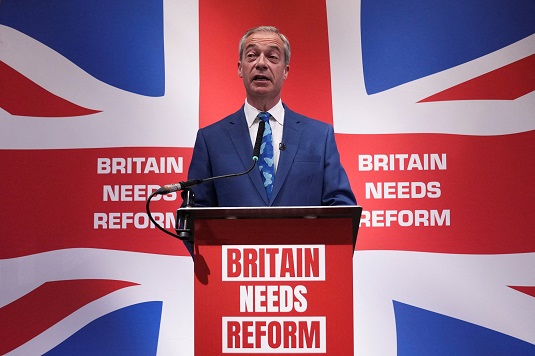
Meet the new boss, same as the old boss. At a press conference on Monday afternoon Nigel Farage made the "emergency" announcement that he was taking over the leadership of Reform (incorporated as a for-profit private company that he's chief shareholder of) and declaring for the Clacton seat. With the Tories already reeling from a series of polls forecast a range from bad defeat to complete catastrophe, rather than doing a deal and saving the party's bacon (as per 2019) he's going to be in there at the kill. He's relishing the chance to administer one, two, many knife thrusts into the guts of the badly wounded Conservative beast. The Tories' final expiration is not a matter of hype now but a very real possibility.

One doesn't have to like his politics or even like Farage to understand his appeal. He's a million miles away from the dead-eyed briefcases that pass for most mainstream MPs. His "you-can't-say-that" use of right wing talking points appear to come from an authentic place, simply because Reform's owner/leader can speak for as long as he likes coherently, without prompts, and not without humour. It's this peculiar charisma that struck a chord with some men of a certain age, and has beguiled many a journalist. Farage's politics are as reactionary as they are boring. But our Nige most assuredly is not, and it's that kind of star quality that is missing from the Tory line up. And that is a problem. For right wing voters hungering for an authoritarian figure, no-knack Sunak doesn't measure up.

In the questions, Farage gave the impression that Reform weren't likely to win any seats. And he's probably right. Clacton, which is held by the anonymous right winger Giles Watling (who is more famous for playing a character in Carla Lane's Bread over 30 years ago, which says it all) has an enormous cushion of votes under his backside. It's unlikely Farage can overturn such a majority, even with Labour winning over Tory voters with the Lib Dems and the Greens tearing out their share here in there. But the danger comes in those marginal seats which, given the state of the polls, could include any constituency where the Tory incumbent has a majority lower than 15,000 votes. Reform could easily make a difference and tip dozens more seats into Labour and Liberal Democrat gains. What a terrible shame.

How are the Tories meeting the threat of Reform? As it stands, their campaign so far has been entirely about shoring up the core vote. Whether it's peddling national service (which appears to account for losing support, according to the latest survey from JL Partners) or cranking up the fear factor, none of it is shifting the polls in their direction, nor is it warding off Reform's menaces. Now that Farage is in play and can use his standing to win over more Tory voters and lure others out on election day, where does the Conservative campaign go? Sunak has decided there's no place like the gutter, and is banging the ECHR drum again in the hope that the promise to do Brexit for a second time will appeal. You don't need to be terribly astute to realise that it won't.

The problems the Tories have is that to the mind of the Reform-minded voter, Farage's tales of Brexit betrayal ring true. They were promised frictionless trade with Europe, a clampdown on immigration, the spending of monies saved on decaying coastal towns and the country outside of the South East. And, of course, the £350m/week for the NHS. Leave campaigners said the cost of living would come down and, to borrow a recent Tory party phrase, the economy would be going "gang busters" free from the sclerotic weight of a decaying EU. None of this has happened. The reason why is because Brexit was a pie-in-the-sky project that suited the interests of a section of British capital, but no one likes to be taken for a mug. And so there's mileage in Farage's argument that Brexit has been mishandled and the opportunities binned because the Tories are Marxists in hock to leftist ideology, or some such rubbish. Therefore, because the Tories are choosing to fight on this ground they are doomed to lose a bidding war with Farage. The result is a split vote and the kind of election result even I didn't contemplate in my more excitable moments writing the book.

But does Farage's return also pose a threat to Labour? The idiot's scribe Tom Harris thinks so, though his argument is perhaps the most stupid comment I've seen on the election so far. Apparently Labour voters might be tempted because excitement. No, Keir Starmer doesn't have to be worried about opposition coming from the right for a while. But if he plays the immigration bad/anti woke politics game, and there's nothing in his speeches on immigration to say he won't, he's throwing Farage a lifeline that will keep him politically relevant long after the Tories are taken out and he fails to win for the eighth time running. In cultivating scapegoats of Labour's own, he also runs the risk of a war with Reform that Labour cannot win. Especially as it would speed up the disintegration of his own base which, to be honest, isn't in rude health - despite what the polls say.

As for Reform itself, does it have much of a future? Not really. As with UKIP before it, because of the character of its support it has all the declinist features of Tory support in extremis. But it doesn't need longevity. Farage's purpose - openly stated - is to pressure UK politics from the right and swing it toward his brand of authoritarian politics before realities catch up with its obsolescence. If by doing so he's able to hold back the struggle for a green transition, the final victory of socially liberal attitudes, and stymie the ascendency of the new class politics, that means a longer period in the spotlight and more cash for a gilded retirement. Reform, after all, is a business and the purpose of a business is to return a profit to its owner.

Image Credit

Tuesday, 23 April 2024

Rishi Sunak's Rwanda Fixation

Boris Johnson and Rishi Sunak don't get on at all well these days, but the former Prime Minister should be flattered by his successor twice removed. Sunak's determination to see the cruel and ludicrous Rwanda scheme through is straight from his strategic play book.

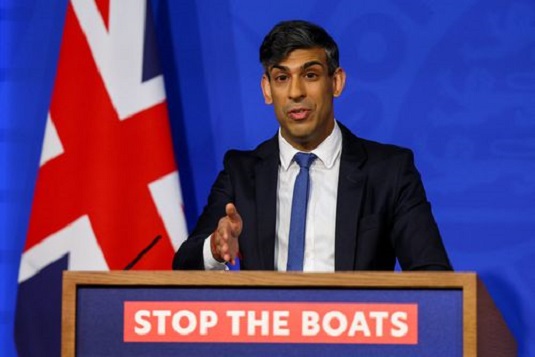
This morning, Sunak was crowing about how the passage of his bill last night changed "the global equation" on immigration. I.e. The Tories have convinced themselves that flying a few hundred traumatised people to Rwanda will deter people from trying to come here and, by extension, discourage others from handing their savings over to smuggling gangs so they can escape their countries. There's no hint of understanding let alone compassion because these most wretched of the earth do not figure as human beings in their political imaginary. When quizzed on this, Sunak says the deal the government struck with Albania has stopped Albanians from clambering onto the small boats. Rwanda will, he hopes, be a universal deterrent for all nationalities.

As forecast a while ago, Keir Starmer was always going to fixate on cost. But there is a point here. Why is this self-styled fiscally prudent government throwing good money after bad to make sure the planes take off? Without regurgitating the basics, which have been discussed here many times goes to the heart of their party's politics. Immigration is a traditional "strong issue" for them. It's something they can mobilise their base behind, and is something of a necessity now Nigel Farage's Reform are menacing their right flank. It's a means of demonstrating the Tories have the competence to govern. And there's the hope that repeatedly smashing the magic bigot button will reverse the polls and hand them an unexpected victory. After all, Leave won the Brexit referendum following a scurrilous anti-immigration campaign. "Controlling our borders" was also an essential prop of Johnson's "Get Brexit Done" election win.

But there is one overlooked component of this pathetic strategy: Sunak's copying of Johnson's Brexit strategy. Readers will recall that this most dishonest of politicians overcame the quibbles some had about him in 2019 by setting himself up as the most Brexity of that year's Tory leadership contenders, and when he was in Number 10 making sure the referendum result was seen through was his sole focus. Johnson proved his seriousness and won over millions of Leave voters by bulldozing through everything that was out to stop him. The courts. Sections of the Tory party. His own brother. And, finally, the Opposition he was able to goad into an election. His manifesto was thin, and enough of the electorate handed the Tories perhaps their greatest and emptiest victory ever.

Sunak is trying to work the same trick. No matter the money, no matter what the courts say, no matter that human rights legislation must be torn up and, in defiance of reality, Rwanda declared a land of milk and honey, Tory strategy is banking on enough voters being impressed by their singular purpose to award them victory. Or at least salvage enough support to head off a cataclysm. It's desperate and delusional stuff, but for the sake of saving a few votes from Farage's clutches they are quite prepared to sacrifice the hopes and health of any number of asylum seekers to achieve it.

Image credit

Tuesday, 26 September 2023

Laura Kuenssberg's State of Chaos

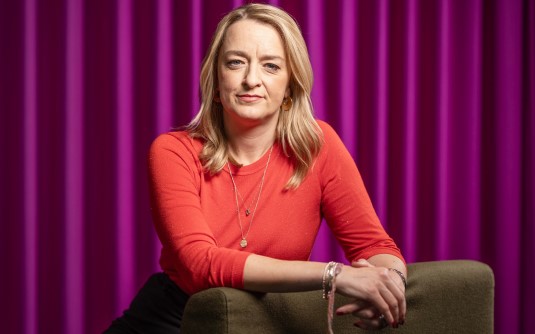
State of Chaos by the BBC's former politics editor was undoubtedly well-watched by everyone at Westminster. It promised to plunge deep into the mess of Brexit and its fallings outs to make sense of the near anarchy that characterised mainstream politics between 2016 and 2022. Promising insider access and never-before-seen interviews with movers, shakers, and bit-part players, did Laura Kuenssberg succeed?

No. Back in March last year, Patrick Howse wrote a blistering critique of her time at the helm. It wasn't that Kuenssberg was bad at her job, it's that her job was not what it should have been. I.e. reporting the news and holding politicians to account. Instead she acted as a relay. Kuenssberg has a nose for political gossip and ingratiated herself with Number 10 insiders, faithfully acting as a conduit for their framing of news stories. Boris Johnson's operation didn't need to establish a rapid rebuttal unit because Kuenssberg could be counted on to repeat whatever nonsense was texted her from the inside. Even if, as was the price for her closeness to Dominic Cummings, this meant regurgitating a complete pack of lies.

State of Chaos was true to Kuenssberg's signature style. There was never any hard questions asked of her interviewees. They were given plenty of space to explain themselves, which has its place. But in a documentary about how politics in this country went into meltdown? Considering how some of her talking heads played important roles in the dramas and behind-the-scenes shenanigans, simply allowing them to spin their own responses without question was a dereliction of political journalism.

I suppose it was to be expected. But this wasn't the only fatal flaw. Replicating standard practice of mainstream political comment and most academic politics coverage, State of Chaos caressed the surface of politics. There was no appreciation of why the Leave campaign won, why the British civil service famously did less contingency planning for Brexit than Japan, the character of the forces politicians pandered to, nor how the Tories were so successful in 2019. There was plenty of she-said he-said minutiae, confessions of plotting, and aspersions cast on the characters of ex-Prime Ministers. But why Theresa May framed Brexit in the hardest possible way when the referendum was won by a slight margin, why Boris Johnson bullishly bulldozed Brexit through all opposition, and why - in the last episode - Liz Truss crashed the economy were all questions that were never asked. What were the interests involved? What drove the crisis? Anyone wanting answers should look elsewhere.

But even more damning was the great unsaid. The so-called state of chaos of the documentary's title was as much a crisis of the Labour Party. Billed as an account of the shambles politics as a whole became, Labour and Jeremy Corbyn merited the briefest of mentions. There was no curiosity about how Labour managed to out-perform expectations in 2017, thereby accelerating Tory crisis. Why and how this was reversed two years later, nothing. It might as well have been natural forces or the politics gnomes at work. Nor were the severe divisions that paralysed the party paid any mind. You can't say this wasn't newsworthy or irrelevant. After all, the BBC's politics output and the "reporting" of Kuenssberg herself devoted to Labour between 2015 and 2019 amplified every lie to undermine its leadership, and helped deliver the party back safely into establishment hands. Its absence was an editorial oversight and nothing more, I'm sure.

State of Chaos failed as a portrayal of the recent political crisis, ignored a huge part of what happened, and reduced everything to the argy-bargy of dysfunctional personal relationships. In short, the "months and months" in the making turned out to be worse than a waste of time. It was a disgrace.

Image Credit

Monday, 25 September 2023

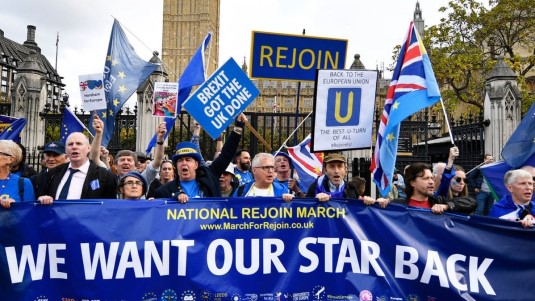
Four Points on the Rejoin March

Four quick points on the national Rejoin march that took place in London on Saturday.

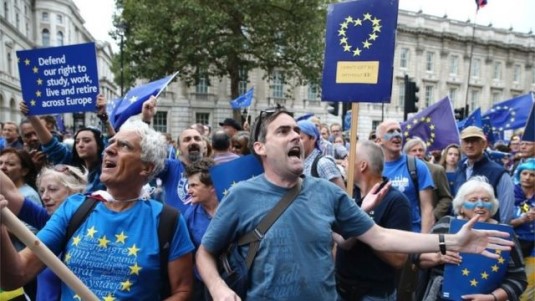
1. The politics of the march haven;t moved on from the second referendum/hard remain demonstrations of the Brexit wars. The list of speakers were a mix of social media celebrities, grifters, and complete unknowns. There were no prominent voices save those already associated with the movement (Gina Miller, Guy Verhofstadt), and not even an obscure Labour, Liberal Democrat, or SNP backbencher could be found to offer a soupçon of official gravitas. This is because, presently, the Rejoin movement is politically spent. At one point hundreds of thousands were involved because of their visceral disgust at the Leave campaign's lies, and also in rebellion against what the referendum told them: that their idea of a progressive consensus - the official ideology of the professional managerial class you might say - did not have as wider purchase as their social circles led them to believe. But more importantly, despite these sentiments and motives for grassroots involvement, the elite forces that funded the coaches and paid event organisers to put on the big demonstrations were less interested in rejoining the EU. Their focus was breaking up Corbynism.

2. This helps explain the lack of media interest. Also in London last Saturday, a few hundred XL Bully owners gathered to protest against government efforts to ban the breed. They received more coverage from the BBC and Sky than the yellow and blue army bopping along the streets to EU Supergirl's greatest hits and the bellows of Steve Bray set to repetitive beats. Divisions among the Tories over the EU have been settled, while Keir Starmer pretends he had nothing to do with trying to overturn Brexit. Ever the client media and with (nearly) all of capital's eggs in his basket as the next Prime Minister, they can be relied upon not to make matters too difficult for the powerful and so bang on about his recent history. But the march did attract the attention of foreign media, notably French, Belgian, and German outlets. And why wouldn't it? They're not interested in a row about dangerous dogs, but that there's still a constituency for returning to the EU after the bullshit of Brexit - that's newsworthy and interesting as far as their editorial offices are concerned.

3. Between 3,000 and 40,500 people took to the streets, depending on who you believe. According to folks who were there, the turnout wasn't different to the last national mobilisation in October last year. That indicates the movement has a stable core, even if it has been abandoned by its establishment backers of old. But it also suggests it's not attracting new layers either. From what I can gather, the composition of the march was mostly professional managerial/middle class types. Trade union banners were not in evidence. If you wanted to be unkind, you could say it was the Lib Dem base LARPing as angry, annoyed demonstrators. And just as that party has proved unable to expand its support beyond certain limits, we find the street expression of its politics suffering from an identical difficulty.

4. But it probably won't always be like this. There is an overlap between Rejoin's constituency, the Lib Dems, and Starmer's base. What's more, despite the very best efforts of the shadow front bench at dampening down expectations, people will be expecting an incoming Labour government to fix public services, to see an end to penny-pinching politics, and making simple things like getting a doctor's appointment and having a passport arrive on time happen. Disappointment is bound to translate into opposition, and because of the state the Tories are in both the Lib Dems and the Greens are well placed to profit from Starmer's difficulties. But there's no reason to believe that pro-European politics won't become another axis of opposition a Labour government will face. Despite burying his record, significant sections of the Labour vote are expecting steps back towards the EU. Some might have fooled themselves into thinking that Starmer's ruling out of single market and custom union membership and dismissal of the associate member status being floated in French and German government circles is electoral expediency, but they will be gutted when they find out his no really means no. At best there will be tinkering, not unlike the recent return to Horizon and Rishi Sunak's fiddling with the Northern Ireland Protocol. And when that penny drops, don't be too surprised if the voices clamouring for a return to the EU or a second referendum becomes a repository that condenses a certain kind of discontent.

Sunday, 2 July 2023

Making Sense of Tory "Corbynism"

I regret to inform you that John Rentoul has written another terrible article about the Conservative Party. Telling us to "beware of Tory Corbynism", he notes the manoeuvres of Lord David Frost. Being an approved candidate, he's on the hunt for a safe seat. And when he's found it, he'll dump the peerage in the canal and make a play for the leadership of the party. Never mind that Rishi Sunak had to spend time undoing the Brexit mess he made. In the whacky world of Tory politics, the real world counts for nothing. Or so we're led to believe.

Why is Rentoul's take so bad? It's because he doesn't even attempt to get beneath the surface of what's going on, relying on lazy tropes that have long circulated among his milieu of commentators, verbally incontinent MPs, and establishment-friendly academics. He first raises the idea of a Tory bounce back. That if (when) Labour forms the new government, Keir Starmer and co. are going to have a tough first term with public finances being what they are and the economy in the toilet. There's a chance for the Tories to come back quickly if they stick with Sunak. How? Rentoul doesn't explain, because such an assertion dissolves when it's put to the analytical test. Would mortgage-holders wistfully look back to the time when the Tories stiffed them to get rid of Starmer? Or working age people in general miss the rocketing energy bills and the rampant price gouging by supermarkets? Only if the electorate lost their memory. And then there's the question of who's going to vote for them. After a term of a Starmer government, there will be fewer Tory-supporting pensioners about and the rising generation will never vote for blue in big numbers. In these conditions, a historic opportunity awaits the Liberal Democrats and the Greens.

And now for the main event. For Rentoul, the "psychology of defeat" means the Tories won't take the sensible Sunak road. Instead "recrimination and magical thinking" will prevail, because this was already evident when the membership voted in Liz Truss. Hit with the trauma of defeat, the Tories will turn inward in a right wing reflection of what happened In Labour when it elected Jeremy Corbyn. This means the party can look forward to going nowhere fast. This might and will be true, but it's apparently too much for a man who makes a handsome living from writing about politics to take the trouble to understand why this happens. Those mad head members, eh?

As argued here many times here and at length in the book, the long-term decline of the Tories manifests itself in the party's crisis of political reproduction. The coalition of propertied pensioners that are the bedrock of their coalition are not replacing themselves like-for-like precisely because of the policies the Tories have enacted to keep this constituency together. By 2017, the limits of relying on pensioners and older working age people was starting to show. Theresa May hit upon the idea of using Brexit as a glue for bringing together mass support, but this could only work if the opposition was split and Labour played ball. Corbyn did not and May lost her slender majority. Two-and-a-half years on, Boris Johnson went to the country using exactly the same strategy. And this time it worked because the opposition was disunited and riven with various flavours of overturning the referendum result. Johnson effectively maxed out the strategy. But since then, you could say the Tories have been looking for a new strategy that can save their bacon. As venal and awful Johnson was, he understood that his government had to be seen to be doing something. Hence the boosterist rhetoric, the brinkmanship with the EU, the levelling up waffle, and the selection of new scapegoats that can fill the space left by Brexit's (political) resolution. It was a coherent strategy, albeit part-derailed by Covid and finally driven off the embankment by Johnson's "colourful character".

Fast forward to last year's leadership contest and the options open to members as determined by the ever-so-wise parliamentary party. As much as I disagreed with Truss's prospectus it was not how Rentoul imagined it. I.e. Sunak's sensible centrism vs "madness". With the strategic impasse the Tories were in, Sunak offered boring technocracy - a politics of doing nothing - plus bad jokes and side dishes of racism and transphobia. Truss, minus the gags but with "interesting positioning" offered something that could get the membership excited. Her prospectus for tax cuts, and what would turn out to be Toryism at its most naked, recommended itself because plenty had swallowed 40-odd years of nonsense that this would boost economic growth. If Truss could unlock that then almost all the other problems would disappear. It was a load of rubbish and, on this occasion, Sunak's pro-Treasury critique of her plans were right. But from the standpoint of forging a way forward it made more political sense than steady-as-she-goes briefcase government. So no. Mistaken, yes. Reckless? Absolutely. But not mad.

Rentoul's detour into pop psychology further demonstrates a poor grasp of politics. Why, after an earth-shattering defeat might a party desire a return to fundamentals? He'll never ask this question and give an honest answer because that might mean a reckoning with Corbynism as it was. It's much better to maintain it was a cranky cult enraptured by purist ideology and the Magic Grandpa. The same is true with the Tories. Looking back at the period between 1997 and 2005 when the Tories were the down and outs of British politics, the accepted explanation for this was, again, madness. This is the view favoured by the country's premier authority on matters Tory, Tim Bale, and it's the line pushed in his otherwise excellent history of the Conservative Party. But, again, this explanation leaves a lot to be desired. For one, when a party suffers a severe reverse the return to basics can consolidate a base that has suffered a shock. The Tories in 1997 knew they were in for a pummelling, but not the wipe out they got. Their doubling down on euroscepticism made total sense in this context. Furthermore, many Tory politicians had convinced themselves that their stance was popular. The right wing press, which in the Tory imaginary is seen as the authentic voice of Middle England (and not the reflection of their own prejudices), echoed and fed that view back to them. And in William Hague's main electoral test prior to the 2001 election - the 1999 EU elections - the Tory vote surged and their MEPs doubled while Labour lost more than half of theirs. UKIP also broke into the political scene for the first time, returning three MEPs. From within the Tory party, not only did their embrace of euroscepticism consolidate their base, the case could be made that under certain circumstances, obsessing over Europe can win elections. Understandable, even if it was wrong.

Therefore, assuming the Tories don't win the next election, I agree with Rentoul they'll turn right. But this is because of the political sociology of their position, not them being thick or irrational. They're in for a shattering defeat. But they have their narrative of betrayal, and a mythology based on fighting a cultural war election and winning an election on that basis. If the Tories go for David Frost, or Kemi Badenoch, or even the grotesquerie of a Suella Braverman leadership, it's because of their reading of the political situation. And if this can't be understood by mega bucks politics commentators, it's high time they found themselves a new profession.

Image Credit

Wednesday, 31 May 2023

Betraying Remain

There are moments when the scales fall from the eyes and what is desired or admired is shown up to be anything but. Today was the occasion when the penny dropped for continuity remain. Their former champion, Mr Second-Referendum-with-an-Option-to-Remain took to the pages of the Daily Express to pledge there would be no return to the European Union, no customs union or single market, and no freedom of movement on his watch. Dear oh dear. Some might pretend that even now, Keir Starmer's embrace of Brexit is all a ruse and that after five years of trying to make it work he'll take us back into the EU, but credulity can only be stretched so far.

As with Starmer's proclamation on matters Europe, the role he played in splitting the Labour Party and trying to reverse Brexit are far down the memory hole. He writes that during the campaign he found plenty of Leave voters wanted the same sorts of things he did: "a better health service, better jobs, better wages, more security, a sense of control over their lives and their communities." A pity he wasn't as keen on upholding their votes when he spent the subsequent three years telling leavers they were wrong and he knew better than them. But when there is a leadership to win, disrespecting a referendum vote and shepherding one's party down the path to an historic defeat were but trifles next to his ambition.

But this isn't just about buttering up the declining Express's Tory-voting readership. It's an effort to close Brexit off as a political issue. Starmer wants to concentrate on Tory mismanagement of Brexit, the betrayal over levelling up, the grandiose promises, and the damage inflicted on the economy. This becomes much more difficult if the question of Brexit is reopened, despite polling registering record levels of Bregret. With the Tories flailing and consumed by more Boris Johnson mess, what would be helpful is something for them to rally around. As their war on woke efforts resonate with few people who aren't Tory journalists, re-opening Brexit would be like manna from heaven. Memories of Starmer's second referendum campaigning would be revived and Labour would have a more difficult time of it. Why turn into a long hard road when an easier, smoother shortcut to office is available?

This isn't without cost. Neutralising Brexit to the right re-opens it to the centre and the left. While the campaign to rerun the referendum had ulterior motives between 2016 and 2019, that wasn't the case for the hundreds of thousands who marched, who protest voted in the EU election debacle, who supported overturning the acceptance of Brexit in the Labour Party, and who backed Starmer on the strength of his European credentials. In the scheme of things, it is reasonable for Starmer to assume that dunking on this constituency will have fewer immediate consequences than antagonising leave opinion. And that's true. If losing council by-elections to the Liberal Democrats and the Greens is the butcher's price, that's entirely acceptable. After the election is when it will become difficult as continuity remain becomes an oppositional current, and one both these parties can exploit. But that's a problem for then.

Image Credit

Sunday, 2 April 2023

The Class Politics of the Tory Pivot to Asia

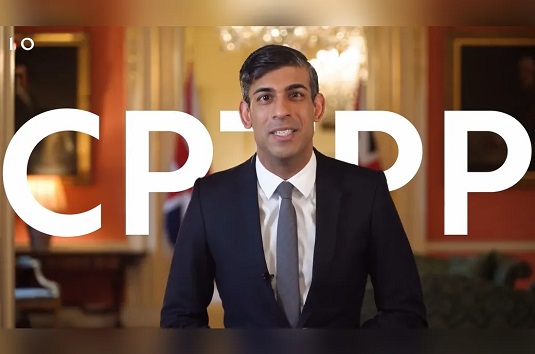
Rishi Sunak has decided to play the sensible game. At the beginning of the year, he announced he was going to become Mr Delivery. Putting distance between himself and his calamitous, chaotic predecessors, the high foreheads on retainer have advised more briefcase, less headcase is the passage to voters' hearts. Especially when his opponent is the epitome of administrative politics. On this score, Sunak has had a good few weeks. Northern Ireland has been solved, even if the DUP are running out of toys to throw out of the pram. The ERG threats and a Boris Johnson-led rebellion were brushed aside, and Jeremy Hunt's budget carried forward the do-nothing logic of "Sunakism" while not upsetting too many people. And now there's another feather in the cap: the UK's admission to the Comprehensive and Progressive Agreement for Trans-Pacific Partnership.

Yes, it does seem a bit strange. We've flounced out of one trading bloc - the world's largest - that happened to be on the country's doorstep and traded it in for another about six thousand miles away. But good headlines for Sunak as the government clinches another trade deal. It, apparently, shows the "real economic benefits of our post-Brexit freedoms". Oh good, guess that means we're all quids in as the beleaguered British economy gets a boost. Actually, no. The government's own briefing suggests CPTPP will increase GDP by 0.08%. That's right, by less than a tenth of one per cent. Or the equivalent of the average family's food shop these days. Seems ridiculous? It is. Trying to big it up, Kemi Badenoch suggested this was a down payment on the future. It's about potential: "40% of the world's middle class is going to come from that region". Nice to know, considering how Britain under the Tories is such an exporting powerhouse. And there's the rest as well. The fact we already have free trade agreements with 11 of CPTPP's 13 members, and how it hammers British farmers. Something the Tories are well practised at. What's the point?

We have to think about the core class component in the confluence of forces the Tories draw together: commercial and finance capital. As explained before, the City cannot be disentangled from the Tories - as Number 10's current resident reminds us. But when it came to Tory divisions over Brexit, the guff about sovereignty was partly about statecraft, of granting the Tory class interest untrammelled political power without limit in its home territory to shape British capitalism and manage its labour force as they see fit. And it was also about commercial opportunities and projecting the global influence of the City. Some city slickers, probably a majority, were happy with the status quo, while others thought their (note, not the country's) best interests were served outside the EU so London can consolidate itself as the global clearing house for laundering dirty cash, parking capital, and networking between commercial elites for future opportunities.

This helps us understand the Tory enthusiasm for CPTPP. Badenoch is right. Asia is on the rise while the EU, no matter how much it grows, is in long-term relative decline. The City needs to be where the action is at. Second, CPTPP is set to grow. China has applied to become a member. The UK is nowhere near as successful at trading with China as other West European countries, but as a CPTPP member with application veto rights the Tory government now hav a say over its terms of entry into the bloc. The naive might celebrate this as a chance to remind China about human rights and democracy. It also puts the UK in a strong position when it comes to the strengthening and enforcement of intellectual property rights, which are notoriously disregarded, unofficially of course, in China. This gives the government leverage and puts them in an advantageous position to extract concessions. More Chinese money in the City? Better (preferential) access for British finance? More opportunities for UK services? And also, the City could become even more of a conduit for Western capitals looking to profit from China's rise. Especially American capital.

All told, even if Badenoch's dreams come true we're not looking at more than a few percentage points on GDP. But that's not the point. Projecting the City is what matters, helping secure the UK's role as a global player is what matters, and ensuring the interests the Tories have traditionally articulated and served have long-term profitable futures are what matters. The UK's membership of CPTPP offers the electoral equivalent of a nice photo opportunity, but as with all things Tory it only makes sense in the context of the interplay between class politics and commerce.

Image Credit

Monday, 27 February 2023

The Triumph Before the Tragedy

Rishi Sunak is probably the most politically flat-footed Prime Minister since ... Liz Truss. But not everything has to be 4D chess. Simple crudity can and does work. In selling his Northern Ireland Brexit deal, there were two very clumsy, clod-hopping moves that made Gordon Brown look the picture of subtlety. We had Sunak's address in the Commons this evening. Showing an uncharacteristic appreciation of his backbenchers and their peccadilloes, he sold his deal with the EU as an exercise in cutting red tape. The successful conclusion of the negotiations, he said, deleted 1,700 pages of EU law. That sounds good to them, and looks good if you want to style out the rest of this calamitous Tory government as something of a "reformer" who doused hundreds and hundreds of regulations in petrol.

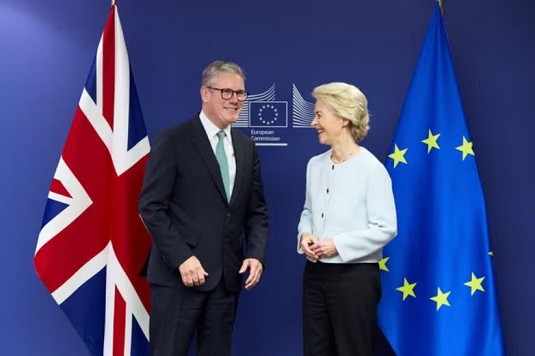
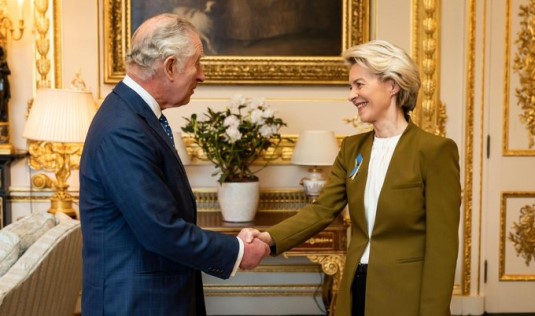
The second was a bit too much on the nose, even for Sunak. We noted yesterday the aborted weekend meeting between the King and EU president Ursula von der Leyen, and how Brexiteers and the DUP cried themselves a river over it. Associating the King with the deal was an obvious attempt at emotional blackmail against two political tendencies who define themselves in relation to the Crown. It was therefore not enough for the tea and tiffin to actually go ahead this Monday afternoon. To almost dare them to vote against the deal it has now been christened the 'Windsor Framework'.

What a clunker of a strategy, but it seems to have worked. Most of the Brexity voices have made emollient noises, with the ERG promising to look carefully at the text of the deal. Even the DUP aren't united in intransigence. Boris Johnson, who kept the running sore of the Northern Ireland Protocol open purely for political posturing purposes has kept a low profile and chose to stay away from the Commons. He's decided not to lead an assault on the deal. With Labour and the Liberal Democrats, and perhaps the SNP all backing the Prime Minister, the Tory right, who've been flexing of late might not choose this as their hill to stand on either. Sunak, therefore, has the first genuine triumph of his premiership. And one that, ultimately, will do nothing to save his government.

Sunday, 26 February 2023

Brexit Vs the Northern Ireland Protocol

Towards the end of his time as Prince of Wales, the King said he would be politically impartial and aloof as per convention when he became monarch. More than a few Westminster eyebrows were raised when he was scheduled to meet EU president Ursula von der Leyen this weekend. Because coincidences don't happen in politics, several Brexiteers were quick to cry foul. According to the Daily Mail, the DUP and Jacob Rees-Mogg protested the King's meeting at the juncture of advanced talks between the UK and the EU set on resolving the Northern Ireland Protocol quagmire. They're right to have picked up something fishy. With all the subtlety of a brick through a constituency office window, facing opposition from his backbenches Rishi Sunak knows associating the King with whatever deal they cook up will make it harder for the Brexit ultras and DUP to vote against.

Nevertheless, news of advanced talks and the seeming likelihood of a resolution marks a clean break with Boris Johnson's handling of the mess. For starters, he was primarily responsible for it. Recalling the turbulent parliamentary year of 2019, after making a song and dance about Theresa May's efforts to secure a deal with the EU, Johnson was able to cobble something together that bore more than a passing resemblance to the document he resigned from May's cabinet over. The UK would leave the EU's customs area in its entirety, except the small print said that while an EU/UK land border lies along the line between the north and the Republic for the purposes of the deal it would move into the Irish Sea. This customs frontier meant goods from the UK mainland passing into the North would be liable for customs charges if they carried a risk of heading south. Bear in mind this deal was supposed to be an insurance policy, the terms of which the UK and EU would default to if a proper trade deal between the two was not secured. In typical slapdash fashion, Johnson didn't care about the detail of the deal. It was done, he could slap "oven ready" on it, and worry about it after winning a general election.

31st January, 2020 comes and we're outside the EU. The UK immediately moves into the transitional period where little to nothing changes. It's the holding pattern until a new trading partnership is negotiated. However, in February the Tories signalled they would be approaching the coming negotiations as a zero sum game. Having seen how Brexit brinkmanship benefited their electoral fortunes, talking up the talks as a battle of plucky Britain versus the combined might of Europe was yet more cynical games playing. While outlines of a draft trade deal were quick to emerge, by the summer talks had stalled and the UK was threatening to walk away if the EU persisted with the Northern Ireland Protocol. Indeed, the government announced it was introducing a UK internal markets bill which, while sounding dry on the surface, amounted to unilaterally altering the withdrawal agreement. It conceded it was preparing to break the law in a "very specific and limited way". This was the usual Johnson theatre, and therefore Downing Street greeted the election of Joe Biden with some dismay. Johnson believed the promise of a quick trade deal with the United States would give him leverage in the talks, and that was on the cards if Donald Trump had won re-election. Furthermore, given the pro-Irish component of American politics, Johnson was aware brinkmanship and threats towards Ireland were no longer consequence-free.

The talks were not looking good, and in December Johnson was talking about an Australian as opposed to a Canadian-style relationship with the EU. I.e. A euphemism for a no-deal scenario. Yet a deal was finally struck on Christmas Eve. It was a poor agreement that erected more bureaucracy, and particularly hammered the UK's efforts at selling services into the EU. A disaster considering the sector comprised 80% of GDP. The language about regulatory divergence covered for the fact £650bn of annual trade with the EU was bound up with conforming to its standards. As far as Northern Ireland was concerned, the new trade deal looked an awful lot like the withdrawal agreement. The UK still could not freely sell goods into one part of its territory, and the new rules governing UK/EU trade solidified it. Disruptions to the flow of goods under this arrangement were described by Johnson as "teething troubles", and the long and interminable negotiations about the implementation of the Protocol started in earnest after it came into force. Matters weren't helped by the DUP and their unwillingness to make it work. They boycotted talks, attempted to use the courts to block the Protocol, and shrugged their shoulders as loyalist areas erupted with violence. The resignation of Arlene Foster and her replacement by Edwin Poots gets off to a great start as he threatens to suspend checks on goods coming from the UK, making the agreement unworkable. This proved to be an empty threat as within two months of Foster's departure he was gone.

For the remainder of the year, EU threats of legal action and Downing Street threats of unilateral action meant the unsteady status quo persisted. Fast forward to the Assembly elections, and because of Northern Ireland's peculiar status its economy was actually outperforming the rest of the UK. Johnson's hasty approach to deal making was laying the material basis for unification, and loyalism was stuck on an existential cliff's edge. Remaining in the UK is its raison d'etre, but how can it retain mass support if loyalty to king and country means making its community poorer? Small wonder they fractured and we're in the absurd situation of having Sinn Fein's Michelle O'Neill in position as First Minister-in-waiting. As far as Johnson was concerned, the moment demanded more brinkmanship and on 13th June the government published its Northern Ireland Protocol Bill, which in UK law would grant ministers powers to set aside the treaty and implement new rules. Never mind this would contravene international law, jeopardise trade with the EU, and undermine the UK's ability to sign future deals with other countries. The passing of the Bill into the committee stage saw the EU begin legal proceedings. But with the departure of Johnson, things start cooling down. When Liz Truss enters office she says she looks forward to a reset of UK-Ireland relations. This carries on when Sunak takes over, and slow progress turns into real progress, to the point where we are today with resolution in sight.

What the Brexit ultras and the DUP fear, and what is likely to be struck with the EU, is some sort of confirmation of the status quo. A characteristic Johnsonian fudge has now governed UK trade into Northern Ireland for two years, and the relatively light touch controls have suited both sides of the border ensuring the disruption of Brexit has been mitigated. Affirming what is with a new range of oversight mechanisms, scopes for further talks and so on, locks a part of the UK into the EU, which limits the prospects of regulatory divergence. It makes a nonsense of the entire Brexit prospectus and will underline the argument frequently made by the remain camp, of the UK's transition from a rule maker to a rule taker outside the EU. It will make the UK look weak, and where the responsibility for this state of affairs lies is very clear. And, like the DUP, the Brexiteers worry what it's doing to the union. For Johnson it's just another issue he can use to remind the media that he still exists and will do politics in between his busy, lucrative speaking schedule. But for Sunak, it would be a real coup. With nothing much going for the Tories in the polls, a victory for sensible briefcase Toryism might turn some floating voter heads - especially those who like their "grown ups". The problem he has if should he get this through, the right of the party are going to become even more ungovernable. Especially if it only passes the Commons with Labour votes. For once, Sunak is doing the right thing. And it could prematurely end his premiership.

Image Credit

Thursday, 26 January 2023

Did Remain Cause a Hard Brexit?

Some points on Nick Tyrone's piece exonerating remainers and Remainism for the hard Brexit we ended up with.

First, where I agree. As a movement of parliamentarians and in the wider country, Remain did not cause the Brexit shit show we ended up with. He's right. Theresa May was responsible when she set out the terms of what Brexit meant in the most narrow, sovereigntist terms possible and as argued at the time and since her concern was about keeping the Tory party together. This trumped everything else. Second, May and Boris Johnson, who converted to Brexit because it was but a trifle, chicken feed you might say, for the country to pay if it meant having him for Prime Minister. And third, the campaign for a second referendum was wrong. For Tyrone, it's because if it was successful and remain won there would be endless bad blood, and if leave was reaffirmed politics would be in an even darker, more reactionary place than now. Though, as was obvious at the time, for many of the elite figures involved, particularly from Labour, getting another referendum was a secondary objective.

Disagreements. On the indicative votes, and the brief window of negotiations that took place between May and Jeremy Corbyn after her Brexit deal was smashed by massive government defeats. Taking the votes first, readers might remember that four options were put before the Commons. There was the revocation of Article 50 in the event of a no deal Brexit, pushed by the SNP. Peter Kyle put down a second referendum option, Ken Clarke a Brexit that would have kept Britain inside the Customs Union, and the softest of Brexits pushed by Nick Boles that kept the meat of Clarke's preference and added the gravy of free movement and some form of single market access. Labour whipped for all save the SNP's motion, and for their part the SNP supported Boles's Brexit. Boles fell 261-282, Kyle 280-292, and Clarke 273-276. Tyrone argues if a few more remain-minded MPs had given an inch and supported Clarke, it wouldn't have mattered because an indicative vote is, unsurprisingly, indicative. Not much would have materially changed.

Politics is a matter of probabilities, and there's a deal of reading back the actual outcome into what might have happened. Remember, the indicative process begun because the Commons was log-jammed. At this stage Article 50 was still ticking away after its first extension and following May's third defeat. No deal was not off the table, and it appeared paralysis could lead to the worst possible outcome. Given the fevered state of politics, the consequence of a positive vote in favour of the Clarke option would have transformed the situation. As we later saw in the Autumn, and given John Bercow's thinly concealed support for the opposition, there is good reason to believe parliament could have wrestled away control of the legislative timetable from May's imploding government. A proper motion for Clarke could have gone down and might well have been won and all bets would have been off for what happened next. But whatever possibilities that moment may have had were shut off because the Liberal Democrats, Change UK and the SNP did not support it. Given Scotland voted remain, there were very good reasons for the SNP to do as they did. Not so the ultra remain parties. That doesn't make them chiefly responsible for what did happen, but their choices had consequences.

On the negotiations, Tyrone argues Corbyn has more responsibility for the hard Brexit because he could simply have whipped for May's deal, which was a de facto customs arrangement anyway. He's right that the Tories would have self-destructed if May had to rely on Corbyn's support, but this supposes Labour were happy campers at this stage. When May invited all comers into negotiations with the government, so desperate was she to get her deal done that she offered absolutely no concessions to anybody. Labour wanted to make changes to her political declaration and, as a floor, affirm remaining in the customs union - as per Clarke's position. May wasn't interested. In this situation, Corbyn could have said fine, the party will support her deal despite not offering anything and caused a serious split in its own ranks. Not just with remain-ultra MPs on its backbenches, but very probably on its front bench and among the membership itself. Remember, Labour was forced to adopt the second referendum position eventually because supporting Leave on Tory terms, whether May's or Johnson's, would have destroyed the party. Think the 2019 result was bad? It could have been so much worse.

When it comes down to it, Brexit is a complete dog's dinner. It's a criminal waste of time when other social problems are going begging and most of the major nations are sitting on their hands as climate change disaster bears down on us. But it could have been handled differently, and the kind of exit we got was not inevitable. Remain as a movement are not responsible, though actions by some of its adherents limited the scope for a different ending. Nor for that matter was Jeremy Corbyn who worked to protect the position of our people. It's so much easier to think about the Brexit wars as personality clashes and blame games, but as with all things political it was a struggle between interests. And that's how the politics and fall out of the referendum must be approached.

Image Credit

Sunday, 8 January 2023

Burying the Second Referendum

In his Sunday interview with Sophy Ridge, Keir Starmer showed a moment of discomfort. Referencing this week's take back control speech, Ridge alighted upon the Labour leader's attempts to associate himself with the reasons why people voted to leave the European Union. The killer question was "why then did you lead the campaign for a second referendum?" And Starmer gave an answer Liz Truss wouldn't have had any problem giving: "I voted remain, I campaigned for remain, but we lost the referendum." Talk about body swerving the question. Following up, Ridge asked if the reason for his change of heart was because then he was pivoting toward a pro-remain party membership thinking about the next Labour leader, whereas now the electorate that matters are swing-voting Brexit supporters. Bang. To. Rights. And again, he simply evaded the question.

At 10pm on 12th December 2019, Starmer dropped the second referendum like a hot potato. Having used the issue to put him ahead of the pack to be Jeremy Corbyn's successor, the Tory win emphatically closed Brexit down as a political issue. Hence, Starmer talked vaguely about preserving some of the advantages of EU membership in the subsequent leadership contest, but once elected anything about the EU and the second referendum did not leave his lips. Indeed, when Boris Johnson's hard Brexit was put to the Commons for ratification two years ago, Labour whipped in favour of it. Since then, with Brexit demonstrating itself to be a dismal failure - in line with all expectations - it's an issue Starmer would prefer not to go anywhere near. The Tory media have been kind not to have talked about his previous die hard remainism, but to be fair to Starmer he hasn't given away any hints about what Britain's relationship with the EU will be like when he gets into Downing Street. There is no meat for the press to worry at, and the shadow cabinet have maintained a disciplined radio silence.

This can't go on forever. In his clumsy, half-arsed way Rishi Sunak has baited Starmer at Prime Minister's Questions about it, but each time he doesn't rise to it. Indeed, the more Starmer gets asked about this over the next 18 months the more we'll see stock phrases about campaigning for remain but respecting the result. Almost as if second referendum/continuity remainism never happened, or if it did Keir Starmer had nothing to do with it. Ridge is right, then. "Take back control" and occasional dalliances with talk about the "freedoms" of Brexit underlines a single-minded effort to win back the Red Wall'ers, and ensure this cannot be used as a wedge issue against Labour again. The only wedge Starmer is now interested in forcing is between the Tories and everyone else.

This does leave a question mark over the UK's future relationship with the EU. Those who think Starmer still keeps the remainer faith and is going to take us back in short order are deluding themselves. The leave vote won't stop being electorally significant for the lifetime of a Starmer premiership, and he's not going to give the Tories an anti-EU populist shot in the arm as they lick their wounds following the next election. The best EU supporters can look forward to is a rationalisation of the absurdities of the EU trade agreement. Excited people might talk about a membership application, but that's all it would be. Talk.

Unfortunately for Starmer, playing fast and loose with remainism is going to have political consequences. When all is said and done, for the viability of the Labour Party embracing the second referendum position was the least worst option in 2019. However, when he turns out not to be Mr Remain in deep cover, what then? For opposition to a Starmer government, while the spent Tories will be the touch post for right wingery and reaction, the growing constituency of social liberalism and every day leftism is going to find forms of opposition of its own. And some of this will undoubtedly take on a pro-EU/return yesterday flavour. Given what happened in the last set of catastrophic EU elections, it could offer an avenue for the Liberal Democrats and the Greens to establish themselves as serious electoral opponents to Labour. Working age people are more likely to find them attractive than the Tories, and for good reason.

For the moment, all this is to come. With the national mood firmly against the Tories, burying his past involvement with the second referendum campaign isn't going to harm Starmer or Labour any. Once he's been in office for a year or so, the story may well be different.

Image Credit

Sunday, 20 November 2022

Briefing Bregret

If there has been consistency between the last four Prime Ministers, it's been a desire to get Brexit done and put distance between the UK and the European Union. It was only a couple of months ago that Liz Truss couldn't decide whether Emmanuel Macron, the president of a nation that's been in alliance with the UK for 120 years, was friend or foe. And today, The Tories are set on delivering Britain to Brussels on a platter. Well, not quite. But the report in the Sunday Times has upset a lot of people. Apparently, Rishi Sunak is looking at developing a "Swiss-style" relationship with the EU. This would mean the removal of tariffs and checks but also, horror of horrors, could allow some influence for the European Court of Justice, contributions to EU coffers, and compromises on the freedom of movement. Some people are not pleased if the right wing froth on Twitter is anything to go by.

This comes with caveats. The report speaks of Britain's relationship with the EU evolving in this direction over the next decade, albeit with Sunak looking to cut deals sooner rather than later to knock the irksome corners of Boris Johnson's Brexit deal. Neither are the EU especially keen to repeat the Swiss arrangement any time soon, but it should be remembered the UK is an order of magnitude more significant (economically speaking) than Switzerland and that Brexit's impact has been felt across Europe as well. There are plenty of businesses on the continent who'd like to see the relaxing of trade barriers. But the politics of this for Sunak are difficult. He might have been a true Brexiteer, but his stronger grip on political realities tends him toward ameliorating the UK's strained relationship with the EU. He can't be anything but aware that the growing consensus among the "sensible" elements of his class that the damage done has to be mitigated.

On the other hand, the Brexit fundamentalists are concentrated on his side of the Commons. Sunak already has a legitimacy issue in that he studiously sidestepped an open contest in front of the membership. And while he has kept some of his would-be enemies close, such as Suella Braverman and Steve Baker, I doubt this would be enough to becalm the backbenches worried that the "achievement" of Brexit could vanish. With a rebellious mood abroad over some aspects of Jeremy Hunt's budget, it might encourage the awkwards to get a little bit awkward. In the medium term, there's concern for the Tories' right flank as well. Some of the more racist elements of Tory support have defected to the continuity Brexit Party, trading these days as Reform UK. And what do you know, Nigel Farage has piped up again with the threat to "crush" the Tories should the government take the Swiss road. Hard to see how he can without EU elections to ponce off, but grifters are gonna grift.

Being seen to renege on Brexit, however, is potentially dangerous to the Tories' shrinking coalition. A lot depends on the attitude the press are going to take. The problem with Truss's budget is she blew up the economy for the benefit of a few hedge funds and everyone, including most of the capitalist class, have paid the price with an unstable pound, skittish money markets and surging inflation. Are they going to play along with the "sensible" consensus, or use it as they have done with Braverman, Dominic Raab, and Gavin Williamson to try and push the government around?

Sunak is walking a tightrope. To his right are the gnashing teeth of Tory irreconcilables and the Brexit ultras. And to his left lies an increasingly confident and combative-sounding Labour Party. The polls continue to have the Tories in doom territory, and the Prime Minister's flat footedness, as per the Swiss briefing here, mean more trips are likely before the final fall.

Image Credit

The Bourgeois Politics of Brexit

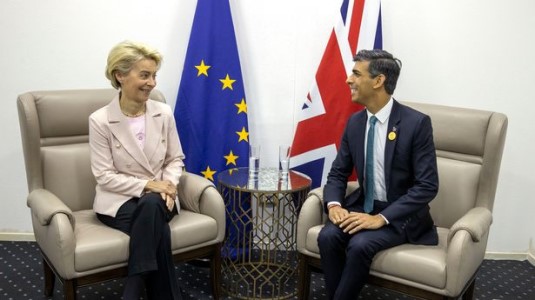
As forecast on many occasions, Brexit is unravelling. It was and is dysfunctional for British capital as a whole, apart from a few outliers, and is depressing GDP growth on mainland Britain as Boris Johnson's deal multiplies paper work and closes off markets on the continent. Polling supports the view that Brexit is turning out to be a failure, with a branding it as such by 56% to 32%. Even the government can't deny reality any longer, with the Sunday Times reporting how Rishi Sunak and Jeremy Hunt are considering a closer, "Swiss-style" relationship with the European Union. Putting this to one side, within establishment circles there is something of a gap. On the one hand, popular support for Leave has been explained as a plebeian revolt against immigration and wokery by white working class people. A bullshit argument if there ever was one, but precious little has been said about the persistence of Brexit and Leaveism among Tory MPs themselves. It's treated like an irrational affectation by centrist and EU-leaning elites.

This "explanation" from a couple of months back from Matthew Syed illustrates the thinking perfectly. Brexit is a cult, and it has the Conservative Party in a vice-like grip. He argues that to understand Tory behaviour of the last six years, only one perspective makes sense: group psychology. Drawing on the work of Leon Festinger who was interested in the sustenance of group delusions, he infiltrated a UFO cult to observe what would happen when its predictions - that members would get whisked away by flying saucers on such-and-such a date - didn't happen. When the aliens stood them up, the cult guru rescheduled their appearance to the future and doubled down on their beliefs. Syed's contention is that believing in Brexit shares these characteristics. Pointing out data demonstrating that Britain is poorer, weaker, and more diminished is like talking to a wall. They're not interested, with its adherents lashing out at the "remainer" Treasury and "woke" financial markets for the country's predicament this last month. More reasonable Brexiteers might point out that Sunak did offer Tory members an alternative, and what we see now is thanks to Truss's idiocy. Which is only partly true.

The only way out for Syed is a change of government. The Tories need to relinquish power. That this is being touted openly across the Conservative press is remarkable and a sign of how dire their circumstances are. In a paean to Tory MP Charles Walker who famously denounced the collapse of government discipline and said the first duty of the Tory party is to the country, Syed writes,

I almost felt like hugging him as I heard those words, for it hinted at the Tory party that so many of us once admired. A party of pragmatism, of moderation, of realism. We need that party back for the health of our democracy. So, please, call an election, take a break and find yourselves again. Do so now, and you’ll be back. Cling on to the bitter end, changing leaders, jumping through hoops, gazing at navels, and you may never be forgiven.
It's worth noting Syed is a former Labour candidate, an admirer of briefcase politics, and a fan of good Tories. But still, his argument is superficially plausible. The Tory majority made a Leave judgement call because reasons and have stuck with it to the moment of destruction. But this explains nothing. For instance, why was Brexit the glue that held their voter coalition together when the Tories might easily have clung to the cuts-and-deficit dogmatism of the Dave and Osborne years? After all, wasn't it Labour's perceived weakness on the issue that won the Tories the 2015 election? Syed does nothing to explain why Brexit was the object of Tory "cultism". And that's fine, for in the bourgeois press it doesn't do to peer too closely into such things. Hence we're left with a junk psychosocial argument that says something while not saying anything.

The truth of the matter is Brexit and the Tory attitude to Europe are closely bound to issues of statecraft, class struggle, and divisions among British capital. It is not a whimsy impermeable to serious analysis, nor a matter of emotional attachments to a free-floating "ideology" these elite circles subscribe to. Consider the obsession with sovereignty, a much-invoked concept at the heart of Tory Brexit discourse. It's not enough to point out that the European Union can't be described as an anti-democratic affront to the UK state, nor that since leaving the EU British sovereignty has declined vis a vis global markets and our reduction in status from a European rule maker to rule taker. These don't matter, and understanding why requires a short descent down the Tory time tunnel.

Euroscepticism as we understand it is inseparable from Thatcherism. As is well known, the overriding (and self-defined) purpose of her governments was putting the labour movement back in its box. This involved shutting down nationalised industries and the deliberate stoking of mass unemployment, and smashing trade union power - above all, the miners - in set piece industrial disputes. This project demanded a centring of state authority. Then, as now, the state was a sprawling set of institutions with their areas of competence, lines of accountability, and degrees of autonomy. This reflected not just the expansion of the state to meet social demands and expectations placed on it, but also the (semi-) integration of the labour movement into official society, the absorption of a growing strata of professional and middle class occupations, and the management of an increasingly complex and variegated population. If the Tories were going to smash the labour movement, the writ of the executive, of the government, had to be enforced in deed and not in word inside the state. Hence, as per its confrontation with pickets Thatcher's government simply trampled over convention, regulation, and expertise in health, education, local government, and social security. In each case the aim was the same: destroy the relative independence they enjoyed from the centre, and firmly subordinate all state institutions to a rapidly centralising, authoritarian government and its habit of arbitrary intervention.

Thatcher made the state's class character more explicit. It became a machine overtly concerned with smashing working class power and eroding its institutions. Therefore any apparatus, within or without, that checked governmental power in some way had to be (and was) seen off. And this is where the antipathy toward the European Community and then the EU came from. Thatcher was a known Europe enthusiast during the 1975 EC referendum, but became progressively more hostile during her premiership. This was simply because, as barriers to governmental authority were dismantled, the European Court and the European Commission, offered limited means by which Tory schemes could be frustrated. As Thatcher put it herself in her famous Bruges speech, "We have not successfully rolled back the frontiers of the state in Britain, only to see them re-imposed at a European level". Sovereignty then has nothing to do with democracy, and its only relationship to freedom is allowing the British government to do as it may without oversight or blockage. As subsequent governments have only enhanced the power of the executive at the expense of other institutions, most Tories experienced the EU as an increasingly burdensome check. Their antipathy persisted because, wrapped in all kinds of nationalist nonsense, was a frustrated class instinct, and one that was finally freed when the UK finally exited the EU. It's therefore no accident the calamity of Liz Truss happened after Brexit and why many Tories cheered her ridiculous budget. This was democracy for them - the complete freedom of the British government to act as it pleased, and "it pleased" meant sustaining the prevalent balance in the relations of production.

Politics, they say, are concentrated economics. And it's not just the practical politics of waging class struggle that made Euroscepticism the common sense of the Tory party but the economics itself. As argued here several times, the Tories are committed to maintaining the global supremacy of the City of London. This comes before increasing GDP figures, deficit management and paying down public debt, dealing with unemployment and tackling the balance of payments. There are several reasons for this. Many Tories, their families, and the networks they move in have direct interests in the health of the City. Sunak as Prime Minister typifies this linkage. It is crucial for the British bourgeoisie itself. The traditionally dominant bloc in the capitalist class owe their fortunes to City-based commercial capital and the investments made via its offices. They have a vested interest in attracting more capital flows to London (i.e. more brokerage fees to be extracted, more opportunities for "wealth management", and a local high end property market to park cash in), and therefore possess an antipathy to anything that might threaten its operation. Such as state regulation of transactions, moves to close tax loopholes, checks on inward "investment" - in other words, anything that might provide a check on these markets. Indeed, the congruence between seeing the City "free" of external interference is not unrelated to the Tory preoccupation with state sovereignty. Finally, the privileged position the City occupies in the raising and disposal of capital grants the British bourgeoisie and, by extension, its state a similarly advantageous position. The empire is long gone but their empire of capital remains, and this extra clout in the international arena can (and does) afford British capital as a whole more access to global investment opportunities. I.e. It opens markets for the export of capital, as opposed to the export of goods.

The interests in the City might be broadly the same, but those who own and manage funds and capital flows aren't necessarily of like mind. All want to expand the City, increase transactions, attract more capital, and keep the British position as global leaders in commercial and finance. But how to go about it? One side, arguably the largest section of the City (as well as the ruling class as a whole), were broadly aligned with the EU project. Having been integrated into the wider European economy for 40 years, the pooling of sovereignty with the UK's traditional rivals offered plenty of opportunities as part of the world's largest economic bloc. The opt outs negotiated by successive governments from certain EU rules enabled the City to enjoy considerable autonomy while remaining within the formal umbrella of its regulatory regime. And, as part of said bloc, the EU's collective muscle would leave the City well placed as a direct beneficiary of trade deals negotiated with the rest of the world. A minority among the City and the capitalist class generally disagreed. For some, it was the swashbuckling view that without the EU "getting in the way" that even more advantageous deals could be pursued by facing outwards. As the sub-Saharan African and East Asian states are on long-term growth trajectories, the EU is in relative decline. A more agile Britain (i.e. the City) could take advantage of this by casting off from the EU. A component of this community of opinion was dark money, whose interests were tied up in laundering money through the capital. Sometimes proceeds of crime, but usually the corrupt acquisitions of heads of state and their families. The Tory support of the Russian oligarchy is a case in point. Outside of the EU, and with a government desperate to cultivate favours with regimes the world over, regulatory oversight of this financial sludge would be weak to non-existent and this section of British commercial capital would benefit handsomely.

As we know, Vote Leave and Leave.EU, who not at all coincidentally had money from murky overseas sources tied up in their enterprises, won. The section of the Tory party who agreed with the Leave prospectus for prosperity outside the EU perfectly understood that this was for them, and not the millions who voted for Brexit. It was only when Liz Truss carried Brexit and the sovereignty it afforded to its logical conclusion, when all but a few Tory-aligned hedge funds were hit by the Truss/Kwarteng car crash that a key section of elite Brexit supporters, again personified by Sunak's briefcase tendency, that perhaps the hard Brexit pursued by Boris Johnson needs unpicking. The wider economy has taken a hit and has added to the pre-existing inflation problem, but more importantly the City itself has been severely degraded thanks to the double whammy of EU capital diverting to its own commercial and finance markets, and the war in Ukraine and associated sanctions has (temporarily) stemmed corrupt Russian capital flows. To salvage something from the wreckage, a closer relationship with the EU is now an obvious necessity.

Ultimately, explaining Brexit and why sections of business and the state are wedded to the project means understanding class politics and divisions within ruling class politics. It does not explain how Brexit won the referendum and, subsequently, won the politics, but it helps us understand the character it has assumed, why euroscepticism was primarily an elite pursuit among the ruling class's preferred party and, because of how it's linked to coalition of interests, why some of these want to double down on Brexit. Values and identities and dogmatic attachments to ideas are fine things to have, but they all pale against power and filthy lucre.