Pasokification, for those unfamiliar with the term, is associated with the collapse of the mainstay of the Greek centre left and describes the process how it went from 44% of the popular vote to 12.3% in 2012 to 4.5% in 2015. So enfeebled this once mighty party was that PASOK has since merged with a couple of small centre left parties, forming the Macron/Change UK-sounding Movement for Change and returning 22 parliamentarians on eight per cent of the vote in 2019. What occasioned this sudden collapse was the party's embrace of austerity measures as the chill wind of the 2008 crisis bit into the Greek economy. They found, to their cost, that forcing workers to pay for a crisis of capital isn't a good idea for centre left parties. Who could have forecast that attacking their core constituencies would entail negative political consequences? Few on Europe's official social democratic and labour parties cottoned on and similar results repeated in the Netherlands, Italy, and France. In other countries, centre left parties who allied themselves with the main ruling class party of the right suffered similar fates. Scottish Labour here was one of them, but a party lucky to experience both was the SPD.
Between 1998 and 2005, the SPD governed in coalition with the Greens. Winning 41% in the first and 38.5% in the second, the pair ruled at the point Third Way politics dominated the horizon of bourgeois politics. In 2005 the SPD vote slid again to 34%, virtually level pegging with Angela Merkel's CDU/CSU, and on this occasion opted to form a grand coalition - the first in 40 years - that oversaw cuts to social security and increases to VAT and the equivalent to National Insurance contributions. In 2009 the SPD's service was awarded with a collapse in its vote down to 23% and the return of just 146 seats, its worst result since the first federal elections in 1949. They were dumped out of office as the Union turned to their preferred coalition partners, the right-liberal Free Democratic Party (FDP). A four-year period of opposition was good for the social democratic constitution as the SPD went on to regain three percentage points worth of lost ground, and presaging what happened in the UK the FDP were completely wiped out, losing every single seat. This was good enough for a resumption of the grand coalition in 2013 and, unsurprisingly, history repeated itself yet again in 2017 when the SPD vote dipped below 10 million again and won them 21%. The rise of Alternative for Deutschland (AfD) helped spare the SPD's blushes by making sure the Christian Democrat vote was hit with a nine-point drop, but as the two main parties remained the most viable partners they renewed their coalition following an appeal from the German president.
What has changed since then? The SPD's ride through the polls since 2017 have been a bumpy one. Upon entering government again the numbers absolutely tanked, occasionally dipping into fourth place behind the Greens and AfD. They reported ratings worse than the vote the SPD received in the fake election of 1933 where the Nazis used the force of the state to attack the party, engaged in ballot stuffing, and getting their bully boys to watch voters as they made their choices. But since June the Union have suffered, with their figures posting well below the 25% floor established in 1949 while the SPD have dramatically recovered and are touching a quarter of the popular vote. How to explain?
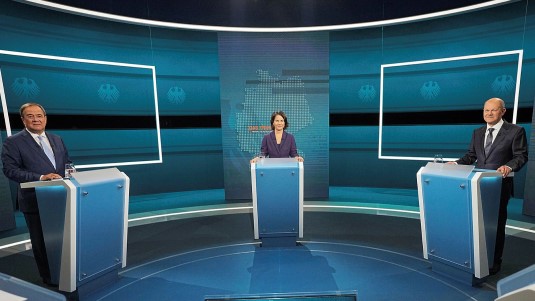
The first is the debacle of this year's floods, in which 184 people died. The Union's candidate, Armin Laschat, is the party leader and state premier of North Rhine-Westphalia's state, a place hit particularly hard by flooding. While there are questions about his regional government's handling of the crisis, what has harmed his chances was him laughing and joking with local officials in the background of a broadcast given by the President mourning victims of the disaster. With nothing left in the tank, Laschet has gone for good old fashioned red baiting, claiming the SPD can't wait to jump into bed with Die Linke, Germany's slowly shrinking SPD left split/fusion with the East German PDS - the successor to the former communist party. The tumbling numbers suggest the traction it's getting is minimal. The Greens have also taken a bit of a dive over the summer after briefly leading several polls. Their candidate for chancellor, Annalena Baerbock, has become embroiled in a plagiarism row which has hurt her personal standing as a fresh faced alternative to the primary parties. And the SPD itself? Their candidate, Olaf Scholz, seems to be winning by simply keeping his nose clean. As finance minister and vice-chancellor to Merkel, if anything he better represents continuity and stability - the CDU/CSU's traditional strong suit - than the Christian Democrats themselves. For many Germans, mainly older Germans, he is a known quantity. As Jeremy Cliffe notes, during this weekend's three-way debate he merely plodded through the answers and is content to trade off the mantle of Merkel's heir - undoubtedly assisted by his sceptical views on public spending and reining in debt. Apart from a preference for a Eurozone-wide financial transaction tax, there's little to suggest he is much of a social democrat.
Therefore what we're seeing is the possibility of a strange ending to the Pasokification process. The Greens are by far and away the most popular party among the young, followed by a reinvented FDP fishing from similar waters. What is saving the SPD is a two pronged assault on the right. The AfD have long soaked up the populist constituencies who might otherwise be relied on to vote reluctantly for the Union, while the SPD are living the Blairite dream of occupying the proving grounds of conservative politics and are proving successful at ripping these supporters away from the CDU/CSU. In other words, in 23 years the SPD have lost its mass base, done its best to liquidate its traditional support among workers, made it very clear the rising generation of immaterial workers aren't welcome, and look like they're coming out the other side with a chip off the old bed rock of dyed-in-the-wool centre right Christian Democrats.
Given what is happening in Germany, we can imagine someone one these shores is watching events closely. With its determination to disperse its coalition inherited from the past two general elections, and temper any policies that might be regarded as radical, such as abolishing tuition fees and improving trade union rights with right wing positioning and unconvincing flag waving, the Labour leadership are seeing their fondest dreams playing out across the North Sea. This gives them the evidence they think they need to plug away as they are doing, downplaying expectations, giving no reason to hope, and merely offering a competent steady-as-she-goes approach to politics. A position that could well lead to the liquidation of Labour without the consolation of replacing its vote with disgruntled Tories.
Image Credit
No time for a blog tonight, so here's my old mucker Ed Rooksby talking about different kinds of reformism, the experience of Chile and Syriza in Greece, and what role - if any - governmental power can play in the transition from a capitalist to a socialist society. It just so happens Ed is currently writing a book on this very topic as well.
The interview is from Alex Doherty at Politics Theory Other. Don't forget to follow the show on Twitter, check out the Patreon page and throw them a like of Facebook.

The deal imposed by the Eurozone grouping on Greece is nothing short of shameful. It continues to pile up the debt, reducing Greece to the status of a debt colony of the rich, Northern European countries. It, like all austerity programmes, expects working people, pensioners, the young to pick up the tab for payments that never touched the Greek economy. It puts the kibosh on Syriza's radical manifesto and any hopes the Greek people had on ending the entirely preventable depression the country sits in. And naturally, as every crisis is an opportunity to make money, parts of the Greek state are to undergo forcible privatisation. This is yet to make its way through the Greek Parliament, but nevertheless I think Tsipras and his comrades have done the best with the awful hand they were dealt. For those screeching betrayal, spare a thought for Syriza's position - it does not command an overall majority, it presides over an economy in a state of collapse, is harried by the big powers who've used their clout to undermine the government as much as they can, and was elected by a people bone weary of austerity but want to stay in the Eurozone at any price. When those are the circumstances, what else could have been done?
While Syriza's appeals for solidarity across Europe didn't get much of a mass echo, the shoddy and stupidly self-destructive way they've been dealt with by technocrats and politicians from Germany, Italy, and Spain will have a lasting impact among left wing activists. What the ceaseless negotiations and brinkmanship have unveiled is an unyielding cruelty at the heart of the European Union, where a member state can see its population reduced to further penury at the stroke of an accountant's pen. It could be, as far as British politics are concerned, just the spur a new left wing Euroscepticism needs. Yet why is it that prior to the Greek crisis coming to a head (again) this was barely a ripple in the political pond? Where are the left wing Eurosceptics?
In one sense, they've never really gone anywhere. Some remnants of the old Bennite left cling to Euro-critical positions. The 'official' Communist Party of Britain believe the EU to be a neoliberal project that circumvents the democratic checks nation states can exert on capital (kinda hard to dispute after this weekend's display), and my erstwhile comrades see it as a "capitalist club" with no progressive content whatsoever. These are very much fringe positions that are unlikely to gain much traction in our in/out referendum campaign unless the Greek crisis rumbles on/flares up again. Yet why should they be on the margins of political life? Why does the mainstream left fight shy of being overly critical of the EU?
Brainstorming a few reasons, there are the very good reasons why, as a rule, the trade unions are supportive. Originally the bastions of left Euroscepticism themselves, the course of industrial struggle in the 80s and 90s helped mold their views. As the Thatcher and Major governments pared back workplace rights and imposed ever more restrictive regulations on trade unions, 'Europe' with its social chapter and enhanced protections for employees was something to aspire to: the labour movement had a stake in the EU. That stake materialised when Tony Blair signed Britain up shortly after the 1997 general election and has since then acted as a guarantor of certain rights. While not all trade unions are pro-EU (the RMT for instance), the majority see the EU as a convenient ally in the protection of their members. What purpose is served by being critical?
The municipal left, primarily the Labour group in the Local Government Association, but also councillors for the SNP, Greens, etc. are also unlikely to take a critical view. Starting in the late 80s where the economic regeneration of towns and cities came to the fore as pressing local political issues, where government was reluctant to stump up the monies the EC/EU were an alternative funding provider - especially via the European Regional Development Fund. There are thousands of buildings and community facilities that now exist become local authorities applied for and were granted monies, and even today there are various cash streams that can be applied for for similar purposes. If the EU was seen as more willing to invest in post-industrial communities than the right wing government of the land, on what basis can the municipal left be critical?
From the perspective of the Parliamentary left the EU was a realisation of social democratic values. Even while neoliberalism was written into EU documents often at the urging of our New Labour government, the EU was the repository of an internationalist ideal (albeit from above) in which European citizens benefited from continent-wide social-democratic policies and do-goodery. By pooling sovereignties Europe had more kick on the world stage. Rather than being pushed around by the winds of global market forces, it was large enough to make weather in its own right in clear contradistinction to those on the right who prattled on about national character and national sovereignty. For British centre left MPs, the EU was a bastion of progressive, modern, and forward-looking politics - everything Britishness, and particularly Englishness, isn't. These were components of the European Idea, a shining beacon of cooperation across borders and solidarity between peoples divided by war in the recent past - even radical MPs see it this way. How then can the left be critical?
Then there are the simple practicalities of governing. The free market may bring perceived social problems, but on inflating GDP, tackling climate change, cracking down on organised crime, and being able to strut around the stage like a senior world figure. All of these are very good reasons to not be outside the EU. Anyone willing to argue the moves to mitigate climate change would be better if Britain acted alone?
And last of all, there's the simple matter of positioning. The most regressive and boorish elements in politics have made anti-EU tub-thumping their cause celebre. Who on the left would want to be politically associated with Boris Johnson, Peter Bone, Melanie Phillips, Nigel Farage, and Nick Griffin? Doesn't a critical attitude vis a vis the EU also entail lining up with them?
These are the props that have kept the mainstream left EU-friendly. Putting aside the awful way Eurozone leaders have acquitted themselves over Greece, the biggest threat to any of these are Dave's negotiations. If he reverts to type and "unsigns" the social chapter, what vision of the EU is being sold to the British public? A big market and that's it? If that's the case, there's every sign more unions could become alienated from the EU project, and f they go tens of thousands of activists will too. Yet if the member states tell Dave no because they won't be bounced into an arbitrary timetable set by the Tory manifesto, it's very unlikely mainstream left support for the EU will unravel.
Of course, it's ridiculous that this is the case. Sensible socialist politics surely means having no sacred cows and understanding that the EU is simultaneously progressive and regressive, that it could become something so much more but is always in danger of sliding into something less than the sum of its parts. Our comrades in Europe raise the idea of a 'Social Europe', the struggle for a continent that strives to imbue the rarefied values of the European project with the flesh and blood of real social content. That should be the socialist starting point - neither Euroscepticism nor Europhilia but Euro-realism, Euro-solidarity, and Euro-internationalism.
Yesterday's vote in Greece was a momentous occasion. Almost two thirds of a people, many with politics far removed from that of its leadership, said no to demands for more austerity from the well heeled bureaucrats of the IMF and European Central Bank, and the ministers of the European Commission. It won't be until tomorrow that we'll know what the troika are going to do in response. Reasoned heads would suggest a debt write down and allowing Greece space to grow its economy to meet its obligations. This, after all, is the oh-so radical demand Syriza are pushing - it's hardly all power to the Soviets combined with the socialisation of private property. Yet as past behaviour indicates, the troika are anything but reasoned.
Moving from the streets of Athens and the committee rooms of Brussels, how has this news been received by British parliamentarians? George Osborne has pretty much shrugged it off. Direct British bank exposure to Greece is only £10bn, though of course in the our interconnected world of toxic financial instruments ostensibly trading as assets who can say what the real risk is? Nevertheless, the government stands ready to print money to protect the banks economy should the need arise. Labour's response to the referendum outcome is not too dissimilar. However, Chris Leslie, goes on to say "Eurozone countries need to do their best to offer the chance for fresh negotiations. And the Greek government must face up to its responsibilities for stronger governance and economic reform." Perhaps if the troika stopped force feeding debt to Greece while hamstringing its ability to help itself, then I'm sure the Greek government would broadly welcome the acting shadow chancellor's sage advice.
For Labour Party people who look to their leaders for a political lead, what then have each of our leadership candidate got to say about yesterday's hugely significant event?
For Liz Kendall, it's not a lot. We learn that 150 councillors are signed up to her campaign, and has caved to the Tories' utterly abysmal English Votes for English Laws nonsense. On her Twitter feed there's a retweet of Duncan Weldon's musings, but that's your lot.
Over to Andy Burnham's gaff and it's pretty much the same. While it is always nice to see Sally Lindsay doing Labour things, it's just endorsement, endorsement, endorsement. Never mind the events in Greece, what if I wanted to know about Andy's policy positions? I've said it about Liz Kendall before, I might not like what she says but it's easy to find out what she stands for without having to trawl the web for policy snippets. There's nothing on his Twitter feed either. Ho-hum.
What about Yvette Cooper? As a trained economist, has she got something to say about the Greek crisis? There's something. Written before the outcome of the referendum became known, she writes that the situation remains pregnant with crisis regardless of the verdict. She argues "Now that this failure risks reaping instability across Europe including here, we need big voices in Europe to persuade both Germany and Greece - and the whole of the Eurozone - that they need to agree an achievable long term plan that will actually get the Greek economy growing again rather than repeatedly putting it into reverse. Without growth any economy will struggle to pay its debts down." Exactly. I'm also buoyed to see Yvette using the occasion to attack the Tories. She notes "The honest broker in that situation ought to be Britain. We are a major European economy, who can play a leading role and we are removed from the immediate negotiations because we are rightly not a member of the Eurozone. But instead our Government has taken a passive approach that is letting Britain's interests down." In other words, Dave and Osborne are striking an isolationist course in the hope the crisis will leave Britain alone and go away. Yvette is right, of course. If Dave was clever, offering its services as a neutral party in the Eurozone dispute might allow him to accrue some political capital that can be expended in return for treaty change concessions. But then Dave is anything but clever.
Does the final challenger have anything to say? As you might expect, Jeremy Corbyn puts his response to the Greek referendum in more forthright tones. As he put it, "Democracy has spoken in Greece. The people must rule, not the financial markets." Quite right. While hoping for more, seeing as Jez has been on Greek solidarity demos and is due to speak outside the Greek embassy in London tonight, there's little more that needs to be said.
Before undertaking this brief exercise, I was not surprised Jeremy - given his activist background - put out a statement. Nor was I about Yvette. Her presence in the leadership campaign so far has been a touch understated, but quietly formidable. Given her range of experience across most government departments and familiarity with economics, for her not to have commented and put forward a straight centre left position (which is miles better than the Chris Leslie press release), well, that would have been a strange occurrence indeed. It reflects badly on Andy and reinforces the image of him being a one-trick pony. As for Liz, what's the point of coming across as a fresh start if you don't have anything to say about *the* crucial issue facing the European Union and the economies of its member states?
A leader is supposed to lead. Jeremy and Yvette have staked out their positions on an issue of enormous import. It's a credit to their political nous and strength as politicians. Liz and Andy haven't, and says pretty much the opposite about them.
In time, they might come to call it the Tsipras Gamble. With an impossibly weak hand, no one seriously thought Syriza could pull it off. The verdict of the bail out referendum was predicted to be close, so close that it might well have been Syriza as opposed to Greece heading for the exit door. Predictions were made and screeds written on the genius/idiocy of Tsipras, but whatever side one took everyone inside and outside Greece forecast a tight vote (including, um, me). That, it was suggested (and indeed, was actively hoped-for in some quarters) would have tied the hands of the Greek negotiating team in meetings with the troika.
And so the decisive result, 61% no to 39% yes is of huge significance. It represents two things, both of which are troubling for the status quo across Europe and the nature of the European project itself. In their decadent determination to imprison Greece behind ever thicker walls of debt, the Commission, the ECB, and IMF have progressively undermined the likelihood that the full amount of monies lent will ever be seen again. The demands that the hard pressed majority of the country have to pay up to stay within the (ideologically defined and selectively enforced) set of rules governing relationships between creditors and debtors have set themselves up for a huge fall. While they and their proxies in the Greek opposition threatened the fiscal equivalent of thermonuclear doom, the ground of national pride and democratic self-determination was ceded to Syriza. Tsipras didn't run rings around the troika because of Napoleon-like genius - he did it because he knows austerity is a political matter, while his opponents have managed to convince themselves it's a matter of technocratic decision-making and economic necessity. The margin of victory, won in the teeth of a near unanimity of yes propaganda pouring from media outlets, means that when the troika meet the negotiating team again, they know there's a solid democratic mandate behind them. It also means something of a precedent has been set. Should Portugal or Cyprus say find themselves in further difficulties, referenda are a proven counter measure to the weapons of economic devastation.
The leading representatives of the EU establishment are not used to dealing with a democratic upsurge. The EU, after all, has always been an elite project with marginal input from EU citizens, apart from sparsely-observed elections once every five years. The shoddy way the troika have treated Greece is not lost on tens of millions who switch on their news every night. The awful behaviour of Merkel in particular does not reflect favourably on the EU. It's already in the legitimacy doldrums as far as many right wing voters across Europe are concerned. Therefore, it's bonkers to risk the political capital the EU has with people of a centre left persuasion - particularly when Dave's vainglorious and totally unnecessary in/out referendum in Britain slowly but surely approaches. Merkel and co. would be extremely foolish to persist in the hard line they've so far pursued. And there appears to be signs of movement - Merkel and Hollande are jointly convening a Eurozone summit for this Tuesday in response to the referendum. What will win out, the short term placating of voices at home calling for no more Greek bail outs or continued commitment to the Euro and EU?
At home, the win has cemented Syriza's position not just as the government (despite, formally, still being a coalition) but as the hegemonic force in Greek political life. It's a lesson all parties of the left can learn from. Tsipras didn't just campaign on national sovereignty and democracy, Syriza has won the argument on economic competency. As I've argued previously, Syriza has promised to manage Greek capitalism better than the capitalists. Their demands are more than just the "isn't it awful" rhetoric that, unfortunately, colours most of the left's anti-austerity campaigning here. It's bound up with a convincing, credible economic model that has something to say to layers of capital as well as labour. Their opponents to the right don't have anything apart from doom-mongering and more misery on offer (unsurprisingly, the official leader of the opposition, Antonis Samaras has resigned as the right fall into disarray), and the left have either capitulated (PASOK) or consigned themselves to irrelevance (KKE). Whatever happens, Syriza's position bristles with the democratic weaponry handed to them. Opposition at home and abroad cannot touch them, for a time at least.
Now what? From the right, Fraser Nelson runs down the dangers of the situation. But there are opportunities too. The risk of financial contagion might focus minds at Tuesday's Eurozone meeting to hammer out something that might inject a bit of stability into the situation. Like following the IMF's recommendation that Greek debt be restructured with some necessary write down. Perhaps even a touch of quantitative easing might be indulged seeing as the deflationary pressures on the European economy remain (provided Germany overcomes its understandable reluctance to do so). As the banking crisis in 2008 reminds us, neoliberal dogma can go out of the window if the system is imperiled.
There's a geopolitical dimension too. Russia as a possible source for a Greek bail out has been discussed and dismissed thanks to collapsing energy prices. However, perhaps now mainstream comment and EU watchers will pay more attention to the invitation Greece received from Brazil, Russia, India, China, and South Africa (the so-called BRICS)in setting up a new development bank. Ostensibly to fund development in emerging economies, in practice it will provide an alternative to both the IMF and World Bank. Rather than accept the punitive strings these outfits have customarily attached to "assistance". It would be a major coup and a blow to the financial status quo if a developed economy, cut adrift by a short-sighted troika was to act as a fiscal honeypot for European states in trouble. That doesn't mean Greece can be ejected from the EU only to fall into the arms of the BRICS in short order, but in the medium to long-term the IMF and its friends might not want to facilitate the development of a rival.

Crisis? Since 2009, when has Greece not been in crisis? What the people of Greece have suffered is nothing less than a permanent depression that has since its economy collapse by almost a quarter and hundreds of thousands of its young people have fled abroad in search of work. Meanwhile, public spending has been cut to the bone in an austerity programme the likes of George Osborne can but aspire to, and has seen it return surpluses of around six per cent of GDP to the treasury. However, instead of investing and allowing that money to recirculate, to grind the cogs of the Greek economy onwards, it's being systematically parcelled up and sent off to the creditors. As the depression grinds on, the state is effectively prioritising the synthetic demands of the so-called troika, of which more shortly, above the human needs of its flesh-and-blood citizens. This is fiscal barbarism, the collective punishment beating of an entire people not responsible for the debts in whose name austerity is being carried out. And it's an austerity that just isn't working. To have complied with the creditors' requests ha seen debt rise from 120% of GDP to an utterly unsustainable 170% - instead of Eurozone bigwigs carping about the credibility of Syriza and Tsipras, the people of the Eurozone would do well to reflect on the idiocies of their finance mandarins.
This wasn't a situation of Syriza's own making, but they've certainly made the best of it. Internationally and domestically, Tsipras and Varoufakis have played a nuanced, sophisticated political game aimed at raising the level of consciousness in Greece and abroad, but as we have seen this week with Tsipras's surprise announcement of a bail out referendum, that hegemony has only brought them very limited wiggle room. For all the talk of capitulation and sell out from ultra-left micro groups and the increasingly unhinged KKE, the referendum caught the troika on the hop, and has allowed Syriza to oppose both democracy and national pride to the EU's carpet bombing of Greece. But even then, Syriza cannot defy political realities. Despite everything that has happened, as Monday's huge Yes demonstration, um, demonstrated; there are millions of Greeks - not all of whom are untouched by austerity by any means - who will cling to the bail out in the hope that by staying in the Eurozone, anything and everything the troika throws at them is going to be a lesser evil than the alternative. That's why, though from the safety and comfort of sunny Stoke-on-Trent, I didn't think ringing up Berlin and asking for an 11th hour renegotiation was a good move, but having out-maneouevred our ECB friends with a referendum, and then looking like it might be lost, Tsipras at least had to do something to try and avoid a major loss of face and, perhaps, the government's resignation. The troika know this too, which is why after their initial shock, and the absurd rant at the Greeks by Commission president Jean Claude Juncker, they've knocked it back. When the Greek electorate can't take more artificially-induced depression, but want to stay in the Eurozone at all costs, Syriza are in a difficult position that no amount of radical posturing can extricate the party from.
Meanwhile, I've seen the argument floating about in some centre left circles that parallels the common sense of the ECB's bovver boys: that Greece ran up the debts, so it has to pay them. It's not as if faceless banks and the debt holders either, as this BBC graph helpfully demonstrates:

This has led some to suggest that Syriza's line is morally reprehensible because what is being lent is taxpayers' money. Spain and Italy, with not a few difficulties of their own, would quite like to see those debts repaid so their own economic houses can be put into order. Understandable, except for a few things. Firstly, Syriza has not repeated the Bolsheviks' actions a century ago and repudiated all foreign debts. What they are asking for is a combination of debt relief, because £170bn is simply not sustainable for an economy of Greece's size, and a restructure. Showing far greater awareness of how capitalism works than the high priests of European capitalism, they know every cut acts as a negative multiplier. Scrapping the "solidarity grant" each pensioner receives upon retirement, for instance, weakens spending power and the jobs reliant on that money, depressing economic activity and therefore the capacity of Greece to service its debts. Secondly, in cheerleading more austerity for Greece because they've been through it themselves, the Spanish and Italian governments are acting in such a reckless way that they're unlikely ever to see the sums returned. Likewise with Angela Merkel. As a canny and astute politician, she knows her tough talking curries favour with the German press and electorate, and she also knows that her policy agenda is imperilling the likelihood of repayments as well as the future stability of the Eurozone itself. Like the centre right here, Merkel is sacrificing the medium and long-term health of German capitalism and those it has subordinated to it in the EU framework for short-term posturing. So what if it keeps a lid on the populist movements in Spain and Italy and those stirring elsewhere if the whole project is in danger of fraying?
In short, on the side of the debtors the people least qualified to negotiate with Greece are recklessly imposing conditions that undermine their own position. As the crisis builds and creates uncertainty and jitters, you can be sure they're the ones insulated from having to pay for it.
I'm not a Marxist for the same reasons Marx wasn't one, but that's not stopped some from acting as arbiters of what is and isn't authentically Marxist. The latest to indulge the 'why so and so isn't a proper Marxist because reasons' is Peter Taaffe, the eternal secretary of the Socialist Party in England and Wales. Before we begin and in the interests of transparency and honesty, it's worth noting the Socialist Party and I have a bit of history. Right, onto the main. The object of his polemic is Greece's celebrity finance minister, Yanis Varoufakis and his recent declaration for 'erratic Marxism''. Here then we shall have a look at the basis of Taaffe's critique, before moving onto what I think can justifiably be regarded as the SP's own erratic Marxism.
There are a number of correct, if banal points Taaffe makes. That Marxism is an open method of inquiry and analysis, not a closed system. That it is the theory and practice of proletarian revolution and is basically inseparable from the experience of a class. That it's as nonsensical to blame Marx for Stalin as holding Jesus responsible for the Lord's Resistance Army. And, um, that's about it. Varoufakis for his part is somewhat less conventional. Rather than challenging European capitalism head on with a list of programmatic demands as per the received Trotskyist playbook, he argues instead for saving it from itself. He recounts sitting down with German finance ministers explaining to them the illogicality of their own positions and notes, with no surprise, how hostile they are to the medicine that could breath new life into their system. Small wonder Taaffe is less than impressed. Greece after all is in an "economically objectively pre-revolutionary situation". The job of Marxists, erratic or otherwise, is to surely bury capitalism, not save it. As far as Taaffe is concerned, this shows Varoufakis's distance from the labour movement and caricatures his position as pleading with the powers that be - a variation of 'if only the Tories knew the facts they wouldn't be so nasty'. Taaffe has got it completely wrong.
Gramsci made a celebrated distinction between the war of position and the war of maneouevre. Evoking the memories of the Alpine battlefields on which Italian peasants and proletarians died in horrifying numbers, he argued that revolutionary strategy in the West has to be cautious, tread carefully, and engage in hundreds of unknown and uncommented upon battles with the enemy to secure this section of trench, this firing position, this foxhole. It's about struggling to improve one's position against an opponent with greater resources and heavier artillery. The battlefield here isn't just politics. It's culture, it's workplaces, it's institutions, it's everyday life. The war of maneouevre is different. Think more of warfare up until the late 19th century: two armies would marshal their forces on a designated battlefield and face each other head on. This was the situation, Gramsci argued, that faced Lenin and the Bolsheviks in its stand off with Tsarism. The February Revolution swept away the autocracy, and the party disposed of the remaining bourgeois state come October. The complex prop of civil society wasn't there, which made a frontal assault all the more possible and likely. British Trotskyism, including Taaffe and friends and with a few qualifications, belong in the latter tradition. It's not that Trotskyists goes round shouting "One Solution, Revolution!" (well, some do, though the SP pointedly does not), but that they have a simplistic understanding of the political conjuncture facing organised labour. For them the blockage in each and every campaign or struggle they engage with is a) the media and b) the official leadership of trade unions/parties/campaigning groups. If it wasn't for these things, if only the revolutionary party could have unmediated contact with the class it seeks to lead, then let the bourgeoisie take fright. There is no reverse gear, it's a politics of constant offensive and one, as we have seen, has led to devastating consequences at the trade union it effectively leads.
Varoufakis has a more Gramscian approach to leftist politics. Syriza's election was the easy part, the difficulty now lies in reversing Europe-wide austerity, disseminating its politics abroad, and bedding the party down as the dominant political force in Greek society. Taking Varoufakis's 'save capitalism' pronouncements in isolation, as Taaffe does, renders them confusing and politically useless. But as part of a counter-hegemonic strategy, they make perfect sense. Here we have the representative of a radical and insurgent proletarian party offering a general direction of travel - for the entire world to see - that accepts the parameters and rhetoric of capitalist realism and offering proposals that will see Greece remain within the Eurozone, see the country's debts paid back, and will put its economy on a surer footing. The capitalism Varoufakis has set out time and again in negotiations and articles is a vision of capitalism as if it was run on a rational basis. If the austerity imposed on Greece, for instance, ceased the economy would bounce back quicker and its capacity to pay down the monies owed to Germany and other creditors enhanced. Here, Varoufakis is showing that the far left understand capitalism and have a plan for it better than the traditional representatives of capital themselves. This effectively calls into question the stewardship of the latter and exposes them not as disinterested captains of industry, but money grubbers obsessed by petty, narrow class interests.
This is superior to what Taaffe has to offer for two reasons. Firstly, it lifts eyes to the way the system is organised and how prevailing power relations are threatened even by the consistent application of the capitalist rules of the game. The SP, and by extension all orthodox Trotskyists, rely on the magical powers of making theoretically achievable demands whose logic points beyond capitalism. Not only in the SP's hands is this overly economistic, i.e. that the struggle for higher wages and against cuts is in and of itself radical, but also it is inappropriate to a situation where labour movements are weak and the composition of proletarians is variegated and dispersed. Secondly, the Varoufakis approach has had some success. German finance still wants its pound of Greek flesh, but by putting forward utterly reasonable demands it has exposed neoliberal dogmatism before a global audience, severely dented the credibility of the creditors, strengthened the head of steam building against austerity and, crucially in Greece itself, advanced Syriza's political hegemony. As Taaffe himself acknowledges, the party's approval ratings at home have gone through the roof. It's not just because Greece has forced a confrontation with the privatisers and neoliberalisers that nearly half of Greek voters are giving the far left the thumbs up, but also because they've made an entirely reasonable case that chimes with people far beyond the tiny numbers for whom a traditional Trotskyist message appeals.
The difference between the two positions ultimately comes down to a contemporary understanding of class and class relationships. The SP argues that Britain's workers suffered a series of key defeats in the 1980s that forced class consciousness back and allowed for the subsequent (temporary) triumph of capital, an era (or period, as Taaffe is fond of calling them) underlined by the collapse of the Soviet Union and the embrace by Mao's heirs of capitalism with Chinese characteristics. There is nothing to suggest that Varoufakis would not accept this position. However, Trotsky's argument that crisis can be reduced to the crisis of proletarian leadership - a position formulated in 1938's Transitional Programme was preserved in aspic and, if you'll forgive the pun, been trotted out regularly ever since by his self-identified followers. And so it is here. Spend time surveying SP literature and it's always about leadership and the treachery of the misleaders, strongly implying that all that is needed is the correct leadership and the rest will take care of itself. Unfortunately for this perspective, the correct leadership(s) have been around in the shape of dozens of central committees since the second world war and the working class generally have proven resistant to their spotless banners and fighting socialist alternatives.
The crisis, however, is much deeper than a matter of leadership. Capitalism has changed a great deal over the last 30-odd years. There are more proletarians than ever before, but in the metropolitan heartlands they've not been as divided and dispersed since capitalism transitioned from an agricultural to industrialised societies. The growth and spread of casualisation, the shrinking of many workplaces, the increasing complexity of the division of labour, the individuation and surveillance of employees, the shift from physical commodities to economies heavily reliant on the production of services and 'immaterial' goods, the increasing importance of networks and information, the take off of popular consumer cultures, the privatisation of personal space, all of these shifts and processes are interlinked, mutually conditioning and reinforcing, and absolutely work against the emergence of a class conscious proletariat according to the old schemas. The main political task for socialists is to get to grips with these processes, analyse and learn the opportunities this new composition of class affords, and try to work out how this composition can grow over into a new mass politics of socialism. Cohering this composition is what Syriza is doing, perhaps sometimes unknowingly, and it has done so on the basis of trying out new strategies appropriate to a Greek proletariat that, despite suffering appallingly under the cosh of austerity, have not risen up and made a revolution.
This is where we get to the Socialist Party's erratic Marxism. As Taaffe notes, Marxism is a fundamentally open research programme and guide to action. However, in the SP's case that's where their Marxism starts getting erratic. Take their understanding of class and the Labour Party between 1992ish and the present day. The labour movement entered this time frame bruised by strategic defeats and hence, diminishing influence. It would therefore follow that the Labour Party, as the organised political wing of that movement, would be similarly damaged, that leftist ideas with wide currency the decade previously be on the retreat and that a cadre of activists would drop out of activity. That is what happened, yet instead of linking the two, looking at the tendencies, opportunities, and counterveiling tendencies working through, opening and closing, and simultaneously binding and distancing the relationship between party and movement, which is what a Marxist analysis should be doing, instead we have the abandonment of Karl Marx for the German sociologist, Max Weber. It's an unconscious shift, but one all the more glaring for it. So rather than analysing Labour in all its contradictions and trajectories, we have two decades worth of articles arguing that the expulsion of several hundred Militant supporters, the diminution of member-led policy-making, Blair's tetchy relationship with the unions, and more latterly Labour councils' failure to live up to the example of Liverpool City Council 1983-1987 as proof positive that Labour has moved from working class party to outright bourgeois outfit. In so doing, Marxist analysis has been substituted for ideal-typical box ticking. Because a social democratic party is supposed to have a certain number of features, such as a programme of nationalisation, an opposition to all cuts, being for the extension of social security, and a socialist rhetoric, Labour is written off. What it is now and hasn't been since, coincidentally, the expulsion of many Militant Tendency comrades, differs because it deviates from a theoretical construct of what Labour should look like. The fact the organisational relationships and myriad cross overs of trade unionists and community campaigners with Labour Party membership and support counts for nothing.
And it's this Weberianism that Taaffe ultimately brings to bear in his analysis of Varoufakis's comments. He has a model of what proletarian struggle should be like, and that model is how the SP and its international co-thinkers go about their political business. Because Syriza do not conform to it, they're failing and, even worse, giving capital succour by the back door. Unfortunately for Taaffe and co, the only failure here is an inability to apply the theoretical methods they profess.
Tucked away in a barely-publicised corner of The Telegraph's web edition is this piece forecasting Labour's possible extinction. There isn't much to the article, the paper quotes Jon Cruddas (who else?) speculating about the possibility of Labour's death before moving on to attack Ed Miliband's pledge to introduce compulsory profit-sharing schemes.
Let's come back to Cruddas. In the context of a discussion about the situation in Greece and whether Labour might not exist a decade from now, he reportedly replied "There is no safe ground for any orthodox parties and the stakes could be high potentially. They could just disintegrate in real time. And I include in that the party that I represent." Unfortunately, I agree with Cruddas. The passing of the Labour Party is an outside possibility. The same is true of the Tories too. The difference is the Conservatives appear hell bent on hastening their own destruction, while there are very small signs Labour has glimpsed the precipice it's shuffling toward and is pondering whether to turn.
In the wake of Syriza's election victory, there was much excited chatter in left wing circles about the PASOKification of the Labour Party here. The argument goes that Pasok, as Greece's main working class party, had deep institutional links with the unions and a loyal voter base. It regularly formed governments on its own, the last being in 2009. Then when the economic crisis hit PASOK oversaw the ruinous austerity imposed on Greece, and in their turn were ruined as their support melted away and transferred more or less wholesale to Syriza. From commanding governments elected with 48% of the popular vote, in 2015 it just squeaked over the four-and-a-half per cent line. A commitment to austerity by Labour, so the argument goes, will see the same happen to it. The proof of the pudding is in the eating of the SNP, a nominally anti-austerity party, into Labour's Scottish strongholds.
This argument has a grain of truth buried in wishful thinking and nonsense. First, the guff. Britain in 2015 is not Greece. An Obvious point to make, but one that needs stating all the same. Austerity here has hammered the poorest and most vulnerable, but it has not been nor will it be - even if the Tories win - remotely comparable to what Greece has gone through. Effectively, a quarter of its economy has disappeared in the last five years. The reason PASOK has fallen and smashed like so many plates is because they oversaw austerity measures that walloped practically everyone who lives on a wage, a salary, draws social security support, and had a pension. Had the Tories and LibDems here implemented a programme as brutal, wide, and deep as this, the opinion polls wouldn't be level pegging right now. On that basis, and sorry to disappoint the Greens and 1917 reenactment committees, Labour's not about to do a PASOK any time soon.
The second nonsense is seeing the SNP surge as part of the PASOKification process. It isn't. The precipitating factor in Labour's collapse north of the border wasn't austerity but it stupidly and foolishly chumming about with Tories in the Better Together campaign. Had the party made a positive case for staying in the union, the damage might not have turned out that severe. But it didn't. Ed Balls lined up with George Osborne to spell out the dire consequences should Scottish voters support separation. It portrayed itself part of a bullying Westminster establishment, and is getting punished accordingly. But the causes go back decades. Crap MPs, shrinking memberships, zero campaigning activity, these are symptoms of a deeper malaise.
You know the story if you've followed this blog for a while. By the time Thatcher came to power the tectonics underpinning capital in Western Europe and North America were starting to slip. The spread of the microchip touched off the development of new information-based economies, and stimulated growing service-based industries. Consumerism was generating new sub cultures, new styles, new ways of living. Employers were reconfiguring workplaces to undermine the ever present potential for worker solidarity and, where possible, outsourcing jobs to the far east. None of these were natural forces that should have been accepted as facts of life,and what Thatcher did - by accident and design - was accelerate the development of these processes as a consequence of the Tory class war against the labour movement. The result was not just the liquidation of entire industries, but evaporating with them went ways of life, whole communities. The labour movement, the institutional expression of proletarian resistance and interest in its relationship with capital, was battered. Locked out - sometimes literally - by employers, defeated by a hostile government, and with shifts in economics and culture away from collectivism so its ranks started to wither.
New Labour was one possible response out of a number of approaches the party could have adopted. As the trade unions started losing strength, so the institutional and community supports that had nourished the party in the post-war era shriveled up. New Labour and Tony Blair were symptomatic of weakness, and they tried short circuiting the difficult task of rebuilding the party and movement by attempting to get business and others, including the LibDems, on board. This coalition worked for a while, albeit at a price that left Labour's roots a-shrivelling, until the crisis claim and blew apart. Gordon Brown avoided a depression, and British capital showed its gratitude by completely abandoning his government.
Meanwhile, in Scotland and various safe Labour seats across England and Wales local parties and the regional machinery carried on much as it always had. The myriad links between constituency organisations, workplace trade union branches, and the community grew ever more attenuated. And it suited many local party bosses fine. As members died or dropped off the rolls, all that was left was a brand and a hollowed out organisation ran by cliques of time servers that could nevertheless dispense largesse thanks to a loyal voter base that scarcely needed engaging with. Who else were they going to vote for? Labour parties became more distant, unwilling and incapable of addressing the problem of their malaise, and treated the communities they were set up to represent as voting fodder.
Belatedly, some sections of the party are slowly waking up to this. Say what you like about Jim Murphy, but he is one of the few leading party figures that works consistently all year round on bread and butter constituency campaigning. It's necessary, but not enough and again, despite his rather hawkish Blairism (hello there Henry Jackson Society), even he has been forced to turn Scottish Labour to the left while his hapless predecessor, a supposed left winger, spent her leadership lambasting the SNP from the right. Elsewhere, moribund CLPs in supposedly safe seats are stirring into life.
This is where the grain of truth our PASOKists speak of comes in. Labour can stop the rot. There is no reason why party membership and organisation should slide once the traditional general election uptick has dissipated. The old ways of doing things in the postwar period are gone and not coming back, but for as long as there are workers there will be the battle for workers rights, of the struggle for security, wages, and against encroachments on time outside of work. A new set of arrangements can be built, a new flow of recruits and influence can flow up from workplaces and our communities into the party. But only if it pursues policies that do not attack our constituency.
This might sound naive. After all, as another erratic Marxist I know the state isn't some neutral embodiment of the general will but an apparatus that supports, defends, and prosecutes the interests of capital. Anything capital has conceded, such as the NHS, has had to be imposed upon the state by powerful movements that straddle official and extra-parliamentary politics. Therefore it's silly to expect Labour to get into power and nationalise the top 100 monopolies, but as the legitimately-constituted government of the day it does have enough room to abandon the cuts agenda precisely because capital itself, and the bureaucrats that populate the state at all levels are also divided about its efficacy. A pro-business, pro-capital case against austerity can be made. Indeed, it's been explored here enough. It's not the case, as the far left have fooled themselves into thinking, that if Labour dispensed with the cuts that political support would mechanically follow. But by shutting down austerity and implementing policies that promote economic and therefore job security, building homes, cleaning up the precarity the Tories have deliberately inserted into social security, investing in education, and so on, new coalitions of worker interest can form around them. By pursuing this "sectional" strategy, the universal interest - that of the overwhelming majority of the population - is served and situation for positively resolving the crisis of the labour movement and Labour Party becomes much improved. Sticking with austerity-lite imperils all this.
Is Labour then doomed. Does PASOK hold up an image of the party's own future? I don't think it does. That fate, however, cannot be avoided by hoping it will go away. It has to be actively avoided, and that requires as many labour movement people as possible to get involved in their party now.
By their friends shall ye know them? This old adage has got some folks feeling a bit uncomfortable as the new Syriza government apparently cosies up to Mother Russia. This is by no means a new thing. Last year Alexis Tsipras provided Putin's interventions in Ukraine with some political cover. Interesting friends of Syriza are by no means confined to the Kremlin, however. Someone else saying warm words is Peter Spence, economics correspondent for The Telegraph. And today out comes an establishment someone else to give Syriza's message succour: Mark Carney of the Bank of England has attacked Eurozone austerity. Whatever next, eulogies in The Sun and Mail? It's only a matter of time before Rupert Murdoch calls for the top 100 monopolies to be nationalised.
Let's separate the economics from the foreign relations for a moment and reflect on the character of capital across the European Union. At one level of remove, all capital is the same. It has certain interests in common, chief of which always and everywhere is the maintenance and strengthening of the system that makes capital possible. Bound up and utterly inseparable from this is wage labour. For capital to reproduce itself as capital, it cannot escape the living labour power resident in the brains and muscles of human beings. It tries, it's always tried. Mechanisation, automation, computerisation, seeks to put distance between accumulation and the production of goods and services, but it cannot. Machinery requires technicians. Computers require programmers and IT specialists. Services require service givers. Because capital is and always will be hopelessly dependent on human bodies, it is in a constant collective struggle with those it employs to render living labour dependent on the dead. Capital is but the accumulated wealth realised by labour power past. As beings who, in the overwhelmingly vast majority of cases, lack property to provide a private income we have to sell that labour power in return for a wage or salary in order to survive. Therefore in capitalist societies, the real terms of the dependency are reversed. A society populated by workers without capital can be conceived. A society with capital and no workers cannot.
Yet as we zoom in at a greater level of magnification, there are considerable differences among capital as well. Their common interest is constantly in tension with their individual interests. Bits of capital in certain sectors scrap over markets and resources. Sectors of capital scrap with each other over wider political and cultural influence. Nation-states scrap with each other to further the interests of their capitals in far-flung markets, and so on. An example of this in British politics is how the Tories and Labour are aligned with different fractions of capital. Another is how capital across the continent is divided about the merits of the EU, and/or the relationship it has with the USA, China, Russia, and emerging markets.
Capital is similarly divided about Greece and austerity generally. Some sections, usually the most short-sighted and more likely to either benefit directly from cheap, flexible labour markets, or from finance taking bits of wrecked economies and throwing them into the alchemical fires, are intensely chillaxed about austerity. The more the merrier. Other bits of capital, those whose moments of accumulation play out over the longer term, or profit from state activism in various markets, are less sanguine. This is the section that realises too much austerity sucks demand from economies. Businesses and consumers generally have less cash to splash, thereby threatening a spiral of decline that might threaten the profitability of capital-in-general and lead to unpleasant political consequences.
Mark Carney is of this school. His comments hinge on EU economic integration, of how the dynamic of competition between the different national capitals of Eurozone states has not seen a natural convergence despite the single currency, shared fiscal rules, and the ECB. The next round of quantitative easing, or creating digital money, to buy up public sector debt (repeating again the counter-intuitive act of the government/taxpayer owning government/taxpayer debt) should overcome unevenness and work to float the boats of those economies worst hit by the financial crisis. Piling on the austerity merely deepens problems by wrecking an economy's capacity to grow down deficits and move on to reducing debts naturally. Carney's intervention certainly gives more power to Syriza's elbow when it comes to renegotiating Greece's debt, a welcome coincidence of divergent interests one might say that could expose divisions in the 'official' position and make a worst case scenario for Greece less and less likely.
This section of capital will always try and make the best of a bad situation pregnant with existential threat. Stalinism was denounced by its Trotskyists critics for, among many other things, doing deals with capitalist powers in return for security. It didn't always work out. Likewise, in the event of Syriza-style radical left governments coming to power elsewhere in Europe there will be sections of business that fulminate, rage, disinvest, and attempt to subvert the new state of affairs. Others will seek some sort of accommodation and talk down the threat posed to capital as a whole. Peter Spence's Telegraph piece is in that mould. Writing of Yanis Varoufakis, the new finance minister, the radical creds are played down and his competence as a British-trained economist talked up. He is a "fan of markets in many contexts", we're told. The sub-text is clear, here's a man with which we can do business. Besides, politically speaking, normalising the abnormal knocks edges off any potential threat coming from labour movement and radical parties here taking Greek lessons, and is a salve to oneself too. If we see Syriza as a blip because of exceptional economic difficulties, and they're acting radically within recognisable parameters of governance then there might not be anything to fear after all.
Returning to foreign affairs, what will concern capital across the EU is the relationship being cultivated with Vladimir Putin. It's cause for disquiet among some otherwise left wing friends of Syriza too. Not surprising really. Yet if by some weird quirk of fate, and as distasteful as I'd find it, were I in the Greek foreign ministry it's a relationship worth pursuing, even if it means treating with the so-called National Bolsheviks. Russia's economy is in the merde thanks to collapsing oil prices, but it's still tussling with the EU over Ukraine and other matters. You don't have to be schooled in centuries of diplomatic game playing to see that a visible, some might say ostentatious, warming of relations between Athens and Moscow sends a message to EU capitals. Are Angela Merkel and the austerity die-hards going to block debt renegotiation if it weakens their hand against Putin? Of course not. A good relationship with Russia is a string to Syriza's bow and strengthens their negotiating position. Realpolitik eh?
When all is said and done, Syriza have an incredibly difficult task before it. If it can make use if allies of convenience with the realms of European finance, if it can exploit the tensions between the EU and Russia to carry through its immediate programme of debt renegotiation, they will find no criticism from me. The stakes are high for Greece and, by extension, for us too. Watch. Learn.
'Radical Left Takes Power'. There's a headline not seen in my lifetime. Syriza's victory in yesterday's Greek elections is rightly being greeted with dismay, derision, and near panic by those who presume to know the needs of Greece better than the 2.2m voters who turned out against a completely unnecessary economic depression and austerity-without-end. Sadly, it was just two seats short from acquiring an absolute majority, tingeing the celebrations with a bit of 'oooh, 'ang on a minute' as Syriza came to a governing arrangement with the Independent Greeks, also known as the British Conservatives' Greek sister party.
Alexis Tsipras and his cabinet, due to be appointed tomorrow, face an incredibly difficult situation. They may have the goodwill of most of the left from across Europe with them, but they could find the financial clout of the ECB and bond markets against them. Internally there are problems too. Even if Tsipras is able to renegotiate the bail out on the most favourable terms austerity policies are unlikely to be reversed in short order. The restoration of pensions, the minimum wage, and sacked public sector workers isn't going to happen tomorrow. Easing off these policies and then clearing up the economic damage left behind might not happen at a pace agreeable to a chunk of Syriza's support. Managing the situation politically is very tough and disappointment and disillusion is an ever-present danger. The only way Syriza can mitigate the potential damage is avoid the spin and stupid optimism of their predecessors who, like our beloved government, bemoaned "tough choices", without seriously tackling tax avoidance and evasion and, in Greece's case, ingrained corruption. Syriza has no choice but to be completely honest with their electorate and the Greek people at large about the challenges and problems facing it.
Another problem is with the state apparatus itself. There are two issues here. Firstly, Syriza is very well placed to purge the administrative machinery of the persistent pockets of corrupt officialdom. As it has supplanted PASOK as the main proletarian party in Greece, albeit with significant small business support also, taking on and rooting corruption out is sociologically possible because its core constituency does not benefit from those kinds of relationships. It's hurt by them. The same is true of tax evasion. Just as it's utopian to believe the Tories here would crack down hard on legal and illegal tax dodging schemes because it's their base who benefits, so it was true of New Democracy's relationship to the conservative business interests aboard their coalition. Only a party standing apart separately from those interests can take them on. Trotsky's theory of permanent revolution finds itself confirmed in constitutional politics too. Taking on entrenched corruption will be a tough fight, and Syriza are certainly motivated enough to do it, but it comes back to matters of timing and energy required.
This is because there's another potential battle within the state looming: that between a government of socialists and a thuggish police force sympathetic - in the main - to Golden Dawn. Lest anyone forget the police's appalling record of attacking what were protesters and are now government supporters. The New Democracy coalition undertook a limited offensive against fascist infiltration of and collaboration between them and the police after Golden Dawn supporters murdered an anti-fascist musician in September 2013. Their so-called fuhrer, Nikolaos Michaloliakos, currently awaits trial for that murder and his alleged involvement in the disappearance of up to 100 migrant workers. Yet the fascists, while still small and hopefully an electorally spent force, might yet be a focal point for reaction within the police and security services. Syriza's 2012 programme demands the removal of arms and masks from those policing demonstrations, and calls for a more comprehensive training programme aimed at understanding the social roots of crime. That was then. Now? I don't know, but one assumes that Syriza comrades have been giving this some serious thought. (If any reader can shed a light, please comment below).
Syriza and its Independent Greek bedfellows make for awkward pillow partners. Syriza is uncompromisingly progressive on social issues, the role of religion in public life, immigration, and so on. The ANEL are not. Yet at least on the primary issue before Greece - the renegotiation of austerity - their positions are more or less identical, even if the bases for it are quite different. For leftists here in Britain who are getting a bit twitchy about it and are already looking for signs of a sell out, as Syriza's leadership have proved themselves politically adept enough to steer their party from a ragtag and bobtail outfit of Trots and Maoists to government in less than a decade, I think it's fair to say they no how to treat with and the dangers of doing a deal with these characters better than you and I.
And that, overall, is the sort of stance the British left should take toward Syriza. They're the experts about the politics of their land, not us. There are a great many activists and thinkers in left politics here who do have expertise and experiences Syriza might find useful. They may occasionally avail themselves of an insight that a bit of distance and grounding in a different political history that could help. The British left should comment and above all learn from the experiences of the coming weeks and months. There is no room for lectures, for carping, for the performative piety of lefty identity politics. Above all the role of the left here, regardless of our background, is to offer solidarity with Syriza, defend it from the calumnies sure to be chucked at it by homegrown idiots and enemies, and make the case that another form of politics is not just possible, but can win too.


