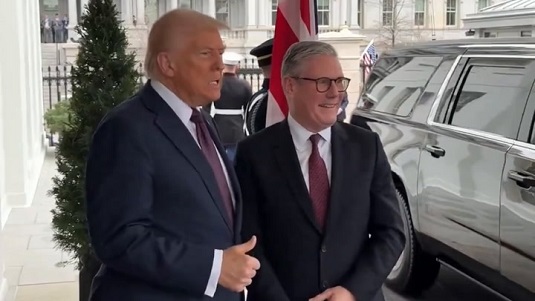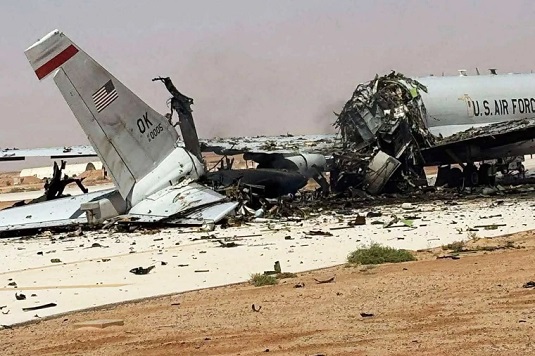
Showing posts with label USA. Show all posts

Monday, 13 April 2026

An End to Orbanism?

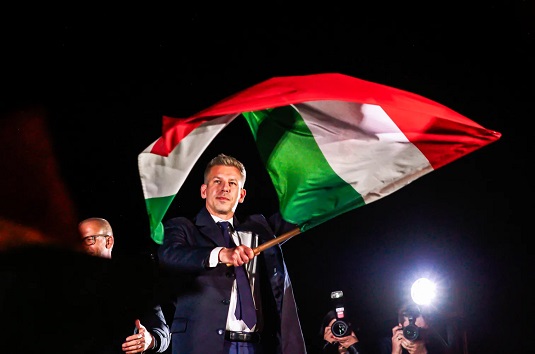
Orban's gone, but so has Orbanism? Sunday's election results must be beyond Péter Magyar's wildest dreams. 138 seats, well over the two-thirds majority required to make sweeping changes to Hungary's constitution does, on paper, give the incoming Prime Minister the tools he needs to address the damage wrought by Orban. The crony appointments to the judiciary, to the media regulators, to the ministries, for 16 years these have been nothing but so many troughs for his allies. The end of his premiership and the impressive electoral performance means, for Magyar, that expectations will be sky high. Is he in a position to reverse Orbanism and clear out the state apparatus? Does he have the trousers to back up what his mouth says?

Unfortunately, even as Hungarians are dancing in the streets and observers abroad cheer on Orban's downfall, the warning lights have long been flashing. If anything, Magyar is more anti-immigration than Orban, having roundly criticised him for the introduction of a guest workers' scheme. Much has also been made of Magyar not being pro-Russian, what with the chants of 'Russians Go Home' echoing as much around Western social media as the streets of Budapest. But this does not necessarily mean he's supportive of Ukraine's war effort. He has, for example, gone on the record to say he supports Hungary's opt out from contributing to the EU's loan to Kyiv, albeit using more emollient tones than Orban's. Likewise he hopes to take advantage of the cheap oil deal Hungary has with Russia, though who knows where that is now Moscow has declared them an "unfriendly country". Nevertheless, Magyar is keen on receiving the €17bn in frozen EU funding, so there are costs to continuity Orbanism.

Apart from this, there are other problems too. The Tisza Party was a down-and-out centrist outfit before Magyar joined, following his exile from the Orbanist state apparat. And he has built it up as a formation distinctly of the centre right, despite its becoming the repository of democratic aspirations across Hungarian society. And how effective could such a figure prove to be in resetting government, untangling institutional corruption, and addressing the fusion of state and oligarchical interests? Imagine if Rishi Sunak were to lead a popular upsurge against a Nigel Farage Reform government. The analogy isn't a million miles away. I'm not in the business of forecasting doom before Magyar has attempted anything, but given his background, his political programme, and the fact unpicking the oligarchy too much could have far reaching progressive consequences for Hungarian politics, which might include a revival of independent working class politics in the long run, there are limits to how far he's going to go. And that could mean a return to Orban or another right wing authoritarian after the next election. The United States and the failure of the Democrats to follow through after the January 2021 putsch debacle serves as a warning.

Outside of Hungary, however, the significance of Orban's loss is obvious. For the United States and Russia, for Trump and for Putin, Orban was a natural ally, a seemingly successful experiment in open class rule, of not bothering to drape the obscenity of the naked oligarchy in anything but a few rags of scapegoating and welfare bribes. That has not only failed, but the record turn out for a Hungarian election shows that even the limited liberalism of an illiberal democracy can be seized upon to lever their sort out of office, if not out of power. Putin is more secure thanks to his extensive domestic security apparatus, but Trump is not. The efforts to try and rig the mid-terms through the ill-fated re-districting efforts and ballot conditionalities shows the forces he coheres are still concerned that there's enough life in American constitutionalism to bring them down. Magyar's victory then has a double edge. His failure to undo the last 16 years could lead to a retread of precisely what's just been cancelled, but simultaneously it shows that no authoritarian leader can indefinitely manage a restricted democracy to their benefit.

Image Credit

Saturday, 11 April 2026

Trump is Not Senile

Following the war on Iran and Trump's usual erratic comments, another round of "the President is senile!" has ripped through mainstream politics. Senior Democrat Jamie Raskin has called for a full cognitive assessment of the President in light of recent behaviour. I hate to break it to folks clinging to the Trump-in-decline thesis, but there is nothing about him that suggests any kind of impairment. There is no difference between Trump now, Trump during his four years out of office, Trump in his first term, and Trump before then. That he seemingly has little impulse control and brow beats others into submission is entirely explicable by his upbringing, his gilded life, and the fact he's unaccustomed to dealing with people who say no.

This allegation comes up time and again. Why? Some of it can be explained by Trump's refusal to abide by the politesse of establishment politics. Consider the idiocies of George W Bush and, before him, Ronald Reagan. They were outrageous in their own ways, but there were certain rules of the game that they either abided by or paid lip service too. Trump's greatest crime among some layers of centrist opinion in his first term was that he was rude. And we can measure this by how some of the policies he introduced were continued and, in some cases, reinforced during Joe Biden's tenure without anywhere near as many complaints from those quarters. But then, for centrists its only appearances that matter. To deviate from political norms can only be explained by senility. That this is simply Trump being "grab them by the pussy" Trump is beyond their comprehension.

Also, talking about Trump's sanity means avoiding asking more awkward questions. Such as how it is that the American system keeps churning up dummies and granting them the highest office. Across the right, it's not just Trump and his cabinet of horrors, but look at the state of current and former GOP representatives. Lindsey Graham, Marjorie Taylor Greene, Ted Cruz, Sarah Palin, an assortment of names that do not connect with intellect or erudition. The question isn't whether Trump is suitable or not, but why do people like Trump - the stupid, the ignorant, the aggressive - keep on getting elected and keep on succeeding? Centrists prattling on about Trump's senility never ask this question. And, in fact, they go on about his cognitive health so much that it appears to be a mix of avoidance and cope, precisely so they don't ever have to ponder why this is the case.

Ultimately, it comes down to the impasse of ruling class politics. On the one hand, there is technocratic centrism which offers technical, managerialist half-explanations for why things are as they are. They don't bother trying to justify ours as the best of all possible worlds. It's just "reality", and it should be left to the experts to make "trade offs" and get on with the complex problem of governing. And on the other, there is hard right, authoritarian politics. It too doesn't bother trying to spin excuses for their system. Instead it manufactures scapegoats and enemies in an orchestrated effort to misdirect dissatisfaction. It too, ultimately, stumps for the same interests and the same class relations as the centrists. It's just that their politics requires a big personality - a demagogue or a clown, it doesn't matter which - to front the show.

In Trump's case, there is a certain alignment between the fact that he is, seemingly, beyond accountability and the position of the United States in the global system. As its power declines in the world, as former satraps are showing independence, it has dispensed with the formalities of international law and has accrued immense damage to its soft power, particularly among its traditional allies. Increasingly, the US state is but a transparent front for the maintenance of oligarchical power and does this fully in the knowledge no one can stop them. Trump's personality and behaviour is the perfect fit for this era of American decline. A six-time bankrupt overseeing the bankruptcy of American values, a braggart and self-fancied hard man surrendering the Strait of Hormuz in a war of aggression he began, and a billionaire - through his and his family's troughing - demonstrating without a care in the world who and what the United States really stands for. This is a world of pure, naked class power. Trump has no airs or graces, every day he testifies to the real nature of the world. And it says everything about the feeble-mindedness of centrism and the interests it caters to that they take baseless allegations about Trump's senility over the truths his very person parades. Why bother speculating about the state of the President's brain when the politics provides the best explainer for his destructive behaviour.

Image Credit

Thursday, 9 April 2026

The Consequences of Defeat

Trump's dire threats to obliterate Iran, as we know, did not come to pass this time. Instead, we had the pattern we've now grown accustomed to. Big threats and violent language followed by complete capitulation. And to be sure, the US has completely caved in faced with an Iranian strategy it did not understand and could not meet. Their 10-point plan has been accepted by Trump as the basis for negotiations in Pakistan this weekend. Despite their being no different to what was "unacceptable" to Washington a week ago.

The truth of the matter is before this crime against peace, the Strait of Hormuz was open. It no longer is, subject to a fee. Iran have shown, regardless of the threats, regardless of the thousands dead, that they can exert control over passage and will do so should the terms of the ceasefire be breached. Hence why it has closed the waterway again, following Wednesday's outrages in Lebanon. But for Trump, political realities are stood on their head. The greatest strategic defeat since the 2nd World War has to be spun as a beautiful thing in the President's ever-green world. Look! We took out their military! Look! The ships are moving again. Unfortunately for Trump and the Republicans, loyal supporters can see the prices at the pumps shooting upwards and the grocery basket weighing heavier on their bank balance. Even the most gullible find it hard to swallow lies if they cost them more today than it did yesterday.

Trump's colossus with the feet of clay moment has upset the world balance of power. The US's declinist trajectory vis a vis China and India has sped up as a much smaller and less powerful country has faced Washington down, and won. The consequences for this are two-fold. Opponents of the US are likely to be emboldened. Or, to be more accurate, less fearful. The brute strength of American arms can no longer dictate outcomes. And secondly, the foundation of US leadership is fraying as its range of subordinate powers, including the UK, slip the leash and start acting more independently of it. We see this with the bilateral talks several West European countries have arranged with Iran as they seek preferential passage through the Strait for ships sailing under their flags.

Nothing says this more than the reaction to Israel's terror bombing of Lebanon on Wednesday, which as of writing has claimed 303 lives. Israel have tried arguing that their operations ostensibly against Hezbollah are not covered by the ceasefire, and they were initially backed up by the US. But throughout Thursday, there has been a steady stream of countries criticising Netanyahu and contradicting the American line. Keir Starmer said the attacks were wrong and "should stop". Australia has said the ceasefire should apply to Lebanon "as well". Brazil has said Israel risks further destabilisation. This builds on the joint statement put out by EU leaders, plus the UK and Canada. With everyone else going one way, Israel has offered talks with Lebanon - seemingly with the US nod. If only the Europeans were as assertive with Israel two-and-a-half years ago. They may have prevented a genocide.

As the American alliance system starts to fray, where does this leave Trump? Lashing out at all and sundry. He's taken to complaining about NATO, again, and continues to drop heavy hints that the US will withdraw from the alliance. An act that requires two-thirds majority approval from Congress, following a 2023 law. Having failed so utterly overseas, and with a budget targeting the living standards of ordinary Americans, Trump and his helpers will be looking to cook up another circus. More super high profile ICE raids? Loud complaints about this Sunday's Hungarian election? For Trump, little over a quarter into his presidency he's already looking at re-running the outrages from his first year, but with diminishing audiences. There are few options open to him to try and bolster his party's support, beyond egregiously and obviously trying to fix elections. Nothing is going Trump's way, and with all this there is still the Epstein scandal waiting to unveil the full depths of his depravity.

Image Credit

Tuesday, 7 April 2026

"A Whole Civilisation Will Die Tonight"


"A whole civilisation will die tonight, never to be brought back again. I don't want that to happen, but it probably will." The genocidal words of Donald Trump, the President of the United States. For days Trump has promised a buffet of war crimes, with targets including bridges, power stations, energy infrastructure, and desalination plants. It goes without saying that residential areas and "soft" institutions, like schools, hospitals, universities, are likely to be in the firing line as the Pentagon designates them semi-military in nature. Just as the Israelis did for the entirety of Gaza.

Trump has promised escalation before, and not delivered. His civilisation-ending rhetoric fits the usual pattern of making extreme, and in this case blood-curdling statements, to monstrously browbeat opponents into submission. Unfortunately, what makes a cataclysm possible is the US government's refusal to understand Iranian strategy. Because Tehran is not responding how Trump and the State Department expects them to, this makes the carrying through of the threats more likely. Even if the US unleashes hell, Iran's position is unlikely to change. It will continue to exert control over the Strait of Hormuz, and it will continue to humiliate the Americans and Israel by striking back. Even more dangerously, the relative restraint Iran has shown toward Gulf state oil refineries and desalination facilities could be gone. Iran alone isn't facing catastrophe.

This brings to head a crisis of US constitutionalism as well. The US and Israeli war on Iran is an illegal war, a conflict that fits the UN definition of war of aggression and an understanding endorsed by the US itself. Attacking civilians occurred at the outset, with the murder of 168 people, including approximately 110 school girls at the Shajareh Tayyebeh primary school in the first wave of American bombings. The administration has done nothing to hide these crimes, and explains its actions as big power bullying. They openly, cynically tell the truth of themselves. But with a declaration of genocidal intent, the consequences of the war should rebound sharply on domestic politics. The 25th amendment allows for the provision of the removal of a president "unable" to discharge their duties, and indeed the Democrat leadership have called on the cabinet to oust Trump. The Republicans, however, are now the face of open, illusion-free, and unaccountable oligarchical power. And there is little chance those cabinet members, who are on the hook for war crimes too, would accede to the pleas for political proprietary. JD Vance, who would take over from Trump, is spending this crisis campaigning for Hungary's Viktor Orban ahead of this Sunday's election. The only Republican to have joined with the Democrats is Marjorie Taylor Greene.

As with the Greenland crisis in January, what the West and significant sections of the US itself are seeing for the first time is how the state operates as a (declining) global hegemon. How it threatens, how it bares its teeth, how it rains death with no regard to the rules of war on its opponents. Iran's every refusal invites a response that tears away not just the liberal democratic veils US power has hitherto dressed itself in, but shows up the emptiness of American constitutionalism itself. If Trump can't be checked, cannot be removed over his stated intent to murder an entire country, how then can he ever be removed? In that question lies the fundamental, and possibly terminal crisis of US legitimacy abroad. And at home.

Image Credit

Saturday, 4 April 2026

Fly Me to the Moon

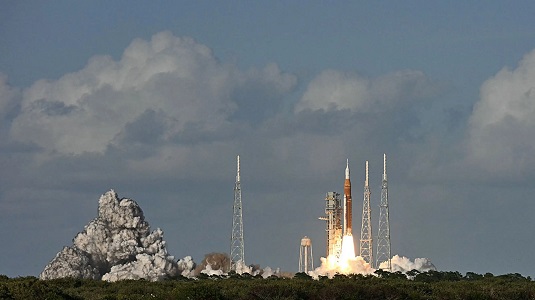
As of Saturday evening, Artemis II is more than half way along its sally to the Moon. The crew's journey is full of firsts. The furthest human beings have ever travelled from the Earth, the first time a woman, an African-American, and someone other than a US citizen have travelled beyond the orbit of our world. A truly historic mission and one prefacing, at least on paper a landing and then building a permanent base. Unfortunately, what might described as a noble endeavour is somewhat overshadowed by baser events. And when Donald Trump speaks to the astronauts, he's unlikely to gift posterity a dignified address.

Space has long been big business, and it's about to get larger. Elon Musk's SpaceX is due to go public, with a $1tn share issue. This success tells the real story of space industries. Like pretty much every major technological leap this last century, the state has taken up the slack of providing the basic infrastructure and demand to build up new markets. It's not for nothing that Musk is known as history's greatest welfare recipient. Take, for example, the discussions around the replacement of the International Space Station. NASA's partnership with Vast speaks to this model. It trains the company to provide the services it requires, will "sell" them some in-orbit store facilities and supplies, and buy back from them their "scientific samples". This is with a view to, later on, the company providing its own modules for attachment to the ISS that NASA will then rent from them. At each step, there's a guarantee that while employees run risks riding up and down on rockets, no capital shall come to undue harm.

What's the point? The commercial attractions of low and high Earth orbit lie in satellite communications, spying, and scientific payloads. Space tourism as a viable business proposition seems a long way away yet. The space race commentary favoured by the BBC and most mainstream outlets try and evoke something of the US/Soviet space race, albeit with America now facing off against China. But there's more than bragging rights at stake. In the immediate term, permanent presences consolidate national claims over near-Earth space, which is why this particular race is more than two superpowers facing off. India celebrated its own successful Moon mission a few years ago, implying to its neighbours that if they can manage that, it will have a similar technological prowess where weaponry is concerned. Thinking about space's place in the state system should not be overlooked.

Perhaps, in the longer longer term, assuming space stations and colonies become self-sufficient and the significant physiological consequences of living in zero and low-gravity environments is navigated, then perhaps they will provide viable markets for asteroid mining and Luna-based resource extraction. And that could prove to be an attractive outlay for Earthly capital. But that could be a century or more away, and none of us will be around to see it. Except techbro biohackers like Bryan Johnson.

Unfortunately, the existence of the space programme has a stronger relationship to something fundamental to capitalism: waste. And the example of American capitalism is the most egregious. As a global system that has drawn more countries into its rule than at any other time, capitalism churns out a surplus so large that the resources exist to feed everyone, provide safe drinking water and sewage systems, housing, clean power generation and delivery, and so on. It doesn't because it is a class system. Everything, including the expectation that business in general should turn a profit, is subordinated to the maintenance of the class relations that makes this possible: the wage and private ownership. In the age of obscene oligopoly, the realities of class are so obvious that whole sections of establishment politics have given up trying to prettify or hide wealth concentration and its consequences. It is too large, too visible to excuse. And so, instead, we get openly authoritarian parties whose chief, open interest is maintaining these class relations. Donald Trump, Vladimir Putin, Viktor Orban, the AfD in Germany, France's National Rally, and between them the Tories and Reform in the UK are part of this trend.

What has the gravitation pull of capital got to do with space exploration? Since the official inauguration of the civilian US space programme in 1958, space has been an outlet for wasteful spending. That is, by creating spending priorities unconnected to maintaining the standard of living and social infrastructure, governments generate a cost pressure that eats up resources and helps them manage the politics. The military are traditionally the chief beneficiary of this arrangement, and money thrown in this direction can be justified by the bogey of foreign adversaries. The US Department of Defense, in 2026, is set on swallowing 15% of the federal budget. The White House want to increase this for the year ahead, to be funded by cuts to useful spending like social security, health, and education. And, topically, taking an axe to NASA as well. The idea, as per the class politics of small state conservatism, is to divert resources away from social programmes that actually build things so as to manage the demands on the state and, in many cases, discourage them. In an age of sharpening uncertainty with rising prices and wages barely able to keep up, the military and threats from abroad are the Trumpist means for ruling out solutions and heading off expectations. We need to take your food stamps away because the Pentagon needs driverless ground attack vehicles.

As such, this is where space funding fits in. For the state, especially one as colossal as the US, it's chicken feed. But part of the class politics of wasteful spending nonetheless. For Musk and Jeff Bezos, their private space programmes are, after luxuries, their main preoccupation. They have a class interest in funding rockets and Moon landers, because spending money beyond derisory sums on social programmes or bumping up the salaries of their hundreds of thousands of employees cedes a smidgen of economic power to the workers and tilts the capital/labour balance that little bit away from them. That's why Musk, for instance, hates philanthropy. So Amazon-branded space suits are in. Amazon-branded breakfast clubs are not.

That said, given the swingeing cuts Trump and his hyper-class conscious cronies want to make to NASA, it appears - in line with their vandalism of US R&D generally - that having a civilian agency accomplish one of the greatest feats in scientific history is too risky for them. It could open the box to hope, to the wider propagation of scientific literacy and an interest in what might crudely be called intellectual subjects, and on top of that the radical suggestion that resources should be put into things that stretch our imagination, our capabilities, and could promise a better tomorrow. A thrust somewhat at odds with the miserable preoccupation with maintaining an indefensible status quo. For while space spending is wasteful spending, unlike throwing money at smarter guns and smarter bombs, it can lift our vision not just to the horizon of the possible, but beyond it.

Image Credit

Tuesday, 31 March 2026

Iran's Baudrillardian Strategy

As the third gulf war drags into its fifth week, neither the end nor the end game are anywhere in sight. Big bets on the stock market before Trump makes an announcement are now routine. And the President's remarks are as incoherent and contradictory as ever. "We're talking to nice people in Iran" one hour, the next is a threat to smash power stations and destroy desalination plants. He says negotiations are ongoing, while Tehran denies any such dialogue. The bombs keep raining down from Iranian skies, while in return their ballistic missiles and drones prick Israel's Iron Dome hype and thwart US defences to make life at 13 of its regional bases difficult. Here, Keir Starmer castigates the Tories and Nigel Farage for wanting to drag the UK into this war, while at the same time the US Air Force is using these islands, as well as Cyprus and Diego Garcia for "defensive strikes". Airstrip One is very much part of the conflict.

It doesn't take much to bamboozle Trump, but the White House and military planners cannot grasp why Iran is still fighting. The boasts about annihilating the navy and air force are noisy brags, but do contain some truth. Conventionally speaking, Iran cannot hold a candle against the firepower America and its Israeli satrap can field. So why aren't they surrendering? Why aren't they keen to cut a deal? Why haven't Iranians taken to the street to depose the regime? Instead, Iran is absorbing the punishment, following through with promised retaliation, shouting its defiance, and trolling Trump with Lego memes. He was expecting a gift-wrapped victory, as per Venezuela, or perhaps an Iraq-style collapse into barbarism. Something that could be sold at home as mission accomplished and, for the Israelis, the elimination of the one regional power that goes some way to matching them. None of this has happened, nor is it likely to happen.

The inscrutability of Iran, its refusal to play by the White House's rules of war is not new. It was something dissected with precision by Jean Baudrillard over 20 years ago in his famous essay, The Spirit of Terrorism. Written in November 2001 and reflecting on the September 11th attacks, much of what he diagnosed then carries over to the Iran war and the country's - apparently baffling - resistance to overwhelming force.

On the spectacle of the attack on New York, Baudrillard wrote the destruction of the Twin Towers fascinated and appalled because of their position in the global order. It symbolically embodied American-led globalisation. But, at the peak of its power, order begot an internal will to disorder, a dream of destruction fed by the conveyor of Hollywood disaster movies. As he put it, "Very logically - and inexorably - the increase in the power of power heightens the will to destroy it." (The Spirit of Terrorism and Other Essays, pp 6-7). Entertainment was meant to exorcise this suicidal impulse through pyrotechnics and special effects, but instead of dampening it down it readied us for catastrophe, almost to the point of desiring the spectacle of disaster. The West was primed for September 11th long before it happened, and the spectacle of the attack was captivating precisely because it showed the mortality of the world's greatest military power. Trump, as a television man, understands the superficiality of the spectacle. Burning Iranian cities and cratered infrastructure is dazzling to him, and plays well to his base. But far more fascinating are the military reversals - the banned footage of Iranian missile strikes across the Gulf states, the hard-to-find smashing up of US military bases, of Israeli cities mourning their dead and counting the cost of demolished districts.

The spectacle of one's own defeat goes beyond the furtive hunt for concealed imagery. It's seen in the endless reams of punditry. The discussion of how, come what may, Iran can exert its control over the Strait of Hormuz. Of how targeted bombing taking out leading regime figures, past and present, has solidified the Iranian position. How Trump's war is spiralling into global economic chaos. How, despite the severe asymmetry in the respective militaries, the US is on the brink of a catastrophic strategic defeat. The talk is of nothing else. The spectacle is as much about the tarnishing of Trump's star power and how he can lie his way out of the calamity. Like all good reality TV, the audience wants his actions to rebound back on him in abject humiliation.

What makes this more acute for Trump and the US is that Iran are refusing to abide by their rulebook. Baudrillard talks about the singular character of large scale suicidal terrorist attacks. In a system of generalised exchange, which American-led globalisation is, this kind of terrorism cannot be "exchanged" - there is no equivalent of it. 20-odd years ago pundits characterised the domestic terrorism in Europe, be it of separatist/nationalist provenance or rooted in political extremism of the left or right, as entirely understandable. Their goals were within the horizon of the modern, if not theoretically possible within the prevailing system. But suicidal Islamist terror was not. The very thing Western societies try and deny - death as a rude tragedy, as the worst thing that could possibly happen to any of us - lies at the heart of its fundamentalist nemesis. This itself is an inevitable outcome of the free, unhindered, and unbalanced operation of global capitalism since the end of the Cold War. Baudrillard argues that the duality of struggle, of good and evil, or capitalism and communism, are as interdependent as they are opposed. When one triumphs over the other, as the principle of good has in the operation of our system, and capitalism has versus its other, the defeated party becomes disarticulated but autonomous. Resistance to and the rejection of globalisation assumes an unpredictable virality, of which Islamist terrorism was one example. And one that, because its existence lies in the inherent contradiction of the system's victory, appears anywhere and everywhere against which the most powerful society in existence appears impotent.

The virality has moved on since then, but the character of Islamism has not. The Islamic Republic is now the repository of this logic. Iran's defiance attacks the logic of an order based on the positivity of life. By propaganda and by deed, the Iranian state is willing to stake its lives and those of its citizens in what amounts to a symbolic challenge. It knows Iran cannot possibly win a military confrontation, but through sacrificing itself while inflicting damage on the US, Israel, and the Gulf states, it assumes the monstrosity of terrorism, of an implacable and fundamentally other foe that will not yield. Faced with such an implacable opponent, of seemingly suicidal defiance, the US is powerless. It can commit troops to a ground invasion, carry on the bombing, see through the promised destruction of civilian infrastructure - but because the Iranian state will offer up any number of lives to maintain this position, the US is doomed to defeat. For Baudrillard, as it was for the 9/11 terrorists the same applies here. For the Iranians are in a duel with the Americans, it is very personal. Their maximalist demands - reparations for damages, closure of American bases, sovereignty of the Strait - dovetail with the "internal" Western desire. Both want to see the US humiliated, not liquidated. Hence Iran's responses to missiles and bombs are missiles and drones, its counter-violence is governed by a symbolic logic, not the operational calculation of x airfields destroyed, and y soldiers and civilians blown up. Trump's empty boasting about victory secured followed swiftly with fire and brimstone is the usual bombast that ordinarily keeps his opponents unbalanced, but Iran has rejected this logic. And that is why underneath it all, panic is the mood among White House insiders, the military, and their allies abroad.

Trump then is looking for the exit ramp, and nothing he does now can look like a victory. More killing and more unnecessary destruction is, sadly, entirely likely. But the strategic defeat has already happened. Iran knows this, and so does the rest of the world.

Image Credit
Monday, 9 March 2026

Slipping the Leash

"I think the war is very complete, pretty much. They have no navy, no communications, they’ve got no Air Force." So said Donald Trump, during an interview with CBS. The reason for the war has never been set out, because neither Trump, his office, nor the Israeli government have a justification. Judging by their commentary, they don't think one is even needed. This is aggression for aggression's sake, an effort to bedazzle and distract from domestic issues. But hard realities are biting. Far from being a bloodless affair, Benjamin Netanyahu condemned Tel Aviv to repeated missile strikes as stores of interceptor supplies remain depleted from last year's exchange with Iran. Meanwhile, despite suffering heavy damage and political decapitation the Iranian regime and military remain robust and have shown a capacity to fight back. Something the US and Israel are not accustomed to. And there is the small matter of Iran's closure of the Strait of Hormuz and the heart attack this has sent through oil and energy markets. The knock on consequences won't do Trump any political favours, and we'll see how much of his base are willing to stump up for this pay-per-view none of them asked for.

Unusually for a US war of aggression, the UK have proven extremely reluctant to get involved. Keir Starmer tried his best to be accommodating without actually committing British forces. After the initial raids over Tehran he was quick to call on Iran to show restraint, and was equally quick to condemn when their missiles and drones found their targets in reply. When British bases and Gulf "partners"/clients were hit, he announced that the US Air Force were welcome to use British facilities for "defensive strikes". Which is so much evasive lawyer babble to avoid admitting his government's complicity in something that, in theory, should see its instigators in the dock at The Hague. Not that this has impressed Trump, who branded Starmer "no Churchill", and downplayed belated UK efforts to move aircraft carriers in sortie distance from Iran. Trump's cheerleaders in this country couldn't help themselves either. The Tory/Reform press have been attacking Starmer ever since the bombs started falling for not joining in, with preposterous stories that the nature of Labour's voting coalition has stayed his hand. Oh yes, the same party so concerned with Muslim voters that they gave Israel a free hand in massacring Palestinians in Gaza. Kemi Badenoch has dived in, saying Starmer can find plenty of money for social security instead of bullets and bombs. Laughable. Nigel Farage said the UK should be dropping ordinance alongside the US. Both have received backing from Tony Blair. He, unsurprisingly, thinks Britain should follow whenever the White House says heel. Once a poodle, always a poodle.

Starmer's effort to keep Britain to a limited role has little to do with the niceties of international law, and even less to do with electoral embarrassment. On paper, the UK's interests in the Middle East and the Gulf are practically identical to the Americans. They want friendly, preferably autocratic regimes, and Israel's role in this set up is the quick-to-anger gendarme. Iran is the destabilising element who, through its own regional strength and networks of irregular allies and semi-state actors were checks on Israel's aggressive posture and, by extension, the challenger to Western hegemony. This suffered severe setbacks with the obliteration of Gaza, incursions into Lebanon, the bombing of the Houthis in Yemen, and missile exchanges between Israel and Iran over the last 18 months. From Britain and, by extension, Western Europe's perspective Iran had largely been put back in its box. There was now no real threat to Israel. Everything was fine.

Until Netanyahu and Trump started their war of aggression. Britain is not concerned about civilian deaths, be they Iranian, from the Gulf states, or fiercely patriotic tax exiles. It is worried about the consequences of destabilisation. As far as the government and the foreign office are concerned, the war is utterly reckless. The disruption to energy supplies, air travel, shipping, and the sloshing of Gulf money into and through the City are unwelcome costs with a range of politically undesirable consequences. Being at odds with the US is a rarity thanks to establishment slavishness - as typified by the repugnant axis of Badenoch, Farage, and Blair - but remaining separate and disengaged reduces political costs and keeps material costs to a minimum. The price shock and mess of Trump's war is not worth it when the overall outcome will largely be no different to when the bombing started, despite White House hyperbole. The special relationship has proven to be anything but since the razzmatazz of the second state visit, and it appears Starmer, David Lammy, and friends have - rightly - calculated that nothing would be gained from joining this criminal enterprise. All of which helps explain why, for once, we're not being dragged into an unwanted war by the government at America's behest.

Image Credit

Friday, 6 March 2026

Tuesday, 3 February 2026

Suitable for the Job

One thing ends now. And that's further speculation about the Peter Mandelson scandal now the police are "investigating a 72-year old man from London" over allegations of misconduct in public office. What we're not going to stop talking about is the Peter Mandelson debacle, and who was responsible for his elevation to one of the highest offices of the British state. This isn't a hard question to answer. The buck stops with Keir Starmer. It doesn't matter how hard he disowns Mandelson, the Prime Minister appointed him US ambassador. This is a charge he cannot escape from. The question then is how much Starmer knew, and when. It's this that determines whether "Mr Rules" himself should get chucked, or be pushed into falling on his sword.

The Times's Patrick Maguire has argued that this is possibly the greatest political scandal since the Profumo Affair. I'm not so sure. The Tories handing out Covid procurement contracts to their donors springs to mind. As does the wrecking campaign, subversion of democracy and undermining Labour's election efforts by the Mandelson-friendly Labour Together faction and their allies. But to be sure, allegedly leaking market sensitive information that financier pals could profit from while government was grappling with the meltdown of global capital circuits is right up there. And it is reasonable to suppose that Starmer knew nothing of this. To him, Mandelson was just a grandee that hung around the party, and whom his advisors and subordinates looked up to as The Master.

What he did know was that Mandelson was associated with Epstein, courted the global oligarchy, counted many a billionaire as paying clients and associates and, of course, had to resign in disgrace from government twice. With such a history behind him, any government with modest centre left ambitions - and Starmer's ambitions for his government are very modest - would surely steer clear. But this is the Labour Party and, of course, this is Britain. For Mandelson's meat puppet, the overrated Morgan McSweeney, what was scandalous about his mentor were ample qualifications for his putative suitability in the court of King Donald. They had a mutual friend in the late Epstein, he was totally on board with Britain being a lapdog state and saw eye-to-eye with the Trump White House on foreign policy. He was good at sucking up to the rich and powerful and, unbeknownst to Starmer and McSweeney, the Epstein files suggest Mandelson was the match for any of Trump's circle for corruption,. Minus the brash crudity. For McSweeney, elevating his mentor meant he would never be too busy to advise on what the Starmer government should be doing. And for Starmer, a man experienced with ensuring Labour never strayed far from the right and proper interests was in situ to secure the US relationship.

Starmer might not have had much interest in Mandelson until fairly recently. But from the inner party shenanigans and through McSweeney, we knew Mandelson was interested in him. When he took McSweeney's advice and appointed him ambassador, his story publicly became intertwined with Mandelson's. It becomes a question of Starmer's political judgement, which has been poor since the first day of this government. The Mandelson revelations should be the final word on the Prince of Darkness's career at the top of British politics. And, by right, it should call time on Starmer's stay in Number 10 too.

Image Credit

Monday, 19 January 2026

Grown Up Politics


Is this what adulting looks like? After straying outside of his comfort zone at the weekend for saying "no" to the United States, Keir Starmer rowed back in familiar surrounds on Monday morning. At a press conference the Prime Minister said tariffs are in no one's interests and allies should sit down and calmly discuss differences. This was why the UK would not be meeting US tariffs over Greenland with counter-measures of its own. A position somewhat at odds with the European Union, and one unlikely to endear London to EU capitals - dspite the warm words of mutual support and protecting sovereignty.

In his speech, because no occasion is too important to punch leftwards, he condemned "grandstanding" and "performative" commentary, saying this "may make politicians feel good, but it does nothing for working people whose jobs, livelihoods and security rely on the relationships we build across the world." Or, just perhaps, the leaders of the Greens and the Liberal Democrats know that if the government does nothing that would be read by Trump as a sign to pressure the UK for future concessions, such as binning food standards. This is nothing but an appeasement strategy - something this government has experience of. Number 10's hope is that doing nothing now will invite favourable treatment later.

The political problems are obvious. In the UK, Trump is marginally less popular than diphtheria and most find his aggressive language over Greenland bewildering, stupid, and scary. Views very common among US punters, incidentally. So yes, Starmer is right that this should be "moment for the whole country to pull together". But not one where we, collectively, raise the white flag and hope for better treatment than an EU seemingly standing up to White House bullying. Those Starmer attacked for "grandstanding" are likely to politically benefit, as they are more in tune with the fear and growing frustrations of public opinion. Meanwhile, our "grown up" PM will be awarded for his "maturity" in due course - an ever-plummeting personal rating that this ridiculous crisis will deepen. How low will it go before his hapless party administers the coup de grâce?

Image Credit

Sunday, 18 January 2026

The Softness of the Hard Right


Blimey. On Friday, Keir Starmer put out a statement that said "no" to the White House. The language wasn't tough and it did play into the fantasy that Russia is a threat in the north Atlantic, but it also said applying tariffs on NATO members supporting Greenland is "completely wrong". And, for legal eagles of international law, arguably a breach of the first four articles of the alliance's founding document. Emmanuel Macron was somewhat tougher in France's statement, and the EU collectively have threatened €93bn worth of tariffs and scrapping the US/EU trade deal if the heavy arm-twisting/bullying continues. As Donald Trump might say, it makes for great television.

Fresh from sacking Robert Jenrick, Kemi Badenoch is backing Starmer. As are the sovereignty maximalists and Brexit supporters of this country's right. Right? Conspicuously, Nigel Farage - who was due on Laura Kuenssberg on Sunday morning - cried off. Was he ill? Did he want to avoid a face-to-face clash with Zack Polanski? Or might questions over his Greenland whataboutery and Trump cronyism cause him embarrassment, and help that recent dip in the polls pick up momentum? Farage is not alone in his equivocation over American provocations, however. Last week, Tim Stanley was at it.

In his wretched piece, Stanley pushes the usual peace-through-strength rubbish, in the context of Trump's pirate raid on Venezuela. But rather than Britain attempting to project power, he advocates for a position that his employers at The Telegraph would ordinarily frown on: an almost Corbynist position. He writes, "We cannot defend Ukraine. We might, if we try very hard, be able to, say, construct a decent system of care for the elderly." But this is in the context of saying bon voyage to any influence in foreign affairs. Not so bad, you might think, considering the centuries of Albion's perfidy but what Stanley is trusting in is letting the USA tear around the world as it sees fit. Greenland, Venezuela, Ukraine, they're no concern of ours. We'll sit by ourselves in splendid isolation.

Why are the hard right soft on Trump? Our old friend Peter Mandelson spelled it out last week. The British state, and particularly its military, is integrated into the US projection of global power to such a degree that its operations, as a matter of course, need Washington's nod. The so-called independent nuclear deterrent cannot be supplied without US support, let alone launched. And because the City remains the key global centre of finance, the dominant wing of British capital is highly internationalised but, in the main, bound up with US capital. Sections of the ruling class are so compromised, particularly its most class conscious sections - which just so happen to be the ones (rhetorically) obsessed with sovereignty. They rightly see the US as the main protector of their interests, because they're so closely intertwined. It means that much of the right, most overtly the Tory press and Reform, can at best be ambivalent and at worse outright apologists for Trump's antics. Hence dullards like Stanley who argues that an American world is fine, even one as brutal as Trump's USA, is entirely fine with him and his employers.

Image Credit

Sunday, 11 January 2026

Their Best Pal

What happens when a useful hanger-on of the well-heeled has to resign in disgrace? They get rehabilitated. Again, and again, and again. How many times has Peter Mandelson been in this position during his career? Everyone has stopped counting. In the space of four months, we've gone from the embarrassing disclosure of his obsequious relationship with Jeffrey Epstein and sacking as Britain's man in Washington, to a leading piece defending Trump's foreign policy in The Spectator, and the chance to exculpate himself on the BBC with Laura Kuenssberg. Some might say people with a sense of shame would keep their heads down.

In his big interview, Mandelson demonstrated how he is useful to the powers that be. Just like the Speccie piece, he laid out his understanding of the Trump doctrine. That the world is a messy place, too many nations are flouting the rules, and the moment requires decisive action by a decisive leader. Venezuela being a case in point, and last year's joint US-Israeli strikes on Iranian nuclear facilities another. What about the bellicose threats over Greenland, repeated this last week? More theatre. Mandelson argues this is Trump's effort to stop Europe free-riding on US military supremacy. He's trying to force Europeans to spend more on guns, not butter mountains. So, in this case, you might say more Danish and non-American NATO troops in the Arctic suits the White House as it boosts the strength of their far northern perimeter. Of course, what Mandelson doesn't mention is the so-called scramble for the North Pole as the ice disappears is a fantasy for a new great game, the appearance of big power rivalry between the US-led West, and Russia - which can't even defeat Ukraine after four years of bloody war - and a China that has no assets or territory in the region. And Mandelson overlooks how the biggest violator of international rules is the United States itself. No surprises there - this is less a Trump-explainer, and more his condensing the slavishness of the dominant section of British capital. If this is to continue, he's saying, we've got to toady some more and get cranking out those weapons.

On his close friendship with Epstein, we got the hand-wringing. "I never saw anything", "Never noticed young women", "Perhaps because I'm gay he kept me out of the sexual side". On the support he offered after the sex offences conviction, Mandelson said he genuinely believed Epstein's protestations of innocence and what his lawyer was saying. To Kuenssberg, he threw down a challenge: "Do you think I would have stayed friends with him had I known?" Mandelson was canny enough to try and make it about the women who survived Epstein's abuse, but he refused to apologise for continuing the friendship when all facts were out in the open. Obviously, like everyone else we don't know what Mandelson did and didn't see/knew, but because of his character and fondness for prostrating himself before billionaires, I don't for one minute believe he would have let knowledge of Epstein's offences get in the way of warm relations. This is why Mandelson did not say sorry. It's not just that he doesn't feel particularly apologetic, something reinforced by the trained inauthenticity common to Blairite figures he affected, but it signals a willingness to debase himself, and to take a fall if serving the powerful requires it.

Between the article and the interview, Mandelson's laid it all out. He can be sacked, humiliated, live (temporarily) in disgrace. But it doesn't matter. If the wealthy or the powerful need him, he'll still be their best pal.

Image Credit

Saturday, 10 January 2026

The Power of the Bare-Faced Lie

Sympathies to the family of Renee Macklin Good, the woman murdered by an ICE agent on Wednesday. And solidarity with the people of Minneapolis that have taken to the streets to protest this outrage. As everyone knows, the US joke of a vice president, JD Vance, has thrown his oar in. ICE employee Jonathan Ross, the killer, is exonerated because Good was driving right at him. As this is an open-and-shut case of self-defence, who wouldn't pull the trigger? Camera footage showed how, quite clearly, Good was set on driving away from the scene. Ross's own body cam footage was then released, which showed that before attempting to drive away she said "That’s fine, dude. I’m not mad at you" to him. He then shot her three times in the face through the windscreen and called her a "fucking bitch".

Presumably, ICE released Ross's footage to bolster their version of events. Something Vance doubles down on. Obviously the self-defence argument does not stand up. Vance knows what the footage shows. ICE knows they haven't got a leg to stand on. And Ross knows he shot in anger, not defence. There is no good faith here, no honest disagreement. It's an exercise in outright cynicism. Only but the most gullible, those who've willingly surrendered their faculties to Trump's misinformation machine are going to believe it. But the lie isn't about shoring up the base, giving activists lines-to-take on social media. It's much worse.

For Vance, his lie is a weapon. Not of misinformation, but as a demonstration of power. It shows that he cannot be called to account, no one can correct him, and that the administration he's (formally) integral to can say and do what they like with impunity. This is important because, along with filling the zone with shit, the brutality and brutalism of Trump's regime is based on shock and awe. We have military spectaculars abroad, and the lawless violence of a state-funded militia for domestic consumption. Particularly in those places that have the temerity to vote for Democrats. In seeming to be beyond democratic checking and reason, murderous violence and brazenly lying about it is supposed to frighten people, cow them, demobilise, and push millions into resigned pessimism. Vance and co. know the polls are against them, but if most opposition-minded people are sufficiently fearful, what are they going to do about it? The lie stands for unaccountability. Its obscenity can stand because no one can cast it down. It's a goad, an insult Vance and ICE are rubbing in the public's face.

Such is the political use of the bare-faced lie. But relying on arms for political power is never the safe bet in the long-term. And the lie, which emotes power, also issues a challenge. Are you going to stand for this? Vance and friends need to be careful, because sooner or later enough Americans will say "No".

Image Credit

Sunday, 4 January 2026

Playing the Supplicant

Every time Donald Trump commits an outrage, he causes a comms nightmare for Downing Street. Keir Starmer cannot and will not ever risk publicly criticising the US president, never mind condemn his criminality. But even he's enough of a politician to realise that The Donald is less popular with the British public than he, and so backing Trump openly makes the chance of a polling come back even less likely. As such, Labour finds itself repeatedly in a horrible no-man's land. Starmer not only confirmed that the UK had no part in kidnapping Maduro, but that he hoped" to "have a phone call" with Trump to talk about it. "We need to establish all the facts", he said. Taking this as the cue, the always-annoying Darren Jones toured to TV studios to push the new improbable line. I.e. We care about the "international rules-based order", but it's not a government's job to pronounce on breaches of it. That's what the courts are for. The charges of hypocrisy almost write themselves.

Having lost their chief Trump whisperer to disgrace, nothing can be done to jeopardise cordial relations with the White House. In an uncharacteristic moment of honesty, the Prime Minister spelled it out on Sunday morning. That is the special relationship is maintaining Britain's status as Washington's favourite supplicant. The intelligence apparatus and the military are so thoroughly integrated into US operational command that, to all intents and purposes, the British state does not have sovereignty over deploying its forces. It always has to "inform", or to be accurate, ask the Pentagon for permission before taking action. Funny how the right in this country have never complained about this infringement of our independence.

Sundry liberals got a bit excited early in 2025 after Trump's initial bouts of rudeness. European governments realised that America was an unreliable ally and EU/NATO countries would have to look to themselves to fend off Russian subversion and aggression. This slice of cringe did numbers on social media as there was talk of "going alone" and positioning a nascent European superpower as the real bastion of liberty. But there were practical questions of collective security and these apply to Britain as well. Starmer's trumpeting of increases in military spending is a crowd pleaser to the Stop Russia Now sliver of elite opinion and allows them to believe Britain is heading in the same direction as the rest of Europe, but this is not so. There is nothing in the government's actions or comms to suggest they're looking at even slightly untangling themselves from the US "partnership".

The dominant section of the British ruling class - the commercial and financial capital of the City - is also closely intertwined with its US counterparts, and a plurality have long hitched their interests to the US as the guarantor for open markets around the world. It was therefore no surprise, considering his proximity to these parts of the British establishment, that Nigel Farage said "The American actions in Venezuela overnight are unorthodox and contrary to international law — but if they make China and Russia think twice, it may be a good thing. I hope the Venezuelan people can now turn a new leaf without Maduro." And, as we've seen, where the right goes Labour follows. Supplication and slavishness to the US is embedded in UK bourgeois culture, and that finds an echo in the common sense of "Atlanticism" in the Labour Party. And there are no crimes even the most extreme, reckless, and right wing American president in history can commit that would cause our country to step away from its subordination to Washington

. Image Credit

Saturday, 3 January 2026

Trump's Venezuelan Oil Piracy

Donald Trump knows how to surprise. The bombing of Venezuela and the kidnapping of Nicolás Maduro and Cilia Flores was audacious. As a spectacle for the media, something the president has an intuitive grasp of, and the brazen contempt for international law. The US reminds us, again, that "the rules", special relationships and trusted allies, and the United Nations are so much flim-flam.

Maduro, like Hugo Chavez before him, has always been objectionable to sections of the US ruling class and their foreign policy establishment. Venezuelan socialism was always overstated, but that's beside the point. The US has been denied tribute since US oil firms were effectively turfed out in 2007 - unless they submitted to giving Petroleos de Venezuela, the state-owned national oil company, a controlling share of their operation. Exactly what Trump is insisting TikTok does as the price of doing business in "his" market. The "official" reason for Maduro and Flores's arrests and the bombing of Caracas - drug trafficking - is but a pretext, regardless of the evidence of Maduro presiding over a narco state. As this piece from November by a liberal think tank argues, regime change under American sponsorship is unlikely to stop the flow of drugs. Those of us with memories will recall that when Latin America was awash with right wing, Washington-backed caudillos they weren't much of a bulwark against the rush of cocaine to the north. Where would Trump's parties in the 1980s and 90s have been without it?

None of this needs second-guessing or hard thinking about shady motives. In Trump's press conference on Saturday morning, he said that "we", as in the US, will be selling Venezuelan oil. That "we" are going to make a lot of money, and that the US running the country won't cost anything because the cash to pay for any occupation, restructuring, and US oil interests "going in" will be met from the wealth pumped from the ground. He expects some kind of reparations as well for the "damage" Venezuela has caused the United States, and for good measure, he issued casual threats in the dircction of Cuba and Colombia.

What sundry liberals and centrists either side of the Atlantic are seeing is the US as it routinely behaved toward developing states throughout the post-war period. Trump forgoes the lip service and usual hypocrisies that attend military incursions because he's blunt about US interests, and because he knows no one is going to challenge him. The European states, which fancy themselves America's peers, have either prevaricated and avoided making a comment or fallen into line. Trump knows that when he says jump, the Europeans will do themselves a mischief trying to out-leap one another. And this is part of a pattern. The brute deployment of US firepower reflects the openness with which Trump enriches himself and the oligarchs around him. A government by and for billionaires, they don't try dressing up as anything else. And this is paralleled here too. Our own government cares little for democracy or ideas. If it collectively cares about anything, it's the future advancement of its senior members after politics. The Tories and Reform offer nothing else either, apart from more racism - which even here Labour has tried outflanking them on.

Trump's international piracy is, obviously, something he and his lackeys were agreed on. But it typifies a wider trend across the West: the assertion of authoritarianism and, with that, the open and unquestioned dictatorship of capital.

Image Credit

Thursday, 3 April 2025

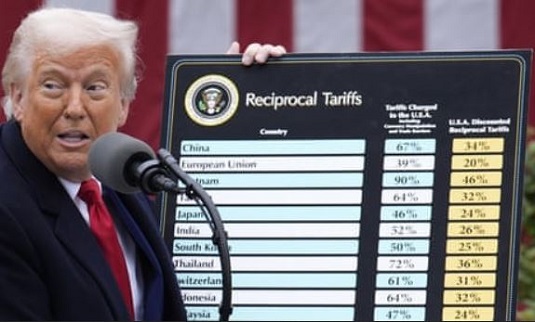
The Class Politics of Trump's Tariffs

Wednesday's announcement of tariffs by Donald Trump was styled by the President as "liberation day". A set of measures that, if the markets are anything to go by, liberated trillions of dollars of value from the largest and most important US companies. As measures go, tariffs - like everything else the Trump presidency has done - can only compound his country's relative decline by encouraging trading flows that eschew the United States for more reliable and stable markets. Like those offered by the European Union and China, for instance. These tariffs constitute the most extraordinary act of self-harm. This is pound-for-pound worse than what Brexit was for the UK, and could be as disruptive to the American domestic economy as the traumas East European states went through following the collapse of Comecon and the restoration of capitalism. Why set out on a course that can only impoverish the country? What is Trump trying to achieve?

Two very quick points looking at this from the perspective of bourgeois interests.

The first is the Liz Truss argument. I.e. What Trump has done is to short the market. The announcement leads to market turmoil and devaluation, and down in the dip the most short-termist sections of finance and commercial capital hoover up cheap assets which they can sell when stocks inevitably recover. Which depends on Trump rowing back on some tariffs, which seems likely given his erratic behaviour. Would some sections of capital be happy to see US capital as a whole take a hit for their profits? Absolutely. We saw some of their British counterparts do this two-and-a-half years ago during Truss's brief stint in Downing Street, so why not again? There are sections of American capital who are totally on board with libertarianism as a strategy for class politics. I.e. Blow up anything that amounts to a social or legal obligation on capital accumulation, even if it's against the interests of capital-in-general. Giving credence to this reading is the "idiotic" way the tariffs have been calculated, and to whom they've been applied - including uninhabited rocks in the middle of the ocean. The slap dash approach indicates a desire in engineering an outcome, not a serious policy orientation.

But supposing it is a turn away from global trade, what does the US stand to gain? It's worth remembering that capital is not unified, and there are competing perspectives within it regarding assumptions about the ways of the world, what policies are appropriate to it, and what strategies are best for advancing the interests of sections of business, and/or capital as a whole. For instance, Trump's slimy relationship to Vladimir Putin is entirely rational viewed in the context of this framework. I would suggest the tariffs are bound up with securing the oligarchical interest on the home front. While trade unionism is hardly in rude health across the sea, the street rebellions around Black Lives Matter and Palestinian Solidarity are read by hyper-class conscious oligarchs as trouble at t'mill; that something is shifting. The proxy for this is the elite's war on woke. They (rightly) discern that the take up of diversity and inclusion policies by big capital is a form of appeasement, of capital responding to the expectations and aspirations of labour rather than laying down the law. After all, how awful it is for business owners that workers resent their aptitudes and identities being used against them. It is a far sighted recognition that the becomings of immaterial labour presents a long-term threat to the stability of class relations. The development of so-called AI is one technique whose application is to head this off, but equally the reconstruction of the federal state as a decrepit do-nothing institution with no purpose beyond enforcing the power of the executive branch can also serve as capital's reply to this existential challenge, albeit one that is crude in its methods and brutal in its outcomes. Trump's new isolationism is a disengagement from US responsibilities and dependencies and is explicitly asserted in sovereigntist terms - Make America Great Again. But what the real consequence will be is not the much-promised economic renaissance, but the reconsolidation of the bourgeois power some class fractions feel is slipping away.

Tuesday, 4 March 2025

Rumpus on the Right

Associating a right wing political project with Donald Trump is a risky move. Though you can't say Nigel Farage wasn't warned. There was a four-year record of chaos available for review, well-telegraphed statements of intent, and before he took office Trump's unprecedented and stupid attacks on friendly nations and allies. And now that transatlantic alliance, which has bitten Farage once is back to tear off a larger chunk.

Following the double-team ambush of Volodymyr Zelenskyy on Saturday, the latest entertainment from the White House include suspending military aid to Ukraine, and JD Vance attacking "random countries" (i.e. Europeans) for not having fought a war for 40 years. The latter, of course, is in poor taste considering personnel from almost every NATO member died needlessly in the occupation of Afghanistan. Fewer countries were in Iraq, but the losses were by no means insignificant. And as for Ukraine, its case against Russia is almost sacrosanct as mainstream politics and public opinion goes. Woe betide anyone who sets their face against this.

Farage is having a go, mind. Josh has done a good job listing his recent compromising utterances. These include criticising Zelenskyy for being "rude" in the White House, excusing Trump's treatment of the visiting leader, and supporting the pathetic question about his attire lacking "respect". There was also his suggestion Ukraine was a uniquely corrupt country, admitting he was not a "huge fan". Whether Farage is actually in the pocket of the Kremlin or not is a moot point. Like Trump, he acts as though he is.

Might this dent the (resistible) rise of Reform? As Josh rightly notes, like all far right outfits there is an inherent instability to the project. The evidence is there in the waxing and the waning of its continental counterparts (who, unfortunately, are on the up), and the history of UKIP had similar peaks and troughs. Farage knows this better than most given the dozen or so times he quit as the party's leader, which is why he ensured the Brexit Party and now Reform were private companies he was the majority shareholder of. As noisy the internal life of the party might be, he can never be challenged because it's his personal, private property. So if the combination of Trump's colourful behaviour and Labour's adoption of military Keynesianism does chip away at Reform's polling, Farage is safe in his manor.

Safe, but politically vulnerable. Vladimir Putin has become a bruise on Reform Labour wants to, and is, punching. Yet this is an opportunity for someone else too. Typically languishing third in the polls and desperately looking for a way back into contention, this is an opportunity to turn the tables on Reform. After all, it was a Tory Prime Minister who was enthusiastic about sending weapons to Ukraine and was critical in persuading Washington to do likewise. Under the Liz Truss interlude and Rishi Sunak, the arms kept making their way to the front lines and there was no suggestion of letting Kyiv roll over. And like Labour, they have tried to capitalise on the moment. At the weekend, Robert Jenrick put out a release condemning the behaviour of Trump and Vance in the strongest terms. Priti Patel has attacked Farage for equivocating on Russia's invasion. The goal is not just open, it's begging the Tories to score against Reform.

Sadly for them, it's Kemi Badenoch in the striker's position. After mildly criticising the Americans at the weekend, she was today making excuses for Vance's comments. The Tory leader said "I've looked at the comments. I don't think he actually said that. A lot of people are getting carried away." Her weak apology meant that Farage, putting self-preservation first, was able to get out a stronger statement that demonstrated a better understanding of how the politics of Vance's comments would land on the right. Instead of Farage looking vulnerable, it was Badenoch. He used the situation to mount a successful rear guard action. The Tory leader completely blew it.

Yes, Reform and their ilk are volatile parties with Russia-sized weak spots. But when the Tory leader is reluctant to get involved in the rumpus to save her party, probability suggests her time at the helm will be short.

Image Credit

Sunday, 2 March 2025

Cuddling the Russian Bear

Following the "great television" of Donald Trump and JD Vance berating Volodymyr Zelenskyy in public, the Kremlin have said the new foreign policy positions of the United State largely aligns with theirs. But this begs the question, how has this come to be? From the end of the Cold War up until Trump's re-election, the settled position of the US has been to contain Russia. As the only power that can presently face down the Pentagon thanks to its huge stocks of nuclear weapons and capacity to turn the US homeland into glass, keeping it strategically boxed in tried ensuring it was never in a position to challenge the unipolar world worked out in the Project for a New American Century.

Why the break from this and the spurning of traditional allies? Why does Trump want to cuddle the Russian bear? The theatrics of the last month are overkill if it was all a crafty move to get European governments to cough up more on military spending. Ditto if it's just for domestic consumption too. Some Trump voters will be amused, the majority bemused, and for nearly all of them they're secondary considerations to the cost of living crisis - a key reason why they put him back in the White House. Nor are the intelligence reports that compromises Trump in all sorts of ways. As head of the most powerful military and intelligence capability the world has ever seen, in a sharply divided America front page splashes about Russian money and grim-sounding sex tapes would make little difference where Trump's support is concerned.

The more compelling answer lies in divisions within the American establishment about the strategic orientation their state should have in the 21st century. The shifting economic centre of gravity towards East Asia coupled with the long-term demographic decline of Europe's wealthy markets provides a compelling case for orienting away from the Atlantic to the Pacific. Something that Britain has tried doing too. But this is not just about where the new profitable opportunities lie. Under Barack Obama, the US downgraded Russia as a rival and therefore European states as clients as they switched attention to the strategic challenge of China. During the 2007-8 stock market cataclysm, the US was weakened by its indebtedness to Beijing, and while the winds of recession blew through Western economies China only grew more, and kept on growing. Over the last decade, Chinese multinationals have been winning strategic infrastructural contracts across the West and is starting to threaten American technological supremacy. The desperate efforts at trying to ban TikTok and the embarrassment of the tech oligarchs by China's cut price AI application are harbingers of more to come.

This context is most useful for thinking about Trump's foreign policy. As a well-known China hawk, he and his goon squad are executing a turn away from the Biden era's preoccupations (save one) with Europe, Ukraine, and Russia to ultimately face down and box in China. Russia fits this picture for a couple of reasons. Gone are the days of the Sino-Soviet split, China and Russia have grown closer to one another. Beijing has tried exerting a moderating influence on Putin over Ukraine without much success, but that doesn't detract from the common interest they share in resisting the American "international community" of allies, lackeys, and puppets that marked the pre-Trump world. For the White House, its overtures appear to be aimed at prising Russia away from China. It also helps to explain the thinking aloud about readmitting Russia to the G8, and the possibility of joint exploitation of Ukrainian mineral wealth in Russian-occupied zones. The economic and diplomatic reintegration of Putin's gangster state could turn Putin's head and leave Beijing without a major military ally. Secondly, on the subject of minerals the bulk of the vast natural resources of Russia remains in the ground. Bringing Moscow in from the cold not only promises US companies the chance of super-profits from exploiting this wealth, it denies China these strategic resources. A strong friendship between Trump's America and Putin's Russia is not just good for business. It would stymie China and keep the US secure in its position as global hegemon.

Others would prefer to prattle on about Trump's alleged cognitive decline or the doings of the FSB to explain all this. They prefer fairy stories that obscure more than they reveal because anything else compromises the fantasies that have been crafted about the US, its actions, and its prime position in the global order. But Trump's embrace of Russia is not without risks. Another reason why post-war American foreign policy has stressed Transatlanticism is to keep Europe under its thumb. Washington's Marshall Plan, the rebuilding of Western Europe, and the encouragement of the EU created affluent markets for US corporations, while tying the West and later the East to NATO ensured that European states were never strategically at odds with them. Trump deciding to position the US as an unreliable ally has had the desired effect of increasing military spending, but at the price of becoming unmoored from US interests. For as long as Putin or a similar nationalist/military adventurist regime remains in the Kremlin, Ukraine reminds everyone that none of Europe's eastern states are safe. Europe also has the wealth and the military and technical expertise to put together an alliance without Trump that could deter Russia. But the real problem for him is if Europe is shepherded down this road by US vibe, US statements, and US actions (notwithstanding attempts at bridging the divide), then far from isolating Beijing we might find a new alignment of east-west interests without America and without Russia. And that could be a recipe for accelerating the decline of US world dominance.

Trump is playing a high stakes game that many in the State Department and the wider American oligarchy are opposed to because it hurts their immediate interests and weakens them in the long-term. Establishment opposition so far appears thin on the ground, but as their power is at stake they cannot and will not sit back in a bewildered haze forever.

Image Credit

Friday, 28 February 2025

The End of the American Illusion


With Donald Trump in the White House, the political climate can change with the wind. The grotesque spectacle of the tangerine tyrant and JD Vance berating Volodymyr Zelenskyy in the Oval Office (and him giving as good as he got) has revealed the truth of American power in its naked obscenity. What normally takes place behind closed doors was allowed to hang out. Or, to be more accurate, was contrived to be shown off. And with the huge wave of revulsion sweeping over a broad range of political opinion, swathes of the establishment here and in Europe have finally seen what the USA is: a rapacious, ruthless power. The jitters that Keir Starmer tried settling on Thursday among his base are well and truly back.

Liberal illusions in what the United States is about lie shredded. And the disgust among polite circles at Trump and Vance's behaviour will find a corresponding echo among the public at large here, in Europe, and in the US itself. The basic injustice of Putin's invasion plus the reams of friendly media coverage hitherto enjoyed by the Ukrainian cause will guarantee a popular reaction against Trump. But amid the disgust, I'm reminded of the hypocrisies of those elites who styled themselves as the "resistance" to Trump in his first term. What they found intolerable (abandoning the Paris Agreement, North Korean peace talks, moving the embassy to Jerusalem) were occasions for excusing, minimising, ignoring, and sometimes endorsing similar when it was their turn in power again. And so it is this evening. "The most disgusting thing I've ever seen" is the consensus liberal view, accidentally-on-purpose failing to remember that the previous administration shovelled money and weapons to a regime that livestreamed and boasted about its massacre of tens of thousands of people. Attacking Zelenskyy in front of the world's press was really bad form, as are tasteless social media stunts, but none of that is as damning as aiding and abetting a genocide and lying about it.

Therefore, while for some this might be an eye-opening moment that leads to a deeper understanding of US power and imperialism for some, most will put this episode down to the repugnant personalities of those who run the US. Once they're gone, everything will be alright again. Nothing structural going on, everything else is fine under the hood. Change the drivers and it will be a-okay. Theirs are not illusions discarded, but illusions suspended. Assuming the next set of presidential elections (if they happen) turf out the Trump crew and a new Democrat replaces him, the bulk of establishment opinion will go back to how it was before Trump took office a month ago. But this won't change the facts of US behaviour on the world stage. West Europeans, liberal media elites, and establishment figures are seeing the face the US routinely presents to the nations of the global south. And the truly shocking thing is they're now getting the same treatment.

Thursday, 27 February 2025

Trump/Starmer

Keir Starmer had two objectives when he met Donald Trump on Thursday. To keep intact the so-called special relationship, and therefore the "bridge" this represents between the US and a chastised/hurt Europe. And ensuring Britain does not fall victim to Trump's tariff scheme, which is threatening to fall on European Union exports when the whim takes the White House. The Prime Minister will be very glad to have banked Trump's assurances on these.

But Starmer got much more than that. Yes, the government's increased military spending was noted and appreciated by Trump, and the letter from the King inviting the Donald for an unprecedented second state visit went down very well indeed. No one does flattery quite like the Brits, and so Starmer will come home lugging two big bonuses: the possibility of a trade deal (hello again, chlorinated chicken!), and US backing of the Chagos Island plan. The very same one Kemi Badenoch and Nigel Farage have berated Starmer for because it serves China's interests or something. I look forward to the leader of the opposition rising at the next PMQs and taking credit for the negotiations she was against, until Trump supported them.

Trump also spoke approvingly of the Ukraine mineral deal that has been cooked up in double quick time. Asked by the BBC's Chris Mason about whether the President still thought Volodymyr Zelenskyy was still a dictator, Trump replied dead pan, "Did I say that? I can't believe I would say that". Some would take that as evidence of cognitive decline. Others as someone who enjoys toying with and discombobulating the press pack. Either way, the Ukrainian president is due to visit Washington, and while Trump refused to be drawn on security guarantees he's unlikely to begin digging without the threat of force backing US investments. However, knowing most of the resources he wants to dig up are in the Russian-occupied east, a partnership there with Putin's regime is unlikely to spark off a shooting war once the signatures are on the armistice. Therefore, the security guarantee isn't there in words but it's implied in the scheme the White House are drawing up for Ukraine after the war. In short, Starmer got all he wanted and then some.

The Prime Minister knows he had to walk a tricky tightrope with Trump. He knows how unpopular he is here (and undoubtedly there will be a large crowd welcoming Trump to London, just like last time), how toxic Tony Blair's relationship with George W Bush was, and would like to avoid similar problems. But while most don't like Trump, public opinion knows that Starmer cannot denounce the president from the roof tops and has to deal with him. The game of diplomacy must be played, and Starmer has so far managed this well. He had to avoid was looking like a supplicant, and for those watching at home this pit fall was side stepped. For now at least, where domestic politics are concerned, Labour is probably going to avoid any negative fall out from this meeting. But it won't always be as easy as this.

Image Credit