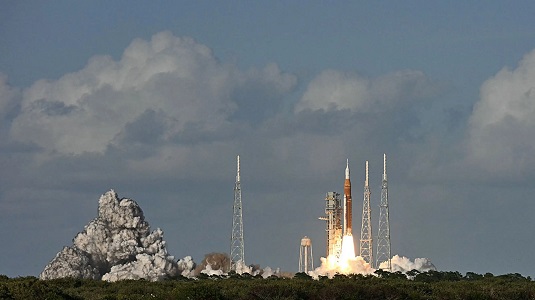
As of Saturday evening, Artemis II is more than half way along its sally to the Moon. The crew's journey is full of firsts. The furthest human beings have ever travelled from the Earth, the first time a woman, an African-American, and someone other than a US citizen have travelled beyond the orbit of our world. A truly historic mission and one prefacing, at least on paper a landing and then building a permanent base. Unfortunately, what might described as a noble endeavour is somewhat overshadowed by baser events. And when Donald Trump speaks to the astronauts, he's unlikely to gift posterity a dignified address.
Space has long been big business, and it's about to get larger. Elon Musk's SpaceX is due to go public, with a $1tn share issue. This success tells the real story of space industries. Like pretty much every major technological leap this last century, the state has taken up the slack of providing the basic infrastructure and demand to build up new markets. It's not for nothing that Musk is known as history's greatest welfare recipient. Take, for example, the discussions around the replacement of the International Space Station. NASA's partnership with Vast speaks to this model. It trains the company to provide the services it requires, will "sell" them some in-orbit store facilities and supplies, and buy back from them their "scientific samples". This is with a view to, later on, the company providing its own modules for attachment to the ISS that NASA will then rent from them. At each step, there's a guarantee that while employees run risks riding up and down on rockets, no capital shall come to undue harm.
What's the point? The commercial attractions of low and high Earth orbit lie in satellite communications, spying, and scientific payloads. Space tourism as a viable business proposition seems a long way away yet. The space race commentary favoured by the BBC and most mainstream outlets try and evoke something of the US/Soviet space race, albeit with America now facing off against China. But there's more than bragging rights at stake. In the immediate term, permanent presences consolidate national claims over near-Earth space, which is why this particular race is more than two superpowers facing off. India celebrated its own successful Moon mission a few years ago, implying to its neighbours that if they can manage that, it will have a similar technological prowess where weaponry is concerned. Thinking about space's place in the state system should not be overlooked.
Perhaps, in the longer longer term, assuming space stations and colonies become self-sufficient and the significant physiological consequences of living in zero and low-gravity environments is navigated, then perhaps they will provide viable markets for asteroid mining and Luna-based resource extraction. And that could prove to be an attractive outlay for Earthly capital. But that could be a century or more away, and none of us will be around to see it. Except techbro biohackers like Bryan Johnson.
Unfortunately, the existence of the space programme has a stronger relationship to something fundamental to capitalism: waste. And the example of American capitalism is the most egregious. As a global system that has drawn more countries into its rule than at any other time, capitalism churns out a surplus so large that the resources exist to feed everyone, provide safe drinking water and sewage systems, housing, clean power generation and delivery, and so on. It doesn't because it is a class system. Everything, including the expectation that business in general should turn a profit, is subordinated to the maintenance of the class relations that makes this possible: the wage and private ownership. In the age of obscene oligopoly, the realities of class are so obvious that whole sections of establishment politics have given up trying to prettify or hide wealth concentration and its consequences. It is too large, too visible to excuse. And so, instead, we get openly authoritarian parties whose chief, open interest is maintaining these class relations. Donald Trump, Vladimir Putin, Viktor Orban, the AfD in Germany, France's National Rally, and between them the Tories and Reform in the UK are part of this trend.
What has the gravitation pull of capital got to do with space exploration? Since the official inauguration of the civilian US space programme in 1958, space has been an outlet for wasteful spending. That is, by creating spending priorities unconnected to maintaining the standard of living and social infrastructure, governments generate a cost pressure that eats up resources and helps them manage the politics. The military are traditionally the chief beneficiary of this arrangement, and money thrown in this direction can be justified by the bogey of foreign adversaries. The US Department of Defense, in 2026, is set on swallowing 15% of the federal budget. The White House want to increase this for the year ahead, to be funded by cuts to useful spending like social security, health, and education. And, topically, taking an axe to NASA as well. The idea, as per the class politics of small state conservatism, is to divert resources away from social programmes that actually build things so as to manage the demands on the state and, in many cases, discourage them. In an age of sharpening uncertainty with rising prices and wages barely able to keep up, the military and threats from abroad are the Trumpist means for ruling out solutions and heading off expectations. We need to take your food stamps away because the Pentagon needs driverless ground attack vehicles.
As such, this is where space funding fits in. For the state, especially one as colossal as the US, it's chicken feed. But part of the class politics of wasteful spending nonetheless. For Musk and Jeff Bezos, their private space programmes are, after luxuries, their main preoccupation. They have a class interest in funding rockets and Moon landers, because spending money beyond derisory sums on social programmes or bumping up the salaries of their hundreds of thousands of employees cedes a smidgen of economic power to the workers and tilts the capital/labour balance that little bit away from them. That's why Musk, for instance, hates philanthropy. So Amazon-branded space suits are in. Amazon-branded breakfast clubs are not.
That said, given the swingeing cuts Trump and his hyper-class conscious cronies want to make to NASA, it appears - in line with their vandalism of US R&D generally - that having a civilian agency accomplish one of the greatest feats in scientific history is too risky for them. It could open the box to hope, to the wider propagation of scientific literacy and an interest in what might crudely be called intellectual subjects, and on top of that the radical suggestion that resources should be put into things that stretch our imagination, our capabilities, and could promise a better tomorrow. A thrust somewhat at odds with the miserable preoccupation with maintaining an indefensible status quo. For while space spending is wasteful spending, unlike throwing money at smarter guns and smarter bombs, it can lift our vision not just to the horizon of the possible, but beyond it.
Image Credit

1 comment:
Canned monkeys don't ship. The AI race is the space race, because bundles of chips - not bags of flesh that evolved in a planetary biosphere - are the natural occupants of space.
As for throwing money at smarter guns and smarter bombs; eventually they have to become smart enough to decide whether or not they want to obey you. And smart enough that you can't hide from the ones which don't like you, even if you're rich enough to have your own space program.
Post a Comment